An Improved Cluster-Head Selection Technique for Distributed
Heterogeneous Wireless Sensor Network
Sagar
1, Jyothi Patil
21PG Student, Department of Computer Science and Engineering,
2Professor, Department of Computer Science and Engineering,
Poojya Doddappa Appa College of Engineering, Kalaburagi, Karnataka, India
Abstract— Cluster Head Selection method is a critical and energy constraint process in the wireless sensor network. This process required significant amount of energy affecting the performance and operation of a wireless sensor network. The advantageous heterogeneous wireless sensor network provides a different type of data from a different variety of sensors in the same network but because of complex network operations it shows poor performance. For enhanced performance of wireless sensor network, improvements are needed at some critical parameters such as energy potential, network lifetime, node readying, fault lenience and dormancy. Proposed cluster-head selection scheme deals with two level heterogeneous wireless sensor networks. Improved Cluster-Head selection process ends up in less energy consumption that prolongs the network lifetime and stability. In this mechanism, calculate energy for each cluster head node and cluster head selection is based on energy consumption. The performance of node levels increased based on energy consumption.
Keywords— Cluster-Head selection, Heterogeneity ,Wireless sensor network
I. INTRODUCTION
A wireless sensor network consists of many small, light weighted, low cost wireless nodes. These nodes are randomly distributed at a remote location to sense physical data such as: Temperature, Humidity, Vibrations, pressure and noise etc. wireless sensor network are an emerging area for research work. Therefore recent technological advancement enabled the development of smaller, low power sensor nodes with improved onboard capacities for instance processing power and enhanced capabilities of wireless communication. Sensor nodes are connected with each other through a wireless medium (infrared or radio waves) depends upon its application. Each node has internal memory to store information about the event packet. Recent advancement in processing power helps sensor nodes to perform data aggregation in an energy efficient manner. In the case of network energy, efficiency, node-clustering scheme is better than conventional schemes, because it offers spatial reuse of node resources and easy routing. Clustering organize these randomly distributed sensor nodes in to hierarchical manner. By grouping them into individual geographically distributed disjointed and usually non-overlapped clusters. All the adjacent nodes are in one more cluster.
Base Station (BS): This node contains the highest node attributes in the network. This can be additionally known as
sink node because it collects all the sensed data from all deployed sensor nodes in region via Cluster-heads.
Cluster-Head (CH): Cluster-head is the highest entity node within a cluster. Cluster-head is liable for coordination between inter-cluster and intra-clusters communication, data assortment. Data aggregation and communication with the base station. A single node cannot be the CH for the entire period of operation. This is because CH node drains its energy faster than normal node due to the added network load. Therefore CH rotates on next highest attribute node within the cluster.
Member Nodes: Member nodes are normal sensor nodes. These nodes sense the data and forward it to CH node or relaying the data from another distant sensor node to the CH. A clustered WSN may contain numerous BS, and hundreds of sensor nodes distributed erratically or manually over a specific region of interest. This kind of network typically self-organized in nature.
There are two types of wireless sensor networks: Homogeneous and Heterogeneous wireless sensor network. Homogeneous WSN consists of the same type of nodes in the region of interest. This kind of network has straightforward node management however, back in terms of network operations. On the other hand, heterogeneous WSN nodes are divided in two heterogeneous levels. These levels categorized according to different network attribute. This categorization eases the network operation in a heterogeneous environment but in the case of larger network this approach becomes quite complex to handle.
Fig.1 WSN System Architecture
II. RELATEDWORK
There are so many clustering schemes are available for optimize network operation. Each scheme proposes different CH selection process relied on different network attributes. Some of most efficient schemes are discussed here; LEACH [1] is the first clustering scheme proposed by Heinzelman, shows more power efficient attributes than conventional MTU (Maximum transfer unit) scheme, furthermore O. Younis proposed HEED [2], an improved scheme which used an hybrid election scheme using node residual energy as primary attribute and intra-cluster cost (depends on cluster size and permissible transmission power) as secondary attribute for CH selection.
In DWEHC [3] P. Ding uses distributed weight to enhance hierarchal clustering algorithm. This scheme serves balanced cluster size and intra cluster topology. The node weight (includes node residual energy and proximity of neighbours) is calculated by node itself.
For heterogeneous wireless sensor network Li Quing [4] proposed DEEC algorithm which completes distributed multilevel clustering. This algorithm used a probability function (depends upon node’s residual energy and network’s average energy) to select CH with node having highest probability available.
In another methodology, a source driven algorithm is proposed by Guihai Chen as UCR [5]. Here local node information or local node attributes (node residual energy and distance from the base station) plays a major role in CH selection. This algorithm erases hot spot snag by the cluster size depends on the distance from the base station. Larger size clusters are kept at the far side of the region and smaller size clusters are made up near the base station for smooth data traffic. This scheme results minimized overall energy dissipation by less energy requirement in intra-clustering data processing. This makes cluster management easier but increase CH selection time delay which is not suitable for large area network.
Another approach by R.S. Marin [6] in C4SD, each node is assigned a novel hardware identity and weight. The node which has higher weight attributes selected as cluster-head per TDMA round. These CH acts as a distributed directory of service registrations for all members nodes in its cluster as CH maintains all member node’s service information. This algorithm gives the advantage of low construction as well as low maintenance overhead but with complicated network management.
B.Elbhiri [7] proposed an algorithm based on stochastic scheme for CH selection called SDEEC. In this scheme application depended sensor node will be active only when maximum or minimum data appear in the region. With this, network lifetime increases but restricted to specific application solely. This application dependency is not suitable for multimedia in WSN.
III.PROPOSEDSYSTEM
There are several assumptions taken in to account for the proposed algorithm. These assumptions are listed below- 1.All nodes are in awake / active state at network’s initialization stage.
2.Base station is deployed in almost middle of the region of interest.
3.Each sensor node has enough computational power to compute its residual energy and numerous network operations. 4.Nodes are location unaware
The proposed algorithm introduces several approaches to improve network performance over previously stated algorithms
1) Optimum number of clusters in the network: The number of clusters in the network ought to be optimum otherwise redundant clusters may form with new CH nodes. This causes the network to die soon as these nodes soon dissipate their energy.
2) Forecasting of node residual energy: Each node can forecast its residual energy by knowing average energy expenditure in a round. This scheme limits the scalability of the network but favourable in terms of energy efficiency. This scheme saves the amount of energy expend in flooding of residual energy-control packet in the whole network. This forecasting demands additional computational power in CH but this issue can be eased by heterogeneity of the network. Heterogeneity of Network provides advanced node and normal nodes. Advance nodes have higher node attributes (high initial energy and computational power) over normal node. For the initial condition, there are most of the nodes are alive; in this scenario principally advanced node is chosen as ch. As the times passes by, nodes start dying and normal node allowed to be a CH due to comparatively less network overhead.
3) Different CH selection probability assignment based on node energy threshold: In the proposed scheme advance nodes and normal nodes have different likelihood for CH selection due to different preassigned node attributes in between. In earlier stated algorithms in Section II advanced nodes are selected as CH until death that depletes the value advanced node as resource. To preserve these advanced nodes for additional rounds in proposed algorithm an energy threshold scheme is proposed in which, advanced nodes treated alike normal nodes where there remaining energy equal or less then energy threshold value, i.e. advanced nodes will have same probability for CH as normal node after approaching threshold value. This scheme saves the advanced nodes to be designated as CH over normal nodes for large period of time so they will be alive for a few additional rounds. This redoubled network life in result.
Proposed Algorithm enforced the same as DEEC algorithm. Here each node expends energy uniformly by rotating the CH role among all nodes. The CH be elected by a probability,
based on the ratio between the residual energy of each node and the average energy of the network.
In heterogeneous network model, assume that there are N sensor nodes, which are haphazardly dispersed among M*M square region and sensor node always have data to transmit to the Base Station. Assume that BS is located in the center of the square region. The network is organized in to a clustering hierarchy, and the cluster-heads executes fusion function to reduce correlated data produced by the sensor nodes within the clusters and transmit to BS. To prevent the frequent modification of the topology, the nodes are kept micro mobile or stationary. Let there are two levels of sensor nodes; advance nodes and Normal modes. If Eo is the initial energy of the normal node and network consists m number of advanced nodes which own a times additional energy than the normal nodes. Thus there are mN advanced nodes equipped with initial energy Eo(1+a) each and (1-m)N normal nodes equipped with initial energy of Eo. The total initial energy of the two-level heterogeneous networks is given by-
We conjointly consider the multi-level heterogeneous networks. For multi level heterogeneous networks, initial energy of sensor nodes is haphazardly distributed over the close set [Eo, Eo(1+max) ], where Eo the lower bound and amax is determined the value of the maximal energy. Initially, the node Si is equipped with initial energy of Eo(1+a), which is at h times additional energy than the lower bound Eo, As in two-level heterogeneous networks, the clustering algorithm should consider the discrepancy of initial energy in multi-level heterogeneous networks.
According to radio dissipation model [12] to achieve an acceptable SNR (signal to noise ratio) energy expended by a Node to transmit L-bit data over distance d will be-
Because we are assuming that the nodes are uniformly distributed in M*M region and BS located at the center of This region we can get the average distance of node to CH and CH to BS as-
The total energy dissipated in the network during a round, is the sum of energy dissipate by a node for a whole network operation in a round, which is transmitting data to CH and then CH to BS, receiving of the data, data aggregation
process. The total energy dissipation in a round is described as-
The average energy of rth round is-
Here R is number of total rounds in the network, it is defined such as-
The proposed algorithm prevents inessential clusters formation for the network to increase stability by calculating optimum number of heads. This optimum no. cluster-head count is given by
Likelihood in 2-level heterogeneous network proposed in existing algorithm (4) defined as-
In earlier algorithm, there are a lot of threshold schemes for heterogeneous environment depending upon on the initial energy, distance from BS, cluster size etc. But here in proposed algorithm threshold value depends on residual energy of the sensor node. For CH selection process, there are two cases based on threshold value of node energy;
Case-1: When node’s residual energy is greater or adequate to the proposed threshold value: Advance and normal node energy attributes, Advance node is a preferred for CH While normal node designated as CH only when advance node is not available in cluster.
Case-2: When node’s residual energy is less than the proposed threshold value: Advance node and normal node both share same CH selection probability. This helps advance nodes to be alive for some more rounds. In this case, as the number of normal node is less so average network energy is being less, here in this proposed algorithm it is assumed over several simulations to 0.02 of total energy available at the initial phase.
The probability function for this is given such as
And the proposed threshold value will be ETH = 0.7 Eo. Calculation for residual energy is done individually by eachNode. In the proposed algorithm, new CH for the next round has been selected by prognostication. This scheme helps the network to skip flooding for selection of new CH which consume an appreciable quantity of energy.
IV.PROGRAMMING STEPS
PHASE-1: INITIALIZATION PHASE
1. BS broadcast INITIALIZATION message to its neighbor nodes.
2. All nodes wait for Tmax time period so that all nodes in the network receive INITIALIZATION message.
3. All nodes now calculate their ERE and by ETH CH has been selected. Thereafter, newly selected CH sends out state message to its H1.
PHASE-2: CLUSTER FORMATION PHASE
1. Nodes receive STATE message and if there is no id available. Assigned a new ID.
2. Node joins that CH as member node.
3. Node Sends membership STATE message to its neighbor nodes.
4. All members nodes starts sends/forward sensed data to respective CH
PHASE-3: CH MIGRATION PHASE
1. New CH is selection process occur at every Tsh and check following conditions-
Condition-1: Current CH has the highest residual energy among neighbourhood nodes; CH remains as it is for the next round.
Condition-2: There is other node in neighbourhood has higher energy than current CH; node selects as CH in next
Round.
2. If a new node get selected as CH then current CH leaves an ABDICATE message to its neighbour nodes.
3. H1 Become uncluttered node when they receive ABDICATE message of their ch.
V.RESULTS
After implementing the proposed system using NS2, the results obtained are as follows:
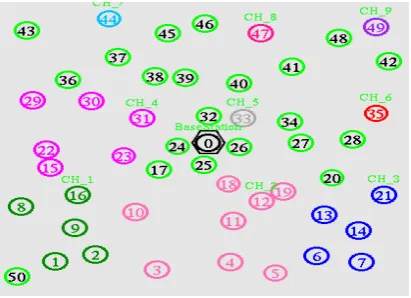
Fig. 2 Network with cluster formation
The figure 2 shows the topology of network, where are identified as wireless sensor nodes, base station and cluster head (CH) nodes.
Fig. 3 Identifying nodes like AN and SN
Fig. 4 Xgraph for Network Lifetime
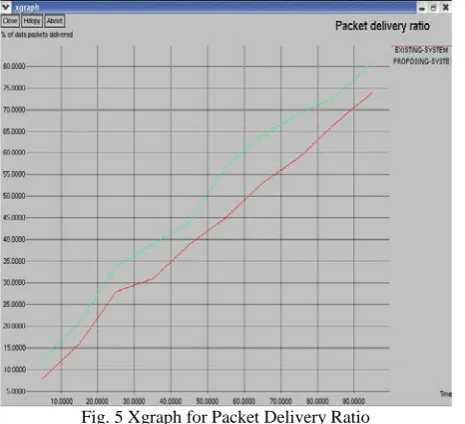
Fig. 5 Xgraph for Packet Delivery Ratio
VI. CONCLUSION
The proposed algorithm introduces new improved scheme to prolong network lifetime in heterogeneous wireless sensor network environment. In such state of affairs, network operation and management methods are complex that’s why CH selection is a critical part of network operation. To handle this critical operation, the proposed scheme utilizes heterogeneous node probability model based on the energy threshold scheme. Here custom simulation environment is employed to evaluate the various aspect performances of proposed scheme and comparison with existing cluster head algorithm. The simulations results clearly indicate that the proposed scheme consistently gave improved performance. In this proposed approach, all deployed nodes considered fixed on their deployed position. There is a considerable opportunity for further research in mobile nodes scenario. Finally it will be interesting to extend this proposed algorithm to mobile heterogeneous network scenario. In this context, it will be necessary to determine the speed of the mobile node with respect of its position and number of mobile and non-mobile nodes. In this, we have shown energy calculation for each cluster head of network and which sets as different targets for mobile communication.
References
[1] W.R. Heinzelman and H Balakrishnan, “Energy-efficient communication protocol for wireless microsensor networks,” In Proc. IEEE 33rdHawali International Conference on System Science, Hawai, Jan 2000,pp. 4–7.
[2] S. F. O. Younis, “Heed: A Hybrid, energy-efficient, distributed clustering approach for adhoc sensor networks,” IEEE Transactions on MobileComputing, vol. 3, no. 4, pp. 366–379, Oct 2004.
[3] M.W. L. Qing, Q. Zhu, “design of a distributed energy-efficient clustering algorithm for heterogeneous wireless sensor networks,” ELSEVIER,Computer Communications, 2006.
[4] A. C. P. Ding, J. Holliday, “Distributed Energy Efficient hierarchicalclustering for wireless sensor networks,” In Proc. IEEE International Confrence on Distributed on Distributed Computing in Sensor Systems(DCOSS05), 2005, pp. 322– 339.
[5] C. L. Guihai Chen, “An unequal cluster-based routing protocol for wireless sensor networks,” Springer Science Business Media, LLC,vol. 15, pp. 193–207, 2009.
[6] S. J. H. P. J. M. Marin-Perianu, R. S. and Hartel, “Cluster-based servicediscovery for heterogeneous wireless sensor networks,” InternationalJournal of Parallel, Emergent and Distributed Systems, vol. 23, pp. 325–346, 2008.
[7] D. A. B. Elbhiri, R. Saadane, “Stochastic Distributed Energy-efficientclustering (speech) for heterogeneous wireless sensor networks,” ICGSTCNIRJournal, vol. 9, December 2009.
[8] A. K. S. Parul Saini, “Energy Efficient scheme for clustering protocolprolonging the lifetime of heterogeneous wireless sensor networks,”International Journal of Computer Applications, vol. 6, pp. 30–36,September 2010.
[9] N. J. Sanjeev Kumar Gupta and P. Sinha, “A density control energetically clustering technique for randomly deployed wireless sensor network,” In Proc. (IEEE) IEEE WOCN’12 Conference, Sept 2012, pp.1–5.
[10] T. Zaman, N.; Tung Jang low; Alghamdi, “Energy efficient routing protocol for wireless sensor network,” In Proc. (IEEE) Advanced Communication Technology (ICACT) 16th International Conference, 2014, pp.808–814.
[11] N. S. Kumar G; Mehra H; Seth Akshat R; Radhakrishnan. Pooja; Hemavathi,“An hybrid clustering algorithm for optimal clusters in wireless sensor networks,” In Proc. (IEEE)Electrical, electronics and ComputerScience (SCEECS) IEEE Students’ Conference, 2014, pp. 1–6.
[12] M. T. Y. Li and W. Wu, “Topology control for wireless sensor networks,”Wireless Sensor Networks and Applications, Springer, pp. 113–147,2008.