The Generalized Centroid Difference method for lifetime measurements via
γ
-
γ
coincidences using large fast-timing arrays
J.-M. Régis1,a, J. Jolie1, H. Mach2,3, G.S. Simpson4,5, A. Blazhev1, G. Pascovici1, M. Pfeiffer1, M. Rudigier1, N. Saed-Samii1, N. Warr1, A. Blanc6, G. de France7, M. Jentschel6, U. Köster6, P. Mutti6, T. Soldner6, C.A. Ur8, W. Urban6,9, A.M. Bruce10, F. Drouet4, L.M. Fraile2, S. Ilieva11, W. Korten12, T. Kröll11, S. Lalkovski13,14, N. M ˘arginean15, V. Paziy2, Zs. Podolyák13, P.H. Regan13,16, O. Stezowski17, and A. Vancraeyenest4
1IKP der Universität zu Köln, Zülpicher Str. 77, 50937 Köln, Germany
2Grupo de Fisica Nuclear, FAMN, Universidad Complutense, CEI Moncloa, 28040 Madrid, Spain 3National Centre for Nuclear Research, BP1, ul. Hoza 69, PL-00-681, Warsaw, Poland
4LPSC Grenoble, 53, rue des Martyrs, 38026 Grenoble Cedex, France
5School of Engineering, University of the West of Scotland, Paisley, PA1 2BE, United Kingdom 6Institut Laue-Langevin, CS 20156, 38042 Grenoble Cedex 9, France
7GANIL, Bd Henri Becquerel, BP 55027, 14076 Caen Cedex 05, France 8INFN, Sezione di Padova, Via Marzolo 8, 35131 Padova, Italy
9Faculty of Physics, University of Warsaw, ul. Hoza 69, PL-00-681, Warsaw, Poland 10SCEM, University of Brighton, Lewes Road, Brighton, BN2 4GJ, United Kingdom
11IKP der Technische Universität zu Darmstadt, Schlossgartenstr. 9, 64289 Darmstadt, Germany 12CEA de Saclay, Route Nationale, 91400 Gif-sur-Yvette, France
13Faculty of Physics, University of Sofia "St. Kliment Ohridski", 1164 Sofia, Bulgaria 14Department of Physics, University of Surrey, Guildford, GU2 7XH, United Kingdom 15Horia Hulubei NIPNE, 77125 Bucharest, Romania
16NPL, Teddington, Middlesex, TW11 0LW, United Kingdom
17IPN de Lyon, 4, Rue Enrico Fermi, 69622 Villeurbanne Cedex, France
Abstract. A novel method for direct electronic "fast-timing" lifetime measurements of nuclear excited states viaγ-γcoincidences using an array equipped withNvery fast high-resolution LaBr3(Ce) scintillator detectors
is presented. The generalized centroid difference method provides two independent “start” and “stop” time spectra obtained without any correction by a superposition of theN(N−1)/2 calibratedγ-γtime difference spectra of theNdetector fast-timing system. The two fast-timing array time spectra correspond to a forward and reverse gating of a specificγ-γcascade and the centroid difference as the time shift between the centroids of the two time spectra provides a picosecond-sensitive mirror-symmetric observable of the set-up. The energy-dependent mean prompt response difference between the start and stop events is calibrated and used as a single correction for lifetime determination. These combined fast-timing array meanγ-γzero-time responses can be determined for 40 keV<Eγ<1.4 MeV with a precision better than 10 ps using a152Euγ-ray source. The
new method is described with examples of (n,γ) and (n,f,γ) experiments performed at the intense cold-neutron beam facility PF1B of the Institut Laue-Langevin in Grenoble, France, using 16 LaBr3(Ce) detectors within
the EXILL&FATIMA campaign in 2013. The results are discussed with respect to possible systematic errors induced by background contributions.
1 Introduction
As an essential nuclear observable, the lifetimes of excited states are needed to determine the reduced transition prob-abilities which are used to test the model dependent intrin-sic structure of the nuclear excited states. The electronic fast-timing technique in combination with very fast scintil-lator detectors is picosecond sensitive [1–3] and therefore is capable of overlapping with complementary techniques such as the Recoil Distance Method [4] and Coulomb
exci-ae-mail: [email protected]
tation [5]. For the picosecond regime, the fast-timing tech-nique is based on the determination of centroids of time distributions (first moment of a time spectrum [6]) gen-erated as time difference spectra of consecutiveγ-γ tran-sitions measured using two start and stopγ-ray detectors. Assuming no background contribution, the experimentally obtained “delayed” time distributionD(t) is a convolution of the Prompt Response Function (PRF) of the setupP(t) C
Owned by the authors, published by EDP Sciences, 2015
with an exponential decay as:
D(t)=nλ t
−∞P(t −t
0)e−λ(t−t )
dt with λ=1/τ,
(1) wherenis the total number of detectedγ-γevents in the time difference spectrum,λthe transition (decay) proba-bility andτthe mean lifetime of the nuclear excited state interconnected by the γ-γcascade andt0 is the position
(centroid) of the PRF P(t). The experimental PRF pro-vides important information on timing characteristics and is obtained for lifetimes which are smaller than 1 ps (sys-tematic errors are expected to be larger). For lifetimes which are larger than the FWHM of the PRF, the mean lifetime is obtained directly using the slope method [1]. Lifetimes which are smaller than the FWHM of the PRF can be determined using the centroid-shift method [6]. For the case of a Gaussian PRF with standard deviation σ FWHM/2.355, the pure statistical time resolving powerδtof a two detector timing system is given by:
δt= √σ
n. (2)
The centroid or center of gravityCD
is the first moment of the statistical time distribution:
CD=<t>= ∞
−∞tD(t)dt ∞
−∞D(t)dt
, δCD=δt= √<t2 >−<t>2,
(3) whereD(t) is given by Eq. (1). According to the centroid-shift method, the centroid of a delayed time spectrum is displaced by the mean lifetime from the centroid of its convoluted PRF:
τ=CstopD −CPstop (4)
or if the functions of the two detectors are interchanged to obtain the “anti-delayed time spectrum” [1],
τ=CPstart−CDstart, (5)
whereCP is the “prompt centroid” of the PRF. The sub-script “start” (“stop”) indicates that the decay transition with its lifetime information provided the start (stop) tim-ing signal of the two detector timtim-ing system.
The centroid-shift method is in principle very simple since the mean lifetime is directly obtained from the cen-troids of the delayed and the prompt time spectrum. In addition, the centroid-shift method is independent of the shape of the PRF, as demonstrated experimentally in Refs. [7, 8]. The major problem inγ-γfast-timing experiments is that the prompt centroid is dependent on the time re-sponse, i.e. the physical zero-time versus energy relation t0(Eγ) (the time-walk characteristics) of both detectors of
the γ-γ fast-timing setup, thus CP = CP(E
start,Estop) =
t0(Estart)+t0(Estop). The calibration of the detector time
response is possible, however, the analysis of an N de-tector timing system becomes complex forN2 as the time response of each single detector has to be calibrated, whereby systematic errors can easily be introduced [9].
The aim of this work is to present the Generalized Centroid Difference (GCD) method, which was developed to pro-vide high-accuracy centroid-shift measurements with anN γ-ray detector timing system by using a simple approach.
2 The Generalized Centroid Difference
method
a)
scintillator detectors
*
γ−ray
source
delay CFD CFD LaBr (Ce)3
TAC Δt
stop start
b)
10
1 3 30
Δ
start Cstop
300 600 900 1200 100
number of events
t [ps]
(anti−delayed) (delayed)
C
decay
C( E ) = 92(4) ps
D D
Δ γ
Figure 1.a: The standard electronicγ-γfast-timing circuitry us-ing Constant Fraction Discriminators (CFD) for picosecond sen-sitive time-difference measurements with a Time-to-Amplitude Converter (TAC). b: Two time spectra are obtained dependent on whether the decay transition provided a stop signal (the delayed time spectrum) or a start signal (anti-delayed).
We first consider the standard γ-γ fast-timing setup consisting of two (start and stop) detectors, as presented in Fig. 1a. As both the start and the stop detectors see the sameγ-ray source, two time distributions are obtained in the off-line analysis by setting a gate (narrow energy window) on the full energy peak of the decay transition γdecay of a nuclear excited state interconnected by a
spe-cificγfeeder-γdecaycascade once by using the start detector
and once by using the stop detector, while the feedingγ ray is detected by the other detector. Assuming no back-ground contributions and according to Eqs. (4) and (5), the time difference between the centroids of the two time spectra presented in Fig. 1b corresponds to:
ΔC(ΔEγ)decay = CD(ΔEγ)stop−CD(ΔEγ)start = PRD(ΔEγ)decay+2τ, (6)
where ΔEγ = Efeeder − Edecay is the energy difference
of the two γ-rays of the cascade and PRD(ΔEγ)decay =
CP(ΔE
γ)stop−CP(ΔEγ)startis the Prompt Response Diff
to a start-stop inversion, the centroid difference is mirror symmetric. For the prompt case, this is equivalent to a hy-pothetical feeder-decay inversion of the cascade [3], thus:
ΔC(ΔEγ)decay=−ΔC(−ΔEγ)feeder, (7)
PRD(ΔEγ)decay =−PRD(−ΔEγ)feeder (8)
and accordingly:
PRD(ΔEγ=0)=0 and|ΔC(ΔEγ=0)|=2τ. (9)
Eqs. (6) to (9) represent the Mirror Symmetric Centroid Difference (MSCD) method for a two detector timing sys-tem. Due to linear combination of start and stop events, the MSCD method reduces possible systematic errors and cancels the typical systematic error by long term shifts due to drifts in the electronics that can be induced using centroid-shift measurements where the reversed gating is not used. The PRD mirror symmetry, Eq. (8), provides additional data points for a precise calibration of the PRD curve, PRD(Eγ), and makes the determination of the PRD for any energy combinationΔEγpossible using [3, 8]:
PRD(Efeeder−Edecay)=PRD(Efeeder)−PRD(Edecay). (10)
The PRD for the energy combination of aγ-γcascade is used as a single correction for the determination of the lifetime according to Eq. (6) and therefore provides the sole uncertainty of the MSCD method, assuming no back-ground contributions to the time spectra.
For the case of a fast-timing array withNalmost equal fast-timing detectors and suitable electronics set-up (e.g. the one shown in Ref. [9]), the centroid differencesΔCi j of all unique detector-detector combinationsi j with j i∈Ncould be measured to provide the mean value as:
ΔC= 2
N−1
i=1 N
j=i+1 ΔCi j
N(N−1) =PRD+2τ. (11)
Eq. (11) represents the Generalized Centroid Difference (GCD) method and denotes that the time difference be-tween start events (decay transition detected by a start de-tector) and stop events are statistically distributed around
ΔC or PRD independent of the detector-detector combi-nation. Experimentally, the mean centroid difference is equal to the time shift between the two fast-timing-array time spectra generated by a simple superposition of the N(N −1)/2 start (stop) time spectra “TACi j” [9] (pro-jected time spectra of detector-detector combinationsi j). This identical procedure called the GCD method provides a substantial simplification of fast-timing analyses on N detector timing systems as the tedious determination ofN detector time responses is eliminated. The complexity of the data analysis is reduced to that of a two detector tim-ing system. Analogous to the MSCD method, the mean PRD is used as the only correction which reduces a possi-ble systematic error to a minimum by taking advantage of the mirror symmetric representation of the GCD method.
3 The GCD method for EXILL&FATIMA
The GCD method was developed especially for large fast-timing arrays such as the “FATIMA”γ-ray spectrometer made ofN =16 5% Ce doped LaBr3 detectors that was
installed at the Institut Laue-Langevin (ILL) in Greno-ble, France. This FATIMA spectrometer was combined with part of the EXILL (EXOGAM at ILL [10]) spec-trometer consisting of 8 HPGe EXOGAM Clover detec-tors. Within the EXILL&FATIMA campaign, fast elec-tronic timing measurements were performed in prompt γ-ray spectroscopy experiments using neutron-capture and neutron-induced fission reactions at the highly collimated high-flux cold-neutron beam facility PF1B [11, 12] of the ILL. Triple coincidences were used in which a Ge gate se-lects the cascade ofγrays to be measured by the LaBr3
detectors. A detailed description of the EXILL&FATIMA set-up is given in Ref. [13]. In a preparatory work, the N(N−1)/2 = 120 LaBr3-LaBr3 coincidence spectra of
the FATIMA set-up were investigated for artefacts such as inter-detector Compton scattering. Such cross-talk events with false timing information have been detected in 16 adjacent and 8 other LaBr3-LaBr3detector combinations,
those are excluded from the main data analysis [13].
a)
0 100 200
50 150 250
0
−2 −1 1 2
events
t [ns]
delayed (decay as stop signal)
anti−delayed (start)
ΔC = − 77(9) ps
gates: 4881−1499 gates: 1499−4881
b)
0 200 400 600
0
−2 −1 1 2
Δ
events
t [ns] C = − 76(3) ps
gates: 1499−4881
gates: 4881−1499
Figure 2. Principle of the GCD method. a: Superposition of 96 remaining time-difference spectra TACi jof a promptγ-γ
cas-cade in49Ti withτ=16(7) fs [14] as obtained from the 16 LaBr 3
fast-timing array of the EXILL&FATIMA spectrometer, by dis-tinguishing between the stop events (decay transition detected as a stop signal) and the start events independent of the detector-detector combination i j. b: Result of the same data shown in Fig. 2a obtained after the alignment of the 96 TACi jspectra
us-ing constant shifti j values (see the text for more detail) in order
Fig. 2 illustrates the principle of the GCD method: The fast-timing data of the 96 unique detector-detector com-binations (time spectra TACi j) are superimposed without any correction by distinguishing between the delayed (de-cay transition detected as stop signal) and the anti-delayed time spectrum of a γ-γcascade to measure the centroid difference. In order to improve the precision of the mea-surement following Eq. (2), the time spectra TACi j are “aligned” using energy-independent constant shifti j val-ues, which means that both the start and stop events from the detector-detector combinationi j are adjusted by the same shifti jconstant. As illustrated in Fig. 2b, this align-ment does not introduce a systematic error and thus does not represent a correction, while it reduces the width of the distribution and thus the statistical error. These obser-vations nicely confirm that the lifetime determination by means of centroid-shift measurements is independent of the shape of the PRF.
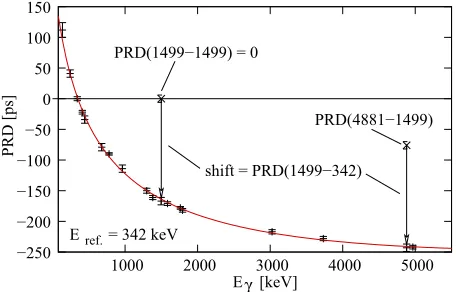
The major work of any fast-timing experiment is to calibrate the zero-time response of the set-up. Fig. 3 shows the (mean) PRD curve of the FATIMA plus the electronics set-up that was calibrated usingγ-γcascades from a standard152Euγ-ray source and the in-beam
reac-tion48Ti(n,γ)49Ti [13]. Some 82% of the data are nearly
free of background due to the use of an additional EXILL (Ge) gate to select a triple γ-ray cascade. For the EX-ILL&FATIMA experiments, a PRD uncertainty of 10 ps has been achieved which includes possible systematic er-rors [13].
PRD(4881−1499)
shift = PRD(1499−342)
PRD [ps]
E [keV]γ ref.
E = 342 keV
PRD(1499−1499) = 0
−250 −200 −150 −100 −50 0 50 100 150
1000 2000 3000 4000 5000
Figure 3.The (mean) PRD curve of the FATIMA plus the elec-tronics set-up of the EXILL&FATIMA spectrometers, adjusted for the refence energy of 342 keV. The PRD-calibration proce-dure is to adjust the two data points of promptγ-γcascades by parallel shifts to fit a single smooth PRD curve. Referring to the decay transition of a cascade, the measured PRD(ΔEγ) is plotted at the energy of the feedingγray, while the PRD at the decay energy vanishes according to Eqs. (9) and (10) and thus provides the second data point with same statistical uncertainty.
The major systematic error that can be induced in GCD analysis is due to the Compton background underneath the full-energy peak of interest which contributes to the FA-TIMA time spectra. Fig. 4 illustrates a test case on the lifetime determination of the 2+1 state in 100Zr. The
re-sults are from triple Ge-LaBr-LaBr (or Ge-LaBr-Ge)
coin-cidences out of 8 TB of data digitally acquired triggerless from a 12 days measurement on cold-neutron-induced fis-sion fragments of235U. As shown in Fig. 4a, a relatively large Compton background is obtained due to highγ-ray multiplicity of over 100 nuclei produced in such exper-iments. However, the double-gated coincidence spectra are clean, meaning that no other γrays are observed in the vicinity of the peak at 352 keV, that could falsify the lifetime determination. The delayed and anti-delayed FA-TIMA time spectra of the 352-212-keV cascade shown in Fig. 4b are nearly mirror symmetric which indicates the high quality of the FATIMA plus electronics set-up. By assuming theγ-Compton (full-energy peak vs. Compton) time response to be nearly prompt, the lifetime can be ex-traced directly from the slope of the time spectra [1].
The GCD method is sensitive to Compton background contributions to the time spectra. As illustrated in Fig. 4c, the 212-keV γvs. 352-keV Compton time response can be derived from a set of time spectra generated by set-ting gates in the Compton background around and above 352 keV. Taking into account the peak-to-background ra-tioΠ =2.6(2) of the 352-keV peak in the FATIMA LaBr3
coincidence spectrum shown in Fig. 4a, the netγ-γ cen-troid differenceΔCnetis derived from the time shift [here +649(20) ps] between the measured centroid difference and the γ-Compton time responseΔCCompton at 352 keV
using [3, 13]:
ΔCnet= ΔC+
ΔC−ΔCCompton
Π . (12)
By inserting the net centroid difference in Eq. (11) with PRD(352) = −61(10) ps, the mean lifetime of the first 2+ state in 100Zr ofτ(2+
1) = 821(12) ps follows, which
is in good agreement with the results obtained using the slope method and also confirms the experimental weighted average ofτ=851(43) ps reported in Ref. [15]. Further tests and new measurements on short lifetimes down to the limit of about 10 ps also confirmed the method [13, 16– 18].
4 Conclusions
At the PF1B collimated cold-neutron-beam line of the In-stitut Laue-Langevin, Ge-gatedγ-γ fast-timing measure-ments of excited states have been performed on around 80 nuclei from neutron-capture and neutron-induced fis-sion experiments using 16 LaBr3(Ce) detectors. The
a)
0
300 400
280 320 340 360 380 420 440 460 1000
counts per keV
E [keV]γ
EXILL HPGe (incl. add−back & Compton suppression)
& FATIMA: 212 keV EXILL: 497 keV gates:
FATIMA LaBr (Ce)3
peak/background = 2.6(2)
3000
2000
b)
10
1 3 100
30
0
−6 −4 −2 2 4 6
counts per 10 ps
(& Ge on 497 keV)
212−352 keV 352−212 keV
(& Ge on 497 keV)
t [ns]
= 810(40) ps
τ
τslope method:= 830(40) ps slope method:
ΔC = 1332(19) ps
c)
C [ps]
derived time−response
γ−γand
γ
γ
E [keV]γ E = 212 keVref.
Compton
(prompt events)the PRD curveγ−γ
PRD(352) = − 61(10) ps of − Compton events − Compton events
Δ
Δ
C(352) = 683(5) ps
0 200 400 600 800 1000 1200 1400
300 350 400 450
Figure 4. a: Comparison of the double-gated (Ge+LaBr) FA-TIMA and EXILL coincidence spectra, showing the cleanliness of the data in the region of the 352-keV peak. b: The two EXILL-gated FATIMA time spectra of the 352-212-keVγ-γcascade in
100Zr. According to the peak-to-background ratio, about 40%
of the data are due toγ-Compton events. c: Illustration of the
γ-Compton time-correction procedure by the centroid difference diagram for the reference energy of 212 keV (common gate of all time spectra). The PRD curve is adjusted by a parallel shift to cross the energy axis at the reference energy.
Acknowledgment
This work was supported by NuPNET, by contracts 05P12PKNUF and 05P12RDNUP of the German BMBF, by contract DNC7RP01/4 of the British STFC and by the Spanish MINECO projects FPA2010-17142, CPAN (CSD 2007-00042) and PRI-PIMNUP-2011-1338 (via the ERA-NET NuPNET call for translational joint activities). The EXILL&FATIMA campaign would not have been possible without the support of several services at the ILL and the LPSC. We are grateful to the EXOGAM collaboration for the loan of the detectors, to GANIL for assistance during installation and dismantling and to the FATIMA collaboration for the use of the LaBr3
(Ce)-scintillator detectors.
References
[1] W. D. Hamilton, The electromagnetic interaction in nuclear spectroscopy, North-Holland New York 1975, 173
[2] H. Mach, R. L. Gill, M. Moszy ´nski, Nuclear Instru-ments and Methods in Physics Research Section A280, 49 (1989)
[3] J.-M. Régis, et al., Nuclear Instruments and Methods in Physics Research Section A622, 83 (2010)
[4] A. Dewald, S. Harissopulos, P. von Brentano, Zeitschrift für Physik A334, 163 (1989)
[5] A. Winther, K. Alder, Amsterdam, North-Holland 1975; New York, American Elsevier 1975
[6] Z. Bay, Physics Review77, 419 (1950)
[7] H. Mach, et al., Nuclear Physics A523, 197 (1991) [8] J.-M. Régis, et al., Nuclear Instruments and Methods
in Physics Research Section A684, 36 (2012)
[9] J.-M. Régis, et al., Nuclear Instruments and Methods in Physics Research Section A726, 191 (2013) [10] G. de France, et al., EPJ Web of Conferences 66,
02010 (2014)
[11] H. Abele, et al., Nuclear Instruments and Methods in Physics Research Section A562407 (2006)
[12] W. Urban, et al., Journal of Instrumentations 8, P03014 (2011)
[13] J.-M. Régis, et al., Nuclear Instruments and Methods in Physics Research Section A763, 210 (2014) [14] A. Kuronen, et al., Nuclear Physics A549, 59 (1992) [15] B. Singh, Nuclear Data Sheets109, 297 (2008) [16] J. Jolie, et al.,these proceedings
[17] J. Jolie, et al., Journal of Physics: Conf. Ser. 533, 012026 (2014)

![Figure 2. Principle of the GCD method. a: Superposition of96 remaining time-difference spectra TACij of a prompt γ-γ cas-cade in 49Ti with τ = 16(7) fs [14] as obtained from the 16 LaBr3fast-timing array of the EXILL&FATIMA spectrometer, by dis-tinguishing](https://thumb-us.123doks.com/thumbv2/123dok_us/8177689.1365767/3.595.306.522.367.646/figure-principle-superposition-remaining-dierence-obtained-spectrometer-tinguishing.webp)