On new quicker n-tupled fixed point implicit iterations for contractive-like
mappings and comparison of their rate of convergence in hyperbolic metric spaces
Ahmed H. Solimana,b,1, Mohamed A. Barakatb,c,2 , M. Imdadd,3 and TAMER NABILa,e,4 a
King Khalid University, College of Science, Department of Mathematics, P.O. Box: 9004, Postal Code:61413, Abha, Saudi Arabia
b
Department of Mathematics, Faculty of Science, Al-Azhar University, Assiut Branch, Assiut 71524, Egypt
c
Department of Mathematics, College of Al Wajh, University of Tabuk, Saudi Arabia d
Department of Mathematics Aligarh Muslim University, Aligarh 202 002, India e
Suez Canal University, Faculty of Computers and Informatics, Department of Basic Science, Ismailia, Egypt
Abstract
In this paper, we study the convergence of new implicit iterations dealing with n-tupled fixed point results
for nonlinear contractive-like mappings on W-hyperbolic metric spaces. Herein, we demonstrate that our
newly implicit iteration schemes have faster rate of convergence than implicit S-iteration process, implicit
Ishikawa and Mann type iteration processes. Furthermore, a numerical simulation to improve our theoretical
results is obtained.
Key words: Implicit iterations,ϕ−contractive mappings, convergence rate.
AMS Mathematics subject Classification. 47H10,47H09,54H25.
1
Introduction and Preliminaries
The classical Banach Contraction Principle is one of the most important results of analysis which considered
as the main source of metric fixed point theory. It states that every contraction operator on a complete metric 1[email protected]
space has a unique fixed point. A great deal of expansions of this principle have been done, for the most part by
generalizing the contraction operator and some of the time by expanding the necessity of completeness or even
both. This principle is applied to prove the existence and uniqueness of solutions of nonlinear Volterra integral
equations and nonlinear integro-differential equations in Banach spaces other than supporting the assembly of
calculations in Computational Mathematics.
In 1987, Guo and Lakshmikantham [5] presented some results about coupled fixed point. Thereafter, in 2006,
Bhaskar and Lakshmikantham [6] gave some fixed point results for weak contractivity type mappings on a
partially ordered complete metric space, using a mixed monotone property. In 2009, Lakshmikantham and
Ciric [7] defined the concept of mixed g-monotone mappings and introduced coupled coincidence and coupled
common fixed point results for nonlinear contractive mappings in a metric space endowed with a partial ordering,
which also extended the fixed point theorems due to Bhaskar and Lakshmikantham [5]. In 2013, Imdad et al.
[14] gave the definition of n-tupled common fixed point as well as n-tupled common coincidence and utilized
these two notions to obtain n-tupled coincidence as well as n-tupled common fixed point results for contraction
operators. The notions given by Imdad et al. [14] are quite different from the notions of Rold´an et al. [16].
On the other hand, there is one, may be more characteristic, approach to respect the idea of convexity. Convexity
in a vector space is characterized utilizing lines between points; in Euclidean spaces or more generally in Banach
spaces, there is a line of most brief length that joins two points, and the length of this line is the line segment
between its two endpoints. However, metric spaces do not naturally have this convex structure. In 1970,
Takahashi [18] defined the concept of convexity in metric spaces and gave some fixed point theorems for
non-expansive mappings in such spaces. A convex metric space is more general than normed space and cone Banach
space [18]. After some time, diverse raised convex structures have been presented on metric spaces. In 2004,
Kohlenbach [11] gave the notion of W-hyperbolic spaces which represents a consolidated approach for both
linear and nonlinear structures at the same time. It is worth noting that every hyperbolic space is a convex
metric space defined by Takahashi [18] but converse may not be true in general [3].
Iterative methods for approximating fixed points in convex metric spaces have been studied by many authors
(see, e.g., [3, 4, 8, 9]), using implicit iterative procedures which are incredible significance from numerical angle
as they give precise estimate.
The following forms give a metric version of implicit Ishikawa and implicit Mann iteration schems defined by ´
Ciri´c et al. [1, 2] in the background of W-hyperbolic space.
LetEbe a nonempty convex subset of a W-hyperbolic spaceX andT :E→E.Choosex0∈Eand define the
sequence{xn} as follows:
xn=W(xn−1, T yn, αn) (1)
yn=W(xn, T xn, βn), n∈N,
and
xn=W(xn−1, T xn, αn), n∈N. (2)
Recently, Yildirim and Abbas [13] introduced implicit S-iteration process with higher rate of convergence than
Mann type (2) and Ishikawa type (1) implicit iterative processes.
Initiated withx0∈E,then we get the following sequence{xn}:
xn=W(T xn−1, T yn, αn) (3)
yn=W(xn, T xn, βn), n∈N,
where (αn) and (βn) are certain real sequences in [0,1].In this paper, we introduce some new implicit iteration
process and study their rate of convergence in hyperbolic metric spaces. Also, we give a numerical example to
exhibit the utility of our proved results.
We need the following definitions and lemma in order to introduce our main results.
Definition 1 [11] A W-hyperbolic space (X, d, W) is a metric space (X, d) together with a convex mapping
W :X2×[0,1]→X satisfying the following properties:
(i)d(u, W(x, y, α))≤(1−α)d(u, x) +αd(u, y),
(ii)d(W(x, y, α), W(x, y, β)) =kα−βkd(x, y),
(iv)d(W(x, z, α), W(y, w, α))≤(1−α)d(x, y) +αd(z, w),
for allx, y, z, w∈X andα, β∈[0,1].
Definition 2 [13] A self mapping T on X is called a contractive-like mapping if there exists a constantδ∈[0,1)
and a strictly increasing and continuous functionϕ: [0,1)→[0,1)withϕ(0) = 0such that for anyx, y∈X we
have
d(T x, T y)≤δd(x, y) +ϕ(d(x, T x)). (4)
Definition 3 [5] An element(x, y)∈X×X is called a coupled fixed point of the mapping T:X×X→X if
T(x, y) =x and T(y, x) =y.
Definition 4 [14] Let X be a nonempty set.An elementx1, x2, x3, ..., xn∈Xn is called an n-tupled fixed point
of the mapping T if
x1=T(x12, x2, x3, ..., xn),
x2=T(x2, x32, x3, ..., xn, x1), ..
.
xn=T(xn, x1, x2, ..., xn−1).
Lemma 5 [17] Let {cn}∞
n=1⊂[0,∞). If there exists ann0∈Nsuch that for all n≥n0,we get
cn+1≤(1 +ηn)cn+ηnθn,
whereηn∈(0,1),
∞
P
n=0
η=∞andθn ≥0 for alln∈N. Then the following holds:
0≤ lim
n→∞sup cn≤nlim→∞sup θn.
2
Main Results
Definition 6 Let E be a nonempty convex subset of a W-hyperbolic space X and T : n Q
i=1
E → E. Choose
{xi
0} ∈E and define the two sequences{xim} and{yim} for eachi= 1,2,3, ..., nas follows:
x2m=W(Tm(x2m−1, x3m−1, . . . , xnm−1, x1m−1), T(y2m, y3m, . . . , ynm, ym1), αm) ..
.
xnm=W(T m
(xnm−1, x 1 m−1, x
2
m−1, . . . , x n−1 m−1), T(y
n m, y
1 m, y
2
m−1, . . . , y n−1 m ), αm)
ym1 =W(x1m, T(x1m, x2m, . . . , xnm), βm)
ym2 =W(x2m, T(x2m, x3m, . . . , xnm, x1m), βm) ..
.
ymn =W(xnm, T(xnm, xm1, x2m, . . . , xnm−1), βm), m, n∈N,
where Tm(x1, x2, . . . , xn) = T(Tm−1(x1, x2, . . . , xn), T(x2, x3, . . . , xn, x1), . . . , T(xn, x1, . . . , xn−1)) and (αm),
(βm)are certain real sequences in[0,1].
Definition 7 Let E be a nonempty convex subset of a W-hyperbolic space X and T : n Q
i=1
E → E. Choose
{xi0} ∈E and define the two sequences{xim} and{yim} for eachi= 1,2,3, ..., nas follows:
x1m=W(T(x1m−1, x2m−1, . . . , xnm−1), T(ym1, ym2, . . . , ymn), αm) (6)
x2m=W(T(x2m−1, x3m−1, . . . , xnm−1, x1m−1), T(y2m, ym3, . . . , ymn, ym1−1), αm) ..
.
xnm=W(T(xnm−1, xm1−1, x2m−1, . . . , xmn−−11), T(ynm, ym1, y2m−1, . . . , ynm−1), αm)
ym1 =W(x1m, T(x1m, x2m, . . . , xnm), βm)
ym2 =W(x2m, T(xm2, x3m, . . . , xnm, x1m), βm) ..
.
ymn =W(xnm, T(xnm, x1m, x2m, . . . , xnm−1), βm), m, n∈N,
where(αm)and(βm)are certain real sequences in[0,1].
Definition 8 Let E be a nonempty convex subset of a W-hyperbolic space X and T : n Q
i=1
E → E. Choose
{xi
0} ∈E and define the two sequences{xim} and{yim} for eachi= 1,2,3, ..., nas follows:
x2m=W(x2m−1, T(ym2, y3m, . . . , ymn, y1m−1), αm) ..
.
xnm=W(x n m−1, T(y
n m, y
1 m, y
2
m−1, . . . , y n−1 m ), αm)
ym1 =W(x1m, T(x1m, x2m, . . . , xnm), βm)
ym2 =W(x2m, T(x2m, x3m, . . . , xnm, x1m), βm) ..
.
ymn =W(xnm, T(xnm, xm1, x2m, . . . , xnm−1), βm), m, n∈N,
where(αm)and(βm)are certain real sequences in[0,1].
Definition 9 Let E be a nonempty convex subset of a W-hyperbolic space X and T : n Q
i=1
E → E. Choose
{xi
0} ∈E and define the two sequences{xim} and{yim} for eachi= 1,2,3, ..., nas follows:
x1m=W(x1m−1, T(x1m, x2m, . . . , xnm), αm) (8)
x2m=W(x2m−1, T(xm2, x3m, . . . , xnm, x1m−1), αm)
.. .
xnm=W(xnm−1, T(xnm, x1m, x2m−1, . . . , xnm−1), αm), m, n∈N,
where(αm)and(βm)are certain real sequences in[0,1].
Definition 10 A self mapping T on X ×X is called a contractive-like mapping if there exists a constant
δ∈[0,1)and a strictly increasing and continuous functionϕ: [0,∞)→[0,∞)with ϕ(0) = 0,such that for any
x, y∈X we have
d(T(x1, x2, . . . , xn), T((y1, y2, . . . , yn))) ≤ δ n[d(x
1, y1) +d(x2, y2) +. . .+d(xn, yn)] +ϕ(d(x1, T(x1, x2, . . . , xn)) +
d(x2, T(x2, x3, . . . , xn, x1)) +. . .+d(xn, T(xn, x1, . . . , xn−1))). (9)
Theorem 11 Let T : n Q
i=1
E → E be a contractive-like mapping defined in (9) on a nonempty closed convex
subset E of a W-hyperbolic metric space (X, d, W) with F(T) 6=φ (F(T) denote the set of all fixed points of
T). Then, for the sequence{xm} defined in(5) we have lim m→∞x
i
Proof. Assume that (p1, p2, ..., pi)∈F(T).Using (5) and (9),we get
d(x1m, p1) +d(x2m, p2) +. . .+d(xnm, pn) (10)
=d(W(Tm(x1m−1, x2m−1, . . . , xnm−1), T(ym1, . . . , ynm−1), αm), p1)
+d(W(Tm(x2m−1, xm3−1, . . . , xnm−1, x1m−1), T(y2m, . . . , ynm−1, ym1−1), αm), p2) ..
.
+d(W(Tm(xnm−1, x1m−1, . . . , xnm−−11), T(ynm, ym1−1, . . . , ymn−−11), αm), pn)
≤αmd(T(Tm−1(x1m−1, x 2
m−1, . . . , x n m−1), T
m−1(x2 m−1, x
3
m−1, . . . , x 1
m−1), . . . ,
Tm−1(xnm−1, x1m−1, . . . , xnm−−11)), T(p1, p2, . . . , pn))
+(1−αm)d(T(ym1, . . . , ymn−1), T(p1, p2, . . . , pn))
+αmd(T(Tm−1(x2m−1, x 3
m−1, . . . , x 1 m−1), T
m−1(x3 m−1, x
4
m−1, . . . , x 2
m−1), . . . ,
Tm−1(x1m−1, x2m−1, . . . , xnm−1)), T(p2, p3, . . . , pn, p1))
+(1−αm)d(T(ym2, . . . , ym1−1), T(p2, p3, . . . , p1)) ..
.
+αmd(T(Tm−1(xnm−1, x1m−1, . . . , xnm−−11), Tm−1(x1m−1, x2m−1, . . . , xnm−1), . . . ,
Tm−1(xmn−−11, xnm−1, x1m−1. . . , xnm−−21)), T(pn, p1, . . . , pn−1))
+(1−αm)d(T(ymn, T(y 1 m, . . . , y
n−1 m−1), T(p
n
, p1, . . . , pn))
≤αmδm[d(x1m−1, p1) +d(x2m−1, p2) +. . .+d(xnm−1, pn)] + (1−αn)δ[d(ym1, p1) +d(ym2, p2) +. . .+d(ymn, pn)],
and
d(ym1, p1) +d(ym2, p2) +. . .+d(ymn, pn) (11)
=d(W(x1m, T(x1m, x2m, . . . , xnm), βm)), p1)
+d(W(x2m, T(x2m, x3m, . . . , x1m), βm)), p2) ..
.
≤βm[d(x1m, p1) +d(x2m, p2) +. . .+d(xnm, pn)]
+(1−βm)[d(T(x1m, x 2 m, . . . , x
n m), T(p
1, p2, . . . , pn)) +d(T(x2 m, x
3 m, . . . , x
1 m), T(p
2, p3, . . . , p1)) ..
.
+d(T(xnm, x1m, . . . , xmn−1), T(pn, p1, . . . , pn−1))]
≤(βm+ (1−βm)δ)[d(x1m, p
1) +d(x2 m, p
2) +. . .+d(xn m, p
n)].
By (10) and (11), we have
d(x1m, p1) +d(x2m, p2) +. . .+d(xnm, pn)
≤αmδm[d(x1m−1, p
1) +d(x2 m−1, p
2) +. . .+d(xn m−1, p
n)] (12)
+(1−αm)δ(βm+ (1−βm)δ)[d(x1m, p1) +d(x2m, p2) +. . .+d(xnm, pn)]
< αmδm[d(x1m−1, p1) +d(x2m−1, p2) +. . .+d(xnm−1, pn)]
+(1−αm)δ[d(x1m, p
1) +d(x2 m, p
2) +. . .+d(xn m, p
n)]
which implies that
d(x1
m, p1) +d(x2m, p2) +. . .+d(xnm, pn) < Dm[d(x 1 m−1, p
1) +d(x2 m−1, p
2) +. . .+d(xn m−1, p
n)], (13)
where
Dm= αmδ
m
1−(1−αm)δ. Observe that
1−Dm = 1− αmδ m
1−(1−αm)δ =
1−(1−αm)δ−αmδm 1−(1−αn)δ ≥1−(1−αm)δ−αmδm
implies that
Dm ≤(1−αm)δ+αmδm< δ (14)
Now, in view of (13) and (14), we have
d(x1
m, p1) +d(x2m, p2) +. . .+d(xnm, pn) < Dm[d(x1m−1, p
1) +d(x2 m−1, p
2) +. . .+d(xn m−1, p
< δ[d(x1m−1, p1) +d(x2m−1, p2) +. . .+d(xnm−1, pn)] ..
.
< δm[d(x10, p 1
) +d(x20, p 2
) +. . .+d(xn0, p n
)].
Taking limit on both sides of the above inequality, we have lim m→∞[d(x
1
m, p1) +d(x2m, p2) +. . .+d(xnm, pn)] = 0.
Theorem 12 Let T : n Q
i=1
E → E be a contractive-like mapping defined in (9) on a nonempty closed convex
subset E of a W-hyperbolic metric space (X, d, W) with F(T)6=φ.Then, for the sequence {xn} defined in (7)
we have lim m→∞x
i
m=pi,where(p1, p2, ..., pi)∈F(T).
Proof. Assume that (p1, p2, ..., pi)∈F(T).Using (7) and (9),we get
(x1m, p 1
) +d(x2m, p 2
) +. . .+d(xnm, p n
) (16)
=d(W(T(x1m−1, x2m−1, . . . , xmn−1), T(y1mym2, . . . , ymn), αm)), p1)
+d(W(T(x2m−1, x3m−1, . . . , x1m−1), T(y2m, y3m, . . . , y1m), αm)), p2) ..
.
+d(W(T(xnm−1, x1m−1, . . . , xmn−−11), T(ynm, ym1, . . . , ynm−1), αm)), pn)
≤αm[d(T(x1m−1, x 2
m−1, . . . , x n
m−1), T(p
1, p2, . . . , pn)) +. . .+d(T(xn m−1, x
1
m−1, . . . , x n−1 m−1), T(p
n, p1, . . . , pn−1))]
+(1−αm)[d(T(ym1, y2m, . . . , ymn), T(p1, p2, . . . , pn)) +. . .+d(T(ymn, ym1, . . . , ymn−1), T(pn, p1, . . . , pn−1))]
≤αmδ[d(x1m−1, p1) +d(x2m−1, p2) +. . .+d(xnm−1, pn)]
+(1−αm)δ[d(ym1, p
1) +d(y2 m, p
2) +. . .+d(yn m, p
n)]
and
d(ym1, p1) +d(ym2, p2) +. . .+d(ymn, pn) (17)
=d(W(x1m, T(x1m, x2m, . . . , xnm), βm)), p1)
+d(W(x2m, T(x2m, x3m, . . . , x1m), βm)), p2) ..
.
≤βm[d(x1m, p1) +d(x2m, p2) +. . .+d(xnm, pn)]
+(1−βm)[d(T(x1m, x 2 m, . . . , x
n m), T(p
1, p2, . . . , pn)) +d(T(x2 m, x
3 m, . . . , x
1 m), T(p
2, p3, . . . , p1)) ..
.
+d(T(xnm, x1m, . . . , xmn−1), T(pn, p1, . . . , pn−1))]
≤(βm+ (1−βm)δ)[d(x1m, p
1) +d(x2 m, p
2) +. . .+d(xn m, p
n)].
Therefore,
d(x1m, p1) +d(x2m, p2) +. . .+d(xnm, pn) (18)
≤αmδ[d(x1m−1, p
1) +d(x2 m−1, p
2) +. . .+d(xn m−1, p
n)]
+(1−αm)δ(βm+ (1−βm)δ)[d(x1m, p 1
) +d(x2m, p 2
) +. . .+d(xnm, p n
)]
< αmδ[d(x1m−1, p1) +d(x2m−1, p2) +. . .+d(xnm−1, pn)]
+(1−αm)δ[d(x1m, p
1) +d(x2 m, p
2) +. . .+d(xn m, p
n)],
which implies that
d(x1
m, p1) +d(x2m, p2) +. . .+d(xnm, pn) < Dm[d(x 1 m−1, p
1) +d(x2 m−1, p
2) +. . .+d(xn m−1, p
n)], (19)
where
Dm= αmδ
1−(1−αm)δ.
Observe that
1−Dm = 1−
αmδ 1−(1−αm)δ
= 1−δ 1−(1−αm)δ
≥1−δ
implies that
Dm ≤δ (20)
Due to (19) and (20), we have
d(x1
m, p1) +d(x2m, p2) +. . .+d(xnm, pn) < δ[d(x 1 m−1, p
1) +d(x2 m−1, p
2) +. . .+d(xn m−1, p
n)] (21)
<(δ)2[d(x1m−2, p1) +d(x2m−2, p2) +. . .+d(xnm−2, pn)] ..
.
<(δ)m[d(x10, p 1
) +d(x20, p 2
) +. . .+d(xn0, p n
)].
Taking limit on both sides of the above inequality, we obtain lim m→∞[d(x
1
m, p1) +d(x2m, p2) +. . .+d(xnm, pn)] = 0.
Theorem 13 Let T : n Q
i=1
E → E be a contractive-like mapping defined in (9) on a nonempty closed convex
subsetE of a W-hyperbolic metric space (X, d, W) withF(T)=6 φ.Then, for the sequences {xn}, {yn} defined
in(6) withP
(1−ϕn) =∞, we have lim m→∞x
i
m=pi, where(p1, p2, ..., pi)∈F(T).
Proof. Assume that (p1, p2, ..., pi)∈F(T).Using (7) and (9),we get
d(x1m, p1) +d(x2m, p2) +. . .+d(xnm, pn) (22)
=d(W(x1m−1, T(ym1, y2m, . . . , ynm), αm), p1) +d(W(x2m−1, T(ym2, y3m, . . . , y1m), αm), p2)
+. . .+d(W(xnm−1, T(ymn, y1m, . . . , ynm−1), αm), pn)
≤αm[x1m, p 1
) +d(x2m, p 2
) +. . .+d(xnm, p n
)] + (1−αm)δ[d(y1m, p 1
) +d(y2m, p 2
) +. . .+d(ynm, p n
)].
And
d(y1
m, p1) +d(ym2, p2) +. . .+d(ymn, pn) ≤(βn+ (1−βn)δ)[d(x1m, p
1) +d(x2 m, p
2) +. . .+d(xn m, p
n)].(23)
Therefore
d(x1m, p1) +d(x2m, p2) +. . .+d(xnm, pn) ≤αm[d(x1m−1, p1) +d(x2m−1, p2) +. . .+d(xnm−1, pn)] (24)
+(1−αm)δ(βm+ (1−βm)δ)[d(x1m, p1) +d(x2m, p2) +. . .+d(xnm, pn)]
< αm[d(x1m−1, p
1) +d(x2 m−1, p
2) +. . .+d(xn m−1, p
n)]
+(1−αm)δ[d(x1m, p1) +d(x2m, p2) +. . .+d(xnm, pn)],
which implies that
[d(x1
m, p1) +d(x2m, p2) +. . .+d(xnm, pn)] < Dm[d(x1m−1, p
1) +d(x2 m−1, p
2) +. . .+d(xn m−1, p
where
Dm= αm
1−(1−αm)δ.
Observe that
1−Dm = 1− αm
1−(1−αm)δ =
(1−αm)(1−δ)
1−(1−αm)δ ≥(1−αm)(1−δ)
implies that
Dm ≤1−(1−αm)(1−δ) (26)
From (25) and (26), we have
[d(x1
m, p1) +d(x2m, p2) +. . .+d(xnm, pn)] <1−(1−αm)(1−δ)[[d(x 1 m−1, p
1) +d(x2 m−1, p
2) +. . .+d(xn m−1, p
n)]] (27)
< m Y
i=1
(1−(1−αi)(1−δ))[d(x10, p
1) +d(x2 0, p
2) +. . .+d(xn 0, p
n)]
<exp{ m X
i=1
(1−αi)(1−δ)}[d(x10, p
1) +d(x2 0, p
2) +. . .+d(xn 0, p
n)]
<exp{
∞
X
i=1
(1−αi)(1−δ)}[d(x10, p1) +d(x20, p2) +. . .+d(xn0, pn)]
Using the fact that 0≤δ <1 andP
(1−αi) =∞,we conclude that
lim m→∞[d(x
1
m, p1) +d(x2m, p2) +. . .+d(xnm, pn)] = 0.
Theorem 14 Let T : n Q
i=1
E → E be a contractive-like mapping defined in (9) on a nonempty closed convex
subsetE of a W-hyperbolic metric space (X, d, W) withF(T)=6 φ.Then, for the sequences {xn}, {yn} defined
in(8) withP(1−αi) =∞,we have lim m→∞x
i
m=pi, where(p1, p2, ..., pi)∈F(T).
Proof. Assume that (p1, p2, ..., pi)∈F(T).Using (8) and (9),we get
d(x1m, p1) +d(x2m, p2) +. . .+d(xnm, pn) (28)
=d(W(x1m−1, T(x1m, x2m, . . . , xnm), αm), p1) +d(W(x2m−1, T(xm2, x3m, . . . , x1m), αm), p2)
≤αm[d(x1m−1, p1) +d(x2m−1, p2) +. . .+d(xnm−1, pn)]
+(1−αm)δ[d(x1m, p
1) +d(x2 m, p
2) +. . .+d(xn m, p
n)],
which implies that
d(x1m, p1) +d(x2m, p2) +. . .+d(xnm, pn) ≤Dm[d(x1m−1, p1) +d(x2m−1, p2) +. . .+d(xnm−1, pn)], (29)
where
Dm= αm
1−(1−αm)δ .
Observe that
1−Dm = 1− αm 1−(1−αm)δ
=(1−αm)(1−δ) 1−(1−αm)δ
≥(1−αm)(1−δ)
implies that
Dm ≤1−(1−αm)(1−δ) (30)
From (29) and (30), we have
d(x1
m, p1) +d(x2m, p2) +. . .+d(xnm, pn) ≤(1−(1−αm)(1−δ))[d(x1m−1, p
1) +d(x2 m−1, p
2) +. . .+d(xn m−1, p
n)]
< m Y
i=1
(1−(1−αi)(1−δ))[d(x10, p1) +d(x20, p2) +. . .+d(xn0, pn)]
<exp{ m X
i=1
(1−αi)(1−δ)}[d(x10, p
1) +d(x2 0, p
2) +. . .+d(xn 0, p
n)]
<exp{
∞
X
i=1
(1−αn)(1−δ)}[d(x10, p1) +d(x20, p2) +. . .+d(xn0, pn)] (31)
Using the fact that 0≤δ <1 andP(1
−αi) =∞,we conclude that
lim n→∞[d(x
1 m, p
1) +d(x2 m, p
2) +. . .+d(xn m, p
n)] = 0.
The following result deals with the rate of convergence of implicit S-n-tupled iteration process.
Theorem 15 Let T : n Q
i=1
E → E be a contractive-like mapping defined in (9) on a nonempty closed convex
subset E of a W-hyperbolic metric space (X, d, W) with F(T)=6 φ. Then, the sequences {xm}, defined in (5)
withP(1−α
Proof. Let (p1, p2, ..., pi) be a fixed point ofT.Using the implicit type iteration process given in (6), we have
d(x1m, p1) +d(x2m, p2) +. . .+d(xnm, pn) (32)
< αmδ 1−(1−αm)δ
[d(x1m−1, p1) +d(x2m−1, p2) +. . .+d(xnm−1, pn)]
< ... < Im,
where
Im= (
αmδ 1−(1−αm)δ)
m[d(x1 0, p
1) +d(x2 0, p
2) +. . .+d(xn 0, p
n)]. (33)
Now, using the implicit iteration defined in (7), we obtain that
d(x1m, p1) +d(x2m, p2) +. . .+d(xnm, pn) (34)
< αm
1−(1−αm)δ(βm+ (1−βm)δ)[d(x 1 m−1, p
1) +d(x2 m−1, p
2) +. . .+d(xn m−1, p
n)]
< ... < Jm,
where
Jm= ( αm
1−(1−αm)δ(βm+ (1−βm)δ)
)m[d(x10, p1) +d(x20, p2) +. . .+d(xn0, pn)]. (35)
Next, using the implicit iteration given in (8), we obtain that
d(x1m, p1) +d(x2m, p2) +. . .+d(xnm, pn) (36)
< αm
1−(1−αm)δ[d(x 1 m−1, p
1) +d(x2 m−1, p
2) +. . .+d(xn m−1, p
n)]
< ... < Km,
where
Km= ( αm
1−(1−αm)δ) m[d(x1
0, p1) +d(x20, p2) +. . .+d(xn0, pn)]. (37)
Finally, using the iteration process (5), we have
d(x1m, p1) +d(x2m, p2) +. . .+d(xnm, pn) (38)
< αmδ m
1−(1−αm)δ
[d(x1m−1, p1) +d(x2m−1, p2) +. . .+d(xnm−1, pn)]
< ... < Lm,
where
Lm= ( αmδ
m
1−(1−αm)δ) m[d(x1
0, p1) +d(x20, p2) +. . .+d(xn0, pn)]. (39)
Now, in view of (33),(35),(37) and (39), we have
lim m→∞
Lm
Im = 0, mlim→∞
Lm
Jm = 0 and mlim→∞
Lm Km = 0.
3
Numerical Simulations
In this section, we are interested in numerical simulations to support our analytical results by a numerical
example using MATLAB.
Example 16 Suppose thatT : n Q
i=1
[0,1]→[0,1] is a mapping defined by T(x1, x2, x3) = 34x1, T(x2, x3, x1) = 3
4x2, T(x3, x2, x1) = 3
4x3. Choose αn =βn = 1− 1
n, n ≥2 and for n = 1, αn =βn = 0. Then we have the following:
(a)T is a contractive type mapping,
(b)Tm(x
1, x2, x3) = (34) mx
1, Tm(x2, x3, x1) = (34) mx
2, Tm(x3, x2, x1) = (34) mx
3, (c)x1
m=x2m=x3masn= 1,2,3in the implicit iterative processes (5), (6),(7) and(8), (d) lim
n→∞(x
1
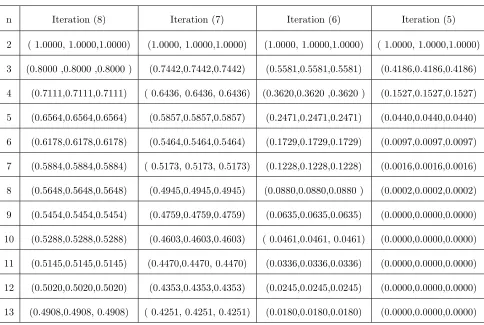
Table 1 shows the comparison of the rate of convergence of the implicit iterations (5), (6), (7) and(8) to the
tripled fixed point (0,0,0)with the initial value (x11, x12, x31) = (1,1,1)for the mapping given in Example(16).
Table 1: The values of (x1
m, x2m, x3m) for Iterations (5),(6),(7),(8).
n Iteration (8) Iteration (7) Iteration (6) Iteration (5)
2 ( 1.0000, 1.0000,1.0000) (1.0000, 1.0000,1.0000) (1.0000, 1.0000,1.0000) ( 1.0000, 1.0000,1.0000)
3 (0.8000 ,0.8000 ,0.8000 ) (0.7442,0.7442,0.7442) (0.5581,0.5581,0.5581) (0.4186,0.4186,0.4186)
4 (0.7111,0.7111,0.7111) ( 0.6436, 0.6436, 0.6436) (0.3620,0.3620 ,0.3620 ) (0.1527,0.1527,0.1527)
5 (0.6564,0.6564,0.6564) (0.5857,0.5857,0.5857) (0.2471,0.2471,0.2471) (0.0440,0.0440,0.0440)
6 (0.6178,0.6178,0.6178) (0.5464,0.5464,0.5464) (0.1729,0.1729,0.1729) (0.0097,0.0097,0.0097)
7 (0.5884,0.5884,0.5884) ( 0.5173, 0.5173, 0.5173) (0.1228,0.1228,0.1228) (0.0016,0.0016,0.0016)
8 (0.5648,0.5648,0.5648) (0.4945,0.4945,0.4945) (0.0880,0.0880,0.0880 ) (0.0002,0.0002,0.0002)
9 (0.5454,0.5454,0.5454) (0.4759,0.4759,0.4759) (0.0635,0.0635,0.0635) (0.0000,0.0000,0.0000)
10 (0.5288,0.5288,0.5288) (0.4603,0.4603,0.4603) ( 0.0461,0.0461, 0.0461) (0.0000,0.0000,0.0000)
11 (0.5145,0.5145,0.5145) (0.4470,0.4470, 0.4470) (0.0336,0.0336,0.0336) (0.0000,0.0000,0.0000)
12 (0.5020,0.5020,0.5020) (0.4353,0.4353,0.4353) (0.0245,0.0245,0.0245) (0.0000,0.0000,0.0000)
13 (0.4908,0.4908, 0.4908) ( 0.4251, 0.4251, 0.4251) (0.0180,0.0180,0.0180) (0.0000,0.0000,0.0000)
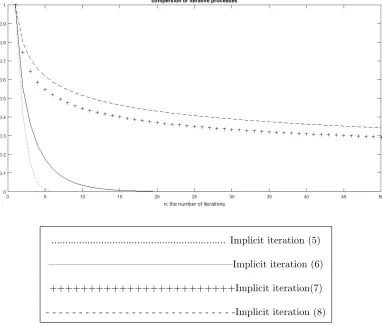
Remark 17 By the example (16), we note that the implicit iteration (5) is faster than the implicit iterations
(6), (7)and(8).
Figure 1 confirm that the iteration (5)) is converges faster than the iteration methods (6),(7) and (8).
... Implicit iteration (5)
——————————————————–Implicit iteration (6)
++++++++++++++++++++++++Implicit iteration(7)
- - - -Implicit iteration (8)
Figure 1: Present the rate of convergence for the iterations (5), (6),(7) and (8).
Competing interests
The authors declare that they have no competing interests.
Data Availability
No data were used to support this study.
Authors’ contributions
The authors contributed equally and significantly in writing this paper. All authors read and approved the final
manuscript.
Funding
c Research at King Khalid University for funding this work through Big Group Research Project under grant
number (G.R.P2/16/40).
References
[1] Lj. B. ´Ciri´c A. Rafiq, S. Radenovi´c M. Rajovi´c & Ume, J. S. On Mann implicit iterations for strongly
accretive and strongly pseudo-contractive mappings. Applied Mathematics and Computation, 198:128-137,
2008.
[2] Lj. B. Ciric, J. S. M. Ume, and S. Khan, On the convergence of the Ishikawa iterates to a common fixed
point of two mappings. Archivum Mathematicum (Brno) Tomus, 39:123-127, 2003.
[3] R. Chugh, P. Malik and V. Kumar. On analytical and numerical study of implicit fixed point iterations.
Cogent Mathematics, 2:1021623, 2015.
[4] S. S. Chang, Y.J. Cho, H. Zhou Demi-closed principle and weak convergence problems for asymptotically
nonexpansive mappings J. Korean Math. Soc., 38 (2001), pp. 1245-1260.
[5] D. Guo, V. Lakshmikantham, Coupled fixed points of nonlinear operations with applications, Nonlinear
Anal. 11, 52, (1987), 525 -562.
[6] T. Gnana Bhaskar, V. Lakshmikantham, Fixed point theorems in partially ordered metric spaces and
applications, Nonlinear Anal, 65 (2006), 1379-1393.
[7] V. Lakshmikantham, L. Ciri´c, Coupled fixed point theorems for nonlinear contractions in partially ordered
metric spaces, Nonlinear Anal, 70 (2009) 4341-4349.
[8] S. Ishikawa Fixed points and iteration of nonexpansive mappings of in a Banach spaces Proc. Amer. Math.
Soc., 73 (1967), pp. 61-71.
[9] M. O. Osilike, A. Udomene Weak and strong convergence theorems for fixed points of asymptotically
nonexpansive mappings Math. Comput. Modelling, 32 (2000), pp. 1181-1191.
[10] J. Schu Iterative construction of fixed points of asymptotically nonexpansive mappings J. Math. Anal.
Appl., 158 (1991), pp. 407-413.
[11] U. Kohlenbach. Some logical metatherems with applications in functional analysis. Transactions of the
American Mathematical Society, 357:89-128, 2004.
[12] I. Yildirim and M. Abbas, Convergence rate of implicit iteration process and a data dependence result,
European Journal of pure and applied mathematics, Vol. 11, No. 1, 2018, 189-201.
[13] C. O. Imoru, M.O. Olantiwo. On the stability of Picard and Mann iteration processes, Carpath. J. Math.
19:155-160, 2003.
[14] M. Imdad, A. H. Soliman, B. S. Choudhury, and P. Das, On n-tupled coincidence and common fixed points
results in metric spaces. J. Oper. (2013). Article ID 532867
[15] M. O. Osilike, A. Udomene. Short proofs of stability results for fixed point itera- tion procedures for a class
of contractive-type mappings. Indian J. Pure Appl. Math. 30: 1229 - 1234, 1999.
[16] A. Roldan, J. Mart´ınez-Moreno and C. Rold´an, Multidimensional fixed point theorems in partially ordered
metric spaces. J. Math. Anal. Appl. 396, 536–545 (2012)
[17] S. M. Soltuz, T. Grosan, Data dependence for Ishikawa iteration when dealing with contractive like
oper-ators, Fixed Point Theory Appl. Article ID 242916 (2008). doi:10.1155/2008/242916, 2008.
[18] W. Takahashi. A convexity in metric space and nonexpansive mappings. Kodai Math. Sem. Rep. 22:142-149,
1970.