1
A Qualitative Investigation into the Role of the Caddie in Elite-level Golf
2
3
Manuscript submitted to International Journal of Sports Science and Coaching
4
5
6
Jarred Pilgrima, 1,Sam Robertsona, 1 andPeter Kremerb, 2
7
8
a
School of Exercise and Nutrition Sciences, Faculty of Health, Deakin University, Melbourne
9
Burwood Campus, 221 Burwood Highway, Victoria 3125, Australia
10
b
School of Exercise and Nutrition Sciences, Faculty of Health, Deakin University, Geelong Waurn
11
Ponds Campus, 75 Pigdons Road, Victoria 3216, Australia
12
13
14
15
1Sam Robertson's and Jarred Pilgrim's present address is the College of Sport and Exercise Science, Victoria University, Footscray Park Campus, Ballarat Road, Footscray, Victoria 3011, Australia 2Corresponding author.
Email address: [email protected]
ABSTRACT
16
The aim of this study was to determine the nature of the caddie's role in the decision-making,
17
psychological conditioning and tournament preparation of elite-level golfers. Semi-structured
18
interviews were conducted with 17 elite-level golfers (17-24 years; 15 male and 2 female) and 6
19
caddies (29-42 years; 6 male). Data were transcribed and subjected to thematic analysis techniques.
20
Analysis produced four main findings: (1) the caddie's role in decision-making was to provide
21
information, assist in shot selection and provide feedback of the golfer's club selection; (2) the
22
caddie's role in psychological conditioning was to maintain the golfer's high performance state using a
23
variety of cognitive and attentional strategies; (3) caddies assist in tournament preparation by
24
'mapping' to plan strategy and record the important characteristics of the course prior to a competitive
25
event; and, (4) although the benefits of the caddie were recognized, golfers were dissatisfied with the
26
quality of caddies available. The findings of this study provide guidelines for the best practice of
27
caddies. Additionally, the development of a prerequisite document or caddie contract was proposed as
28
an appropriate solution to the issue of golfer discontent in caddie quality. The application of this
29
knowledge has implications for national sport agencies, performance enhancement in the sport and the
30
development of more effective working relationships between elite golfers and their caddies.
31
32
Key words: Decision-making; tournament preparation; sport psychology; interviews; optimal
33
psychological state; attentional control
34
INTRODUCTION
36
Golf is unique when compared with other individual skill based sports as golfers at the highest
37
level usually compete with an assistant, known as the caddie, who plays a support role alongside the
38
golfer [1]. Thus, at the highest levels of golf, the golfer and caddie operate as one complete 'unit'.
39
Traditional duties, commonly performed by the caddie to reduce the golfer’s workload, such as
40
carrying the golfer's bag, cleaning clubs, and maintaining the course for play are well documented
[1-41
4]. Furthermore, recent research has investigated the qualities that underpin an effective golfer-caddie
42
relationship [5-6], the caddie’s impact on the golfer’s scoring outcomes [7], and basic structure of the
43
caddie role [3-6]. However, there remains a dearth of empirical evidence concerning the broader roles
44
that caddies may play in adjusting psychological states, assisting in decision-making, and in
45
preparation for a competitive event.
46
In competitive sport, the ability of athletes to achieve and maintain a psychological state
47
appropriate for the execution of a well-learned skill is an important determinant of success. The
48
specific psychological qualities associated with optimal performance in golf have been well identified
49
[8-12]. Unlike open-skilled sports, in which split second decisions are common, golf is relatively
50
closed-skilled in nature and is played over a long duration, interspersed with regular periods of
51
downtime between movements [13, 14]. Therefore, to achieve the desired scoring outcomes golfers
52
must be able to 'adjust' their psychological activation throughout the course of play [6, 13, 15].
53
Caddies may assist in facilitating this optimal state by: (a) optimizing golfer's self-confidence prior to
54
shot execution; and, (b) maintaining the golfer's psychological state in the period between shots [3, 6].
55
However, the specific techniques used to perform these duties are yet to be empirically shown.
56
Elite golfers have been shown to employ several different coping techniques or strategies, often in
57
combination, to minimize poor execution, manage competitive stressors and maintain their optimal
58
performance state [11-13, 16]. These include: cognitive (e.g., imagery, self-talk), behavioural (e.g.,
59
following a specific routine) and emotional (e.g., physical relaxation, seeking on-course social
60
support) strategies [16]. Several of these strategies are used internally by the golfer and offer limited
61
capacity for direct caddie intervention. However, the position the caddie occupies, being: (a) proximal
62
to the golfer; (b) trusted by the golfer; and, (c) aware of the golfer's psychological state, provides a
63
Comment [SR1]: I don’t think this is
a great opening line compared to what was there in the first instance. Can we split into two or improve the wording?
Comment [SR2]: Be specific I think
– i.e., 4-5 hour duration
Comment [SR3]: Are we going with
signficant opportunity for the caddie to promote or encourage specific techniques. For example, there
64
is potential for the caddie to assist in the delivery of 'triggers', which may include statements or
65
phrases, delivered once or several times in succession. These triggers are designed to promote a direct
66
response from the golfer; or alternatively encourage the golfer to employ other psychological
67
strategies (e.g., imagery) thus having an indirect effect on the golfer's psychological state [6,17,18].
68
Decision-making in golf involves the gathering of information relevant to the golfer's current
69
position (e.g., wind, lie, yardage) and the consideration of how this information applies to the shot
70
required [19]. It has been shown that the caddie's role in decision-making is to assemble information
71
(e.g., yardage, wind direction), assist in club and shot selection, and to provide positive reinforcement
72
of the golfer's decision in order to increase confidence and commitment prior to execution [2,3,6].
73
However, previous studies have been exploratory in nature and thus were unable to provide a concise
74
description of optimal caddie function. In order to design performance interventions targeting the
75
efficiency of the decision-making period, more detailed investigations are required. Further, there is
76
relatively little information available concerning how and when caddies obtain the information
77
required to inform shot selection. It has been observed that caddies may assist golfers by 'mapping' the
78
course prior to competitive play [2], however it is presently unknown whether or not this process is
79
considered effective and what factors may influence the quality of this information.
80
Therefore, the present study aimed to determine the nature of the caddie's role in the
decision-81
making, psychological conditioning and tournament preparation of elite-level golfers from a
golfer-82
caddie perspective.
83
METHOD
84
Participants
85
Purposeful sampling was used to recruit 17 golfers (15 male, 2 female; playing level = 2 rookie
86
professionals, 15 high-level amateurs; age range = 17-24 years; M age = 20 years; M years of playing
87
= 10 years) and 6 caddies (6 male; age range = 29-42 years; M age = 37 years; M years of caddying =
88
15 years; M number of golfers worked with = 19). Inclusion criteria for golfers required that
89
participants were either (a) a current member of the Australian Amateur National Squad; or (b) a
90
current member of the Australian Rookie Squad; and, (c) greater than 17 years of age. Both the rookie
91
Comment [SR4]: This is extremely
long now. See how I have edited. Just as a note – I think when making changes to review, you need to re-read the new sentences a little more thoroughly as most of the
professional group and the high level amateur group were considered 'elite' based on definition by
92
previous research [20]. Inclusion criteria for caddies stipulated that they were currently or had
93
previously worked with (a) a current member of the Australian Amateur National Squad; or (b) a
94
current member of the Australian Rookie Squad; and, (c) greater than 18 years of age. The caddies
95
recruited were all full-time employed in golf (tournament coaching consultant, one national coach,
96
three PGA teaching professionals and one PGA professional trainee). These individuals volunteered to
97
caddies for elite-level golfers as part of their capacity within these roles and were not paid for their
98
services. The participants were recruited either by being approached directly (phone, electronic mail)
99
or via liaison with the second authors existing industry contacts. Ethical clearance to conduct the
100
study was provided by the Deakin University Human Ethics Advisory Group.
101
Materials
102
Interview Guide. Separate semi-structured guides (adapted from similar work by Lavallee, Bruce
103
and Gorely [3]) were used to elicit information from participant caddies and golfers. Each guide
104
included a brief introductory script, topic questions and follow-up probes. Topic questions were
105
designed to assess the participant’s experience in several areas relevant to the caddie role, including:
106
background, playing/caddying experience, function of the caddie, the caddie’s role in maintaining a
107
golfer's mental state, communication and decision-making. Sample questions included: "When did
108
you first play with a caddie?", "Most people are aware of the basic duties of the caddie, for example:
109
carrying bags or course maintenance, from your experience could you tell me more about what
110
caddies do during a round?", and, "Who has the final responsibility for decisions that are made on the
111
course?" Each content topic and related questions were introduced in such a way that encouraged the
112
interview to develop in a natural, conversational manner [21,22]. Probes were used to further explore
113
aspects of the participant's experience that arose during the interviews. Thus, whilst each interview
114
followed the topic guide, the interviewer had the flexibility to pursue responses beyond the scope of
115
the specific questions [21]. Each interview guide was reviewed by the research team as well as an
116
independent expert in interview methods. The guides were piloted with two non-elite golfers (n = 2) to
117
assess the appropriateness of each of the topic areas. Feedback from participants was positive and no
118
Instruments. Interviews were conducted locally (Melbourne, Australia) and internationally
120
(Texas, USA). A combination of four audio devices were used to record the interviews: (a) Zoom
121
Q3HD video/audio recorder; (b) Olympus Note Corder DP-211; (c) Livescribe 2GB Echo Smartpen;
122
and, (d) Samsung Galaxy S5 internal recorder. The Q3HD and the Echo Smartpen were used as the
123
primary and secondary recorders for all Melbourne-based interviews and the DP-211 and the S5 were
124
employed as the primary and secondary audio recorders for interviews conducted in Texas. The
125
NVivo 10 ® analysis software (Qualitative Research Solutions International QSR; 2012) was used for
126
the management and analysis of textual data. This software enabled the data to be assigned meaning
127
by associating codes or labels with congruent sections of text [23].
128
Procedure
129
Each player and caddie was interviewed once. Seventeen face-to-face semi-structured interviews
130
were conducted with golfers on-site at the Woodlands Country Club in Houston, Texas, during the
131
Golf Australia National Squad camp (July, 2014) by the second author. Three face-to-face interviews
132
and three phone interviews were conducted with caddies by the first author (August, 2014). For the
133
face-to-face interviews, locations included a quiet office space at the University campus and a similar
134
facility at participants' places of employment. Both the face-to-face and phone interviews lasted
135
between 10 and 30 minutes. With permission, the interviews were audio taped and field notes taken as
136
a means of recording the interviewer’s observations and preliminary coding ideas.
137
Interview recordings were transcribed verbatim by the first author and a trained research assistant.
138
The first two golfer interviews were cross transcribed (research assistant and first author) to ensure
139
accuracy and transferability between transcribers [24]. During transcription all identifying information
140
was removed and participants were assigned a pseudonym to preserve anonymity [25]. Golfers and
141
caddies were indicated by the code 'G' and 'C', respectively, followed by their gender and
142
identification number [25]. Following transcription golfer and caddie transcripts were checked for
143
accuracy (e.g., analyzed alongside interview audio) by the author and the research assistant [24].
144
Data analysis
145
A six-step thematic analysis was used to analyze the content of the interview transcripts: (1)
146
(3) collate similar coded extracts into candidate themes; (4) review the validity of each theme in
148
relation to the coded extracts and the entire data set; (5) use the themes identified to construct a
149
'thematic map' of the data; (6) generate an accompanying narrative describing the specifics of each
150
theme in relation to the research question [26]. A sample of interview transcripts (n = 5) were
151
submitted to multiple coding by the research assistant and assessed against those of the primary coder.
152
Crosschecking of coding strategies concluded that codings were consistent in 87% of cases, which is
153
acceptable according to methods defined by LeCompte and Goetz [27]. The use of multiple
154
investigators (coders) was positioned to facilitate triangulation of the data, in order to reduce the
155
impact of individual bias. To ensure trustworthiness, data analysis and interpretation was conducted in
156
reference to the consolidated criteria for the reporting of qualitative research [28].
157
RESULTS
158
Thematic analysis of the data highlighted four central themes and additional subthemes to describe
159
the role of the caddie. These central themes included: decision-making, psychological conditioning,
160
tournament preparation and perceptions of caddie quality, and are presented in Table 1.
161
162
Insert Table 1 about here
163
164
Each of the themes and subthemes are analyzed in further detail.
165
Decision-making
166
This theme represents the behaviors undertaken by golfers and caddies from when they first
167
approach the ball to when the golfer executes the shot. Two subthemes emerged, 'stages of
decision-168
making', and 'moderating factors'.
169
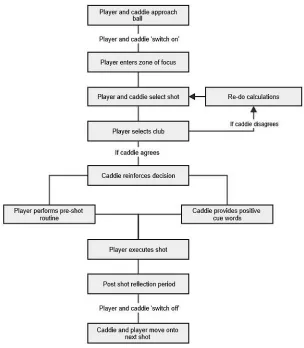
Stages of decision-making. Stages of decision-making referred to the predefined sequence of
170
events that golfers and caddies progress through prior to shot execution, these stages included: (a)
171
zone of focus, (b) shot selection, (c) club selection, (d) pre-shot routine, (e) shot execution and (f) post
172
shot reflection period. The specific order and content of these stages varied between participants,
173
however this subtheme represented what participants considered to be optimal. The sequence of these
174
176
Insert Figure 1 about here
177
178
Zone of focus.This first stage was defined as the golfer and caddie narrowing their focus or
179
psychological activation; in essence 'switching on' in preparation for analysis and shot execution. The
180
exact threshold or distance at which the golfer initiated this process varied between participants, but
181
typically this was 5-10 m from the ball.
182
Shot selection. Golfers and caddiesagreed that the caddie’s role during shot selection was to
183
provide the golfer with relevant information pertaining to a shot. The exact content of this information
184
varied considerably, but those reported to be most fundamental to the caddie's role included: hazard
185
placement, pin position, wind (angle, intensity) and yardage (to the front, side and back of the green;
186
yardage to hazards; yardage to the pin). This information was collected upon reaching the ball or
pre-187
recorded in the caddies 'yardage book'. Following the provision of information, each variable was
188
considered in relation to the desired shot outcome and used to discuss the intended landing zone, line
189
of approach, shot shape (draw, fade, high, low) and to calculate the exact yardage or 'true distance', as
190
one golfer described:
191
"You just work out, if it's 150m, I hit my 8 iron 150m, but it's uphill and into the wind. It's
192
probably playing 5m (more) for uphill, 10m (more) for the wind, so you just do a bit of
193
adding and subtracting for the yardages." (GM014).
194
Club selection.After all information has been collated and calculations completed it was the
195
golfer's responsibility to select the club based on the distance required to execute the desired shot.
196
This decision should be mathematical and not based on visual estimates:
197
"Never tell them what club to hit. Run the numbers, go through your list, check off your
198
list as these things that I want from this shot, the club will choose itself, you'll come up
199
with a number..." (CM002).
Based on the golfer’s decision the caddie had two options, they could choose to either agree with
201
the initial club selection or they may be unsure and could choose to disagree. If the caddie chose to
202
agree their duty was to provide positive reinforcement to the golfer’s decision, this task was essential
203
to the caddie’s role and helped to ensure the golfer is confident and committed to their shot execution.
204
The content of this reinforcement was described as a short phrase to convey agreement. Conversely, if
205
the caddie disagreed with the golfer's club selection this was done in a diplomatic way. To avoid
206
potential conflict, the caddie's role was not to inform the golfer their decision was wrong, but rather to
207
suggest they re-do the initial calculations to confirm the distance.
208
Pre-shot routine.Once the golfer and caddie were content with the club selection, the golfer
209
approached the ball and began the pre-shot routine. During this time, both golfers and caddies stated
210
that the caddie's role was to simultaneously provide the golfer with positive prompts or trigger words.
211
The use of trigger words was highlighted as a means to positively influence the golfer’s focus:
212
"And then while I'm doing my routine he would just say 'commit, commit to your golf
213
shot' and then I'd walk in and hit it. That's about it really." (GM008).
214
Shot execution.Following the pre-shot routine the caddie adopted a passive role as the golfer
215
executed the shot.
216
Post-shot reflection period.Post execution the golfer and caddie allowed a short period of time to
217
reflect on the shot outcome and the execution of the decision-making process. Several caddies
218
reported that this period was important in reducing a golfer’s build-up of negative energy. Generally,
219
if the golfer wanted to release some anger or frustration the caddie would encourage the golfer to do
220
so during this stage.
221
Variability.The input and feedback requested by golfers from their caddies during
decision-222
making varied considerably depending on individual preference and several moderating factors. This
223
variability ranged from complete involvement in almost every aspect, to relatively no involvement at
224
Moderating factors. Responses indicated that the caddie's level of involvement during the
226
decision-making period was moderated by two factors: (a) the caddie's knowledge of the golfer's
227
specific requirements, and (b) the golfer’s trust in the caddie.
228
Knowledge of golfer requirements.The responses of caddies identified the ‘knowledge of golfer
229
requirements’ to be a key factor in their ability to deliver effective input and advice during
decision-230
making. Currently, it appears that the golfers were not using a systematic approach to effectively
231
communicate their exact preferences during this period. Several caddies believed that the
232
responsibility should fall on the golfer to inform the caddie of their needs and requirements prior to
233
competition; allowing the caddie to deliver specific input that is most beneficial to the golfer's
234
decision-making process.
235
Trust.Participants discussed trust more than any other factor when describing the determinants
236
that may influence the nature of the caddie's role in decision-making. The consensus was that a
237
distrusting golfer-caddie partnership results in ineffective decision-making, particularly by reducing
238
the level of input that golfers feel comfortable requesting from caddies during shot selection. The
239
caddie's level of experience and the degree of familiarity between the golfer and caddie were both
240
found to increase the trust that golfers had in their caddie's abilities, with many golfers stating that
241
they would not trust the input of an unfamiliar caddie.
242
Psychological conditioning
243
This theme contained any reference made by participants concerning a golfer's psychological state
244
or condition. In particular, the variables used to define a golfer’s peak psychological state were
245
highlighted and any techniques or strategies used by caddies to maintain or regain this state were
246
explored. The theme contained two subthemes; these were 'high performance state,' and 'caddie input'.
247
High performance state. Participants described a golfer's 'high performance state' as their
248
psychological state or 'headspace' when they are performing at their peak. Seven main characteristics
249
were identified to define this state: effortless performance, able to isolate each shot, high
self-250
confidence, focused, relaxed, staying in the present, feeling unstoppable, and able to switch off
251
between shots. It was revealed that the caddie's role was to keep the golfer performing within their
252
Caddie input. To maintain the golfer's high performance state players indicated that caddies
254
employed two primary methods: 'cognitive strategies' and 'attentional control'.
255
Cognitive strategies. Participants indicated that several cognitive strategies were used by caddies
256
to influence the psychological state of the golfers. As noted previously, caddies used three cognitive
257
strategies during the decision-making period: (a) positive reinforcement; (b) trigger words; and (c) the
258
post-shot reflection period. Proving reinforcement of the golfer's club selection allowed caddies to
259
embed confidence prior to execution, reducing self-doubt and improving the likelihood of a successful
260
outcome. The caddie's provision of trigger words was noted to have two purposes; first, to narrow the
261
golfer’s focus of attention, and second to improve their ability to concentrate. The third cognitive
262
strategy, post-shot reflection, enabled the caddie to facilitate release of negative energy by the golfer
263
through discussion of the golfer’s feelings concerning the previous decision-making period. This
264
period of reflection represented a form of coping, helping the golfer to release stress and frustration
265
before moving onto the next shot.
266
Attentional control. Participant's responses indicated that the ability to modify attention to meet
267
situational requirements was an important determinant of a golfer's psychological state. It was
268
identified that the caddie's main influence in regulating golfer attention occurs in the period of
269
downtime in-between shots. Following the post-shot reflection period, caddies used frequent periods
270
of conversation with the golfer, focusing on non-golf related topics to re-direct the golfer’s attention,
271
in effect keeping their mind off golf. Re-directing the golfer’s attentional focus helped the golfer avoid
272
external distractions, stay focused in the present and maintain a low level of psychological activation;
273
thereby facilitating maintenance of the golfer’s high performance state and allowing them to
274
concentrate more effectively when they reach the ball:
275
"If you can get their mind off (golf) the player is able to concentrate a lot more when they
276
get to (the ball), usually if they are thinking about golf the whole time they burn out after
277
9 or 10 holes." (CM005).
278
Tournament preparation
Participants defined tournament preparation as a series of tasks undertaken by golfers and caddies
280
prior to a competitive event in order to optimize performance. This theme describes the caddie's role
281
in this process. Two subthemes emerged: the 'practice round' and 'course mapping'.
282
Practice round. It was reported that during the practice round the caddie completes a series of
283
duties similar to that of a normal round, to support the golfer's performance. However, several
284
respondents indicated that there was also a trust element to the caddie’s involvement, and that golfers
285
may use the practice round as a means to gauge caddie competency. This was particularly the case
286
when the golfer did not have a pre-existing relationship with the caddie. Furthermore, depending on
287
how the golfer perceived the caddie’s abilities, this was found to either increase or decrease the
288
golfer’s trust in the caddie and had significant implications for the dynamic of the relationship:
289
"In the practice round I might ask the caddie for a lot more input because then I can use
290
that for evidence as to whether he's getting it right or not." (GM013).
291
Course mapping. Participants considered course mapping to involve measuring out the course,
292
identifying hazards, approach paths, planning strategy and recording this information in the yardage
293
book. Although not specifically mentioned, it was explicit that the caddie's involvement in course
294
mapping may influence their ability to provide input during the decision-making process. Caddies
295
who are technically skilled in mapping and routinely involved in this process had more detailed, high
296
quality information to contribute during the decision-making period than those whose yardage books
297
were poorly designed and sourced.
298
Perceptions of caddie quality
299
While a critical analysis of caddie quality was not the purpose of this investigation, this theme
300
emerged throughout the analysis and was considered an important element when reflecting on the
301
golfer-caddie dynamic in elite golf. Golfers spoke quite candidly concerning the quality and
302
usefulness of caddies with whom they had previously worked, with the majority of golfers reporting a
303
feeling of dissatisfaction:
304
"I've never had a good caddie …" (GM011).
These feelings of inadequacy were directed particularly toward parent or family member caddies.
306
It was reported that younger golfers working alongside a family member tended to place added
307
pressure on themselves either to perform or meet expectations, resulting in an ineffective
golfer-308
caddie relationship. Of the golfers interviewed, many still regularly employed the services of family
309
members or friends as caddies. Despite golfers reporting general dissatisfaction with their caddie
310
experiences, most recognized the importance of the caddie’s role and reported a desire to work with
311
high-quality caddies in the future.
312
DISCUSSION
313
The present study aimed to determine the nature of the caddie's role in the decision-making,
314
psychological conditioning and tournament preparation of elite-level golfers. The caddie's most
315
fundamental role in decision-making was to provide the golfer with information concerning the
316
situation of play or the physical characteristics of a shot. Caddies also assisted the golfer in shot
317
selection and provided feedback concerning the golfer's club selection. It is important to understand
318
that the findings presented herein are representative of what golfers and caddies considered being
319
optimal. The actual input provided by caddies was found to vary considerably depending on the
320
golfer's individual preferences, the caddie's knowledge of the golfer’s requirements and the golfer's
321
level of trust in the caddie. In particular, low levels of trust were associated with the caddie being less
322
involved in the decision-making process.
323
Interestingly, when discussing the input provided by caddies, a greater quantity of information was
324
not necessarily considered beneficial to golfers. For example, several golfers recalled situations in
325
which previous caddies had identified a hazard and explicitly stated to 'avoid the area', which
326
disrupted the golfer's thought processes and resulted in a negative shot outcome. This finding is
327
consistent with Wegner's [29] theory of 'ironic mental processes', which proposed that attempts to
328
suppress thoughts from one's conscious awareness increase the probability that the suppressed thought
329
will influence subsequent thoughts and actions [30, 31]. The communication delivered by a caddie
330
may also influence the content of a golfer’s self-talk. The human environment surrounding a sporting
331
experience plays an important role in shaping an athletes’ self-talk [32]. Interestingly, a negative style
332
[33]. In golf, the qualities of the golfer-caddie relationship are similar to that of the relationship
334
between coach and athlete. Therefore, any negative communication from a caddie (e.g., avoid the
335
bunker, beware the water hazard) could influence the content of a golfer’s self-talk. Interviews
336
performed by Aitken and Weigand [6] lend support to this theory, as the caddies they interviewed
337
stated that it is crucial to avoid negative communication with golfers during a competitive round.
338
Overall, the findings reported were consistent with previous models of golfer-caddie
decision-339
making (e.g., Bruce [2]; Lavallee et al. [3]). Specifically, similarities were noted concerning the
340
caddie's role in providing information, in evaluating the golfer's club selection and the variables that
341
moderate the level of input requested by golfers. However, the findings of the present study described
342
the caddie choosing to disagree with the golfer’s selection as a diplomatic re-negotiation of the initial
343
calculation. This is in contrast to previous models that have suggested it to be 'precarious' and suggest
344
that if a caddie is to attempt to change a golfer’s decision they need to provide supporting information
345
and an alternate option to consider [2, 3]. Another important distinguishing factor between this study
346
and previous investigations was the sample utilized. The present sample included mostly elite amateur
347
golfers with a small number of rookie professionals, while previous studies (Bruce [2]; Lavallee et al.
348
[3]) used professional golfers, playing on the Australasian PGA Tour. It is possible that this may
349
account for these differences, as more experienced golfers may be less open to discussing alternatives
350
to their decision.
351
As with decision-making, caddies were reported to fulfill a variety of roles in order to influence the
352
psychological condition of the golfer. The most central role was to maintain the golfer's 'high
353
performance state'. It was indicated that any deviation from this state increased the likelihood the
354
golfer would experience a decrement in their performance. This statement was consistent with
355
previous theories of optimal mental climate [34]. To preserve the golfer's high performance state,
356
caddies used a variety of cognitive strategies (positive reinforcement, trigger words and post shot
357
reflection) and attentional control. The first cognitive strategy, positive reinforcement, involved the
358
caddie providing reassurance of the golfer’s club selection by using a short statement to convey
359
agreement. Golfers reported that reinforcement from the caddie was an effective strategy to increase
360
positive reinforcement as an essential component of the caddie’s role [2,3]. Additionally, the
362
importance of self-confidence in creating an assurance of certainty, encouraging effortless
363
performance and allowing the golfer to play with maximum commitment has been well documented
364
[18,35].
365
Caddies delivered the second strategy, trigger words, while the golfer completed their pre-shot
366
routine. The use of trigger words was described as an attentional tool, used by the caddies to narrow
367
the golfers focus and ensure they are able to adopt an optimal internal state prior to skill execution.
368
The use of trigger words has been reported amongst elite-level golfers as a form of structured
self-369
talk, designed to manipulate the golfer's focus and concentration [13,18]. While previous research has
370
not considered the role of the caddie in the delivery of such techniques, the underlying mechanisms
371
may function on the same basis. That is, the caddie provides a positive, instructional statement to the
372
golfer, similar to what the golfer would focus on internally while practicing self-talk, to improve the
373
golfer’s attentional skills and remind them of the relevant focus points in a given situation [18]. The
374
third strategy, post-shot reflection, was employed by the caddie to facilitate the release of negative
375
frustration by the golfer. Golfers seeking social support and venting have been recognized as forms of
376
emotional-focused coping [36]. It is conceivable that the post-shot reflection period used by caddies
377
represents a combination of these methods.
378
Attentional control was a further strategy used by caddies as a means to preserve the golfer's high
379
performance state. Caddies used frequent conversation with the golfer, focusing on non-golf related
380
topics, to redirect the golfer's attention away from the external environment and toward the novel
381
stimulus (conversation). Thereby mitigating the effect of external distractions, keeping the golfer
382
focused on the present and maintaining a low level of psychological activation. In effect, this enabled
383
the caddie to facilitate maintenance of the golfer's high performance state and preserve attentional
384
resources by introducing a stimulus positioned to redirect the golfer's attention from potential stressors
385
(e.g. future performance associated anxiety) that may induce a negative psychophysiological response.
386
While the caddie's role in such methods has been recognized [6, 37] and the relationship between
387
'concentration disruption' and tournament performance documented [38], the mechanism underlying
388
In elite golfers, a more 'task orientated', rather than 'outcome orientated' concentration style has
390
been associated with peak performance [2]. When golfers fixate on future or past performance they
391
tend to become more outcome orientated, creating a self-imposed pressure to perform in an attempt to
392
re-capture missed opportunities. According to Baumeister's [39] self-focus model, increased
393
performance pressure generally results in heightened levels of self-directed attention. An internal
394
focus shifts the golfer’s attention to the step-by-step processes of skill execution and results in the
395
golfer taking conscious control of what is usually an unconscious process, often resulting in a
396
decrease in their performance [40].
397
The caddie's role in pre-tournament preparation was comprised of the practice round and course
398
mapping. Like in a competition round, the caddie's role during the practice round was to support the
399
performance of the golfer, which has been previously highlighted [2, 8]. Interestingly, participants
400
reported that the practice round was also used as a means to assess the caddie's abilities. If the caddie
401
was perceived as competent, the golfer's trust in the caddie would subsequently be increased. This
402
finding has significant implications for the golfer-caddie dynamic. Specifically, by demonstrating
403
efficacy in the practice round, caddies may be able to circumvent the absence of a pre-existing
404
relationship and increase the golfer’s trust, because as previously noted, trust was dependent on two
405
variables: familiarity and caddie skill. As a result of an increased level of trust the caddie may be
406
invited to provide a greater degree of input into the golfer's decision-making. This was in contrast to
407
Aitken and Weigand [6] who found that professional tour caddies they interviewed reported taking
408
from two to three weeks of tournament golf until their golfer developed enough trust in them so they
409
could contribute significantly to the decision-making process. The caddie’s second role in tournament
410
preparation was to assist golfers in 'mapping' by measuring out the course, identifying hazards,
411
approach paths, planning strategy and recording this information in their yardage book.
412
Understandably, caddies whose yardage books were detailed and of a high quality had more
413
information to contribute during decision-making. These findings are novel, as to our knowledge, the
414
ability of the caddie to build trust using the practice round and increase the quality of the information
415
they can provide to golfers has not been empirically determined, although there has been some
416
Despite recognizing the benefits of caddies, golfers were generally dissatisfied with the current
418
quality of caddies available. When interpreting this finding, it is important to understand that the
419
sample of caddies recruited for this study were all employed in other areas of golf performance (e.g.,
420
golf coach, tournament consultant), and caddied infrequently for golfers as part of their capacity
421
within these roles. There caddies were not necessarily reflective of the quality of caddies typically
422
available to elite-level golfers. Caddies explained that National Squad golfers do not have access to
423
the monetary resources required to employ a regular, high quality (professional) caddie. Therefore,
424
golfers often employed the services of family members, teammates or one-off caddies (individuals
425
provided by the golf course at which a tournament or playing event is held). It is likely that these
426
caddies did not fulfill the specific roles reported in this study, which may account for golfer’s current
427
discontent. In the case of caddies with multiple roles (e.g., caddie and family member), this may be
428
attributed to the power ratio of the relationship [6]. To enable effective communication between golfer
429
and caddie, the power in the relationship should belong to the golfer, however, if the caddie and golfer
430
have an existing relationship in which the balance of power is reversed, the caddie may be unwilling
431
to surrender their position of power. This inappropriate allocation of power can reduce the
432
effectiveness of the golfer-caddie communication and overall the success of the partnership [6]. In
433
order to reduce the influence of power balance, it is important for both golfer and caddie to recognize
434
their role and appreciate who is in control to create the best possible working environment and
435
maximize competitive outcomes [6]. Despite the clear need for skilled caddies at the high-level
436
amateur/rookie professional level of golf, due to the lack of employment incentives, it seems likely
437
full time caddying at this level is still not a viable career option.
438
From an applied perspective these findings have a number of implications worth highlighting.
439
First, an intervention to increase the effectiveness of caddies regularly available to elite-level golfers
440
may be beneficial. As mentioned, the caddies employed by these golfers vary considerably, from a
441
close family member (while playing in their local region), to an individual provided by the golf course
442
(while playing out of state or internationally). Therefore, a skill development program may be an
443
ineffective solution, as the cohort from which caddies are sourced is inconsistent, and it would be
444
and most likely face significant time constraints. Rather, a more appropriate method to address this
446
situation maybe the development of a prerequisite document or 'caddie contract'. This caddie contract
447
would contain many of the components of an average employment contract; in particular, it would
448
outline the pre-requisites of the caddie’s role and describe what the golfer expects of them as an
449
'employee'. As reported by this study, golfer's specific preferences vary considerably; therefore it is
450
important that the circulation of a generic contract be avoided. Contracts should be individualized to
451
meet golfer’s unique requirements and developed based on the coach’s recommendations. Future
452
research and evaluation is needed to assist in the development of such methods to ensure the validity
453
and reliability of the instrument, and to determine its effectiveness before it can be applied to the
454
wider golf population.
455
The findings of this study highlight the specific roles fulfilled by caddies in the decision-making,
456
psychological conditioning and tournament preparation of elite-level golfers. Specifically, caddies
457
provide information and feedback during decision-making, use a variety of strategies to maintain the
458
golfer's high performance state and assist in preparation by 'mapping' the course. Although the
459
benefits of caddies were recognized, elite-level golfers were dissatisfied with current caddie quality.
460
To increase the quality of the service provided by caddies it was recommended that a list of
461
prerequisites or 'contract' be developed and delivered to caddies prior to competition. The results of
462
this study have significant practical relevance for the elite-level golfer, their caddies, golf researchers
463
and National sport agencies. Golfers and caddies may apply this knowledge to optimize performance
464
of the golfer-caddie unit. While researchers and sport agencies may use this information in the
465
development of performance interventions, such as a caddie contract. Future research may also be
466
useful to assess the validity and applicability of the proposed golfer-caddie decision-making model
467
using quantifiable measures. The application of these findings has clear implications for performance
468
enhancement, the development of best practice guidelines and more effective working relationships
469
between elite golfers and their caddies.
470
REFERENCES
472
1. Carrick, M. and Duno, S., Caddie Sense: Revelations of a PGA Tour Caddie on Playing Golf, St.
473
Martin's Griffin, New York, 2002.
474
2. Bruce, D., Turn Up, Keep Up & Shut Up: The Role of a Caddie in Male Professional Golf in
475
Australia, Unpublished Master's thesis, University of Queesnalnd, 1999.
476
3. Lavallee, D., Bruce, D. and Gorely, T., The Golfer-Caddie Partnership: An Exploratory
477
Investigation into the Role of the Caddie, Athletic Insight: The Online Journal of Sport
478
Psychology, 2004, 6, 20-35.
479
4. Mackenzie, R., A Wee Nip at the 19th hole: A History of the St. Andrews Caddie, Sleeping Bear
480
Press, Ann Arbor, 1997.
481
5. Jowett, S. and Zhong, X., Understanding the Quality and Functions of the Golfer-Caddie
482
Relationship. Unpublished manuscript, Loughbourough University, 2014.
483
6. Aitken, V. and Weigand, D., Caddy-Talk: Psychology of Being a Great Golf Caddy, Dawvija
484
Publishing, Milton Keynes, 2007.
485
7. Coate, D. and Toomey, M., Do Professional Golf Tour Caddies Improve Player Scoring? The
486
Journal of Sports Economics, 2014, 15(3), 303-312.
487
8. Beauchamp, P.H., Peak Putting Performance: Psychological Skills and Strategies Utilized by
488
PGA Tour Golfers, in: Farally, M.R. and Cochran, A.J., eds., Science and Golf: III. Proceedings
489
of the World Scienfitic Congress of Golf, Human Kinetics, Champaign (IL), 1999, 181-189.
490
9. Cohn, P.J., An Exploratory Study on Peak Performance in Golf, The Sport Psychologist, 1991,
491
5(1), 1-14.
492
10. Douglas, K. and Fox, K., Practice for Competition in Women Professional Golfers, in: Thain, E.,
493
ed., Science and Golf: IV. Proceedings of the World Scientific Congress of Golf, Routledge, New
494
York, 2002, 257-267.
495
11. Hellström, J., Psychological Hallmarks of Skilled Golfers, Sports Medicine, 2009, 39(10),
845-496
855.
497
12. McCaffrey, N. and Orlick, T., Mental Factors Related to Excellence Among Top Professional
498
13. Finn, J., An Introduction to Using Mental Skills to Enhance Performance in Golf: Beyond the
500
Bounds of Positive and Negative Thinking. The International Journal of Sports Science Coaching,
501
2008, 3(1), 255-269.
502
14. Spittle, M., Motor Learning and Skill Acquisition: Applications for Physical Education and Sport,
503
Macmillan Education Australia, South Yarra, 2013.
504
15. Bois, J.E., Sarrazin, P.G., Southon, J. and Boiché, J. Psychological Characteristics and their
505
Relation to Performance in Professional Golfers, The Sport Psychologist, 2009, 23(2), 252-270.
506
16. Nicholls, A., Holt, N.L. and Polman, R.C., A Phenomenological Analysis of Coping Effectiveness
507
in Golf, The Sport Psychologist, 2005, 19(2), 111-130.
508
17. Cotterill, S. T., Effect of Shot type, Task Difficulty and Research Environment on Consistency of
509
Pre-Performance Routines in Golf: Psycho-Physiological Bases and Implications, Unpublished
510
PhD Thesis, University of Gloucestershire, 2007.
511
18. Cotterill, S.T., Sanders, R. and Collins, D., Developing Effective Pre-Performance Routines in
512
Golf: Why don't we ask the Golfer? The Journal of Applied Sport Psychology, 2010, 22, 51-64.
513
19. Furst, A.J., Dispositional Optimism, Sport Confidence, and Golf Performance, Unpublished PhD
514
Thesis, Griffith University, 2010.
515
20. Robertson, S.J., Burnett, A.F., Newton, R.U. and Knight, P.W., Development of the Nine-Ball
516
Skills Test to Discriminate Elite and High-Level Amateur Golfers, The Journal of Sports
517
Sciences, 2012, 30(5), 431-437.
518
21. Barriball, K.L. and While, A., Collecting Data Using a Semi-Structured Interview: A Discussion
519
Paper, The Journal of Advanced Nursing, 1994, 19, 328-335.
520
22. Whiting, L.S., Semi-Structured Interviews: Guidance for Novice Researchers, Nursing Standard,
521
2008, 22(23), 35-40.
522
23. Bringer, J.D., Johnston, L.H. and Brackenridge, C.H., Maximizing Transparency in a Doctoral
523
Thesis: The Complexities of Writing About the Use of QSR*NVivo Within a Grounded Theory
524
Study, Qualitative Research, 2004, 4(2),247-265.
525
24. Davidson, C., Transcription: Imperatives for Qualitative Research, The International Journal of
526
25. Dearnley, C., A Reflection on the Use of Semi-Structured Interviews, The Journal of Nursing
528
Research,2005, 13(1), 19-28.
529
26. Braun, V. and Clarke, V., Using Thematic Analysis in Psychology, Qualitative Research in
530
Psychology,2006, 3(2), 77-101.
531
27. LeCompte, M. D. and Goetz, J. P., Problems of Reliability and Validity in Educational Research,
532
Review of Educational Research, 1982, 52, 31-60.
533
28. Tong, A., Sainsbury, P. and Craig, J., Consolidated Criteria for Reporting Qualitative Research
534
(COREQ): A 32-item Checklist for Interviews and Focus Groups, The International Journal of
535
Qualitative Health Care, 2007,19(6), 349-357.
536
29. Wegner, D.M., Ironic Processes of Mental Control, Psychological Review, 1994, 101(1), 34-52.
537
30. Beilock, S.L., Afremow, J.A., Rabe, A.L., and Carr, T.H., "Don't miss!" The Delibiltating Effects
538
of Suppressive Imagery on Golf Putting Performance, Journal of Sport and Exercise Psychology,
539
2001, 23, 200-221.
540
31. Macrae, C.N., Bodenhausen, G.V., Milne, A.B. and Jetten, J., Out of Mind but Back in Sight:
541
Stereotypes on the Rebound, Journal of Personality and Social Psychology, 1994, 67(5), 808-817.
542
32. Papaioannou, A.G. and Hackfort, D., Routledge Companion to Sport and Exercise Psychology:
543
Global Perspectives and Fundemental Concepts, Routledge, New York, 2014.
544
33. Zourbanos, N., Hatzigeorgiadis, A., Goudas, M., Papaioannou, A., Chroni, S., & Theodorakis, Y.,
545
The Social Side of Self-Talk: Relationships between Perceptions of Support Received from the
546
Coach and Athletes' Self-Talk, Psychology of Sport and Exercise, 2011, 12(4), 407-414.
547
34. Williams, J.M. and Krane, V., Psychologial Characteristics of Peak Performance, in: Williams,
548
J.M., ed., Applied Sport Psychology: Personal Growth to Peak Performance. Mayfield Publishing
549
Company, Mountain View, 1993.
550
35. Ferraro, T., The Zone and Golf, Athletic Insight: The Online Journal of Sport Psychology, 1999,
551
1(3), 8-12.
552
36. Giacobbi, P., Foore, B. and Weinberg, R.S., Broken Clubs and Expletives: The Sources of Stress
553
and Coping Responses of Skilled and Moderately Skilled Golfers. Journal of Applied Sport
554
37. Simpson, D., Bell, R.J. and Flippin, K.J., Caddying is Timing: An Interview with Joe Skovron,
556
PGA Tour Caddy, Journal of Excellence, 2011, 14, 93-100.
557
38. Hayslip, B., Petrie, T.A., MacIntire, M.M. and Jones, G.M., The Influnece of Skill Level,
558
Anxiety, and Psychological Skills Use on Amateur Golfers' Performances, Journal of Applied
559
Sport Psychology, 2010, 22(2), 123-133.
560
39. Baumeister, R.F., Choking Under Pressure: Self-Consciousness and Paradoxical Effects of
561
Incentives on Skillful Performance, Journal of Personality and Social Psychology, 1984, 46(3),
562
610-620.
563
40. Land, W. and Tenenbaum, G., An Outcome and Process Orientated Examination of a
Golf-564
Specific Secondary Task Strategy to Prevent Choking Under Pressure, Journal of Applied Sport
565
Psychology, 2012, 24(3), 303-322.
566
Table 1.
568
Summary of central themes and subthemes reported by golfers and caddies
569
Central themes Subthemes
Decision-making Stages of decision-making
Moderating factors Psychological conditioning High performance state
Caddie input
Tournament preparation Practice round
Course-mapping Perceptions of caddie quality
570
572
573
Figure 1. Model depicting the optimal sequence of events in the decision-making of golfers and
574
caddies.