1
Identification and Differences in Antimicrobial Susceptibility of Lactococcusgarvieae
from Farmed Grey Mullet ( Mugil cephalus ) and non-Grey Mullet in Southern Taiwan
Jian-Lin Lee1, Shu-Yung Chiu2, Che-Chun Chen 3, Chishih Chu4*, Jiann-Hsiung Wang5,*
1. Ph.D.program of Agriculture Science, College of Agriculture National Chiayi University, Chiayi 60004, Taiwan; [email protected] (J.-L.L)
2. Livestock Disease Control Center of Chiayi County, Chiayi 61241, Taiwan; [email protected]
3. Department of Aquatic Biosciences, National Chiayi University, Chiayi 60004, Taiwan; [email protected]
4. Department of Microbiology Immunology and Biopharmaceuticals, National Chiayi University, Chiayi 60004, Taiwan; [email protected]
5. Department of Veterinary Medicine, National Chiayi University, Chiay 60004, Taiwan; [email protected]
* Correspondence:
[email protected] (C. C);Tel:+886-52717898
Abstract
Streptococcal infection is a main infectious diseases for farmed grey mullet (Mugil cephalus). This study were to identify spreptococcal species in diseased farmed grey mullet and to investigate differences in susceptibility to 13 antibiotics and in genotypes between the stains from the grey mullet and non-grey mullet. 170 samples from diseased farmed grey mullet were collected from three county in 2013 -2016. Multiplex PCR identified L. garviea (146) as the main pathogen, S. agalactia (9), S. dysgalactiae
(19), and double infection (5), but no S. iniae. The prevalence changed annually and differed among three counties. Pulsed-field gel electrophoresis (PFGE) analysis demonstrated identical genotype with an ApaI-digested DNA pattern. Disc diffusion results demonstrated differences in antibiotic susceptibility between the strains from grey mullet (146) and non-grey mullet (30). Almost all strains resisted to clindamycin and all strains were susceptible to six antibiotic in grey mullet and 4 antibiotics in non-grey mullet. The reduced susceptible strains was more in non-non-grey mullet than non-grey mullet group. The reduced susceptible strains were observed the highest in 2014 and in Chiayi county and decreased from 2014 to 2016. However, the strains with reduced susceptibility to ceftriaxone, cirpofoxacin, moxifloxacin, tetracycline for human treatment were observed.
Keywords: Lactococcus garvieae; Grey Mullet (Mugil cephalus);;Multiplex
1. Introduction
critical for treating fish diseases on site [17,18,19,20]. The public health problem of antibiotic resistance has attracted scholars’ attention [21]. The objectives of this study were to establish a method for the rapid diagnosis of Gram-positive streptococcal infection in cultured grey mullet and to clarify the differences between infectious strains by using the results of studies conducted in different years to provide a foundation for subsequent vaccine research. Problems with medical treatment for the main infection strains encountered on site can be identified using the results of antibiotic susceptibility testing conducted in this study. We can also use these results to determine whether fish exhibit resistance to antibiotics not developed for use on fish, which would serve as a warning sign.
2. Materials and Methods
2.1 Sample collection
A total of 170 samples of the heart, liver, kidneys, spleen, and brain were collected from diseased farmed grey mullet from three counties Yunlin, Chiayi, and Tainan in southern Taiwan from 2013 to 2016. The samples were ground and plated on blood agar (BAP, Difco) containing 5% defibrinated sheep blood. The plates were placed for bacterial growth at 28°C for 24–72 h. This experiment also included 36 L. garvieae strains from other fish species. Bacterial species were examined by Gram-staining, catalase testing, the Rapid ID 32 STREP system (Bio-Mérieux Inc, France). The bacterial strains were preserved in glycerine at −76°C for further use [1,2]. This experiment was approved by the guidelines of the Animal Use Protocol and the Institutional Animal Care and Use Committee (Protocol 97017) of the National Chiayi University.
Bacterial DNA were purified using the Qiagen commercialized DNA extraction kit (DNeasy® Tissue Kit, New England Biolabs, Inc., USA ). Four primer pairs used for species identification by a multiplex PCR are listed in Table 1 and included the pLG-1 and pLG-2 pair to amplify a 1,100-bp DNA fragment for for L. garvieae [10]; the Sdi-61 and Sdi-252 pair to amplify 192-bp PCR product for S. agalactia [10]; and the Strd-dyl and Dys-16S-23S-2 pair to amplify a 259-bp PCR product for S. dysgalactiae [22]; and . The LOX-1 and LOX-2 pair to amplify a 870-bp PCR product for S. iniae [10]. The 25-μl PCR reaction mixture contained 1X PCR buffer, 0.2 mM dNTPs, 1.5 mM MgCl2, 0.2 μM primers, and 0.5 U Taq DNA polymerase. The PCR conditions were as follows: predenaturation at 94 °C for 2 min; 25 cycles of denaturation at 94 °C for 30 s, annealing at 55 °C for 45 s, and extension at 72 °C for 45 s; and a final extension at 72 °C for 5 min.
2.3 Pulsed field gel electrophoresis (PFGE) analysis
Genotyping of L. garvieae was determined by PFGE analysis with the methods previously [11]. Briefly, overnight bacteria were first embedded in 0.8 % agarose to make the plugs that were treated with lysozyme and then 1 mg/ml proteinase K at 50 °C. After washing with TE buffer, the plugs were digested with the restriction endonuclease ApaI. The macro-DNA fragments were separated by CHEF DRIII (BioRad, Taiwan) using a switching time of 4 s/70 s, 120°, and 6 V for 18 h for the first step and then a switching time of 4 s/70 s, 120°, and 4 V for 6 h. Different genotypes were determined by difference in banding pattern more than three bands. After electrophoresis, the gel was stained with 0.5 mg/mL EtBr for 30 min and the image was recorded under an ultraviolet light illumination. A camera system (Vilber Lourmat, EEC) was used to capture images, which were stored in TIFF format [23].
Susceptibility to 13 antibiotics, including amoxicillin (AML), ampicillin
(AMP), azithromycin (AZM), ceftriaxone (CRO), ciprofloxacin (CIP), clindamycin, (CLI), doxycycline (DOX), erythromycin (ERY), levofloxacin (LVX), moxifloxacin (MXF), oxytetracycline (TET), penicillin (PEN) and tetracycline (TET) were determined using the disk diffusion method[17,20]. The bacterial solution was adjusted to the same turbidity as the 0.5 McFarland standard and plated on blood agar at 37℃ for The antibiotic susceptibility was determined based on criteria of Clinical and Laboratory Standards Institute (CLSI) [24]. Streptococcus pneumonia ATCC49619 was used as the reference strain.
3. Results
3.1 Species identification
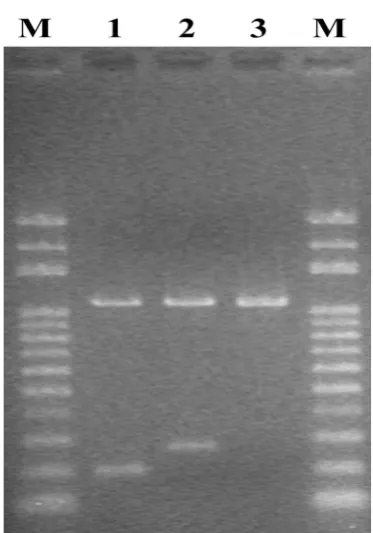
The multiplex PCR analysis identified L. garvieae, S. agalactiae, and S.
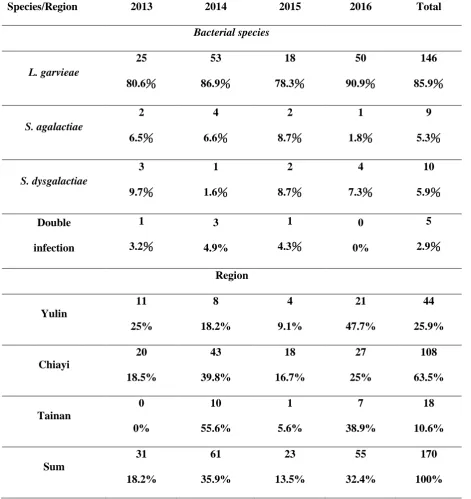
dysgalactiae, but no S. iniae detected (Figure 1). The prevalence differed among microbial species with the highest for Lactococcus garvieae (146, 85.9%), followed by Streptococcus dysgalactiae (10, 5.9%) and S. agalactiae (9, 5.3%). Additionally, five double infections were obtained for L. garvieae and S. agalactiae in one case as well as L. garvieae and S. dysgalactiae in four cases (Table 2, Figure 1). These prevalence changed by yeas ranging from 78.3% to 90.9% for L. garvieae, 1.8% - 8.7% for S. agalactiae, and 1.6% - 9.7% for S. dysgalactiae.
3.2 Different prevalence among regions and microbial species
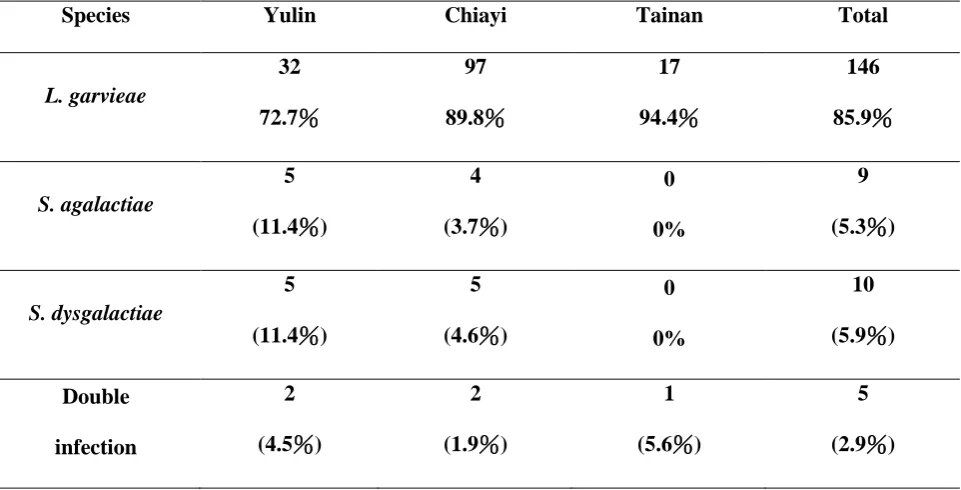
differed among three counties, ranging from 72.9% in Yulin to 94.4% in Tainan for L. garvieae, from 3.7% in Chiayi to 11.4% in Yulin for S. agalactiae, and from 4.6% in Chiayi to 11.4% in Yulin for S. dysgalactiae (Table 3).,
3.3 PFGE genotyping of L. garvieae s
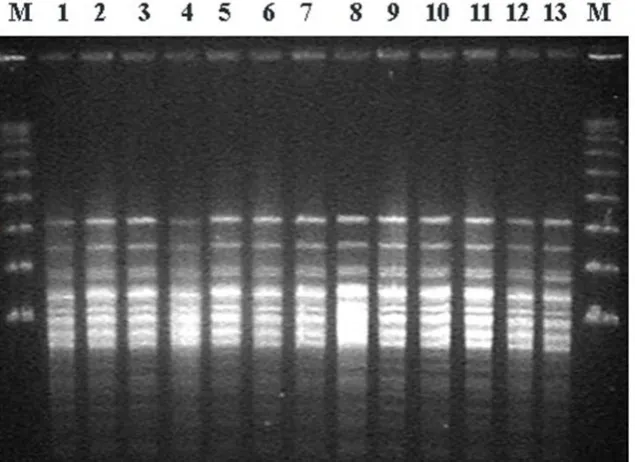
Totally 172 L. garvieae were investigated in this study. To differentiate the difference among these strains genetically, we used PFGE analysis and the restriction enzyme ApaI for genotyping. All DNA fragments were smaller than 194 kb, but all strains showed identical patterns (Figure 2), suggesting possibly that single genotype spread in these three counties. Furthermore, all strains lacked plasmid (dada not shown). 3.4Antibiotic susceptibility analysis
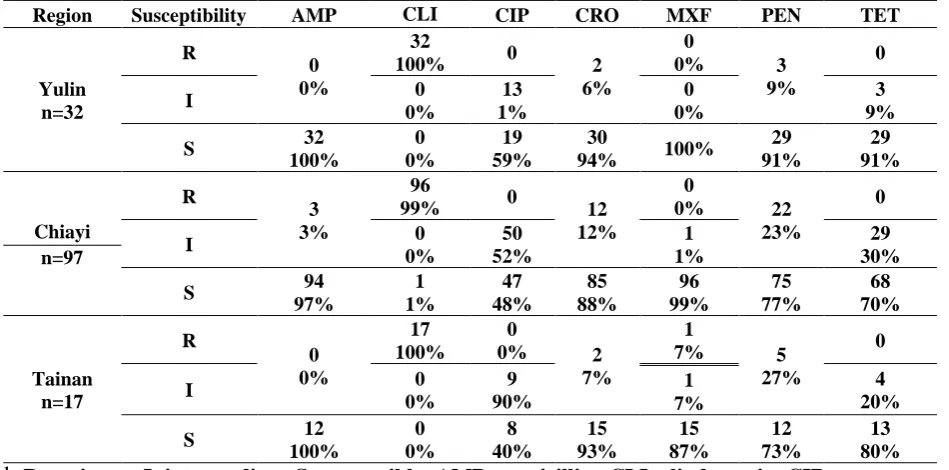
Among 13 antibiotics, 146 strains from grey mullet were susceptible to AML, AZM, ERY, DOX, OXT and LVX, but non-susceptible rate differed depending on the antibiotics tested (Table 4). Almost all strains were resistance to CLI in 2013 – 2016 with reduced susceptibility to AMP (3, 2%), CRO (16, 11%) and PEN (30, 21%) of β
-lactam group, CIP (74, 51%) and MXF (3, 2%) of fluoroquilonone group, and TET (36, 25%) of tetracycline group. The highest reduced susceptible rate was found in 2014 for CIP, CRO, MXF and TET, while the lowest reduced susceptible rate was found in 2016. Compared to the antibiotic susceptibility for the non-grey mullet, a decrease of resistant strains for CLI and an increase of resistance to AML, MXF, OXT and TET and the reduced susceptibility to AMP, CRO, and PEN were found for the non-grey mullet (Table 4). The antibiotic susceptibility of the strains from grey mullet differed among three counties with the higher non-susceptible rate was found for AMP, CIP, CRO, PEN in the strains isolated from chiayi
4. Discussion
The diseased fishes in this study exhibited corneas with a turbid, whitened, or red appearance and especially those with severe infection exhibited budging eyes on one or both sides. These symptoms were similar to the finding on rainbow trout infected with L. garvieae infection [25]. In 1997–2004, Lee et al. reported infection by Gram-positive streptococcus in 51 samples of cultured grey mullet in Taiwan [2]. Based on 16S rDNA sequence analysis, L. garvieae (45, 90%), S. agalactiae (3, 5%), and S. dysgalactiae (3, 5%), except S. iniae, Traditionally biochemical methods are used for
bacterial identification. In this study we applied multiplex PCR to identify L. garvieae, S. agalactiae, S. dysgalact iae, and
S. iniae, simultaneously [10]. We confirmed similar prevalence of the three bacterial species and no S. iniae from diseased grey mullet from 2013–2016 (Table 2). These results demonstrated no main change of the bacterial pathogens with the L. garvieae
(87%) as the primary infectious species for grey mullet. In 265 tilapia infection from 2013–2015, S. agalactiae was the major streptococcal species, followed by S. iniae,L. garvieae, and S. dysgalactiae [8,11], indicating the infection of streptococcus species is associated with fish species, maybe due to host immunity and bacterial virulence factors. Previously, L. garvieae commercialized vaccine was applied for farmedctured amberjack and Japanese amberjack for protection, however, the fishes was die by S. dysgalactiae infection [26]. In this study, occasional double infection occurred mainly in 2014 and in the Yulin and Chiayi counties (Table 2 and 3). Therefore, multivalent Gram-positive Streptococcus vaccines should be developed in the future because of multiple species infection.
Possiblythe grey mullet is more susceptible to L. garvieae infection and resistant to S. iniae infection. However, the infection may be strain dependent due to differences in the virulence factors they carry. Therefore, PFGE method has been used to distinguish the genotypic differences between strains. The restriction enzyme ApaI digested PFGE analysis could separate 82 L. garvieae strains from Spain and Italy and different animals of fish, dairy cattle, or water buffalo into 19 pulsotypes [16]. Although restriction enzymes may affect PFGE DNA pattern, restriction enzymes ApaI and SmaI for studying L. garvieae genotypes showed identical pulsotype [23]. In our study, the presence of one pulsotype implies that the L. garvieae exists commonly in the aquatic farmed grey mullet in Taiwan [Figure 2].
4.2 Antibiotic susceptibility testing
Antibiotic susceptibility to 13 tested antibiotics differed between the strains from grey mullet and non-grey mullet, such that grey mullet strains were susceptible to 6 antibiotics, including AML, DOX, ERY, LEV, LIN, and OXT; while non-grey mullet strain only susceptible to AZM, ERY, and LEV and showed more reduced susceptible strains, except for antibiotics CLI and MXF (Table 4). These results indicate possible that the antibiotics are used differently for fish species. were found in This study conducted antibiotic susceptibility testing on the primary bacterium L. garvieae in grey mullet. Thirteen types of antibiotics disks were selected. Especially, the highest reduced susceptible strains was located in Chiayi county. Therefore regional antibiotic used shall be controlled more strictly. Antibiotic use can control clinical symptoms in sick fish, while the fishes that become the carrier for these bacterial species makes this disease difficult to eradicate [32].
liver abscess [34]. These findings may serve as references for public health studies on drug resistance. Among 13 antibiotics, AMP, AML, DOX, ERY and OXY are legally used on grey mullet in Taiwan, whereas AZM, CRO, CIP, CLI, LVX, MXF, PEN, and TET are inhibited. In this study, we observed the strains with the reduced susceptibility to CRO, CIP. CLI (100%), MXF, PEN, and TET. However, the number of the reduced susceptible strains decreased from 2014 to 2016 (Table 4). Our finding demonstrate the misuse of the antibiotics for human, not for aquatic fishes. The surveillances of human antibiotic shall be conducted for farmed fishes in assistane of public health.
Acknowledgments
This research was financially supported by grants of the Council of Agriculture, Taiwan (R.O.C.)(106AS-9.9.3-BQ-B1 and 107AS-8.7.2-BQ-B1).
Author Contributions
Conceptualization, J.-H.W. and C.C. data analysis, C.-C.C and S.-Y C.; formal analysis, J.-L.L.; funding acquisition, C.-C.C. J.L.L. and J.-H.W. investigation, S.-Y. C. and J.-L.L; methodology, C.-C.C. and J.-H.W. supervision, J.-H.W. and C.C.; validation, C.C.; writing—original draft, J.-L.L. and J.-H.W.; final editing, C.C. All authors have read and agreed to the published version of the manuscript.
Conflicts of Interest
Authors declare no conflict of interest.
References
of the diseases in cultured brood grey mullet (Mugil cephalus Linnaeus) in the Yun-Chia-Nan Area of Taiwan. Taiwan Vet. J. 2001, 27, 89-93.
2. Lee, J.L.; Chu, S.Y.; Yu, Z.S.; Lee, C.Y.; Hung, C.S.; Wang, J.H.; Wu, Z.B.; Chen, S.C.; Chang, T.C.; Tsai, S.S. Identification and survey on gram-positive
Streptococcus-like organisms isolated from grey mullet(Mugil cephalus
Linnaeus. Taiwan Vet. J. 2006, 32, 136-145.
3. Miyazaki, T.; Kubota, S.S.; Kaige, N.; Miyashita, T. A histopathological study of streptococcal disease in tilapia. Fish Pathol. 1984, 19, 167-172.
4. Rasheed, V; Limsuwan, C; Plumb, J. Histopathology of bullminnows, Fundulus grandis Baird & Girard, infection with a non-haemolytic group B Streptococcus
sp. J. Fish Dis. 1985, 8, 65-74.
5. Austin, B.; Austin, D.A. Bacterial Fish Pathogens: Disease of Farmed and Wild Fish. 1999, p.4.
6. Facklam, R. What happened to the streptococci: overview of taxonomic and nomenclature changes. Clin. Microb. Rev. 2002, 15, 613–630.
7. Vendrell, D.; Balcazar, J.L.; Ruiz-Zarzuela, I.; Blas, I.; Girones, O.; Muzquiz, J.L.
Lactococcus garvieae in fish: a review. Comp. Immun. Microb. Infect. Dis. 2006, 29, 177–198.
8. Liao, P.C.; Tsai, Y.L.; Chen, Y.C.; Wang, P.C.; Liu, S.C.; Chen, S.C. Analysis of streptococcal infection and correlation with climatic factors in cultured tilapia
Oreochromis spp. in Taiwan. Appl. Sci. 2020, 10, 4018.
9. Zlotkin, A.; Eldar, A.; Ghittino, C.; Bercovier, H. Identification of Lactococcus garvieae by PCR. J. Clin. Microb. 1998, 36, 983–985.
pathogens associated with warm-water Streptococcosis in Fish. Appl. Environ. Microb. 2004, 70, 3183–3187.
11. Chu, C.; Huang, P.Y.; Chen, H.M.;Wang, Y.H.; Tsai, I.A.; Lu, C.C.; Chen, C.C. Genetic and pathogenic difference between Streptococcus agalactiae serotype Ia fish and human isolates. BMC Microb. 2016, 16, 175.
12. Costa, F.A.A.; Leal C.A.G.; Leite R.C.; Figueiredo, H.C.P. Genotyping of
Streptococcus dysgalactiae strains isolated from Nile tilapia, Oreochromis niloticus (L.). J. Fish Dis. 2014, 37, 463-469.
13. Li, L.; Wanga, R.; Liang, W.; Gan, X.; Huang, T.; Huang, Y.; Li, J.; Shi, Y.L.; Chen, M.; Luo, H.L. Rare serotype occurrence and PFGE genotypic diversity of
Streptococcus agalactiae isolated from tilapia in China. Vet. Microb. 2013, 167, 719–724.
14. Chen, M.; Li, L.P.; Wang, R.; Liang, W.W.; Huang, Y.;, Li, J.; Lei, A.Y.; Huang, W.Y.; Gan, X. PCR detection and PFGE genotype analyses of streptococcal clinical isolates from tilapia in China. Vet. Microb. 2012, 159, 526–530.
15. Haghighi, K. S.; Soltani, M.; Nikbakhat-Brojeni, G.; Ghasemi, M.; Skall, H.F. Molecular epidemiology of zoonotic streptococcosis/lactococcosis in rainbow trout (Oncorhynchus mykiss) aquaculture in Iran. Iran J. Microb. 2010, 2, 198-209. 16. Vela, A. I.;. Vazquez, J.; Gibello, A.; Blanco, M. M.; Moreno, M.A.; Liebana, P.; Albendea, C.; Alcala, B.; Mendwz, A.; Dominguez, L.; Fernandez-Garayzabal, J.F.; Phenotypic and genetic characterization of Lactococcus garvieae isolated in Spain from lactococcosis outbreaks and comparison with isolates of other countries and sources. J. Clin. Microb. 2000, 10, 3791–3795.
17. Huang, T.M.; Cheng, S.H.; Tu, C. Antimicrobial susceptibility of fish
18. Maki, T.; Hirono, I.; Kondo, H.; Aoki, T. Drug resistance mechanism of the fish-pathogenic bacterium Lactococcus garvieae. J. Fish Dis. 2008, 31, 461–468. 19. Baeck, G.W.; Kim, J.H.; Gomez, D.K.; Park, S.C. Isolation and characterization
of Streptococcus sp. from diseased flounder (Paralichthys olivaceus) in Jeju island. J. Vet. Sci. 2006, 7, 53–58.
20. Kirkan S.; Parin U. ; Dolgun O. Identification of Lactococcus garvieae by PCR from Rainbow Trout and investigation of susceptibility to antibiotics. Inter. J. Vet. Sci, 2018, 7: 28-32.
21. Hsueh, P.R.; Teng, L.J.; Lee, L.N.; HO, S.W.; Yang, P.C.; Luh, K.T. High incidence of erythromycin resistance among clinical isolates of Streptococcus agalactiae in Taiwan. Antimicrob. Agents Chemother. 2001, 11, 3205–3208. 22. Hassan, A.A.; Khan, I.U.; Lammler, C. Identification of Streptococcus
dysgalactiae strains of Lancefield’s group C, G and L by polymerase chain reaction. J. Vet. Med. B. 2003, 50, 161-165.
23. Tsai, M.A.; Wang, P.C.; Liaw, L.L.; Yoshida, T.; Chen, S.C. Comparison of genetic characteristics and pathogenicity of Lactococcus garvieae isolated from aquatic animals in Taiwan. Dis. Aquat. Org., 2012, 102, 43–51.
24. Clinical and Laboratory Standards Institute (CLSI). Performance Standards for Antimicrobial Susceptibility Testing. 2017, 27th ed, M100-S26.
25. Balta, F.; Dengiz, B.Z. The Isolation of Lactococcus garvieae from eyes of diseased rainbow trout (Oncorhynchus mykiss) with exopthalmia. J. Anatolian Env. Anim. Sci. 2019, 4, 27-33.
24, 679-686.
27. Pastorino, P.; Alonso, A.I.V.; Colussi, S.; Cavazza, G.; Menconi, V.; Mugetti, D.; Righetti, M.; Barbero, R.; Zuccaro, G.; Fernández-Garayzábal, J.F.; Dondo A.; Acutis P.L.; Prearo M. A summer mortality outbreak of Lactococcosis by
Lactococcus garvieae in a raceway system affecting farmed rainbow trout (Oncorhynchus mykiss) and brook trout (Salvelinus fontinalis). Animals. 2019, 9, 1043.
28. Meyburgh, C.M.; Bragg, R.R.; Bouche,r C.E. Lactococcus garvieae:an emerging bacterial pathogen of fish. Dis. Aquat. Org. 2017, 123, 67–79.
29. Chen, S.C.; Lin, Y.D.; Liaw, L.L.; Wang, P.C. Lactococcus garvieae infection in the giant freshwater prawn Macrobranchium rosenbergii confirmed by polymerase chain reaction and 16S rDNA sequencing. Dis. Aquat. Org. 2001, 45, 45-52.
30. Chen, S.C.; Liaw, L.L.; Su, H.Y.; Ko S.C.; Wu, C.Y., Chaung, H.C.; Tsai Y.H.; Yang. K.L.; Chen Y.C.; Chen T.H.; Lin, G.R.; Cheng, S.Y.; Lin, Y.D.; Lee, J.L.; Lai, C.C. Weng, Y.J.; Chu, S.Y. Lactococcus garvieae, a cause of disease in grey mullet Mugil cephalus L. in Taiwan. J. Fish Dis. 2002, 25, 727-732.
31. Chang, P.H.; Lin, C.W.; Lee, Y.C. Latococcus garvieae infection of cultured rainbow trout Oncorhynchus mykiss in Taiwan and associated biophysical characteristics and histopathology. Bull Eur. Assoc. Fish Pathol. 2002, 22: 319-327.
32. Shoemaker, C.A.; Klesius, PH.; Evans, J.J. Prevalence of Streptococcus iniae in tilapia, hybrid striped bass, and channel catfish on commercial fish farms in the United States. Am. J. Vet. Res. 2001, 62, 174-177.
a case and review of the literature. Diagn. Microb. Infect. Dis. 1998, 32, 127-130. 34. Mofredj, A.; Baraka D.; Cadranel J.F.; Maitre P.L.; Kloeti G.; Dumont J.L.
Figure 1. Electrophoresis of Multiplex PCR amplified PCR products. M: 100-bp size marker.
The size of represented species is 1100 bp for L. garvieae, 259 bp for S. dysgalactiae and 192 bp
for S. agalactiae. Lane 1: double infection of L. garvieae and S. agalactiae, Lane 2: double
infection of L. garvieae and S. dysgalactiae, and L3: L. garvieae.
Figure 2. PFGE analysis of ApaI-digested chromosomal DNA fragment of L. garvieae . M: λ
DNA size marker. Lane 1-13: different L. garvieae strains.
.
Table 1 . Multiplex PCR primers of pathogens used in this study.
Pathogens
Target gene
(accession No.)
Primers Sequences (5’ to 3’)
Product
Size (bp)
Reference
Lactococcus
garvieae
16S rDNA
pLG-1
pLG-2
CATAACAATGAGAATCGC
GCACCTCGCGGGTTG
1100 [10]
Streptococcus
agalactiae
16S-23S rDNA
(U39765)
Sdi-61
Sdi-252
AGGAAACCTGCCATTTGCG
CAATCTATTTCTAGATCGTGG
192 [10]
Streptococcus
dysgalactiae
16S-23S rDNA
Strd-dyl
Dys-16S-23S-2
TGGAACACGTTAGGGTCG
CTTAACTAGAAAACTCTTGAT
TATTC
259 [22]
Streptococcus
iniae
LacO gene
(Y07622)
LOX-1
LOX-2
AAGGGGAAATCGCAAGTGCC
ATATCTGATTGGGCCGTCTAA
PCR between 2013-2016 in Taiwan.
Species/Region 2013 2014 2015 2016 Total
Taiwan.
Species Yulin Chiayi Tainan Total
L. garvieae
32
72.7%
97
89.8%
17
94.4%
146
85.9%
S. agalactiae
5
(11.4%)
4
(3.7%)
0
0%
9
(5.3%)
S. dysgalactiae
5
(11.4%)
5
(4.6%)
0
0%
10
(5.9%)
Double
infection
2
(4.5%)
2
(1.9%)
1
(5.6%)
5
Year Susceptibility1 AMP AML CLI CIP CRO DOX MXF PEN OXT TET
Strains from grey mullet
2013
n=25
R
1 0 24 0 1 0 0 0 0 0
I 0 0 15 0 0 6
S 24 25 1 10 24 25 25 25 25 19
2014
n=53
R
1 0 53 0 12 0 1 23 0 0
I 0 0 38 0 2 0 22
S 52 53 0 15 41 53 50 30 53 31
2015
n=18
R
1 0 18 0 3 0 0 6 0 0
I 0 0 15 0 0 8
S 17 18 0 3 15 18 18 12 18 10
2016
n=50
R
0 0 50 0 0 0 0 1 0
0
0
I 0 0 6 0 0
S 50 50 0 44 50 50 50 49 50 50
Total n=146 R 3 2% 0 0% 145 99% 0
0% 16
11%
0
0% 1
0.7% 30
21%
0
0% 0
I 0 0% 0 0% 74 51% 0 0% 2 1.4% 0 0% 36 25% S 143 98% 50 100% 1 1% 72 49% 130 89% 50 100% 143 98% 116 79% 50 100% 110 75%
Strains from other fish species
Non-grey
Mullet
n = 30
R 9 30% 7 23% 22 73% 0
0% 8
27% 0
0% 0
0% 13
43% 2
7%
2
7%
I 0
0% 0 0% 9 30% 1 3% 0
0% 0 0
S 21 70% 23 77% 8 27% 21 70% 22 73% 29 97% 30 100% 17 57% 28
(93%)
28
(93%)
1: R: resistant, I: intermediate, S: susceptible; AMP: ampicillin, AML: amoxicillin, CLI: clindamycin,
CIP: ciprofloxacin, CRO: ceftriaxone, DOX: doxycycline, MXF: moxifloxacin, OXT: oxytetracycline,
Region Susceptibility AMP CLI CIP CRO MXF PEN TET Yulin n=32 R 0 0% 32
100% 0 2
6%
0
0% 3
9%
0
I 0
0% 13 1% 0 0% 3 9%
S 32
100% 0 0% 19 59% 30
94% 100%
29 91% 29 91% Chiayi n=97 R 3 3% 96
99% 0 12
12%
0
0% 22
23%
0
I 0
0% 50 52% 1 1% 29 30%
S 94
97% 1 1% 47 48% 85 88% 96 99% 75 77% 68 70% Tainan n=17 R 0 0% 17 100% 0
0% 2
7%
1
7% 5
27%
0
I 0
0% 9 90% 1 7% 4 20%
S 12
100% 0 0% 8 40% 15 93% 15 87% 12 73% 13 80% 1: R: resistant, I: intermediate, S: susceptible; AMP: ampicillin, CLI: clindamycin, CIP: