www.hydrol-earth-syst-sci.net/20/1405/2016/ doi:10.5194/hess-20-1405-2016
© Author(s) 2016. CC Attribution 3.0 License.
Technical note: Application of artificial neural networks
in groundwater table forecasting – a case study in a
Singapore swamp forest
Yabin Sun1, Dadiyorto Wendi1, Dong Eon Kim1, and Shie-Yui Liong1,2,3 1Tropical Marine Science Institute, National University of Singapore, Singapore 2Willis Research Network, Willis Re Inc., London, UK
3Center for Environmental Modeling and Sensing, SMART, Singapore
Correspondence to: Yabin Sun ([email protected])
Received: 9 July 2015 – Published in Hydrol. Earth Syst. Sci. Discuss.: 10 September 2015 Revised: 19 March 2016 – Accepted: 23 March 2016 – Published: 14 April 2016
Abstract. Accurate prediction of groundwater table is im-portant for the efficient management of groundwater re-sources. Despite being the most widely used tools for de-picting the hydrological regime, numerical models suffer from formidable constraints, such as extensive data demand-ing, high computational cost, and inevitable parameter un-certainty. Artificial neural networks (ANNs), in contrast, can make predictions on the basis of more easily accessible vari-ables, rather than requiring explicit characterization of the physical systems and prior knowledge of the physical param-eters. This study applies ANN to predict the groundwater ta-ble in a freshwater swamp forest of Singapore. The inputs to the network are solely the surrounding reservoir levels and rainfall. The results reveal that ANN is able to produce an accurate forecast with a leading time of 1 day, whereas the performance decreases when leading time increases to 3 and 7 days.
1 Introduction
Physical-based numerical models are widely used in ground-water table simulation. Different numerical models have been developed for different regions with different objec-tives, such as to describe regional groundwater flow patterns, and to understand local hydrological processes. (e.g. Matej et al., 2007; Pool et al., 2011; Yao et al., 2015). Numerical mod-els solve the deterministic equations to simulate the ground-water systems based on the knowledge of the system
charac-teristics, initial conditions, system forcings, etc. To develop a groundwater numerical model, essential data include: to-pography, geological coverage, soil properties, land use map, vegetation distribution, evapotranspiration information, hy-drologic and climatic data, etc. Extensive data demanding makes numerical models highly data dependent and data sen-sitive. Fitting a physical model is not possible when data are not sufficient; the accuracy of the numerical model to a great extent depends on how accurate the model inputs are. Nu-merical models are also less competent in forecasting as most of the system forcings (e.g. evapotranspiration, rainfall) are less predictable. As a result of aforementioned constraints, numerical models tend to produce imperfect results in spite of the perfect knowledge of the governing laws (Sun et al., 2010).
mod-1406 Y. Sun et al.: Technical note: Application of artificial neural networks
elling, ANNs are capable of simulating the nonlinear dynam-ics of the hydrological processes and hence result in superior modelling and forecasting performance.
ANNs in recent years have also been successfully applied in groundwater table modelling. Yang et al. (1997) utilized ANN to predict groundwater table variations in subsurface-drained farmland. Coulibaly et al. (2001) calibrated three different ANN models using groundwater recordings and other hydrometeorological data to simulate groundwater ta-ble fluctuations. Lallahem et al. (2005) showed the feasibility of using ANN to estimate groundwater level in an uncon-fined chalky aquifer. Daliakopoulous et al. (2005) examined the performance of different ANN architectures and train-ing algorithms in groundwater table forecasttrain-ing. Taormina et al. (2012) developed a two-step ANN model to simulate the groundwater fluctuations in a coastal aquifer using past observed groundwater levels and external inputs, i.e. evap-otranspiration and rainfall. Most of above studies, however, focus on applying ANN in large-scale semiarid or arid wa-tersheds, where groundwater table is less variable and long-term groundwater table variation (e.g. monthly, annually) is of more concern. In addition, these studies use historical groundwater tables as inputs to the network, requiring con-tinuously long groundwater table recordings which can be a luxury for many regions.
This study, for the first time, applies ANN to forecast the groundwater table in a tropical wetland – the Nee Soon Swamp Forest (NSSF) in Singapore. Being nourished with water supply from reservoirs and precipitation, the ground-water table in the NSSF is close to the ground level and ex-tremely sensitive to the changes in hydrometeorological con-ditions. This study selects surrounding reservoir levels and rainfall as inputs to the network, avoiding the requirement on continuously long groundwater table recordings. The fore-cast is made with 3 leading times, i.e. 1 day, 3 days, and 7 days, which provide sufficient reaction time for human inter-vention to maintain favourable hydrological conditions for conserving local ecosystems. The methodology, application, results, and conclusions are elaborated in the following sec-tions.
2 Methodology 2.1 Overview
As defined by Haykin (1999), artificial neural networks (ANNs) are massively parallel distributed processors made up of simple processing units, known as neurons, which have a natural propensity for storing experiential knowledge and making it available for use. ANNs are inspired by biological neural networks to emulate the way in which human brains function. The fact that neurons can be interconnected in nu-merous ways results in nunu-merous possible topologies that can be divided into two basic classes, i.e. feedforward neural
net-works (FNNs) and recurrent neural netnet-works (RNNs; Graves et al., 2009). In FNNs information flows from inputs to out-puts in only one direction, whereas in RNNs some of the information can flow not only in one direction from inputs to outputs but also in the opposite direction.
There are many algorithms for training neural network models, most of which employ some form of gradient de-scent using backpropagation to compute the actual gradients (Werbos, 1974). The backpropagation algorithm is imple-mented by taking the derivatives of the cost function with re-spect to the synaptic weights and then changing the weights in a gradient-related direction (Sexton and Dorsey, 2000; Mandischer, 2002).
This study opts for a standard FNN and a quasi-Newton training algorithm, more specifically a multilayer perceptron (MLP) trained with the Levenberg–Marquardt (LM) algo-rithm, attributing to its superior accuracy in groundwater ta-ble forecasting (Daliakopoulous et al., 2005).
2.2 Multilayer perceptron
Multilayer perceptron (MLP) was developed for pattern clas-sification by Rosenblatt (1958). The architecture of a typical MLP consists of an input layer, one hidden layer and an out-put layer. In mathematical terms, a comout-putational neuron in the hidden or output layers can be described by following pair of equations:
u= n
X
i=1
wixi (1)
and
y=ϕ(u+b), (2)
wherex1,x2, . . . ,xnare the input signals to the neuron,w1, w2, . . . ,wnare the synaptic weights,uis the linear combiner of the input signals,b is the bias, andy is the output signal of the neuron, whereasφ (·)is the activation function to limit the amplitude of the output signal and to create a mapping between the input and output signals.
The universal approximation theorem states that every continuous function defined on a closed and bounded set can be approximated arbitrarily closely by an MLP provided that the number of neurons in the hidden layers is sufficiently high and that their activation functions belong to a restricted class of functions with particular properties (Hornik et al., 1989).
2.3 Levenberg–Marquardt algorithm
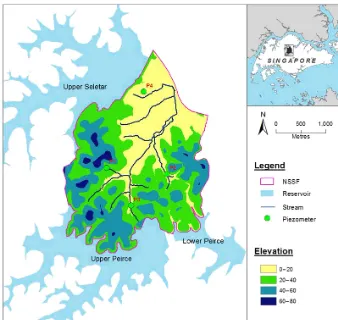
Figure 1. Geographical location of the Nee Soon Swamp Forest in Singapore.
be presented as follows:
wk=wk−
JTkJk+µkI
−1
Jkek, (3)
wherekis the iteration index, J is the Jacobian matrix,µis the combination coefficient, I is the identity matrix, andeis the error vector.
The LM algorithm essentially blends the steepest descent method and the Gauss–Newton algorithm. The optimization process is guided by the combination coefficientµ. Around the error surface with complex curvature, the LM algorithm switches to the steepest descent algorithm with a bigger µ, whereas if the local curvature is appropriate to make a quadratic approximation,µcan be decreased, giving the LM algorithm a step closer to the Gauss–Newton algorithm. The LM algorithm is faster, more stable, and less easily trapped in local minima than other algorithms (Toth et al., 2000).
3 Application 3.1 Study case
Figure 1 shows the geographical location of the study area – the Nee Soon Swamp Forecast (NSSF) in Singapore. The
NSSF is located in the northern part of the Singapore central catchment nature reserve bounded by the Upper Seletar, Up-per Peirce, and Lower Peirce reservoirs. As the only substan-tial freshwater swamp forest remaining on the main island of Singapore, the NSSF houses a diversity of flora and fauna, some of which are found nowhere else in Singapore or the world (Karunasingha et al., 2013).
With an estimated area of about 750 ha, the NSSF covers the lower area of shallow valleys with slow-flowing streams and a few higher grounds with dryland forests. The eleva-tion of NSSF ranges between 1 and 80 m above mean sea level (a.m.s.l.). The aquifer depth in the NSSF is 20–40 m, and the major soil type features silty sand with a hydraulic conductivity of 4.05×10⁻⁵m s−1. Figure 1 also depicts the locations of the 4 piezometers installed for groundwater table monitoring. The piezometers are deployed near the streams, where the observed groundwater tables vary 0–1 m below the ground level.
3.2 ANN setup
1408 Y. Sun et al.: Technical note: Application of artificial neural networks
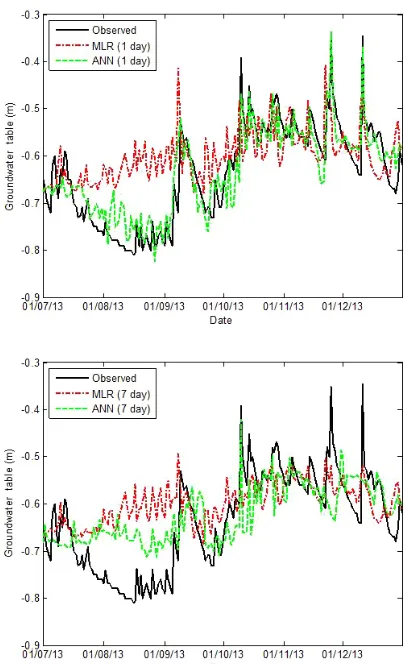
Figure 2. Observed vs. MLR- and ANN-forecasted groundwater tables (P1).
has a typical tropical rainforest climate with abundant rain-fall; the annual rainfall at the NSSF region can be as high as 3000 mm. Despite being another important influential factor for the groundwater, observed evapotranspiration is not avail-able due to the constraints imposed from setting up monitor-ing stations in the protected forest, and hence it is excluded in the ANN setup. Reservoir levels and rainfall, as the ma-jor water source and driving force, are fed to the networks as inputs, while the output is the observed groundwater tables with a leading time of 1, 3, and 7 days (i.e. future observed groundwater tables after 1, 3, and 7 days).
A multiple-input multiple-output (MIMO) network is se-lected over 4 multiple-input single-output (MISO) ANNs for two reasons: (1) it is easier to implement; and (2) cross cor-relation exists in the observed groundwater tables, e.g. the synchronous response to dry and wet conditions; targeting the groundwater table measurements at 4 locations simulta-neously, the cross-correlation impact can be captured in the synaptic weights of the trained ANN and hence a better per-formance is expected. The MIMO network is composed of an input layer with 4 input neurons (including 3 reservoir levels and one rainfall), a hidden layer with 10 neurons (inspired by the universal approximation theorem and determined by
trial and error), and an output layer with 4 output neurons (future observed groundwater tables at the 4 piezometers). The logistic function and threshold function are respectively adopted as the activation functions for the hidden layer and the output layer.
Daily observed data, i.e. reservoir levels, rainfall and groundwater tables, are available in 2012 and 2013. The data set is divided into three subsets as follows:
– Training data (January 2012–December 2012)
Training data are used for adjusting the synaptic weights in the network. An entire year’s data are selected as the training data, so as to expose the network to a complete annual cycle for a robust training.
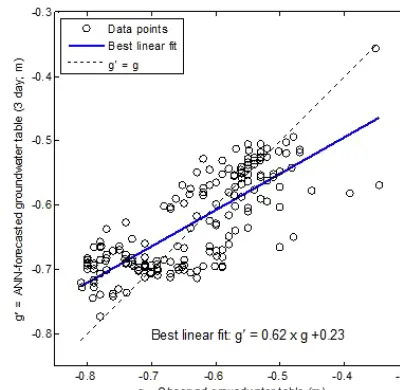
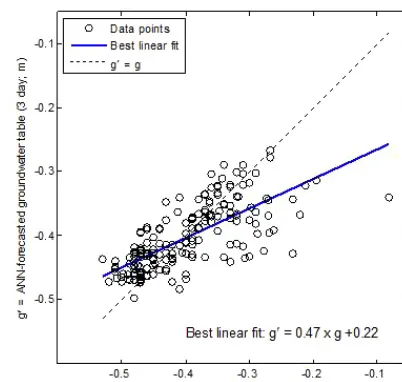
Figure 3. Scatter plots of observed and ANN-forecasted groundwater tables (P1).
– Testing data (July 2013–December 2013)
Testing data are used for evaluating the performance of the network. Once the network is trained, the weights are frozen; the testing set is fed into the network and the network output is then compared with the desired output. The remaining half of a year’s data are selected as the testing data.
4 Results and discussion
Figure 2 illustrates examples at P1 of the observed ground-water tables, the forecasted groundground-water tables from a multi-ple linear regression (MLR) model and the ANN model. Due to the complicated geological characteristics and
[image:5.612.84.291.62.487.2] [image:5.612.307.507.65.260.2]Au-1410 Y. Sun et al.: Technical note: Application of artificial neural networks
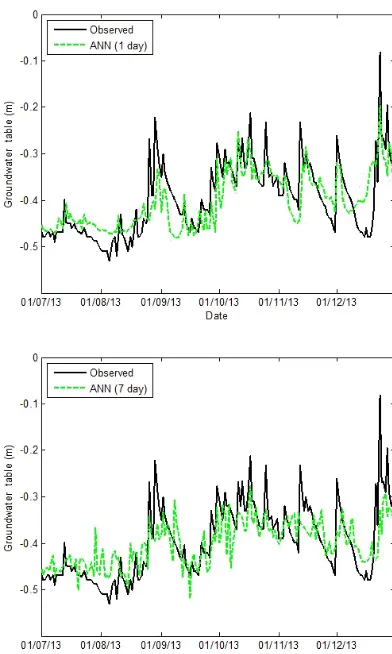
[image:6.612.310.509.68.221.2]Figure 4. Observed vs. ANN-forecasted groundwater tables (P4).
Table 1. Evaluation statistics of the ANN forecast.
P1 P2 P3 P4
RMSE r RMSE r RMSE r RMSE r
(cm) (cm) (cm) (cm)
1 day 5.4 0.88 6.4 0.78 5.2 0.77 12.2 0.69 3 day 8.2 0.76 7.1 0.76 6.6 0.71 13.3 0.68 7 day 9.9 0.64 9.2 0.72 8.6 0.67 15.8 0.65 Average 7.8 0.76 7.6 0.75 6.8 0.72 13.8 0.67
gust 2013, caused by a continuous 2-month drought. As such an extreme drought condition does not exist in the training data, the ANN tends to overpredict the groundwater tables for that period.
Figures 4 and 5, respectively, present the groundwater ta-ble time series and scatter plots at P4. P4 is located near the Upper Seletar Reservoir, and the groundwater table is af-fected by the spillway discharge released from the reservoir. Failing to include the spillway information makes the ANN less competent in capturing the groundwater table extreme values caused by the spillway discharge, and hence results in the lower forecast accuracy at P4.
Figure 5. Scatter plots of observed and ANN-forecasted groundwater tables (P4).
5 Conclusions
This study, for the first time, applies artificial neural networks (ANNs) to predict the groundwater table variations in a trop-ical wetland – the Nee Soon Swamp Forest (NSSF) in Sin-gapore. The ANN model solely utilizes the easily accessi-ble surrounding reservoir levels and rainfall as inputs to fore-cast the groundwater tables, without requiring any other prior knowledge of the system’s physical properties. The ANN forecast shows generally promising accuracy, while its per-formance decreases when the leading time progresses due to the fading correlation between the network inputs and out-puts.
In this study, surrounding reservoir levels and rainfall are selected as ANN inputs. The limited number of inputs elimi-nates the data-demanding restrictions inherent in the
1412 Y. Sun et al.: Technical note: Application of artificial neural networks
Acknowledgements. This study forms part of the research project
“Nee Soon Swamp Forest Biodiversity and Hydrology Baseline Studies – Phase 2” funded by National Parks Board (NParks), Singapore. The authors are also grateful for the data support from Public Utilities Board (PUB), Singapore for making this study possible.
Edited by: D. Solomatine
References
Coulibaly, P., Anctil, F., Aravena, R., and Bobee, B.: Artificial neu-ral network modeling of water table depth fluctuations, Water Resour. Res., 37, 885–896, 2001.
Daliakopoulosa, I. N., Coulibaly, P., and Tsanis, I. K.: Groundwater level forecasting using artificial neural networks, J. Hydrol., 309, 229–240, 2005.
French, M. N., Krajewski, W. F., and Cuykendall, R. R.: Rainfall forecasting in space and time using a neural network, J. Hydrol., 137, 1–31, 1992.
Graves, A., Liwicki, M., Fernández, S., Bertolami, R., Bunke, H., and Schmidhuber, J.: A novel connectionist system for uncon-strained handwriting recognition, IEEE T. Pattern Anal., 31, 855–868, 2009.
Haykin, S.: Neural Networks: A Comprehensive Foundation, Pren-tice Hall, New Jersey, 1999.
Hornik, K., Stinchcombe, M., and White, M.: Multilayer feedfor-ward networks are universal approximators, Neural Networks 2, 359–366, 1989.
Karunasingha, D. S. K., Chui, T. F. M., and Liong, S. Y.: An ap-proach for modelling the effects of changes in hydrological envi-ronmental variables on tropical primary forest vegetation, J. Hy-drol., 505, 102–112, 2013.
Lallahem, S., Mania, J., Hani, A., and Najjar, Y.: On the use of neu-ral networks to evaluate groundwater levels in fractured media, J. Hydrol., 307, 92–111, 2005.
Levenberg, K.: A method for the solution of certain problems in least squares, Q. Appl. Math., 5, 164–168, 1944.
Maier, H. R. and Dandy, G. C.: Neural networks for the prediction and forecasting of water resources variables: a review of mod-eling issues and applications, Environ. Modell. Softw., 15, 101– 124, 2000.
Mandischer, M.: A comparison of evolution strategies and back-propagation for neural network training, Neurocomputing, 42, 87–117, 2002.
Marquardt, D.: An algorithm for least-squares estimation of nonlin-ear parameters, SIAM J. Appl. Math., 11, 431–441, 1963. Matej, G., Isabelle, W., and Jan, M.: Regional groundwater model
of north-east Belgium, J. Hydrol., 335, 133–139, 2007. Pool, D. R., Blasch, K. W., Callegary, J. B., Leake, S. A.,
and Graser, L. F.: Regional Groundwater-Flow Model of the Redwall-Muav, Coconino, and Alluvial Basin Aquifer Systems of Northern and Central Arizona: USGS Scientific Investigation Report 2010-5180, v. 1.1, 101, 2011.
Rosenblatt, F.: The perceptron: a probabilistic model for informa-tion storage and organizainforma-tion in the brain, Psychol. Rev., 65, 386– 408, 1958.
Sexton, R. S. and Dorsey, E. D.: Reliable classification using neural networks: a Genetic Algorithm and backpropagation compari-son, Decis. Support Syst., 30, 11–22, 2000.
Sun, Y., Babovic, V., and Chan, E. S.: Multi-step-ahead model er-ror prediction using time-delay neural networks combined with chaos theory, J. Hydrol., 395, 109–116, 2010.
Taormina, R., Chau, K.-W., and Sethi, R.: Artificial neural network simulation of hourly groundwater levels in a coastal aquifer sys-tem of the Venice lagoon, Eng. Appl. Artif. Intel., 25, 1670– 1676, 2012.
Toth, E., Brath, A., and Montanari, A.: Comparison of short-term rainfall prediction models for real-time flood forecasting, J. Hy-drol., 239, 132–147, 2000.
Werbos, P. J.: Beyond Regression: New Tools for Prediction and Analysis in the Behavioral Sciences, PhD Thesis, Harvard Uni-versity, Cambridge, MA, 1974.