Parser Evaluation across Frameworks without Format Conversion
Wai Lok Tam
Interfaculty Initiative in Information Studies University of Tokyo 7-3-1 Hongo Bunkyo-ku
Tokyo 113-0033 Japan
Yo Sato
Dept of Computer Science Queen Mary University of London
Mile End Road London E1 4NS, U.K.
Yusuke Miyao
Dept of Computer Science University of Tokyo 7-3-1 Hongo Bunkyo-ku
Tokyo 113-0033 Japan
Jun-ichi Tsujii
Abstract
In the area of parser evaluation, formats like GR and SD which are based on dependencies, the simplest representation of syntactic information, are proposed as framework-independent metrics for parser evaluation. The assumption behind these proposals is that the simplicity of depen-dencies would make conversion from syn-tactic structures and semantic representa-tions used in other formalisms to GR/SD a easy job. But (Miyao et al., 2007) reports that even conversion between these two formats is not easy at all. Not to mention that the 80% success rate of conversion is not meaningful for parsers that boast
90% accuracy. In this paper, we make an attempt at evaluation across frame-works without format conversion. This is achieved by generating a list of names of phenomena with each parse. These names of phenomena are matched against the phenomena given in the gold stan-dard. The number of matches found is used for evaluating the parser that produces the parses. The evaluation method is more ef-fective than evaluation methods which in-volve format conversion because the gen-eration of names of phenomena from the output of a parser loaded is done by a rec-ognizer that has a 100% success rate of recognizing a phenomenon illustrated by a sentence. The success rate is made pos-sible by the reuse of native codes: codes
c
°2008. Licensed under the Creative Commons
Attribution-Noncommercial-Share Alike 3.0 Unported
li-cense (http://creativecommons.org/licenses/by-nc-sa/3.0/). Some rights reserved.
used for writing the parser and rules of the grammar loaded into the parser.
1 Introduction
The traditional evaluation method for a deep parser is to test it against a list of sentences, each of which is paired with a yes or no. The parser is evaluated on the number of grammatical sentences it accepts and that of ungrammatical sentences it rules out. A problem with this approach to evaluation is that it neither penalizes a parser for getting an analy-sis wrong for a sentence nor rewards it for getting it right. What prevents the NLP community from working out a universally applicable reward and penalty scheme is the absence of a gold standard that can be used across frameworks. The correct-ness of an analysis produced by a parser can only be judged by matching it to the analysis produced by linguists in syntactic structures and semantic representations created specifically for the frame-work on which the grammar is based. A match or a mismatch between analyses produced by differ-ent parsers based on differdiffer-ent frameworks does not lend itself for a meaningful comparison that leads to a fair evaluation of the parsers. To evaluate two parsers across frameworks, two kinds of methods suggest themselves:
1. Converting an analysis given in a certain for-mat native to one framework to another na-tive to a differernt framework (e.g. converting from a CCG (Steedman, 2000) derivation tree to an HPSG (Pollard and Sag, 1994) phrase structure tree with AVM)
2. Converting analyses given in different framework-specific formats to some simpler format proposed as a framework-independent evaluation schema (e.g. converting from
HPSG phrase structure tree with AVM to GR (Briscoe et al., 2006))
However, the feasibility of either solution is questionable. Even conversion between two eval-uation schemata which make use of the simplest representation of syntactic information in the form of dependencies is reported to be problematic by (Miyao et al., 2007).
In this paper, therefore, we propose a different method of parser evaluation that makes no attempt at any conversion of syntactic structures and se-mantic representations. We remove the need for such conversion by abstracting away from com-parison of syntactic structures and semantic rep-resentations. The basic idea is to generate a list of names of phenomena with each parse. These names of phenomena are matched against the phe-nomena given in the gold standard for the same sentence. The number of matches found is used for evaluating the parser that produces the parse.
2 Research Problem
Grammar formalisms differ in many aspects. In syntax, they differ in POS label assignment, phrase structure (if any), syntactic head assignment (if any) and so on, while in semantics, they differ from each other in semantic head assignment, role assignment, number of arguments taken by pred-icates, etc. Finding a common denominator be-tween grammar formalisms in full and complex representation of syntactic information and seman-tic information has been generally considered by the NLP community to be an unrealistic task, al-though some serious attempts have been made re-cently to offer simpler representation of syntactic information (Briscoe et al., 2006; de Marneffe et al., 2006).
Briscoe et al (2006)’s Grammatical Rela-tion (GR) scheme is proposed as a framework-independent metric for parsing accuracy. The promise of GR lies actually in its dependence on a framework that makes use of simple representa-tion of syntactic informarepresenta-tion. The assumprepresenta-tion be-hind the usefulness of GR for evaluating the out-put of parsers is that most conflicts between gram-mar formalisms would be removed by discarding less useful information carried by complex syn-tactic or semantic representations used in gram-mar formalisms during conversion to GRs. But is this assumption true? The answer is not clear. A GR represents syntactic information in the form
of a binary relation between a token assigned as the head of the relation and other tokens assigned as its dependents. Notice however that grammar frameworks considerably disagree in the way they assign heads and non-heads. This would raise the doubt that, no matter how much information is re-moved, there could still remain disagreements be-tween grammar formalisms in what is left.
The simplicity of GR, or other dependency-based metrics, may give the impression that con-version from a more complex representation into it is easier than conversion between two complex representations. In other words, GRs or a sim-ilar dependency relation looks like a promising candidate for lingua franca of grammar frame-works. However the experiment results given by Miyao et al (2007) show that even conversion into GRs of predicate-argument structures, which is not much more complex than GRs, is not a trivial task. Miyao et al (2007) manage to convert 80% of the predicate-argument structures outputted by their deep parser, ENJU, to GRs correctly. However the parser, with an over 90% accuracy, is too good for the 80% conversion rate. The lesson here is that simplicity of a representation is a different thing from simplicity in converting into that representa-tion.
3 Outline of our Solution
The problem of finding a common denominator for grammar formalisms and the problem of conver-sion to a common denominator may be best ad-dressed by evaluating parsers without making any attempt to find a common denominator or conduct any conversion. Let us describe briefly in this sec-tion how such evaluasec-tion can be realised.
3.1 Creating the Gold Standard
The first step of our evaluation method is to con-struct or find a number of sentences and get an an-notator to mark each sentence for the phenomena illustrated by each sentence. After annotating all the sentences in a test suite, we get a list of pairs, whose first element is a sentence ID and second is again a list, one of the corresponding phenomena. This list of pairs is our gold standard. To illustrate, suppose we only get sentence 1 and sentence 2 in our test suite.
(1) John gives a flower to Mary
Sentence 1 is assigned the phenomena: proper noun, unshifted ditransitive, preposition. Sentence 2 is assigned the phenomena: proper noun, dative-shifted ditransitive. Our gold standard is thus the following list of pairs:
h1,hproper noun, unshifted ditransitive, prepositioni i,
h2,hproper noun,dative-shifted ditransitivei i
3.2 Phenomena Recognition
The second step of our evaluation method requires a small program that recognises what phenomena are illustrated by an input sentence taken from the test suite based on the output resulted from pars-ing the sentence. The recogniser provides a set of conditions that assign names of phenomena to an output, based on which the output is matched with some framework-specific regular expressions. It looks for hints like the rule being applied at a node, the POS label being assigned to a node, the phrase structure and the role assigned to a refer-ence marker. The names of phenomena assigned to a sentence are stored in a list. The list of phe-nomena forms a pair with the ID of the sentence, and running the recogniser on multiple outputs ob-tained by batch parsing (with the parser to be eval-uated) will produce a list of such pairs, in exactly the same format as our gold standard. Let us illus-trate this with a parser that:
1. assigns a monotransitive verb analysis to ‘give’ and an adjunct analysis to ‘to Mary’ in 1
2. assigns a ditransitive verb analysis to ‘give’ in 2
The list of pairs we obtain from running the recogniser on the results produced by batch pars-ing the test suite with the parser to be evaluated is the following:
h1,hproper noun,monotransitive,preposition,adjunctii,
h2,hproper noun,dative-shifted ditransitivei i
3.3 Performance Measure Calculation
Comparing the two list of pairs generated from the previous steps, we can calculate the precision and recall of a parser using the following formulae:
P recision= (
n X
i=1
|Ri∩Ai|
|Ri| )÷n (1)
Recall= (Xn
i=1
|Ri∩Ai|
|Ai| )÷n (2)
where listRiis the list generated by the recogniser for sentencei, listAiis the list produced by anno-tators for sentencei, andnthe number of sentences in the test suite.
In our example, the parser that does a good job with dative-shifted ditransitives but does a poor job with unshifted ditranstives would have a precision of:
(24 +22)÷2 = 0.75
and a recall of:
(23 +22)÷2 = 0.83
4 Refining our Solution
In order for the precision and recall given above to be a fair measure, it is necessary for both the recog-niser and the annotators to produce an exhaustive list of the phenomena illustrated by a sentence.
But we foresee that annotation errors are likely to be a problem of exhaustive annotation, as is re-ported in Miyao et al (2007) for the gold standard described in Briscoe et al (2006). Exhaustive an-notation procedures require annotators to repeat-edly parse a sentence in search for a number of phenomena, which is not the way language is nor-mally processed by humans. Forcing annotators to do this, particularly for a long and complex sen-tence, is a probable reason for the annotation er-rors in the gold standard described in (Briscoe et al., 2006).
dative-shifted ditransitive. This revision of anno-tation policy removes the need for exhaustive an-notation. Instead, annotators are given a new task. They are asked to assign to each sentence the most
common error that a parser is likely to make. Thus
Sentence 1 would be assigned adjunct for such an error. Sentence 2 would be assigned the error of noun-noun compound. Note that these errors are also names of phenomena.
This change in annotation policy calls for a change in the calculation of precision and recall. We leave the recogniser as it is, i.e. to produce an exhaustive list of phenomena, since it is far beyond our remit to render it intelligent enough to select a single, intended, phenomenon. Therefore, an in-correctly low precision would result from a mis-match between the exhaustive list generated by the recogniser and the singleton list produced by an-notators for a sentence. For example, suppose we only have sentence 2 in our test suite and the parser correctly analyses the sentence. Our recogniser as-signs two phenomena (proper noun, dative-shifted ditransitive) to this sentence as before. This would result in a precision of 0.5.
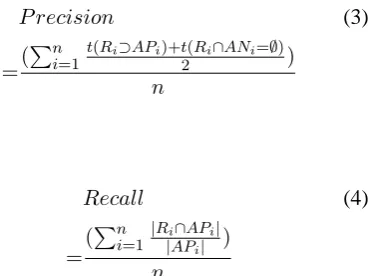
Thus we need to revise our definition of preci-sion, but before we give our new definition, let us define a truth functiont:
t(A⊃B) =
½
1 A ⊃B
0 A∩B =∅
t(A∩B=∅) =
½
0 A∩B 6=∅ 1 A∩B =∅
Now, our new definition of precision and recall is as follows:
P recision (3)
=(
Pn
i=1 t(Ri⊃APi)+t2(Ri∩ANi=∅))
n
Recall (4)
=(
Pn
i=1 |R|iAP∩APi|i|) n
where listAPi is the list of phenomena produced by annotators for sentencei, and listANiis the list of errors produced by annotators for sentencei.
While the change in the definition of recall is trivial, the new definition of precision requires some explanation. The exhaustive list of phenom-ena generated by our recogniser for each sentence is taken as a combination of two answers to two questions on the two lists produced by annotators for each sentence. The correct answer to the ques-tion on the one-item-list of phenomenon produced by annotators for a sentence is a superset-subset re-lation between the list generated by our recogniser and the one-item-list of phenomenon produced by annotators. The correct answer to the question on the one-item-list of error produced by annotators for a sentence is the non-existence of any common member between the list generated by our recog-niser and the one-item-list of error produced by an-notators.
To illustrate, let us try a parser that does a good job with dative-shifted ditransitives but does a poor job with unshifted ditranstives on both 2 and 1. The precision of such a parser would be:
(02 +22)÷2 = 0.5
and its recall would be:
(01 +11)÷2 = 0.5
5 Experiment
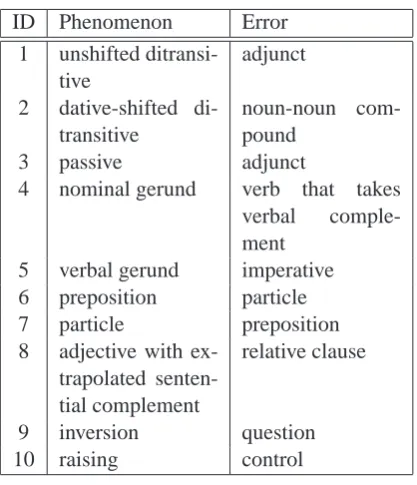
For this abstract, we evaluate ENJU (Miyao, 2006), a released deep parser based on the HPSG formalism and a parser based on the Dynamic Syn-tax formalism (Kempson et al., 2001) under devel-opment against the gold standard given in table 1.
[image:4.595.107.297.586.724.2]The precision and recall of the two parsers (ENJU and DSPD, which stands for ”Dynamic Syntax Parser under Development”) are given in table 3:
ID Phenomenon Error
1 unshifted
ditransi-tive
adjunct
2 dative-shifted
di-transitive
noun-noun
com-pound
3 passive adjunct
4 nominal gerund verb that takes
verbal
comple-ment
5 verbal gerund imperative
6 preposition particle
7 particle preposition
8 adjective with
ex-trapolated senten-tial complement
relative clause
9 inversion question
[image:5.595.72.281.100.343.2]10 raising control
Figure 1: Gold Standard for Parser Evaluation
ID Sentence
1 John gives a flower to Mary
2 John give Mary a flower
3 John is dumped by Mary
4 Your walking me pleases me
5 Abandoning children increased
6 He talks to Mary
7 John makes up the story
8 It is obvious that John is a fool
9 Hardly does anyone know Mary
[image:5.595.71.250.428.584.2]10 John continues to please Mary
Figure 2: Sentences Used in the Gold Standard
Measure ENJU DSPD
Precision 0.8 0.7
Recall 0.7 0.5
Figure 3: Performance of Two Parsers
6 Discussion
6.1 Recognition Rate
The 100% success rate is not as surprising as it may look. We made use of two recognisers, one for each parser. Each of them is written by the one of us who is somehow involved in the devel-opment of the parser whose output is being recog-nised and familiar with the formalism on which the output is based. This is a clear advantage to for-mat conversion used in other evaluation methods, which is usually done by someone familiar with ei-ther the source or the target of conversion, but not both, as such a recogniser only requires knowledge of one formalism and one parser. For someone who is involved in the development of the gram-mar and of the parser that runs it, it is straight-forward to write a recogniser that can make use of the code built into the parser or rules included in the grammar. We can imagine that the 100% recognition rate would drop a little if we needed to recognise a large number of sentences but were not allowed sufficient time to write detailed regular expressions. Even in such a situation, we are con-fident that the success rate of recognition would be higher than the conversion method.
Note that the effectiveness of our evaluation method depends on the success rate of recognition to the same extent that the conversion method em-ployed in Briscoe et al. (2006) and de Marneff et al. (2006) depends on the conversion rate. Given the high success rate of recognition, we argue that our evaluation method is more effective than any evaluation method which makes use of a format claimed to be framework independent and involves conversion of output based on a different formal-ism to the proposed format.
6.2 Strictness of Recognition and Precision
phe-nomenon in the gold standard. But it gets 1 point for its answer to the question on the singleton list of error in the gold standard because it does not go to the other extreme: a relative clause analysis, yielding a 0.5 precision. In this case, this value is fair for ENJU, which produces a partially correct analysis. However, a parser that does not accept the sentence at all, a parser that fails to produce any output or one that erroneously produces an un-expected phenomenon would get the same result: for Sentence 8, such a parser would still get a pre-cision of 0.5, simply because its output does not show that it assigns a relative clause analysis.
We can however rectify this situation. For the lack of parse output, we can add an exception clause to make the parser automatically get a 0 pre-cision (for that sentence). Parsers that make unex-pected mistakes are more problematic. An obvi-ous solution to deal with these parsers is to come up with an exhaustive list of mistakes but this is an unrealistic task. For the moment, a temporary but realistic solution would be to expand the list of er-rors assigned to each sentence in the gold standard and ask annotators to make more intelligent guess of the mistakes that can be made by parsers by con-sidering factors such as similarities in phrase struc-tures or the sharing of sub-trees.
6.3 Combining Evaluation Methods
For all measures, some distortion is unavoidable when applied to exceptional cases. This is true for the classical precision and recall, and our redefined precision and recall is no exception. In the case of the classical precision and recall, the distortion is countered by the inverse relation between them so that even if one is distorted, we can tell from the other that how well (poorly) the object of evalua-tion performs. Our redefined precision and recall works pretty much the same way.
What motivates us to derive measures so closely related to the classical precision and recall is the ease to combine the redefined precision and recall obtained from our evaluation method with the clas-sical precision and recall obtained from other eval-uation methods, so as to obtain a full picture of the performance of the object of evaluation. For example, our redefined precision and recall figures given in Table 3 (or figures obtained from running the same experiment on a larger test set) for ENJU can be combined with the precision and recall fig-ures given in Miyao et al. (2006) for ENJU, which
is based on a evaluation method that compares its predicate-argument structures those given in Penn Treebank. Here the precision and recall figures are calculated by assigning an equal weight to every sentence in Section 23 of Penn Treebank. This means that different weights are assigned to dif-ferent phenomena depending on their frequency in the Penn Treebank. Such assignment of weights may not be desirable for linguists or developers of NLP systems who are targeting a corpus with a very different distribution of phenomena from this particular section of the Penn Treebank. For exam-ple, a linguist may wish to assign an equal weight across phenomena or more weights to ‘interesting’ phenomena. A developer of a question-answering system may wish to give more weights to question-related phenomena than other phenomena of less interest which are nevertheless attested more fre-quently in the Penn Treebank.
In sum, the classical precision and recall fig-ures calculated by assigning equal weight to ev-ery sentence could be considered skewed from the perspective of phenomena, whereas our redefined precision and recall figures may be seen as skewed from the frequency perspective. Frequency is rela-tive to domains: less common phenomena in some domains could occur more often in others. Our re-defined precision and recall are not only useful for those who want a performance measure skewed the way they want, but also useful for those who want a performance measure as ‘unskewed’ as possible. This may be obtained by combining our redefined precision and recall with the classical precision and recall yielded from other evaluation methods.
7 Conclusion
prob-lematic area is the annotation methods we have suggested. At the time we write this paper based on a small-scale experiment, we get slightly bet-ter result by asking our annotator to give one phe-nomenon and one common mistake for each sen-tence. This may be attributed to the fact that he is a member of the NLP community and hence he gets the knowledge to identify the core phenom-ena we want to test and the common error that parsers tend to make. If we expand our test set and includes longer sentences, annotators would make more mistakes whether they attempt exhaus-tive annotation or non-exhausexhaus-tive annotation. It is difficult to tell whether exhaustive annotation or non-exhaustive annotation would be better for large scale experiments. As future work, we intend to try our evaluation method on more test data to determine which one is better and find ways to im-prove the one we believe to be better for large scale evaluation.
References
Briscoe, Ted, John Carroll, and Rebecca Watson. 2006. The second release of the RASP system. In
Proceed-ings of COLING/ACL 2006.
de Marneffe, Marie-Catherine, Bill MacCartney, and Christopher D. Manning. 2006. Generating typed dependency parses from phrase structure parses. In
Proceedings of LREC 2006.
Kempson, Ruth, Wilfried Meyer-Viol, and Dov Gab-bay. 2001. Dynamic Syntax: The Flow of Language
Understanding. Blackwell.
Lehmann, Sabine and Stephan Oepen. 1996. TSNLP test suites for natural language processing. In
Pro-ceedings of COLING 1996.
Miyao, Yusuke, Kenji Sagae, and Junichi Tsujii. 2007. Towards framework-independent evaluation of deep linguistic parsers. In Proceedings of GEAF 2007.
Miyao, Yusuke. 2006. From Linguistic Theory to
Syn-tactic Analysis: Corpus-Oriented Grammar Devel-opment and Feature Forest Model. Ph.D. thesis,
Uni-versity of Tokyo.
Pollard, Carl and Ivan A. Sag. 1994. Head-Driven
Phrase Structure Grammar. University of Chicago
Press and CSLI Publications.