s
C
H
O
O
L
O
F
M
A
N
A
G
E
M
E
N
T
WORKING PAPER SERIES
“A Theoretical Examination of
Triple – Bottom – Line
Reporting”
Professor Geoffrey George
mailto:[email protected]
Synopsis:
This paper has its origins in a re-examination of the literature of socio-economic accounting which incorporates issues of financial, social and environmental measurement and reporting of enterprises. This issue incorporates the more recent reporting framework proposed for enterprises and described as Triple-Bottom-Line (TBL) reporting and recently, Sustainability Reporting as proposed by the Global Reporting Initiative.
This paper examines the theoretical basis of socio-economic accounting through a review of the literature of accounting and other disciplines which has flourished during the past 30 years. The literature demonstrates that the time for a broader reporting framework for the measurement of the performance of enterprises is overdue and that TBL provides an interesting and perhaps valuable framework within which the reporting of economic, social and environmental achievements of enterprises can be presented in a more balanced way.
A recent report prepared for the Victorian Government demonstrates an interest of government in TBL reporting.(1)
Introduction:
Issues of the comprehensiveness of accounting reporting and measurement systems were addressed by Bedford (1965), Linowes (1968), Mobley (1970), Estes (1973), Gambling (1974) and others more than 30 years ago in a period when considerable debate prevailed regarding the socio-economic performance of enterprises.
Since that time a substantial literature has emerged within accounting and other disciplines which addresses the measurement and reporting of enterprises, much of which seeks to incorporate within measurement and reporting systems, the achievements of enterprises within a wider context including the measurement and reporting of social and environmental performance as well as economic/financial performance reporting.
This paper reviews the literature of accounting and related disciplines and demonstrates a broadening and deepening interest of researchers, enterprises, governments and the wider community, in the broader measurement and reporting of enterprise performance and achievement.
The paper proceeds in the following way:
Part 1: Reviews the literature which addresses socio-economic (including environmental) measurement and performance during the past 30 years;
Part 2: develops a speculative measurement model which may provide for the balanced measurement of enterprise achievements in the economic, social and environmental dimensions. The “300 Point Enterprise” is proposed;
Part 3: proposes indicators of performance which will enable the measurement and reporting of enterprise achievements within the “300 Point Enterprise” measurement and reporting system; and
1.0 A Review of the Literature of Socio-Economic Accounting
The work of Linowes (1968), Bedford (1965), Mobley (1970), Estes (1973), Gambling (1974) and others more than 30 years ago was typified by examination of the relevance and comprehensiveness of accounting measurement and reporting. These researchers examined the scope and comprehensiveness of accounting information systems and the reports derived therefrom. As a group, these researchers were critical of the narrowness of accounting reporting and measurement systems, and sought to demonstrate that the boundaries of accounting information systems required a broadening to enable the incorporation of more comprehensive measurements of enterprise performance encompassing social and environmental achievements as well as economic/financial measurements of performance.
A recent re-examination of the above research, together with a review of the literature of accounting and other disciplines which has emerged during the past 30 years demonstrates that social and (particularly) environmental issues have occupied considerable space in the published literature of accounting.
A re-consideration of Gray et al (1993) which examines the (non) role of environmental accounting and environmental accountants in organizational change is instructive, particularly when compared with the more recent work of Gray (2001). It is clear that any examination of the present accounting literature presents social and environmental issues as topical and popular issues for accounting (and other) research. Why is this so?
The views of Tinker & Gray et al are juxtapositioned in the following examination of the claim that accounting can be a vehicle for organizational and social change, change in particular which emphasizes the role of accounting information systems as valid measurement and reporting systems. Validity is agreed to mean a measurement and reporting system which is unbiased, comprehensive and robust to the extent that enterprise performance is measured and reported in the widest socio-economic context to capture in the broadest way the “whole of enterprise performance”.
Gray (1993) uses the framework proposed by Laughlin (1991) derived from Habermas to examine change within organizations. This model is recognized as relevant for this paper because the proposed broadening of accounting information systems to incorporate social and environmental dimensions requires substantial change to existing accounting and business information systems and the reports produced by such systems.
Laughlin classified change as morphostatic and morphographic, the former being changes which attempt to make things (phenomena) look different without attempting to change the underlying organizing principles and practices of an enterprise or society. In comparison morphographic change is explained as change which penetrates deeply into the underlying organizing principles and practices of enterprises and society resulting in the emergence of new models of enterprises and society, their conduct and behaviour.
Morphostatic and morphographic change are further sub-classified into the following stages of change:-
Inertia - where forces for change are mildly absorbed by existing systems;
Rebuttal - where organizations/society incorporate information to counter emerging views;
Re-orientation - where organizations/society “take on board” parts of the counter and emerging views;
colonization - where organizations/society “re-invent” the new ideas/views within the context of existing systems;
The model of Laughlin (around P14-16) can be examined from a critical perspective. It is asserted that accounting information systems of organizations reflect the values, ambitions, aspirations and perceived responsibilities of the leadership group of organizations and the perception of the societal role of any organization (Gambling 1974). Clearly the leadership of any organization can change, and the values incorporated by any new leadership can/may reflect changing societal values. Changing societal values, organizational values and the values held by the leadership group in any organization can result from either external or internal pressures for change in combination with a variety of changes in the internal/external environments.
Accounting information systems represent a financial reality of an enterprise within a societal context, and such systems also change but remain reflective of societal values embedded within the value systems of the leadership of the enterprise. Accountants, often part of the leadership group of any enterprise, are therefore participants within a changing social/economic/environmental framework and structure.
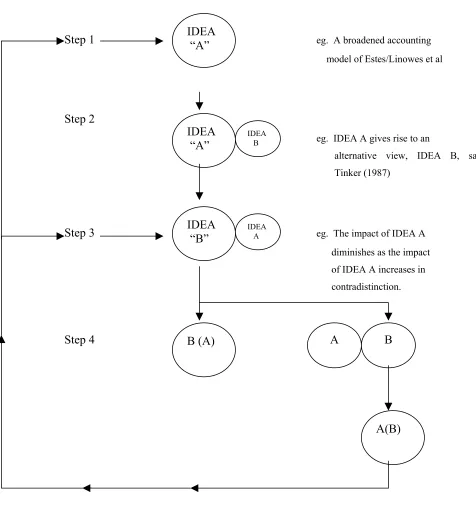
FIGURE 1
Step 1 eg. A broadened accounting
model of Estes/Linowes et al
Step 2
eg. IDEA A gives rise to an
alternative view, IDEA B, say Tinker (1987)
Step 3 eg. The impact of IDEA A
diminishes as the impact of IDEA A increases in contradistinction.
Step 4
IDEA “A”
IDEA “A”
IDEA B
IDEA “B”
IDEA A
B (A) A B
A(B)
It is contended that either of two outcomes will emerge:-
Situation 1 - where the issues (ideology) of B subsume the ideas (ideology) of A and surplants A with a new ideology (paradigm).
OR
Situation 2 - where the ideas (ideologies) of both A and B continue to co-exist in conflict, resulting, eventually in the “winner takes all” circumstance where letter B subsumes A or A subsumes B.
This argument is the dialectic found in Popper, a comprehensive treatise on the formation of knowledge and its reformation.
I now proceed to interpret Laughlin and the above adaptation of his model presented as Figure 1 to the issue of the progress towards the emergence of socio-economic accounting.
Reference to Tinker (1987), O’Donovan et al (1999) suggests that socio-economic accounting, including environmental accounting has progressed no further than the rebuttal stage of morphostatic change where we observe (in corporate annual reports and or corporate environmental reports) the presentation of information, typically not quantified, which seeks to introduce information that seeks to diffuse criticism of the enterprise. The literature including (Matthews (1993) recognizes examples of the re-orientation stage of change, and such is typified by Valtenfall of Sweden where considerable effort (and expenditure) has been directed towards the presentation of much new information about the performance of the enterprise which particularly reflects upon the environmental achievements of that enterprise.
colonization is the equivalent of “capture” as illustrated by Tinker (1991) and as such, represents a serious attempt to reproduce Step 4, and showing the old Idea A subsuming the new idea (ideology) of B.
The outcome of the present debate upon environmental accounting could have, at least, 3 possible outcomes:
• Idea A (old ideology) subsumes Idea B (new ideology) and little changes Or
• Idea B (new ideology) subsumes idea A (old ideology) and radical reform occurs Or
• Idea B (new ideology) and Idea A (old ideology) co-exist until such time that AB or BA emerges an evolutionary step for change.
The above 3 results would be defined as: 1. Conservative
2. Radical 3. Reformist
2.000 Triple Bottom-Line Reporting – A Speculative Model.
It is asserted by proponents of TBL reporting that enterprise achievements be measured in a more balanced way, de-emphasising financial achievements and promoting the significance of social and environmental achievements.
Let us assume that financial, social and environmental performance are rated equally and that the most successful enterprises will be able to demonstrate superior, within each domain, and balanced performance across each measurement domain. Assuming that FA = SA = EA where:
FA = Financial Achievement SA = Social Achievement
EA = Environmental Achievement
Further, that for convenience and in recognition of the TBL literature, we allocate 100 points to each of FA, SA & EA, ie. the “300 Point Enterprise”.
Also, Total Enterprise Performance (TEP) is equal to the sum of FA+ SA+ EA. Therefore: TEP = ∑ FA + SA + EA
Financial Performance: (each ratio, measured for at least the most recent 5 years)
• Profitability EBIT/TA 10
• Liquidity Free Cash Flow 10
• Risk Rating Agency Report 10
• Risk Interest Cover Ratio 10
• Shareholder Returns Earnings per Share 10
• Shareholder Returns Dividends per Share 10
• Activity Activity Ratio: Total Turnover 10
Total Assets
• Performance Value Added (in total) 10
Value Added by Labour ($) 10
Other Value added ($) 10
___
100 points
Social Performance: (each measure for at least the most recent 5 years)
• Employment Full-time employees as % of total employees 10
• Employment Female employment as % of total employees 10
• Employment % Female employees in top 20% of Payroll 10
• Compliance Number of legal actions taken against the
corporation 10
• Compliance Number of adverse legal decisions awarded
against a corporation 10
• Contribution Total taxes paid (last 5 years) as % of Turnover 10
• Contribution Gross tax paid less allowances 10
• Contribution Donations to worthy causes 10
• Compliance Evidence of compliance with the Universal
Declaration of Human Rights 10
• Contribution The amount of money paid to political parties and institutions whose prime purpose is to fund political parties or candidates. 10
Environmental Performance: (each measure for at least the most recent 5 years)
• Dow Jones Environmental Rating 10
• At work accidents 10
• Evidence of use/transport of unsafe materials 10
• Evidence of emissions into the air 10
• Evidence of water usage 10
• Evidence of conservation of use of production inputs 10
• Evidence of waste utilization 10
• Evidence of product / service liability claims 10
• Evidence of safe waste disposal 10
• Evidence of penalties for corporate environmental non- compliance
10 ___ 100 points
TOTAL ORGANIZATION PERFORMANCE (TEP) 300 points
3.000 Triple-Bottom-Line Reporting – Some Performance Indicators
Economic Achievement of Enterprises:
Measures of economic achievement of the enterprise should reflect the essential financial achievements of the enterprise – profitability, liquidity, risk aversion, activity and performance. It is generally considered that profitable enterprises which are liquid, using assets to generate profit, which are financed satisfactorily and which generate added value will be successful, continuing enterprises.
Social Achievement of Enterprises:
The reporting of social achievements of enterprises has gained increasing attention from accounting researchers and corporations during the past 30 years. Matthews (1997) notes the lack of progress since the works cited earlier in the paper. Research to date, including longitudinal studies, provide evidence of the variations in disclosure requirements and the variations in quality and quantity of social disclosures within various jurisdictions.
A further significant part of the accounting literature seeks to provide an explanation for social and environmental disclosures by enterprises Gibson & O’Donovan (2000). Much of the literature focuses upon investigation of legitimacy of the corporation – i.e “that there exists some form of contractual relationship between business and the wider society within which enterprises agree to perform in return for approval of its objectives, other rewards and ultimate survival” (Guthrie & Parker 1989, P. 344). Researchers have further examined various forms of legitimacy as follows:-
L1 - actions taken to inform upon actual changes in social performance and activities;
L2 - actions taken to change the perceptions of “relevant publics” without any accompanying change in actual enterprise behaviour; L3 - actions to manipulate public perceptions of social performance; L4 - actions taken to change external perceptions of social performance.
O’Dwyer (2000) concludes, following an examination of Corporate Social Reporting (CSR) in Ireland, that within that jurisdiction the form and content of social reporting was minimal, and much that was reported resulted from the motivations implicit in L2 to L4 above. That study also questions the usefulness of the corporate annual report as a suitable vehicle for such disclosures.
Environmental Achievements of Enterprises
Environmental reporting has also been the subject of increasing interest of accounting researchers, practitioners, consultants, businesses and governments. The literature evidences a variety of practices world-wide with some jurisdictions, particularly the European Community, taking a particularly pro-active stance with regard to environmental reporting. Companies variously provide a separate environmental report or incorporate environmental information within the annual report to shareholders. Environmental reporting in evidence at present includes information in the following categories:-
1. a corporate environmental report;
2. an environmental impact statement, or eco-balance report;
3. a report of regulatory information for legal compliance purposes (Oliver 2000, p614).
Gibson & O’Donovan (2000) collected environmental information reported by a sample of 41 Australian listed public companies and classified the environmental information reported in each annual report as follows:
1. Financial Environmental Information - including any quantifiable information contained in the financial statements and the notes to the accounts eg. provisions for future clean up costs.
2. Quantifiable, Non Financial Information – those matters reported in quantitative terms but not directly financial matters eg. graphs and tables reporting resource use, pollution concerns, financial contributions to remediation projects;
3. Descriptive Environmental Information – matters reported as narrative often within the Director’s Report;
4. All categories 1-3 above – the aggregate of all environmental matters reported by each company.
1997. Descriptive, non-quantitative reporting remains the most typical form of reporting with a substantial increase in quantitative information reported over the period, including both financial and non-financial information. The proportion of each corporate annual report devoted to environmental reporting remains a very small part of each annual report, however.
Estes (1999) continues with his earlier theme, essentially a stakeholder approach to corporate reporting. Most recently Estes has proposed a “Win Scorecard”™ for Business and Stakeholders and the following attributes of enterprise achievements are identified:
Customer Information Requirements:
• Claims against corporations for product liability, injury and wrongful death;
• Mentions of corporations of indictments and citations for regulatory violations;
• Product recall data and remediation actions subsequently taken;
• Product content classifications regarding food safety;
• Biodegradability of packaging;
• Air pollution measurements.
Workers Information Requirements:
• Corporate history of employee layoffs and shutdowns including statement of layoff policies, overtime worked;
• Risk exposures at work;
• Data, historical on accidents at work, and work-related health problems;
• Gender, race employee information regarding earnings, seniority, promotions etc;
• Employee turnover by above classifications;
• Information regarding employee pension schemes.
Community Information Requirements:
• Mentions of the corporation in any legal actions in the last 5 years;
• Corporate history of tax exemptions, deferral or other benefits from government and outcomes of such benefits received;
• Quantities of waste generated by the corporation and evidence of remediations, re-use etc.
• Data on hazardous, toxic dangerous materials used, stored at work sites or transported within the community;
• Data for sites occupied including the condition of all sites;
• Percentage of materials purchased from local and other sources where tax concessions are in existence;
• Air, water emissions by category and quantity;
• Record of corporate unemployment compensation ratings;
• Political contributions classified by amount and duration.
For Society at Large:
• Quantity and value of trade with countries designated as not consistent with national policy;
• Value of foreign currency generated and used including an estimate of the contribution to the balance of trade of the nation;
• Data on major government contracts by quantity and value;
• Penalties imposed as statutory minimum penalties or as penalties;
• Corporation and other taxes paid and details of any tax credits offset.
A number of key questions emerge in reaching a settlement of an “agreed” list of indicators of social and environmental performance of an enterprise.
Environmental Issues:
• Statements of community concern abound in regard to issues of water and water quality; therefore measurements of corporate impact upon water and air quality appear to be priority measures.
• Resources as inputs to any production process are finite and evidence of input re-use, re-cycling of materials and use of biodegradable materials in the supply of goods appear also to be a priority issue;
• Evidence of corporation failure to meet regulatory environmental standards (where appropriate) will evidence (minimum) compliance with community (legislated) standards;
• Evidence of waste disposal resulting from the provision of goods and services will provide a measure of the impact of a corporation upon the waste disposal systems of the national (international) economy;
• Evidence of product or service delivery which is deflective and likely to cause injury to either employees or consumers;
• Employee injury patterns, lost work through injuries at work will evidence the safety of the workplace, an “in-house” working environmental concern for most organizations.
Social Issues:
• Issues relating to the composition of a workplace with specific reference to gender equality regularly occupy organizations, the press and the media. Hence data on employment of women, remuneration and seniority would evidence corporate acceptance and action regarding the status of women in work and society.
• Evidence of legal action of any kind taken against a corporation would provide a measure of the obedience of the corporation to the existing legal framework and this would be taken to reflect the values in society;
however the impact of the absence of such government expenditures is well documented.
• It is asserted that continuous full time work is preferable for most people and therefore annual data for each corporation which measures labour turnover, redundancy, re-employments, layoffs, full time and part-time employment.
It is proposed that 10 measures for each of the environment and social dimensions will provide the remaining points to be allocated to the “300 POINT CORPORATION” as follows:-
Financial Performance 100 points
Environmental Performance 100 points
Social Performance 100 points
________
TOTAL PERFORMANCE 300 points
________
4.000 Some Issues Requiring Further Attention:
1. Comparative or Absolute Performance?
As the Global Reporting Initiative™ notes, the reporting of performance indicators data in absolute terms is regarded as necessary as reporting data in absolute terms avoids some of the complications associated with the presentation and use of ratio and percentage measures.
2. Measurement
The literature reporting upon Socio-Economic Accounting, both the older and newer literatures, contain much about the measurements to be used to measure social and environmental performance. The measures indicated here require close investigation regarding the validity of inclusion and measurement. The Global Reporting Initiative™ presents a comprehensive measurement set, and further, provides for the separation of core and additional indicators. It is proposed that reporting organizations would be able to present reports as being “in accordance with GRI Guidelines” only if all core reporting indicators are reported.
3. Principles of Measurement and Reporting
4. The Ideology of TBL
A major difficulty confronting the implementation of TBL reporting or Sustainability reporting is the unresolved matter of the equality of financial, social and environmental reporting indicators. An equality of these indicators is implicit within a TBL scheme and is explicit within the “300 Point Enterprise” system as proposed earlier in this paper. Can it be said that financial, social and environmental performance are equally important? Are these measurement areas equally important? Are these measurements of equal importance to any, all, or some stakeholders of an enterprise? Boatright (1999) reviews the literature regarding the origins of stakeholder and shareholder orientations, and examines the notion of corporate social responsibility. Economic theorists as divergent as Marx (1844) and Milton Friedman (1972) reach similar conclusions regarding the primacy of economic activity – the “economic base” of Marx or the primary objective of wealth maximization of Friedman. Reference to the origins and development of law, including corporate law, also emphasises the primacy of owners (shareholders) within corporate regulation.
A TBL or Sustainability reporting context requires that enterprise achievements be reported in a balanced way, reporting to the various stakeholders of an enterprise, not only reporting on financial matters to owners/shareholders.
Bibliography:
Bedford, N.M., 1965, Income Determination Theory: An accounting Framework, Massachusetts, Addison-Wesley.
Boatright, J. 1999, Ethics in Finance, Blackwell, Malden, Mass.
Estes, R.W. (ed) 1973, Accounting and Society, Melville, Los Angeles, .
Estes, R.W. 1972, `Socio-Economic Accounting and External Diseconomies‘, Accounting Review, vol. 47, no. 2, pp. 284-290.
Friedman, M. 1972, Economics and Freedom, Nelson, New York.
Gambling, T.E. 1974, Societal Accounting, George Allen and Urwin, London.
Gambling, T.E. 1971, `Towards a General Theory of Accounting‘, International Journal of Accounting Education and Research, vol. 17, no. 1, Fall, pp. 1-13.
Gibson, K. & O’Donovan, G. 2000, `Environmental Disclosures in Australia: A Longitudinal Study‘, RMIT Business, School of Accounting and Law Seminar Series 2000, Accounting for the Environment, May, Melbourne, Australia
Gray, R. Walters, D. Bebbington, J. & Thompson, I. 1993, `The Greening of Enterprise: An Exploration of the (Non) Role of Environmental Accounting and Environmental Accountants in Organisational Change’, Working Paper 93-8, Department of Accounting and Financial Management, The University of New England, November, Armidale, Australia.
Linowes,D.F.1968, `Socio-Economic Accounting‘, The Journal of Accountancy, vol. 136, no. 5, pp. 37-42.
Linowes, D.F. 1973, `The Accounting Profession and Social Progress‘, The Journal of Accountancy, vol. 146, no. 1, pp. 32-40.
Marlin, J.T. 1973, `Accounting for Pollution‘, The Journal of Accountancy, vol. 145, no. 2, , pp. 41-46.
Marx, K. 1964, Economic and Philosophic Manuscripts of 1844, Edited, with an introduction by D.J. Struik, International, New York.
Mobley, S.C. 1970, `The Challenges of Socio-Economic Accounting‘, Accounting Review, vol 45, no. 4, pp. 762-768.
O’Dwyer, B. 2000, `Corporate Social Reporting in Ireland: Legitimacy Denied?’, RMIT Business, School of Accounting and Law Seminar Series 2000, Accounting for the Environment, May, Melbourne, Australia.
Prince, T.R. 1963, Extension of the Boundaries of Accounting Theory, Cincinnati, South-Western Publishing.
Tinker, T. Lehman, C. & Neimark, M. 1991, `Falling Down the Hole in the Middle of the Road: Political Quietism in Corporate Social Reporting‘, Accounting Auditing and Accountability Journal, vol. 4, no. 2, pp. 28-54.