IJEDR1603117
International Journal of Engineering Development and Research (www.ijedr.org)710
Deterministic Energy Efficient Clustering Protocol
For Wireless Sensor Network Using Evolutionary
Optimization Technique
Almas Zargham M.Tech Student
Department of Electronics and Communication AlFalah University, Dhauj ,Faridabad, India
Abstract - Wireless sensor network (WSN) technologies have been employed in recent years for monitoring purposes in various areas from engineering industry to our home environment due to their ability to intelligently monitor remote locations. In this paper, we have studied a purely deterministic model that utilizes clustering to organize the WSN. We propose a deterministic energy-efficient clustering protocol using evolutionary optimization Technique that is dynamic, distributive, self-organizing and more energy efficient than the existing protocols. It utilizes a simplified approach which minimizes computational overhead-cost to self-organize the sensor network. Our simulation result shows a better performance with respect to energy consumption, which is reflected in the network lifetime in both homogeneous and heterogeneous settings when compared with the existing protocols.
I. INTRODUCTION
With the advancement in micro-fabrication technology, Wireless Sensor Networks (WSNs) have started to play a vital role in our daily lives. Efficient design and implementation of wireless sensor networks have become a hot area of research in recent years, due to the immense capacity of sensor networks to enable applications connecting the physical world with the virtual world. It is possible to obtain data about physical or environmental phenomena by networking large number of tiny sensor nodes that was difficult or impossible to obtain in more conventional ways. WSN is a collection of wireless nodes with limited energy capabilities that may be mobile or stationary and are located randomly on a dynamically changing environment. The routing strategies selection is an important issue for the efficient delivery of the packets to their destination. Moreover, in such networks, the applied routing strategy should ensure the minimum of the energy consumption and hence maximization of the lifetime of the network. A lot of work on the WSNs field has been carried out resulting in the development of the WSNs on a wide variety of applications and systems with vastly varying requirements and characteristics. At the same time, various energy-efficient routing protocols have been designed and developed for WSNs in order to support efficient data delivery to their destination. Thus, each energy-efficient routing protocol may have specific characteristics depending on the application and network architecture. A routing protocol is required when a source node cannot send its packets directly to its destination node but has to rely on the assistance of intermediate nodes to forward these packets on its behalf. Routing in WSNs is very challenging due to several inherent characteristics that distinguish them from contemporary communication and wireless ad hoc networks. First, it is not possible to build a global addressing scheme for the deployment of sheer number of sensor nodes. Therefore, classical IP-based protocols cannot be applied to sensor networks. Second, in contrast to typical communication networks almost all applications of sensor networks within the vicinity of a phenomenon. Such redundancy needs to be exploited by the routing protocols to improve energy and bandwidth utilization. Fourth, sensor nodes are tightly constrained in terms of transmission power, on-board energy, processing capacity and storage. Thus, they require careful resource management Due to such differences, many new algorithms have been proposed for the routing problem in WSNs.
II.DEC Protocol:
A deterministic energy-efficient clustering protocol that promises a better election of cluster-heads is proposed. This proposed protocol uses the sensor node’s residual energy solely as the election criterion. Simulation results show that the proposed model is able to manage energy consumption better and achieves the desired result for wireless sensor networks
III. WIRELESS SENSOR NETWORK MODELS
Developing a protocol that can optimize the energy consumption has been the focus of several authors. One of the main attributes of these protocols such as LEACH is that they utilize clustering schemes to collaborate among the sensors in the network.
IJEDR1603117
International Journal of Engineering Development and Research (www.ijedr.org)711
suffers from similar problem of unguaranteed cluster-head election per round as with the other probabilistic-based models. Although, LEACH proposed an optimal setting that can guarantee the best performance using their stochastic model, but most of the time the result could be sub-optimal due to the uncertainties in the cluster-head election process. A generic probabilistic model used by these protocols is given in Eq.(1).where 𝑥could be 𝑛𝑟𝑚, 𝑖𝑛𝑡 or 𝑎𝑑𝑣i.e normal, intermediate or advanced nodes respectively and 𝑄is an additional quantity that can be defined as a function of the ratio of the residual energy of each node or just a constant value. For example Qis set to one in other models. However we use a deterministicquotient for the value of 𝑄, which is computed in each roundfor all the nodes in order to improve on the LEACH protocol. According to the threshold indicator function in Eq.(1), every node decides to be cluster-head for each round 𝑟, the sensornode chooses a random number between 0 and 1. If this islower than the threshold for node 𝑛, (𝑛), the sensor node becomes a CH. Here 𝐺denotes a set of non-elected cluster members (CMs) and 𝑃𝑥is the probability of being elected as CH. SEP, improved LEACH by considering a two-node heterogeneous setup. Likewise, SEP-E, improved both SEP and LEACH, by using a three-node heterogeneous setup. Both the SEP-E and SEP protocols adapted the indicator function in Eq.(1) to suit their model estimations by using intermediate and advanced nodes respectively. These studies also defined different probabilities 𝑃𝑥for the different types of nodes use in the network to achieve their goals of improved lifetime. According to these protocols, the operation of the clustering process begins with a setup phase when all nodes use the indicator function for election as CHs. The elected CHs broadcast advertisement message (ADV) using the non-persistent carrier sense multiple access (CSMA MAC) protocol. This message contains the CH’s ID and a header that indicates it as an announcement message. The non-elected nodes called clustermembers (CMs) determine their cluster by choosing the CH with the minimum communication cost based on the received signal strength of the advertisement message. The CMs send join-request to their chosen CH using CSMA MAC protocol. This message contains the CM-ID (cluster member-ID), CHID (cluster head-ID) and the header that indicates the message as a request. The CHs set up a TDMA for their intra cluster communication, which ends the setup phase. The steady-state phase begins when sensed data are sent from CMs to CHs and from CHs to BS. The inter-cluster communication is achieved using the direct sequencing spread spectrum (DSSS). Motivated by these studies, we propose a deterministic based model that can yield a better lifetime and ensures the node with the largest residual energy will get elected as the CH. This method provides a more ideal solution for energy consumption in WSNs. To the best of our knowledge we are the first to attempt a purely deterministic model that can guarantee a fixed number of cluster-heads election per round.
IV.DETERMINISTIC PROTOCOL
Deterministic Energy-efficient Clustering protocol (DEC) that determines CH election based on the residual
Fig. 1. Behavior of node energy consumption overtime
energy (RE) of each node. The threshold function in Eq.(1) is completely abandoned, firstly, due to the uncertainties in the CH’s election process and secondly, due to the underutilization of the potential for lifetime maximization in clustered WSN. In simple term, the aim is to conform DEC algorithm to look similar to an ideal solution as shown in Fig. 2. The major advantage in DEC model is that the uncertainties in the cluster-head elections have been minimized.
IJEDR1603117
International Journal of Engineering Development and Research (www.ijedr.org)712
LEACH). The next round 𝑟= 𝑚+1 begins; but since the new CH’s are already chosen in the previous round, they broadcast their role in the new round, CMs join their cluster as already explained above. The steady phase begins again. This process continues in each round until the last node dies.V.RESEARCH METHODOLOGY
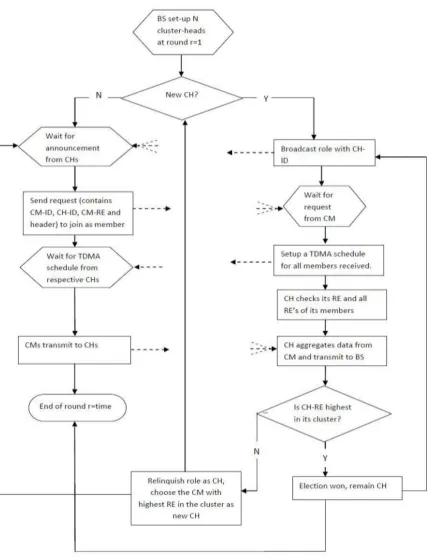
A modified setup phase used in LEACH is used, but keep the steady-state phase as the same. Since node’s energy can be determined a priori, the CH election process is reorganized to only use the residual energy (RE) of each node. In DEC, at round 𝑚, the BS elects 𝑁𝑜𝑝𝑡cluster-heads for the network. The BS can only take part in the election of CHs if and only if 𝑚= 1. The elected CHs advertise their role using CSMA MAC just as in LEACH. However, in DEC unlike in LEACH, the join-request message will contain CM-ID, CHID, CM-RE (cluster member-residual energy) and the header that indicates it as a request. This way the RE information of CMs is known by their respective CHs, thus localized and it can be utilized for CH rotation in the subsequent rounds. After the setup phase ends, the steady phase begins, but before the end of this phase, the current CHs checks the piggy-backed CM-RE’s information received to decide whether they will remain as CHs or relinquish their roles by choosing any node in their clusters with the highest RE as the new CHs. After this decision is made for the new CHs and all the data from the current round is communicated to the BS, the current round (𝑟= 𝑚) ends (a perfect synchronization is assumed, just as in LEACH). The next round 𝑟= 𝑚+1 begins; but since the new CH’s are already chosen in the previous round, they broadcast their role in the new round, CMs join their cluster as already explained above. The steady phase begins again. This process continues in each round until the last node dies.
With this method, the battery life of WSNs is significantly optimized. The flowchart for our DEC algorithm is presented in Fig. 3. Based on our simulation studies, the followings are observed, which makes the DEC protocol desirable:
The CH election is locally decided based on each node’s RE. And each round is independent of the subsequent round unlike in LEACH, SEP and SEP-E.
DEC guarantees every node a chance of election as long as its RE is higher than its neighbors. DEC ensures a fixed 𝑁𝑜𝑝𝑡cluster-head is chosen.
DEC significantly reduces the overhead cost of computation associated with CH search in the existing protocols, by refining this search to cluster 𝑁𝑖at round 𝑚.
DEC guarantees that every CH has enough energy to take up its role, until at least the end of the network lifetime, unlike in LEACH.
IJEDR1603117
International Journal of Engineering Development and Research (www.ijedr.org)713
Fig. 2. Flowchart of DEC algorithmVI.SIMULATION SETUP
DEC protocol is verified using simulations and its performance is compared with existing protocols i.e. LEACH, SEP and SEP-E. The performance metrics also are defined as FND (First Node Dies, also known as stability period), PNA (90, Percent Nodes Alive) and LND (Last Node Dies, also known as instability period). These protocols are compared both in homogeneous and heterogeneous setups. The LEACH protocol is used as representation of homogeneous scenario, because this is the purpose for which it was designed. Likewise, SEP, SEPE and LEACH are used as representation of heterogeneous setup, especially, since both SEP and SEP-E are designed by their authors to be robust to heterogeneity.
IJEDR1603117
International Journal of Engineering Development and Research (www.ijedr.org)714
Setup 1: A 100𝑚×100𝑚of randomly dispersed homogeneous nodes, each with 0.5J of energy and BS located at thecenter of the network system.
2) Setup 2: A 100𝑚 × 100𝑚of randomly dispersed heterogeneous nodes with energies varied between 0.5J to 2.25J and BS located at the center of the network system. For the sake of brevity and complete fairness, the total energy of the system for each protocol are ensured to be the same, we use a total energy of 102.5J. In LEACH, SEP-E and DEC, 20% of the nodes are equipped with 2J of energy, 30% with 1.25J of energy and 50% with 0.5J of energy. However, in SEP two types of nodes are assumed. In order to be fair, 30% of the nodes are equipped with 2.25J of energy and 70% with 0.5J of energy. The total energy of the system remains 102.5J. Also, the optimal parameters of these protocols are used in order to yield their respective highest performances.
VII. ANALYSIS OF OPTIMUM CLUSTER-HEADS:
In DEC, the clustering algorithm was created to guarantee that the expected number of cluster-heads per round is fixed as 𝑁𝑜𝑝𝑡, which can be set a priori. In Fig. 4, we use a probabilistic-based model such as LEACH, to analyze the number of elected cluster heads per round. The solid curve, which represents LEACH protocol shows the inherent uncertainties in the model, the consequence is that the required fixed number of cluster heads election cannot be guaranteed per round. Due to this, in some rounds very few cluster-heads are elected, and the cluster-members will need to transmit at a much longer distances to reach their cluster-heads. Likewise, if the number of elected cluster-heads is higher, not much data aggregation will be done, since the cluster size is smaller. Thus, more energy will be used for transmitting. This is one of the major drawback of this model. Another disadvantage of this model is that, the energy consumption across nodes become increasingly uneven as the network progresses. This phenomenon is explained later in the following subsection.
Fig. 4 plots the number of elected CHs overtime as given by LEACH and DEC. The dotted line represent the DEC protocol which reveals that the uncertainties in the cluster-head election has been completely eliminated. This ensures that, for any network size, once the 𝑁𝑜𝑝𝑡is decided at the beginning of the network operation, our DEC protocol guarantees that the number of cluster-head election remain fixed at 𝑁𝑜𝑝𝑡. The advantage of this behavior is that, the energy across node is balanced as the network evolves and for the majority of the time the cluster-members will have relatively shorter distances to transmit to their cluster-heads. Overall, the energy gain is reflected in the simulation results in favor of the DEC protocol. This makes DEC to be very close to an ideal clustering solution for WSN.
IJEDR1603117
International Journal of Engineering Development and Research (www.ijedr.org)715
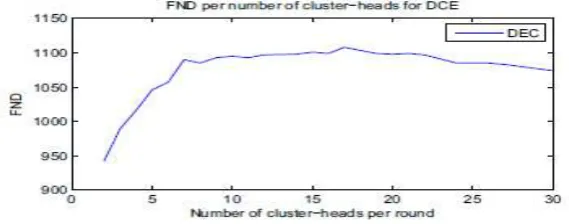
between. Beyond 20 clusterheads, the curve starts descending. The optimality of 𝑁𝑜𝑝𝑡lies around 16 cluster-heads. As already explained above, when there are few cluster-heads, non-cluster head nodes will often transmit data very far to their cluster-heads, this drains their energy faster. When there are more cluster-heads (from 10 to 20), non-cluster head nodes can easily locate a nearby head. But when the number of CHs increases beyond 20, there is not much local data aggregation being performed, thus more energy will be consumed because the size of the cluster is reduced. DEC is stable when the number of cluster-head varies between 10 to 20, this shows the robustness of DEC to variable number of cluster-head election.VIII. ENERGY CONSUMPTION ANALYSIS
We analyze the residual energy of each node during the network operation, by observing the variation of energy levels between the nodes at 100-round intervals from round 100 to 5000. We use the standard deviation to verify these differences among the nodes using Setup 1 and 2. Our objective is to verify the relative energy consumption pattern across the sensor nodes, as this can tell us whether the energy in the system is evenly consumed across the nodes. Using Setup 1, as shown in Fig. 6, DEC has a flat and much lower standard deviation over time compared with LEACH which increases consistently as the network progressed from 100 to 1000 rounds. This clearly showsthat energy is not evenly consumed among the nodes as the network evolves in LEACH. This is a result of the randomized cluster-head election process in LEACH, making the entire network operation to be very unstable. In Setup 2, we observe a similar phenomenon in DEC, SEP-E, SEP and LEACH. Again, we compute the standard deviations for the residual energy among the nodes of each protocol as shown in Fig. 7. The fast decrease in the DEC curve from 100 to 1000 rounds shows clearly that DEC balances the energy consumption in the network better than the other protocols, by adapting well to heterogeneity. As the network progresses from 100 to 1000, DEC reduces the energy gap (measured as standard deviation) within the network by ensuring that nodes with higher residual energy are elected often than nodes with lower residual energy, hence lower standard deviation at 1000 round than the other protocols. Although SEP-E and SEP adapt to the energy heterogeneity, they are much slower in coping with this phenomenon. It is obvious that LEACH protocol is indifferent to heterogeneity, as there is no response to the different energy levels in the network. Overall the performance of DEC compared with the other protocols is significant. The DEC protocol has achieved our goal of a well balanced energy
consumption pattern across the nodes regardless of the energy hierarchies in the network system. This result supports our model of a fixed elected number 𝑁𝑜𝑝𝑡of cluster-heads in each round as used by the DEC protocol to balance the energy consumption among the nodes.
We investigate the number of live nodes per round for both homogeneous and heterogeneous setups. The simulation results are discussed below.
IJEDR1603117
International Journal of Engineering Development and Research (www.ijedr.org)716
requires about 90-100% monitoring requirement, DEC proves to be more suitable. But for less critical applications, with about 70% monitoring requirements, LEACH protocol could still be useful. However, the practical applicability for LEACH scenario is very limited as most often new nodes will be deployed to replace dead nodes.
Setup 2: Network lifetime analysis is performed with the protocols considered using Setup 2. In general, DEC improves the WSN lifetime compared to LEACH, SEP and SEP-E up to a magnitude of 45%, 24% and 21% respectively. Fig. 9, shows the behavior of these protocols to energy heterogeneity. It is worthy of note that DEC curve is at right angle to the knee point, the gradual decent at the beginning is as a result of different energy levels of the nodes in the network. DEC proves to be superior up to when 60% of the nodes are alive. SEP-E, SEP and LEACH descends slowly until the end of the network, although both SEP-E and SEP outperformed the LEACH protocol. This is expected because LEACH was designed for homogeneous scenario. For applications that have minimal monitoring requirements LEACH, SEP and SEP-E could still be desirable. However, it is expected that most applications will introduce new nodes as the network evolves, which makes DEC a more ideal protocol for most WSN deployment scenario. It should however, be noted that the simulations do not account for the setup time or the energy consumed during the update processes; they do however give an approximation of the network lifetime that can be achieved using these protocols.IJEDR1603117
International Journal of Engineering Development and Research (www.ijedr.org)717
Fig.1.Different Cluster Heads getting selected based on energy level.Fig.2. Clusters dying out after the exhaustion of energy from nodes.
IJEDR1603117
International Journal of Engineering Development and Research (www.ijedr.org)718
Fig.4.Final figure after exhaustion of energy from all nodes after proposed number of Iterations.Fig.5 Nodes left after proposed number of iterations.
Fig.6 Total Energy decrement from round 0 to proposed iterations. IX. RESULT AND DISCUSSION
A purely deterministic protocol DEC that better utilizes the most valuable network resource (energy) in WSN is introduced. DEC outperforms the probabilistic-based models we have considered, by guaranteeing that a fixed number of cluster-heads are elected per round. At different rounds cluster-heads are elected using the local information of their residual energies within each cluster to choose the appropriate cluster-heads.
IJEDR1603117
International Journal of Engineering Development and Research (www.ijedr.org)719
DEC improves the lifetime of wireless sensor networks by an order of magnitude which is significant when compared with LEACH, SEP and SEP-E. DEC takes advantage of the local information i.e. the residual energy of each node to optimize the energy consumption in both homogeneous and heterogeneous scenarios we have considered, regardless of the level of energy hierarchies in the network. In our future work, we intend to adapt DEC protocol to a real world application setting such as in agricultural farmland for fertilizer spraying operations. It is our hope that this method can provide more insight into optimizing WSN energy consumption in real-world scenarios.XI. ACKNOWLEDGMENT
The author thank the referees and anonymous reviewers for their critical annotations that enabled me to improve the quality of this research paper.
REFERENCES
[1] F. A. Aderohunmu, J. D. Deng, and M. K. Purvis. Enhancing Clustering in Wireless Sensor Networks with Energy Heterogeneity. International Journal of Business Data Communications and Networking-(Accepted, to appear in the forthcoming issue, 2011.
[2] F. Comeau. Optimal Clustering in Wireless Sensor Networks Employing Different Propagation Models And Data Aggregation Techniques. PhD thesis, Dalhousie University, Halifax, Nova Scotia, 2008.
[3] S. Gamwarige and C. Kulasekere. An algorithm for energy driven cluster head rotation in a distributed wireless sensor network. In Proceeding of the International Conference on Information and Automation, pages 354–359, Dec 2005.
[4] M. Haase and D. Timmermann. Low energy adaptive clustering hierarchy with deterministic cluster-head selection. In IEEE Conference on Mobile and Wireless Communications Networks (MWCN), pages 368–372, 2002.
[5] W. R. Heinzelman, A. Chandrakasan, and H. Balakrishnan. Energyefficient communication protocol for wireless microsensor networks. In Proceeding 33rd Hawaii International Conference on System Sciences, 2000.
[6] W. R. Heinzelman, A. Chandrakasan, and H. Balakrishnan. An Application-Specific Protocol Architectures for Wireless Networks. IEEE Transactions on Wireless Communications, 1:660–670, 2002.
[7] C. Li, M. Ye, and G. Chen. An Energy-Efficient Unequal Clustering Mechanism for Wireless Sensor Networks. In Proceeding of IEEE MASS05, pages 3–17, 2005.
[8] L. Qing, Q. Zhu, and M. Wang. Design of a distributed energy-efficient clustering algorithm for heterogeneous wireless sensor networks. Computer Communication, 29:2230–2237, 2006.
[9] G. Smaragdakis, I. Matta, and A. Bestavros. SEP: A Stable Election Protocol for clustered heterogeneous wireless sensor networks. In Proceeding of the International Workshop on SANPA, 2004.
[10] F. Xiangning and S. Yulin. Improvement on LEACH Protocol of Wireless Sensor Network. In SENSORCOMM ’07: Proceedings of the 2007 International Conference on Sensor Technologies and Applications, pages 260–264, Washington, DC, USA, 2007. IEEE Computer Society.
[11] O. Younis and S. Fahmy. HEED: A Hybrid, Energy-Efficient, Distributed Clustering Approach for Ad Hoc Sensor Networks. IEEE Transactions on Mobile Computing, 3:366–379, 2004.
[12] D. Estrin, L. Girod, G. Pottie, M. Srivastava, Instrumenting the world with wireless sensor networks, in: In International Conference on Acoustics, Speech, and Signal Processing (ICASSP 2001), 2001, pp. 2033–2036.
[13] J.N. Al-karaki, A.E. Kamal, Routing techniques in wireless sensor networks: a survey, IEEE Wireless Communications 11 (2004) 6–28.
[14] K. Akkaya, M. Younis, A survey on routing protocols for wireless sensor networks, Elsevier Ad Hoc Networks 3 (2005) 325–349.
[15] C.-J. Huang, Y.-W. Wang, H.-H. Liao, C.-F. Lin, K.-W. Hu, T.-Y. Chang, A powerefficient routing protocol for underwater wireless sensor networks, Applied Soft Computing 11 (March (2)) (2011) 2348–2355.
[16] .L.Y. Ming, V.W.S. Wong, An energy-efficient multipath routing protocol for wireless sensor networks: research articles, International Journal of Communication Systems 20 (7) (2007) 747–766.
[17] W. Heinzelman, J. Kulik, H. Balakrishnan, Adaptive protocols for information dissemination in wireless sensor networks, in: Proceedings of ACM/IEEE Mobi- Com’99, Seattle, WA, U.S.A., 1999, pp. 174–185.