Available Online at www.ijcsmc.com
International Journal of Computer Science and Mobile Computing
A Monthly Journal of Computer Science and Information Technology
ISSN 2320–088X
IMPACT FACTOR: 5.258
IJCSMC, Vol. 5, Issue. 7, July 2016, pg.177 – 185
Enhanced Rules Framework for
Predicting Disk Drives Failures
Vineetha B.Y
M.Tech (CSE), New Horizon College of Engineering, Bengaluru [email protected]
Asha Borah
Assistant Professor (CSE), New Horizon College of Engineering, Bengaluru [email protected]
ABSTRACT: Disk Drive failure prediction and analysis is one of the important areas in the field of storage. The SMART [Self- Monitoring, Analysis and Reporting Technology] is the closest technology that can predict to an extent that which disk drives may go bad. For the enterprise cloud storage environment it needs to have an additional rules and framework which can ensure the impending drive failures are caught. This paper proposes disk drive prediction model based on statistical and machine learning methods using Maximum Likelihood rule induction algorithm for solving classification problems through probability distribution based on SMART attributes, which are evaluated by using the data provided by the real world data center called Backblaze and also based on the IO latency of each of the disks drives, we are predicting the failures of the disks drives.
Keywords: Disk Drive failure prediction, SMART, Enterprise cloud storage, Maximum
I. INTRODUCTION
Predicting the impending failure of hard disks in the field accurately can help storage systems or
data center administrators to take corrective actions before the failure to avoid loss of data and
performance degradation. The main hard challenge here is for predicting the impending failure of
hard disks which factors should be taken into consideration are not clear. Most of the hard drive
vendors support self-monitoring, analysis and reporting technology (S.M.A.R.T.), which
measures drive characteristics such as temperature, spin-up time, data error rates, etc. however, it
has been found that S.M.A.R.T. parameters alone are not enough to reliably predict individual
drive failures [5].
In addition to SMART attributes we have taken live disk performance parameters like message
queues, read errors, write errors, busy also for consideration for predicting the impending failure
of hard disks. We have taken the drives monitored data which consists of the SMART attribute
values for respective failed drives and good drives, using these observed data we can use the
proposed system for classifying the bad disks.
The next challenge is of classification. An algorithm is trained with data to recognize the
characteristics of two classes – “good disks” and “failing disks”. By using an application of an
existing machine learning approach called Maximum Likelihood [ML] Rules algorithm [3],
which is used on a rule induction principle for solving classification problems through
probability estimation that can be effectively employed to detect impending disk failures. The
MLRules algorithm generates an ensemble of classifiers to give an overall prediction of whether
a disk will fail based on the hard disk events and warnings logged during the lifetime of the hard
disk. It uses decision rules as its base classifier. A simple decision rule classifier contains a set of
logical statements or conditions which, when satisfied, votes for a particular class. It is in the
form: “ if condition then response”. It can be treated as a simple classifier that gives a constant
response for the objects satisfying the condition part, and abstains from the response for all the
other objects. The MLRules algorithm sequentially generates decision rules with an associated
weight factor, by greedily minimizing the negative log-likelihood to estimate the conditional
interpretability. We follow an approach in which a single decision rule is treated as a base
classifier in an ensemble.
Rules can be learnt and calculated with low memory and computational requirements and can be
used to develop an efficient stand-alone system for predicting hard disk failures with very good
accuracy and low false alarm rate, unlike many other machine learning techniques. Rule-based
techniques, since they are intuitively comprehensible, have special significance in case of hard
disk failures.
II. RELATED WORK
Hard drive manufacturers have been developing self-monitoring technology in their products for
predicting failures before it actually occurs, to allow users or storage systems enough time to
back up their data.The Self-Monitoring and Reporting Technology (S.M.A.R.T.) system is used
by nearly all hard drive manufacturers. It collects data such as temperature, spin-up time, data
error rates, etc., during normal operation and uses them to set a failure prediction flag. The
S.M.A.R.T. flag is a one-bit signal that is generated to warn users of impending drive failure.
Nearly all hard drive manufacturers use a very naive threshold algorithm which triggers an
S.M.A.R.T. flag when any attribute exceeds a predefined value. These thresholds are set so as to
avoid false alarms at the expense of predictive accuracy.
Past research [5] has found very little correlation between failure rates and either elevated
temperature or activity levels. They show that some S.M.A.R.T. parameters (scan errors,
reallocation counts, offline reallocation counts, and probational counts) can be helpful in
predicting disk failure. However, due to the lack of occurrence of predictive S.M.A.R.T. signals
on a large fraction of failed drives, they concluded that S.M.A.R.T. alone cannot be used to form
an accurate predictive failure model.
Bairavasundaram et al. [1, 2] found that SATA disks and their adapters develop checksum
mismatches an order of magnitude more often than FC disks. They also observed that the
probability of developing checksum mismatches varies significantly across different disk models
even within the same disk class. Also, the fraction of disks with latent sector errors varies
significantly across manufacturers and disk models. They observed that as disk size increases,
the fraction of disks with latent sector errors increases across all disk models. We use these
Another study on drive failure prediction was performed by Hughes et al. [6]. They used
Wilcoxon rank-sum test to build prediction models. They proposed two different strategies:
multivariate test and ORing single attribute test. Their methods were tested on 3;744 drives. The
highest detection rate achievable was 60% with 0:5% FAR.
Murray et al. [7] compared the performance of SVM, unsupervised clustering, rank-sum test and
reverse arrangements test. In their subsequent work [8], they developed a new algorithm termed
multiple-instance naive Bayes (mi-NB). They found that, on the dataset concerning 369 drives,
ranksum test outperformed SVM for certain small set of SMART attributes (28:1% failure
detection at 0% FAR). When using all features, SVM achieved the best performance of 50:6 %
detection with 0% FAR.
Hamerly and Elkan [4] employed two Bayesian approaches to predict hard drive failures based
on SMART attributes. Firstly, they used a cluster-based model named NBEM. The second
approach was a supervised naive Bayes classifier. Both algorithms were tested on a dataset from
Quantum Inc. concerning 1;927 good hard drives and 9 failed drives. They achieved prediction
accuracy of 35�40% for NBEM and 55% for naive Bayes classifier with about 1% FAR.
III. EXISTING SYSTEM
Most of the modern hard disk drives support Self-Monitoring, Analysis and Reporting
Technology (SMART), which can monitor internal attributes of individual drives and predict
impending drive failures by a thresholding method. As the prediction performance of the
thresholding algorithm which triggers a S.M.A.R.T. flag when any attribute exceeds a predefined
value. These thresholds are set so as to avoid false alarms at the expense of predictive accuracy.
IV. PROPOSED SYSTEM
Data Sets:
The data set consists of time series of SMART attributes values for every disk model. Data were
collected from the Backblaze Company where they provide the drive data every year which
consist of SMART attributes values for the failed and good disks.
These data sets consist of Disk Model name, Serial Number, Capacity, failures, and totally 200
if it is 1 that disk is good. These data sets are used as training examples for the algorithm to learn
the data and give the result.
Feature selection:
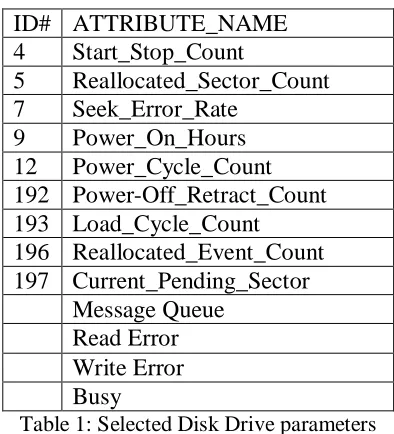
Among 200 SMART attributes we selected the below parameters given in a table as a feature
from the data sets as they were common for all the disk vendors and which are important in
predicting the drive failures, and also we have considered the drive live performance parameters
with the help of storage layer which decides the performance of the disk by the IO latency using
the last 4 features.
ID# ATTRIBUTE_NAME
4 Start_Stop_Count
5 Reallocated_Sector_Count
7 Seek_Error_Rate
9 Power_On_Hours
12 Power_Cycle_Count
192 Power-Off_Retract_Count 193 Load_Cycle_Count 196 Reallocated_Event_Count 197 Current_Pending_Sector
Message Queue Read Error Write Error Busy
Table 1: Selected Disk Drive parameters
The Figure 1 shows the design of predicting failures of disk drive system. Using Backblaze datasets with the help of SQL database rules are created and weights are created for each parameter, According to the created weights of selected parameters if the combined weight of the selected parameter in live system exceeds threshold value(fixed by system administrator) the drive is flagged as “BAD” and same disk is predicted for replacement.
Algorithm:
We use a new rule induction algorithm Maximum likelihood for solving classification problem
through probability estimation. The purpose of maximum likelihood is to find the parameters of
the model that best explain the data in the sense of yielding the largest probability or likelihood
of explaining the data.
Probability estimation provides us with the conditional class distribution P(y/x), by which we can
measure the prediction confidence. Moreover, all we need to obtain the Bayes classifier for any
loss function is the conditional probability distribution. Here we consider the estimation of
probabilities using the well-known maximum likelihood estimation (MLE) method. MLE can be
stated as the empirical risk minimization by taking the negative logarithm of the conditional
likelihood as the loss function (l) as shown in below:
…… (1)
Algorithm for predicting failure of disk drives, given the Backblaze datasets:
Input: Set of n training examples given by Backblaze data X = number of features selected
Output: Decision Rule
1. for x=1 to X
2. Find the likelihood value for the feature
3. Calculate the weight for the feature
4. Add a new feature to the existing one
Generation of Decision Rule:
Decision rules are in the form of logical statements which are used for classifying the disk as
bad or good, here single decision rule is treated as base classifier. Decision rule is formed by
using the likelihood value calculated for each feature and weight associated with it. For Example
if feature1 > a_MLvalue
then feature1_weight = a
if feature2 > b_MLvalue
then feature2_weight = b
total_weight = feature1_weight + feature2_weight
Decision Rule :
if total_wgt > M
then class = Bad
Here M is a real time constant value decided upon the storage environment drive failure
experience. M can vary according to the requirements of storage administrators.
V. RESULTS
The weights and likelihood value generated by using the Maximum likelihood Rule Algorithm
with the Backblaze datasets for the above selected parameters are given below according to their
parameters. According to these weights the system administrator can monitor their drives in
order to predict the failure of disk drives.
Parameters Weights Likelihood value
Start_Stop_Count 0.01670 22
Reallocated_Sector_Count 0.59803 6452
Seek_Error_Rate 0.01280 7102252
Power_On_Hours 0.01213 16420
Power_Cycle_Count 0.01135 13
Reallocated_Event_Count 0.00907 925
Current_Pending_Sector 0.01116 4896
Message Queue 0.0340 >90%
Read Error 0.10046 >10%
Write Error 0.13200 >10%
Busy 0.23012 >90%
Table 2: Calculated weights and likelihood value for the parameters
VI. CONCLUSION AND FUTURE WORK
In this paper we designed a system framework using the drive parameters and result of IO
latency of each drive, which helps to predict the drives which are going to fail in the future so
that storage administrators can replace the disks early before failing of disks. As the predicting
failure of disks becomes very important for the performance of the storage read write
performance in cloud storage.
This framework can be extended by adding more parameters of the drives causing the drive to
fail. Can be considered for all different types of the disk drives where Backblaze has not used.
REFERENCES
[1] Lakshmi N. Bairavasundaram, Garth R. Goodson, Shankar Pasupathy and Jiri Schindler. An analysis of latent sector errors in disk drives. In Proceedings of the 2007 SIGMETRICS Conference on Measurement and Modeling of Computer Systems, 2007.
[2] Lakshmi N. Bairavasundaram, Garth R. Goodson, Bianca Schroeder, Andrea C. Arpacidusseau, and Remzi H. Arpaci-dusseau. An analysis of data corruption in the storage stack. In Proceedings of the 6th USENIX Symposium on File and Storage Technologies (FAST 08), 2008.
[3] Krzysztof Dembczynski, Wojciech Kotlowski, and Roman Slowinski. Maximum likelihood rule ensembles. In Proceedings of the 25th International Conference on Machine Learning, 2008.
[4] G. Hamerly and C. Elkan, “Bayesian approaches to failure prediction for disk drives,” in Proceedings of the 18th International Conference on Machine Learning, San Francisco, CA, June 2001, pp. 202–209.
[5] Eduardo Pinheiro, Wolf Dietrich Weber, and Luiz Andr´e Barroso. Failure trends in a large disk drive population. In Proceedings of the 5th USENIX Symposium on File and Storage Technologies (FAST 07), 2007.
[6] G. F. Hughes, J. F. Murray, K. Kreutz-Delgado, and C. Elkan, “Improved disk-drive failure warnings,” IEEE Transactions on Reliability, vol. 51, no. 3, pp. 350–357, Sep 2002.
[8] Jerome H. Friedman and Bogdan E. Popescu. Predictive learning via rule ensembles. Annals of Applied Statistics, 2:916, 2008.
[9] Weihang Jiang, Chongfeng Hu, Yuanyuan Zhou, and Arkady Kanevsky. Are disks the dominant contributor for storage failures? a comprehensive study of failure characteristics. In Proceedings of the 6th USENIX Symposium on File and Storage Technologies (FAST 08), 2008.
[10] Joseph F. Murray, Gordon F. Hughes, and Kenneth Kreutz-Delgado. Machine learning methods for predicting failures in hard drives: A multiple-instance application. Journal of machine Learning research, volume 6, 2005.
[11] Jae Myung, Tutorial on maximum likelihood estimation, October 2002
[12] Vipul Agrawal, Chiranjib Bhattacharyya, Thirumale Niranjan, Sai Susarla, Prediction of Hard Drive Failures via Rule Discovery from