Available Online atwww.ijcsmc.com
International Journal of Computer Science and Mobile Computing
A Monthly Journal of Computer Science and Information Technology
ISSN 2320–088X
IJCSMC, Vol. 4, Issue. 5, May 2015, pg.432 – 443
RESEARCH ARTICLE
Communication Layer, Attacks and Security
Mechanisms of Wireless Sensor Network
Ku. Trupti D. Kadu
Student
Dept. of Computer Science, & Engineering,
Sant Gadge Baba Amaravati University,
Amaravati, India.
Mr. D. C. Dhanawani
Assistant professor
Dept. Of Computer Science & Engineering
Sant. Gadge Baba Amaravati University,
Amaravati, India,
I. Introduction
One of fundamental goals for Wireless Sensor Networks (WSNs) is to collect information from the
physical world. Comparing to existing infrastructure – based networks, wireless sensor networks can
virtually work in any environment, especially those where wired connections are not possible. WSNs are
often deployed to sense, process and disseminate information of targeted physical environments.
Today Intrusion Detection Systems (IDS) are widely used as a security solution in a wired network in
the form of software/ hardware by which one can detect unwanted services going on the system by way of
enhanced/abnormal network activity and identify suspicious patterns that may indicate whether the
network/system is under attack? For WSN several schemes were proposed but they have limited features
like only concern to attacks on a particular layer. Some others have also proposed a theoretical framework
that is not suitable at deployment time [16, 17].
In general, WSNs consist of battery- operated sensor devices with computing, data processing, and
communicating components. The ways the sensors are deployed can either be in a controlled environment
where monitoring and surveillance are critical or in an uncontrolled environment. In the uncontrolled
environments, security for sensor networks becomes extremely important.
A. WSN Architecture
In a typical WSN we see following network components – Sensor nodes (Field devices) – Each sensor
network node has typically several parts: a radio transceiver with an internal antenna or connection to an
external antenna, a microcontroller, an electronic circuit for -
a) Interfacing with the sensors and an energy source, usually a battery or an embedded form of energy
harvesting.
b) Gateway or Access points – A Gateway enables communication between Host application and field
devices.
c) Network manager – A Network Manager is responsible for configuration of the network, scheduling
communication between devices (i.e., configuring super frames), management of the routing tables and
monitoring and reporting the health of the network.
d) Security manager – The Security Manager is responsible for the generation, storage, and management
of keys.
The base stations are one or more distinguished components of the WSN with much more
computational, energy and communication resources. They act as a gateway between sensor nodes and
routing based networks are routers, designed to compute, calculate and distribute the routing tables. Many
techniques are used to connect to the outside world including mobile phone networks, satellite phones,
radio modems, high power Wi-Fi links etc. Figure 1-1 shows the architecture of WSN.
II. COMMUNICATION PROTOCOLS
Wireless sensor networks use layered architecture like wired network architecture. Characteristics and
functions of their each layer is given below in figure 2.
Figure 2. Layered Architecture of WSN
A. Physical Layer
The objective of physical layer is to increase the reliability by reducing path loss effect and shadowing.
This layer is responsible for established connection, data rate, modulation, data encryption, signal
detection, frequency generation and signal detection.
B. Data Link Layer
The objective of Data link layer is to insure interoperability amongst communication between nodes to
nodes. This layer is responsible for error detection, multiplexing. Prevention of Collision of packets,
repeated transmission etc. To secure data link layer, Karlof et al [2] proposed a link layer security
architecture “TinySec” for wireless sensor networks. Naveen Sastry et al[4] proposed Zigbee or the
802.15.4 standard for hardware based symmetric key encryption. Some researches also proposed the
possible use of public key cryptography [3, 9], secure code distribution [10] to create secure key during
network deployment and maintenance.
C. Network Layer
The objective of Network layer is to find best path for efficient routing mechanism. This layer is
responsible for routing the data from node to node, node to sink, node to base station, node to cluster head
and vice versa. The LEACH and PEGASIS are the protocols which describe the techniques to save the
transmission while PEGASIS is chain protocol [5, 6, 15]. WSN use ID based protocols and data centric
protocols for routing mechanism. In WSN, each node in the network acts as a router (because they use
broadcast mechanism), so as to create secure routing protocol. Encryption and decryption techniques are
used for secure routing [8, 13, 14].
D. Transport Layer
The objective of Transport Layer is to establish communication for external networks i.e. sensor network
connected to the internet. This is most challenging issue in wireless sensor networks.
E. Application Layer
The objective of Application Layer is to present final output by ensuring smooth information flow to
lower layers. This layer is responsible for data collection, management and processing of the data through
the application software for getting reliable results.
III. ATTACKS ON WSN
The security breaches occur primarily in the form of Interruption (breakdown of communication
links), Interception (unauthorized access of WSN), Modification (Change of data by unauthorized access)
and fabrication (Addition of false data by unauthorized accesses) [13, 25, 26].
A. Denial of service
This type of attack results into making unavailable the resources to their intended users. As an
example node „A‟ sends request to node „B‟ for communication and node „B‟ sends acknowledge to node „A‟ but „A‟ keeps on sending request to „B‟ continuously. As a result „B‟ is not able to
communicate with any other nodes and thus becomes unavailable to all of them.
Denial of service attack may also occur at physical layer by jamming (by broadcasting mechanism)
and/or tampering (modification or fabrication) of the packet. In Link Layer it is by producing collision
data, exhaustion of resources and unfairness in use of networks. In network layer, it occurs by way of
neglecting and the greediness of packets resulting into path failure. In transport layer, DOS attack occurs
due to flooding and de-synchronization. Most of denial of service attacks may be prevented by powerful
B. Attack of information in transit
In case of wireless sensor networks usually each node reports changes to a cluster head or base station
only for data above some threshold. Information in transit may be altered, spoofed, replayed again or
vanished. In this type of attack attacker has high processing power and large communication range. This
type of attack may be prevented by data aggregation and authentication techniques.
C. Sybil attack
In this attack the attacker gets illegally multiple identities on one node. By this, the attacker mostly
affects the routing mechanism. Sybil attacks are generally prevented by validation techniques.
D. Blackhole/ Sinkhole Attack:
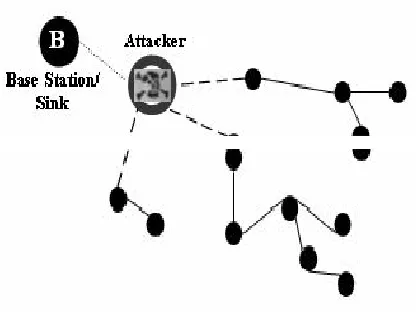
In this type of attack, attacker places himself in a network with high capability resources (high
processing power and high band width) by which it always creates shortest path. As a result, all data
passes through attacker‟s node.
Figure 3: Conceptual view of Black hole Attack
E. ‘Hello flood’ Attack
This is one of the simplest attack in wireless sensor networks in which attacker broadcasts HELLO
packets with high transmission power to sender or receiver. The nodes receiving the messages assume
that the sender node is nearest to them and sends packets by this node. By this attack congestion occurs in
F. Wormhole Attack
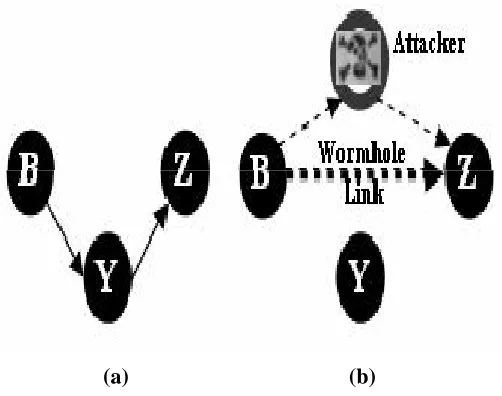
Wormhole attack is a critical attack in which the attacker records the packets (or bits) at one location
in the network and tunnels those to another location.
(a) (b)
Figure 4: Wormhole Attack
packet, the attacker receives this packet and replays it in its neighborhood. Each neighboring node
receiving this replayed packet will consider itself to be in the range of Node B, and will mark this node as
its parent. Hence, even if the victim nodes are multi-hop apart from B, attacker in this case convinces
them that B is only a single hop away from them, thus creates a wormhole.
IV. SECURITY MECHANISM
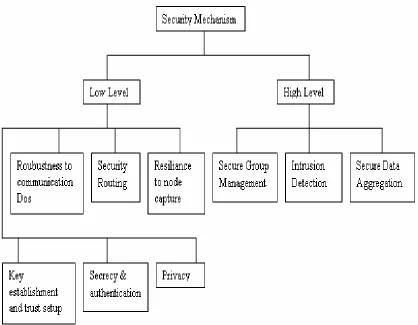
The security mechanisms are actually used to detect, prevent and recover from the security attacks. A
wide variety of security schemes can be invented to counter malicious attacks and these can be
Figure 5: Security mechanisms
A. Low-Level Mechanism
Low-level security primitives for securing sensor networks includes,
1. Key establishment and trust setup
2. Secrecy and authentication
3. Privacy
4. Robustness to communication denial of service
5. Secure routing
1) Key establishment and trust setup
The primary requirement of setting up the sensor network is the establishment of cryptographic
keys. Generally the sensor devices have limited computational power and the public key cryptographic
primitives are too expensive to follow. Key-establishment techniques need to scale to networks with
hundreds or thousands of nodes. In addition, the communication patterns of sensor networks differ from
traditional networks; sensor nodes may need to set up keys with their neighbors and with data aggregation
nodes. The disadvantage of this approach is that attackers who compromised sufficiently and many nodes
could also reconstruct the complete key pool and break the scheme.[1]
2) Secrecy and authentication
Most of the sensor network applications require protection against eavesdropping, injection, and
modification of packets. Cryptography is the standard defense. Remarkable system trade-offs arise when
incorporating cryptography into sensor networks. For point-to-point communication[12],end-to-end
cryptography achieves a high level of security but requires that keys be set up among all end points and
be incompatible with passive participation and local broadcast. Link-layer cryptography with a network
wide shared key simplifies key setup and supports passive participation and local broadcast, but
intermediate nodes might eavesdrop or alter messages. The earliest sensor networks are likely to use link
layer cryptography, because this approach provides the greatest ease of deployment among currently
available network cryptographic approaches.[6]
3) Privacy
Like other traditional networks, the sensor networks have also force privacy concerns. Initially
the sensor networks are deployed for legitimate purpose might subsequently be used in unanticipated
ways. Providing awareness of the presence of sensor nodes and data acquisition is particularly important.
[1]
4) Robustness to communication denial of service
An adversary attempts to disrupt the network’s operation by broadcasting a high-energy signal. If the transmission is powerful enough, the entire system’s communication could be jammed. More
sophisticated attacks are also possible; the adversary might inhibit communication by violating the 802.11
medium access control (MAC) protocol by, say, transmitting while a neighbor is also transmitting or by
5) Secure routing
Routing and data forwarding is a crucial service for enabling communication in sensor networks.
Unfortunately, current routing protocols suffer from many security vulnerabilities. For example, an
attacker might launch denial of- service attacks on the routing protocol, preventing communication. The
simplest attacks involve injecting malicious routing information into the network, resulting in routing
inconsistencies. Simple authentication might guard against injection attacks, but some routing protocols
are susceptible to replay by the attacker of legitimate routing messages. [6]
6) Resilience to node capture
One of the most challenging issues in sensor networks is resiliency against node capture attacks.
In most applications, sensor nodes are likely to be placed in locations easily accessible to attackers. Such
exposure raises the possibility that an attacker might capture sensor nodes, extract cryptographic secrets,
modify their programming, or replace them with malicious nodes under the control of the attacker.
Tamper-resistant packaging may be one defense, but it’s expensive, since current technology does not
provide a high level of security. Algorithmic solutions to the problem of node capture are preferable.[1]
B. High-Level Mechanism
High-level security mechanisms for securing sensor networks, includes secure group management,
intrusion detection, and secure data aggregation.
1) Secure group management
Each and every node in a wireless sensor network is limited in its computing and communication
capabilities. However, interesting in-network data aggregation and analysis can be performed by groups
of nodes. For example, a group of nodes might be responsible for jointly tracking a vehicle through the
network. The actual nodes comprising the group may change continuously and quickly. Many other key
services in wireless sensor networks are also performed by groups. Consequently, secure protocols for
group management are required, securely admitting new group members and supporting secure group
communication. The outcome of the group key computation is normally transmitted to a base station. The
2) Intrusion detection
Wireless sensor networks are susceptible to many forms of intrusion. Wireless sensor networks
require a solution that is fully distributed and inexpensive in terms of communication, energy, and
memory requirements. The use of secure groups may be a promising approach for decentralized intrusion
detection.[1]
3) Secure data aggregation
One advantage of a wireless sensor network is the fine grain sensing that large and dense sets of
nodes can provide. The sensed values must be aggregated to avoid overwhelming amounts of traffic back
to the base station. For example, the system may average the temperature of a geographic region, combine
sensor values to compute the location and velocity of a moving object, or aggregate data to avoid false
alarms in real-world event detection. Depending on the architecture of the wireless sensor network,
aggregation may take place in many places in the network. All aggregation locations must be secured.[6]
V. Conclusion
The deployment of sensor nodes in an unattended environment makes the networks vulnerable.
Wireless sensor networks are increasingly being used in military, environmental, health and commercial
applications. Sensor networks are inherently different from traditional wired networks as well as wireless
ad-hoc networks. Security is an important feature for the deployment of Wireless Sensor Networks. This
paper summarizes the attacks and their classifications in wireless sensor networks and also an attempt has
been made to explore the security mechanism widely used to handle those attacks.
REFERENCES
[1] Adrian Perrig, John Stankovic, David Wagner, “Security in Wireless Sensor Networks”
Communications of the ACM, Page53-57, year 2004
[2] Al-Sakib Khan Pathan, Hyung-Woo Lee, Choong Seon Hong, “Security in Wireless Sensor Networks:
Issues and Challenges”, International conference on Advanced Computing Technologies, Page1043-1045,
year 2006
[3] Chris Karlof, David Wagner, “Secure Routing in Wireless Sensor Networks: Attacks and
Countermeasures”, AdHoc Networks (elsevier), Page: 299-302, year 2003
[5] S. Basagni, K. Herrin, D. Bruschi, and E. Rosti.“Secure pebblenets.” In Proceedings of the 2001 ACM
International Symposium on Mobile Ad Hoc Networking and Computing, pages 156-163. ACM Press,
October 2001.
[6] S. Rajasegarar, C. Leckie, and M. Palansiwami, "Anomaly detection in wireless sensor networks",
IEEE Wireless Communications, vol. 15, no. 4, Aug. 2008, pp. 34-40.
[7] Yun Zhou, Yuguang Fang, Yanchao Zhang, Securing Wireless Sensor Networks: A Survey, IEEE
Communications Surveys & Tutorials, year 2008
[8]Y. Wang, G. Attebury, and B. Ramamurthy, “A Survey of Security Issues in Wireless Sensor Networks, ” IEEE Commun. Surveys Tutorials, vol. 8, pp. 2– 23, year 2006.
[9] Malan D. J., Welsh M., and Smith M. D.,” A public-key infrastructure for key distribution in tinyos based on elliptic curve cryptography” In First IEEE International Conference on Sensor and Ad Hoc
Communications and Networks SECON04, 2004.
[10] Wen Hu, Peter Corke, Wen Chan, et al., “secFleck: A Public Key Technology Platform for Wireless