Laconic Conditional Disclosure of Secrets and Applications
Nico D¨ottling∗ Sanjam Garg† Vipul Goyal‡ Giulio Malavolta§
Abstract
In a Conditional Disclosure of Secrets (CDS) a verifier V wants to reveal a messagem
to a proverP conditioned on the fact thatxis an accepting instance of some NP-language L. An honest prover (holding the corresponding witnessw) always obtains the message m
at the end of the interaction. On the other hand, ifx /∈ Lwe require that no PPT P∗ can learn the messagem. We introduce laconic CDS, a two round CDS protocol with optimal
computational cost for the verifier V and optimal communication cost. More specifically, the verifier’s computation and overall communication grows withpoly(|x|, λ,log(T)), where
λis the security parameter andT is the verification time for checking thatx∈ L(givenw). We obtain constructions of laconic CDS under standard assumptions, such as CDH or LWE. Laconic CDS serves as a powerful tool for maliciousifying semi-honest protocols while preserving their computational and communication complexities. To substantiate this claim, we consider the setting of non-interactive secure computation: Alice wants to publish ashort
digest corresponding to a privatelarge inputxon her web page such that (possibly many) Bob, with a private inputy, can send ashort message to Alice allowing her to learnC(x, y) (where C is a public circuit). The protocol must be reusable in the sense that Bob can engage in arbitrarily many executions on the same digest. In this context we obtain the following new implications.
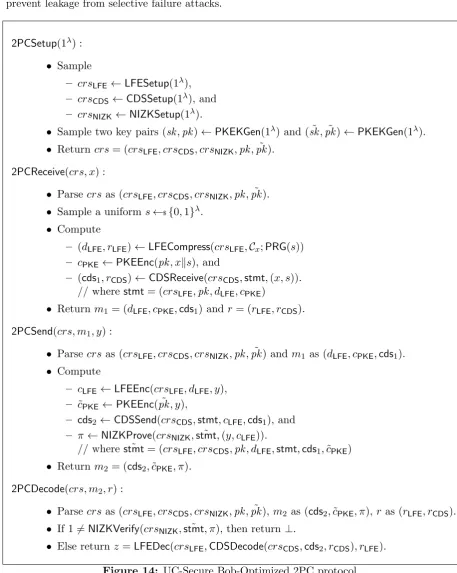
(1) UC Secure Bob-optimized 2PC: We obtain a UC secure protocol where Bob’s compu-tational cost and the communication cost of the protocol grows withpoly(|x|,|y|, λ, d), wheredis the depth of the computed circuitC.
(2) Malicious Laconic Function Evaluation: Next, we move on to the setting where Alice’s input x is large. For this case, UC secure protocols must have communication cost growing with |x|. Thus, with the goal of achieving better efficiency, we consider a weaker notion of malicious security. For this setting, we obtain a protocol for which Bob’s computational cost and the communication cost of the protocol grows with poly(|y|, λ, d), wheredis the depth of the computed circuitC.
∗
CISPA Helmholtz Center for Information Security. †
University of California, Berkeley. Supported in part from AFOSR Award FA9550-19-1-0200, AFOSR YIP Award, NSF CNS Award 1936826, DARPA and SPAWAR under contract N66001-15-C-4065, a Hellman Award and research grants by the Okawa Foundation, Visa Inc., and Center for Long-Term Cybersecurity (CLTC, UC Berkeley). The views expressed are those of the authors and do not reflect the official policy or position of the funding agencies.
‡
Carnegie Mellon University. Supported in part by NSF grant 1916939, a gift from Ripple, a JP Morgan Faculty Fellowship, and a Cylab seed funding award.
§
1
Introduction
Consider the following setting: Alice would like to publish a digest h corresponding to her private datax on her web page. Next, Bob (with a private input y) would like to send a short
message to Alice, so that she learns C(x, y) for some public circuit C. As is standard in secure computation, Alice and Bob want to achieve this result while keeping their respective inputs hidden from each other. Analogous to Bob’s message, Charlie or any other party could reuse
h provided by Alice on her web page. This non-interactive nature of Alice’s message makes this setting highly desirable and has been extensively studied in cryptography [IKO+11]. This primitive is commonly referred to as non-interactive secure computation.
Bob-Optimization. Unfortunately, traditional cryptographic techniques for realizing the above task require Bob’s computational complexity to grow with |C|and|x|(in addition toy), which is undesirable in several settings. In particular, since only Alice learns the output of the computation, Bob might find it unfair that he has to perform the computation of |C|. In other words, Bob might be happy to see Alice learn the output of the computation, but may not be willing to take on doing the computation himself. For example, consider the case where Alice’s input is her genomic sequence and Bob would like to help Alice to learn how likely she is to have cancer while keeping the logic that he is using to make predictions secret.
Making the problem more challenging, computational constraints on Bob imply additional constraints on the sizes of Alice’s digest and Bob’s message, which must now also be small. Constructing such Bob-optimized protocols has been the focus of several recent results such as laconic function evaluation [QWW18] and laconic oblivious transfer [CDG+17]. Our setting is inspired by these works. In particular, prior work on laconic function evaluation [QWW18] also considers the problem of non-interactive secure computation, which is computationally optimized for Bob. However, these results are limited to the semi-honest setting and need non-falsifiable assumptions [Kil92, Mic94, Gro10, BCCT13, GGPR13] to upgrade security to the malicious setting. This brings us to the following question:
Can we realize maliciously secure Bob-optimized non-interactive secure computation from standard assumptions?
Bob-Optimization with Large Inputs. Next, we consider the more demanding setting, where Alice’s input x itself might be very large. As before, Bob might be happy to see Alice learning the output of the computation, but may find readingxhimself prohibitively expensive. This could be especially prohibitive if Bob interacts with multiple users, all playing the role of Alice. For example, the FBI (playing as Alice) could hold a huge database of passenger names on the no-fly list. An an airline company (playing as Bob) might want to help the FBI check if any of the passengers on one of its flights is on the list. Here the airline company would prefer to perform computation independent of the FBI’s database. This is a special case of the very important and well-studied problem of private set intersection (PSI) [FNP04]. This brings us to the following question:
Can we realize maliciously secure Bob-optimized non-interactive secure computation when Alice has a large input from standard assumptions?
Reverse Delegation. One can view our setting as a reverse delegation scheme. In a delegation scheme, a user outsources its computation to an untrusted server with the goal of learning the output (possibly while even keeping it private). In contrast, our applications allow a user (Bob) to delegate its computation to the untrusted server (Alice) while also letting it learn the output of the computation, and nothing beyond that.
1.1 Our Results
In this work we introduce the notion of laconic conditional disclosure of secrets (CDS). In a CDS protocol a verifierV wants to reveal a message m to a proverP conditioned on the fact that x
is an accepting instance of some NP-languge L. An honest prover (holding the corresponding witness w) always obtains the message m at the end of the interaction. On the other hand if
x /∈ L we require that no (possibly corrupted) P∗ can learn the messagem. CDS can be seen as the two round analog of witness encryption [GGSW13]. The new constraint that we impose is that the interaction has to be laconic in the sense that it should not depend on the size of the parties inputs, and in particular on the size of the witness w. Additionally, the verifier computation must be much smaller than recomputing the relation. More specifically, verifier’s computation and overall communication grows withpoly(|x|, λ,log(T)), where λis the security parameter andT is the verification time for checking that x∈ L(givenw).
Next, we obtain constructions of laconic CDS in the common reference string model under standard assumptions, such as CDH or (standard) LWE. Laconic CDS serves as a powerful tool for maliciousifying semi-honest protocols while preserving their computational and communi-cation complexities. To demonstrate this power, we show applicommuni-cation of laconic CDS to the above-mentioned settings:
(1) Bob-optimized 2PC:We obtain a UC secure protocol where Bob’s computational cost and the communication cost of the protocol grows withpoly(|x|,|y|, λ, d), wheredis the depth of the computed circuit C. This protocol achieves UC-security [Can01] and security is based on the LWE assumption.
(1) Malicious Laconic Function Evaluation: Next, we consider the more demanding setting where Alice’s inputx is large. For this case, UC secure protocols must have communica-tion cost growing with|x|. Thus, with the goal of achieving better efficiency, we consider a weaker notion of malicious security which we callcontext security. Context security allows us to rewind parts of the execution while at the same time providing some form of compos-ability and subsumes the standard notion of indistinguishcompos-ability-based security. For this setting, we obtain a protocol for which Bob’s computational cost and the communication cost of the protocol grows withpoly(|y|, λ, d), wheredis the depth of the computed circuit
C. The security of this construction is based on LWE as well. This result can be seen as the malicious variant of the recent work on laconic function evaluation [QWW18].
The above applications demonstrate the power of laconic CDS. We see laconic CDS as a natural primitive and expect it to have other applications. As another example, laconic CDS allows a resource-constrained client to delegate the computation of a large circuit to an untrusted worker and to condition the payment of the worker on the fact that the provided output is the correct one. This does not achieve the notion of verifiable computation in the traditional sense, since the client cannotexplicitly check that the output is correct. However in certain scenarios, e.g., mining in cryptocurrencies, one is interested in rewarding under the condition that some
1.2 Technical Overview
To understand and motivate our techniques it is instructive to discuss a few plausible approaches for constructing laconic CDS and highlight the barriers that they encounter. Below we start with such approaches.
1.2.1 Why Known Techniques Fail
If we were to omit the laconic constraint, then CDS admits a very simple two-round protocol based on two-round oblivious transfer (OT) and Yao’s garbled circuits [Yao86]: The prover encodes the binary representation of its witness as the choice bits in several parallel repetitions of the OT. The verifier garbles the circuit that hardcodes the statement x and the message m
and returns m if and only ifR(·, x) = 1. Then it sends the garbled circuit together with the second message of the OT on input each pair of input label. The prover can locally recover the labels corresponding to its witness and evaluate the circuit learning nothing beyond its output. It is clear that such a solution satisfies our security requirements but falls short in achieving laconic communication since the full circuit encoding of the NP-relation is exchanged between the two parties. At a first glance this seems to be inherent to garbled-circuit based solutions since secure two-party computation with low communication complexity usually requires more sophisticated tools, such as fully-homomorphic encryption [Gen09].
Another plausible angle to attack the problem is to resort to techniques from the field of succinct arguments [Kil92, Mic94]. Then the prover could simply augment a succinct proof with a public key and the verifier would then encrypt the message if the proof correctly verifies. Unfortunately known schemes require at least three rounds of interaction (four without assum-ing a setup) or rely on non-falsifiable assumptions [Gro10, BCCT13, GGPR13]. Constructassum-ing succinct arguments from standard assumptions in less than three rounds seems to hit a road-block: It has been shown [GW11] that non-interactive succinct arguments cannot be based on falsifiable assumptions, at least in a black-box sense.
1.2.2 Our Solution in a Nutshell
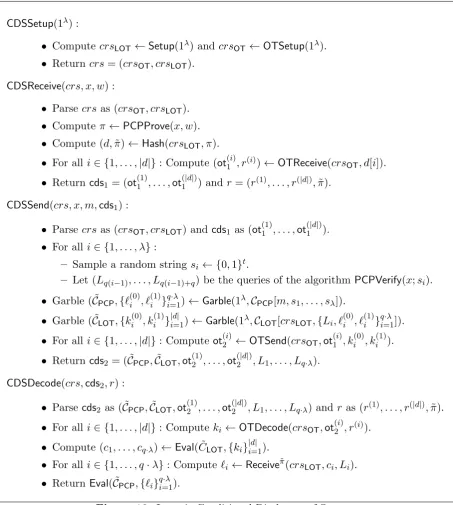
Our starting point is the classical garbled circuit-based solution. A closer look to the source of inefficiency reveals that there are two major challenges to overcome in order to achieve our goal: (1) We need to remove the linear dependency of the OT with respect to the size of the witness and (2) we cannot recompute the full blown NP-relation in the garbled circuit. Our first insight is to bypass the first obstacle using laconic OT [CDG+17]. A laconic OT allows one to hash a long database into a small digest, then the sender can compute the second message of an OT where the choice bit is set to be the value at an arbitrary location of the database. The important message here is that the communication complexity is independent of the size of the database (in our case the witness w). This primitive alone allows us to compress the size of the first message of the CDS. However, laconic OT alone does not buy us anything for the complexity of the second message. Overcoming the second obstacle requires us to borrow techniques from the domain of succinct arguments. The observation here is that checking the validity of an NP-instance does not necessarily require one to recompute the corresponding relation: Probabilistically checkable proofs (PCP) [AS98] encode a witness into a (longer) string such that the membership of the statement can be probabilistically verified by querying a constant amount of bits. Such verification algorithms are inherently erroneous, but the gap can be made negligibly small via standard amplification techniques.
Weak LOT Ind. LOT Context Secure LOT Laconic CDS
Malicious LFE
UC-Secure Bob-Opt. 2PC Laconic OT
CDH LWE PCP LFE
Figure 1: Overview of our Results
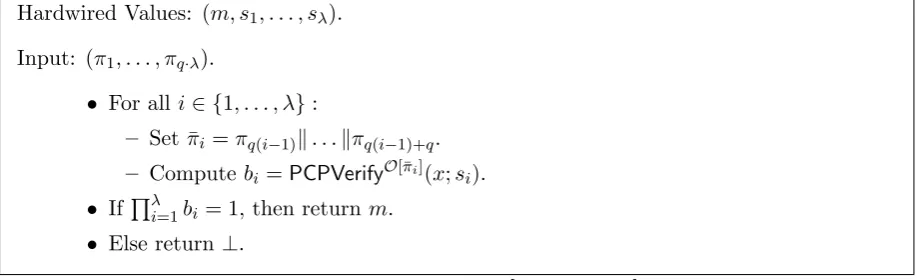
the verifier. The latter then samples a few random locations and garbles a circuit that takes as input the bits of the PCP encoding at such locations and returnsmif the PCP verifier accepts. Then it sends the garbled circuit in plain and the input labels via the laconic OT. This allows the prover to recover the labels corresponding to the bits of the PCP encoding, evaluate the circuit, and eventually recover the message. This introduces a negligible soundness gap, which does not make a difference in our settings as we rely anyway on computational assumptions. The stretch in the size of the witness is also not a problem since the communication complexity of a laconic OT is independent of the size of the database (in our case the PCP encoding).
While this construction seems to solve all problems at once, a closer look to the building blocks reveals the dependency on a maliciously secure laconic OT. Currently, the only known way to construct laconic OT resilient against active attackers is to compile a semi-honest one with succinct arguments. Due to its compressing nature, bypassing the usage of non-falsifiable assumptions in laconic CDS might then appear to be out of reach of current techniques. How-ever, we have now reduced the problem of constructing laconic CDS to that of building laconic OT: In this work we show how to construct maliciously secure laconic OT assuming the hard-ness of CDH or (standard) LWE with polynomial modulo-to-noise ratio. Most of the technical innovations of this work, and the remainder of this section, are devoted to instantiating mali-cious laconic OT from standard assumptions. Looking ahead, this will allow us to construct laconic CDS, which in turn will be used as the main technical component to build malicious LFE and UC-secure Bob-optimized 2PC. An outline of our results is given in Figure 1.
1.2.3 Towards Malicious Laconic OT
Before we delve into the actual instantiations of malicious laconic OT we further simplify the problem by lowering the efficiency and security requirements for a laconic OT.
Our starting point is a recent work by D¨ottling, Garg, Hajiabadi, Masny and Wichs [DGH+19] which constructs maliciously secure oblivious transfer from search assumptions. The main idea in [DGH+19] is to start with a very simple notion of security against malicious receivers and carefully bootstrap this notion to standard simulation based notions. The weakest notion con-sidered in [DGH+19] is called elementary OT, and our basic notion of malicious laconic OT extends this notion to the setting of laconic OT. We refer to this primitive as weak malicious
laconic OT (when it is clear from the context we drop the term malicious). Jumping ahead, we will then show, building on techniques developed in [DGH+19] how to generically upgrade a laconic OT that meets these conditions to a fully efficient and fully secure one. Concretely, we aim for the following guarantees.
output c. This can be seen as the analog of key-encapsulation mechanism, where (k0, k1) are then used as the session keys to transfer the desired messages.
(2) Weak Security: We require that, given the sender messagec, no efficient polynomial-time algorithm can output both k0 and k1 at the same time. This does not guarantee, for instance, that an attacker cannot output the first half of k0 and the second half of k1. This requirement is in fact identical to the notion of elementary sender security considered in [DGH+19].
(3) Weak Efficiency: We consider a laconic OT where the only efficiency constraint is that the receiver message is 2-to-1 compressing. That is, we do not impose any bound on the size of the setup string and of the sender message, which are potentially as long as the database.
1.2.4 Pitfalls of Known Constructions
A natural question to ask is whether existing constructions of semi-honest laconic OT already satisfies any meaningful notion of security in presence of a corrupted receiver. To exemplify the issues that arise, we briefly recall a simplified version of the hash-encryption construction of [DG17]: The public parameters consist of a matrix of uniformly sampled group elements
crs= g (0) 1 , . . . , g
(0)
m g(1)1 , . . . , gm(1)
!
←$G2×m
and the hash of a database Dis computed as
d=
m
Y
i=1
gi(D[i]).
To generate two keys for a positionL, one samples two random random integers (r, s), computes the ciphertext cas the concatenation of the matrices
g1(0)r, . . . , gL(0)r, . . . , gm(0)
r
g(1)1 r, . . . , 1, . . . , gm(1)
r
and
g(0)1 s
, . . . , 1, . . . ,
g(0)m
s
g(1)1
s , . . . ,
g(1)L
s , . . . ,
g(1)m
s
,
then setsk0 =dr and k1 =ds. Security stems from the fact that ifD[L]6=b, then the receiver has to find a different linear combination of elements that yields the samedin order to compute the corresponding key. This however crucially relies on the fact that the receiver always chooses at least one group element per column of thecrs. Consider the following attack wheredis set to be d = g1(0). Then the receiver can recover the keys for both b = {0,1}, when encrypting with respect to someL6= 1. This is because the elementg(0)1 r is always given if L6= 1, then
1.2.5 Construction from CDH
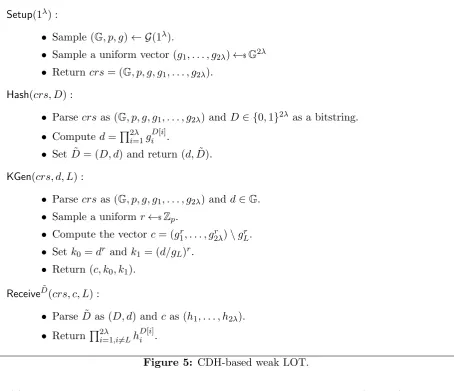
Our approach diverges from prior works and takes a fresh look at the problem. In our scheme the public parameters consist of a vector of group elements sampled uniformly at random
crs= (g1, . . . , gm)←$Gm
and the hash of a database Dis defined as
d=
m
Y
i=1
giD[i].
That is the i-th element of the vector is included in the product if D[i] = 1 and skipped if
D[i] = 0. The subtle difference with respect to previous approaches lies in the fact that even setting d=g1 gives us a perfectly valid hash, which corresponds to the pre-image 1k0m−1. To generate two session keys (k0, k1) for a location L, the sender samples a random integer r and sets the ciphertext to
c= g1r, . . . , grL−1, gLr+1, . . . , gmr
,
i.e., all powers are given except for grL. We now want to define k0 and k1 in such a way that only kD[i] can be recovered using a pre-imageD ofd. To this end we set
k0=dr and k1=dr/grL.
Observe that ifD[L] = 0, then ccontains enough information to recompute
k0 =dr=
m
Y
i=1
gDi [i]·r,
sincegrLwould be excluded from the product anyway. On the other hand if D[L] = 1, then one can only recompute
k1 =dr/grL= m
Y
i=1,i6=L giD[i]·r.
To get an intuition why the scheme is secure for any (possibly maliciously generated) image d, observe that outputting both k0 and k1 also reveals k0/k1 =gLr, regardless of the value of d.
However, gr
L was not given as part of the ciphertext and therefore predicting it, given only c
and crs, is as hard as solving a random instance of the CDH problem.
1.2.6 Construction from LWE
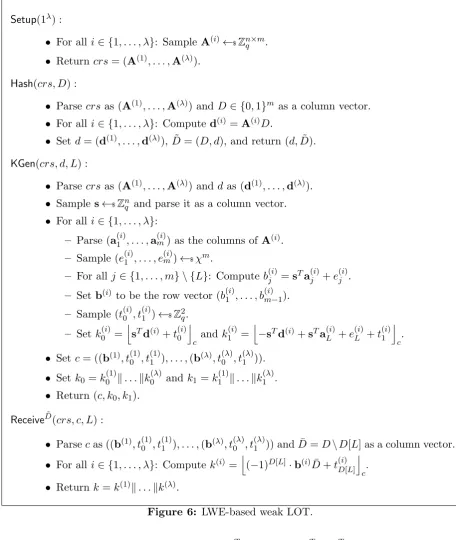
A CDH-based construction is not entirely satisfactory in terms of assumptions since most of the applications of malicious laconic OT (and consequently of laconic CDS) are only known under the hardness of lattice-related problems. If we were to plug in our machinery we would introduce an additional number-theoretic assumption (i.e., CDH), which is not ideal. An additional reason to look into lattice-based schemes is that current cryptanalytic techniques fail even in the quantum settings, whereas there are polynomial-time quantum algorithms to solve discrete logarithm-related problems. For these reasons, we turn our attention to constructing weak malicious laconic OT from the hardness of the LWE problem. The basic idea of our scheme is conceptually simple, but the noisy nature of the LWE problem introduces some complications. The public parameters consist of a single matrix
wheremis the size of the database andnis a parameter that governs the hardness of the LWE problem. Hashing a databaseD∈ {0,1}m(parsed as a column vector) is a simple multiplication
AD=d∈Znq
that is, we take a linear combination of the columns of A depending on the bits ofD. For a given locationL, the sender algorithm samples a column vector s←$Znq and computes a noisy
inner product with each column of A, except for the L-th one. The sender messagec consists of the set
sTa1+e1, . . . ,sTam+em \
sTaL+eL
where the noise vector is sampled from a discrete Gaussian and has small norm. As before we set the keys in such a way that it is easy to compute one, but it is hard to compute both. This is done by setting
k0 =sTd and k1=−sTd+sTaL+eL.
It is important to observe that k0 +k1 = sTaL+eL, which is an LWE sample but it is not
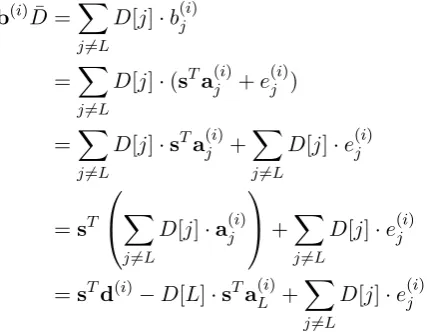
among those included inc. This suggests that outputting both values ofk0 andk1 is equivalent to predicting an LWE sample and it is going to be our central leverage to show the security of the scheme. However, the more challenging part is how to ensure that the receiver is able to recover kD[L]. In contrast to our previous scheme, the naive strategy fails to recover the key due to the presence of the noise. In fact
m
X
i=1,i6=L
ci·D[i] =kD[L]+
m
X
i=1,i6=L
ei·D[i] =kD[L]+ ˜e.
To overcome this issue we exploit the fact that ˜eis relatively small when compared tokD[L]. We then partition Zq inc-many intervals and we set the actual session key to be kb (as computed
above) rounded at the closest multiple of q/c. The key property of this rounding function is that it is resilient to small perturbations, which means that
kD[L]+ ˜e
c=
kD[L]
c
with high probability, for a small enough ˜e. This strategy introduces a few issues, among others the fact that the output of the rounding function is not long enough to argue about unpredictability (i.e., it can be randomly guessed with high enough probability). Fortunately, this issue can be easily circumvented with standard amplification techniques.
1.2.7 Indistinguishability Laconic OT
As discussed before, our notion of security only guarantees that the adversary cannot output both k0 and k1 in their entirety but it does not guarantee that there exists a consistent bit b for which the adversary can always guess kb and never kb⊕1. For example, it could be possible that for a fixed value of d, the adversary is able to predict k0 for half of the support ofc and
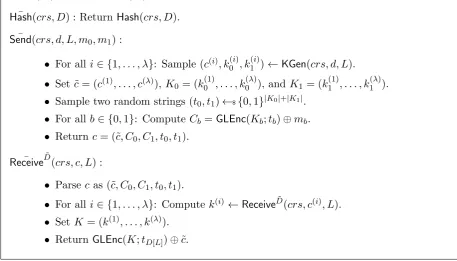
k1 for the complement. To fix this issue, follow the blueprint of [DGH+19] and use techniques developed in the context of hardness amplification of puzzles [CHS05]. The key idea of this step is to amplify the success probability of the adversary via parallel repetitions: By setting the new key to be the concatenation of many independent instances, with high probability at least one of elements will belong to the wrong partition of the support ofc. Thus with high enough probability, the adversary is forced to simultaneously predict two values (k0, k1).
Goldreich-Levin hardcore predicate [GL89]. At this point we can give as input to the sender algorithm any message pair (m0, m1) and implement the standard OT functionality by aug-menting c with k0⊕m0 and k1⊕m1. It is easy to see that at least one of the two messages must be hidden to the eyes of the adversary as the key kD[L]⊕1 acts as a one-time pad. At this point, our security definition looks as follows: We define two experiments (Exp0 and Exp1) where the adversary is allowed to choose a hash d, two messages (m0, m1), and a location L, then the challenger flips a coin b. If b= 0 then the ciphertext c is honestly computed via the sender algorithm on input (L, m0, m1), otherwisem0 (m1 forExp1) is replaced with a uniformly sampled message. The guarantee is that the adversary cannot succeed in both experiments with non-negligible probability.
This gives us a more intuitive security notion but it is still not sufficient for constructing laconic CDS. The reason is that we have no idea whether the adversary is going to be able to succeed in Exp0 or Exp1, for a given value of L. This information is needed by the simulator when using laconic OT in conjunction with garbled circuits: In a reduction against the security of the garbling scheme we need to know in which position we should plug the challenge label, to correctly simulate the view of the adversary. Even worse, determining whether the adversary is successful in Exp0 orExp1, for all locations L, corresponds to extracting the whole database
D! Recall that the hash d of a laconic OT is compressing, therefore its pre-image is not even information-theoretically determined, let alone efficiently computable.
1.2.8 Context-Secure Laconic OT
The final challenge towards constructing malicious laconic OT boils down to extracting the pre-image of any given (possibly maliciously computed) hash. As discussed before, the hash does not even determine the pre-image in an information theoretic sense, so trivial solutions are not applicable. An additional complication is that the protocol is non-interactive, i.e., the receiver outputs a single message and goes offline. Therefore rewinding the receiver also does not seem to help. Of course one could justassume the existence of an extractor, which would however place our solution within the category of non-falsifiable assumptions.
We address this problem by leveraging the distinguisher-dependent simulation technique re-cently developed [JKKR17]. We introduce a new security notion calledcontext security to pro-vide a versatile toolkit which allows to deploy distinguisher-dependent simulation in much more complex settings. While on a technical level we use many of the same techniques as [DGH+19], context security allows us to use distinguisher-dependent simulation to its full effect.
We use distinguisher-dependent simulation in the following way to extract the input of a malicious receiver: A careful look to the indistinguishability-based definition shows that, given black-box access to a malicious receiver, we can determine the bit D[L], by approximating the success probability in Exp0 and Exp1: For a given location L, the experiment where the adversary is successful must correspond to the value of D[L]! Iterating over all locations, we can recover the complete database.
Our main insight is that this technique can be applied to a setting where the overall commu-nication between receiver and sender is too small to information-theoretically specify the input of the receiver. This is in contrast to previous uses of this technique in [JKKR17, DGH+19]. Somewhat counterintuitively, we are able to extract the full pre-image of a short hash in poly-nomial time without resorting to non-falsifiable assumptions. Our new notion of contextcontext security is crafted to precisely characterize the security guarantees we can achieve via distin-guisher dependend simulation.
as input the sender’s message. Security is defined in terms of the existence of an extractor and a simulator: The extractor (with oracle access to the distinguisher) recovers the original input of the receiver and gives enough information to the simulator to simulate the sender message, where the simulator only interacts with the ideal functionality. Additionally, the runtime of the extrac-tor is independent of that of the corrupted receiver (but depends on that of the distinguisher). This enables a meaningful notion of composability since the protocol is required to be remain secure for any context. Since the extractor depends on the distinguisher, context-security does not achieve the same strong guarantees of universal composability (UC) [Can01]. However, in contrast with UC, a protocol can be context-secure even when its transcript does not determine the inputs of the parties in an information theoretic sense. Thus we view context-security as a meaningful relaxation of UC and a versatile tool, instrumental to construct laconic CDS. Fi-nally, we remark that context security implies the standard notion of indistinguishability-based secure computation.
Using ideas developed in [DGH+19] we show that any indistinguishability laconic OT is also context secure. The argument crucially relies on rewinding the distinguisher and measuring its success-probability.
1.2.9 Efficient Laconic OT
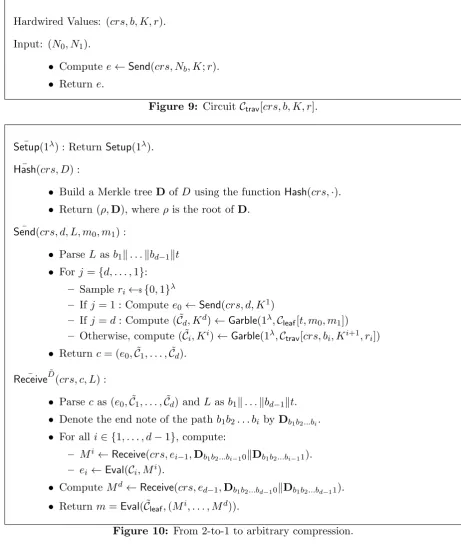
Equipped with a context-secure laconic OT, we can show a bootstrapping theorem in the same spirit as [CDG+17]: Given any 2-to-1 compressing context-secure laconic OT we can construct an equally efficient context-secure laconic OT where the size of the hash (and of the common reference string) is independent of the size of the database. The transformation is identical to that of [CDG+17] and works by hashing the database into a Merkle tree and using a chain of garbled circuit to access the leaf corresponding to the location L. However, the argument is fundamentally different since we cannot assume that the hash is honestly computed. The usefulness of the notion of context security is demonstrated by our bootstrapping theorem. We crucially rely on the recursive application of context extractors to extract an entire Merkle-tree. A critical aspect in this step which avoids an exponential blowup is that the runtime of the context-extractor is independent of the computation of the receiver.
1.3 Applications
We now discuss how laconic CDS can be used as a maliciousifier for two-round protocols: A two round protocol consists of a message m1 from the receiver to the sender and a message
m2 from the sender to the receiver. At the end of the interaction, the receiver performs some computation to retrieve the output of the protocol. Using laconic CDS we can turn a semi-honest two-round protocol into a malicious one (for a corrupted receiver) by augmenting m1 with the first message of a laconic CDS certifying thatm1 is well formed. Then the sender computes the second message of a laconic CDS where the secret is set tom2. That is, the receiver will learn
m2 if and only ifm1 was well-formed. The new properties that our transformation enables are:
(1) The communication complexity of the malicious protocol is identical to that of the semi-honest one.
(2) The computational complexity of the sender is unchanged.
(LFE). In this case we obtain the first maliciously secure Bob-optimized non-interactive secure computation protocol where the communication complexity grows only with the depth of the circuit and with the size of Bob’s input. In other words, the malicious protocol is (asymp-totically) as efficient as the underlying semi-honest LFE. We can even lift the security to the UC-settings, however at the cost of the communication growing with the size of the receiver’s input, which is unavoidable.
Delegating Computation. A less orthodox usage of a laconic CDS is in the context of non-interactive delegation of computation: A client wants to delegate the computation of a large circuit to an untrusted worker and wants some insurance that the output given by the worker is the correct one. The worker performs the computation and obtains the outputz, then computes a laconic CDS that certifies that z is indeed the correct output. On input the first message of the laconic CDS and z, the client conditions the payment of the worker on the fact that z
is computed correctly. This protocol is not verifiable in the traditional sense since the client cannot explicitly check thatz is indeed the correct output. However we can envision scenarios where this is not a limitation. As an example, miners of cryptocurrencies often aggregate in pools, where each peer is rewarded basing on the amount of computation it performed. In this case it is not critical to verify that the output is correct but we are mostly interested in the fact thatsome large circuit has been computed. The miners could of course provide the wrong output and not claim the reward, but it is unclear what would be the incentive to do that.
2
Preliminaries
We denote by λ ∈ N the security parameter. We we say that a function negl is negligible if it vanishes faster than any polynomial. Given a set S, we denote by s←$S the uniform
sampling of an element fromS. We say that an algorithm is PPT if it can be implemented by a probabilistic Turing machine running in time polynomial inλ. We recall two useful inequalities.
Theorem 1 (Hoeffding Inequality). Let (X1, . . . , XN) ∈ [0,1] be i.i.d. random variable with
expectation E[ ¯X]. Then it holds that
Pr
"
1
N N
X
i=1
Xi−E[ ¯X]
> δ #
≤2e−2N δ2.
Lemma 1 (Markov Inequality for Advantages (taken from [DGH+19])). Let A(Z) and B(Z)
be two random variables depending on a random variable Z and potentially additional random choices. Assume that |PrZ[A(Z) = 1]−PrZ[B(Z) = 1]| ≥ε≥0. Then
Pr
Z[|Pr[A(Z) = 1]−Pr[B(Z) = 1]| ≥ε/2]≥ε/2.
Proof. Leta:= PrZ[|Pr[A(Z) = 1]−Pr[B(Z) = 1]| ≥ε/2]. We haveε≤a×1 + (1−a)×ε/2.
Since 0≤1−a≤1, we obtain ε≤a+ε/2. The inequality now follows.
2.1 Probabilistically Checkable Proofs
Probabilistic checkable proofs (PCP) [AS98] are a central tool in complexity theory. The PCP theorem shows that any witness w for an NP-statement can be encoded into a PCP of length
poly(|w|) such that it is sufficient to probabilistically test O(1) bits of the encoded witness.
PCPProve(x, w) → π : On input a statement x ∈ L and the corresponding witness w, the proving algorithm returns an encoding π.
PCPVerifyπ(x)→ {0,1}: On input a statement x and with random access to the encoding π, the verification algorithm returns a bit {0,1}.
Correctness is defined canonically.
Definition 2 (Correctness). A PCP (PCPProve,PCPVerify) is correct if for all (x, w) ∈ R it holds that
Pr [PCPVerifyπ(x) = 1|π ←PCPProve(x, w)] = 1
where the probability is taken over the random coins of PCPVerify.
The central efficiency measure for a PCP is the number of queries that the verifier issues to the encoding, i.e., the amount of bits that the verifier needs to read before producing his output. This amount (which we denote by q) can be as low as 3 queries. We consider without loss of generality PCPs where the verifier is non-adaptive, i.e., the bits queried do not depend on previous answers. Note that any query adaptive PCP can be turned into a constant-query non-adaptive PCP by constant-querying all possible bits for a given random tape (introducing a constant factor in the query complexity). Another important parameter for a PCP is the amount of random coins needed by the verifier, which is bounded by the PCP theorem to be at mostt=O(log(|π|)) =O(log(λ)). We now state the soundness property.
Definition 3 (Soundness). A PCP(PCPProve,PCPVerify) is sound if for all x /∈ Land for all
π it holds that
Pr [PCPVerifyπ(x) = 1]<1/3
where the probability is taken over the random coins of PCPVerify.
It is well known that the success probability can be amplified to a negligible fraction (in the security parameter) by parallel repetition. Additionally we say that a PCP iswitness-extractable
if there exists a PPT algorithmPCPExtand a constantγ such that, on input a PCP encodingπ
that passes the PCP test with probability at least (1−γ), the algorithm outputs a valid witness
w for x. This additional property can be obtained for γ = 2/3 and an explicit construction appears in [Val08].
2.2 Intractable Problems
In the following we introduce some hard problems in cryptography that are going to be useful for our work.
2.2.1 Computational Diffie-Hellman
We recall the search version of the classical Diffie-Hellman problem [DH76]. LetG be a (prime-order) group generator that takes as input the security parameter and 1λ and outputs (G, p, g),
whereGis the description of a multiplicative cyclic group,p is the order of the group, andg is
a generator of the group.
Definition 4 (Computational Diffie-Hellman (CDH) assumption). We say that G satisfies the CDH assumption (or is CDH-hard) if for any PPT adversary A it holds that
Pr[A(G, p, g, ga1, ga2) =ga1a2] =negl(λ)
2.2.2 Learning with Errors
The learning with errors (LWE) problem was introduced by Regev [Reg05]. In this work we exclusively use the decisional version, since there exists a well known reduction to the search variant of the problem.
Definition 5(Learning with Errors (LWE) assumption). The LWEn,n,q,χ˜ problem, for(n,˜n, q) ∈ N and for a distribution χ supported over Z, is to distinguish between the distributions
(A,sA+e mod q) and (A,u), where A←$Zqn×n˜, s←$Znq, e←$χn˜, and u←$Z˜nq. Then, the
LWEn,n,q,χ˜ assumption is that the two distributions are computationally indistinguishable.
The assumption is consider to hold for any ˜n=poly(n,log(q)) and we denote this problem by LWEn,q,χ. As shown in [Reg05, PRS17], the LWEn,q,χ problem with χ being the discrete
Gaussian distribution with parameter σ = αq ≥ 2√n (i.e. the distribution over Z where the
probability ofxis proportional toe−π(|x|/σ)2), is at least as hard as approximating the shortest independent vector problem (SIVP) to within a factor ofγ = ˜O(n/α) inworst case dimensionn
lattices. This is proven using a quantum reduction. Classical reductions (to a slightly different problem) exist as well [Pei09, BLP+13] but with somewhat worse parameters. The best known (classical or quantum) algorithms for these problems run in time 2O˜(n/log(γ)), and in particular they are conjectured to be intractable for γ=poly(n).
A discrete gaussian with parameterαqisB =αqbounded, except with negligible probability. For parameterαthe worst-to-average case reduction of [Reg05] gives a worst-case approximation factor of ˜O(n/α) for SIVP. Consequently, in terms of the boundB and the modulusq we get a worst-case approximation factor of ˜O(nq/B) for SIVP.
2.3 Pseudorandom Generator
A pseudorandom generator (PRG) [ILL89] stretches random strings into random-looking strings.
Definition 6 (Pseudorandom Generator). A PRG PRG :{0,1}λ → {0,1}m is pseudorandom
if m > λand for all PPT adversaries A there exists a negligible function negl such that
|Pr [1← A(r)]−Pr [1← A(PRG(s))]|=negl(λ)
where r←${0,1}m and s←${0,1}λ.
2.4 Garbled Circuits
We recall the definition of Yao’s garbled circuits [Yao86]. A garbling scheme allows one to obfuscate a circuit and provide enough information to learn a single output and nothing more. Garbled circuits can be constructed assuming the existence of one-way functions only.
Definition 7(Garbled Circuits). A garbling scheme is a tuple of PPT algorithms(Garble,Eval)
defined as follows:
Garble(1λ,C)→( ˜C,{`(0)i , `(1)i }n
i=1) : The garbling algorithm takes as input the security
parame-ter1λ and the description of a circuitC and returns a garbled circuitC˜and a set of labels
{`(0)i , `(1)i }n
i=1 for each input wire of the circuit.
Eval( ˜C,{`(ixi)}n
i=1) → y : The evaluation algorithm takes as input a garbled circuit C˜and one
label per input wire `(ixi) and returns an outputy.
Definition 8 (Correctness). A garbling scheme (Garble,Eval) is correct if for allλ∈N, for all polynomial size circuits C with input length n, and for all inputsx∈ {0,1}n it holds that
PrhC(x) =Eval( ˜C,{`(ixi)}ni=1)
( ˜C,{`
(0)
i , `
(1)
i }ni=1)←Garble(1λ,C)
i
= 1
where the probability is taken over the random coins of Garble.
Security requires that the evaluation of a circuit reveals nothing beyond its output.
Definition 9 (Security). A garbling scheme (Garble,Eval) is secure if for all λ∈N there exists a PPT algorithm GCSim such that for all PPT attacker A = (A1,A2) there exists a negligible function negl such that
Pr "
1← A2( ˜C,{`(ixi)}n i=1,st)
(C, x,st)← A1(1λ) ( ˜C,{`(0)i , `(1)i }n
i=1)←Garble(1λ,C)
#
−
Pr
1← A2( ˜C,{`i}ni=1,st)
(C, x,st)← A1(1λ)
( ˜C,{`i}ni=1)←GCSim(1λ,|C|,C(x))
=negl(λ)
where the probability is taken over the random coins of A1, Garble, and GCSim.
2.5 Public Key Encryption
We recall the notion of public-key encryption [GM82].
Definition 10 (Public-Key Encryption). A public-key encryption scheme PKE= (PKEKGen, PKEEnc,PKEDec) is defined as the following tuple of efficient algorithms.
PKEKGen(1λ) → (sk,pk) : On input the security parameter 1λ the key generation algorithm returns a secret key sk and a public key pk .
PKEEnc(pk, m) → c : On input a public key pk and a message m, the encryption algorithm returns a ciphertext c.
PKEDec(sk, c) → m : On input a secret key sk and a ciphertext c, the decryption algorithm returns a message m.
We require the scheme to be perfectly correct. It is well known that perfectly correct public-key encryption can be constructed from CDH [ElG84] or LWE [Reg05].
Definition 11(Correctness). A public-key encryption schemePKE= (PKEKGen,PKEEnc,PKEDec)
is correct if for all λ∈N and for all messagesm it holds that
Pr
m=PKEDec(sk, c)
(sk,pk)←PKEKGen(1λ)
c←PKEEnc(pk, m)
= 1
and the probability is taken over the random coins of PKEKGen and PKEEnc.
We recall the definition of semantic security.
Definition 12(Security). A public-key encryption schemePKE= (PKEKGen,PKEEnc,PKEDec)
is semantically secure if for all λ ∈ N and for all admissible PPT adversaries A = (A1,A2)
there exists a negligible function negl such that
Pr
1← A2(c,st)
(sk,pk)←PKEKGen(1λ) (m0, m1,st)← A1(pk)
c←PKEEnc(pk, m0)
−
Pr
1← A2(c,st)
(sk,pk)←PKEKGen(1λ) (m0, m1,st)← A1(pk)
c←PKEEnc(pk, m1)
where A is admissible if m0 and m1 have equal length and the probabilities are taken over the
random coins of PKEKGen, A1, andPKEEnc.
2.6 Non-Interactive Zero-Knowledge
We define non-interactive zero-knowledge (NIZK) [BFM88]. NIZKs have been constructed from trapdoor permutation [FLS90] or, very recently, from LWE [PS19].
Definition 13 (Non-Interactive Zero-Knowledge). A NIZK NIZK = (NIZKSetup,NIZKProve, NIZKVerify)for an NP-languageLwith relationRis defined as the following tuple of algorithms.
NIZKSetup(1λ) → crs : On input the security parameter 1λ the setup algorithm returns a common reference string crs.
NIZKProve(crs, x, w) → π : On input the common reference string crs, a statement x and a witness w, the proving algorithm returns a proof π.
NIZKVerify(crs, x, π)→ {0,1}:On input the common refrence stringcrs, a statmentx, and a proof π, the verifier algorithm returns a bit{0,1}.
Correctness is defined in a standard way.
Definition 14 (Correctness). A NIZK scheme NIZK = (NIZKSetup,NIZKProveNIZKVerify) is correct if for all λ∈Nand for all pairs (x, w)∈ R it holds that
Pr
1 =NIZKVerify(crs, x, π)
crs←NIZKSetup(1λ)
π←NIZKProve(crs, x, w)
= 1
and the probability is taken over the random coins of NIZKSetup and NIZKProve.
We require that proofs for statements not in the language are hard to find.
Definition 15 (Soundness). A NIZK scheme NIZK = (NIZKSetup,NIZKProve,NIZKVerify) is sound if for all λ∈ N, for all PPT adversaries A, and for all x /∈ L, there exists a negligible
function negl such that
Pr
1 =NIZKVerify(crs, x, π∗)
crs←NIZKSetup(1λ)
π∗← A(crs, x)
=negl(λ)
and the probability is taken over the random coins of NIZKSetup and A.
We define the classical notion of simulation-based zero-knowledge.
Definition 16(Zero-Knowledge). A NIZK schemeNIZK= (NIZKSetup,NIZKProve,NIZKVerify)
is zero-knowledge if there exists a PPT simulator NIZKSim= (NIZKSim1,NIZKSim2) such that
for all λ∈N, all (x, w)∈ R, and all PPT adversariesA it holds that
Pr
1← A(crs, π)
crs←NIZKSetup(1λ) π←NIZKProve(crs, x, w)
−
Pr
1← A(crs, π)
(crs,td)←NIZKSim1(1λ)
π←NIZKSim2(crs,td, x)
=negl(λ)
where the probabilities are taken over the random coins of NIZKSetup, NIZKProve, NIZKSim1,
NIZKSim2, andA.
Fcrs interacts with a set of parties (P1, . . . , Pn) and an adversary and it is parametrized by a
distributionD:
(1) On input (sid, Pi, Pj) from party Pi, samplecrs←$D and send (sid, crs) toPi and
(sid, crs, Pi, Pj) to Pj.
(2) On input (sid, Pi, Pj) from party Pj, check if sid was already used and return
(sid, crs) to Pj and the adversary in case; otherwise send nothing.
Figure 2: Ideal Functionality Fcrs [CR03].
3
Universal Composability
We give a brief overview of the definition of UC-security [Can01] with static corruption and we establish some terminology. The following assumes familiarity with the basic concepts of UC-security and we refer the reader to [Can01] for a comprehensive discussion on the matter. We denote the environment by Z. For a real protocol Π and an adversary A we writeEXECΠ,A,Z
to denote the ensemble corresponding to the protocol execution. For an ideal functionality F and an adversary Sim we write IDEALF,Sim,Z to denote the distribution ensemble of the ideal
world execution.
Definition 17(Security). A protocolΠUC-realizes a functionalityF if for all PPT adversaries
A corrupting a subset of parties there exists a simulator Sim such that for all environments Z
it holds that the following ensembles
EXECΠ,A,Z ≈IDEALF,Sim,Z
are computationally indistinguishable.
Since all of our protocols will be in the common reference string model we define the corre-sponding functionality in Figure 2.
3.1 Two-Round Oblivious Transfer
In the following we define the notion of UC-secure two-round oblivious transfer (OT). Two-round OT can be realized from a wide range of assumptions, including CDH [DGH+19] and LWE [PVW08]. The syntax is given below and the corresponding ideal functionality is shown in Figure 3.
Definition 18(Oblivious Transfer). A two-round string-OTOT= (OTSetup,OTSend,OTReceive, OTDecode) is defined as the following tuple of algorithms.
OTSetup(1λ) →crs: On input the security parameter 1λ, the generation algorithm returns a common reference string crs.
OTReceive(crs, b) → (ot1, r) : On input the common reference string crs and a bit b, the
receiver algorithm returns a first messageot1 and a state r.
OTSend(crs,ot1, m0, m1) → ot2 : On input the common reference string crs, a first message
ot1, and a pair of strings (m0, m1) ∈ {0,1}2λ, the sender algorithm returns a second
FOT interacts with an ideal senderS and an ideal receiverR as follows:
(1) On input (sid,send, m0, m1) from the sender, store (m0, m1).
(2) On input (sid,receive, b) from the receiver, check if some inputs (m0, m1) have been recorded forsid. If this is the case, sendmb to the receiver andsid to the adversary;
otherwise send nothing.
Figure 3: Ideal Functionality FOT.
OTDecode(crs,ot2, r)→m:On input the common reference string crs, a second message ot2,
and the receiver state r, the decoding algorithm returns a message m.
Correctness is given in the following.
Definition 19 (Correctness). A string-OTOT= (OTSetup,OTSend,OTReceive,OTDecode)is correct if for all λ∈N, for all bits b∈ {0,1}, and any pair of messages (m0, m1) ∈ {0,1}2λ it
holds that
Pr
mb =OTDecode(crs,ot2, r)
crs←OTSetup(1λ)
(ot1, r)←OTReceive(crs, b)
ot2←OTSend(crs,ot1, m0, m1)
= 1
where the probability is taken over the random coins of OTSetup, OTReceive, and OTSend.
3.2 Two-Round Two-Party Computation
We define two-party computation (2PC) and we focus on the case where the protocol consists of a single message per party. Constructing a UC-secure protocol (with sublinear communication) is going to be one of the main objective of this work. The ideal functionality is given in Figure 4.
Definition 20 (Two-Party Computation). A 2PC protocol 2PC = (2PCSetup,2PCReceive, 2PCSend,2PCDecode) is defined with respect to a function f and consists of the following algo-rithms.
2PCSetup(1λ)→crs: On input the security parameter 1λ, the generation algorithm returns a common reference string crs.
2PCReceive(crs, x)→(m1, r) :On input the common reference string crsand an input x, the
receiver algorithm returns a first messagem1 and a state r.
2PCSend(crs, m1, y) → m2 : On input the common reference string crs, a first message m1,
and an input y, the sender algorithm returns a second message m2.
2PCDecode(crs, m2, r)→z:On input the common reference string crs, a second messagem2,
and the state r, the decoding algorithm returns a message z.
Correctness is given in the following.
Definition 21(Correctness). A 2PC protocol2PC= (2PCSetup,2PCReceive,2PCSend,2PCDecode)
is correct if for all λ∈N, for all inputs (x, y) it holds that
Pr
f(x, y) =2PCDecode(crs, m2, r)
crs←2PCSetup(1λ)
(m1, r)←2PCReceive(crs, x)
m2←2PCSend(crs, m1, y1)
= 1
F2PC is parametrized by a function f and interacts with an ideal pair of parties (P1, P2) as follows:
(1) On input (sid,receive, x) from the P1, store x.
(2) On input (sid,send, y) fromP2, check if some input xhave been recorded for sid. If this is the case, sendf(x, y) toP1 andsid to the adversary; otherwise send nothing.
Figure 4: Ideal Functionality F2PC.
4
Laconic Cryptography
In this section we define the main objects of interest of our work. All of the primitives that we consider are in the common reference string (CRS) model.
4.1 Laconic Oblivious Transfer
In the following we introduce laconic oblivious transfer (LOT), the main object of interest of our work [CDG+17]. For presentation purposes, we define two variants of LOT with different efficiency and security requirements. Looking ahead, we will show a generic transformation, thereby simplifying the task of designing a LOT scheme to its simplest flavour.
As discussed by Cho et al. [CDG+17], we can ignore any security requirement on the receiver side: Although some bits of the database could be leaked, any LOT scheme can be generically upgraded to achieve receiver security through a generic transformation, i.e., by running the LOT under a 2PC protocol. In contrast to our work, Cho et al. [CDG+17] also considers the property of updatability for a LOT, which allows one to modify a bit of the database and update the digest in a significantly more efficient way than computing it from scratch. Since it is not relevant for our applications, we omit this property.
4.1.1 Weak Laconic Oblivious Transfer
A weak LOT scheme is identical to the standard LOT [CDG+17] except that the sender algo-rithm does not take as input two messages but chooses itself two random keys (k0, k1). This can be seen as the analogous to key encapsulation for encryption schemes. The syntax is given in the following.
Definition 22(Weak Laconic Oblivious Transfer). A weak LOTLOT= (Setup,Hash,KGen,Receive)
is defined as the following tuple of algorithms.
Setup(1λ) → crs : On input the security parameter 1λ, the generation algorithm returns a
common reference string crs.
Hash(crs, D)→(d,D˜) :On input the common reference stringcrsand a databaseD∈ {0,1}∗, the hashing algorithm returns a digest dand a state D˜.
KGen(crs, d, L) → (c, k0, k1) : On input the common reference string crs, a digest d, and a
location L ∈ N, the key generation algorithm returns a ciphertext c and a pair of keys
(k0, k1).
The definition of correctness is given in the following.
Definition 23 (Correctness). A weak LOT LOT = (Setup,Hash,KGen,Receive) is correct if for all λ ∈ N, for all databases D of size polynomial in λ, and for all memory locations L ∈ {1, . . . ,|D|} it holds that
Pr
kD[L]=Receive
˜
D(crs, c, L)
crs←Setup(1λ) (d,D˜)←Hash(crs, D) (c, k0, k1)←KGen(crs, d, L)
= 1
where the probability is taken over the random coins of Setup and KGen.
We also consider a weaker notion of correctness where the above probability is bounded from below by 1−1/poly(λ), for some polynomial function poly. We refer to such notion as (1/poly(λ))-correctness. A weak LOT is required to satisfy only a rudimental notion of sender security that we define in the following. Loosely speaking, we require that the adversary is not able to predict both keys (k0, k1) in their entirety.
Definition 24 (Weak Sender Security). A weak LOT LOT = (Setup,Hash,KGen,Receive) is weakly sender secure if for all λ∈N and for all PPT adversaries A= (A1,A2) there exists a
negligible function negl such that
Pr
(k0, k1) =A2(c,st)
crs←Setup(1λ) (d, L,st)← A1(crs)
(c, k0, k1)←KGen(crs, d, L)
=negl(λ)
where the probability is taken over the random coins of Setup, A1, and KGen.
Efficiency. For efficiency, it is only required that the size of the digest d is at most half of that ofD, i.e, the Hash function is 2-to-1 compressing. In particular, there is no bound on the efficiency of the algorithms and on the size of the ciphertext, except for being polynomial in the security parameter. We refer to such notion as semi-efficiency. Jumping ahead, we will show a generic transformation from any semi-efficient LOT to a full-fledged LOT without additional assumptions.
4.1.2 Indistinguishable Laconic Oblivious Transfer
This version of LOT is equivalent to that introduced in [CDG+17], except that we upgrade the definition of sender security to the malicious settings. Note that we consider without loss of generality schemes that transfer a single bit (bit-LOT), which can be turned into multi-bit schemes (string-LOT) by simply computing multiple ciphertexts over the same digest. The security is preserved by a standard hybrid argument.
Definition 25 (Laconic Oblivious Transfer). A LOT LOT = (Setup,Hash,Send,Receive) is defined as the following tuple of algorithms.
Setup(1λ) → crs : On input the security parameter 1λ, the generation algorithm returns a common reference string crs.
Hash(crs, D)→(d,D˜) :On input the common reference stringcrsand a databaseD∈ {0,1}∗,
the hashing algorithm returns a digest dand a state D˜.
Send(crs, d, L, m0, m1) → c : On input the common reference string crs, a digest d, a
loca-tion L ∈ N, and a pair of messages (m0, m1) ∈ {0,1}2, the sender algorithm returns a
ReceiveD˜(crs, c, L) → m : On input the common reference string crs, a ciphertext c, and a database location L ∈ N, the receiver algorithm (with random access to D˜) returns a
messagem.
The definition of correctness is given in the following.
Definition 26 (Correctness). A LOT LOT = (Setup,Hash,Send,Receive) is correct if for all
λ∈N, for all databases D of size polynomial in λ, for all memory locations L ∈ {1, . . . ,|D|},
and any pair of messages (m0, m1)∈ {0,1}2 it holds that
Pr
mD[L]=Receive
˜
D(crs, c, L)
crs←Setup(1λ) (d,D˜)←Hash(crs, D)
c←Send(crs, d, L, m0, m1)
= 1
where the probability is taken over the random coins of Setup and Send.
The fact that the digest of a LOT is compressing, makes even defining sender security a non-trivial task. We put forward the following indistinguishability-based definition, which suffices for our purposes.
Definition 27 (Sender Indistinguishability). A LOT LOT = (Setup,Hash,Send,Receive) is sender secure if for all λ ∈ N, for all PPT adversaries A = (A1,A2), and for all polynomial
functions poly(λ) there exists a negligible function negl such that
Pr
ε0>
1
poly(λ) and ε1 > 1
poly(λ)
=negl(λ)
where, forβ ∈ {0,1}, εβ is defined as
εβ = Pr
1← A2(c,st)
crs←Setup(1λ)
(d, L, m0, m1,st)← A1(crs)
c←Send(crs, d, L, m0, m1)
−
Pr
1← A2(c,st)
crs←Setup(1λ)
(d, L, m0, m1,st)← A1(crs)
c←Send(crs, d, L, r0, r1)
whererβ←${0,1},r1−β =m1−β, and the probabilities are taken over the random coins ofSetup,
Send, and A1.
Efficiency. Here it is required that the size of the digest d is a fixed polynomial in the security parameter. Furthermore, we also impose a bound on the running time of the Hash
algorithm of |D| ·poly(log(|D|), λ) and on the time complexity ofSetup,Encode, andReceive of
poly(log(|D|), λ). These are the same efficiency requirements of Cho et al. [CDG+17].
4.2 Laconic Function Evaluation
We define laconic function evaluation (LFE), a primitive recently introduced by Quack, Wichs, and Wee [QWW18]. In the same work, they presented a construction assuming the sub-exponential hardness of the LWE problem. The scheme is defined with respect to a class of circuits parametrized by the input and the circuit size, which we denote by C.
LFESetup(1λ)→crs:On input the security parameter 1λ, the generation algorithm returns a common reference string crs.
LFECompress(crs,C)→(d, r) :On input the common reference string crs and a circuit C, the compression algorithm returns a digest dand a decoding information r.
LFEEnc(crs, d, x)→ c:On input the common reference string crs, a digest d, and a message
x, the encryption algorithm returns a ciphertext c.
LFEDec(crs, c, r) → y : On input the common reference string crs, a ciphertext c, and a decoding string y, the decoding algorithm returns a message y.
The definition of correctness is given in the following.
Definition 29 (Correctness). ALFE= (LFESetup,LFECompress,LFEEnc,LFEDec) is correct if for all λ∈N, for all circuits C ∈C, and all messages x it holds that
Pr
C(x) =LFEDec(crs, c, r)
crs←LFESetup(1λ)
(d, r)←LFECompress(crs,C)
c←LFEEnc(crs, d, x)
= 1
where the probability is taken over the random coins of LFESetup, LFECompress, andLFEEnc.
We require that the encryption of a messagexwith respect to a compressed circuitC reveals nothing beyond C(x). Here we define directly the notion of semi-malicious security, where the adversary is allowed to specify the random coins of for the compression of the circuit.
Definition 30 (Security). A LFE LFE= (LFESetup,LFECompress,LFEEnc,LFEDec) is (semi-maliciously) secure if there exists a PPT simulator LFESim such that for all admissible PPT attackers A= (A1,A2) there exists a negligible function negl such that
Pr
1← A2(c,st)
crs←LFESetup(1λ) (x,C, s,st)← A1(crs)
(d, r)←LFECompress(crs,C;s)
c←LFEEnc(crs, d, x)
− Pr
1← A2(c,st)
crs←LFESetup(1λ) (x,C, s,st)← A1(crs)
(d, r)←LFECompress(crs,C;s)
c←LFESim(crs, d,C,C(x))
=negl(λ)
where the attacker is admissible if C ∈C and the probability is taken over the random coins of
LFESetup, A1, LFECompress, LFEEnc and LFESim.
Function hiding says that the compressed version of a circuit carries no information about the circuit itself.
Definition 31 (Function-Hiding). A LFE LFE = (LFESetup,LFECompress,LFEEnc,LFEDec)
is function-hiding if there exists a PPT simulator LFESimFH such that for all admissible PPT attackers A= (A1,A2) there exists a negligible function negl such that
Pr
1← A2(d,st)
crs←LFESetup(1λ) (C,st)← A1(crs)
(d, r)←LFECompress(crs,C)
−
Pr
1← A2(d,st)
crs←LFESetup(1λ) (C,st)← A1(crs)
d←LFESimFH(crs,C)
where the attacker is admissible if C ∈ C the probability is taken over the random coins of
LFESetup, A1, and LFESimFH.
Efficiency. The scheme is requires to be laconic in the sense that the size of crs, d, and c
must be sublinear in the size of the circuitC. In the scheme constructed in [QWW18], the size ofcrsand cis independent of the circuit width (but grows with the circuit depth), on the other hand the size of d is bounded by a fixed polynomial in the security parameter. In terms of computation, an LFE is required to beBob-optimized, i.e., the computational complexity of the
LFEEnc algorithm depends only on the size of its inputy and in particular does not depend on the size of the circuit (except for its depth).
4.3 Laconic Conditional Disclosure of Secrets
Conditional disclosure of secrets (CDS) [AIR01] for a language L in NP with relationR is the two-round analog of witness encryption [GGSW13]: Given a statementxand a messagemfrom the sender, the receiver is able to recoverm ifx∈ L, whereasm stays hidden if this is not the case. Furthermore, the witnessw forx should be kept secret from the eyes of the sender.
Definition 32(Conditional Disclosure of Secrets). A CDS schemeCDS= (CDSSetup,CDSReceive, CDSSend,CDSDecode) for an NP-langauge L is defined as the following tuple of algorithms.
CDSSetup(1λ)→crs: On input the security parameter1λ, the generation algorithm returns a common reference string crs.
CDSReceive(crs, x, w)→(cds1, r) :On input the common reference string crsand a
statement-witness pair (x, w), the receiver algorithm returns a first message cds1 and a state r.
CDSSend(crs, x, m,cds1)→cds2 :On input the common reference stringcrs, a statement x, a
messagem∈ {0,1}∗, a first messagecds1, the sender algorithm returns a second message
cds2.
CDSDecode(crs,cds2, r) → m : On input the common reference string crs, a second message
cds2, and the receiver state r, the decoding algorithm returns a message m. Correctness requires that the decoding is successful ifx∈ L.
Definition 33(Correctness). A CDS schemeCDS= (CDSSetup,CDSSend,CDSReceive,CDSDecode)
is correct if for all λ∈N, all (x, w)∈ R, and any messagem∈ {0,1}∗ it holds that
Pr
m=CDSDecode(crs,cds2, r)
crs←CDSSetup(1λ)
(cds1, r)←CDSReceive(crs, x, w)
cds2←CDSSend(crs, x, m,cds1)
= 1
where the probability is taken over the random coins of CDSSetup, CDSReceive, andCDSSend.
The central requirement for a CDS scheme is that the message is hidden if the given state-ment is not in the corresponding NP-language.
Definition 34 (Message Indistinguishability). A CDS scheme CDS = (CDSSetup,CDSSend, CDSReceive,CDSDecode) is message-indistinguishable if for all λ∈ N, for all admissible PPT adversaries A= (A1,A2), for allx /∈ L there exists a negligible function negl such that
Pr
1← A2(cds2,st)
crs←CDSSetup(1λ)
(cds1, m0, m1,st)← A1(crs)
cds2 ←CDSSend(crs, x, m0,cds1)
−
Pr
1← A2(cds2,st)
crs←CDSSetup(1λ)
(cds1, m0, m1,st)← A1(crs)
cds2←CDSSend(crs, x, m1,cds1)
where A is admissible if m0 and m1 have equal length and the probabilities are taken over the
random coins of CDSSetup, CDSSend, andA1.
Finally, we require that no information is leaked to the sender by the message of the receiver.
Definition 35(Receiver Simulation). A CDS schemeCDS= (CDSSetup,CDSSend,CDSReceive, CDSDecode)is receiver simulatable if there exists a PPT simulatorCDSSim= (CDSSim1,CDSSim2)
such that for all λ∈N, all (x, w)∈ R, and all PPT adversaries A it holds that
Pr
1← A(crs,cds1)
crs←CDSSetup(1λ)
(cds1,·)←CDSReceive(crs, x, w)
−
Pr
1← A(crs,cds1)
(crs,td)←CDSSim1(1λ)
cds1 ←CDSSim2(crs,td, x)
=negl(λ)
where the probabilities are taken over the random coins of CDSSetup, CDSReceive, CDSSim1,
CDSSim2, and A.
Efficiency. The standard requirement for a CDS scheme is to run in time polynomial in the security parameter and, possibly, in the size of the statement and of the witness. We say that a CDS islaconic if the communication complexity is a fixed polynomialpoly(λ) and in particular is independent of the size of w (up to a poly-logarithmic factor). This notion can be seen as the equivalent of succinct arguments [Mic94, Kil92] with implicit verification.
5
Context Security
In this Section we provide our definition of context security, which is a UC-inspired security notion [Can01]. The notion is specifically geared towards non-interactive secure computation protocols for which the communication complexity is sublinear in the receiver’s input.
UC security ensures that a protocol is secure in any environment or context. However, the way UC-security is formalized makes it necessary that a straight-line simulator is able to extract the inputs of malicious parties, which immediately implies that the communication complexity scales with the size of the inputs of the parties. An important aspect in (standard) UC-security is that the environment is chosen after the simulator. Specialized-Simulator UC [Lin03] allows the simulator to depend on the environment, but not on its random coins. Context security aims for a compromise, while salvaging the original motivation of UC, namely that protocols remain secure in any context.
Unlike other works which relax UC security, e.g., [CLP13, BDH+17], the purpose of con-text security is not to get rid of a trusted setup. Rather, our goal is to obtain meaningful composability guarantees in the malicious setting while allowing for round-optimal protocols with communication complexity that is sublinear in the inputs. This is neither possible with UC/straight-line extraction, nor in the standalone simulation framework: While rewinding does allow to extract large inputs from protocols with small communication, it does not help in the two message setting. Our definition will only consider the single instance setting, but is crafted in a way that multi instance security can be dealt with via standard hybrid arguments. In this sense, we aim for conceptual simplicity rather than generality. We start by formally defining a context.
Definition 36 (Protocol Context). We say that a PPT machine Z = (Z1,Z2) is a context
for two message protocol Π = (Setup,R1,S,R2), if it has the following syntactic properties: The
the state st and random coins r2. The second phase is allowed to make queries y to a sender
oracle O(y), which are answered by S(crs,rec, y) (using fresh randomness from r2). In the end
the context outputs a bit b∗. Define Z(1λ) by
• Choose random tapes r1,r2
• Computecrs←Setup(1λ)
• (st,rec)← Z1(crs,r1)
• b∗ ← Z2S(crs,rec,·)(st,r2)
• Output b∗
We will now provide our definition of context security.
Definition 37. Let Π = (Setup,R1,S,R2) be a two-message protocol realizing a two-party
functionality F. We say that Π is context-secure if the following holds for every Π-context
Z = (Z1,Z2). We require that there exists a context extractor ExtZ and simulators SimSetup
and Sim such that the following holds for everyδ >0:
(1) SimSetup runs in time polynomial in λ (but independent of the run-time of Z1 and Z2)
and outputs a common reference stringcrs and a trapdoortd.
(2) ExtZ takes as input crs,st,rec, random coins r∗ and a parameterδ and outputs a valuex∗
and an auxiliary stringaux. ExtZ has overhead poly(λ, p(λ))·T2, whereT2 is the overhead
of Z2 and the polynomial is independent of Z, only depending on λ.
(3) Simtakes as inputtd,rec,auxand a value zand outputs a sender-messagesnd. We require The overhead ofSim to be polynomial in the overhead ofλ, but independent ofZ1 andZ2.
(4) The experiment EZ(1λ, δ) is defined by
• Choose random tapes r1,r2
• Compute(crs,td)←SimSetup(1λ)
• (st, d)← Z1(crs,r1)
• (x∗,aux)←ExtZ(crs,st,rec,r∗, δ)
• b∗ ← Z2O0(·)(st,r2), where O0(y) computes and outputs Sim(td,rec,aux,F(x∗, y)) • Output b∗
(5) (Security) It holds for every inverse polynomial ε=ε(λ) that
|Pr[Z(1λ) = 1]−Pr[EZ(1λ, ε) = 1]|< ε,
except for finitely many λ.

![Figure 8: Circuit Cleaf[m0, m1].](https://thumb-us.123doks.com/thumbv2/123dok_us/7991129.1326379/40.595.73.529.619.719/figure-circuit-cleaf-m-m.webp)