Precomputation Methods for Faster and
Greener Post-Quantum Cryptography on
Emerging Embedded Platforms
Aydin Aysu, Patrick Schaumont
Secure Embedded Systems
Center for Embedded Systems for Critical Applications Bradley Department of ECE
Virginia Tech, Blacksburg, VA 24061, USA {aydinay,schaum}@vt.edu
Abstract. Precomputation techniques are useful to improve real-time performance of complex algorithms at the expense of extra memory, and extra preparatory computations. This practice is ne-glected especially in the embedded context where energy and mem-ory space is limited. Instead, the embedded space favors the imme-diate reduction of energy and memory footprint. However, the em-bedded platforms of the future may be different from the traditional ones. Energy-harvesting sensor nodes may extract virtually limit-less energy from their surrounding, while at the same time they are able to store more data at cheaper cost, thanks to Moore’s law. Yet, minimizing the run-time energy and latency will still be primary targets for today’s as well as future real-time embed-ded systems. Another important challenge for the future systems is to provide efficient public-key based solutions that can thwart quantum-cryptanalysis. In this article, we address these two con-cepts. We apply precomputation techniques on two post-quantum digital signature schemes: hash-based and lattice-based digital sig-natures. We first demonstrate that precomputation methods are extensible to post-quantum cryptography and are applicable on cur-rent energy-harvesting platforms. Then, we quantify its impact on energy, execution time, and the overall system yield. The results show that precomputation can improve the run-time latency and energy consumption up to a factor of 82.7×and 11.8×, respectively. Moreover, for a typical energy-harvesting profile, it can triple the total number of generated signatures. We reveal that precompu-tation enables very complex and even probabilistic algorithms to achieve acceptable real-time performance on resource-constrained platforms. Thus, it will expand the scope of post-quantum algo-rithms to a broader range of platforms and applications.
1
Introduction
Digital signatures are arguably the most important public-key cryptographic primitive. We rely heavily on these signatures to authenticate critical electronic data such as identity information on e-passports, quantity, source, and destina-tion of financial transacdestina-tions, consumpdestina-tion amount and time of smart-meters, and enterprise names on software distribution. Even tough these applications use well-established standard tools like ECDSA and RSA on a daily basis, re-cent advances in cryptanalysis and quantum-computers motivate new pillars for the future of our digital security.
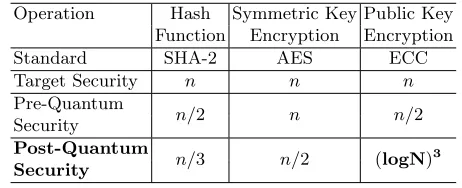
Traditional cryptography, and classic public-key cryptography in particu-lar, faces an increasing risk at a catastrophic event because of improvements in quantum computing architectures, and because of continuous progress in the cryptanalysis of traditional public-key algorithms. Table 1 highlights the impact of quantum algorithms on the security of fundamental cryptographic construc-tions. Grover’s algorithm enables a fast database search and hence reduces the security of an n-bit key to n/2-bits [23]. Likewise, quantum birthday attacks reduce a collision search complexity from O(n/2) to O(n/3) [11]. While these security reductions indicate that quantum computers will affect symmetric key and hash-based constructions, we can still assure pre-quantum security levels by simply doubling and tripling the key size and the hash output respectively. The case for public-key encryption is much worse. Shor’s algorithm [45] can solve the factorization and the (elliptic curve) discrete logarithm problem in polylogarith-mic time [41]. Hence, we have to increase the key size exponentially which is infeasible in practice. This is the main motivation of post-quantum public-key constructions. We need practical public-key building blocks for the post-quantum era.
Table 1.Security reductions of pre- and post-quantum era
Operation Hash Symmetric Key Public Key Function Encryption Encryption
Standard SHA-2 AES ECC
Target Security n n n
Pre-Quantum
n/2 n n/2
Security
Post-Quantum
n/3 n/2 (logN)3
1.1 Precomputation as an Emerging Topic in Cryptographic Computing
In the post-quantum era, not only the security primitives will change but also the paradigm of computing for the embedded systems. In this paper, we argue that precomputation, an old practice that is typically overlooked in the em-bedded domains, will be a re-trending phenomena for the emerging computing systems. Precomputation in cryptography was previously proposed to acceler-ate exponentiation or elliptic curve multiplication [29], [12], [44], [10]. A major disadvantage of precomputation is that it usually requires more computation (energy) and storage, two resources that are constrained in traditional embed-ded systems. However, these assumptions are changing. The technology of flash memory, the predominant storage unit of embedded domains, introduced 15 new generations of products over the last 20 years, accumulating to a cost improve-ment of 25,000× [26]. This trend will make the integration of more capable storage units increasingly cheaper. On the other hand, although the Moore’s law does not apply to the battery technologies, energy-harvesting platforms make energy no longer a limited and monotonically decreasing concept.
Evidently, this is not the first research on energy optimization for harvesting nodes. Previous work likeDewdrop [14] andDEOS [49] propose to relabel iter-ative operations as atomic tasks and then to (dynamically) schedule them for maximum computations with the available energy. In contrast, we leverage our application specific expertise to transform algorithms into a set of divisible tasks. This transformation enables optimizations like partial evaluation with aware partitions; the system precomputes and stores static values at energy-friendly intervals, and minimizes the run-time energy and latency. Mementos also divides the atomic operations but it aims to allocate checkpoints within a task to quickly restart in case of power failure or energy depletion [42]. The techniques we apply in this paper are orthogonal, they can be implemented on top of the previous work.
Ateniese et al. makes similar claims on precomputation for wireless sensor nodes implementing pre-quantum primitives like ECDSA [3]. They show that a mote can precompute intermediate values when there is an (excess) energy available and then use it to minimize the latency. We extend these method-ologies for the post-quantum era. We show that two post-quantum signature schemes, lattice-based and hash-based digital signatures can be accelerated by precomputation techniques. Then, we quantify the savings of this methodology in terms of latency, energy, and system yield.
1.2 Organization
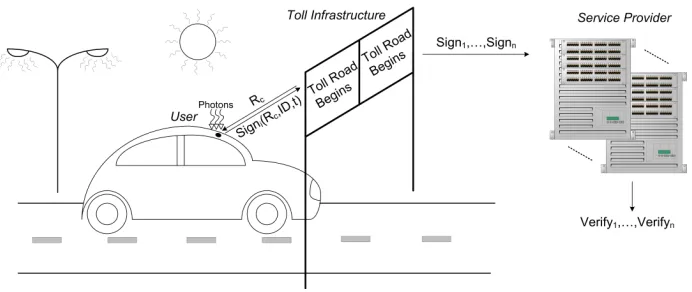
Fig. 1.The operations of a road tolling authentication system with digital signatures
Table 2.The asymmetry of the two computing devices
Computing Center of the cloud Edge of the cloud device (Servers) (Portable embedded
nodes)
Operation Signature verification Signature generation Platform High-end CPUs Simple microcontrollers Rate 1000 verifications per min. 1 signing per hour Optimization Throughput Latency
2
Post-Quantum World
In this section, we will conceptualize a scenario for the post-quantum era and later argue why we consider precomputation as a very suitable optimization methodology for these type of applications.
Figure 1 shows a road tolling system, a classic application of digital signatures using embedded platforms. These systems authenticate motor vehicles as they drive past a toll booth. The authentication protocol uses digital signatures. The toll infrastructure sends a random challenge (Rc) and the on-board unit replies with a digital signature on the challenge, identification attributes, and a time stamp. The toll infrastructure collects and stores these signatures at fine grain intervals (as the car passes by). At coarse grain intervals (eg. at the end of the day), it transmits all signatures to the service provider which is responsible for verifying the signatures and charging the associated users.
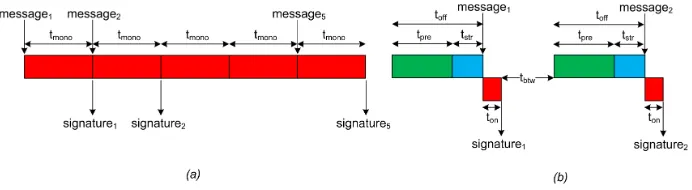
em-Fig. 2.Principle of operation for the offline phase (a) and the online phase (b)
bedded platforms of the future may change, generating signatures on-demand with minimal latency and energy will still be of primary importance for many applications.
Table 2 summarizes the differences of the computing devices for the target scenario. The cloud server consists of a sea of high-end CPUs that can verify thousands of signatures per minute. Operations within the cloud are streamlined and the executions are optimized for throughput, to maximize the number of op-erations per unit time. In contrast, the edge of the cloud is a portable embedded node that is typically a low-end microcontroller. These nodes become rarely ac-tive (eg. once per hour) but they are real-time, hence they are optimized for latency, to minimize the execution time per signing.
2.1 The need for partitioning and precomputation
The nature of real-time applications allows partitioning computations into of-fline and online phases. The ofof-fline phase refers to the workload that can be handled before an operation request comes. In our context, it corresponds to all computations that can be completed without full knowledge of the message to sign; it includes operations like accumulating an entropy pool, generating keys, selecting random numbers, and computing message independent variables. On-line computations include all operations that have an immediate dependency on the message. These operations appear with the real-time signing request. The system then transitions to the online phase and quickly generates the output with precomputed coupons.
Figure 2 shows the principle of operation for the monolithic case (Figure 2(a)) vs. a partitioned one (Figure 2(b)). Typically, the total execution time of the monolithic mode (tmono) is shorter than the partitioned mode (tof f +
ton), making it more suitable for throughput optimization. Therefore, the servers usually follow a monolithic mode as they constantly execute a streamline of operations. On the other hand, the embedded nodes can utilize the partitioning to minimize the execution time if the operations are partitioned such thatton≤
also be interleaved. We also assume thattof fis not critical and the time between two consecutive execution is long (tbtw ≥0). Indeed, under those assumptions, the platform can seek energy-efficient solutions, either wait for a pre-configured amount of harvested energy to start an uninterrupted execution [33] or start precomputations when the system reached its maximum energy level[8].
3
Post-Quantum Signatures
Post-Quantum signatures are classified into four groups: hash-based signatures, lattice-based signatures, code-based signatures and multivariate quadratic sig-natures. In this section, we will give an overview of all these digital signature schemes, but we will only investigate hash-based and lattice-based signatures in more detail. All these signature schemes are promising candidates in the post-quantum era, but the hash-based and the lattice-based signatures have relatively slower execution time which we can accelerate with precomputation methods.
3.1 Hash-based Signatures
Hash-based constructions provide forward-secure signing schemes. Moreover, de-pending on the underlying hash function, they can also be provably secure even in the post-quantum era [32]. In this work, we implement the Winternitz one-time signature (W-OTS) scheme defined as in [17]. Compared to Lamport-Diffie signatures [30], Winternitz offers a trade-off between signature size (commu-nication energy) and execution time (computation energy). We have used the standard SHA-256 because it is fast and it provides 84-bits and 128-bits post-quantum security of pre-image and collision resistance respectively. Any secure hash function that has at least 256-bit outputs (eg. Keccak) can also replace the SHA-256 in our implementation.
In the Winternitz signature scheme, one generates a hash chainY =h(h(h(..h(X)))) with the secret keyX and the public keyY. A signature of messageµis created by selecting intermediate values on the hash chain using portions ofµ. The veri-fier can, usingµ, check if those intermediate values indeed reveal the public key
Y at the end of the chain. The one-way character of the hash protects the secret key. Hash-based signatures are one-time signatures, since disclosing hash chain is equivalent to disclosing the secret key. In what follows, we derive a formal definition of these operations.
The key idea behind the Winternitz is to signω-bit portions of the message simultaneously. Hence, the Winternitz parameter ω ≥2 determines the trade-off between the execution time and the signature size. The number of required hash computations grow exponentially while the signature and key size reduce linearly. The parameters t1,t2, andtof the Winternitz signature are defined as
t1=
ln
ω
m
, t2=
blog
2t1+ 1 +ωc
ω
The secret key X is t-blocks of 256-bit hash output values (xt−1, ..., x1, x0) generated from a single random seed and the public keyY istblocks of 256-bit hash output values (yt−1, ..., y1, y0) generated using hash chains of 2w−1 length where yi = h2
w−1
(xi),0 ≤ i ≤ t−1. The scheme divides the message (or its hash) intot1blocks ofω-bits (bt−1, ..., bt−t1) and also computes the checksum of
t2blocks of ω-bits (bt2−1, ..., b0). Then, depending on the values of these blocks (from 0 to 2w−1), it calculates the signatureσ(s
t−1, ..., s1, s0) with hash chains ranging from 0 to 2w−1 as
σ= (st−1, ..., s1, s0) = (hbt−1(xt−1), ..., hb1(x1), hb0(x0)) (2)
To verify the signature σ, one has to first use the message (or its hash) to compute the values of t1 and t2 blocks of ω-bits (bt−1, ..., b0). Then, if the signature is valid, applying the remaining hash chains of 2ω−1−b
i(0≤i≤t−1) on the signature σshould reveal the public keyY (yt−1, ..., y1, y0).
Generating the secret and the public key requirestandt(2w−1) hash com-putations respectively. The number of hash operations required to compute the signature depends on the message (or its hash) to be signed and is bounded with [0,t(2w−1)]. The length of the secret key, public key and the signature ist×n
bits.
Standalone hash-based constructions offer one-time signatures that can only sign a single message. However, with Merkle trees [35] or Chaining, they can be further extended into schemes that can sign multiple messages. Merkle trees expand a one-time signature to a 2H-time signature by using a hash-tree of height H. The root node of the hash-tree is a public value and the leaves are the one-time signatures. Together with each signature, the signer also sends an index value (≤2H) indicating the key position (leaf node), the path from the root node corresponding to that index, and the one-time public key. The verifier first checks if the index value is greater than the previous one and if the path is correct. Then, it validates the one-time signature.
Chaining is simply including the next public key to the message to be signed. One drawback of Chaining is that it enforces the verifier to validate signatures in an order. We opt to implement Chaining instead of Merkle tree as they both achieve similar signature size (even with the latest work on Merkle trees [13], [27], [28]) while Chaining does not limit the number of signature generations for a given device.
3.2 Applying Precomputation Methods for Hash-based Signatures
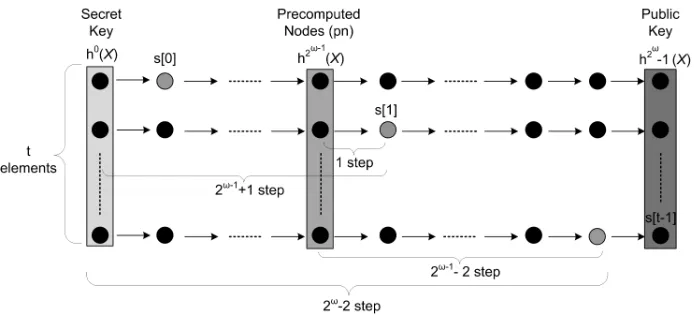
Fig. 3.Precomputation of intermediate nodes for the Winternitz scheme
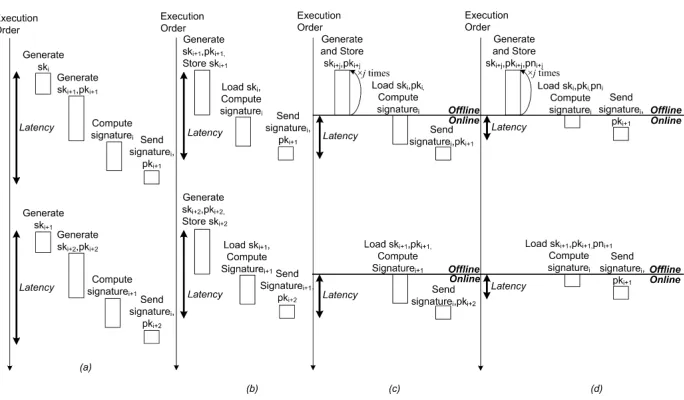
states of the hash chain. Then, the online phase simply becomes selecting and loading the appropriate values from the memory.
Figure 3 illustrates an example scenario of how precomputation can accelerate the signature generation. If we assume that the entire hash-chain is generated online, then the computation of s[0], s[1], and s[t−1] requires 1, 2ω−1+ 1, and 2ω−2 evaluations of the hash function respectively. If we precompute the intermediate hash-chain step of h2ω−1, the number of evaluation steps for x[1] andx[t−1] shortens to 1 and 2ω−1−2 respectively. The more intermediate steps we store, the shorter the number of evaluation steps become on average.
Fig. 4. Computation modes for (a) generic, (b) optimized, (c) partitioned, and (d) partitioned-with-precomputing execution
As usual, precomputation comes with a memory overhead. For the mode(a) it is enough just to store the root of the secret key which is 256-bits where as mode (b) requirest×256-bits of storage. As we precomputej secret and public keys, mode (c) needst×j×256×2 amount of memory bits and if the system utilizespnprecomputed node blocks, then the memory cost of mode (d) becomes
t×j×256×(2 +pn)-bits.
3.3 Lattice-based Signatures
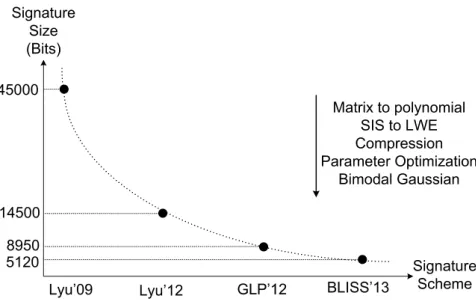
The family of lattice-based signatures is another promising group of candidates in the post-quantum era. Currently, lattice-based signatures that utilize Fiat-Shamir paradigm [21] yields the most efficient constructions. These constructions first introduce an identification scheme and then transform it to signatures.
Fig. 5.Practical Lattice-based Digital Signature Schemes
In this paper, we will focus on the basic signature scheme presented in [24] due to its conceptual simplicity and reasonable signature size. However, the op-timization methods that we propose apply to all Lyubashevski-like constructions and we can extrapolate our results to other lattice-based signature schemes as well.
Algorithm 1The basic signature scheme of [24]
1: procedureKey Generation(a, s1, s2, t)
2: s1, s2←rand(Rp
n
1 )
3: a←rand(Rpn) 4: t←as1+s2
5: end procedure
6: procedureSigning(s1, s2, µ, z1, z2, c)
7: y1, y2←rand(Rp
n k ) 8: c←H(ay1+y2, µ)
9: z1←s1c+y1, z2←s2c+y2
10: ifz1orz26∈Rp
n
k−32go to step 7
11: end procedure
12: procedureVerification(z1, z2, c, µ, t,)
13: Validate iff 14: z1,z2∈Rp
n k−32
15: c=H(az1+z2+tc, µ)
16: end procedure
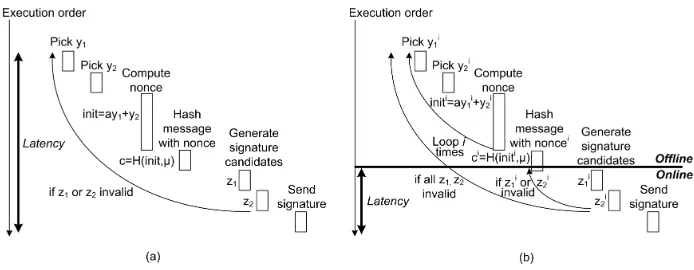
Fig. 6.Monolithic (a) and the partitioned (b) computation modes for the GLP signa-ture scheme
scheme are picking uniformly random polynomials (rand()), polynomial multi-plication, polynomial addition, and hashing (H).
Key Generationconsists of picking the secret keys1, s2 with small coeffi-cients (either -1,0 or 1), setting a parameter a, and generating the public key
t. Then, the signer uses the unique masking polynomials y1, y2 and generates the nonceay1+y2. This value is concatenated with the messageµand hashed. Now, the signaturez1 and z2 can be generated using the secret key s1, s2, the output of the hash (c) and the masking polynomials. If the coefficients of z1 and z2 are not bounded with (−k,+k), the signing process has to restart by picking another two masking polynomials. V erif icationstarts with checking if the coefficients of the signature polynomials are bounded accordingly. Then, to validate a signature, the verifier can check if the equationc=H(az1+z2+tc, µ) holds.
3.4 Applying Precomputation Methods for Lattice-based Signatures
There are two different types of precomputation methods for lattice-based signa-tures. The first one refers to an arithmetic trick on the multiplicative operands during the Number Theoretic Transform (NTT) [2]. The previous work reports the effects of generating these operands on-the-fly vs. precomputing them on re-configurable hardware [4]. In this work, we study its effects on microcontrollers. We will also discuss another precomputation method that requires latency-optimized algorithmic transformation for a partitioned execution.
Figure 6 illustrates the operation flow of monolithic(a) and partitioned ex-ecution (b). To generate the signature, the monolithic execution first processes all steps of the signature scheme such as picking masking polynomials (y1,y2), calculating nonce values (init), hashing the output (c), and generating the sig-nature candidate (z1,z2). Then, it checks if the candidate is valid and repeats the same process if necessary. In contrast, the partitioned execution selects a num-ber of masking polynomials (yi
values. These coupons are used to create the signature during the online phase. If all attempts fail to generate a single valid signature, the signer has to start all over and compute new coupons. However, given enough memory space to store coupons, the probability of failure becomes arbitrarily small. The partition is especially useful for our application scenario because it outsources the most complicated operation, NTT-based multiplication of ay1, to the offline phase. The online phase operations consist of simple operations like hash, sparse poly-nomial multiplication ofsc1, polynomial addition, and coefficient comparison.
3.5 Other Signature Schemes
Code-based and multivariate quadratic (MQ) signature schemes can also be used in the post-quantum era. Code-based McEllice encryptions follow the equation
x=mG⊕e. The public key is the generator matrixGof at-bit error correcting code that encodes the message m and generates the signature x by adding a
t-bit error vectore. The decoding process computes the syndromesas s=Hxt using the secret parity matrix H. Then, the message can be recovered with bit-flipping algorithms [22] or using more complex decoding techniques [7]. The nature of the coding algorithms makes this family of crypto-systems very suit-able for the application scenario; encoding is typically a simple process while decoding is much more complex. However, they do not additionally accelerate with precomputation as all the operations have dependency on the input mes-sage. Currently, the most efficient and secure code-based encryption method is a McEllice-based construction with a Quasi-Cyclic (QC) Moderate Density Par-ity Check (MDPC) code using 4801-bits of public and secret keys [36]. Recent work shows that encryption with QC-MDPC codes takes 42 ms on an ARM Cortex-M4 microcontroller [34]. The McEllice-based public key encryption can be transformed to a digital signature [15] but such an implementation utilizing the QC-MDPC is not available yet.
MQ signatures also have a fast signature generation rate.F ism quadratic polynomials of n variables, referred to as central map. The polynomials of F
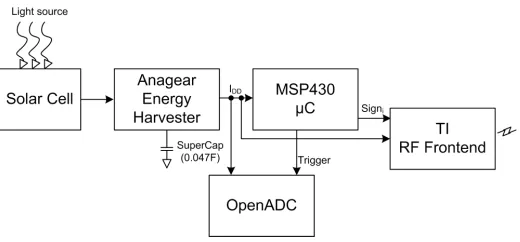
Fig. 7.The block diagram of the research platform
4
Platform
In this work, we used our research prototype with energy harvesting and mea-surement capabilities. This section gives a brief overview but we refer the in-terested readers to [37] for a detailed description of our complete setup. Figure 7 shows a block diagram of the building blocks of our system. A Photovoltaic cell converts the energy from photons into electricity and transmits it to the Anagear ANG 1010 energy-harvesting board. Attached to the Anagear, a low-leakage supercapacitor can accumulate an energy-level up to 710 mJ. This energy can activate the main processing unit of the system, a low-power 16-bit MSP microprocessor with 16KBs of SRAM and 128 KBs of Flash memory that ex-ecutes the digital signature schemes. The RF Frontend of the system (CC2500 transceiver of Texas Instruments) also uses the harvested energy and it can send the signatures with 64-byte packets. The MSP microprocessor is also responsi-ble to send trigger signals to the measurement unit, an OpenADC board with a Spartan-3 FPGA that can measure the energy consumption of both computation and communication with a high-precision.
5
Implementation Results
We used the C programming language to implement the digital signature schemes. We compiled the software codes with the gcc 4.6.3 cross compiler with an optimization level of O2that minimizes the code size. The processor runs at 10 MHz and does not utilize a hardware multiplier. We used the RELIC 0.3.3 li-brary [1] to realize the hash primitive and select the SHA-256 hash function as it provides an acceptable level of collision resistance (84-bits) in the post-quantum era. Even though the software-efficiency can potentially be improved with assem-bly level programming, we aim to show the relative savings of precomputation and argue that it will be similar also on an optimized implementation.
– Communication requires more energy per unit time than computation
– Precomputation can reduce the latency and the run-time energy consump-tion by an order of magnitude
– GLP is faster and requires less energy than Winternitz
– The parameterωcan be selected to optimize either execution time or energy-efficiency
– Post-Quantum signatures have comparable time/energy results with pre-quantum signatures
– Proposed methods extend the operation hours of the system and increase the number of signature generations for a given energy level
5.1 Impact of Proposed Methods on Single Executions
Figures 8 and 9 report the energy consumption and the execution time of the post-quantum signature schemes. The results separately show the costs of offline operations, online operations, and the signature transmission. For hash-based signatures, the run-time energy and the latency of the monolithic mode (strategy (b) in Section 3.2) is equal to the sum of all these operations where as the partitioned modes (strategy (c), and (d) in Section 3.2) do not include the offline phase.pre= 7, pre= 3, pre= 1, and pre= 0 correspond to chains with 7, 3, 1, and 0 precomputed nodes respectively (ommitting the first node, secret key). Ideally, we would like to store the complete hash chain but the size of the SRAM is 16KB and it can not contain more than 7 precomputed nodes forω = 8 and 3 precomputed nodes for ω = 4. Forω = 8 (resp., ω = 4), the total run-time energy of strategy (b), (c), and (d) is 100.69 mJ (resp., 20.86 mJ), 32.16 mJ (resp., 12.05 mJ), and 8.5 mJ (resp., 9.54 mJ). The latency of these strategies are 52.29 s (resp., 6.98 s), 15.53 s (resp., 2.15 s), and 2.22 s (resp., 0.69 s).
Fig. 9.The execution time measurements of signature schemes
As expected, the communication energy reduces linearly while the computa-tion energy grows exponentially with ω. Likewise, the execution time and the energy of the online phase scales down linearly with the increase in the precom-puted nodes. The experiments also reveal that the extra operations of strategy (d), which is storing intermediate nodes of the hash chains, require minimal calculations (approximately %1 increase) during the offline phase. Hence, we conclude that the cost of precomputation is marginal especially compared to its saving and given more memory space, the precomputation can further reduce the execution time and the energy of the online phase.
For lattice-based signatures, the run-time energy and latency of the parti-tioned execution does not include the offline phase, where as the monolithic execution involve all these operations. The energy consumption of the offline phase depends largely on how we perform the NTT operation. The naive imple-mentation computes the powers of multiplicative operands of NTT from scratch at each iteration while the on-the-fly configuration uses the outer-loop iteration trick in [2].Of f line tablerefers to computing and storing all required powers of the multiplicative operands during design-time, and later loading the appropri-ate values during NTT [40]. Even with an optimization of 6×, the offline phase of GLP signature requires a significant amount of energy and the execution time is several seconds. In contrast, the system can quickly calculate the online phase which brings a further optimization of 27×, making the total latency 230 ms. Likewise, the run-time energy drops down to 4.63 mJ. Note that the results show the computation of one signature candidate, the average number of trials depends on the parameter set. The parameters that we use requires a repetition rate of 7 on average but this number reduces to 1.6 with more recent constructions [18].
Table 3.The best cases for the signature generations
Signature GLP Winternitz Winternitz
Scheme ω= 8 ω= 4
Optimizations Precomp. Operands Precomp. Chain Nodes Off/on partition Off/on partition Offline phase
6.82/3.15 68.53/36.76 8.81/4.83 (mJ/s)
Online phase
0.25/0.10 3.84/2.09 0.77/0.42 (mJ/s)
Transmission
4.38/0.13 4.66/0.13 8.77/0.27 (mJ/s)
Online Total
4.63/0.23 8.5/2.22 9.54/0.69 (mJ/s)
8.5 mJ and 0.69 s with the best cases of Winternitz. With the available mem-ory and the transmission infrastructure, hash-based signatures with ω = 8 is more energy-efficient whileω= 4 has a lower latency. BLISS improvements over GLP signatures enable a reduction in transmission energy/time while moving to a more sophisticated microprocessor enable a reduction in transmission and computation energy/time of Winternitz. Since a monolithic ECDSA signature operation takes 91 mJ and 12.5 s to compute on the same platform[37], we can conclude that post-quantum signatures are quite competitive, if not better suited for real-time applications with energy constraints.
5.2 Impact of the Proposed Methods on the System
Apart from latency and run-time energy optimizations of online operations with the precomputed coupons, we observed two advantages of using the precompu-tation with partitioned execution modes. First, it extends the availability of the system. Second, it provides more service (more signature) for the given energy level. In the remainder of this section, we will describe how we arrived to these conclusions.
Fig. 10.The typical energy levels on the supercapacitor for two consecutive days (ex-trapolated from [8])
Next, we investigate how different approaches utilize the excess energy and the impact of offline/online partitioning on the system output. Figure 11 quan-tifies the energy-efficiency of the precomputation for hash-based (with ω = 8) and lattice-based signatures respectively. These plots reflect the potentials of the system right after 7.30PM on the first day until the next excess energy interval occurs. The x-axis represents the energy level of the supercapacitor from 0 to the maximum energy level of 710 mJ and the y-axis shows the total number of signatures that system can generate for the corresponding energy level. For an excess energy of 823 mJ, the processor can perform the precomputation opera-tions of 12 hash-based signatures. Hence, the strategy (d) and (c) (see Section 3.2 for an overview of these strategies) require significantly less energy to com-pute the first 12 signatures. Then, strategy (b) and (c) become equivalent but (d) still requires less energy to perform a signature due to its precomputation of the intermediate nodes.∆s corresponds to the difference of signature gener-ation capability between different strategies. From these results we can clearly observe the effect of our optimization methods and deduce that its impact is much more important for critical energy levels. For example, if a burst signing request comes when the energy level is 100 mJ, the strategy (d), (c), and (b) can generate 11, 3, and 0 signatures respectively. This also shows that there are certain times (energy intervals) where the system can only generate a signature using an optimized strategy.
The energy required for lattice-based signatures (Figure 11 (b)) is much lower than its hash-based counterpart. The excess energy enables to precompute nec-essary values for the next 71 signatures, but the available memory space can only store 60 of them. Therefore, after the 60th generation, it takes more energy to compute next signatures. For critical energy levels (eg. 100 mJ) the partitioned execution makes a significant improvement on the signature generation capabil-ity. However, maximum difference of 36 occurs around moderate energy levels following the 60thgeneration and it remains fixed for the remainder of the energy spectrum. Note that, this implementation uses anOf f line tableprecomputation method, and it shows the signature candidate generation.
6
Related Work
Yet, the signing process (including the key generation) still is at the order of sec-onds.
7
Conclusions
Together with security assumptions, the principles of embedded systems may also change in time. This calls a rethinking of the design and optimization methodolo-gies. In this paper, we investigated precomputation with partitioned execution modes as a potential optimization technique for post-quantum digital signatures. We later provided two proof-of-concept digital signature implementations utiliz-ing these optimizations. We proved that today’s embedded research platforms can effectively employ precomputation methodologies. We first showed that pre-computation can save significant run-time energy and bring the execution time down to milliseconds range. Then, we highlight its impact on the overall system and demonstrate that it can increase the total number of signature computations for a typical use-case. Hence, we argue that in the emerging era of post-quantum real-time embedded systems, such optimizations will play a significant role. Pre-computation methods will enable an improved real-time security with faster signatures and will provide energy-efficient solutions towards a greener future.
8
Acknowledgements
This work is supported in part by National Scientific Foundation (NSF) award no 1314598. The authors would like to thank Bilgiday Yuce for his extensive support on the energy-harvesting platform.
References
1. Aranha, D.F., Gouvˆea, C.P.L.: RELIC is an efficient library for cryptography. Homepage at http://code. google. com/p/relic-toolkit 163, 182 (2010)
2. Arndt, J.: Algorithms for programmers-ideas and source code (2004)
3. Ateniese, G., Bianchi, G., Capossele, A., Petrioli, C.: Low-cost standard signa-tures in wireless sensor networks: a case for reviving pre-computation techniques? In: Proceedings of the 20th Annual Network & Distributed System Security Sym-posium, NDSS 2013. NDSS2013, San Diego, CA (February 24-27 2013)
4. Aysu, A., Patterson, C., Schaumont, P.: Low-cost and area-efficient FPGA im-plementations of lattice-based cryptography. In: Hardware-Oriented Security and Trust (HOST), 2013 IEEE International Symposium on. pp. 81–86 (June 2013) 5. Bai, S., Galbraith, S.: An improved compression technique for signatures based on
learning with errors. In: Benaloh, J. (ed.) Topics in Cryptology CT-RSA 2014, Lecture Notes in Computer Science, vol. 8366, pp. 28–47. Springer International Publishing (2014),http://dx.doi.org/10.1007/978-3-319-04852-9_2
7. Berlekamp, E., McEliece, R., Van Tilborg, H.: On the inherent intractability of certain coding problems (corresp.). Information Theory, IEEE Transactions on 24(3), 384–386 (May 1978)
8. Bianchi, G., Capossele, A.T., Petrioli, C., Spenza, D.: AGREE: exploiting energy harvesting to support data-centric access control in WSNs. Ad Hoc Networks 11(8), 2625–2636 (2013)
9. Boorghany, A., Jalili, R.: Implementation and comparison of lattice-based identifi-cation protocols on smart cards and microcontrollers. Cryptology ePrint Archive, Report 2014/078 (2014),http://eprint.iacr.org/
10. Boyko, V., Peinado, M., Venkatesan, R.: Speeding up discrete log and factor-ing based schemes via precomputations. In: Nyberg, K. (ed.) Advances in Cryp-tology EUROCRYPT’98, Lecture Notes in Computer Science, vol. 1403, pp. 221–235. Springer Berlin Heidelberg (1998), http://dx.doi.org/10.1007/ BFb0054129
11. Brassard, G., Høyer, P., Tapp, A.: Quantum cryptanalysis of hash and claw-free functions. In: Lucchesi, C., Moura, A. (eds.) LATIN’98: Theoretical Informatics, Lecture Notes in Computer Science, vol. 1380, pp. 163–169. Springer Berlin Hei-delberg (1998),http://dx.doi.org/10.1007/BFb0054319
12. Brickell, E., Gordon, D., McCurley, K., Wilson, D.: Fast exponentiation with pre-computation. In: Rueppel, R. (ed.) Advances in Cryptology EUROCRYPT 92, Lecture Notes in Computer Science, vol. 658, pp. 200–207. Springer Berlin Heidel-berg (1993),http://dx.doi.org/10.1007/3-540-47555-9_18
13. Buchmann, J., Dahmen, E., H¨ulsing, A.: XMSS - a practical forward secure signature scheme based on minimal security assumptions. In: Yang, B.Y. (ed.) Post-Quantum Cryptography, Lecture Notes in Computer Science, vol. 7071, pp. 117–129. Springer Berlin Heidelberg (2011), http://dx.doi.org/10.1007/ 978-3-642-25405-5_8
14. Buettner, M., Greenstein, B., Wetherall, D.: Dewdrop: An energy-aware runtime for computational RFID. In: Proceedings of the 8th USENIX Conference on Net-worked Systems Design and Implementation. pp. 197–210. NSDI’11, USENIX As-sociation, Berkeley, CA, USA (2011), http://dl.acm.org/citation.cfm? id=1972457.1972478
15. Courtois, N., Finiasz, M., Sendrier, N.: How to achieve a McEliece-based digital signature scheme. In: Boyd, C. (ed.) Advances in Cryptology ASIACRYPT 2001, Lecture Notes in Computer Science, vol. 2248, pp. 157–174. Springer Berlin Hei-delberg (2001),http://dx.doi.org/10.1007/3-540-45682-1_10
16. Czypek, P.: Implementing Multivariate Quadratic Public Key Signature Schemes on Embedded Devices. Ph.D. thesis, Diploma Thesis, Chair for Embedded Security, Ruhr-Universit¨at Bochum (2012)
17. Dods, C., Smart, N., Stam, M.: Hash based digital signature schemes. In: Smart, N. (ed.) Cryptography and Coding, Lecture Notes in Computer Science, vol. 3796, pp. 96–115. Springer Berlin Heidelberg (2005),http://dx.doi.org/10.1007/ 11586821_8
18. Ducas, L., Durmus, A., Lepoint, T., Lyubashevsky, V.: Lattice signatures and bimodal gaussians. In: Canetti, R., Garay, J. (eds.) Advances in Cryp-tology CRYPTO 2013, Lecture Notes in Computer Science, vol. 8042, pp. 40–56. Springer Berlin Heidelberg (2013), http://dx.doi.org/10.1007/ 978-3-642-40041-4_3
– SAC 2013, pp. 223–243. Lecture Notes in Computer Science, Springer Berlin Heidelberg (2014),http://dx.doi.org/10.1007/978-3-662-43414-7_12
20. Faugere, J.C., Gligoroski, D., Perret, L., Samardjiska, S., Thomae, E.: A polynomial-time key-recovery attack on MQQ cryptosystems. Cryptology ePrint Archive, Report 2014/811 (2014),http://eprint.iacr.org/
21. Fiat, A., Shamir, A.: How to prove yourself: Practical solutions to identification and signature problems. In: Odlyzko, A. (ed.) Advances in Cryptology CRYPTO 86, Lecture Notes in Computer Science, vol. 263, pp. 186–194. Springer Berlin Heidelberg (1987),http://dx.doi.org/10.1007/3-540-47721-7_12
22. Gallager, R.: Low-density parity-check codes. Information Theory, IRE Transac-tions on 8(1), 21–28 (January 1962)
23. Grover, L.K.: A fast quantum mechanical algorithm for database search. In: Pro-ceedings of the Twenty-eighth Annual ACM Symposium on Theory of Com-puting. pp. 212–219. STOC ’96, ACM, New York, NY, USA (1996), http: //doi.acm.org/10.1145/237814.237866
24. G¨uneysu, T., Lyubashevsky, V., P¨oppelmann, T.: Practical lattice-based cryp-tography: A signature scheme for embedded systems. In: Prouff, E., Schaumont, P. (eds.) Cryptographic Hardware and Embedded Systems CHES 2012, Lecture Notes in Computer Science, vol. 7428, pp. 530–547. Springer Berlin Heidelberg (2012),http://dx.doi.org/10.1007/978-3-642-33027-8_31
25. G¨uneysu, T., Oder, T., P¨oppelmann, T., Schwabe, P.: Software speed records for lattice-based signatures. In: Gaborit, P. (ed.) Post-Quantum Cryptography, Lec-ture Notes in Computer Science, vol. 7932, pp. 67–82. Springer Berlin Heidelberg (2013),http://dx.doi.org/10.1007/978-3-642-38616-9_5
26. Harari, E.: The non-volatile memory industry - a personal journey. In: Memory Workshop (IMW), 2011 3rd IEEE International. pp. 1–4 (May 2011)
27. H¨ulsing, A.: W-OTS+ shorter signatures for hash-based signature schemes. In: Youssef, A., Nitaj, A., Hassanien, A. (eds.) Progress in Cryptology AFRICACRYPT 2013, Lecture Notes in Computer Science, vol. 7918, pp. 173–188. Springer Berlin Heidelberg (2013), http://dx.doi.org/10.1007/ 978-3-642-38553-7_10
28. H¨ulsing, A., Busold, C., Buchmann, J.: Forward secure signatures on smart cards. In: Knudsen, L., Wu, H. (eds.) Selected Areas in Cryptography, Lecture Notes in Computer Science, vol. 7707, pp. 66–80. Springer Berlin Heidelberg (2013),
http://dx.doi.org/10.1007/978-3-642-35999-6_5
29. Koyama, K., Tsuruoka, Y.: Speeding up elliptic cryptosystems by using a signed binary window method. In: Brickell, E. (ed.) Advances in Cryptology CRYPTO 92, Lecture Notes in Computer Science, vol. 740, pp. 345–357. Springer Berlin Heidelberg (1993),http://dx.doi.org/10.1007/3-540-48071-4_25
30. Lamport, L.: Constructing digital signatures from a one-way function. Tech. rep., Technical Report CSL-98, SRI International Palo Alto (1979)
31. Lyubashevsky, V.: Fiat-shamir with aborts: Applications to lattice and factoring-based signatures. In: Matsui, M. (ed.) Advances in Cryptology ASIACRYPT 2009, Lecture Notes in Computer Science, vol. 5912, pp. 598–616. Springer Berlin Hei-delberg (2009),http://dx.doi.org/10.1007/978-3-642-10366-7_35
32. Lyubashevsky, V., Micciancio, D., Peikert, C., Rosen, A.: SWIFFT: A modest proposal for FFT hashing. In: Nyberg, K. (ed.) Fast Software Encryption, Lecture Notes in Computer Science, vol. 5086, pp. 54–72. Springer Berlin Heidelberg (2008),
33. Mane, D., Schaumont, P.: Energy-architecture tuning for ECC-based RFID tags. In: Hutter, M., Schmidt, J.M. (eds.) Radio Frequency Identification, pp. 147–160. Lecture Notes in Computer Science, Springer Berlin Heidelberg (2013), http: //dx.doi.org/10.1007/978-3-642-41332-2_10
34. von Maurich, I., G¨uneysu, T.: Towards side-channel resistant implementations of QC-MDPC McEliece encryption on constrained devices. In: Mosca, M. (ed.) Post-Quantum Cryptography, Lecture Notes in Computer Science, vol. 8772, pp. 266– 282. Springer International Publishing (2014),http://dx.doi.org/10.1007/ 978-3-319-11659-4_16
35. Merkle, R.: A certified digital signature. In: Brassard, G. (ed.) Advances in Cryptology CRYPTO 89 Proceedings, Lecture Notes in Computer Science, vol. 435, pp. 218–238. Springer New York (1990), http://dx.doi.org/10.1007/ 0-387-34805-0_21
36. Misoczki, R., Tillich, J.P., Sendrier, N., Barreto, P.: MDPC-McEliece: New McEliece variants from moderate density parity-check codes. In: Information The-ory Proceedings (ISIT), 2013 IEEE International Symposium on. pp. 2069–2073 (July 2013)
37. Pabbuleti, K., Mane, D., Schaumont, P.: Energy budget analysis for signature protocols on a self-powered wireless sensor node. In: Saxena, N., Sadeghi, A.R. (eds.) Radio Frequency Identification: Security and Privacy Issues, pp. 123–136. Lecture Notes in Computer Science, Springer International Publishing (2014),
http://dx.doi.org/10.1007/978-3-319-13066-8_8
38. Petzoldt, A., Thomae, E., Bulygin, S., Wolf, C.: Small public keys and fast ver-ification for Multivariate Quadratic public key systems. In: Preneel, B., Takagi, T. (eds.) Cryptographic Hardware and Embedded Systems CHES 2011, Lecture Notes in Computer Science, vol. 6917, pp. 475–490. Springer Berlin Heidelberg (2011),http://dx.doi.org/10.1007/978-3-642-23951-9_31
39. P¨oppelmann, T., Ducas, L., G¨uneysu, T.: Enhanced lattice-based signatures on reconfigurable hardware. In: Batina, L., Robshaw, M. (eds.) Cryptographic Hard-ware and Embedded Systems CHES 2014, Lecture Notes in Computer Science, vol. 8731, pp. 353–370. Springer Berlin Heidelberg (2014),http://dx.doi.org/ 10.1007/978-3-662-44709-3_20
40. P¨oppelmann, T., G¨uneysu, T.: Towards efficient arithmetic for lattice-based cryp-tography on reconfigurable hardware. In: Hevia, A., Neven, G. (eds.) Progress in Cryptology LATINCRYPT 2012, Lecture Notes in Computer Science, vol. 7533, pp. 139–158. Springer Berlin Heidelberg (2012),http://dx.doi.org/10. 1007/978-3-642-33481-8_8
41. Proos, J., Zalka, C.: Shor’s discrete logarithm quantum algorithm for elliptic curves. Quantum Info. Comput. 3(4), 317–344 (jul 2003),http://dl.acm.org/ citation.cfm?id=2011528.2011531
42. Ransford, B., Sorber, J., Fu, K.: Mementos: System support for long-running com-putation on RFID-scale devices. SIGARCH Comput. Archit. News 39(1), 159–170 (Mar 2011),http://doi.acm.org/10.1145/1961295.1950386
43. Rohde, S., Eisenbarth, T., Dahmen, E., Buchmann, J., Paar, C.: Fast hash-based signatures on constrained devices. In: Grimaud, G., Standaert, F.X. (eds.) Smart Card Research and Advanced Applications, Lecture Notes in Computer Science, vol. 5189, pp. 104–117. Springer Berlin Heidelberg (2008),http://dx.doi.org/ 10.1007/978-3-540-85893-5_8
Lec-ture Notes in Computer Science, vol. 950, pp. 389–399. Springer Berlin Heidelberg (1995),http://dx.doi.org/10.1007/BFb0053453
45. Shor, P.W.: Algorithms for quantum computation: discrete logarithms and factor-ing. In: Foundations of Computer Science, 1994 Proceedings., 35th Annual Sym-posium on. pp. 124–134 (November 1994)
46. Thomae, E., Wolf, C.: Solving underdetermined systems of multivariate quadratic equations revisited. In: Fischlin, M., Buchmann, J., Manulis, M. (eds.) Public Key Cryptography PKC 2012, Lecture Notes in Computer Science, vol. 7293, pp. 156–171. Springer Berlin Heidelberg (2012), http://dx.doi.org/10.1007/ 978-3-642-30057-8_10
47. V. Lyubashevksy: Lattice signatures without trapdoors. In: Proceedings of the 31st Annual International Conference on Theory and Applications of Cryptographic Techniques. pp. 738–755. EUROCRYPT’12, Springer-Verlag, Berlin, Heidelberg (2012),http://dx.doi.org/10.1007/978-3-642-29011-4_43
48. Whyte, W., Weimerskirch, A., Kumar, V., Hehn, T.: A security credential man-agement system for V2V communications. In: Vehicular Networking Conference (VNC), 2013 IEEE. pp. 1–8 (Dec 2013)