Oblivious Transfer in Incomplete Networks
Varun Narayanan and Vinod M. Prabahakaran Tata Institute of Fundamental Research, Mumbai
[email protected], [email protected]
Abstract. Secure message transmission and Byzantine agreement have been studied extensively in incomplete networks. However, information theoretically secure multiparty computation (MPC) inincomplete net-works is less well understood. In this paper, we characterize the condi-tions under which a pair of parties can computeoblivious transfer (OT) information theoretically securely against a general adversary structure in an incomplete network of reliable, private channels. We provide char-acterizations for both semi-honest and malicious models. A consequence of our results is a complete characterization of networks in which a given subset of parties can compute any functionality securely with respect to an adversary structure in the semi-honest case and a partial characteri-zation in the malicious case.
1
Introduction
Secure message transmission (SMT) [12, 33, 13, 34, 28, 36, 35] and Byzantine agreement [31, 12, 14, 15, 37] in incomplete networks have been studied exten-sively. However, information theoretically secure multiparty computation (MPC) in incompletenetworks is less well studied with a few notable exceptions [26, 6, 3, 17]. In this paper we consider the problem of realizingoblivious transfer (OT) between a given pair of parties in an incomplete network of reliable, private links with unconditional security with respect to a general adversary structure. We characterize networks in which a given pair of parties may securely compute OT in both the semi-honest and malicious models. For the malicious case, our characterization is limited to statistical security.
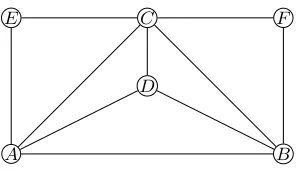
For a pair of parties A and B to compute OT securely in an incomplete network, an approach which might suggest itself is the following. Try to complete the network (or a part of the network which includesAandB) by using SMT to realize the missing private links. Then, use a protocol for complete networks [4, 9, 24] on the ‘completed’ (part of the) network to realize OT betweenAandB. It turns out that such a direct approach is, in general, not adequate. In particular, Figure 1 shows a network where this approach fails, but it is still possible to realize OT securely.
C
D
A B
E F
Fig. 1. Semi-honest 2-secure OT between A and B is possible in G by Theorem 1. However, a ‘direct’ approach of completing (a part of) the network using semi-honest SMT with 2-security and applying a standard MPC protocol for complete networks does not work.
that the pairs of vertices that are not already connected by an edge are only 2-connected, hence no new semi-honest 2-secure links can be established in this network using SMT. Thus, the biggest complete network containing A and B
that can be obtained by such a ‘completion’ is the subgraph induced by vertices
A, B, C, D. Theorem 1 also shows that 2-secure OT between A and B is im-possible in this induced subgraph. Alternatively, this impossibility can be seen as follows. If 2-secure OT can be realized between a pair of parties in a com-plete network with 4 parties, then, by symmetry, it is possible to set up 2-secure OT between every pair of parties in the network. This would imply semi-honest 2-secure MPC in a network with 4 parties [18, 19], which is impossible [4, 9].
Standard results [18, 19, 11, 20, 25] allow reduction of MPC to establishing pairwise OT between the parties wishing to compute securely. In the semi-honest case, a consequence of our result is a complete characterization of networks in which a given subset of parties can compute any functionality with perfect pri-vacy with respect to a given adversary structure. When the adversary is mali-cious, our results imply a condition that is necessary for statistically secure com-putation of any functionality among a given subset of parties in an incomplete network. This condition is also sufficient for statistically secure computation of any functionality, butwith abort and no fairness.
1.1 Our Model and Results
Consider a simple graphG(V,E) on a setVofnparties (or vertices), where each undirected edge {u, v} ∈ E represents a private, authenticated, synchronous, bidirectional communication link between the distinct parties u and v. Let
A, B ∈ V be two distinct parties. Given an adversary structure Z ⊆ 2V, we seek necessary and sufficient conditions on G so that A and B may compute OT with unconditional security with respect to (w.r.t.) the adversary structure
Z. By security w.r.t.Z, we mean security against the corruption of every set of
Given a vertex u∈ V and a subset of vertices Z ⊆ V, we define u-blocked vertices of Z, denoted by Γu(Z), as the set of vertices whose every path to
u contains some vertex in Z. Our main result for the semi-honest case is the following:
Theorem 1. Given a graphG(V,E)and an adversary structureZ, two distinct
parties A, B ∈ V can compute OT with perfect unconditional security in the semi-honest, static adversary setting if and only if the following conditions are satisfied:
1. For every Z ∈Z such thatA, B /∈ Z, there exists a path fromA to B that
does not have any vertex fromZ.
2. There do not exist sets of partiesZA,ZB ∈Z such thatA ∈ ZA, B /∈ ZA,
B∈ ZB,A /∈ ZB, and
ΓB(ZA)∪ΓA(ZB) =V.
Moreover, when these conditions are satisfied and |Z| = poly(n), there is an
efficient (poly(n) complexity) protocol to compute OT securely.
Standard results [18, 19] imply that if every pair in a set of vertices can realize oblivious transfer with security w.r.t. Z, then these vertices can compute any functionality with security w.r.t.Z.
Corollary 1. Given a graphG(V,E)and a subset of verticesK ⊆ V, any func-tionality can be computed among the vertices in K with perfect security with respect to a semi-honest adversary structure Z if and only if the conditions in
Theorem 1 are satisfied by every pair of vertices inK.
The proof is provided in Appendix A. WhenGis complete,Γu(Z) =Zwhenever
u /∈ Z ⊂ V. Hence, when K =V, the condition in Corollary 1 is equivalent to non-existence of setsZ1,Z2∈Zsuch thatZ1∪ Z2=V. Thus, for this case, we
retrieve theQ2 condition of Hirt and Maurer [24].
While the focus of this paper is on deriving tight necessary and sufficient conditions on the network which permit information theoretically secure com-putation, we consider efficiency in two regimes for t-privacy (i.e., semi-honest adversary structures of the form Zt := {Z ⊂ V : |Z| ≤ t}). Theorem 1 al-ready gives an efficient protocol for t =O(1). We separately consider the case ofn= 2t+O(1) and give an efficient protocol in this setting as well (when the conditions of Theorem 1 are satisfied). The case of other regimes of t remains open.
The following is our result for the malicious case:
Theorem 2. Two vertices A, B in G(V,E) can realize OT with statistical se-curity (with guaranteed output delivery) against an adversary structureZin the malicious static adversary setting if and only if the following conditions are sat-isfied:
1. For every Z1,Z2∈Zsuch thatA, B /∈ Z1∪ Z2, there exists a path from A
2. There do not exist ZA,ZB,Z ∈ Z such that A ∈ ZA, B /∈ ZA, B ∈ ZB,
A /∈ ZB,A, B /∈ Z, and
ΓB(ZA∪ Z)∪ΓA(ZB∪ Z) =V.
Moreover, when these conditions are satisfied and |Z| = poly(n), there is an efficient (poly(n) complexity) protocol to compute OT securely.
This characterization can be easily extended to 2-party functionalities with out-put only at one party since standard results [27] allow reduction of such function-alities to establishing OT between the parties. Unlike in the semi-honest case, the availability of secure OT between every pair of parties does not directly imply that any functionality may be computed securely in the malicious case. Hence, we have a more modest implication in this case using standard results in [11, 20] and [25].
Corollary 2. Consider a graph G(V,E), a subset of verticesK ⊆ V and a ma-licious adversary structureZ.
1. The vertices inK can statistically securely compute any functionality w.r.t.
Zonly if every pair of vertices inK satisfies the conditions in Theorem 2.
2. The vertices inK can statistically securely compute any functionality with abort and no fairness w.r.t. Z if every pair of vertices in K satisfies the
conditions in Theorem 2.
The proof is provided in Appendix B. WhenGis complete andK=V, we indeed recover the Q3 condition of Hirt and Maurer [24]. Note that, for this case, [24]
shows thatQ3condition is sufficient to achieve perfect security.
1.2 Technical Overview
We now give a quick overview of the technical details of our results.
Necessity of Conditions: Semi-honest Case. The first condition in Theo-rem 1 is simply the necessary (and sufficient) condition for SMT betweenAand
B in the semi-honest setting. To show the necessity of the second condition, we observe that security w.r.t. the adversary structure {ZA,ZB} implies security w.r.t. {ΓB(ZA), ΓA(ZB)}, i.e., we may throw into ZA those vertices which it blocks from reachingB, and, similarly, forZBandA. Our condition simply says that this should not be aQ2adversary structure [24].
Sufficiency of Conditions: Semi-honest Case. To show the sufficiency of these conditions, we first observe (Lemma 1) that if one could find a vertex C
which cannot be blocked from an honest Aor B, then C can provideAand B
C
A B
D
E F
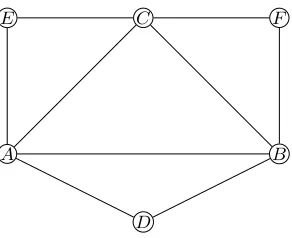
Fig. 2. HOT: OT betweenA and B is not
possi-ble with security against the malicious adversary structure{{C},{A, D}and{B, D}}.
C0
B0 A1
D0
F0 E1
C1
A0 B1
D1
E0 F1
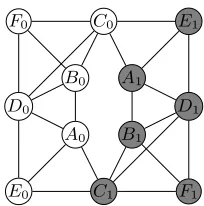
Fig. 3. SOT: constructed by
in-terconnecting two copies ofHOT.
adversary structure. This will allow us to employ the idea of OT combiner[22, 23, 32, 38] to obtain one protocol which is secure w.r.t. the adversary structure. The bulk of our proof is in showing that there is a set of such C’s. In fact, we do this for a special class of adversary structures (Lemma 3) – those with only one member which contains A (B, respectively). We show that, in this case, the vertices C of interest are precisely those that are not blocked from B (A, respectively) the unique member of the adversary structure which containsA(B, respectively). We then obtain a protocol for OT in the general case by employing the idea of OT combiner again, this time on the protocols constructed for the special class of adversary structures above.
Efficiency of t-privacy. Our protocol has complexity which is polynomial in the size of the graph and the size of the adversary structure. So, it is efficient fort-privacy whent=O(1). We also give at-private protocol which is efficient whenn= 2t+O(1). For this, we first consider adversary structures where all the members which contain A (B, respectively) block the same set of vertices. We show that for such an adversary structure, using OT combiner, we may construct an efficient protocol for OT. We show that, similar to the construction in the general case, we may combine these protocols to get a t-private OT protocol. If n= 2t+O(1), the number of such adversary structures is polynomial in n, thereby making the combiner efficient.
HOTsecurely w.r.t. the malicious adversary structure{{C},{A, D},{B, D}}, we interconnect two copies ofHOT(see Figure 3) and consider (a pair of) executions of a purported OT protocol to argue that this would give a secure two-party OT protocol in the semi-honest setting (Lemma 4).
Sufficiency of Conditions: Malicious Case. To show the sufficiency of these conditions, we proceed along the lines of the semi-honest case. But here, we construct a separate OT protocol corresponding to each set in the adversary structure which does not contain either A or B. The parties in this set do not participate in the protocol thereby ensuring that it is perfectly secure against their corruption. However, the corruption of any other set in the adversary struc-ture may force this protocol to abort. But, if the protocol does not abort, it is guaranteed to compute OT with statistical security w.r.t Z. Our final protocol
iterates over every protocol of this kind. If the OT is computed in any iteration, it is guaranteed to be statistically secure. If every iteration is aborted, either A
orB is corrupt, in which case, a honestB may output a random bit.
1.3 Related Work
Secure multiparty computation in complete networks is addressed in a large body of literature. Ben-Or, Goldwasser, and Wigderson [4] and Chaum, Cr´epeau, and Damg˚ard [9] showed that every function can be computed with perfect infor-mation theoretic security against a semi-honest adversary whenever there is an honest majority; and against a malicious adversary if more than two-third of the parties are honest. Hirt and Maurer [24] extended these results and char-acterized adversary structures, in both semi-honest and malicious settings, that allow perfectly secure computation. Keeping these results in view, our problem formulation is a natural one. However, to the best of our knowledge, there is no prior work on the characterization problem we address even in restricted settings of graph topologies other than the complete graph. We list below the works in the literature that come closest to our problem.
Kumaresan, Raghuraman, and Sealfon [29] characterized incomplete networks of OT channels which, when used along with a complete pairwise communica-tion network, allowt-secure computation. Haleviet al. [21] studied notions of security in multiparty computation with restricted interaction patterns.
Privacy and reliability of communication over incomplete networks has been extensively studied. The problems of reliable and private message transmission have been studied for threshold adversary structures [12, 13, 33, 34, 36, 1, 30, 35] and for arbitrary adversary structures [28]. The problem of Byzantine agreement was studied in [31, 12, 14, 15, 37].
2
Semi-Honest Case
In this section we prove Theorem 1. We start with some notation and definitions which will be used throughout the sequel. We define the following subclasses of an adversary structureZ.
ZA:={Z ∈Z|A∈ Z}, ZB:={Z ∈Z|B ∈ Z}, Z¬A¬B:={Z ∈Z|A, B6∈ Z}.
Clearly ifZ ∈ZA∪ZB, then it cannot be inZ¬A¬Bby definition. IfZ ∈ZA∩ZB, then A, B ∈ Z, but any protocol is trivially secure against the corruption of such a set since only A and B have inputs and outputs. Hence, without loss of generality, we consider only adversary structures Zthat do not contain such sets. Thus, ZA,ZB, andZ¬A¬B form a partition ofZ.
Definition 1. Given a pair of verticesu, v∈ V in an undirected graphG(V,E), apathfromutovis a sequence of distinct vertices such thatuis the first vertex and v is the last vertex and there is an edge between every pair of consecutive vertices. The length-one sequenceuis a path from utou.
Definition 2. Given a vertex u∈ V and a subset of vertices Z ⊆ V, we define
u-blocked vertices of Z as the set of vertices whose every path to u includes some vertex in Z. We denote this set byΓu(Z).
Γu(Z) :={v∈ V |every path from v touhas a vertex fromZ}.
2.1 Necessity of Conditions
Necessity of the second condition. We show that if the second condition in Theorem 1 is not satisfied, a protocol that can realize OT between A and
B would imply a 2-party OT protocol. The necessity then follows from the impossibility of 2-party OT. Suppose the second condition is not satisfied, then there areZA ∈ZA and ZB ∈ZB such thatΓB(ZA)∪ΓA(ZB) =V. LetΠ be an OT protocol that is secure against the corruption ofZAandZB.
Claim 1. Π is secure against the corruption ofΓB(ZA) and ofΓA(ZB). Proof. We prove thatΠ is secure against the corruption of ΓB(ZA), the other case can be proved in a similar manner. Letube a vertex inΓB(ZA)\ ZA and
v be any vertex outside ΓB(ZA). By the definition ofB-blocked vertices ofZA (i.e.,ΓB(ZA)), every path fromutoB has a vertex fromZA andv has a path to B that has no vertex from ZA. Hence, every path from uto v must have a vertex from ZA. Also, no vertex in ΓB(ZA)\ ZA has inputs since A∈ ZA and
B /∈ΓB(ZA). Hence we may conclude that the vertices inΓB(ZA)\ ZA do not have inputs or outputs and are separated fromV \ΓB(ZA) byZA. Consequently, theview ofΓB(ZA)\ ZAmay be simulated byZA. SinceΠ is secure against the corruption ofZA, it must also be secure against the corruption ofΓB(ZA). ut Now consider three parties P1,P2, andP3. Let P3 simulate vertices in the set
Z :=ΓB(ZA)∩ΓA(ZB) and P1 and P2 simulate ΓB(ZA)\ Z and ΓA(ZB)\ Z respectively. By Claim 1, there is a 3-party protocol Π3 that computes OT
between P1 andP2 that is secure against the corruption of {P1,P3} and that
of {P2,P3}. Since P3 does not have any input, Π3 is also secure against the
corruption of {P1} (and {P2}); see [22, Lemma 2]. From Π3 we can get a
2-party OT protocol Π2 by letting one party simulate P1 and the other party
simulate {P2,P3}(see [22, Section 3.2]), yielding a contradiction.
2.2 Sufficiency of Conditions
Next, we construct a protocolΠshfor OT betweenAandB that is secure w.r.t. an adversary structureZ if the conditions in Theorem 1 are met. If the size of Z is polynomial in n, the Πsh constructed is efficient. We first consider a few special cases that will lead us up to the general case.
For the complete graph on 3 verticesA, B, C, 1-secure OT between A and
B can be realized as follows: Vertex C samples a precomputed OT uniformly at random and sends it privately to A and B, who use this to securely realize OT [2]. i.e.,Csamples independent, uniform bitsr0, r1, cand then sends (r0, r1)
to A and (c, rc) toB privately. B sends toA the sumu:=b⊕c of its inputb with c, where ⊕denotes addition in the binary field. Let (x0, x1) be the input
to A, thenAreplies with (y0, y1) := (x0⊕ru, x1⊕r1⊕u). B reconstructs xb as
yb⊕rc.
Lemma 1. Consider G(V,E)with vertices A, B ∈ V and a semi-honest adver-sary structure Z that satisfy the conditions in Theorem 1. Suppose there exists a vertexC such that
(i) ∀ZA∈ZA, C /∈ΓB(ZA), and (ii) ∀ZB∈ZB, C /∈ΓA(ZB).
Then, there is an efficient protocol ΠC for securely computing OT between A
andB.
The protocol involves C sending precomputed OT to A and B using SMT. A
andBuse it to carry out OT by using the standard protocol from [2] mentioned above. In carrying out the OT, A and B communicate with each other using SMT; something which the first condition of Theorem 1 guarantees is possible. The conditions in the lemma ensure that ifCis corrupt,AandBmust be honest and, since they carry out OT over SMT, they have privacy. IfA is corrupt, the conditions in the lemma guarantee that both C and B are honest, and have a path of honest vertices between them ensuring the privacy of SMT from C to
B used to deliver the precomputed OT. The privacy ofB’s input then follows. A similar argument can be made for the case whenB is corrupt. The full proof which includes a description of ΠC is deferred to Appendix C. Note that A is a valid candidate for the choice of C in Lemma 1 if (and only if)ZA is empty, i.e., A is honest. Similarly, B is a valid choice if and only if ZB is empty, i.e.,
B is honest. The protocols,ΠA andΠB, for these cases will play a role in the sequel.
In general, the conditions in Theorem 1 do not imply the existence of a vertex
C that satisfies the conditions in Lemma 1. Our approach is to next consider several protocols of the kind used in the proof of this lemma, each corresponding to a potentially different choice of C. In general, no such protocol on its own may be secure against the corruption of each set inZ. We invoke the idea ofOT combiner[22, 23, 32, 38] to obtain one protocol which is secure w.r.t.Z. An OT combiner is a compiler of OT protocols which produces one OT protocol which is secure w.r.t. Z by ‘combining’ many OT protocols, none of which is secure against the corruption of every set inZ.
Lemma 2. [22, 23, 32, 38]
Let Π1, . . . , Πm be m protocols for OT betweenA and B, such that against the passive corruption of everyZ ∈Z, a majority ofΠ1, . . . , Πmis secure. Then, there exists a protocolCombiner(Π1, . . . , Πm)for OT betweenAandB which is secure w.r.t. the semi-honest adversary structure Z. Moreover, this protocol is efficient if mis polynomial in n, andΠi is efficient for each i∈[m].
Lemma 3. Consider G(V,E)with vertices A, B ∈ V and a semi-honest adver-sary structureZ={ZA}∪ZB∪Z¬A¬B, whereA∈ ZA, (Z={ZB}∪ZA∪Z¬A¬B,
B∈ ZB, respectively) that satisfy the conditions in Theorem 1. There is an effi-cient protocolΠZA (ΠZB, respectively) that securely realizes OT betweenAand B.
Before we present the construction of the protocols, we make the following claims. Claim 2. For everyC /∈ΓB(ZA), the protocolΠC (Protocol 11) is secure w.r.t.
{ZA} ∪Z¬A¬B.
Proof. IfC /∈ΓB(ZA), thenC satisfies both the conditions in Lemma 1 for the adversary structure{ZA} ∪Z¬A¬B. This proves the claim. ut Claim 3. LetZ0
B ∈ZB, then there existsC /∈ΓB(ZA)∪ΓA(ZB0 ). The protocol
ΠC (Protocol 11) is secure w.r.t.{Z
A} ∪Z¬A¬B∪ {ZB0 }.
Proof. If there exists aC /∈ΓB(ZA)∪ΓA(ZB0 ), thenC satisfies both the condi-tions in Lemma 1 for the adversary structure{ZA} ∪Z¬A¬B∪ {ZB0 }and second part of the claim follows. Such aC must exist, since ΓB(ZA)∪ΓA(ZB0 )6=V by
the second condition in Theorem 1. ut
Similar claims can be made regarding the adversary structure{ZB} ∪ZA∪
Z¬A¬B, and the proof for these claims are similar.
Claims 2, 3 directly imply the following observations. For ZA ∈ ZA, let
V \ΓB(ZA) = {C1, . . . , CkA}. Note that V \ΓB(ZA) is non-empty since B /∈
ΓB(ZA). Then, by Claim 2,ΠC
i
is secure w.r.t.{ZA} ∪Z¬A¬B for alli∈[kA]. By Claim 3, for eachZ0
B∈ZB, there existsi∈[kA] such thatΠC
i
is secure w.r.t.
{ZA} ∪Z¬A¬B∪ {ZB0 }. Similarly, forZB∈ZB, letV \ΓA(ZB) ={C1, . . . , CkB}. Then ΠCi is secure w.r.t. {Z
B} ∪Z¬A¬B for all i ∈[kB]. For each,ZA0 ∈ZA there existsi∈[kB] such thatΠC
i
is secure w.r.t.{Z0
A} ∪Z¬A¬B∪ {ZB}. Proof (Proof of Lemma 3).
Consider a collection of protocols Π1, . . . Π2kA−1, whereΠi :=Π
Ci
for i∈
[kA] and Πi := ΠA for i = kA + 1, . . . ,2kA−1. We construct the protocol
ΠZA as Combiner(Π
1, . . . , Π2kA−1). Since Π1, . . . Π2kA−1 are protocols for OT
between A and B, this is a valid combiner. As we argued above, Π1, . . . , ΠkA
(= ΠC1, . . . , ΠCkA) are secure w.r.t. {ZA} ∪Z¬A¬B. Hence a majority of the protocols (kA out of 2kA−1 protocols) used in the combiner is secure w.r.t.
{ZA} ∪Z¬A¬B. The security of ΠZA w.r.t. {ZA} ∪Z¬A¬B now follows from Lemma 2. Consider the corruption of any Z0
B ∈ ZB. Since A is honest (i.e.,
A /∈ ZB0 ), thekA−1 copies of ΠA used in the combiner are secure against the corruption of Z0
B. As we previously observed, for each Z 0
B ∈ ZB, at least one of the protocols Π1, . . . , ΠkA is secure against the corruption of Z
0
B. Hence, at leastkAprotocols used in the combiner are secure against the corruption of each
Z0
protocols of the kindΠC. Since, by Lemma 1, each of these protocols is efficient,
ΠZA is efficient according to Lemma 2.
Similarly, the protocolΠZB :=Combiner(Π
1, . . . Π2kB−1), whereΠi:=Π
Ci
fori∈[kB] andΠi:=ΠB fori=kB+ 1, . . . ,2kB−1 will efficiently realize OT betweenAandB with security w.r.t.{ZB} ∪Z¬A¬B∪ZA. ut We are finally ready to prove Theorem 1. The idea is to combine protocols of the kindΠZA,Z
A∈ZAandΠZB,ZB ∈ZB in a way such that a majority of these protocols is secure against the corruption of every set of vertices inZ.
Proof (Proof of Theorem 1).If the adversary structureZis such thatZA (ZB), respectively) is empty then, we have already seen that ΠA (ΠB, respectively) is secure w.r.t. Z. So, let ZA ={ZA1, . . . ,Z
`A
A } and ZB = {Z
1
B, . . . ,Z `B
B }. We consider the following pairs of protocols.
(Π1,1, Π1,2), . . . ,(Π`A,1, Π`A,2),(Π`A+1,1, Π`A+1,2), . . . ,(Π`A+`B,1, Π`A+`B,2),
where
(Πi,1, Πi,2) := (ΠZ i
A, ΠB), for 1≤i≤`A, (1)
(Π`A+i,1, Π`A+i,2) := (Π
Zi
B, ΠA), for 1≤i≤`B. (2)
Let Πsh := Combiner((Π1,1, Π1,2). . . ,(Π`A+`B,1, Π`A+`B,2)). All the protocols
used in the combiner realize OT betweenAandB, hence the combiner is valid. For all ZA ∈ ZA and ZB ∈ ZB, ΠZA and ΠZB are secure w.r.t. Z¬A¬B by Lemma 3. ΠA and ΠB are also secure w.r.t.
Z¬A¬B. Therefore, by Lemma 2,
Πsh is secure w.r.t. Z¬A¬B. The essential idea for the proof of security of Πsh w.r.t. ZA∪ZB is the fact that for each Z ∈ ZA∪ZB, both protocols in the pair corresponding toZ are secure against the corruption ofZ and at least one protocol from every other pair is also secure against the corruption ofZ. Hence, a majority of protocols used in the combiner is secure against the corruption of
Z.
Formally, letZAj be any set inZA. Note that (Πj,1, Πj,2) = (ΠZ j
A, ΠB). By
Lemma 3,ΠZAj is secure against the corruption ofZj
A. Also,ΠBis secure against the corruption ofZAj sinceB /∈ ZAj. Hence, the pair of protocols (Πj,1, Πj,2) is
secure against the corruption of ZAj. Among the other pairs, for 1 ≤ i ≤ `A, the protocols Πi,2 are copies of ΠB and hence, secure against the corruption
of ZAj. For the remaining pairs, note that Π`A+i,1 =Π
Zi
B,1 ≤i ≤`B are also
secure against the corruption of ZAj by Lemma 3. Thus, at least `A+`B + 1 protocols (among 2(`A+`B)) protocols used in the combiner are secure against the corruption ofZAj. Hence, by Lemma 2,Πshis secure against the corruption of this set. This proves that the protocol Πsh is secure w.r.t.ZA. The proof of security againstZB is similar.
If the size of ZA ∪ZB is polynomial in n, Πsh is a combiner of poly(n) protocols, each of which is efficient by Lemma 3. Hence, in this case Πsh is
2.3 Efficiency of t-privacy
A protocol is said to bet-private if it is secure w.r.t. the semi-honest adversary structure Zt :={Z ⊆ V : |Z| ≤t}. Without loss of generality, we restrict our
attention tot < n/2 since OT cannot be computed withdn/2e-privacy even in a complete graph [4, 9]. We have the following result:
Theorem 3. Given a communication graph G(V,E), vertices A, B ∈ V can compute OT with perfect t-privacy if and only if the following conditions are satisfied:
1. There exists an edge or at leastt+ 1vertex disjoint paths betweenA andB. 2. There do not exist ZA,ZB ⊂ V of size at most t such that A ∈ ZA, B /∈
ZA, A /∈ ZB, B∈ ZB, andΓB(ZA)∪ΓA(ZB) =V.
Moreover, this can be performed using an efficient protocol if t=O(1) or n= 2t+O(1).
The conditions 1 and 2 above are just restatements of the conditions in Theorem 1 forZt. The efficiency whent=O(1) follows from Theorem 1 as the
size of the adversary structure in this case ispoly(n). It only remains to construct an efficientt-private OT protocol for the case ofn= 2t+O(1). In Appendix D, we give such a protocol and prove the theorem.
3
Malicious Case
In this section, we characterize graphs in which a given pair of vertices may realize OT with statistical security w.r.t. an adversary structureZin the static malicious setting.
3.1 Necessity of Conditions
Necessity of the first condition. If A andB can compute OT with statis-tical security, then they can communicate with non-trivial (greater than 1/2) probability of success. Necessity of the condition follows from the fact that in a graph, if Aand B are disconnected by removing two verticesC andD from the graph, then A and B cannot communicate with non-trivial probability of success w.r.t the adversary structure {{C},{D}}in the malicious setting [15]. Note that although the proof in [15] is for communication with zero-error, it also works for communication with non-trivial probability of success. A full proof of the necessity of this condition is included in Appendix E.
Necessity of the second condition. We show that in a graphG, it is impos-sible to realize OT between two of its verticesAandB with statistical security w.r.t. the adversary structureZif the second condition is not satisfied,i.e.,there existsZA∈ZA,ZB ∈ZB, andZ ∈Z¬A¬B such that
C (Z)
A (Z0
A)
B (Z0
B) D
(ZAB) E
(SA)
F (SB)
Fig. 4. HOT(VHOT,EHOT): OT between A and B with security w.r.t. malicious adversary structure {{C},{A, D},{B, D}} is impossible (Lemma 4). The sets shown inside brackets correspond to the vertex identification used in the proof of Lemma 5.
C0
B0 A1
D0
F0 E1
C1
A0 B1
D1
E0 F1
Fig. 5. SOT(VS
OT,ESOT): Con-structed by interconnecting two copies of HOT. We analyze the
scenario wherevi, i= 0,1 inSOT
execute the instructions forvin HOTfor protocolΠ faithfully.
For the ease of exposition, we provide a proof for a special case where the fol-lowing additional conditions hold for the setsZA,ZB and Z satisfying (3).1
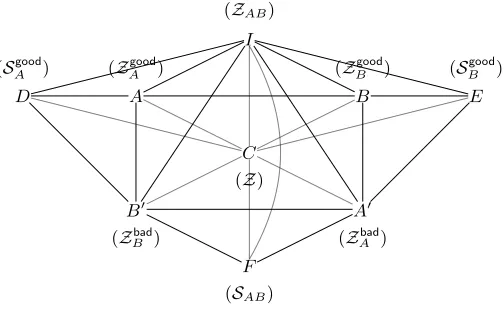
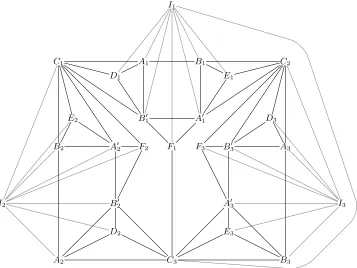
(ΓB(ZA∪ Z)\(ZA∪ Z))∩ΓA(ZB∪ Z) =∅, (4) (ΓA(ZB∪ Z)\(ZB∪ Z))∩ΓB(ZA∪ Z) =∅. (5) The proof for the general case is included in the appendix. The proof technique is identical, but uses a more elaborate construction (Figure 10).
The proof proceeds in two steps: First we show the impossibility of OT be-tween A and B in the graph HOT of Figure 4 with security w.r.t. a certain adversary structure (Lemma 4), then we use this observation to prove the neces-sity of the second condition in Theorem 2 for the special case through a reduction argument (Lemma 5).
Lemma 4. In HOT(VHOT,EHOT) (Figure 4), it is impossible to realize OT be-tween A andB with statistical security w.r.t. the malicious adversary structure
{{C},{A, D},{B, D}}.
Proof. The proof uses ideas from the proof for impossibility of Byzantine agree-ment by Fischer et al. in [15]. We first consider the case of perfect security for clarity and later argue the case of statistical security. We will show that a protocol for OT between A and B with perfect security w.r.t. the malicious adversary structure {{C},{A, D},{B, D}} would imply a secure 2-party OT protocol for the semi-honest case. The impossibility will then follow from the impossibility of secure 2-party semi-honest OT. To prove a contradiction, letΠ
be a protocol that realizes OT between A and B with perfect security w.r.t.
{{C},{A, D},{B, D}}. Similar to the construction used in [15], we construct a
1 ΓB(ZA∪ Z)\(ZA∪ Z
C0
B0 A1
D0
F0 E1
C1
A0 B1
D1
E0 F1
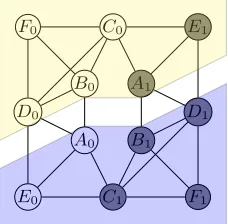
Fig. 6. We may visualize the execution of Π0 as vertices A0, B0, D0, E0, F0
fol-lowingΠ honestly and the corrupted set {C}simulating all the vertices in the yel-low region. SinceΠ is secure against the corruption of{C},A0 andB0 must have
computed OT correctly.
C0
B0 A1
D0
F0 E1
C1
A0 B1
D1
E0 F1
Fig. 7.We may also visualize the execu-tion of Π0 as vertices B0, C0, F0, E1
fol-lowingΠ honestly and the corrupted set {A, D} simulating all the vertices in the blue region. SinceΠ is secure against the corruption of{A, D}, view of all vertices in the blue region is independent ofB0’s
input.
graph SOT(VSOT,ESOT) by interconnecting two copies of HOT as shown in Fig-ure 5. Consider the map φ : VSOT → VHOT such that φ(vi) = v, i = 0,1, i.e.,
φ(A0) =φ(A1) = A, φ(B0) = φ(B1) = B and so on. Then SOT looks locally like HOT. For example, A0 has edges to B0, D0, E0 andC1 in SOT, whereas in
HOT, φ(A0) has edges to φ(B0), φ(D0), φ(E0), andφ(C1). Let each vertex v in
SOT run the instruction for φ(v) in the protocol Π. Wefix the input to A1 as
(0,0) and input toB1 as 0 and let the input to A0 be (X0, X1) and that toB0
beQ, whereX0, X1, Qare independent uniformly random bits. We call this the
execution of a protocolΠ0 inSOT. ClearlyΠ0 is not the same asΠ (Π is defined for 6 parties), but it is easy to see that this execution is well-defined.
Claim 4. The output atB0 isXQ.
Proof. In Figure 6, it can be verified none of the vertices in the yellow region has any inputs or outputs in the protocol (inputs ofA1, B1have been fixed) and that
all the edges that enter the yellow region (edges in red) are incident on either
C0orC1. Hence, all the vertices in the yellow region may be thought of as being
simulated by a malicious C. The execution of Π0 in S
OT can be interpreted as an execution ofΠ among honest verticesA0, B0, D0, E0, F0, and a corrupted set
{C} as shown in Figure 6.Π is assumed to be secure against the corruption of
C, thereforeA0, B0, D0, E0, F0 halt and realize OT between A0 and B0; hence
B0 outputsXQ. This proves the claim. ut
Claim 5. LetA{A,D}:={A0, A1, D0, D1, B1, C1, F1, E0}, the vertices in the blue
region of Figure 7. ThenQis independent of the view ofA{A,D}.
edges (red edges in the figure) from the vertices outside the blue region. Hence, the execution ofΠ0inSOTcan also be interpreted as an execution ofΠby honest
B0, C0, E1, F0, and a corrupted set {A, D} that simulates A{A,D} (the vertices in the blue region) and communicates with the honest vertices accordingly. Since
Π is secure against the corruption of{A, D}, the inputQofB0 is independent
of the view of{A, D}. HenceQis independent of the view ofA{A,D}. ut Claim 6. LetA{B,D}:={B0, B1, D0, D1, A1, C0, E1, F0}, the vertices in the
yel-low region of Figure 8.X0, X1 is independent of the view ofA{B,D}conditioned onQ, XQ.
Proof. Similar to the previous claims, as shown in Figure 8, the execution ofΠ0in
SOTcan also be interpreted as an execution ofΠ by honest partiesA0, E0, C1, F1
and a corrupted set{B, D}simulates the vertices in the yellow region (A{B,D}) and communicates with the honest vertices accordingly. Notice that the view of this set contains the input Qand output XQ of B0. SinceΠ is secure against
the corruption of {B, D}, the input (X0, X1) of A0 is independent of the view
of {B, D} conditioned on its input and output. Hence (X0, X1) is independent
of the view ofA{B,D}conditioned on Q, XQ. ut
C0
B0 A1
D0
F0 E1
C1
A0 B1
D1
E0 F1
Fig. 8.We may visualize the execution ofΠ0 as vertices A0, C1, E0, F1 following Π
hon-estly and the corrupted set{B, D}simulating all the vertices in the yellow region. SinceΠis secure against the corruption of{B, D}, the view of vertices in the yellow region must be conditionally independent ofA0’s input
con-ditioned onB0’s input and output.
C0
B0 A1
D0
F0 E1
C1
A0 B1
D1
E0 F1
Fig. 9. P1 and P2 simulate the
ver-tices in the blue and yellow regions respectively and runΠ0 faithfully by setting their inputs as inputs to A0
and B0 respectively to securely
real-ize a 2-party OT, a contradiction.
We show that Claims 4, 5, and 6 lead to a contradiction. To see this, let parties P1 and P2 simulate the vertices in the blue region (AP1) and yellow
region (AP2) respectively in Figure 9. Let them execute Π
0 faithfully with P
1
setting the input to the simulatedA0 asX0, X1 and that to the simulatedB1 as
0, andP2 setting the input to the simulatedB0asQand that to the simulated
Set Definition
Z Z =ψ−1(C)
ZAB(ZA∩ ZB)\ Z =ψ−1(D) Z0
A ZA\(Z ∪(ZA∩ ZB)) =ψ
−1
(A) Z0
B ZB\(Z ∪(ZA∩ ZB)) =ψ
−1
(B) SA ΓA\(ZA∪ ZB∪ Z) =ψ−1(E) SB ΓB\(ZA∪ ZB∪ Z) =ψ−1(F) Table 1. Partition ofV. Here ΓA := ΓB(ZA∪ Z) andΓB :=ΓA(ZB∪ Z).
C
A B
D E
B0 A0
F I
Fig. 10.In Appendix F, we show the neces-sity of the second condition for the general case by showing the impossibility of OT be-tweenAandBin this graph with statistical security w.r.t. the malicious adversary struc-ture{{C},{A, A0, I},{B, B0, I}}.
(i) The output at B0 isXQ.
(ii) Qis independent of the view ofAP1.
(iii) X0, X1is independent of the view ofAP2 conditioned on Q, XQ.
Here (i) follows from Claim 4. Claim 5 implies (ii) since the verticesAP1(the blue
region in Figure 9) is contained inA{A,D} (the blue region in Figure 7) and the only vertex inA{A,D}with input or output isA0. Similarly, Claim 6 implies (iii)
becauseAP2(the blue region in Figure 9) is contained inA{B,D}(the blue region
in Figure 8) and the only vertex inA{B,D}with input or output inA{B,D}isB0.
But, (i), (ii), and (iii) together imply that partiesP1andP2can securely realize
a 2-party OT in the semi-honest setting. Hence a protocol for OT betweenAand
B with perfect security w.r.t. the adversary structure{{C},{A, D},{B, D}}in the graph HOT in the malicious setting implies a perfectly secure 2-party OT protocol in the semi-honest setting. By the same line of reasoning, a protocol for statistically secure OT between AandB in the same setting would imply a statistically secure 2-party OT protocol in the semi-honest setting. The lemma now follows from the impossibility of statistically secure semi-honest 2-party
OT. ut
Lemma 5 below shows that ifZA ∈ZA,ZB ∈ ZB, andZ ∈ Z¬A¬B satisfy conditions (3), (4), and (5), then any protocol for OT betweenAandBinGwith security w.r.t.Zmay be simulated inHOTto realize OT betweenAandB with security w.r.t. {{C},{A, D},{B, D}}. The necessity of the second condition in Theorem 2 for the special case when (4) and (5) is satisfied will then follow from Lemma 5.
Lemma 5. Let ZA ∈ ZA,ZB ∈ ZB, and Z ∈ Z¬A¬B be such that condi-tions (3), (4), and (5) are satisfied. If OT between A and B in G(V,E) can be computed with statistical security w.r.t. the malicious adversary structure
{ZA,ZB,Z} thenA andB in HOT(VHOT,EHOT) (Figure 4) can realize OT with statistical security w.r.t. the malicious adversary structure{{C},{A, D},{B, D}}.
(i) Z0 A,Z
0
B,Z,ZAB,SA, andSB form a partition ofV andA∈ ZA0 , B∈ Z 0 B. (ii) Let the mapψ:V → VHOT be as given in Figure 4,i.e.,forv∈ Z
0
A, ψ(v) =A and so on. (i) implies thatψ is well-defined. Foru, v ∈ V, edge{u, v} is in
Gonly ifψ(u) =ψ(v) or edge{ψ(u), ψ(v)}is present inHOT. In short,HOT (or a subgraph of HOT) is obtained fromGon applying vertex contraction to every subset ofV given in Table 1.
(iii) IfΠ realizes OT betweenAandB in Gsecurely w.r.t. malicious adversary structure{Z,ZA,ZB}, then it is also secure w.r.t. malicious adversary struc-ture{Z,Z0
A∪ ZAB,ZB0 ∪ ZAB}={ψ−1({C}), ψ−1({A, D}), ψ−1({B, D})}. Assuming (i), (ii), and (iii), it is easy to see that the vertices in HOT can simulate Π and realize OT betweenA andB with statistical security w.r.t. the malicious adversary{{C},{A, D},{B, D}}. It remains to show (i), (ii), and (iii).
Proof of (i) – From their definitions, it can be easily verified thatZ,ZAB,ZA0,ZB0 are disjoint and that their union isZ ∪ ZA∪ ZB. By definition ofSA,SB, their union isΓB(ZA∪ Z)∪ΓA(ZB∪ Z)\(ZA∪ ZB∪ Z). By condition (3), this union is equal toV \(Z ∪ZA∪ZB). Finally, the fact thatSAandSBare disjoint follows from (4) sinceSA⊆ΓB(ZA∪ Z)\(ZA∪ Z) andSB ⊆ΓA(ZB∪ Z).
Proof of (ii) – Note that the only edges missing in HOT are {F, A},{F, E} and {E, B}. We will now show that there is no edge between any vertex in
ψ−1(F) = S
B and any vertex in ψ−1(A) = ZA0 or ψ−1(E) = SA. The fact that there is no edge between any vertex in ψ−1(E) = S
A and any vertex in
ψ−1(B) = Z0
B follows similarly. Suppose there exists u∈ SB and v∈ ZA0 ∪ SA such that{u, v}is an edge inG. SinceZB∪ Z ⊆ΓA(ZB∪ Z), we have
ZA∩ΓA(ZB∪ Z) = (ZA∩(ZB∪ Z))∪(ZA∩(ΓA(ZB∪ Z)\(ZB∪ Z))) = (ZA∩(ZB∪ Z))∪ ∅(by (5) since ZA⊂ΓB(ZA∪ Z))
⊆ Z ∪(ZA∩ ZB)
=⇒ ZA0 =ZA\(Z ∪(ZA∩ ZB))⊆ V \ΓA(ZB∪ Z).
SA=ΓB(ZA∪ Z)\(Z ∪ ZA∪ ZB)⊆ΓB(ZA∪ Z)\(ZA∪ Z) =⇒ SA⊆ V \ΓA(ZB∪ Z), by (4).
Hence we havev ∈ Z0
A∪ SA ⊆ V \ΓA(ZB∪ Z) and u∈ SB ⊆ΓA(ZB∪ Z)\ (ZB∪ Z). Sincev∈ V \ΓA(ZB∪ Z), there is a path fromv toAthat does not have any vertex fromZB∪ Z. Since edge{u, v}is present inG,uhas a path via
v to Athat does not contain any vertex fromZB∪ Z (note thatu /∈ ZB∪ Z). Butu∈ SB and henceu∈ΓA(ZB∪ Z), a contradiction.
Proof of (iii) – A∈ Z0
A andB ∈ ZB0 are the only vertices with input or output in Π. Also, Z0
A∪ ZAB ⊆ ZA andZB0 ∪ ZAB ⊆ ZB. Hence, if Π is secure w.r.t.
General Case: The necessity of the second condition for the general case is proved in a similar manner. We first show that it is impossible to realize OT between
A and B in the graph shown in Figure 10 with statistical security w.r.t. the malicious adversary structure{{C},{A, A0, I},{B, B0, I}}. This is shown using an argument similar to the one used in Lemma 4 on a graph constructed by interconnectingthree copiesof this graph. Then we use this observation to prove the necessity of the second condition in Theorem 2 for the general case through a reduction argument. This proof is included in Appendix F.
3.2 Sufficiency of Conditions
In this section, we consider a graph G(V,E) with A, B ∈ V and a malicious adversary structureZthat satisfies the conditions in Theorem 2 and construct a protocolΠmal that realizes OT betweenAandB with statistical security w.r.t.
Z. First we comment on two protocols we use extensively in this section: for
realizing secure communication and for computing OT from sampled OT.
Realizing Perfectly Secure Communication: In the previous section, we saw that the first condition in Theorem 2 is necessary for statistically correct communi-cation. In [28], Kumaret al. showed that this condition is sufficient for perfectly secure communication. We will use their protocol for realizing secure commu-nication between A and B in all the protocols that follow. This protocol is guaranteed to be efficient if the size ofZ is polynomial inn. We note here that their protocol can be shown to be composable.
OT computation using sampled OT: A sampled OT or a precomputed OT be-tweenAandB is a functionality that generatesr0, r1, cindependently and
uni-formly at random and sends the ordered pair (r0, r1) toAand the ordered pair
(c, rc) toB. The following protocol describes a well known technique for realizing OT between A with input (x0, x1) and B with input b using this sampled OT.
The OT computed by this protocol is statistically secure as long as the sampled OT was computed with statistical security [2].
Protocol 4 (SampledOT→OT(A: (x0, x1;r0, r1), B: (b;c, rc))). 2 1. B: Sendsp:=b⊕c toAsecurely.
2. A: Sends (y0, y1) := (x0⊕rp, x1⊕r1⊕p) securely.
3. B: Stores the messages it received as (y0, y1) and outputsyb⊕rc.
Πpath(C,A),path(C,B) ΠA, ΠB
ΠZA,Z, ΠZB,Z ΠA, ΠB
ΠZ Πmal
Iteration Combiner
Combiner
Fig. 11.Protocols in each column (except the ones in blue) make calls to the protocols in the previous column.
aborted if both A and B output ⊥ while guaranteeing perfect privacy of the inputs ofAandB.
First we demonstrate the construction Πmal assuming the following lemma which claims the existence of protocolsΠZ,Z ∈Z¬A¬B with certain properties. We prove this lemma later in the section by giving an explicit construction for
ΠZ,Z ∈ Z¬A¬B. The construction and analysis of ΠZ,Z ∈ Z¬A¬B is very similar to that of protocolΠsh described in the semi-honest section.
Lemma 6. Consider a pair of vertices A, B in G(V,E), and a malicious ad-versary structure Z such that the conditions in Theorem 2 hold. For each Z ∈ Z¬A¬B, there is a protocol ΠZ such that
(i) ΠZ computes OT betweenA and B with perfect security against the cor-ruption ofZ.
(ii) ΠZ is either aborted or it computes OT between A and B with statistical security w.r.t.Z\ {Z}.
This protocol is efficient if the size ofZis polynomial in n.
ProtocolΠmal. This protocol computes OT betweenAandBwith statistical se-curity with guaranteed output delivery. For eachZ ∈Z¬A¬B,AandB attempts to compute a sampled OT by executingΠZ with independent uniform bits as input. If, for someZ ∈Z¬A¬B, ΠZ succeeds in computing a sampled OT,Aand
B use this sampled OT to realize the OT. Since the sampled OT is statistically secure by Lemma 6 (ii), the OT computed using it is also statistically secure. By Lemma 6 (i), ΠZ aborts for all Z ∈
Z¬A¬B only if the corrupted set is not in
Z¬A¬B, i.e.,either AorB is corrupt. In that case,B (if honest) may output a random bit and the computation is still secure. Let Z¬A¬B ={Z1, . . . ,Z`}, we formally describeΠmal as follows:
Protocol 5 (Πmal(A: (x0, x1), B: (b))).
1. Fori= 1, . . . , `:
(a) A generates bits r0i, r1i uniformly and independently andB generates a
bitci uniformly and executesΠZi(A: (ri0, ri1), B:ci).
2
(b) If for somei≤`, Breceives ¯ri
c as output (i.e.,ΠZ
i
does not abort) then
AandBexecuteSampledOT→OT A: (x0, x1;r0i, r1i), B: (b;ci,r¯ic)
, out-put whatever the protocol outout-puts and terminate.
2. If for alli≤`, ΠZi aborts, then B outputs a bit uniformly at random. Proof (Proof of the sufficiency part of Theorem 2).We show thatΠmalcomputes OT betweenAandB with statistical security w.r.t.Z. For everyi= 1, . . . `, the
inputs ofAandBtoΠZiare random bits independent of their real inputs. Hence their input remains perfectly private after the execution of ΠZi
irrespective of whether it is aborted or not. We consider two cases.
Case 1 – For some iterationi∈ {1, . . . , `},ΠZi
does not abort:By Lemma 6 (ii), the sampled OT computed by ΠZi is statistically secure, hence the OT computed using this sampled OT is also statistically secure.
Case 2 – Fori= 1, . . . `,ΠZi aborts: By Lemma 6 (i), for anyZ ∈Z¬A¬B,
ΠZ realizes OT with perfect security against the corruption of Z. Hence,ΠZi
aborts for all i only if the corrupted set is in Z\Z¬A¬B i.e., either A or B is corrupted. In this case, an honestB may output a random bit and the protocol remains perfectly secure.
Hence Πmal computes OT between A and B with statistical security w.r.t.
Z. The efficiency claim follows from the fact that Πmal runs at most |Z¬A¬B| protocols of the kind ΠZ, each of which is efficient when Z is of size poly(n)
according to Lemma 6. ut
In the rest of this section, we prove Lemma 6 by explicitly constructingΠZ,Z ∈
Z¬A¬B. As a first step, we construct a protocolΠpath(C,A),path(C,B)that is defined for C∈ V \ {A, B}, and paths path(C, A) and path(C, B) fromC toA and B, respectively.
Protocol Πpath(C,A),path(C,B) (analogous to ΠC in Lemma 1). In this protocol vertex C facilitates an OT computation between A and B by providing them with a sampled OT similar to protocol ΠC described in the semi-honest case. The protocol either computes OT with statistical security or aborts in a precom-putation phase unlessAand a vertex inpath(C, B) are corrupted simultaneously orB and a vertex inpath(C, A) are corrupted simultaneously.
The protocol has two phases; a precomputation phase and an OT compu-tation phase. In the precompucompu-tation phase, vertex C generates a sampled OT and distributes it toAandBby communicating withAandBalongpath(C, A) and path(C, B) respectively. Unlike in the semi-honest case, the correctness of the sampled OT has to be verified, lestAandBcompute OT using an incorrect sampled OT. If the verification succeeds, A and B enter the OT computation phase in which they use the sampled OT to compute OT with their real inputs, else the protocol aborts. The verification step accepts an incorrect sampled OT with positive probability, but this probability can be made as small as needed.
Protocol 6 (Πpath(C,A),path(C,B)(A: (x
– Precomputation Phase3
1. C: Generates uniformly random bits r0, r1, c, and chooses a0, a1
inde-pendently and uniformly at random from F of size at least 3. Define
p0(x) := a0x+r0, and p1(x) := a1x+r1. C sends (p0, p1) to A along
path(C, A) and (c, pc) toB alongpath(C, B). 2. A: Stores the received polynomials as ¯pA
0,p¯A1.B: Stores the received bit
as ¯c and polynomial as ¯pB
¯
c
3. B: Generatesαuniformly at random fromF\ {0}.BsendsαtoCalong path(C, B) and sendsαtoAsecurely.
4. C: Sends αreceived from B to A along path(C, A). If αis non-zero, it sends (p0(α), p1(α)) toB alongpath(C, B) else it sends⊥to B.
5. A: If α received from B and C are identical and non-zero, A sends (pA
0(α), pA1(α)) to B securely, otherwise it sends ⊥ to B securely and
aborts by outputting⊥.
6. B: Stores evaluations received fromAasyA
0, y1Aand evaluations fromC
asyC
0, y1C. IfyiA=yCi , i= 0,1 andyA¯c = ¯pB¯c(α):
– Then: Sends ACCEPT to A securely and stores the sampled OT (¯c,p¯B
¯
c(0)).
– Else: Sends REJECT to Asecurely and aborts by outputting⊥. 7. A: If REJECT is received from B, then it aborts by outputting⊥ else
it stores the sampled OT (¯pA
0(0),p¯A1(0)).
– OT computation Phase:
ExecuteSampledOT→OT A: (x0, x1; ¯pA0(0),p¯A1(0), B: (b; ¯c,p¯Bc¯(0))
and re-turn the output.
Lemma 7. Consider a network G(V,E), vertices A, B ∈ V and a malicious adversary structureZsuch that the conditions in Theorem 2 hold. Suppose there
exists a vertexC ∈ V \ {A, B}, and paths path(C, A)andpath(C, B) fromC to
AandBrespectively such that, for every setZ ∈Z, at least one of the following
conditions is satisfied. (i) A, B /∈ Z,
(ii) A∈ Z butpath(C, B)∩ Z=∅, (iii) B∈ Z butpath(C, A)∩ Z=∅.
Then, the protocol Πpath(C,A),path(C,B) is either aborted in the precomputation phase while guaranteeing perfect privacy of inputs or computes OT between A
and B with statistical security w.r.t. Z with error probability |F|−11. Moreover,
this protocol is efficient as long as the size ofZis polynomial in n.
Proof. Refer to Appendix G for the proof. ut
The probability of error in this protocol can be brought down to| 1
F|−1 k
ifCdistributeskpairs of independent and uniformly random polynomials with
3
r0, r1as constant terms and the verification steps are carried out independently
for each pair of polynomials with a fresh sample ofα.
We define OT protocolsΠA, ΠB as follows. In both these protocols,A and
B interpret missing or invalid messages as 0.
Protocol 7 (ΠA(A: (x
0, x1), B:b)).
1. B: Sendsb toAsecurely. 2. A: Sendsxb toB securely. 3. B: Outputsxb.
Protocol 8 (ΠB(A: (x
0, x1), B:b)).
1. A: Sends (x0, x1) toB securely.
2. B: Outputsxb.
It is easy to see that ΠA is perfectly secure as long as A is honest and communication between A andB is secure, similarly ΠB is perfectly secure as long asBis honest and communication betweenAandBis secure. Specifically, if
A, Bsatisfy the conditions in Theorem 2 for an adversary structureZ, thenΠAis
secure w.r.t.ZB∪Z¬A¬BandΠBis secure w.r.t.ZA∪Z¬A¬B. These protocols are also efficient as long as|Z|=poly(n) since the secure communication between
AandB can be carried out efficiently.
We construct the protocol ΠZ corresponding to each Z ∈ Z¬A¬B in two steps along the lines of the construction of OT protocolΠsh in the semi-honest case. In the first step, the protocol will be secure w.r.t. some specific adversary structures. Then we use these protocols to construct a protocol for the general case. In both these protocols, similar to the semi-honest case, we invoke the idea of compiling many protocols that are not individually secure w.r.t. the adversary structure to create a protocol that is secure. For this, we use an OT combiner for malicious setting as described in [23].
Lemma 8. [23, Corollary 7]
Given a malicious adversary structureZ and protocols Π1, . . . , Πm realizing OT between A and B such that against the corruption of every set Z ∈ Z, a
majority of protocolsΠ1, . . . , Πmare statistically secure, there is a hybrid proto-colCombinermal(Π1, . . . , Πm) that makes calls toΠ1, . . . , Πm and computes OT between AandB with statistical security w.r.t.Z. Moreover, ifmis polynomial inn and eachΠi is efficient fori∈[m], then the combiner is efficient.
In the first step, for Z ∈ Z¬A¬B and ZA ∈ ZA (ZB ∈ ZB, respectively), we construct a protocol ΠZ,ZA (ΠZ,ZB, respectively) that runs in two stages. It
is either aborted in the first stage or computes OT between A and B with security w.r.t. the adversary structure{ZA} ∪Z¬A¬B∪ZB({ZB} ∪Z¬A¬B∪ZA, respectively). The protocol has the additional property that it computes OT withperfect security against the corruption ofZ.
ProtocolΠZ,ZA (analogous toΠZAin Lemma 3). The protocol involves only the
vertices inV \ Z, hence it is perfectly secure against the corruption ofZ. It is a combiner of a set of protocols of the kind defined in Protocol 6 and copies ofΠA. It runs in two phases. In the first phase, Aand B compute and store sufficient number of sampled OTs for each protocol of the kindΠpath(C,A),path(C,B)used in
the combiner by running their precomputation phases.ΠZ,ZB is aborted if any
the combiner with each call to Πpath(C,A),path(C,B) being realized by executing
the OT computation phase of Protocol 6. Analysis of this protocol is very similar to ΠZA described in Lemma 3. Since the protocol ΠZ,ZB is similar, with the
roles ofAandB reversed, we omit its description.
Consider the adversary structure {ZA} ∪Z¬A¬B∪ZB, such that A ∈ ZA and a set Z ∈ Z¬A¬B. For every ZB ∈ ZB, there exists a vertex CZB and
pathspathZB(CZB, B) andpathZB(CZB, A) such that pathZB(CZB, A) does not
have any vertex from setZB∪ Z andpathZB(CZB, B) does not have any vertex
from set ZA∪ Z. Otherwise, for each vertex v ∈ V, we have v ∈ΓA(ZB∪ Z) or v ∈ ΓB(ZA∪ Z). This would lead to the contradiction that ΓA(ZB∪ Z)∪
ΓB(ZA∪ Z) =V. Note that, sinceCZB ∈/ ΓA(ZB∪ Z)∪ΓB(ZA∪ Z), it can not
beA orB, henceΠpathZi B
(CZi B
,A),pathZi B
(CZi B
,B)
are well-defined. LetZB ={ZB1, . . . ,Z
`B
B }. Consider the protocolsΠ1, . . . , Π2`B−1, where Πi:=Π
pathZi B
(CZi B
,A),pathZi B
(CZi B
,B)
, for 1≤i≤`B,
Πi:=ΠA, for`B+ 1≤j≤2`B−1.
Consider the combiner of these 2`B −1 protocols for OT between A and B. LetCalls(Πi) represent the number of calls made to the protocol Πi during an execution of the combiner. Then we construct the protocolΠZ,ZA as follows. Protocol 9 (ΠZ,ZA(A: (x
0, x1), B:b)).
1. For 1≤i≤`B, performCalls(Πi) number of independent executions of the precomputation phase ofΠpathZi
B (CZi
B
,A),pathZi B
(CZi B
,B)
.
2. If any of the executions is aborted: abort the protocol otherwise execute the protocolCombinermal(Π1, . . . , Π2`B−1) with (x0, x1) andb as input from A
andB respectively and output what the combiner outputs.
Note: Every call to Πi,1 ≤ i ≤`B is realized by executing the OT com-putation phase ofΠpathZi
B (CZi
B
,A),pathZi B
(CZi B
,B)
with the sampled OT from step 1. All other protocols in the combiner are copies of ΠA, which are executed online.
Lemma 9. Consider a pair of verticesA, Bin a graphG(V,E), and a malicious adversary structureZ={ZA} ∪Z¬A¬B∪ZB whereA∈ ZA (Z=ZA∪Z¬A¬B∪
{ZB} whereB ∈ ZB, respectively) such that the conditions in Theorem 2 hold. Let Z ∈Z¬A¬B, then the following hold:
(i) ΠZ,ZA (ΠZ,ZB, respectively) computes OT between Aand B with perfect
security against the corruption ofZ.
(ii) ΠZ,ZA (ΠZ,ZB, respectively) is either aborted in step 1 or computes OT
betweenA andB with statistical security w.r.t.Z\ {Z}.
The protocolΠZ,ZA (ΠZ,ZB, respectively) is efficient if the size of
Zis
polyno-mial inn.
Protocol ΠZ (analogous to Πsh in the proof of Theorem 1). Now we are ready to prove Lemma 6 which will complete the proof of the sufficiency of Theo-rem 2. We do this by constructing ΠZ for each Z ∈ Z¬A¬B using protocols
ΠZ,ZA,Z
A ∈ZA, ΠZ,ZB,ZB ∈ZB and copies of ΠA and ΠB. This protocol realizes OT betweenAandBwith perfect security against corruption ofZ and guarantees statistical security w.r.t.Z\{Z}whenever it is not aborted. The
con-struction of this protocol and its analysis is similar to the concon-struction of Πsh from ΠZA,Z
A ∈ZA, ΠZB,ZA ∈ZB and copies of ΠA, ΠB in the semi-honest case (Proof of Theorem 1). Let ZA={ZA1, . . . ,Z
`A
A } andZB ={ZB1, . . . ,Z `B
B }. Consider the following set of protocols
(Π1,1, Π1,2), . . . ,(Π`A,1, Π`A,2),(Π`A+1,1, Π`A+1,2), . . . ,(Π`A+`B,1, Π`A+`B,2),
where (Πi,1, Πi,2) := (ΠZ,ZA, ΠB), for 1≤i≤`A, (Π`A+i,1, Π`A+i,2) := (Π
Z,ZB, ΠA), for 1≤i≤`
B.
Let Calls(Πi,j) represent the maximum number of calls made to the protocol
Πi,j during any execution ofCombinermal(Π1,1, Π1,2, . . . , Π`A+`B,1, Π`A+`B,2). Protocol 10 (ΠZ(A: (x0, x1), B:b)).
– Precomputation Phase
1. For 1≤i≤`A: ExecuteCalls(Πi,1) instances ofΠZ,ZA with uniformly
random independent bits as inputs byA andB. (a) If any of the executions abort: abort the protocol. (b) Else: Store the sampled OT from each execution. 2. For 1 ≤ i ≤ `B: Execute Calls(Π`A+i,1) instances of Π
Z,ZB with
uni-formly random independent bits as inputs byAandB. (a) If any of the executions abort: abort the protocol. (b) Else: Store the sampled OT from each execution.
– OT Computation Phase
1. Run Combinermal(Π1,1, Π1,2, . . . , Π`A+`B,1, Π`A+`B,2) and output what
the combiner outputs. Calls to Πi,1,1 ≤ i ≤ `A+`B are realized by computing OT using the sampled OT from the corresponding protocol. Proof (Proof of Lemma 6).The protocol involves only vertices inV \Z, hence it is perfectly secure against the corruption ofZ. Consider any setZ0 ∈
Z\{Z}. If the
protocol aborts during the precomputation phase, the inputs of honest vertices are private since the real inputs are not used in this phase. Suppose the protocol is not aborted in the precomputation phase. Using the same argument we used in the proof of security ofΠshin the semi-honest case, one could verify that against the corruption of any Z0 ∈ Z\ {Z}, a majority of the protocols used in the
combiner is secure. Hence, the combiner computes OT with statistical security by Lemma 8. Moreover, if the size of Zis polynomial in n, then the protocols that are combined are all efficient by Lemma 9 and properties ofΠA, ΠB. Since,
ΠZis a combiner of 2(|ZA|+|ZB|) protocols, Lemma 8 implies that it is efficient
4
Discussion
In this section we address some of the limitations of our results and scope for further improvements.
• In the semi-honest case, Theorem 1 provides a complete characterization of incomplete networks that allow a given pair of parties to compute OT. Fur-thermore, this result implies the more general result (Corollary 1) regarding the characterization of networks in which a given subset may realize MPC. As we previously observed, this generalizes the result by Hirt and Mau-rer [24] on feasibility of MPC with respect to a general adversary structure in complete networks.
However, in the malicious case, our characterization is limited to the notion of statistical security. Our results leave open the possibility that the neces-sary and sufficient condition for OT with perfect security between a given pair of parties in an incomplete network might be different from the one in Theorem 2. As previously observed, our characterization directly extends to statistically secure computation of 2-party functionalities with output only at one party. However, the problem of 2-party secure computation with out-put at both parties remains open. Although our current technique using OT combiners is unable to realize secure computation (with fairness), we con-jecture that the conditions in Theorem 2 might be sufficient for statistically secure MPC of such functionalities too.
Corollary 2 only partially solves the problem of the characterization of net-works in which a given subset of parties may realize statistically secure MPC. The characterization of networks in which a given subset of parties may re-alize statistically secure MPC without abort and with fairness (guaranteed output delivery) still remains open. The example given in Figure 12 shows that the necessary and sufficient condition for this must be strictly stronger than the condition given in Corollary 2. We also leave open the problem of whether the conditions in Corollary 2 are sufficient for a given subset of parties to realize statistically secure MPC with fairness, but with abort.
• Section 2.3 addresses efficiency for threshold adversarial structures when the threshold is a constant or whenn= 2t+O(1). Except for these cases, the communication complexity of our protocols are polynomial in the size of adversary structure. Efficiency of the protocol in the case of large adversary structures is an important aspect which needs further study. Being the first work on this problem, our focus has been mostly on the characterization. We hope that future work will address the efficiency question more thoroughly; we believe this might require a different set of tools.
• Protocols for general adversary structures often have the following property: if they are secure against the corruption of a set of parties, then they would be secure against the corruption of a subset of these parties. This is not true, in general, for the protocols we construct, neither in the semi-honest nor in the malicious setting. Consider a graph G(V,E), where V ={A, B,1} and
C
D
A B
E F
Fig. 12.Consider the problem of MPC among the parties {A, B, C}with statistical security w.r.t. the malicious adversary structureZ={{A},{B},{C}}. Every pair of
parties in{A, B, C}satisfies the conditions in Theorem 2, hence the condition given in Corollary 2 is satisfied. However, an argument almost identical to the one presented by Fischeret al. in [15] can be used to show the impossibility of Byzantine agreement among{A, B, C}in this network. This shows that the conditions given in Corollary 2 are not sufficient for a given subset of parties in an incomplete network to do MPC with statistical security w.r.t. a given adversary structure, with guaranteed output delivery.
OT betweenAand B is impossible with security against the corruption of vertex 1, as SMT betweenAandB with security against such a corruption itself is impossible. As a consequence, unlike most protocols constructed for general adversary structures, our protocols are not efficient in the number of maximal sets in the adversary structure. However, a more limited form of monotonicity does hold for our protocols. It is easy to see from the con-ditions in both Theorems 2 and 1 that if a setZA ⊂ V such thatA ∈ ZA is present in the adversary structure, then we may as well throw in sets of the kindZ0
A ⊂ ZA such that A ∈ ZA0 and this larger adversary structure will satisfy the conditions stated in both these Theorems if and only if the adversary structure we started out with satisfied these conditions. Similarly, ifB ∈CB ⊂ Vis present in the adversary structure, we may as well throw in sets of the kindZ0
B⊂CB such thatB∈ ZB0 . Also, ifZ such thatA, B /∈ Z is present in the adversary structure, then throwing in every subset of Z
will not make any difference. Indeed, with some modifications, our protocols can be made efficient w.r.t. the size of ‘maximal’ adversary structure in the above sense.
Another consequence of this lack of monotonicity is that our protocols do not, in general, continue to be secure when the adversary is adaptive rather than static (see [10, Chapter 4.5]). To see this, we again consider the graph
5
Acknowledgments
We acknowledge useful discussions with Manoj Prabhakaran, IIT Bombay.
References
[1] S. Agarwal, R. Cramer, and R. de Haan. “Asymptotically Optimal Two-round Perfectly Secure Message Transmission”. In:CRYPTO. 2006, pp. 394– 408.
[2] D. Beaver. “Precomputing Oblivious Transfer”. In:CRYPTO. 1995, pp. 97– 109.
[3] A. Beimel. “On private computation in incomplete networks”. In: J. Dis-tributed Computing 19.3 (2007), pp. 237–252.
[4] M. Ben-Or, S. Goldwasser, and A. Wigderson. “Completeness Theorems for Non-Cryptographic Fault-Tolerant Distributed Computation”. In:STOC. 1988, pp. 1–10.
[5] M. Bl¨aser et al. “Privacy in Non-private Environments”. In: J. Theory Comput. Syst. 48.1 (2011), pp. 211–245.
[6] M. Bl¨aser et al. “Private Computation: k-Connected versus 1-Connected Networks”. In: J. Cryptology 19.3 (2006), pp. 341–357.
[7] N. Chandran, J. Garay, and R. Ostrovsky. “Edge Fault Tolerance on Sparse Networks”. In: ICALP. 2012, pp. 452–463.
[8] N. Chandran, J. Garay, and R. Ostrovsky. “Improved Fault Tolerance and Secure Computation on Sparse Networks”. In:ICALP. 2010, pp. 249–260. [9] D. Chaum, C. Cr´epeau, and I. Damg˚ard. “Multiparty Unconditionally
Secure Protocols”. In:STOC. 1988, pp. 11–19.
[10] R. Cramer, I. Damg˚ard, and J. Nielsen. Secure Multiparty Computation and Secret Sharing. Cambridge University Press, 2015.
[11] C. Cr´epeau, J. van de Graaf, and A. Tapp. “Committed Oblivious Transfer and Private Multi-Party Computation”. In:CRYPTO. 1995, pp. 110–123. [12] D. Dolev. “The Byzantine Generals Strike Again”. In: J. Algorithms 3.1
(1982), pp. 14–30.
[13] D. Dolev et al. “Perfectly Secure Message Transmission”. In:J. ACM 40.1 (1993), pp. 17–47.
[14] C. Dwork et al. “Fault Tolerance in Networks of Bounded Degree”. In: SIAM J. Comput.17.5 (1988), pp. 975–988.
[15] M. J. Fischer, N. A. Lynch, and M. Merritt. “Easy Impossibility Proofs for Distributed Consensus Problems”. In: J. Distributed Computing 1.1 (1986), pp. 26–39.
[16] M. K. Franklin and M. Yung. “Secure Hypergraphs: Privacy from Partial Broadcast”. In:SIAM J. Discrete Math. 18.3 (2004), pp. 437–450. [17] J. Garay and R. Ostrovsky. “Almost-everywhere Secure Computation”.
[18] O. Goldreich, S. Micali, and A. Wigderson. “How to Play any Mental Game or A Completeness Theorem for Protocols with Honest Majority”. In:STOC. 1987, pp. 218–229.
[19] O. Goldreich and R. Vainish. “How to Solve any Protocol Problem - An Efficiency Improvement”. In: CRYPTO. 1987, pp. 73–86.
[20] S. Goldwasser and Y. Lindell. “Secure Computation without Agreement”. In:Distributed Computing. 2002, pp. 17–32.
[21] S. Halevi et al. “Secure Multiparty Computation with General Interaction Patterns”. In:ITCS. 2016, pp. 157–168.
[22] D. Harnik, Y. Ishai, and E. Kushilevitz. “How Many Oblivious Transfers Are Needed for Secure Multiparty Computation?” In: CRYPTO. 2007, pp. 284–302.
[23] D. Harnik et al. “OT-Combiners via Secure Computation”. In:TCC. 2008, pp. 393–411.
[24] M. Hirt and U. M. Maurer. “Complete Characterization of Adversaries Tolerable in Secure Multi-Party Computation (Extended Abstract)”. In: PODC. 1997, pp. 25–34.
[25] Y. Ishai, M. Prabhakaran, and A. Sahai. “Founding Cryptography on Oblivious Transfer - Efficiently”. In: CRYPTO. 2008, pp. 572–591. [26] A. Jakoby, M. Li´skiewicz, and R. Reischuk. “Private Computations in
Networks: Topology versus Randomness”. In: STACS. 2003, pp. 121–132. [27] J. Kilian. “Founding Cryptography on Oblivious Transfer”. In: STOC.
1988, pp. 20–31.
[28] M. V. N. A. Kumar et al. “On perfectly secure communication over arbi-trary networks”. In:PODC. 2002, pp. 193–202.
[29] R. Kumaresan, S. Raghuraman, and A. Sealfon. “Network Oblivious Trans-fer”. In:CRYPTO. 2016, pp. 366–396.
[30] K. Kurosawa and K. Suzuki. “Truly Efficient 2-round Perfectly Secure Message Transmission Scheme”. In:IEEE Trans. Inf. Theor.55.11 (2009), pp. 5223–5232.
[31] L. Lamport, R. Shostak, and M. Pease. “The Byzantine Generals Prob-lem”. In:ACM Trans. Program. Lang. Syst.(1982), pp. 382–401.
[32] R. Meier, B. Przydatek, and J. Wullschleger. “Robuster Combiners for Oblivious Transfer”. In: TCC. 2007, pp. 404–418.
[33] T. Rabin and M. Ben-Or. “Verifiable Secret Sharing and Multiparty Pro-tocols with Honest Majority”. In:STOC. 1989, pp. 73–85.
[34] H. Md. Sayeed and H. Abu-Amara. “Efficient Perfectly Secure Message Transmission in Synchronous Networks”. In:J. Inf. Comput.126.1 (1996), pp. 53–61.
[35] G. Spini and G. Z´emor. “Perfectly Secure Message Transmission in Two Rounds”. In:TCC. 2016, pp. 286–304.
[36] K. Srinathan, A. Narayanan, and C. P. Rangan. “Optimal Perfectly Secure Message Transmission”. In:CRYPTO. 2004, pp. 545–561.