BoostReduce – A Framework For Strong Lattice Basis Reduction
Werner Backes and Susanne Wetzel
Stevens Institute of Technology
Castle Point on Hudson, Hoboken, NJ 07030 USA Email:{wbackes,swetzel}@cs.stevens.edu
Abstract In this paper, we propose a new generic reduction frameworkBoostReducefor strong lattice basis reduction. At the core of our new framework is an iterative method which uses a newly-developed algorithm for finding short lattice vectors and integrating them efficiently into an improved lattice basis. We presentBoostBKZas an instance of BoostReduceusing the Block-Korkine-Zolotarev (BKZ) reduction.BoostBKZis tailored to make effective use of modern computer architectures in that it takes advantage of multiple threads. Experimental results ofBoostBKZshow a significant reduction in running time while maintaining the quality of the reduced lattice basis in comparison to the traditional BKZ reduction algorithm.
Keywords Parallel Algorithm, Lattice Basis Reduction, Framework, Multi-Core, Cryptanalysis.
1 Introduction
Over the past few years, lattice theory has assumed an ever-increasing role in cryptography. Major milestones include the seminal work by Lenstra, Lenstra, and Lov´asz introducing the LLL lattice basis reduction algorithm; Schnorr and Euchner proposing a variant of the LLL algorithm [33]— marking a break-through in enabling efficient lattice basis reduction in practice; or the advances in providing for stronger lattice basis reduction in practice (e.g., Block Korkine-Zolotarev reduction [10, 34]). These works have led to lattice basis reduction becoming a prominent tool in cryptanalysis (e.g., [33, 11, 28, 29, 13, 14, 25]). Furthermore, lattice theory is gaining importance in designing cryp-tographic primitives. In particular, it is widely believed that lattice theory can provide the means for constructing cryptographic primitives that exhibit strong security even in the presence of quan-tum computers. Recent advances in constructing lattice-based cryptographic primitives include the introduction of the first fully homomorphic cryptosystem by Gentry [15] using ideal lattices, Peik-ert’s work on constructing public key cryptosystems from the worst-case shortest vector problem [30], lattice-based hash functions (e.g., [31, 24]), lattice-based identification schemes [23], or the NTRU (e.g., [20, 37]) and GGH cryptosystems [16]—much of which was originally spurred by the work of Ajtai and Dwork [1–3] which was the first to prove security based on hardness assumptions of lattice problems.
recently. Pujol et al. [35] developed a first parallel algorithm for finding the shortest lattice vectors based on a variant of Kannan’s algorithm [21, 17]. The work of Hermans et al. [18, 19] focuses on a similar parallel algorithm for finding shortest lattice vectors using CUDA capable graphics cards. Both works constitute an important step towards a parallel BKZ reduction algorithm, but neither of these algorithms does yet support pruning techniques which are essential for enabling efficient, parallel BKZ reduction in practice—especially when considering typical problem sizes in many of today’s cryptographic contexts.
Our new reduction framework pursues a different approach. The core structure of BoostReduce
is based on the use of sequences of lattice basis reductions [4, 5]. As a main component of the novel framework we introduce a new set of intermediate steps in between the individual reductions that are tailored to further improve the lattice basis and thus the starting point for the subsequent lattice basis reduction. This is combined with a sophisticated tightening of the parameters for the intermediate steps as well as the reduction algorithm itself. In addition, the new framework supports the execution of multiple heuristics in parallel and as such provides the means to select an optimal lattice basis as the starting point for the next round of the overall reduction process.
As a second main contribution of this paper, we introduceBoostBKZas an instance of our new framework BoostReducewhich is based on the BKZ reduction algorithm. In particular, as part of
BoostBKZwe develop a new parallel algorithm for finding short lattice vectors that makes effective use of the multi-core features of today’s computer architectures.
The third main component of this paper is an extensive analysis of the performance ofBoostBKZ. Our experiments show that BoostBKZprovides a significant improvement in practice over conven-tional BKZ reduction.
Outline: Section 2 provides the definitions and notations used in the remainder of the paper. Section 3 introduces our new reduction frameworkBoostReduceand Section 4 details BoostBKZas instance of our frameworkBoostReduce. Section 5 presents our new parallel algorithm for finding short lattice vectors and Section 6 describes an algorithm for incorporating these short lattice vectors into an improved lattice basis. Section 7 provides a detailed analysis of BoostBKZ. The paper closes with some directions for future work.
2 Preliminaries
AlatticeL= n
Pk
i=1xibi|xi ∈Z,1≤i≤k o
⊂Rnis an additive discrete subgroup of
Rn. The linear
independent vectors b1, . . . , bk ∈Rn (k≤n) form a basis B = (b
1, . . . , bk) ∈Rn×k of dimension k
of the latticeL. The basis of a lattice is not unique. A basisB may be transformed into a basis B0 of the same lattice L by applying a unimodular transformation U, i.e., B0 = BU with U ∈ Zn×k
and |detU|= 1.
TheGram-Schmidt orthogonalizationB∗ = (b∗1, . . . , b∗k) of a lattice basisB = (b1, . . . , bk)∈Rn×k
is computed as b∗1 =b1, b∗i =bi−Pi−1 j=1µi,jb
∗
j for 2≤ i≤k where µi,j = hbi,b∗ji
kb∗
jk for 1 ≤j < i≤k
whereh., .idefines the scalar product of two vectors. It is important to note thatB∗is not necessarily a basis for the latticeL, nor is a vector b∗i of the orthogonalization B∗ necessarily inL.
The defect of a lattice basis B = (b1, . . . , bk) ∈ Rn×k defined as dft(B) =
Qn i=1kbik
det(L) allows one
to compare the quality of different bases. Obviously, dft(B)≥1 and dft(B) = 1 for an orthogonal basis. The goal of lattice basis reduction is to determine a basis with smaller defect. That is, for a latticeL⊂Rn with basesB andB0∈
For a lattice L ⊆ Zn with basis B = (b
1, . . . , bk) ∈ Zn×k, corresponding Gram-Schmidt
or-thogonalization B∗ = (b∗1, . . . , b∗k) ∈ Rn×k, and coefficients µ
i,j with 1 ≤ j < i ≤ k, πi :−→ span(b1, . . . , bi−1)⊥ for 1 ≤ i ≤k denotes the orthogonal projection with πi(bj) =
Pk
s=iµjsb∗s. A
basis B = (b1, . . . , bk) ∈ Zn×k for lattice L ⊆ Zn is Block Korkine-Zolotarev reduced for block size β ∈ N and reduction parameter 14 < y < 1, iff |µij| ≤ 12 for 1 ≤ j < i ≤ k (Eq. 1) and ykπi(bi)k ≤λ1(L(πi(bi), . . . , πi(bmin(i+β−1,n)))) (Eq. 2) whereλ1 denotes the length of the shortest
non-zero vector ofL(πi(bi), . . . , πi(bmin(i+β−1,n))) [32].
3 The New Approach
In the following, we introduce and motivate the three main ideas of our new algorithmic framework tailored to significantly decrease the running time of strong lattice basis reduction algorithms in practice—thus enabling the tackling of large lattice bases.
The first idea in designing the framework is to iteratively reduce a lattice basis using a sequence of reduction parameters that increase in size. This general heuristic previously proved beneficial in the context of LLL reduction [4, 5]. The second idea is the introduction of suitable intermediate steps in between two iterations with the goal of further improving the lattice basis and thus providing for a better starting point for the subsequent reduction algorithm. In [7], for example, simple modifications—such as sorting—resulted in a decrease of the running time when LLL reducing unimodular lattice bases. The third idea for our new approach is to make effective use of today’s multi-core computer architectures by exploiting the inherent parallel capabilities due to multiple cores. Specifically, our framework is designed to allow for the executing of the same basic sequential algorithm while employing differing algorithmic heuristics or using varying inputs on different cores. As such it is possible to execute multiple heuristics or treat different inputs at once with the benefit that the best one among multiple results can be selected as the starting point for subsequent steps. These three basic ideas lead to the following structure of our new BoostReduce reduction framework (see Algorithm 1): At the beginning, we perform an initial reduction using a weak set of parameters. The main loop of BoostReduce(Lines (2)- (7)) corresponds to the overall iterative algorithmic framework of our new approach. In each iteration of the main loop, we first use an algorithm for finding a setS of linear combinations of short lattice vectors.
Algorithm 1:BoostReduce
Input:B= (b1, . . . , bk)∈Zn×k,
Piparameter set forReduceBasis,Eiparameter set forFindShortLV
Gjparameter set for generating improved bases
tnumber of allocated threads,rnumber of steps
Output:B= (b1, . . . , bk), BKZ reduced
(1) B=ReduceBasis(B,P0)
(2) for(1≤i≤r)do
(3) S=FindShortLV(B, Ei)
(4) Use setSand parametersG1, . . . , Gtto generate improved basesB01, . . . , B0t (5) RunBj00=ReduceBasis(Bj0,Pi) with 1≤j≤t
in parallel untilmaxredinstances have finished.
(6) Selectlsuch thatpl= min{pj|1≤j≤t}withpj=Qki=1kb00jik
(7) B=Bl00
basesBj0 are then reduced in parallel. In order to limit the time spent on the reductions and keeping the overall algorithm balanced, ongoing reductions as part of Line(5)are terminated oncemaxred
number of the reductions are completed. Then, the best reduced lattice basis among the results of all completed reductions is selected as the input for the next iteration of BoostReduce. This selection can be done efficiently by searching for the basis with a minimal product of the lengths of its basis vectors.1
In the following, we detail BoostBKZ as a concrete instance of our new reduction framework
BoostReducebased on BKZ reduction. In particular, as part of designing BoostBKZwe develop a new parallel algorithmFindShortLVfor finding short lattice vectors, introduce a new algorithm for generating an improved lattice basis, and show how the various parameter sets need to be chosen in a suitable fashion.
4 BoostBKZ — An Instance Of BoostReduce Using BKZ
In seeking for a strong lattice basis reduction method, BKZ often is the method of choice. While the LLL lattice basis reduction algorithm generally outperforms BKZ reduction in terms of the reduc-tion time, BKZ generally provides for better reducreduc-tion results (for appropriately chosen parameters). Generally, the quality of a BKZ reduced lattice basis depends on the reduction parameter δ (see Eq. 2), the block size β, and the so-called pruning parameter for the enumeration process [10, 34].
BoostBKZ (see Algorithm 2) is the instantiation of the BoostReduce framework for the BKZ lattice basis reduction algorithm. The main component of BoostBKZ is the subroutine
ThreadBoostBKZj (see Algorithm 3) which allows for the reduction of the improved lattice
bases in parallel. BoostBKZ first performs an initial BKZ reduction in Line (1). The main loop (Lines(3) - (9)) implements the finding of short lattice vectors, generating, and reducing the improved lattice basis.
Algorithm 2:BoostBKZ
Input:B= (b1, . . . , bk)∈Zn×k,
Piparameter set for BKZ reduction,
Eiparameter set forFindShortLV,
Gjparameter set forGenerateBasis,
maxrednumber of BKZ instances,
tnumber of allocated threads,
rnumber of steps
Output:B= (b1, . . . , bk), BKZ reduced
(1) B=BKZ(B,P0)
(2) MUTEX INIT(lock) (3) for(1≤i≤r)do (4) S=FindShortLV(B, Ei) (5) finished= 0
(6) for(1≤j≤t)do (7) start thread with
B00j =ThreadBoostBKZi(S, Pi, Gj) (8) findlwithkb00
l1k ·. . .· kb 00
lkkminimal
(9) B=Bl00
Algorithm 3:ThreadBoostBKZj
Input:B= (b1, . . . , bk)∈Zn×k,
Sset of linear combinations of short vectors,
P parameter set for BKZ reduction,
Gparameter set forGenerateBasis,
jthread number
Output:Bj∗= (b1, . . . , bk), BKZ reduced
(1) B0=GenerateBasis(B, G, S)2
(2) Bj00=BKZ(B0, P) (3) MUTEX LOCK(lock) (4) finished=finished+ 1 (5) if(finished≥maxred)then (6) kill remaining instances of
threads withThreadBoostBKZi
(7) fi
(8) MUTEX UNLOCK(lock)
1
In this case the product is sufficient to determine the quality of the reduced bases because all are bases of the same lattice. Generally, determining the quality of a reduced basis requires the considering of the defect of the lattice. 2
In outlining our multi-threaded programs, we distinguish between variables that are local for every thread and variables that are shared among all threads. Local variables are highlighted by the use of a different font (e.g.,
In Line (4),BoostBKZcalls algorithm FindShortLV—a newly-developed parallel algorithm for finding short lattice vectors (see Section 5 for details). Lines(5)- (7) initialize and create the t threads running algorithm ThreadBoostBKZj with the set S of linear combinations of short lattice
vectors, the parameters for generating an improved basis, and the parameters of BKZ for the current step as input parameters. In Lines (8)- (9), the best reduced basis is selected (amongst those who finished as part of the parallel threads ThreadBoostBKZj) as a starting point for the
next iteration of BoostBKZ. It is necessary to adjust and tighten the parameters in each iteration of BoostBKZ in order to improve the quality of the reduced basis. In particular, the block sizes for BKZ and the size of the subsets for FindShortLVare increased in each iteration of BoostBKZ. The respective parameter sets are Pi for the BKZ reduction and Ei forFindShortLVfor iteration i of BoostBKZ. Unlike the parameter sets Pi and Ei, the parameter sets Gj do not concern the
tightening or updating of parameters but rather correspond to the different strategies pursued in parallel for algorithmGenerateBasis(see Section 6 for details). The number of different strategies is directly correlated to the number of allocated threads.
In algorithm ThreadBoostBKZj, we first generate the improved lattice basis using the set S
provided byFindShortLVand the parameter setG which is unique for each one of thet executed threads. This ensures that GenerateBasis does create a different B0 in each thread. The global variablefinishedis used to count the completed BKZ instances. If the required numbermaxredis reached, the remaining running threads ThreadBoostBKZj (see Lines(5) - (7), Algorithm 3) are
aborted. The access tofinishedis protected by a mutex in order to avoid a data race condition. In the following, we first detail our newly-developed parallel enumeration algorithm
FindShortLV for finding short lattice vectors. FindShortLV is based on the idea of performing multiple enumerations in parallel. The inputs for each enumeration are small subsets of the lattice basis that are distinct with high probability. In Section 6 we then introduce a new algorithm that generates an improved lattice basis using the set of short vectors found by FindShortLV.
5 Finding Short Lattice Vectors
To date, one of the best known methods for finding the shortest lattice vector in practice is the enumeration methodENUM developed by Schnorr and Hoerner [10, 34]. However, the running time of this algorithm is exponential in the size of the lattice basis and as such is not practical for higher dimensions. Nevertheless, we use this algorithm as a subroutine as part of our new parallel algorithm for finding short lattice vectors. It is in the novel way we use the subroutine that makes this approach viable in practice. In contrast to the original use of the enumeration by Schnorr and Hoerner, we are not interested in finding only the shortest lattice vectors, but we are interested in vectors that are shorter than the current basis vectors we seek to replace. It is important to note that our variant of theENUMalgorithm keeps all intermediate results and not only the shortest vector(s) thus providing a larger set of short vectors which allows for more flexibility and opportunities in improving the lattice basis as part of the subsequent steps of BoostBKZ. Another main difference of our approach to that of Schnorr and Hoerner is that the enumeration is only applied to suitable subsets of the lattice basis.
5.1 Parallel Enumeration
initialization of the global variables that are later accessed and modified by the individual threads. In addition,FindShortLVcreates a mutex to avoid data race conditions before it spins offtthreads each running algorithmThreadFindShortLV.
Overall, the parallel enumeration process is carried out in q sequence steps, each of which includes the parallel enumeration ofp subsets of a basisB. A simple approach for distributing the work load among all threads would be to assign each thread p/t subsets in each sequence step. This approach is not optimal because the running time of the subroutine ENUM depends on the chosen subset and therefore varies greatly. This behavior forces us to implement a work-stealing approach [9] in order to balance the work load equally among all threads. ThreadFindShortLV
entails q iterations and implements the idea of updating the parameters in each sequence step of the iteration process. In Line (2), thep subsets of the lattice basis vectors are chosen based on a specific strategy (see Section 5.2 for details). The thread that finishes the last one of thep subsets in the current sequence step performs the transition of the parallel enumeration process to the next sequence step (Lines(9)- (13)) resetting the subset counterpcand adjusting the parameters Lc and c for ENUM and f, w and d for Strategyx3. It is particularly important to note that the
length of the currently shortest lattice vectors found Lc is used to limit the enumeration bounds
for subsequent calls of the algorithmENUM. It is updated within a particular sequence step, i.e., in the course of treating the p sets in parallel (Line (7)), as well as during the transition from one iteration to the next (Line(11)).
Algorithm 4:FindShortLV
Input:B= (b1, . . . , bk)∈Zn×k,
f, w, d∈Nparam forStrategyx cpruning param forENUM,
pno subsets per sequence step,
qno sequence steps,
fa, wa, daadjustment forf, dandw,
caadjustment value forc
l1, l2 slack factors
Output:Sset of linear combinations
of short lattice vectors
(1) S=∅
(2) Lc= minkb1k2}, . . .kbkk2 (3) qc=pc= 0
(4) MUTEX INIT(lock) (5) for(1≤i≤t)do
(6) start threadThreadFindShortLVi
Algorithm 5:ThreadFindShortLVi
Input:B= (b1, . . . , bk)∈Zn×k,
f, w, d∈Nparam forStrategyx cpruning param forENUM,
pno subsets per sequence step,
qno sequence steps,
fa, wa, daadjustment forf, dandw,
caadjustment value forc
l1, l2 slack factors
Output:Sset of linear combinations
of short lattice vectors
(1) repeat
(2) Strategyx(B0, B, f, w, d)
(3) Le=Lc·l1
(4) S0=ENUM(B0,Le, c,1, d) (5) MUTEX LOCK(lock) (6) S=S∪S0
(7) Lc= min
kvk2}|v∈S
(8) pc=pc+ 1 (9) if(pc≥p)then (10) pc= 0,qc=qc+ 1 (11) Lc=l2·Lc
(12) f=f+fa,d=d+da (13) w=w+wa,c=c·ca (14) MUTEX UNLOCK(lock) (15) until(qc≥q)
In order to enable the finding of sufficiently many short lattice vectors, Algorithms 4 and 5 use so-called slack or length adjustment parameters l1 and l2. These parameters provide an effective
means for adjusting the upper bound for the length of lattice vectors (Le) considered in the process
of ENUM. To recall, we are not only interested in finding the shortest vectors but strive to also find vectors that are close in length to the shortest lattice vectors. While the introduction of the
3
slack parameters significantly increases the number of short vectors found, this comes at the cost of a performance overhead. Consequently, it is crucial to strike a good balance between finding sufficiently many short vectors and not suffering too much of a performance overhead.
5.2 Selecting Suitable Subsets
We have developed a randomized heuristic for selecting suitable subsets as part of the parallel enumeration process. The heuristic approach is based on Conjecture 1 which was established as a result of extensive experiments in which the Schnorr/Hoerner enumeration method was used for determining a shortest lattice vector.
Conjecture 1. It is possible to compute short basis vectors of a lattice as a linear combination of mostly short lattice basis vectors and a few longer vectors of the respective lattice basis.
In using the conjecture in practice, we start with a reduced lattice basis. Roughly speaking, Con-jecture 1 is then interpreted as mainly using lattice basis vectors located in the front of the lattice basis and combining them with a few vectors selected from the remainder of the reduced lattice ba-sis. We have developed and evaluated three different strategies. While the first two are designed in accordance with the conjecture, the third strategy was purposely designed to violate the conjecture. For a lattice basis B = (b1, . . . , bk) ∈ Zn×k and f, d ∈ N with f < d, our first strategy (Strategy1) selects the first f vectors of the reduced lattice basis B. The other d−f vectors
are chosen at random from the remaining lattice basis vectors.Strategy2 introduces an additional
parameter w with f < w. The parameter w defines a window of consecutive basis vectors from which the first f vectors are selected. In Strategy2, this window is located at the front of the
lattice basis in order to comply with the conjecture. The remaining vectors are chosen at random from basis vectors outside of the window (i.e., similar toStrategy1).
Strategy1
Input:B= (b1, . . . , bk)∈Zn×k,f < d
Output:B0= (b0
1, . . . , b 0
d)
(1) M=∅
(2) for(1≤i≤f)do (3) M=M∪ {i}
(4) j=f
(5) while(j < d)do
(6) selectirandomly out of [f+ 1, k] (7) if(M∩ {i}=∅)then
(8) M=M∪ {i}, j=j+ 1 (9) j= 1
(10) for(1≤i≤k)do (11) if(M∩ {i} 6=∅)then (12) b0j=bi, j=j+ 1
Strategy2
Input:B= (b1, . . . , bk)∈Zn×k,f < w < d
Output:B0= (b01, . . . , b0d)
(1) M=∅, j= 0 (2) while(j < f)do
(3) selectirandomly out of [1, w] (4) if(M∩ {i}=∅)then (5) M=M∪ {i}, j=j+ 1 (6) j=f
(7) while(j < d)do
(8) selectirandomly out of [w+ 1, k] (9) if(M∩ {i}=∅)then
(10) M=M∪ {i}, j=j+ 1 (11) j= 1
(12) for(1≤i≤k)do (13) if(M∩ {i} 6=∅)then (14) b0j=bi, j=j+ 1
The third strategy (Strategy3) is based on Strategy2 but allows for the position of the window
of sizew to be selected at random. As a consequence,Strategy3 chooses the majority of the basis
5.3 Evaluation of Selection Strategies
The effectiveness of the three strategies in selecting subsets of lattice basis vectors was evaluated using lattice bases generated as part of a lattice challenge contest conducted by the TU Darmstadt [36]. These lattice bases are assumed to be hard instances constructed to allow the testing and comparing of lattice basis reduction algorithms. Our tests use the lattice bases of the challenge for dimensions 200 to 500 (the challenge provides one lattice basis for each dimension). Each basis was first BKZ reduced with a block size ofβ = 20 using the NTL [40] implementation of the BKZ reduction algorithm. Then, for each BKZ reduced basis we carried out 10 runs of FindShortLV
(using parameters q = 1 and p = 20,000) each yielding a set of short vectors. Using the length of the shortest of the short vectors of each one of the ten sets allows us to determine the average length of the shortest of the short vectors determined by the experiment.
200 225 250 275 300 325 350 375 400 425 450 475 500 0
10 20 30 40
dimension
length
bkz 20 strategy
1 − f=50 strategy2 − w=55,f=50 strategy3 − w=55,f=50
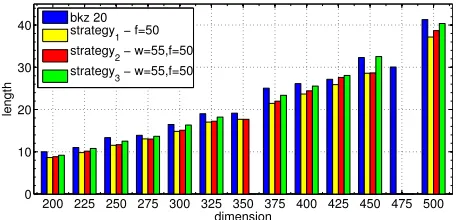
Figure 1.Strategyx forFindShortLVwithq= 1 andp= 20000.
In a series of tests, we fix the number d of lattice vectors chosen as part of the Strategyx
algorithms to d = 75. For Strategy1 we chose f = 50. For Strategy2 and Strategy3 we used a
window of sizew= 55 for selecting the firstf = 50 basis vectors. Figure 1 summarizes the results of the test. For each dimension, it shows the average length of the shortest of the short vectors averaged over the ten runs for each test instance. For the challenge lattice basis of dimension 475 none of our tested strategies were able to find short lattice vectors. Strategy3 also failed for dimension 350.
The results show that the average length of the shortest of the short vectors found by Strategy1
is significantly smaller than that for Strategy3. This result was expected due to the fact that
Strategy3 was designed to violate Conjecture 1 whileStrategy1 was designed in compliance with
Conjecture 1. The average length for Strategy2 is significantly better than that for Strategy3,
yet slightly inferior to Strategy1. These results clearly support Conjecture 1 and suggest that
Strategy1 is the best among the tested strategies. We therefore useStrategy1 exclusively for the
experiments detailed in Section 7.
6 Generate An Improved Basis
In order to allow for an effective use of the short vectors found byFindShortLVas part ofBoostBKZ
(see Algorithm 2, Line (4)), some of these short vectors must first be integrated properly into a lattice basis. A straightforward approach is to add the short vectors to the lattice basis which was the starting point forFindShortLV, thus yielding a generating system of lattice vectors. One would then have to either transform the generating system into a basis or use a variant of the BKZ that allows the use of a generating system instead of a lattice basis. However, both of these options have a significant running time overhead. We therefore devise a new heuristic algorithmGenerateBasis
Algorithm 6:GenerateBasis
Input:B= (b1, . . . , bk)∈Zn×k,
Sset of linear combinations of short vectors,
Nnumber of vectors to be replaced
Output:B0= (b01, . . . b0k)∈Zn×k
improved basis
(1) z= (0, . . . ,0) (2) B0=B
(3) l= 0
(4) remove trivialswithksk= 1 out ofS
(5) foreach(s∈S)do (6) S=S\ {s}
(7) findiwithsi=±1 andzi= 0 (8) if(iexists)then
(9) b0i=Pk i=1sibi (10) l=l+ 1
(11) for(1≤j≤k)do (12) if(sj6= 0)then (13) zj= 1 (14) if(l==N)then (15) break
(16) possible repositioning (sort/random) of newly inserted vectors
GenerateBasis receives as input the set S of linear combinations of short lattice vectors which was computed by FindShortLV. These linear combinations are key in selecting a suitable linear combination of basis vectors (which can be used to compute the actual set of short lattice vectors) that can be used to replace a longer basis vectors. Specifically, GenerateBasis uses a flag array, i.e., vectorzthat allows one to determine whether the exchange of a specific basis vector is allowed thus ensuring that one never leaves the actual lattice. At the outset, all basis vectors are possible candidates to be replaced (see Line(1), Algorithm 6). The main loop of the algorithm is executed (Lines(5) - (15)) until a sufficiently large numberN of vectors has been replaced. At the beginning of each iteration of the loop, the linear combination s∈S is chosen which represents the shortest of the short vectors left in S at that point. In order to determine whether the lattice vector corresponding to the linear combinationscan be used to replace a lattice basis vector, it is necessary to check whether there is an 1≤i≤ksuch thatsi=±1 andzi = 0 (Line(7)). The lattice vector corresponding to s cannot be used to replace a basis vector bi if si 6= ±1 as one would otherwise leave the lattice. It is important to note that the replacing of a lattice basis vector (Line(9)) must be carried out on a copyB0 of input basis B as all the linear combinations in S are relative to B. Thus, a modification ofB would invalidate the set of linear combinations S. The flag arrayz must be updated after the respective lattice basis vector has been replaced. In Lines(11) - (13), every positionjinzis marked where the corresponding entry in the linear combinationsj is not equal to zero—thus disallowing every basis vector which has been used as part of the linear combinations for further consideration. The final step of algorithm GenerateBasis allows the newly inserted vectors to be repositioned within the improved lattice basisB0.
One of challenges with this new algorithm GenerateBasis is to decide which vector should be replaced. The replacement is triggered by i(Line(7)) and each lattice vectorbi withsi=±1 and zi = 0 is a proper candidate. In our experiments (see Section 7) we focus on two variants: The first variant chooses a minimal positionito allow the newly inserted vector to have an effect early on in the subsequent BKZ reduction. This variant starts withi= 1 and checks thesiand zi in a forward direction by continuously increasing i. The second variant is tailored to incorporate the length of the basis vector to be replaced. As such, the variant maximizes the position i in order to replace longer vectors. The variant starts with i =k and searches for a suitable position in a backwards direction by decreasing i continuously. It, however, is important to note that positioning a short vector towards the end of the lattice basis can be a disadvantage as it takes longer for this shorter vector to have an impact on the subsequent BKZ reduction.
Some of our earlier experiments suggest that sorting the entire lattice basis may have a negative impact on the quality of the reduced basis.
7 Results
The experiments were performed on a Sun x4150 server with two quad core Intel Xeon processors at 2.83 GHz and 8 GB of main memory. We used NTL 5.5.1 [40] for the BKZ reduction, GMP 4.3.1 [38] as long integer arithmetic, and MPFR 2.3.1 [39] as multi-precision floating point arithmetic. All programs (including our own code forGenerateBasis,FindShortLVetc.) have been compiled with GCC 4.3.2 using identical optimization flags. As detailed in Section 5.3, for our experiments we use the lattice bases published as part of the lattice contest conducted by the TU Darmstadt [36].
7.1 Evaluating FindShortLV
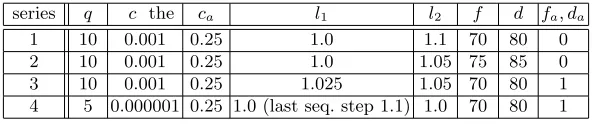
A first set of experiments was carried out to determine suitable parameters forFindShortLV. The goal was to determine a set of parameters that yield the best cost-benefit ratio, i.e., balancing the running time, the length, and the number of short vectors found. Due to the large number of parameters, we were forced to fix some of the parameters for our tests. In particular, we fixed p= 2,000 and through some initial tests we determined that it proves beneficial to fixf =d−10 for a givend. Table 1 summarizes the parameter sets for four different series of experiments. It is important to note that in test series 3 and 4, the size of the subset of lattice vectors is adjusted before advancing to the next iteration inThreadFindShortLVi. Each test lattice is first BKZ reduced with
block size 20. Then, for each combination of parameters and test lattice we execute FindShortLV
ten times. Each run results in a setSof short lattice vectors. Using the length of the shortest of the short vectors of each one of the ten sets allows us to determine the average length of the shortest of the short vectors determined in each instance of the experiment. Figure 2 shows the average
series q c the ca l1 l2 f d fa, da
1 10 0.001 0.25 1.0 1.1 70 80 0
2 10 0.001 0.25 1.0 1.05 75 85 0
3 10 0.001 0.25 1.025 1.05 70 80 1
4 5 0.000001 0.25 1.0 (last seq. step 1.1) 1.0 70 80 1
Table 1.Parameters forFindShortLV
length of the shortest of the short lattice vector found byFindShortLVfor a specific parameter set and lattice basis. As expected, an increase inf anddhas a positive effect on the average length of the shortest of the short vectors found. Both the series 3 and 4 with their dynamically increasingf and dmanage to find the shortest vectors in our experiments. It is important to note that in most cases series 4 yields a significantly higher number of short lattice vectors compared to series 1, 2, and 3. This can easily be seen in Figure 3 which shows the average number of short vectors found by FindShortLV (where the average is taken over the sizes of the ten sets resulting from the ten individual runs). With the exception of dimensions 475 and 500, test series 3 does not find more short vectors than test series 1 and 2 even though the slack parameterl1 is increased (see Table 1).
The shorter lattice vectors found by series 3 parameters make it more difficult to find additional lattice vectors of similar size and this therefore requires an additional increase of slack parameterl1.
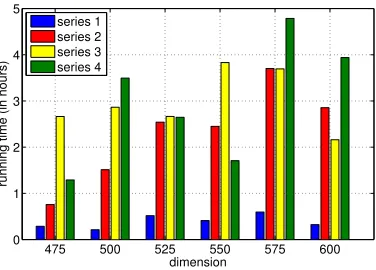
Figure 3). To compensate for the increase in running time, test series 4 therefore uses a reduced number of sequence stepsq but with a tighter initial pruning parameterc. For the first four of the q = 5 sequence steps test series 4 uses a slack parameter l1 = 1.0. This measure helps us to find a
reasonable short lattice vector as starting point for the final one of theq sequence steps. In the 5th and final sequence step we use a slack parameterl1 = 1.1 in order to maximize the number of short
lattice vectors found. Figure 4 shows the average running time (in hours, averaged over the ten
475 500 525 550 575 600
20 30 40 50 60 70 80
dimension
average length
series 1 series 2 series 3 series 4
Figure 2.Average length of shortest of the short vector found byFindShortLV.
475 500 525 550 575 600 0
20 40 60 80 100
average number of vectors
series 1 series 2 series 3 series 4
Figure 3. Average number of short vectors found by FindShortLV.
475 500 525 550 575 600
0 1 2 3 4 5
dimension
running time (in hours)
series 1 series 2 series 3 series 4
Figure 4.Average real time ofFindShortLVwith 8 threads and different parameters.
7.2 Evaluating BoostBKZ
Through a set of initial experiments it was determined that replacing a large number of basis vectors often has no positive impact on the running time ofBoostBKZ. Consequently, the number of lattice basis vectors to be replaced as part ofGenerateBasisis limited to at most ten. As discussed earlier, the number of different parameter sets Gj for GenerateBasis is tied to the number of available
threadst. The compute servers in our test setup (see above) offer 8 cores. We therefore have chosen the number of threads to bet= 8. Table 2 details the parameter setsGj (N, the direction, and the
repositioning) used in combination with the test series as outlined previously (1 ≤j ≤ 8). These parameter sets have been determined based on an analysis of a set of initial experiments. (Further details will be included in an extended version of this paper.)
G1 G2 G3 G4 G5 G6 G7 G8
N 3 5 7 10 3 5 7 10
Direction fwd. fwd. fwd. fwd. bwd. bwd. bwd. bwd.
Repositioning — — — — random random random random
Table 2.Parameters forGenerateBasis
In analyzingBoostBKZ, we conduct an experiment that is tailored to show the effectiveness of our intermediate steps introduced as part ofBoostBKZto improve the overall reduction result. For that, we fixed the number of iterations inBoostBKZtor = 1. For the initial BKZ reduction (Line(1)in Algorithm 2) we used block size 20. For the BKZ reductions inThreadBoostBKZj(as part of the one
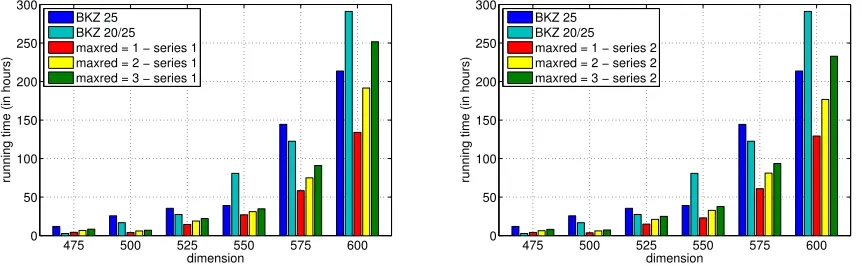
and only iteration inBoostBKZ) we used block size 25. The other parameters, such as the reduction parameter (δ= 0.99) and the pruning parameter for the enumeration (2−15), were identical in both cases. The maximum number of BKZ instances to be completed was set to maxred ∈ {1,2,3}. We compared the performance of BoostBKZ to a conventional BKZ reduction with block size 25 (referred to as BKZ 25) and a sequence of conventional BKZ reductions with first block size 20 followed by a second one with block size 25 (referred to as BKZ 20/25). Each experiment was conducted ten times and the averages were computed over the results of these ten runs. Figure 5
475 500 525 550 575 600 0
50 100 150 200 250 300
dimension
running time (in hours)
BKZ 25 BKZ 20/25 maxred = 1 − series 1 maxred = 2 − series 1 maxred = 3 − series 1
475 500 525 550 575 600 0
50 100 150 200 250 300
dimension
running time (in hours)
BKZ 25 BKZ 20/25 maxred = 1 − series 2 maxred = 2 − series 2 maxred = 3 − series 2
Figure 5.Comparison of running time for conventional BKZ andBoostBKZ(Lines(5)-(9)) with maxred=1,2,3 forFindShortLVwith series 1 and 2
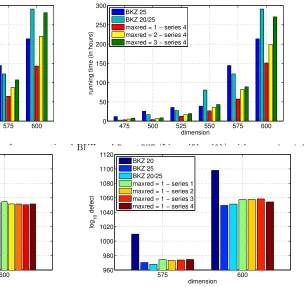
to note that for some test lattices BKZ 25 outperforms BKZ 20/25 and for some it is the other way around. That is, neither BKZ 25 nor BKZ 20/25 is an optimal choice for conventional BKZ. Figure 5 also shows that an increase inf and dfrom series 1 to series 2 has a significant impact on the running time, especially for higher dimensions. The additional time spent in FindShortLVfor series 2 in comparison to series 1 is beneficial with respect to the overall running time. In particular, it is important to note, that the running time for FindShortLV (see Figure 4) is negligible when compared to the running time of Lines(5) - (9) of algorithm BoostBKZ in higher dimensions4. Figure 6 shows the running time for series 3 and 4. At first, the results seem inferior in comparison to the running times for series 1 and 2. However, when comparing the quality of the reduced basis (see Figure 7) it becomes clear that series 3 and especially series 4 produce lattice bases of better quality. Figure 7 shows that the quality for series 4 withmaxred= 2 is almost equal to the quality obtained for series 1 and 2 with maxred= 3. Even for maxred= 1, BoostBKZyields lattice bases of acceptable quality given test series 2 and 4 (see Figure 8) when compared to the conventional BKZ reduction.
In order to gain a better understanding for the connection between the parameter maxredand the quality of the reduced lattice basis we have analyzed the set of short lattice vectors found by
FindShortLVin more detail. Figure 9 shows the average length of the first 3, 5, 7, and 10 lattice vectors that are inserted into the lattice basis by GenerateBasis. It is interesting to see that the difference between the first ten short vectors and the first three short vectors is noticeably higher for series 2 than for series 4. This difference is caused by the use of slack parameterl2 for series 2 and
l1 for series 4. Slack parameter l1 should therefore be preferred overl2. These results indicate that
4
By construction,FindShortLVscales almost perfectly with the number of dedicated CPU cores. E.g., doubling the number of CPU cores will in general cut the running time ofFindShortLVin half.
475 500 525 550 575 600 0 50 100 150 200 250 300 dimension
running time (in hours)
BKZ 25 BKZ 20/25 maxred = 1 − series 3 maxred = 2 − series 3 maxred = 3 − series 3
475 500 525 550 575 600 0 50 100 150 200 250 300 dimension
running time (in hours)
BKZ 25 BKZ 20/25 maxred = 1 − series 4 maxred = 2 − series 4 maxred = 3 − series 4
Figure 6.Comparison of running time for conventional BKZ andBoostBKZ(Lines(5)-(9)) with maxred=1,2,3 forFindShortLVwith series 3 and 4
575 600 960 980 1000 1020 1040 1060 1080 1100 1120 dimension log 10 defect BKZ 20 BKZ 25 BKZ 20/25 maxred = 2 − series 1 maxred = 2 − series 2 maxred = 2 − series 3 maxred = 2 − series 4 maxred = 3 − series 1 maxred = 3 − series 2
Figure 7.Quality of lattice basis formaxred= 2,3.
575 600 960 980 1000 1020 1040 1060 1080 1100 1120 dimension log 10 defect BKZ 20 BKZ 25 BKZ 20/25 maxred = 1 − series 1 maxred = 1 − series 2 maxred = 1 − series 3 maxred = 1 − series 4
450 475 500 525 550 575 600 30
40 50 60 70 80
dimension
length
series 2 − 3 SV series 2 − 5 SV series 2 − 7 SV series 2 − 10 SV
450 475 500 525 550 575 600
30 40 50 60 70 80
dimension
length
series 4 − 3 SV series 4 − 5 SV series 4 − 7 SV series 4 − 10 SV
Figure 9.Average length of 3, 5, 7 and 10 vectors inserted byGenerateBasis.
dedicating additional time inBoostBKZforFindShortLVis beneficial in cases where the difference in length between the inserted lattice vectors is minimal.
8 Conclusion and Future Work
The new algorithmic framework BoostReduce and the concrete instance BoostBKZ based on the BKZ reduction presented in this paper provide an effective new means to strong lattice basis reduction. Future work includes additional experiments to further fine-tune the choice of the various parameters. In addition, we will investigate how much of an additional advantage one may achieve by replacing the traditional BKZ reduction or the ENUM algorithm with recent developments in reducing lattice bases and finding shortest lattice vectors [35, 18].
References
1. M. Ajtai. Generating Hard Instances of Lattice Problems. InProceedings of the 28th ACM Symposium on Theory
of Computing, pages 99–108. ACM Press, 1996.
2. M. Ajtai. The Shortest Vector Problem inL2isN P-hard for Randomized Reductions. Technical report, ECCC Electronic Colloquium on Computational Complexity, Trier, 1997.
3. M. Ajtai and C. Dwork. A Public-Key Cryptosystem with Worst-Case/Average-Case Equivalence. InProceedings
of the 29th ACM Symposium on Theory of Computing, pages 284–293. ACM Press, 1997.
4. W. Backes and S. Wetzel. New Results on Lattice Basis Reduction in Practice. InAlgorithmic Number Theory
(ANTS-00), volume 1838 ofLNCS, pages 135–152. Springer, 2000.
5. W. Backes and S. Wetzel. Heuristics on Lattice Basis Reduction in Practice. ACM Journal on Experimental
Algorithms, 7, 2002.
6. W. Backes and S. Wetzel. An Efficient LLL Gram Using Buffered Transformations. In Proceedings of CASC 2007, volume 4770 ofLNCS, pages 31–44. Springer, 2007.
7. W. Backes and S. Wetzel. The Effect Of Sorting On Lattice Basis Reduction. Poster Session of LLL+25 Workshop, 2007.
8. W. Backes and S. Wetzel. Parallel Lattice Basis Reduction Using a Multi-threaded Schnorr-Euchner LLL Algo-rithm. InProceedings of Euro-Par 2009, volume 5704 ofLNCS, pages 960–973. Springer, 2009.
9. R. D. Blumofe and C. E. Leiserson. Scheduling Multithreaded Computations by Work Stealing. InSFCS ’94:
Proceedings of the 35th Annual Symposium on Foundations of Computer Science, pages 356–368, Washington,
DC, USA, 1994. IEEE Computer Society.
10. Claus-Peter Schnorr. Block Reduced Lattice Bases and Successive Minima. Combinatorics, Probability &
Com-puting, 3:507–522, 1994.
11. M. Coster, A. Joux, B. LaMacchia, A. Odlyzko, C. Schnorr, and J. Stern. Improved Low-Density Subset Sum Algorithm. Journal of Computational Complexity, 2:111–128, 1992.
13. N. Gama, N. Howgrave-Graham, H. Koy, and P. Nguyen. Rankin’s Constant and Blockwise Lattice Reduction.
InAdvances in Cryptology (CRYPTO 2006), volume 4117 ofLNCS, pages 112–130. Springer, 2006.
14. N. Gama, N. Howgrave-Graham, and P. Nguyen. Sympletic Lattice Reduction and NTRU. In Advances in
Cryptology (EUROCRYPT 2006), volume 4004 ofLNCS, pages 233–253. Springer, 2006.
15. C. Gentry. Fully Homomorphic Encryption using Ideal Lattices. InProceedings of the 41st Annual ACM
Sym-posium on Theory of Computing, STOC 2009, pages 169–178. ACM, 2009.
16. O. Goldreich, S. Goldwasser, and S. Halevi. Public-Key-Cryptosystems from Lattice Reduction Problems. In
Proceedings of CRYPTO 1997, volume 1294 ofLNCS, pages 112–131. Springer, 1997.
17. G. Hanrot and D. Stehl´e. Improved analysis of Kannan’s shortest lattice vector algorithm. In CRYPTO’07:
Proceedings of the 27th Annual International Cryptology Conference on Advances in Cryptology, pages 170–186,
Berlin, Heidelberg, 2007. Springer-Verlag.
18. J. Hermans, M. Schneider, J. Buchmann, F. Vercauteren, and B. Preneel. Parallel Shortest Lattice Vector Enumeration on Graphics Cards. Cryptology ePrint Archive, Report 2009/601, 2009.http://eprint.iacr.org/. 19. J. Hermans, M. Schneider, J. Buchmann, F. Vercauteren, and B. Preneel. Parallel Shortest Lattice Vector Enumeration on Graphics Cards. In Third International Conference on Cryptology in Africa (Africacrypt), volume 6055 ofLNCS, pages 52–68. Springer-Verlag, 2010.
20. J. Hoffstein, J. Pipher, and J. H. Silverman. NTRU: A Ring-Based Public Key Cryptosystem. InAlgorithmic
Number Theory (ANTS-98), volume 1423 ofLNCS, pages 267–288. Springer, 1998.
21. R. Kannan. Improved algorithms for integer programming and related lattice problems. InSTOC ’83: Proceedings
of the fifteenth annual ACM symposium on Theory of computing, pages 193–206. ACM Press, 1983.
22. H. Koy and C. Schnorr. Segment LLL-Reduction of Lattice Bases. InCryptography and Lattices, volume 2146 ofLNCS, pages 67 – 80. CaLC 2001, Springer, 2001.
23. V. Lyubashevsky. Lattice-Based Identification Schemes Secure Under Active Attacks. InPublic Key Cryptography
- PKC 2008, 11th International Workshop on Practice and Theory in Public-Key Cryptography, Proceedings,
volume 4939 ofLecture Notes in Computer Science, pages 162–179. Springer, 2008.
24. V. Lyubashevsky and D. Micciancio. Generalized Compact Knapsacks are Collision Resistant. In33rd
Inter-national Colloquium on Automata, Languages and Programming (ICALP 2006), volume 4052 ofLNCS, pages
144–155. Springer, 2006.
25. P. Nguyen and O. Regev. Learning a Parallelepiped: Cryptanalysis of GGH and NTRU Signatures. InAdvances
in Cryptology (EUROCRYPT 2006), volume 4004 ofLNCS, pages 271–288. Springer, 2006.
26. P. Nguyen and D. Stehl´e. Floating-Point LLL Revisited. InProceedings of Eurocrypt 2005, volume 3494 ofLNCS, pages 215–233. Springer, 2005.
27. P. Nguyen and D. Stehl´e. LLL on the Average. InProceedings of the 7th Algorithmic Number Theory Symposium
(ANTS-06), volume 4076 ofLNCS, pages 238–256. Springer, 2006.
28. P. Q. Nguyen. Cryptanalysis of the Goldreich-Goldwasser-Halevi Cryptosystem from Crypto ’97. InAdvances
in Cryptology (CRYPTO 1999), pages 288 – 304. Springer, 1999.
29. P. Q. Nguyen and J. Stern. Lattice Reduction in Cryptology: An Update. In Algorithmic Number Theory
(ANTS-00), volume 1838 ofLNCS, pages 85 – 112. Springer, 2000.
30. C. Peikert. Public-key Cryptosystems from the Worst-Case Shortest Vector Problem (Extended Abstract). In
Proceedings of the 41st Annual ACM Symposium on Theory of Computing, STOC 2009, pages 333–342. ACM,
2009.
31. C. Peikert and A. Rosen. Efficient Collision-Resistant Hashing from Worst-case Assumptions on Cyclic Lattices.
In3rd Theory of Cryptography Conference (TCC 2006), volume 3876 ofLNCS, pages 145–166. Springer, 2006.
32. H. Ritter. Aufz¨ahlung von kurzen Gittervektoren in allgemeiner Norm. PhD thesis, University of Frankfurt am Main, Research Group of Prof.C.P.Schnorr, 1997.
33. C. Schnorr and M. Euchner. Lattice Basis Reduction: Improved Practical Algorithms and Solving Subset Sum Problems. InProceedings of FCT 91, pages 68–85. Springer, 1991.
34. C. Schnorr and H. H¨orner. Attacking the Chor-Rivest Cryptosystem by Improved Lattice Reduction. In
Pro-ceedings of EUROCRYPT 1995, volume 921 ofLNCS, pages 1–12. Springer, 1995.
35. Homepage of Xavier Pujol (LatEnum/ParEnum), May 2010. http://perso.ens-lyon.fr/xavier.pujol/. 36. Lattice Challenge TU Darmstadt, May 2010. http://www.latticechallenge.org/.
37. NTRU - Hompage, May 2010. http://www.ntru.com/. 38. GMP - Homepage. http://gmplib.org/.