On CCA-Secure Somewhat Homomorphic Encryption
J. Loftus1, A. May2, N.P. Smart1, and F. Vercauteren3 1
Dept. Computer Science, University of Bristol,
Merchant Venturers Building, Woodland Road, Bristol, BS8 1UB, United Kingdom. {loftus,nigel}@cs.bris.ac.uk
2
Horst G¨ortz Institute for IT-Security, Faculty of Mathematics, Ruhr-University Bochum, Germany
COSIC - Electrical Engineering, Katholieke Universiteit Leuven,
Kasteelpark Arenberg 10, B-3001 Heverlee, Belgium. [email protected]
Abstract. It is well known that any encryption scheme which supports any form of homomorphic operation cannot be secure against adaptive chosen ciphertext attacks. The question then arises as to what is the most stringent security defini-tion which is achievable by homomorphic encrypdefini-tion schemes. Prior work has shown that various schemes which support a single homomorphic encryption scheme can be shown to be IND-CCA1, i.e. secure against lunchtime attacks. In this paper we extend this analysis to the recent fully homomorphic encryp-tion scheme proposed by Gentry, as refined by Gentry, Halevi, Smart and Ver-cauteren. We show that the basic Gentry scheme is not IND-CCA1; indeed a trivial lunchtime attack allows one to recover the secret key. We then show that a minor modification to the variant of the somewhat homomorphic encryption scheme of Smart and Vercauteren will allow one to achieve IND-CCA1, indeed PA-1, in the standard model assuming a lattice based knowledge assumption. We also examine the security of the scheme against another security notion, namely security in the presence of ciphertext validity checking oracles; and show why CCA-like notions are important in applications in which multiple parties submit encrypted data to the “cloud” for secure processing.
1
Introduction
The usefulness of schemes supporting a single homomorphic operation has led some authors to consider what security definition existing homomorphic encryption schemes meet. A natural notion to try to achieve is that of IND-CCA1, i.e. security in the pres-ence of a lunch-time attack. Lipmaa [20] shows that the ElGamal encryption scheme is IND-CCA1 secure with respect to a hard problem which is essentially the same as the IND-CCA1 security of the ElGamal scheme; a path of work recently extended in [2] to other schemes.
A different line of work has been to examine security in the context of Plaintext Awareness, introduced by Bellare and Rogaway [5] in the random oracle model and later refined into a hierarchy of security notions (PA-0, -1 and -2) by Bellare and Palacio [4]. Intuitively a scheme is said to be PA if the only way an adversary can create a valid ciphertext is by applying encryption to a public key and a valid message. Bellare and Palacio prove that a scheme which possesses both PA-1 (resp. PA-2) and is IND-CPA, is in fact secure against IND-CCA1 (resp. IND-CCA2) attacks.
The advantage of Bellare and Palacio’s work is that one works in the standard model to prove security of a scheme; the disadvantage appears to be that one needs to make a strong assumption to prove a scheme is PA-1 or PA-2. The assumption required is a so-calledknowledge assumption. That such a strong assumption is needed should not be surprising as the PA security notions are themselves very strong. In the context of encryption schemes supporting a single homomorphic operation Bellare and Pallacio show that the Cramer-Shoup Lite scheme [10] and an ElGamal variant introduced by Damg˚ard [11] are both PA-1, and hence IND-CCA1, assuming the standard DDH (to obtain IND-CPA security) and a Diffie–Hellman knowledge assumption (to obtain PA-1 security). Informally, the Diffie–Hellman knowledge assumption is the assumption that an algorithm can only output a Diffie–Hellman tuple if the algorithm “knows” the discrete logarithm of one-tuple member with respect to another.
Rivest et. al originally proposed homomorphic encryption schemes so as to enable arbitrary computation on encrypted data. To perform such operations one would require an encryption scheme which supports two homomorphic operations, which are “com-plete” in the sense of allowing arbitrary computations. Such schemes are called fully homomorphic encryption (FHE) schemes, and it was not until Gentry’s breakthrough construction in 2009 [15,16] that such schemes could be constructed. Since Gentry’s construction appeared a number of variants have been proposed, such as [14], as well as various simplifications [27] and improvements thereof [17]. All such schemes have been proved to be IND-CPA, i.e. secure under chosen plaintext attack.
of IND-CCA1 security is redundant; although in Section 7 we present a notion of CCA embeddability which can be extended to FHE.
In this paper we consider the Smart–Vercauteren variant [27] of Gentry’s scheme. In this variant there are two possible message spaces; one can either use the scheme to encrypt bits, and hence perform homomorphic operations inF2; or one can encrypt polynomials of degreeN overF2. When one encrypts bits one achieves a scheme that is a specialisation of the original Gentry scheme, and it is this variant that has recently been realised by Gentry and Halevi [17]. We call this the Gentry–Halevi variant, to avoid confusion with other variants of Gentry’s scheme, and we show that this scheme is not IND-CCA1 secure.
In particular in Section 4 we present a trivial complete break of the Gentry–Halevi variant scheme, in which the secret key can be recovered via a polynomial number of queries to a decryption oracle. The attack we propose works in a similar fashion to the attack of Bleichenbacher on RSA [8], in that on each successive oracle call we reduce the possible interval containing the secret key, based on the output of the oracle. Eventually the interval contains a single element, namely the secret key. Interesting all the Bleichenbacher style attacks on RSA, [8,21,26], recover a target message, and are hence strictly CCA2 attacks, whereas our attack takes no target ciphertext and recovers the key itself.
In Section 5 we go on to show that a modification of the Smart–Vercauteren SHE variant which encrypts polynomials can be shown to be PA-1, and hence is IND-CCA1. Informally we use the full Smart–Vercauteren variant to recover the random polyno-mial used to encrypt the plaintext polynopolyno-mial in the decryption phase, and then we re-encrypt the result to check against the ciphertext. This forms a ciphertext validity check which then allows us to show PA-1 security based on a new lattice knowledge assumption. Our lattice knowledge assumption is a natural lattice based variant of the Diffie–Hellman knowledge assumption mentioned previously. In particular we assume that if an algorithm is able to output a non-lattice vector which is sufficiently close to a lattice vector then it must “know” the corresponding close lattice vector. We hope that this problem may be of independent interest in analysing other lattice based cryp-tographic schemes; indeed the notion is closely linked to a key “quantum” step in the results of Regev [23].
en-cryption schemes. We use the term CVA rather than CPA+ as it conveys more easily the meaning of the security notion.
Such ciphertext validity oracles are actually the key component behind the tradi-tional application of Bleichenbacher style attacks against RSA, in that one uses the oracle to recover information about the target plaintext. We show that our SHE scheme which is IND-CCA1 is not IND-CVA, by presenting an IND-CVA attack. In particu-lar this shows that CVA security is not implied by PA-1 security. Given PA-1 is such a strong notion this is itself interesting since it shows that CVA attacks are relatively pow-erful. The attack is not of the Bleichenbacher type, but is now more akin to the security reduction between search and decision LWE [25]. This attack opens up the possibil-ity of a new SHE scheme which is also IND-CVA, a topic which we leave as an open problem; or indeed the construction of standard additive or multiplicative homomorphic schemes which are IND-CVA.
Finally, in Section 7 we consider an application area of cloud computing in which multiple players submit encrypted data to a cloud computer; which in turn will per-form computations on the encrypted data. We show that such a scenario does indeed seem to require a form of IND-CCA2 protection of ciphertexts, yet still maintaining ho-momorphic properties. To deal with this we introduce the notion of CCA-embeddable homomorphic encryption.
2
Notation and Standard Definitions
For integersz, dreduction ofzmodulodin the interval[−d/2, d/2)will be denoted by [z]d. For a rational numberq,bqewill denote the rounding ofqto the nearest integer,
and[q]denotes the (signed) distance betweenqand the nearest integer, i.e.bqe=q−[q]. The notationa←bmeans assign the objectbtoa, whereasa←Bfor a setBmeans assignauniformly at random from the setB. IfB is an algorithm this means assigna
with the output ofBwhere the probability distribution is over the random coins ofB. For a polynomialF(X) ∈Q[X]we letkF(X)k∞denote the∞-norm of the co-efficient vector, i.e. the maximum coco-efficient in absolute value. IfF(X)∈Q[X]then
we letbF(X)edenote the polynomial inZ[X]obtained by rounding the coefficients of
F(X)to the nearest integer.
FULLYHOMOMORPHICENCRYPTION: A fully homomorphic encryption scheme is a tuple of three algorithmsE= (KeyGen,Encrypt,Decrypt)in which the message space is a ring (R,+,·)and the ciphertext space is also a ring(R,⊕,⊗) such that for all messagesm1, m2∈R, and all outputs(pk,sk)←KeyGen(1λ), we have
m1+m2=Decrypt(Encrypt(m1,pk)⊕Encrypt(m2,pk),sk)
m1·m2=Decrypt(Encrypt(m1,pk)⊗Encrypt(m2,pk),sk).
A scheme is said to besomewhathomomorphic if it can deal with only a limited number of addition and multiplications before decryption fails.
cap-tured by the following game between a challenger and an adversaryA, running in two stages;
– (pk,sk)←KeyGen(1λ).
– (m0, m1,St)← A (·)
1 (pk). /* Stage 1 */
– b← {0,1}.
– c∗←Encrypt(mb,pk;r).
– b0← A(2·)(c∗,St). /* Stage 2 */
The adversary is said to win the game ifb =b0, with the advantage of the adversary winning the game being defined by
AdvIN DA,E,λ−atk=|Pr(b=b0)−1/2|.
A scheme is said to be IND-atk secure if no polynomial time adversary Acan win the above game with non-negligible advantage in the security parameterλ. The precise security notion one obtains depends on the oracle access one gives the adversary in its different stages.
– IfAhas access to no oracles in either stage then atk=CPA.
– IfAhas access to a decryption oracle in stage one then atk=CCA1.
– IfAhas access to a decryption oracle in both stages then atk=CCA2, often now denoted simply CCA.
– IfAhas access to a ciphertext validity oracle in both stages, which on input of a ci-phertext determines whether it would output⊥or not on decryption, then atk=CVA.
LATTICES: A (full-rank) lattice is simply a discrete subgroup ofRn generated by n
linear independent vectors, B = {b1, . . . ,bn}, called a basis. Every lattice has an
infinite number of bases, with each set of basis vectors being related by a unimodular transformation matrix. IfBis such a set of vectors, we write
L=L(B) ={v·B|v∈Zn}
to be the resulting lattice. An integer lattice is a lattice in which all the bases vectors have integer coordinates.
For any basis there is an associated fundamental parallelepiped which can be taken as P(B) = {Pn
i=1xi·bi|xi ∈ [−1/2,1/2)}. The volume of this fundamental
par-allelepiped is given by the absolute value of the determinant of the basis matrix∆ = |det(B)|. We denote byλ∞(L)the∞-norm of a shortest vector (for the∞-norm) in L.
3
The Smart-Vercauteren Variant of Gentry’s Scheme
by a tuple of integers(N, t, µ); we assume there is a function mapping security param-etersλinto tuples(N, t, µ). In practiceNwill be a power of two,twill be greater than 2
√
N andµwill be a small integer, perhaps one.
KeyGen(1λ)
– Pick an irreducible polynomialF ∈Z[X]of degreeN.
– Pick a polynomialG(X) ∈ Z[X] of degree at most N −1, with coefficients
bounded byt.
– d←resultant(F, G).
– Gis chosen such thatG(X)has a single unique root in common withF(X)modulo
d. Letαdenote this root.
– Z(X)←d/G(X) (modF(X)).
– pk←(α, d, µ, F(X)),sk←(Z(X), G(X), d, F(X)).
In [17] Gentry and Halevi show how to compute, for the polynomialF(X) =X2n
+ 1, the rootαand the polynomialZ(X)using a method based on the Fast Fourier Trans-form. In particular they show how this can be done for non-prime values ofd(removing one of the main restrictions in the key generation method proposed in [27]).
By construction, the principal idealggenerated byG(X)in the number fieldK=
Z[X]/(F(X))is equal to the ideal withOK basis(d, X−α). In particular, the ideal gprecisely consists of all elements inZ[X]/(F(X))that are zero when evaluated at
αmodulod. The Hermite-Normal-Form of a basis matrix of the lattice defined by the coefficient vectors ofgis given by
B = d 0
−α 1 −α2 1
..
. . ..
−αN−1 0 1
, (1)
where the elements in the first column are reduced modulod.
To aid what follows we writeZ(X) =z0+z1·X+. . .+zN−1·XN−1and define
δ∞= sup
kg(X)·h(X) (mod F(X))k∞ kg(X)k∞· kh(X)k∞
:g, h∈Z[X],deg(g),deg(h)< N
.
For the choice f = XN + 1, we haveδ
∞ = N. The key result to understand how the simplification of Smart and Vercauteren to Gentry’s scheme works is the following lemma adapted from [27].
Lemma 1. LetZ(X), G(X), αanddbe as defined in the above key generation proce-dure. IfC(X)∈Z[X]/(F(X))is a polynomial withkC(X)k∞< Uand setc=C(α) (mod d), then
C(X) =c−
c·Z(X)
d
·G(X) (modF(X))
for
U = d
Proof. By definition ofc, we have that c−C(X)is contained in the principal ideal generated byG(X)and thus there exists aq(X)∈Z[X]/(F(X))such thatc−C(X) =
q(X)G(X). UsingZ(X) =d/G(X) (modF(X)), we can write
q(X) =cZ(X)
d −
C(X)Z(X)
d .
Sinceq(X)has integer coefficients, we can recover it by rounding the coefficients of the first term if the coefficients of the second term are strictly bounded by1/2. This shows thatC(X)can be recovered fromcforkC(X)k∞< d/(2·δ∞· kZ(X)k∞).
Note that the above lemma essentially states that ifkC(X)k∞< U, thenC(X)is determined uniquely by its evaluation inαmodulod. Recall that any polynomialH(X) of degree less thanN, whose coefficient vector is in the lattice defined in equation (1), satisfiesH(α) = 0 (modd). Therefore, ifH(X)6= 0, the lemma implies, for such an
H, thatkH(X)k∞ ≥U, and thus we conclude thatU ≤λ∞(L). Since the coefficient vector ofG(X)is clearly in the latticeL, we conclude that
U≤λ∞(L)≤ kG(X)k∞.
Although Lemma 1 provides the maximum value ofU for which ciphertexts are de-cryptable, we will only allow a quarter of this maximum value, i.e.T =U/4. As such we are guaranteed thatT ≤ λ∞(L)/4. We note thatT defines the size of the circuit that the somewhat homomorphic encryption scheme can deal with. Our choice ofTwill become clear in Section 5.
Using the above key generation method we can define three variants of the Smart– Vercauteren variant of Gentry’s scheme. The first variant is the one used in the Gen-try/Halevi implementation of [17], the second is the general variant proposed by Smart and Vercauteren, whereas the third divides the decryption procedure into two steps and provides a ciphertext validity check. In later sections we shall show that the first variant is not IND-CCA1 secure, and by extension neither is the second variant. However, we will show that the third variant is indeed IND-CCA1. We will then show that the third variant is not IND-CVA secure.
Each of the following variants is only a somewhat homomorphic scheme, extending it to a fully homomorphic scheme can be performed using methods of [15,16,17].
GENTRY–HALEVIVARIANT: The plaintext space is the field F2. The above KeyGen algorithm is modified to only output keys for whichd≡1 (mod 2). This implies that at least one coefficient ofZ(X), sayzi0 will be odd. We replaceZ(X)in the private
key withzi0, and can drop the valuesG(X)andF(X)entirely from the private key.
Encryption and decryption can now be defined via the functions:
Encrypt(m,pk;r)
– R(X)←Z[X]s.t.kR(X)k∞≤µ. – C(X)←m+ 2·R(X).
– c←[C(α)]d. – Returnc.
Decrypt(c,sk)
– m←[c·zi0]d (mod 2)
FULL-SPACESMART–VERCAUTEREN: In this variant the plaintext space is the algebra
F2[X]/(F(X)), where messages are given by binary polynomials of degree less than
N. As such we call this the Full-Space Smart–Vercauteren system as the plaintext space is the full set of binary polynomials, with multiplication and addition defined modulo
F(X). We modify the above key generation algorithm so that it only outputs keys for which the polynomialG(X)satisifiesG(X)≡1 (mod 2). This results in algorithms defined by:
Encrypt(M(X),pk;r)
– R(X)←Z[X]s.t.kR(X)k∞≤µ. – C(X)←M(X) + 2·R(X).
– c←[C(α)]d. – Returnc.
Decrypt(c,sk)
– C(X)←c− bc·Z(X)/de.
– M(X)←C(X) (mod 2).
– ReturnM(X).
That decryption works, assuming the input ciphertext corresponds to the evaluation of a polynomial with coefficients bounded byT, follows from Lemma 1 and the fact that
G(X)≡1 (mod 2).
CCSHE: This is our ciphertext-checking SHE scheme (or ccSHE scheme for short). This is exactly like the above Full-Space Smart–Vercauteren variant in terms of key generation, but we now check the ciphertext before we output the message. Thus en-cryption/decryption become;
Encrypt(M(X),pk;r)
– R(X)←Z[X]s.t.kR(X)k∞≤µ. – C(X)←M(X) + 2·R(X).
– c←[C(α)]d. – Returnc.
Decrypt(c,sk)
– C(X)←c− bc·Z(X)/de ·G(X).
– C(X)←C(X) (modF(X))
– c0 ←[C(α)]d.
– Ifc06=corkC(X)k∞> T return⊥. – M(X)←C(X) (mod 2).
– ReturnM(X).
4
CCA1 attack on the Gentry–Halevi Variant
We construct an IND-CCA1 attacker against the above Gentry–Halevi variant. Letzbe the secret key, i.e. the specific odd coefficient ofZ(X)chosen by the decryptor. Note that we can assumez∈[0, d), since decryption in the Gentry–Halevi variant works for any secret keyz+k·dwithk∈Z. We assume the attacker has access to a decryption
oracle to which it can make polynomially many queries, OD(c). On each query the
oracle returns the value of[c·z]d (mod 2).
In Algorithm 1 we present pseudo-code to describe how the attack proceeds. We start with an interval[L, . . . , U]which is known to contain the secret keyzand in each iteration we split the interval into two halves determined by a specific ciphertext c. The choice of which sub-interval to take next depends on whetherkmultiples ofdare sufficient to reducec·zinto the range[−d/2, . . . , d/2)or whetherk+ 1multiples are required.
Algorithm 1:CCA1 attack on the Gentry–Halevi Variant L←0, U←d−1
whileU−L >1do c← bd/(U−L)c b← OD(c)
q←(c+b) mod 2 k← bLc/d+ 1/2c B←(k+ 1/2)d/c if(kmod 2 =q)then
U ← bBc else
L← dBe returnL
each step,z ∈[L, U], we need to takec=bd/(U−L)c. As such it is easy to see that
c(U −L)≤d.
To reducecL, we need to subtractkdsuch that−d/2 ≤ cL−kd < d/2, which shows thatk = bLc/d+ 1/2c. Furthermore, since the length of the interval forc·z
is bounded byd, there will be exactly one number of the formd/2 +idin[cL, cU], namelyd/2 +kd. This means that there is exactly one boundaryB= (k+ 1/2)d/cin the interval forz.
Defineqas the unique integer such that−d/2 ≤ cz−qd < d/2, then since the length of the interval forc·zis bounded byd, we either haveq = korq = k+ 1. To distinguish between the two cases, we simply look at the output of the decryption oracle: recall that the oracle outputs[c·z]d (mod 2), i.e. the bit output by the oracle is
b=c·z−q·d (mod 2) = (c+q) (mod 2).
Therefore,q = (b+c) (mod 2)which allows us to choose between the caseskand
k+ 1. Ifq=k (mod 2), thenzlies in the first part[L,bBc], whereas in the other case,
zlies in the second part[dBe, U].
Having proved correctness we now estimate the running time. The behaviour of the algorithm is easily seen to be as follows: in each step, we obtain a boundaryB in the interval[L, U]and the next interval becomes either[L,bBc]or[dBe, U]. SinceBcan be considered random in[L, U]as well as the choice of the interval, this shows that in each step, the size of the interval decreases by a factor2on average. In conclusion we deduce that recovering the secret key will requireO(logd)calls to the oracle.
The above attack is highly efficient in practice and recovers keys in a matter of seconds for all parameter sizes in [17].
5
ccSHE is PA-1
PLAINTEXTAWARENESS– PA-1: The original intuition for the introduction of plain-text awareness was as follows - if an adversary knows the plainplain-text corresponding to every ciphertext it produces, then the adversary has no need for a decryption oracle and hence, PA+IND-CPA must imply IND-CCA. Unfortunately, there are subtleties in the definition for plaintext awareness, leading to three definitions, PA-0, PA-1 and PA-2. However, after suitably formalizing the definitions, PA-x plus CPA implies IND-CCAx, for x = 1 and 2. In our context we are only interested in IND-CCA1 security, so we will only discuss the notion of PA-1 in this paper.
Before formalizing PA-1 it is worth outlining some of the terminology. We have a polynomial time adversaryAcalled aciphertext creator, that takes as input a public key and can query ciphertexts to an oracle. An algorithmA∗is called asuccessful extractor forAif it can provide responses toAwhich are computationally indistinguishable from those provided by a decryption oracle. In particular a scheme is said to be PA-1 if there exists a successful extractor for any ciphertext creator that makes a polynomial number of queries. The extractor gets the same public key as A and also has access to the random coins used by algorithmA. Following [4] we define PA-1 formally as follows:
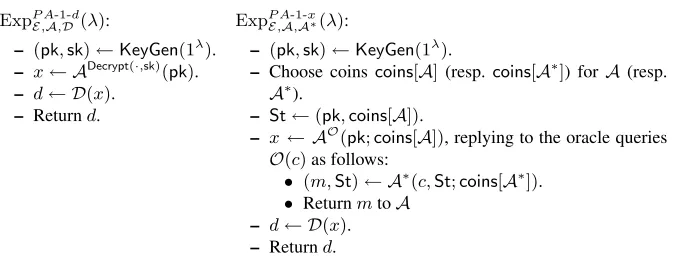
Definition 1 (PA1).LetE be a public key encryption scheme andAbe an algorithm with access to an oracleOtaking inputpkand returning a string. LetDbe an algorithm that takes as input a string and returns a single bit and letA∗be an algorithm which takes as input a string and some state information and returns either a string or the symbol⊥, plus a new state. We callAaciphertext creator,A∗aPA-1-extractor, andD adistinguisher. For security parameterλwe define the (distinguishing and extracting) experiments in Figure 1, and then define the PA-1 advantage to be
AdvP AE,A-1,D,A∗(λ) =
Pr(Exp
P A-1-d
E,A,D (λ) = 1)−Pr(ExpP AE,A-1-,Dx,A∗(λ) = 1)
.
We sayA∗ is a successful PA-1-extractor for A, if for every polynomial time distin-guisher the above advantage is negligible.
ExpP A-1-d
E,A,D(λ):
– (pk,sk)←KeyGen(1λ).
– x← ADecrypt(·,sk) (pk). – d← D(x).
– Returnd.
ExpP A-1-x
E,A,A∗(λ):
– (pk,sk)←KeyGen(1λ).
– Choose coins coins[A](resp. coins[A∗]) forA (resp. A∗
).
– St←(pk,coins[A]). – x ← AO
(pk;coins[A]), replying to the oracle queries O(c)as follows:
• (m,St)← A∗
(c,St;coins[A∗ ]). • ReturnmtoA
– d← D(x). – Returnd.
Fig. 1.ExperimentsExpP AE,A-1-,DdandExp
P A-1-x
E,A,A∗
re-sponded to by the PA-1-extractor. IfA∗did not receive the coinscoins[A]fromAthen it would be functionally equivalent to the real decryption oracle, thus the fact thatA∗ gets access to the coins in the second experiment is crucial. Also note that the distin-guisher acts independently ofA∗, and thus this is strictly stronger than havingAdecide as to whether it is interacting with an extractor or a real decryption oracle.
The intuition is thatA∗acts as the unknowing subconscious ofA, and is able to extract knowledge aboutA’s queries to its oracle. ThatA∗ can obtain the underlying message captures the notion thatAneeds to know the message before it can output a valid ciphertext.
The following lemma is taken from [4] and will be used in the proof of the main theorem.
Lemma 2. LetE be a public key encryption scheme. LetAbe a polynomial-time ci-phertext creator attackingE,Da polynomial-time distinguisher, andA∗a polynomial-time PA-1-extractor. LetDecOKdenote the event that allA∗’s answers toA’s queries are correct in experimentExpP AE,A-1-,Dx,A∗(λ). Then,
Pr(ExpP AE,A-1-,Dx,A∗(λ) = 1)≥Pr(ExpP AE,A-1-,Dd(λ) = 1)−Pr(DecOK)
LATTICEKNOWLEDGEASSUMPTION: Our knowledge assumption can be stated in-formally as follows: suppose there is a (probabilistic) algorithmCwhich takes as input a lattice basis of a latticeLand outputs a vectorcsuitably close to a lattice pointp, i.e. closer than·λ∞(L)in the∞-norm for a fixed∈(0,1/2). Then there is an algorithm C∗which on input ofcand the random coins ofCoutputs a close lattice vectorp, i.e. one for whichkc−pk∞< ·λ∞(L). Note that the algorithmC∗can therefore act as a -CVP-solver forcin the∞-norm, given the coinscoins[C]. Again as in the PA-1 defi-nition it is perhaps useful to think ofC∗as the “subconscious” ofC, sinceCis capable of outputting a vector close to the lattice it must have known the close lattice vector in the first place. Formally we have:
Definition 2 (LK-).Letbe a fixed constant in the interval(0,1/2). LetGdenote an algorithm which on input of a security parameter1λoutputs a latticeLgiven by a basis B of dimensionn = n(λ)and volume∆ = ∆(λ). LetC be an algorithm that takes a lattice basisB as input, and has access to an oracleO, and returns nothing. LetC∗ denote an algorithm which takes as input a vectorc∈Rnand some state information,
and returns another vectorp∈Rnplus a new state. Consider the experiment in Figure
2. The LK-advantage ofCrelative toC∗is defined by
AdvGLK,C,-C∗(λ) = Pr[ExpGLK,C,-C∗(λ) = 1].
We sayG satisfies the LK-assumption, for a fixed , if for every polynomial timeC there exists a polynomial timeC∗such thatAdvLK-
ExpLK-
G,C,C∗(λ): – B← G(1λ).
– Choose coinscoins[C](resp.coins[C∗
]) forC(resp.C∗ ). – St←(B,coins[C]).
– RunCO(B;coins[C])until it halts, replying to the oracle queriesO(c)as follows: • (p,St)← C∗
(c,St;coins[C∗ ]). • Ifp6∈ L(B), return1.
• Ifkp−ck∞> ·λ∞(L), return1. • ReturnptoC.
– Return0.
Fig. 2.ExperimentExpLK-
G,C,C∗(λ)
allup to1/2. Our choice ofT in the ccSHE scheme asU/4is to guarantee that our lattice knowledge assumption is applied with= 1/4, and hence is more likely to hold. If the querycwhichCasks of its oracle is within·λ∞(L)of a lattice point then we require thatC∗finds such a close lattice point. If it does not then the experiment will output1; and the assumption is that this happens with negligible probability.
Notice that ifCasks its oracle a query of a vector which is not within·λ∞(L)of a lattice point then the algorithmC∗may do whatever it wants. However, to determine this condition within the experiment we require that the environment running the experiment is all powerful, in particular, that it can computeλ∞(L)and decide whether a vector is close enough to the lattice. Thus our experiment, but not algorithms C andC∗, is assumed to be information theoretic. This might seem strange at first sight but is akin to a similarly powerful game experiment in the strong security model for certificateless encryption [1], or the definition of insider unforgeable signcryption in [3].
For certain input bases, e.g. reduced ones or ones of small dimension, an algorithm C∗can be constructed by standard algorithms to solve the CVP problem. This does not contradict our assumption, sinceCwould also be able to apply such an algorithm and hence “know” the close lattice point. Our assumption is that when this is not true, the only wayC could generate a close lattice point (for small enough values of) is by computingx∈Znand perturbing the vectorx·B.
MAINTHEOREM:
Theorem 1. LetG denote the lattice basis generator induced from theKeyGen algo-rithm of the ccSHE scheme, i.e. for a given security parameter1λ, runKeyGen(1λ) to obtainpk = (α, d, µ, F(X))andsk = (Z(X), G(X), d, F(X)), and generate the lattice basisBas in equation(1). Then, ifGsatisfies the LK-assumption for= 1/4 then the ccSHE scheme is PA-1.
block for the PA1-extractor A∗. The description of the LK-adversaryC is given in Figure 3 and the description of the PA-1-extractorA∗is given in Figure 4.
LK-adversaryCO
(B;coins[C]) – Letd=B[0][0]andα=−B[1][0] – Parsecoins[C]asµ||F(X)||coins[A]
– RunAon input(α, d, µ, F(X))and coinscoins[A]until it halts, replying to its oracle queries as follows:
• IfAmakes a query with inputc, then
• Submit(c,0,0, . . . ,0)toOand letpdenote the response • Letc= (c,0, . . . ,0)−p, andC(X) =PN−1
i=0 ciX
i
• Letc0= [C(α)]d
• Ifc06=corkC(X)k∞≥T, thenM(X)←⊥, elseM(X)←C(X) (mod 2) • ReturnM(X)toAas the oracle response.
– Halt
Fig. 3.LK-adversary
PA-1-extractorA∗
(c,St[A∗
];coins[A∗ ]) – IfSt[A∗
]is initial state then • parsecoins[A∗
]as(α, d, µ, F(X))||coins[A] • St[C∗]←(α, d, µ, F(X))||coins[A] • else parsecoins[A∗
]as(α, d, µ, F(X))||St[C∗ ] – (p,St[C∗])← C∗((c,0, . . . ,0),St[C∗];coins[A∗]) – Letc= (c,0, . . . ,0)−p, andC(X) =PN−1
i=0 ciXi
– Letc0= [C(α)]d
– Ifc06=corkC(X)k∞≥T, thenM(X)←⊥, elseM(X)←C(X) (mod 2) – St[A∗
]←(α, d, µ, F(X))||St[C∗] – Return(M(X),St[A∗
]).
Fig. 4.PA-1-extractor
We first show thatA∗is a successful PA-1-extractor forA. In particular, letDecOK denote the event that allA∗’s answers toA’s queries are correct inExpP A-1-x
ccSHE,A,D,A∗(λ), then we have thatPr(DecOK)≤AdvGLK,C,-C∗(λ).
Whencis an invalid ciphertext then the real decryption oracle will always output ⊥, and it can be easily seen that our PA-1 extractorA∗ will also output⊥. Thus in the case of an invalid ciphertext the adversaryAcannot tell the two oracles apart. The theorem now follows from combining the inequalityPr(DecOK)≤AdvGLK,C,-C∗(λ)with Lemma 2 as follows:
AdvP AE,A-1,D,A∗(λ) = Pr(ExpP AE,A-1-,Dd(λ) = 1)−Pr(ExpEP A,A-1-,Dx,A∗(λ) = 1)
≤Pr(ExpP AE,A-1-,Dd(λ) = 1)−Pr(ExpP AE,A-1-,Dd(λ) = 1) + Pr(DecOK) ≤AdvLKG,C-,C∗(λ).
6
ccSHE is not secure in the presence of a CVA attack
We now show that our ccSHE scheme is not secure when the attacker, after being given the target ciphertextc∗, is given access to an oracleOCVA(c)which returns1ifc is a valid ciphertext (i.e. the decryption algorithm would output a message), and which returns0if it is invalid (i.e. the decryption algorithm would output⊥). Such an “oracle” can often be obtained in the real world by the attacker observing the behaviour of a party who is fed ciphertexts of the attackers choosing. Since a CVA attack is strictly weaker than a IND-CCA2 attack it is an interesting open (and practical) question as to whether an FHE scheme can be CVA secure.
We now show that the ccSHE scheme is not CVA secure, by presenting a relatively trivial attack: Suppose the adversary is given a target ciphertext c∗ associated with a hidden messagem∗. Using the method in Algorithm 2 it is easy to determine the mes-sage using access toOCVA(c). Basically, we add on multiples ofαi to the ciphertext until it does not decrypt; this allows us to perform a binary search on thei-th coefficient ofC(X), since we know the boundT on the coefficients ofC(X).
Algorithm 2:CVA attack on ccSHE
C(X)←0
forifrom0uptoN−1do L← −T+ 1,U ←T−1 whileU 6=Ldo
M ← d(U+L)/2e.
c←[−c∗+ (M+T−1)·αi] d.
ifOCVA(c) = 1then L←M. else
U ←M−1. C(X)←C(X) +U·Xi. m∗←C(X) (mod 2) returnm∗
OCVAoracle is given byM+T−1−ci. WhenM ≤cithis coefficient is less thanT
and so the oracle will return1, however whenM > cithe coefficient is greater than or
equalTand hence the oracle will return0. Thus we can divide the interval forciin two
depending on the outcome of the test.
It is obvious that the complexity of the attack isO(N ·log2T). Since, for the rec-ommended parameters in the key generation method, N and log2T are polynomial functions of the security parameter, we obtain a polynomial time attack.
7
CCA2 Somewhat Homomorphic Encryption?
In this section we deal with an additional issue related to CCA security of somewhat homomorphic encryption schemes. Consider the following scenario: three parties wish to use SHE to compute some information about some data they posses. Suppose the three pieces of data arem1,m2andm3. The parties encrypt these messages with the SHE scheme to obtain ciphertextsc1,c2andc3. These are then passed to a third party who computes, via the SHE properties, the required function. The resulting ciphertext is passed to an “Opener” who then decrypts the output and passes the computed value back to the three parties. As such we are using SHE to perform a form of multi-party computation, using SHE to perform the computation and a special third party, called an Opener, to produce the final result.
Consider the above scenario in which the messages lie in{0,1}and the function to be computed is the majority function. Now assume that the third party and the protocol are not synchronous. In such a situation the third party may be able to make a copy of the first party’s ciphertext and submit it as his own. In such a situation the third party forces the above protocol to produce an output equal to the first party’s input; thus security of the first party’s input is lost. This example may seem a little contrived but it is, in essence, the basis of the recent attack by Smyth and Cortier [28] on the Helios voting system; recall Helios is a voting system based on homomorphic (but not fully homomorphic) encryption.
An obvious defence against the above attack would be to disallow input ciphertexts from one party, which are identical to another party’s. However, this does not preclude a party from using malleability of the underlying SHE scheme to produce a ciphertextc3, such thatc3 6=c1, butDecrypt(c1,sk) =Decrypt(c3,sk). Hence, we need to preclude (at least) forms of benign malleability, but to do so would contradict the fact that we require a fully homomorphic encryption scheme.
To get around this problem we introduce the notion ofCCA-embeddable homomor-phic encryption. Informally this is an IND-CCA2 public key encryption schemeE, for which given a ciphertextcone can publicly extract an equivalent ciphertextc0 for an IND-CPA homomorphic encryption schemeE0. More formally
Definition 3. An IND-CPA homomorphic (possibly fully homomorphic) public key en-cryption schemeE0 = (KeyGen0,Encrypt0,Decrypt0)
is said to beCCA-embeddable if there is an IND-CCA encryption scheme E = (KeyGen,Encrypt,Decrypt)and an algorithmExtractsuch that
– Decrypt0(Extract(Encrypt(m, pk),sk00),sk0) =m.
– The ciphertext validity check forEis computable using only the secret keysk00.
– CCA1 security ofE0is not compromised by leakage ofsk00 .
As a simple example, for standard homomorphic encryption, is that ElGamal is CCA-embeddable into the Cramer–Shoup encryption scheme [10]. We note that this notion of CCA-embeddable encryption was independently arrived at by [7] for standard (singu-larly) homomorphic encryption in the context of providing a defence against the earlier mentioned attack on Helios. See [7] for a more complete discussion of the concept.
As a proof of concept for somewhat homomorphic encryption schemes we show that, in the random oracle model, the somewhat homomorphic encryption schemes considered in this paper are CCA-embeddable. We do this by utilizing the Naor–Yung paradigm [22] for constructing IND-CCA encryption schemes, and the zero-knowledge proofs of knowledge for semi-homomorphic schemes considered in [6]. Note that our construction is inefficient; we leave it as an open problem as to whether more specific constructions can be provided for the specific SHE schemes considered in this paper.
CONSTRUCTION: Given an SHE schemeE0 = (KeyGen0,Encrypt0,Decrypt0)we con-struct the schemeE = (KeyGen,Encrypt,Decrypt)into whichE0 embeds as follows, whereNIZKPoK = (Prove,Verify)is a suitable non-malleable non-interactive zero-knowledge proof of zero-knowledge of equality of two plaintexts:
KeyGen(1λ)
– (pk01,sk01)←KeyGen0(1λ). – (pk02,sk02)←KeyGen0(1λ). – pk←(pk01,pk02),sk←(sk01,sk02).
– Return(pk,sk).
Extract(c)
– Parsecas(c01, c02, Σ).
– Returnc01.
Encrypt(m,pk;r)
– c01←Encrypt0(m,pk01;r01).
– c02←Encrypt0(m,pk02;r02).
– Σ←Prove(c1, c2;m, r10, r20).
– c←(c01, c02, Σ).
– Returnc.
Decrypt(c,sk)
– Parsecas(c01, c02, Σ).
– IfVerify(Σ, c01, c02) = 0return⊥.
– m←Decrypt0(c01,sk01).
– Returnm.
Prover Verifier c1=Encrypt0(m,pk01;r
0 1)
c2=Encrypt0(m,pk02;r20) c1, c2 y← {0,1}
a1←Encrypt0(y,pk01;s01) a2←Encrypt0(y,pk02;s
0
2) a1, a2 -e
e← {0,1} z←y⊕e·m
t1←s1+e·r1+e·y·m
t2←s2+e·r2+e·y·m z, t1, t2- Accept if and only if
Encrypt0(z, pk1;t1) =a1+e·c1
Encrypt0(z, pk2;t2) =a2+e·c2.
Fig. 5.ZKPoK of equality of two plaintexts
8
Acknowledgements
All authors were partially supported by the European Commission through the ICT Programme under Contract ICT-2007-216676 ECRYPT II. The first author was also partially funded by EPSRC and Trend Micro. The third author was supported by the Defense Advanced Research Projects Agency (DARPA) and the Air Force Research Laboratory (AFRL) under agreement number FA8750-11-2-0079, and by a Royal So-ciety Wolfson Merit Award.
References
1. S.S. Al-Riyami and K.G. Patterson. Certificateless public key cryptography. InAdvances in Cryptology – ASIACRYPT 2003, Springer LNCS 2894, 452–473, 2003.
2. F. Armknecht, A. Peter and S. Katzenbeisser. A cleaner view on IND-CCA1 secure homo-morphic encryption using SOAP. IACR e-print 2010/501,http://eprint.iacr.org/ 2010/501, 2010.
3. J. Baek, R. Steinfeld and Y. Zheng. Formal proofs for the security of signcryption.Journal of Cryptology,20(2), 203–235, 2007.
4. M. Bellare and A. Palacio. Towards Plaintext-Aware Public-Key Encryption without Ran-dom Oracles. InAdvances in Cryptology – ASIACRYPT 2004, Springer LNCS 3329, 37-52, 2004.
5. M. Bellare and P. Rogaway. Optimal Asymmetric Encryption. InAdvances in Cryptology – EUROCRYPT’94, Springer LNCS 950, 92-111, 1994.
6. R. Bendlin, I. Damg˚ard, C. Orlandi and S. Zakarias. Semi-homomorphic encryption and multiparty computation. InAdvances in Cryptology – EUROCRYPT 2011, Springer LNCS 6632, 169–188, 2011.
7. D. Bernhard, V. Cortier, O. Pereira, B. Smyth and B. Warinschi. Adapting Helios for provable ballot privacy. To appearESORICS 2011.
9. R. Cramer, R. Gennaro and B. Schoenmakers. A secure and optimally efficient multi-authority election scheme. InAdvances in Cryptology – EUROCRYPT ’97, Springer LNCS 1233, 103–118, 1997.
10. R. Cramer and V. Shoup. A practical public key cryptosystem provably secure against adap-tive chosen ciphertext attack. InAdvances in Cryptology – CRYPTO ’98, Springer LNCS 1462, 13–25, 1998.
11. I. Damg˚ard Towards practical public-key schemes secure against chosen ciphertext attacks. InAdvances in Cryptology – CRYPTO ’91, Springer LNCS 576, 1991.
12. I. Damg˚ard, J. Groth and G. Salomonsen. The theory and implementation of an electronic voting system. InSecure Electronic Voting, Kluwer Academic Publishers, 77–99, 2002. 13. A. Dent. A designer’s guide to KEMs. InCoding and Cryptography 2003, Springer LNCS
2898, 133–151, 2003.
14. M. van Dijk, C. Gentry, S. Halevi, and V. Vaikuntanathan. Fully homomorphic encryption over the integers. InAdvances in Cryptology – EUROCRYPT 2010, Springer LNCS 6110, 24–43, 2010.
15. C. Gentry. Fully homomorphic encryption using ideal lattices. InSymposium on Theory of Computing – STOC 2009, ACM, 169–178, 2009.
16. C. Gentry. A fully homomorphic encryption scheme. PhD, Stanford University, 2009. 17. C. Gentry and S. Halevi. Implementing Gentry’s fully-homomorphic encryption scheme. In
Advances in Cryptology – EUROCRYPT 2011, Springer LNCS, 2011.
18. Z.-Y. Hu, F.-C. Sun and J.-C. Jiang. Ciphertext verification security of symmetric encryption schemes.Science in China Series F,52(9), 1617–1631, 2009.
19. M. Joye, J. Quisquater, and M. Yung. On the power of misbehaving adversaries and security analysis of the original EPOC. InTopics in Cryptography – CT-RSA 2001, Springer LNCS 2020, 208–222, 2001.
20. H. Lipmaa. On the CCA1-security of ElGamal and Damg˚ard’s ElGamal. InInformation Security and Cryptology – INSCRYPT 2010, Springer LNCS 6584, 18–35, 2010.
21. J. Manger. A chosen ciphertext attack on RSA Optimal Asymmetric Encryption Padding (OAEP) as standardized in PKCS # 1 v2.0 In Advances in Cryptology – CRYPTO ’01, Springer LNCS 2139, 230–238, 2001.
22. M. Naor and M. Yung. Public-key cryptosystems provably secure against chosen ciphertext attacks. InSymposium on Theory of Computing – STOC 1990, ACM, 427–437, 1990. 23. O. Regev. On lattices, learning with errors, random linear codes, and cryptography. In
Symposium on Theory of Computing – STOC 2005, ACM, 84–93, 2005.
24. R. L. Rivest, L. Adleman, and M. L. Dertouzos. On data banks and privacy homomorphisms. InFoundations of Secure Computation, 169–177, 1978.
25. O. Regev. On lattices, learning with errors, random linear codes, and cryptography.Journal ACM,56(6), 1–40, 2009.
26. N.P. Smart. Breaking RSA-based PIN encryption with thirty ciphertext validity queries. In
Topics in Cryptology – CT-RSA 2010, Springer LNCS 5985, 15-25, 2010.
27. N.P. Smart and F. Vercauteren. Fully homomorphic encryption with relatively small key and ciphertext sizes. InPublic Key Cryptography – PKC 2010, Springer LNCS 6056, 420–443, 2010