A New Class of Multivariate Public Key Cryptosystem Constructed on the
Basis of Message-Dependent Transformation
Masao KASAHARA
Faculty of Informatics, Osaka Gakuin University, Suita-shi, 564-8511 Japan.
[email protected]
Abstract
In this paper, a new class of Public-Key
Cryptosys-tem (PKC) based on Random Simultaneous Equation of
de-greeg(RSE(g)PKC) is presented. The proposed scheme uses
a new class of trap-doors based on two classes of transforma-tion, i.e. random transformation and message-dependent ran-dom transformation. For constructing the proposed scheme,
random transformationsX and Ψ are used. The
transforma-tion Ψ would yield a breakthrough to a field of multivaliate cryptosystem in a sense that the transformation is dependent on a message. Namely it is a message-dependent transfor-mation on the basis of random coding. We show that the proposed PKC’s, can be secure against the various excellent
attacks such as the attack based on the Gr¨obner bases
cal-culation(Gr¨obner bases attack, GB attack), Patarin’s attack
and Braeken-Wolf-Preneel attack, due to the random trans-formations using new trap-doors.
Keyword
Public-key cryptosystem, Multivariate cryptosystem,
Ran-dom coding, Gr¨obner bases, PQC.
1
Introduction
In this paper, we present a new class of PKC whose security depends on the difficulty of the problem of solving a set of
random simultaneous equations of degreeg.
Extensive studies have been made of the PKC
con-structed based on the simultaneous equations of degree g
(SE(g)PKC)[1-20]. All these proposed schemes are very
inter-esting and important. However unfortunately, some of these schemes have been proved not necessarily secure against the
conventional attacks such as Patarin’s attack[21], Gr¨obner
ba-sis attack[22-24], Braeken-Wolf-Preneel (BWP) attack[25]. In 2008, the author proposed a multivariate public key
cryptosystem referred to as K(III)RSE(g)PKC [16]. The
au-thor has long endeavored to improve the security of the
K(III)SE(g)PKC, because K(III)SE(g)PKC might be insecure
against the rank attack[25].
In this paper, for being secure against the conventional
attacks, we present a new class of RSE(g)PKC. The proposed
RSE(g)PKC will be referred to as K(XIV)RSE(g)PKC,
which is a modified version K(III)RSE(g)PKC. In
K(XIV)RSE(g)PKC, the random transformations X and Ψ
are used. The transformation Ψ would yield a breakthrough to a field of multivariate cryptosystem in a sense that it is dependent on a message. Namely it is a message-dependent transformation on the basis of a random coding.
We show that the proposed PKC can be secure against the
various attacks including Gr¨obner basis attack.
Throughout this paper, when the variable vi takes on
a value ˜vi, we shall denote the corresponding vector v =
(v1, v2,· · ·, vn) as
˜
v = (˜v1,˜v2,· · · ,v˜n). (1)
The vector v = (v1, v2,· · · , vn) will be represented by the polynomial as
v(x) =v1+v2x+· · ·+vnxn−1. (2) The ˜u,u˜(x) et al. will be defined in a similar manner.
2
K(XIV)RSE(g)PKC
2.1
Preliminaries
Let a messageM overF2 be denoted by
M = (M1, M2,· · ·, M3n). (3)
We assume that the messagesM1, M2,· · ·, M3n are mutu-ally independent and equmutu-ally likely.
The messageM is transformed to vectorm as follows:
M·HI =m= (m1, m2,· · ·, m3n), (4)
whereHI is a 3n×3nnon-singular matrix overF2.
Definition 1: The transformation:
is referred to as “non-singular”, if and only if the trans-formation has the following inverse transtrans-formation:
F−1(Y) = X, (6)
for any givenY in a unique manner. On the other hand if
the inverse-transformed value does not exist uniquely, for a givenY, the transformation is referred to as “singular”. 2
Throughout this paper, the transformation F(X) will be
denoted byF(Y|X) or simply byF.
For the proposed K(XIV)RSE(g)PKC, in the followings, we
assume that the degreegis given byg= 2 for simplicity. The
generalization to the case forg >2 is straightforward.
Let us partition m into three n-tuplesmL, mR and mP
as
mL = (m1, m2,· · · , mn) (7)
mR = (mn+1, mn+2,· · · , m2n) (8)
and
mP = (m2n+1, m2n+2,· · · , m3n). (9)
The messagemP is publicized.
Remark 1: Each of the components of mL, mR and mP constitutes a set of linear equations in the vari-ables M1, M2,· · ·, M3n. 2
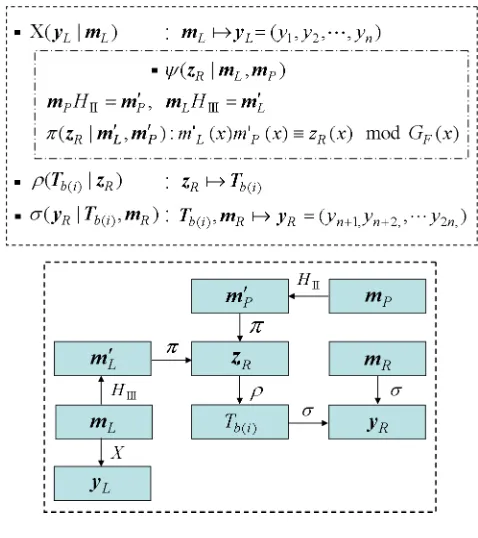
Before describing the details of the transformations, in Fig.1, we show the rough sketch of the transformations
per-formed onmL,mR andmP.
2.2
Transformation
X(
y
L|
m
L)
Using X(yL|mL), the message mL = (m1, m2,· · · , mn) is
encrypted to yL, for example by the methods presented in
Refs.[1], [5] and [20], as
yi =h
(2)
i (m1, m2,· · ·, mn);i= 1,2,· · ·, n, (10)
where h(2)i (m1, m2,· · · , mn) implies the i-th quadratic
equa-tion in the variablesm1, m2,· · ·, mn.
The p(2)i (m1, m2,· · · , mn) and q (2)
i (m2n+1, m2n+2, · · · , m3n) will be similarly defined.
Set of the equations y1, y2,· · ·, yn constitutes the set of public key{yi}L.
2.3
Transformation
Ψ(
y
R|
m
L,
m
P,
m
R)
The transformation Ψ(yR|mL,mP,mR) is performed by a
series of transformations ψ(zR|mL,mP), ρ(Tb(i)|zR) and
ρ(yR|Tb(i),mR) as shown in Fig.1.
Figure 1: Brief sketch of transformations
(I) Transformation ψ(zR|mL,mP)
The publicizedmP is transformed into
mPHII =m′P, (11)
whereHII is ann×nnon-singular matrix overF2.
The messagemL is transformed into
mLHIII =m′L, (12)
whereHIII is ann×nmatrix overF2which is not necessarily
non-singular.
Them′L andm′P are transformed into
m′L(x)m′P(x)≡zR(x) modGF(x) =z1+z2x+· · ·+znxn−1,
(13)
where GF(x) is a random primitive polynomial of degree n
overF2.
ThezR(x) is publicized.
(II) Transformation ρ(Tb(i)|zR)
For zR = (z1, z2,· · · , zn), let us define a sampling func-tionSi(θi1, θi2,· · ·, θiµ);i= 1,· · ·, λ, wherei1, i2,· · ·, iµ
ran-domly take on values from 1 tonunder the condition that
1≤i1< i2<· · ·< iµ≤n. (14)
The components of zR, zi1, zi2,· · ·, zn, are sampled using the sampling function Si(θi1, θi2,· · · , θiµ). Let the sampled
valuezSi be denoted by
Regardingzi1as the most significant digit andziµ, the least
significant digit,zSican be transformed to a binary number,
b(i). The order of{b(i)}is evidently given by
#{b(i)}= 2µ. (16)
For eachb(i), we provide uniquely decodable tables,{Tb(i) }
. We assume that the tables Tb(i)’s are all distinct each other.
Namely, the order of the tables, #{Tb(i)} is also given by
#{Tb(i)}= 2µ. (17)
Let us partition messagemR into
mR= (mR1,mR2,· · ·,mRλ), (18)
wheremRi is given by
mRi= (mn+(i−1)t+1,· · ·, mn+it),(1≤i≤λ). (19)
We assume that the following relation holds:
µ≥t= n
λ. (20)
For the components ofmR,mR1,mR2,· · · ,mRλ,2µ differ-ent random coding tables are provided.
When mRi˜ is given, the i-th sampling function
Si(θi1, θi2,· · · , θiµ) is assinged to ˜zR, yielding ˜zSi = (˜zi1,˜zi2,· · ·,z˜iµ) given by Eq.(15). When ˜zSi represent
the binary number ˜b(i), Table T˜b(i) is selected from the
set {Tb(i) }
for encrypting m˜Ri. For message mR˜ =
( ˜mR1,mR˜ 2,· · ·,mRλ), the following vector of the chosen ta-˜
bles is given.
T˜b(i)= (T˜b(1), Tb˜(2),· · · , T˜b(λ)). (21)
(III) Transformation σ(yR|{Tb(i) }
,mR)
In the followings we shall present one of the methods for pro-viding the set of tables, {Tb(i)}, each of which lists 2t code words that are uniquely decodable. Using the set of tables
{
Tb(i) }
the messagemRi, a component ofmR, is transformed
to the codeword as
mRi = (mn+(i−1)t+1,· · · , mn+it)
7→yRi= (yi1, yi2,· · ·, yit). (22)
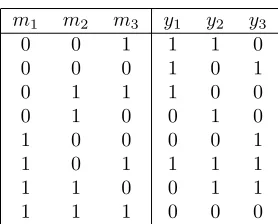
An example of Tb(i) is given in Table 1 where we assume
that t = 3. As the size of mRi is t = 3, we see that the
2t= 23= 8 different code words are provided for the
encrypt-ing of mRi, the i-th component ofmR. For example, when
zSi represents the binary number b(i) = 1011, then T1011as
shown in Table 1 is chosen. Furthermore we assume that the
messagemRi happens to be (1 1 0), then this message (1 1 0)
is encoded toyRi= (011).
Table 1: Example ofT1011
m1 m2 m3 y1 y2 y3
0 0 1 1 1 0
0 0 0 1 0 1
0 1 1 1 0 0
0 1 0 0 1 0
1 0 0 0 0 1
1 0 1 1 1 1
1 1 0 0 1 1
1 1 1 0 0 0
As we have explained by the above-mentioned example, in general, the message mR = (mR1,mR2,· · · ,mRλ) is en-crypted to (yR1,yR2,· · · ,yRλ) based on the set of tables
{
Tb(i) }
andzR.
The ciphertextCRis simply given by
CR= (yR1,yR2,· · ·,yRλ), (23)
whereyRi= (yn+(i−1)t+1,· · ·, yn+it);i= 1,2,· · ·, λ.
Remark 1 : Thei-th component of the message vectormR, mRi, is transformed to the code wordyRiusing the table
Tb(i). For the given ˜mRi, the table T˜b(i) is not fixed but
is given, depending on another message vector ˜zSi in the
variables ˜M1,M˜2,· · · ,M˜3n. Namely K(XIV)SE(g)PKC
is constructed based on a series of message depen-dent transformations ψ(zR|mL,mP), ρ(Tb(i)|zR) and
σ(yR|{Tb(i) }
,mR). 2
Public Keys : mP,{yi}L,{zRi},ρ(Tb(i)|zR),
σ(yR|{Tb(i)},mR).
Secret Keys : HI,GF(x),X(yL|mL),
ψ(zR|mL,mP).
2.4
Ciphertext
Letting the ciphertext C be represented by C =
(CL,CR,CP), the ciphertextCL is given by
CL= (y1, y2,· · ·, yn), (24)
whereyi=h
(2)
i (m1, m2,· · ·, mn).
The ciphertextCRis simply given by
CR= (CR1,CR2,· · ·,CRλ), (25)
where
Table 2: Example of K(III)RSE(g)PKC
Example
Number of Variables,
3n
Length of Subblock,
n (bit)
Size of Public key
SP K(KB)
t λ µ
I 90 30 93 3 10 8
II 120 40 219 4 8 10
III 150 50 427 5 8 10
IV 180 60 738 6 8 10
The ciphertextCP is given by
CP = (m2n+1, m2n+2,· · · , m3n). (27)
2.5
Encryption and dycryption
2.5.1 Encryption
Step1: Given the message sequences M˜ 1, M˜ 2, · · ·,
˜
M3n, the ciphertext ˜CL is given by ˜CL =
(˜y1,y˜2, . . . ,y˜n).
Step2: After calculating ˜zR from the public key {zRi}, using the sampling function Si(θi1, θi2,· · ·, θiµ) ; i = (1,2,· · ·, λ), the set of tables
T˜b(1), T˜b(2),· · · , T˜b(λ) is obtained.
Step3: Using ˜T = (T˜b(1), Tb˜(2),· · · , T˜b(λ)), the
mes-sage ˜mR = ( ˜mR1,mR˜ 2,· · · ,mRλ) is encrypted˜
to the ciphertext C˜R = (˜y1,y˜2,· · ·,y˜λ) = (˜yn+1,y˜n+2,· · · ,y˜2n).
Step4: From the public equations, m2n+1, m2n+2, · · ·,
m3n, the ciphertext ˜CP is simply given by ˜CP = ( ˜m2n+1,· · ·,m˜3n).
2.5.2 Decryption
Step1: From ˜CL = (˜y1,y˜2,· · ·,y˜n), the message vector ˜
m1,m˜2,· · ·,m˜n are decoded.
Step2: From mL˜ = ( ˜m1,m˜2,· · ·,m˜n) and mP˜ =
( ˜m2n+1,m˜2n+2,· · ·,m˜3n), the venctor ˜zR =
(˜zR1,zR˜ 2,· · ·,˜zRλ) is decoded by Eqs.(11),(12)
and (13).
Step3: Using the sampling functions {Si(θi1,· · ·, θiµ)},
the set of tablesT˜b(1),T˜b(2),· · ·,T˜b(λ)are decoded.
Step4: From the i-th component of ˜CR, ˜yi, the
mes-sage ˜mRi is decoded using the table T˜b(i) ; i =
1,2,· · · , λ, yielding ˜mR= ( ˜m1,m˜2,· · ·,m˜λ).
Step5: From m˜L, m˜R and m˜P, the message m˜ =
( ˜mL,m˜R,m˜P) = ( ˜m1,m˜2,· · ·,m˜3n) is decoded. Step6: The original message ˜M = ( ˜M1,M˜2,· · · ,M˜3n) is
decoded by
( ˜m1,m˜2,· · · ,m˜3n)HI−1= ˜M (28)
2.6
Several parameters
Let us define several symbols:
NV : Total number of message variables, 3n.
NEP l : Total number of linear equations used for
encryptingmP.
NELq : Total number of quadratic equations used
for encryptingmL.
NERq : Total number of random quadratic equations
used for choosing a random coding table from{Tb(i)}
ST : Size ofTb(i) (bit).
The size of the public key{yi}L for encodingmL,SP KLq, is given by
SP KLq=NVH2·NELq =
(3n+ 1)9n2
2 (bit). (29)
Similarly, the size of the public key used for choosing a random table from{Tb(i)}is given by
SP KRq=NVH2·NERq=
(3n+ 1)9n2
2 (bit). (30)
The size of the public key for encrypting mP, SP KP l, is
given by
SP KP l=NV ·NEP l = 3n2. (31)
The size of the table{Tb(i)},ST, is given by
ST = 2t+1·2µ (bit). (32)
The size of the public key,SP K, is given by
SP K = SP KLq+SP KRq+SP KP l+ST
= 27n3+ 12n2+ 2t+1+µ (bit). (33)
The size of the ciphertexts,CL,CR andCP are given by
|CL|=|CR|=|CP|=n (bit). (34)
The size of the ciphertexts,C= (CL, CR, CP) is given by
The coding rate, ρ, is give by
ρ=NV
|C| =
3n
3n = 1.0. (36)
We see that the proposed scheme realizes the coding rate of exactly 1.0.
We present several examples of K(XIV)RSE(g)PKC in
Ta-ble 2.
3
Security Considerations
3.1
Preliminaries
It should be noted that K(XIV)RSE(g)PKC has the following
advantage, before discussing on the security of the proposed scheme.
”One of the advantage of the proposed K(XIV)RSE(g)PKC is that for any given ci-phertext, zR˜ = (˜zR1,˜zR2,· · ·,zRλ)˜ is not
ex-plicity given, although the set of public keys,
{zRi}, is publicized.”
3.2
Various attack on K(XIV)RSE(2)PKC
Attack I: Disclosingm1, m2,· · · , mn, from the given the
ci-phertext ˜CL.
The total number of the quadratic equationsy1, y2,· · · , yn is equal to the total number of variablesm1, m2,· · ·, mn.
As a result, using GB attack[23,24], it would be possible to disclose ˜m′1,m˜′2,· · ·,m˜n′ in the variables ˜M1,M˜2,· · · ,M˜3n that yields the set of equations ˜y1,y˜2,· · ·,y˜n. However it seems hard to find the set ofm′1, m′2,· · ·, m′n such that
˜
m′i= ˜mi;i= 1,2,· · ·, n. (37) 2
Attack II: Exhaustive attack on a set of tables used for ˜CR.
As the order of the set of the random coding tables{Tb(i) }
is given by Eq.(17) the probability PC[{T˜b(i)}] of estimating all of the tables ˜Tb(i)’s randomly chosen at the sending end,
with no knowledge on ˜zR, is given by
PC[{T˜b(i)}] ={2µλ}−1. (38)
We see that the probabilityPC[{T˜b(i)}] can be made suffi-ciently small when
µλ >∼ 80 (39)
holds. 2
Attack III: BWP attack.
Braeken-Wolf-Preneel(BWP) attack have been widely
known. Using the rank attack [25], it would be
possi-ble to disclose n linear equations m′′L = (m1′′, m′′2,· · · , m′′n)
that can be obtained by a linear transformation of mL =
(m1, m2,· · · , mn).
However it seems quite hard to constructzRfromm′′L and
mP, because zR is constructed by Eq.(11), (12) and (13). 2
4
Concluding remarks
In this paper a new class of multivariate cryptosystem referred
to as K(XIV)RSE(g)PKC. The K(XIV)RSE(g)PKC seems
se-cure due to the following reasons:
A new type of trap-door is given. That is, the
“message-dependent” transformation Ψ(yL|mR,mP,mR) is used.
The transformation Ψ(yR|mL,mP,mR) is given by a
se-ries of tranformations ψ(zR|mL,mP) → ρ(Tb(i)|zR) →
σ(yR|Tb(i),mR). It should be noted that ˜zR is not explicitly
given, but only ˜yR is given, although zR is publicized as a
public key.
We have shown that, with this new trap-door,
K(XIV)RSE(g)PKC is secure against the various attacks.
References
[1] T. Mastumoto and H. Imai, ”Public Quadratic
Polynomial-Tuples for Efficient Signature - Verification and Message-Encryption”, Advances in Cryptology, Eu-rocrypt’88, Springer-Verlag, pp.419-453, (1988).
[2] S. Tsujii, A. Fujioka and Y. Hirayama, ”Generalization of the public-key cryptosystem based on the difficulty of solving a system of non-linear equations”, IEICE Trans. Vol.1 J-72-A, 2, pp.390-397, (1989-02).
[3] J.Patarin,”Hidden fields equations(HFE) and isomor-phisms of polynomials(IP): two new families of asymmet-ric algorithms,” Proc.EUROCRYPT’96, Lecture Notes in Computer Science, Vol.1070, pp.33-48, Springer, (1996-05).
[4] M. Kasahara and R. Sakai, ”Notes on Public Key Cryp-tosystem Based on Multivariate Polynomials of High De-gree”, Technical Report of IEICE, ISEC 2001-64 (2001-09).
[5] M. Kasahara and R. Sakai, ”A Construction of Public Key Cryptosystem for Realizing Ciphertext of size 100 bit and Digital Signature Scheme”, IEICE Trans. Vol. E87-A, 1, pp.102-109, (2004-01).
type public key cryptosystem”, Technical Report of IE-ICE, ISEC 2004-74, (2004-09).
[7] J.Ding,”A New Variant of the Matsumoto-Imai Cryp-tosystem through Perturbation”, PKC 2004, LNCS 2947, pp.305-318, 2004.
[8] M. Kasahara and R. Sakai, ”A Construction of Pub-lic Key Cryptosystem Based on Singular Simultane-ous Equations”, IEICE Trans. Vol. E88-A, 1, pp.74-79, (2005-01).
[9] M. Kasahara: ”A Construction of Public-Key Cryptosys-tem Using Algebraic Coding on the Basis of Superim-position and Randomness”, ISICE Trans.Fundamentals, Vol.E-89A, No.1, (2006-01).
[10] M. Kasahara, ”K-Matrix Public-Key Cryptosystems
Constructed Based on Random Coding Technique
-Along with a proposal of new classes of SE(g)·PKC -”,
Technical Report of IEICE, ISEC 2005-171, pp.133-118, (2006-03).
[11] M. Kasahara, ”Construction of a new Class of SE(g)PKC
- Along with some notes onK-Matrix PKC -”, Technical
Report of IEICE, ISEC 2006-4, pp.23-28, (2006-05).
[12] M. Kasahara, ”Constructions of KHLN·SE(g)PKC on
the basis of K-construction with hidden location noise (HLN)”, Technical Report of IEICE, ISEC 2006-83, pp.85-90, (2006-09).
[13] M.Kasahara,”A New Class of Public Key Cryptosystem Constructed on the Basis of Multivariate Polynomials Randomly Generated”, Technical Report of IEICE, ISEC 2007 (2007-09).
[14] M.Kasahara,”New Classes of Public Key Cryptosystem Constructed on the Basis of Multivariate Polynomials”, 12-03, SITA 2007, Kashikojima, (2007-11).
[15] M.Kasahara,”New Classes of Public Key Cryptosystem Constructed on the Basis of Multivariate Polynomials”, Technical Report of IEICE, ISEC 2007, (2007-12).
[16] M.Kasahara,”New Classes of Public Key Cryptosys-tem Constructed on the Basis of Multivariate Poly-nomials and Random Coding – Another Class of
K(III)RSE(g)PKC –”, Technical Report of IEICE, ISEC
2007, (2008-02).
[17] M.Kasahara,”New Classes of Public Key Cryptosystem Constructed on the Basis of Multivariate Polynomials and Error Control Coding”, Technical Report of IEICE, ISEC. 2008-13, 108, 38 (2008-05).
[18] M.Kasahara,”New Classes of Public Key Cryptosystems Constructed on the Basis of Low Density Multivaliate
Polynomials”, Technical Report of IEICE, ISEC, (2008-09).
[19] M.Kasahara: ”Multivariate Public-Key Cryptosystems Constructed Based on Source and Channel Joint Cod-ing”, SITA 2008, (2008-10).
[20] M.Kasahara: ”A New Class of Multivariate Public Key Cryptosystems Constructed Based on Random Pseudo Cyclic Codes, K(XIII)SE(2)PKC, Realizing Coding Rate of Exactly 1.0”, Cryptology ePrint Archive 2011/573 (2011-10).
[21] J. Patarin, ”Cryptanalysis of the Matsumoto and Imai Public Key Scheme of Eurocrypt’88”, Advances in Cryptography, Crypto’95, Springer Verlag, pp.248-261, (1996).
[22] A.Kipnis and A.Shamir, ”Cryptanalysis of the HFE Pub-lic Key Cryptosystem by Relinearization”, Advances in Cryptography-Crypto’99, LNCS 1666 pp.19-30, (1999).
[23] J.C.Faugere and A.Joux, ”Algebraic Cryptanalysis
of Hidden Field Equation(HFE) Cryptosystem Using
Gr¨obner Bases”, CRYPTO 2003, LNCS 2729, pp.44-60,
(2003).
[24] M.Bardet, J.C.Faug´ere and B.Salvy ”Complexity of
Gr¨obner basis computation for semi-regular
overdeter-mined sequence overF2 with solutions inF2”, Technical
Report RR-5049, INRIA, (2003-12).