E
ABSTRA networks although possible prolong applicatio 802.15.4/Z especially conservin framewor 4 nodes) 802.15.4/Z involves a the ap autonomo network minimize integrated without Simulatio very ener using NS2 Keyword efficiency Wireless many re monitorin automatio to the ad which de (MAC) l specifica layers. conserva Indeed, i 802.15.4/ especially conservin research sensor n communi to a certa of WSNs the main follow t Therefore provided expendituEnergy
Senso
N.GopalACT -A major (WSNs) is ene reliability is a to trade-off the network on requirem Zigbee Suffer y when pow ng energy. In t rk for reliable ) collection Zigbee standa an energy-awa pplication’s ously configur topology and the power c d into WSNs requiring any on results show rgy efficient. T
2.
s: Cross-laye y, Network top
1. INT sensor netwo eal-life applic
ng, security on and contro dvent of: (i) T efines the phy
ayers of the p tions, which c A major c tion, although it has been sh /ZigBee suffe y when pow ng energy. T
to enable eff networks (W ication protoc ain extent by e
s and its corr n commonality
the traditiona e, effective an to achieve ure [3 -
y effic
or Net
Krishna, S.Gr consideratio ergy conservat also very critic energy consu k lifetime, w ments. WSNs
from serious wer managem his research w and energy-ef in WSNs ba ards and NS are adaptation
reliability res the MAC
the traffic co consumption. s based on I
y modificatio w that the cro The proposed w
r framework ology, WSN’s,
TRODUCTIO orks (WSNs) a
cations, such y and surv
ol [1]. This ha The IEEE 80 ysical and me protocol stack cover the netw concern in
h reliability i hown that W er from serious wer managem There exist ex ficient commu WSNs). Most
cols improve t exploiting the relation chara y of these pr al layered pr nd efficient m e reliability
4]. Environ
ciency
tworks
anesan, N.AnDept of ECE,
on in wireless tion (between 4 cal. In most ca umption in or while satisfyi
based on s unreliability
ent is enabl we propose cro fficient data (b ased on the S2. The fram
module that c requirements, layer based onditions in o
Our solution EEE 802.15.4 n to the sta oss-layer appr work can be sim
k, reliability, , Zigbee.
ON:
are being depl h as environ veillance, in
as been possib 02.15.4 standa edium access k; and (ii) the work and app WSNs is is also very
SNs based on s unreliability ment is enabl xhaustive amo unication in w t of the pr the energy eff e collaborative acteristics. Ho rotocols is th rotocol archi mechanisms sh with low nmental mon
y in IE
s: Cro
nand Ratnesh, B. Naveen Ku
, K L Univers
s sensor 4nodes), ases it is rder to ng the IEEE y issues, led for oss-layer between e IEEE mework captures , and on the order to can be 4/Zigbee andards. roach is mulated Energy oyed in nmental dustrial ble due ard [2], control ZigBee lication energy critical. n IEEE y issues, led for ount of wireless roposed ficiency e nature owever, hat they itecture. ould be energy nitoring app tra Fo be pro of the ne exp pro de sta tra an dy fai ou co po co ne of co be ide rec to de Th me op fle sce
EEE 80
oss-lay
S.Kishore Bab umar
ity, Vaddeswa
plications mi ade-off betwe or energy effic tuned accord otocols may a f the metrics re ey are not joi
twork perfor penditure. C ocessing reso
sign of netw ands as the m aditional laye nd network c ynamic, due bo
ilure probabili ut of battery mposed of n ower and can mmunication twork may co f different top
ntent messag low) the node entify fault configuration transmit a m stination node
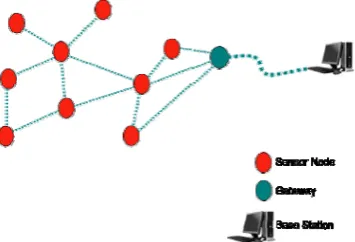
Fig 1: Wi
hus, energy-echanisms sh perating cond exible enough enarios, witho
02.15.
yer Ap
bu, B.Venkate aram.ight tolerate m een energy co
ciency, the W ding to the a achieve very elated to each intly optimize rmance while Considering ources of WSN working layer most promisin ered protocol
conditions in oth to the nois
ity of sensor power). A c nodes, each n transmit an links, wirele onsist of seve pologies. In a ges, in some es transmit sp
conditions. for fault reco message, hand
e are used to i
reless Sensor
aware and hould be abl ditions. In a h to support a out any prior o
4/zigb
pproac
eswara Reddymessage loss, onservation an WSN protocol s actual needs.
high perform h of these indi ed to maximiz e minimizing
the scarce Ns, joint opti rs, i.e., cross ng alternative
architectures a WSN ar sy wireless ch
nodes (e.g., w communicatio
of which ha nd receive m ess or cabled
eral interconn addition to th protocols (e.g pecial frames
This can al overy. When a
shaking proto mprove reliab
Network arch
reliable dat e to adapt t addition, they a wide variety
or global know
bee
ch
y, leading to a nd reliability stack needs to
While these mance in terms ividual layers ze the overall g the energy energy and imization and s-layer design to inefficient s. The traffic re often very hannel and the when they run on network is as computing messages over [5]. A single nected subnets e information g. FDDI- see to report and llow network a node desires ocols with the bility.
hitecture
network topology and the traffic pattern. To this, a cross-layer approach is definitely beneficial, since it can exploit the knowledge provided by the different layers of the protocol stack to minimize the energy expenditure [6]. In this paper we propose a cross-layer approach for reliable and energy-efficient data collection in WSNs based on the IEEE 802.15.4/ZigBee standards [7]. Our approach involves an energy-aware adaptation module that captures the application’s reliability requirements and autonomously configures the MAC layer, based on the network topology and current traffic conditions.
2. IEEE 802.15.4 AND ZIGBEE:
ZigBee technology is a low data rate, low power consumption, low cost, wireless networking protocol targeted towards automation and remote control applications. IEEE 802.15.4 committee started working on a low data rate standard a short while later. Then the ZigBee Alliance and the IEEE decided to join forces and ZigBee is the commercial name for this technology. ZigBee is expected to provide low cost and low power connectivity for equipment that needs battery life as long as several months to several years but does not require data transfer rates as high as those enabled by Bluetooth. In addition, ZigBee can be implemented in mesh networks larger than is possible with Bluetooth. ZigBee compliant wireless devices are expected to transmit 10-75 meters, depending on the RF environment and the power output consumption required for a given application, and will operate in the unlicensed RF worldwide (2.4GHz global, 915MHz Americas or 868 MHz Europe). The data rate is 250kbps at 2.4GHz, 40kbps at 915MHz and 20kbps at 868MHz. IEEE and ZigBee Alliance have been working closely to specify the entire protocol stack. IEEE 802.15.4 focuses on the specification of the lower two layers of the protocol (physical and data link layer). On the other hand, ZigBee Alliance aims to provide the upper layers of the protocol stack (From network to the application layer) for interoperable data networking, security services and a range of wireless home and building control solutions, provide interoperability compliance testing, marketing of the standard, advanced engineering for the evolution of the standard. This will assure consumers to buy products from different manufacturers with confidence that the products will work together. IEEE 802.15.4 is now detailing the specification of PHY and MAC by offering building blocks for different types of networking known as”star, mesh, and cluster tree”. Network routing schemes are designed to ensure power conservation, and low latency through guaranteed time slots. A unique feature of ZigBee network layer is communication redundancy eliminating”single point of failure” in mesh networks. Key features of PHY include energy and link quality
detection, clear channel assessment for improved coexistence with other wireless networks.
As for the channel access, the standard defines two different functions: the beacon enabled and non-beacon enabled modes. The beacon enabled mode provides a power management mechanism based on duty-cycle, and implemented through a super frame structure bounded by beacons, i.e., special synchronization frames generated periodically by the coordinator nodes.
3. CROSS LAYER DESIGN IN WSN: Many researchers studied the necessity and possibility of taking advantages of cross layer design to improve the power efficiency and system throughput of Wireless sensor network [8-9]. (Safwat et al. 2003) proposed Optimal Cross-Layer Designs for Energy-efficient Wireless Ad hoc and Sensor Networks. They propose Energy-Constrained Path Selection (ECPS) scheme and Energy-Efficient Load Assignment (E2LA). ECPS is a novel energy-efficient scheme for wireless ad hoc and sensor networks. it utilizes cross-layer interactions between the network layer and MAC sublayer. The main objective of the ECPS is to maximize the probability of sending a packet to its destination in at most n transmissions. To achieve this objective, ECPS employs probabilistic dynamic programming (PDP) techniques assigning a unit reward if the favorable event (reaching the destination in n or less transmissions) occurs, and assigns no reward otherwise. Maximizing the expected reward is equivalent to maximizing the probability that the packet reaches the destination in at most n transmissions.
Where D is the destination node and j is the next hop towards the destination D. Any energy-aware route that contains D and the distance between D and the source node is less or equal to n can be used as input to ECPS. The MAC sub-layer provides the network layer with the information pertaining to successfully receiving CTS or an ACK frame, or failure to receive one. Then ECPS chooses the route that will minimize the probability of error. The objective of the E2LA scheme is to distribute the routing load among set Z of Energy aware routes. Packets are allotted to routes based on their willing to save energy. Similar to ECPS, E2LA employs probabilistic dynamic programming techniques and utilize cross-layer interactions between the network and MAC layers.
3.1 Cross layer framework:
will optimally allocate resources among various traffic flows; a congestion-optimized routing algorithm will provide multiple paths to real-time media streams; finally at the transport and application level, intelligent packet scheduling and error-resilient audio/video coding will be optimized for low-latency delivery over ad-hoc wireless networks. The proposed framework will integrate the above components in a dynamic and iterative fashion.
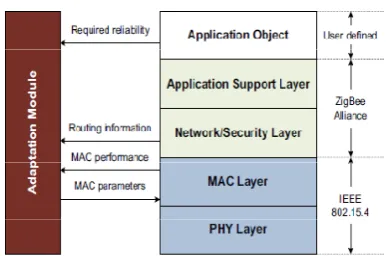
Fig 2: Frame Work architecture.
The proposed framework will integrate the above components in a dynamic and iterative fashion. It allows the exchange of relevant information such as link capacities, traffic flows, packet deadlines and rate-distortion preamble of the source data across the entire protocol stack. Within this framework, we will develop a suite of new techniques for joint optimization, including. As a result, the information coming from one layer can be exploited for tuning the operations of protocols residing in a different (nonadjacent) layer. Specifically, the adaptation module obtains a target level of reliability (in terms of the required delivery ratio) from the application. In order to satisfy the required reliability, the adaptation module continuously monitors the performance of the MAC layer, and provides feedback on the current operating conditions by properly tuning the MAC parameters.
3.2 Cross-layer adaptation module:
Fig 3: Cross layer Adaption Module.
Our solution to adaptive data collection is cross-layer, and involves an adaptation module which interacts with the different layers of the WSN protocol stack (see Figure 2).Our scheme follows the approach in, where a vertical component is added to the layered architecture to facilitate the sharing of information between different layers of the protocol stack. This avoids duplicating efforts to collect internal state information, and leads to a more efficient system design, as the information collected by the adaptation module can be used for optimizing the protocols’ functions. As a result, the information coming from one layer can be exploited for tuning the operations of protocols residing in a different (nonadjacent) layer. Specifically, the adaptation module obtains a target level of reliability (in terms of the required delivery ratio) from the application. In order to satisfy the required reliability, the adaptation module continuously monitors the performance of the MAC layer, and provides feedback on the current operating conditions by properly tuning the MAC parameters. In addition, in multi-hop networks, it exploits the information about the network topology, made available by the routing layer.
4. NETWORK SIMULATOR VERSION 2(NS2): Network Simulator (Version 2), widely known as NS2, is simply an event driven simulation tool that has proved useful in studying the dynamic nature of communication networks. Simulation of wired as well as wireless network functions and protocols (e.g., routing algorithms, TCP, UDP) can be done using NS2. In general, NS2 provides users with a way of specifying such network protocols and simulating their corresponding behaviours. Due to its flexibility and modular nature, NS2 has gained constant popularity in the networking research community since its birth in 1989. Ever since, several revolutions and revisions have marked the growing maturity of the tool, thanks to substantial contributions from the players in the field. Among these are the University of California and Cornell University who developed the REAL network simulator.
1. The foundation which NS is based on was since 1995 the Defence Advanced Research Projects Agency (DARPA) supported development of NS through the Virtual Inter Network Testbed (VINT) project.
2. Currently the National Science Foundation (NSF) has joined the ride in development. Last but not the least, the group of researchers and developers in the community are constantly working to keep NS2 strong and versatile. Again, the main objective of this book is to provide the readers with insights into the NS2 architecture.
Linux), W are distrib compone all the re compone for the be
This type central s server), b reliable a as far as data from reach in span larg
Fig 4: O
Windows, and buted in two f ent-wise. With equired comp ents. This is
eginners.
5. SIMUL e of infrastruc server) or cen both are rel and resilient, the next node m nearby node a single hop ger distances.
Output for Data
Fig 5:
d Mac system forms: The all h the all-in-on ponents along basically a re
LATION OU cture can be de
ntrally manag latively inex
as each node e. Nodes act a es to peers tha p, resulting in
a transferring Simulator
: Terminal Ou
ms.NS2 source l-in-one suite ne package, us
with some o ecommended
UTPUT: ecentralized (w ged (with a xpensive, and needs only t as routers to t at are too far a n a network th
at Nodes usin
utput e codes and the sers get optional choice with no central d very transmit ransmit away to hat can ng NS2 Th ne in In wi an rat wi sen of da life tra ne ha Th dep for thi [1 [2 [3 [4 [5 [6 [7 [8 [9 [1
he same mo twork simula Fig 4.
Future wor ireless sensor nd data transfe te can also ireless sensor nsor network f energy is spe ata from one n fe time of ea ansmission oc
twork simulat ave been prese
AC he authors l
partment of E r their continu is work.
1] Willig, “Rec
communicati
4, no. 2, pp.
2] G. Anastasi
“Reliability 802.15.4/Zig
Symposium Rimini, Italy
3] Mario Di Fra
Das,”Reliabi 802.15.4/Zig layer Appro
communicati
4] G. Anastasi,
analysis of t wireless sens
no. 1, pp. 52–
5] G. Anastasi,
“Energy con
Ad Hoc Netw
6] T. Melodia, M
in cross laye EuroNGI W Lecture Note
7] J. Misic, S
management Mag., vol. 44
8] Tommaso M
State of the Networks”.
9] W. Su and T
wireless sen
International Intelligence, (SNPD 2006 10] P. Park, C.
802.15.4 pro communicati
Information P 12-16 2010,
odel has bee ator and the
6. CONCL rk the mathe node obtaine er rate of each be calculated network play applications. ent on each n node to anothe ch node ,and ccur between tor; the theore ented.
CKNOWLED like to expr ECE and mana
uous support
REFERE
cent and emergi ions: A selection,
102–124, May 20 , M. Conti, M
and energy gBee wireless sens
on Computers an , 22-25 June 2010 ancesco, Giusepp
ility and E gBee Sensor Net
oach,” IEEE j ions, vol. 29, no.
M. Conti, and M
the MAC unrelia sor networks,” IE –65, February 20 M. Conti, M. D
servation in wire
works, vol. 7, no. M. C. Vuran, and
er design for wir Workshops on W es in Computer Sc
S. Shafi, and V
t in an 802-15.4
4, no. 1, pp. 131– Melodia, Mehmet C
Art in Cross-La
T. Lim, “Cross-l
nsor networks,” Conference on
Networking, and 6), June 2006, pp. . Fischione, and
otocol for energ ions,” in Proc. Processing in Sen pp. 327–338.
en simulated e output is s
LUSION: ematical anal ed by Markov h node, overal d. Energy ca ys major role
According to node while tra er node, it is d also the am n two nodes
etical and sim
DGEMENTS ress their th
agement of K and encourag
ENCES:
ing topics in wi
” IEEE Trans. In 008.
M. Di Francesco
efficiency in m sor networks,” in nd Communicatio
0.
pe Anastasi, Marc
Energy-efficiency tworks: An Adap
journal on sel 8, September 201 M. Di Francesco, “
ability problem i
EEE Trans. Ind. 11.
Di Francesco, an
eless sensor netw
3, pp. 537–568,
d D. Pompili, “Th
reless sensor net Wireless and M cience3883, July
V. Misic, “Cro
sensor network,” –136, January 200 C. Vuran, and Da
ayer Design for
layer design and
” in Proc. of Software Engin d Parallel/ Distrib
278–284. d K. Johansson,
gy efficient, reli
9th Internationa nsor Networks (IP
using NS-2 shown above
lysis of each v chain model
ll data transfer alculation for in large scale o the amount ansmitting the found out the mount of data using NS-2 mulated results
:
hanks to the K L University gement during
ireless industria
nd. Informat., vol
o, and V. Neri
multi-hop IEEE
n Proc. 15th IEEE ons (ISCC 2010)
co Conti, Sajal K
y in IEEE
ptive and
Cross-lected areas in 11.
“A comprehensive n IEEE 802.15.4
Informat., vol. 7
nd A. Passarella
works: A survey,” May 2009.
he state of the ar tworks,” in Proc Mobility. Springer
y 2005.
oss-layer activity
” IEEE Commun
06.
ario Pompili “The Wireless Sensor
d optimization for
the 7th ACIS neering, Artificia
buted Computing
“Adaptive IEEE iable and timely
l Conference on PSN 2010), Apri
Mr. N. Gopala Krishna was born in 1989 in Krishna district, Andhra Pradesh, India. He completed his B.Tech at SSIET College Affiliated to JNTUK and received his Bachelor’s degree in ECE, from JNTU Kakinada in 2010. Currently he is pursuing M.Tech in Communication and Radar Systems in the ECE department of K L University. His interested research areas are Sensor networks, Antennas, DIP, Radars and Wireless Communications.
Mr. S. GANESAN was born in 1978, India. He received his Bachelor’s degree in ECE, from Madurai Kamraj University in 2000 and His M.E (Digital communication and networking) degree in 2004 from Anna University. He worked with reputed Universities in India as well as Abroad and published six papers in International Conferences and journals. Currently he works as an Associate professor at K L University, Guntur. His research areas are Wireless sensor Network, Information coding theory.
Mr. N. ANAND RATNESH was born in
1988 in Guntur district, Andhra Pradesh, India. He completed his B.Tech at NIET College Affiliated to JNTUK and received his Bachelor’s degree in ECE, from JNTU Kakinada in 2010. Currently he is pursuing M.Tech in Communication and Radar Systems in the ECE department of K L University. His interested research areas are Antennas, DIP, Radars and Wireless Communications.
Mr. S. KISHORE BABU was born in 1981 in West Godavari district, Andhra Pradesh, India. He completed his B.Tech at SRKR College Affiliated to Andhra University in 2003.He has obtained his M.TECH degree from JNTUA in 2007. Currently he is pursuing PhD in DIGITAL SYSTEMS in the ECE department of ACHARYA NAGARJUNA University. His interested research areas are VLSI, VHDL, Sensor networks, DIP, and Wireless Communications.
Mr.B.VENKATESWARA REDDY was
born in 1981 in Krishna district, Andhra Pradesh, India. He completed his B.Tech at LBRCE College Affiliated to JNTUH in 2003.He has obtained his M.TECH degree in 2005. Currently he is pursuing Ph.D in DIGITAL IMAGE PROCESSING in the ECE department of JNTUH University. His interested research areas are s DIP, microprocessors, microcontrollers and Wireless Communications.
Mr. B. NAVEEN KUMAR was born in