A Fast Algorithm
for the Generation of Referring Expressions
A b s t r a c t
We simplify previous work in the development of algorithms for the generation of referring expre~ sions while at the same time taking account of psy- cholinguistic findings and transcript data. The result is a straightforward algorithm t h a t is computation- ally tractable, sensitive to the preferences of human users, and reasonably domain-independent. We pro- vide a specification of the resources a host system must provide in order to make use of the algorithm, and describe an implementation used in the IDAS sys- tem.
I n t r o d u c t i o n
In previous work [Da189,DH91,Rei90a,Rei90b] we have proposed algorithms for determining the con- tent of referring expressions. Scrutiny of the psy- cholinguistics literature and transcripts of human di- alogues shows t h a t in a number of respects the be- haviour of these algorithms does not correspond to what people do. In particular, as compared to these algorithms, human speakers pay far less attention to reducing the length of a referring expression, and far more attention to making sure they use attributes and values t h a t human hearers can easily process; in the terms introduced in [Da188,Da189], hearers are more concerned with the principle of sensitivity t h a n with the principle of efficiency. We have designed a new referring expression generation algorithm t h a t is based on t h e ~ observations, and believe t h a t the new algorithm is more practical for real-world natu- ral language generation systems t h a n the algorithms we have previously proposed. In particular, the al- gorithm is:
• fast: its run-time is linear in the number of distrac- tors, and independent of the number of possible modifiers;
• sensitive to h u m a n preferences: it attempts to use easily perceivable attributes and basic-level [Ros78] attribute values; and
• Supported by SERC grant GR/F/36750. E-mail ad- dress is E.Reiter@ed. ac.uk.
tAiso of the Centre for Cognitive Science at the Univer- sity of Edinburgh. E-mail address is R. DaleQed. ac .uk.
E h u d R e i t e r * a n d R o b e r t D a l e f D e p a r t m e n t of A r t i f i c i a l I n t e l l i g e n c e
U n i v e r s i t y of E d i n b u r g h E d i n b u r g h EH1 1tlN
S c o t l a n d
• domain-independent: the core algorithm should work in any domain, once an appropriate knowl- edge base and user model has been set up.
A version of the algorithm has been implemented within the IDAS natural-language generation system [RML92], and it is performing satisfactorily. The algorithm presented in this paper only gener- ates definite noun phrases t h a t identify an object t h a t is in the current focus of attention. Algorithms and models t h a t can be used to generate pronominal and one-anaphoric referring expressions have been presented elsewhere, e.g., [Sid81,GJW83,Da189]. We have recently begun to look at the problem of gen- erating referring expressions for objects t h a t are not in the current focus of attention; this is discussed in the section on Future Work.
B a c k g r o u n d
D i s t i n g u i s h i n g D e s c r i p t i o n s
The term 'referring expression' has been used by dif- ferent people to mean different things. In this paper, we define a referring expression in intentional terms: a noun phrase is considered to be a referring expres- sion if and only if its only communicative purpose is to identify an object to the hearer, in Kronfeld's ter- minology [Kro86], we only use the modal aspect of Donefian's distinction between attributive and ref- erential descriptions [Don66]; we consider a noun phrase to be referential if it is intended to identify the object it describes to the hearer, and attributive if it is intended t o communicate information about t h a t object to the hearer. This usage is similar to t h a t adopted by Reiter [Rei90b] and Dale and Had- dock [DH91], but differs from the terminology used by Appelt [App85], who allowed 'referring expres- sions' to satisfy any communicative goal t h a t could be stated in the underlying logical framework. We here follow Dale and Haddock [DH91] in assum- ing t h a t a referring expression satisfies the referential communicative goal if it is a d i s t i n g u i s h i n g d e - a c r i p t i o n , i.e., if it is an accurate description of the entity being referred to, b u t not of any other object in the current c o n t e x t s e t . We define the context set to be the set of entities t h a t the hearer is cur- rently assumed to be attending to; this is similar
to the notion of a d i s c o u r ~ focus space [GS86]. We also define the c o n t r a s t s e t to be all elements of the context set except the intended referent. The role of tile conlponcnts of a referring expression can then be regarded as 'ruling o u t ' members of the c o n t r a s t set. For example, if the speaker wished to identify a small black dog in a situation wlmre tile contrast set consisted of a large white dog a n d a small black cat, she might choose the adjective black in order to rule out the white dog a n d the heart noun dog in order to rule out the eat; this results in the referring ex- pression the black dog, which m a t c h e s the intended referent b u t no other object in the current context. The small dog would also be a succ~csful referring expre~-~ion in this context, under the distinguishing description model.
U n n e c e s s a r y M o d i f i e r s
A referring expression m u s t communicate enough in- fornlation to be able to uniquely identify the in- tended referent in t h e current discourse context (i.e., it must adhere to the principle of adequacy [Da188,Da189]). B u t . t h i s is not the only constraint a good referring expression m u s t obey; it is clear t h a t m a n y referring expressions t h a t meet this con- straint are inappropriate because they couvey incor- rect a n d u n w a n t e d c o n v e r s a t i o n a l i m p l i e a t u r e s
[Gri75,Rei90a] to a h u m a n hearer.
One source of such false implicatures can he the p r e ~ ence of r e d u n d a n t or otherwise unnecessary modifiers in a referring expression. For example, consider two possible referring expressions t h a t a speaker might use to request tilat a hearer sit by a talfle:
(l) a. Sit by the table.
h. Sit by the brown wooden table.
If the context was such t h a t only one table was vis- ible, a n d this table was brown raid m a d e of wood, u t t e r a n c e s (In) a n d (lb) would both be distinguish- ing descriptions t h a t unranbiguously identified the intended referent to the hearer; a hearer who heard either u t t e r a n c e would know where he was supposed to sit. However, a hearer who heard u t t e r a n c e (lb) in such a context might make the additional infer- enee t h a t it was i m p o r t a n t to the disc~mrse t h a t the tM)le was brown a n d m a d e of wood; for, tile hearer might reason, why else would the speaker include in- formation a b o u t the table's colour a n d material t h a t was not necessary for the reference task? This infer- enc~ is an example of a conversational implicature caused by a violation of Grice's maxim of Q u a n t i t y [Gri75].
I n a p p r o p r i a t e M o d i f i e r s
Unwanted conversational implicatures can alse be caused by the use of overly specific or otherwise un- expected modifiers. One example is ms follows:
(2) IL l,ook a t the doq. b. Look at the pil bull.
In a context where there is only one dog present, tile hearer would n o m m l l y expect u t t e r a n c e (2a) to be used, since dog is a b a s i c - l e v e l class [Ros78] for most native speakers of English. Hence the use of ut- terance (2b) might implicate to the hearer t h a t the speaker t h o u g h t it was relevant t h a t the a n i m a l was a pit bull and not some other kind of dog [Cru77], per- haps because the speaker wished t o w a r n the hearer t h a t the animal m i g h t be dangerous; if the speaker h a d no such intention, site should avoid using utter- ance (2b), despite the fact t h a t it fulfills the referen- tial communicative goal.
P r e v i o u s W o r k
In previous work [Dalgg,D}191,Rei90a,Rei90b] we have noted t h a t the presence of extra information in a referring expression can lead the hearer to make false implicaturcs, a n d therefore concluded t h a t a referring-expression generation system should taake a strong a t t e m p t to ensure t h a t generated refer- ring expressions do not include unnecessary infor- mation, either as superfluous NP modifiers or as overly-specific head n o u n s or a t t r i b u t e values. Dale [DaI88,DaI89,DH91] }ins suggested doing this by re- quiring the generation system to produce m t n i m a l distinguishing descriptions, i.e., distinguishing de- scriptions t h a t include as few a t t r i b u t e s of the in- tended referent as possible. Keiter [Keig0a, Rei90b] ha.s pointed out t h a t this task is in fact NP-Hard, a n d has proposed instead t h a t referring expressions should obey three rules:
N o U n n e c e s s a r y C o m p o n e n t s : all components of a referring expremion m u s t be necessary to ful- fill the referential goal. For example, the small black dog is not acceptable if the black dog is a dis- tinguishing description, since this means small is a n unnecessary component.
L o c a l B r e v i t y : it should not be p o ~ i b l e to pro- duce a shorter referring expression by replacing a set of existing modifiers by a single new modifier. For exanlple, the sleeping female dog should not he treed if the small dog is a distinguishing descrip- tion, since the two modifiers sleeping a n d female can b c replaced by the single modifier small. L e x i c a l P r e f e r e n c e : this is an extension of the
ba.sicAcvel preference proposed by Cruse [Cru77]; more details are given in [Reigl].
A referring expression t h a t mt.~ts l[eiter's con- straints cart be foumt in polynomial time if the lexical preference relation meets certain conditions [Rei90a]; such a referring expression can not, imwever, always be found in linear time.
P s y c h o l o g i c a l a n d T r a n s c r i p t D a t a
P s y c h o l o g i c a l E v i d e n c e
Subsequent to performing the above research, we have looked in some detail at the psychological lit- erature on h u m a n generation of referring expres- sions. This research (e.g., [FO75,Whi76,Son85,
Pec891; [Lev89, pages 129-134] is a useful s u m m a r y of much of this work) clearly shows t h a t in many cases h u m a n speakem do include unnecessary modi- tiers in referring expressions; this presumably implies t h a t in many cases h u m a n hearers do not make impli- catures from the presence of unnecessary modifiers. For example, if h u m a n subjects are shown a picture of a white bird, a black cup, a n d a white cup, a n d are asked to identify the white bird, they frequently say the white bird, even t h o u g h j u s t the bird would have been sufficient in this ease.
A partial explanation for this use of r e d u n d a n c y m a y be t h a t h u m a n speakers generate referring expres- sions incrementally [Pee89]. An incremental gener- ation algorithm cannot always detect unnecessary modifiers; in the above example, for instance, one could imagine the algorithm choosing the adjective white to rule out the black cup, a n d then the noun bird in order to rule out the white cup, without then erasing white because the black cup is also ruled out by bird.
A n o t h e r explanation of r e d u n d a n c y might involve the speaker's desire to make it easier for the hearer to identify the object; the speaker might believe, for example, t h a t it is easier for the hearer to identify a white bird t h a n a bird, since colour may be more immediately perceptible t h a n shape. 1.
Both of the above explanations primarily justify ad- jectives t h a t have some discriminatory power even if they are redundant in this particular context. In the above example, for instance, white possesses some discriminatory power since it rules out the black cup, even t h o u g h it does h a p p e n to be r e d u n d a n t in the expression the white bird. It would be h a r d e r for either of the above factors to explain the use of a modifier with no discriminatory power, e.g., the use of white if all objects in the c o n t r a s t set were white. 2qaere is some psychological research (e.g., [FO75]) t h a t suggests t h a t h u m a n speakers do not use mod- ifiers t h a t have no discriminatory power, b u t this research is probably not conclusive.
Thc a r g u m e n t can be made t h a t psychological real- ism is not the most i m p o r t a n t constraint for gener- ation algorithms; the goal of such algorithms should be to p r o d u c e referring expressions t h a t h u m a n hear- ers will u n d e r s t a n d , r a t h e r t h a n referring expressions t h a t h u m a n speakers would utter. The fact t h a t hu- m a n speakers include r e d u n d a n t modifiers in refer- ring expressions does not mean t h a t NL generation systems are also required to include such modifiers; there is n o t h i n g in principle wrong with building gen- eration systems t h a t perform more optimizatious of their o u t p u t t h a n h u m a n speakers. On the other hand, if such beyond-human-speaker optimizations
1Another possible explanation is that speakers may in some cases use precompiled 'reference scripts' instead of computing a referring expression from scratch; such refer- enoe scripts specify a set of attributes that are included as a group in a referring expression, even if some members of the group have no discriminatory power in the current context
are computationally expensive and require complex algorithms, they m a y not be w o r t h performing; they are clearly unnecessary in some sense, after all, since h u m a n speakers do not perform them.
T r a n s c r i p t A n a l y s i s
In addition to the l~ychological literature review, we have also examined a t r a n s c r i p t of a dialogue be- tween two h u m a n s performing a n assembly task. ~ We were particularly interested in questions of mod- ifier choice; if a discriminating description can be formed by adding a n y one of several modifiers to a head noun, which modifier should be used? In par- ticular,
1. Which a t t r i b u t e should be used? E.g., is it b e t t e r to generate the small dog, the black dog, or the female dog, if these are discriminating descriptions but j n s t the dog is not?
2. Is it preferable t o a d d a modifier or to use a more specific head noun? E.g., is it b e t t e r to say the small dog or the chihuahua?
3. Should relative or absolute adjectives be used? E.g., is it b e t t e r to say the small dog or the one foot high dog?
In our analysis, we observed several phenomena which we believe m a y generalise to other situations involving spoken, face-tooface language:
1. H u m a n speakers prefer to use adjectives t h a t com- municate size, shape, or colour in referring expres¢ sions. In tile above examples, for instance, a hu- m a n speaker would p r o b a b l y prefer the black dog a n d the small dog over the female dog.
2. H u m a n hearers sometimes have trouble determin- ing if a n object belongs to a specialized class. In the above example, for instance, the chihuahua should only be used if the speaker is certain the hearer is capable of distinguishing chihuahuas from other types of dogs. If there is a n y doubt a b o u t the heater's ability to do this, a d d i n g an explicit modifier (e.g., the small dog) is a better s t r a t e g y t h a n using a specialized h e a d noun.
3. H u m a n speakers seem to prefer to use relative ad- jectives, a n d h u m a n hearers seem to have less trou- ble u n d e r s t a n d i n g them. However, h u m a n - w r i t t e n instructional texts sometimes use absolute adjec- tives instead of relative ones; this m a y be a con- sequence of the fact t h a t writers c a n n o t predict the context their text will be read in, a n d hence how readers will interpret relative adjectives. In the above example, therefore, a speaker would be expected to use the small dog, b u t a writer might use the one foot high dog.
ZThe transcript was made by Phil Agre and John Batali, from a videotape taken by Candy Sidser. We are very grateful to them for allowing us to use it.
T h e A l g o r i t h m
Based on the above considerations, we have created a new algorithm for generating referring expressions. This algorithm is simpler a n d faster t h a n the algo- r i t h m s proposed in [Dai89,Rei90a] because i t per- forms much less length-oriented optimization of its o u t p u t i we now believe t h a t the level of optimiza- tion suggested in [Da189,ReigOa] was unnecessary a n d psycholinguistically implausible. T h e algorithm has been implemented as p a r t of a larger natural- language generation system, a n d we are pleased with its performance to date.
A s s u m p t i o n s a b o u t t h e K n o w l e d g e B a s e
O u r algorithm is intended to be reasonably domain- independent. We. do, however, make some assump- tions a b o u t the s t r u c t u r e of the host s y s t e m ' s un- derlying knowledge base, a n d require t h a t certain interface functions be provided.
in particular, we assume that:
• Every entity is characterised in terms of a col- lection of a t t r i b u t e s a n d their v a l u e s . An attrii)ute-value pair is w h a t is sometimes t h o u g h t of as a property; an example is (colour, red). Every entity has as one of its a t t r i b u t e s some t y p e . This is a special a t t r i b u t e t h a t corresponds to the kinds of properties t h a t are typically real- iT, ed by head nouns; an example is (type, dog). • The knowledge base m a y organize some a t t r i b u t e
values in a s u b s u m p t i o n t a x o n o m y (e.g., as is done in KI:ONE [BS85] a n d related KR systems). Such a t a x o n o m y might record, for example, t h a t an- imM subsumes dog, a n d t h a t red subsumes scar- let. For such taxonomically-organized values, the knowledge-base or a n associated user-model should specify which level of the t a x o n o m y is basic-level for the current user.
We require t h a t the following interface functions be provided:
value(object,attribute) r e t u r n s the value (if any) t h a t an a t t r i b u t e has for a p a r t i c u l a r object. Value should r e t u r n the m o s t specific possible value for this a t t r i b u t e , e.g., chihuahua instead of dog, a n d scarlet instead of red.
taxonomy-children(value)
r e t u r n s the immediate chil-dren
of a value in the taxonomy. For example,taxonomy-children(animal) might be the set {dog,
cat, horse, . . . }.basle-level-value(object.attribute) returns the basic~ level value of a n a t t r i b u t e of an object. FOr exam- ple,
basic-level-value(Garfield, type) might be cat.
The knowledge-representation system should in principle allow different basic-level classes to be specified for different users [Ros78,Rei91]. user-knows(object, attribute-value-pair) returns trueif the user knows or can easily determine (e.g., by direct visual perception) t h a t the a t t r i b u t e - v a l u c
pair applies to the object; false if the user knows or can easily determine t h a t the a t t r i b u t e - v a l u e pair does n o t a p p l y to the object; a n d unknown other- wise. FOr exmnple, if object x h a d the a t t r i b u t e - value pair (type, chihuahua), a n d the user was ca- pable of distinguishing dogs from eats, then user- knows(x, (type, dog)) would be true, while user- knows(x, (type, cat)) would be false. If the user was not, however, capable of distinguishing differ- ent breeds of dogs, a n d h a d no prior knowledge of x ' s breed, t h e n user-knows(x, (type, chihuahua)) a n d user~knows(x, (type, poodle)) would b o t h re- t u r n unknown, since the user would not know or be able to easily determine whether x was a chi- huahua, poodle, or some other breed of dog.
Finally, we a ~ u m e t h a t the global variable *p~eferred-attributes* lists the a t t r i b u t e s t h a t h u m a n speakers a n d hearers prefer (e.g., type, size, shape, a n d colour in the ~.,~embly task t r a n s c r i p t mentioned above). These a t t r i b u t e s should be listed in order of preference, with t h e most preferable a t t r i b u t e flint. The elements of this list a n d their order will vary with the domain, a~ld should be determined by em- pirical i n v ~ t i g a t i o n .
I n p u t s t o t h e A l g o r i t h m
In order to construct a reference to a p a r t i c u l a r em tity, tile host system must provide:
- a symbol corresponding to the intended referent; a n d
• a list of symbols correspondiug t o t h e members of the contrast set (i.e., the other entities in focus, besides the intended referent).
The algorithm r e t u r u s a list of a t t r i b u t e - v a l u e pairs t h a t correspond to tim romantic content of the refer- ring expression to be realized. This list c a n t h e n be converted into an SPL [K&~9] term, as is done in the II)AS implementation; it can also be converted into a r e c o v e r a b l e s e m a n t i c s t r u c t u r e of t h e kind used in Daie's EPICOltE system [Da188,Dai89].
T h e A l g o r i t h m
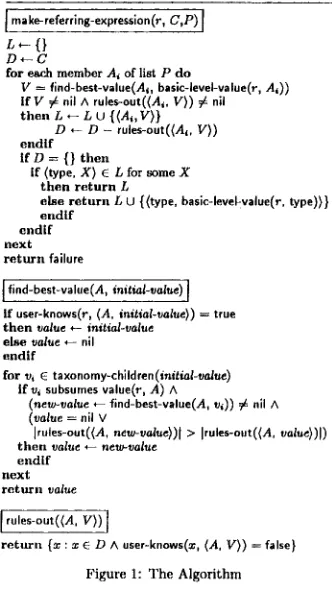
In general terms, the algorithm iterates t h r o u g h the a t t r i b u t e s in *preferred-attributes*. For each at- tribute, it checks if specifying a value for it would rule out a t least one m e m b e r of the c o n t r a s t set t h a t has not already becu ruled out; if so, this a t t r i b u t e is added to the referring ~ t , with a value t h a t is known to the User, rules out as m a n y c o n t r a s t set mem- bers as possible, and, subject to these constraints, is as cl(~e as possible to the basic-level value. The process of a d d i n g a t t r i b u t ~ v a l u e pairs continues mt- til a referring expression has been formed t h a t rules out every m e m b e r of the contrast set. There is no backtracking; once an a t t r i b u t e - v a l u e p a i r has been added to the referring expression, it is not removed even if the addition of subsequent a t t r i b u t e - v a l u e pairs make it unnecessary. A h e a d noun (i.e., a value for tim type attribute) is always included, even if it
l make-referring-expression(r, C,P) I
L*-- {} D , - C
for each member A~ of list P d o
V = flnd-best-value(A~, baslc-level-value(r, A~)) I f V ~ nil A rules-out((A~, V)) ~ nil t h e n L ~ L U {(AI, V)}
D ~ D - rules-out((At, V))
e n d l f If D = {} t h e n
if (type, X) (: L for some X t h e n r e t u r n L
else r e t u r n L U {(type, basic-level-value(r, type))} e n d i f
e n d i f next r e t u r n failure
I find-best-value(A, initial-valse) l
ff user-knows(r, (A. initial-value)) = true t h e n value ~-- initial-value
else value ~ nil vndlf
for v~ E taxonomy-children(initial-value) lfv~ subsumes value(r, A) A
(new-value ~ find-best-value(A, vi)) ~ nil A (value = nll Y
Irules-out((A, new-value)) I > Irules-out((a, valse) )l) t h e n value ~ new-value
e n d i f next r e t u r n value
[ ,ul;s-out(<A,
v>)[
r e t u r n {x : x E D A user-knows(x, (A, V)) = false}
Figure 1: The Algorithm
has no discriminatory power (in which ease t h e basic level value is used); other a t t r i b u t e values are only included if, a t the time t h e y were u n d e r considera- tion, they h a d some discriminatory power.
More precisely, the algorithm is as shown in Figure 1. Here, r is the intended referent, C is the c o n t r a s t set, P is the list of preferred attributes, D is the set of distractom (contrast set members) t h a t have n o t yet been ruled out, a n d L is t h e list of a t t r i b u t e - v a l u e pairs returned, a
make-referring-expression is the top level function. This r e t u r n s a list of a t t r i b u t e - v a l u e pairs t h a t specify a referring expression for the intended ref-
a For simplicity of expo6ition, the algorithm as described here returns failure if it is not pesaible to rule out all the mernbem of the contrast set. A more robust algorithm might attempt to pur~m other strategies here, e.g, gen- erating a referring expression of the form one of the Xs, or modifying the contrast set by adding navigation infor- mation (navigation is discussed in the section on Future Work).
erent. Note t h a t the a t t r i b u t e s are tried in the or- der specified in the *preferred-attributes* list, and t h a t a value for type is always included, even if type has no discriminatory power.
find-best-value takes a n a t t r i b u t e a n d a n initial value; it r e t u r n s a value for t h a t a t t r i b u t e t h a t is s u b s u m e d by t h e initial value, a c c u r a t e l y describes the intended referent (i.e., subsumes the value the intended referent possesses for the attribute), rules o u t as m a n y distractors as possible, and, subject to these constraints, is as close as possible in the t a x o n o m y to the initial value.
rules-out takes a n attribut~.~value pair a n d returns the elements of the set of r e m a i n i n g distractom t h a t are ruled o u t by this a t t r i b u t e - v a l u e pair.
A n E x a m p l e
Assume the task is to create a referring expression for Objectl in a context t h a t also includes Object2 a n d Object3:
• Object1: (type, chihuahua), (size, small), (calour, black)
• Object2: (type, chihuahua), (size, large), (colour, white)
* Object3: (type, siamese-cat), (size, small), (colour, black)
In other words, r = 0 b j e c t l a n d (7 = {Objest2, Object3}. Assume t h a t P = {type, colour, size, . . . }.
When make-referring-expression is called in this con- text, it initializes L to the e m p t y set a n d D to C, i.e., to {Object2, Object3}. Find-best-value is then caUed with A = type, a n d initial-value set to t h e basic-level type of Object1, which, let us assume, is dog.
Assume user-knows(Object1, (type, dog)) is true, i.e., the user knows or can easily perceive t h a t Objectl is a dog. Find-best-value then sets value to dog, a n d examines the t a x o n o m i c descendants of dog to see if a n y of them are a c c u r a t e descriptions of Ob- ject1 (this is the s u b s u m p t i o n test) a n d rule out more distractors t h a n dog does. In this case, the only a c c u r a t e child of dog is chihuahua, but (type, chihuahua) does not have more discriminatory power t h a n (type, dog) (both rule out {Object3}), so find- best-value r e t u r n s dog as the best value for the type attribute. Make-referring-expression then verifies t h a t (type. dog) rules out a t least one distraetor, and therefore a d d s this attribute-value pair to L, while removing rules-out((type, dog)) = {Object3} from D. This means t h a t the only remaining distraetor in D is Object2. Make-referring-expression (after cheek- ing t h a t D is not e m p t y ) calls find-best-value again with A = colour (the second m e m b e r of P). Find- best-value r e t u r n s Objectl~s basic-level colour value, which is black, since no more specific colour term has more discriminatory power. Make-referring- expression t h e n a d d s (colour, black) to L a n d removes rules-out((colour, black)) = {Object2} from D. D is then empty, so the generation task is completed,
[image:5.432.48.214.29.327.2]and make-referring-expression returns {(type, dog), (celour, black)} , i.e., a specification for the refer- ring expression the black day. Note t h a t if P had been {type, size, colour, . . . } instead of {type, cnlour, size, . . . } , make-referring-expeession would have rc~ turned {(type, dog), (size, small)} instead, i.e., the sraall do#.
I m p l e m e n t a t i o n
The algorithm is currently being used within the n)AS system [RML92]. ll)hS is a n a t u r a l lm~guage generation system t h a t generates on-line documen- tation a n d help texts from a domain arid linguistic knowledge base, lining user expertise models, user task models, a n d discourse models.
IDAS uses a KL-ONE type knowledge r e p r ~ e n t a t i o n system, with roles corresponding to attributes a n d lillem to values. The type a t t r i b u t e is implicit in the position of a n object in the taxonomy, a n d is not explicitly represented. The value a n d taxonomy- children functions are defined in terms of s t a n d a r d knowledge-base access functions.
A k n o w l e d g ~ b a s e a u t h o r can specify explicit basic- level a t t r i b u t e values in IDAS user models, but IDAS is also capable of using heuristics to guess which value is basic-level. The heuristics are fairly simple (e.g., "nse the most general value t h a t is not in the upper- model [BKMW90] a n d has a one-word realization"), b u t they seem (so far) to be a t least s o m e w h a t effec- tive. A *preferred-attributes* list has been crcated for IOAS's d o m a i n (complex electronic machinery) by visual inspection of the equipment being docu- mented; its first members are type, colour, a n d la- bel. The user-knows function simply returns true if the attributc~value pair is accurate a n d false other- wise; this essentially assumes t h a t the user can visu- ally perceive the value of any a t t r i b u t e in *preferred- attributes*, which m a y not tie true in general.
The referring expression generation model seems rea- sonably successful in IDAS. In parLieular, the algo- rithm lure proven to be useful because:
1. It is fast. T h e algorithm runs in linear time in the n u m b e r of distractors, which is probably im- possible for any algorithm t h a t includes an ex- plicit brevity requirement (e.g., the algorithms of [Da189,Rei90a]). O f equal importance, its run- time is independent of the n u m b e r of potential a t t r i b u t e s t h a t could be used in the referring ex- preszion. This ks a consequence of the fact t h a t the algorithm does not a t t e m p t to find the at- tribute with the highest discriminatory power, but r a t h e r simply takes a t t r i b u t e s from the *preferred- attributes* list until it has built a successful refer- ring expression.
2. It allows h u m a n preferences a n d capabilities to be taken into consideration. The *preferred- attributes* list, the preference for basic-level val- ues, a n d the user~knows function are all ways of biasing the algorithm towards generating referring expressions t h a t use a t t r i b u t e s a n d values t h a t hu-
taan hearers, with all their perceptual limitations, lind easy to process.
Almost all referring expressions generated by IDAS contain a head noun and zero, one, or perhaps at most two modifiers; longer referring expressions are rare. The most important task of the algorithm is therefore to quickly generate easy-to-understand re- ferring expre~mions in such simple cases; optimal han- dling of more complex referring expressions is lees important, although the algorithm should be robuat enough to generate something plausible if a long re- ferring expression is needed.
F u t u r e W o r k
N a v i g a t i o n
As mentioned in the introduction, the algorithm pre- sented here assumes t h a t the intended referent is in the context set. An i m p o r t a n t question we need to address is w h a t action should be taken if this is not the c~.se, i.e., if the intended referent is n o t in the current focus of attention.
Unfortunately, we have very little d a t a available ou which to bose a model of the generation of such refer- ring expressions. Psyclmlinguistic researchers seem to have paid relatively little attention to such eases, a n d the transcripts we have (to date) examined have contained relatively few instances where the intended referent was not already salient.
ltowever, we take the view t h a t , in the general case, a referring expression contains two kinds of informa- tion: n a v i g a t i o n a n d d i s c r i m i n a t i o n . Each de~ scriptor used in a referring expression plays one of these two roles.
• Navigational, or a t t e n t i o n - d i r e c t i n g informa- tion, is intended to bring the intended referent into the hearer's focus of attention.
• Discrimination information is intended to distin- guish the intended referent from other objects in the hearer's focus of attention; such information has been the subject of this paper.
Navigational information is not needed if the in- tended referent is already in the focus of attention. If it is needed, it frequently (although not always) takes the form of loeational information. T h e IDAS system, for example, can generate referring expres- sions such as tl~e black power supply in the equipment rack. In this case, in the equipment rack is navigation information t h a t is intended to bring the equipment rack a n d its components into the hearer's focus of attention, while black power supply is discrimination information t h a t is intended Ix) distinguish the in- tended referent from other members of the context ~ t (e.g., the white power supply t h a t is also present in the equipment rack).
The navigation model currently implemented in If)AS is simplistic and not theoretically well-justified. We hope to do further research on building a better- ju~stified model of navigation.
R e l a t i v e A t t r i b u t e V a l u e s
As mentioned previously, the t r a n s c r i p t analysis shows t h a t h u m a n speakers a n d hearers often pre- fer relative instead of absolute a t t r i b u t e values, e.g., small instead of one inch. Knowledge bases some- times explicitly encode relative a t t r i b u t e values (e.g., (size. small)), b u t this c a n c a u s e difficulties when re- ferring expressions need to he generated in different contexts; a one-inch screw, for example, m i g h t be considered to be small in a context where the other screws were all two-inch screws, but large in a context where the other screws were all half-inch screws. A b e t t e r solution is for the knowledge base to record absolute a t t r i b u t e values, a n d then for the genera- tion algorithm to a u t o m a t i c a l l y convert absolute val- ues to relative values, depending on the values t h a t other members of the context set p u s s c ~ for this at- tribute. Thus, the knowledge base might record t h a t a p a r t i c u l a r screw h a d (size. one-inch), a n d the gen- eration system would choose to call this screw small o r / a r y e depending on the size of the other screws in the context set. We hope to do further research on determining how exactly this process should work.
C o n c l u s i o n s
We have presented an algorithm for the generation of referring expressions t h a t is substantially simpler a n d faster t h a n the algorithms we have proposed in previous work [Da189,Rei90a], largely because it performs much less length-oriented optimization of its o u t p u t . We have been guided in this simplifica- tion effort by psycholinguistic findings a n d t r a n s c r i p t analyses, a n d believe t h a t t h e resulting algorithm is a more practical one for n a t u r a l language generation systems t h a n the ones we proposed previously.
R e f e r e n c e s
lapp85] Douglas E Appelt. Planning English Sentences. Cambridge Univemity Press, New York, 1985. [BKMWgO] John Bateman, Robert T Kasper, Johanna
D Moore and Richard A Whitney. A General Organization of Knowledge for Natural Language Processing:. The Penman Upper Model. Unpub- lished technical report, Information Sciences Insti- tute/University of Southern California, 1990. [BS85] Ronald Brachman and James Schmolze. An
overview of the KL-ONE knowledge representation system. Cognitive Science 9:171-216, 1985. [Cru77] D. Cruse. The pragmatics of lexieal specificity.
Journal of Linguistics , 13:153-164~ 1977. [Da188] Robert Dale. Generating Referring Expressions in
a Domain of Objects and Processes. PhD Thesis, Centre for Cognitive Science, University of Edin- burgh, 1988.
IDol89] Robert Dale. Cooking up referring expre~ens. In Proceedings of the $7th Annual Meeting of the Association for Computational Linguistics, pages 68-75. 1989.
[DH91] Robert Dale and Nicholas Haddock. Content de- termination in the generation of referring expres- sions. Computational Intelligence, 7(4), 1991.
[Don66] Kelth Donnellan. Reference and definite descrip- tion. Philosophical Review, 75:281-304, 1986. [17075] William Ford and David Olsea The elaboration
of the noun phrase in children's de~riptton of ob- jects. Journal of Ezpemmentol Child Psychology, 19:371-382, 1975.
[GJW83] Barbara Gresz, Aravind Jeshi, and Scott Wein- stein. Providing a unified account of definite noun phrasesin discourse. In Proceedings of the £1st An- nual Meeting of the A ssoeiation for Computafional Linguistics, pages 44-50. 1983.
[Gri75] H. Paul Grice. Logic and conversation. In P. Cole and J. Morgun~ editors, Syntax and Semantics: Vat 3, Speech Acts, pages 43-58. Academic Prese, New
York, 1975.
[GS86] Barbara Grenz and Candaen Siduer. Attentlon~ intention, and the structure of discourse. Compu- tatioual Linguistic, 12:175-208, 1986.
[Kns89] Robert Kasper. A flexible interface for linking applications to Penman's sentence generator. Pro- ceedings of the 1989 DARPA Speech and Natural Language Workshop~ pages 153-158.
[Kro86] Amichai Kronfeid. Donnsllan's distinction and a computational model of reference. In Proceedings of the ~.~th Annual Meeting of the Association for Computational Linguistics, pages 185-191. 1986. [Lev89] Willera Levelt. Speaking: bq~om Intention to Ar-
ticulation. MIT Pre~s, 1989.
[Pec89] Thomas Pechmann. Incremental speech produc- tion and referential overspeeificatlon. Linguistics, 27:89-110, 1989.
[Rdg0a] Ehud Reiter. The computational complexity of avoiding conversational implicatures. In Pea~.2A- ings of the ~8th Annual Meeting of the Association for Computational Linguistics, pages 97-104. 1990. [Relg0b] Ehud Reiter. Generating Appropriate Natural Language Object Descriptions. Phi3 thesis, Aiken Computation Lab, Harvard Univeraity, 1990. Also available as Aiken Computation Lab technical re- port TK-10-go.
[Rei91] Ehud Reiter. A new model of lexical choice for nouns. Computational Intelligence, 7(4), 1991. [RML92] Ehod Relter, Chris Mellish, and John Levine.
Automatic generation of on-line documentation In tbe IDAS project. In Proceedings of the Third Cor~ ferenee on Applied Natural Language Pn~.p_.~sing, pages 64-71. 1992.
IRes78] Eleanor Rcech. Principles of categorization. In E. Resc~ and B. Lloydj editors, Cognition and Cat- egorization, pages 27-48. Lawrence Erlbaum, Hills- dale, NJ, 1978.
[Sid81] Canda~e Sidner. Focusing in the comprehension of definite anaphora. In M. Brady and R. Berwick, editors, Computational Models of Discourse, pages 267-330. MIT Press, Cambridge, Mass, 1981. [Son85] Susan Sonnenschein. The development of rder-
ential communication skills: Some situations in which speakers give redundant messages. Journal of Paycholingnistic Research, 14:489-508, 1985. [Wh176] Graver Whitehurst. The development of commu-
nicatiea: Changes with age and modeling. Child Development, 47:473-482, 1876.