Morphology Induction from Limited Noisy Data
Using Approximate String Matching
Burcu Karagol-Ayan, David Doermann, and Amy Weinberg
Institute for Advanced Computer Studies (UMIACS) University of Maryland
College Park, MD 20742
{burcu,doermann,weinberg}@umiacs.umd.edu
Abstract
For a language with limited resources, a dictionary may be one of the few available electronic resources. To make effective use of the dictionary for translation, how-ever, users must be able to access it us-ing the root form of morphologically de-formed variant found in the text. Stem-ming and data driven methods, however, are not suitable when data is sparse. We present algorithms for discovering mor-phemes from limited, noisy data obtained by scanning a hard copy dictionary. Our approach is based on the novel applica-tion of the longest common substring and string edit distance metrics. Results show that these algorithms can in fact segment words into roots and affixes from the lim-ited data contained in a dictionary, and ex-tract affixes. This in turn allows non na-tive speakers to perform multilingual tasks for applications where response must be rapid, and their knowledge is limited. In addition, this analysis can feed other NLP tools requiring lexicons.
1 Introduction
In order to develop morphological analyzers for lan-guages that have limited resources (either in terms of experienced linguists, or electronic data), we must move beyond data intensive methods developed for rich resource languages that rely on large amounts
of data for statistical methods. New approaches that can deal with limited, and perhaps noisy, data are necessary for these languages.
Printed dictionaries often exist for languages be-fore large amounts of electronic text, and provide a variety of information in a structured format. In this paper, we propose Morphology Induction from Noisy Data (MIND), a natural language morphology induction framework that operates on from informa-tion in dicinforma-tionaries, specifically headwords and ex-amples of usage. We use string searching algorithms to morphologically segment words and identify pre-fixes, sufpre-fixes, circumpre-fixes, and infixes in noisy and limited data. We present our preliminary results on two data sources (Cebuano and Turkish), give a de-tailed analysis of results, and compare them to a state-of-the-art morphology learner. We employ the automatically induced affixes in a simple word seg-mentation process, decreasing the error rate of in-correctly segmented words by 35.41%.
The next section discusses prior work on mor-phology learning. In Section 3 and 4, we describe our approach and MIND framework in detail. Sec-tion 6 explains the experiments and presents results. We conclude with future work.
2 Related Work
Much of the previous work on morphology learning has been reported on automatically acquiring affix lists. Inspired by works of Harris (1955), Dejean (1998) attempted to find a list of frequent affixes for several languages. He used successor and pre-decessor frequencies of letters in a given sequence of letters in identifying possible morpheme
aries. The morpheme boundaries are where the pre-dictability of the next letter in the letter sequence is the lowest.
Several researchers (Brent, 1993; Brent et al., 1995; Goldsmith, 2001) used Minimum Description Length (MDL) for morphology learning. Snover and Brent (2001) proposed a generative probabil-ity model to identify stems and suffixes. Schone and Jurafsky (2001) used latent semantic analysis to find affixes. Baroni et al. (2002) produced a ranked list of morphologically related pairs from a corpus using orthographic or semantic similarity with minimum edit distance and mutual informa-tion metrics. Creutz and Lagus (2002) proposed two unsupervised methods for word segmentation, one based on maximum description length, and one based on maximum likelihood. In their model, words consisted of lengthy sequences of segments and there is no distinction between stems and af-fixes. The Whole Word Morphologizer (Neuvel and Fulop, 2002) uses a POS-tagged lexicon as input, in-duces morphological relationships without attempt-ing to discover or identify morphemes. It is also ca-pable of generating new words beyond the learning sample.
Mystem (Segalovich, 2003) uses a dictionary for unknown word guessing in a morphological analysis algorithm for web search engines. Using a very sim-ple idea of morphological similarity, unknown word morphology is taken from all the closest words in the dictionary, where the closeness is the number of letters on its end.
The WordFrame model (Wicentowski, 2004) uses inflection-root pairs, where unseen inflections are transformed into their corresponding root forms. The model works with imperfect data, and can han-dle prefixes, suffixes, stem-internal vowel shifts, and point-of-affixation stem changes. The WordFrame model can be used for co-training with low-accuracy unsupervised algorithms.
Monson (2004) concentrated on languages with limited resources. The proposed language-independent framework used a corpus of full word forms. Candidate suffixes are grouped into candi-date inflection classes, which are then arranged in a lattice structure.
A recent work (Goldsmith et al., 2005) proposed to use string edit distance algorithm as a
bootstrap-ping heuristic to analyze languages with rich mor-phologies. String edit distance is used for rank-ing and quantifyrank-ing the robustness of morphological generalizations in a set of clean data.
All these methods require clean and most of the time large amounts of data, which may not exist for languages with limited electronic resources. For such languages, the morphology induction is still a problem. The work in this paper is applicable to noisy and limited data. String searching algorithms are used with information found in dictionaries to extract the affixes.
3 Approach
Dictionary entries contain headwords, and the exam-ples of how these words are used in context (i.e. ex-amples of usage). Our algorithm assumes that each example of usage will contain at least one instance of the headword, either in its root form, or as one of its morphological variants. For each headword– example of usage pair, we find the headword occur-rence in the example of usage, and extract the affix if the headword is in one of its morphological vari-ants. We should note that we do not require the data to be perfect. It may have noise such as OCR errors, and our approach successfully identifies the affixes in such noisy data.
4 Framework
Our framework has two stages, exact match and ap-proximate match, and uses three string distance met-rics, the longest common substring (LCS), approx-imate string matching with k differences (k-DIFF), and string edit distance (SED). We differentiate be-tween exact and approximate matches and assign two counts for each identified affix, exact count and approximate count. We require that each affix should have a positive exact count in order to be in the final affix list. Although approximate match can be used to find exact matches to identify prefixes, suffixes, and circumfixes, it is not possible to differ-entiate between infixes and OCR errors. For these reasons, we process the two cases separately.
4.1 String Searching Algorithms
Longest Common Substring (LCS) Given two
stringsp =p1...pn andq =q1...qm, LCS finds the longest contiguous sequence appearing in p andq. The longest common substring is not same as the longest common subsequence because the longest common subsequence need not be contiguous.
There is a dynamic programming solution for LCS1 that finds the longest common substring for two strings with lengthnandminO(nm).
String Edit Distance (SED) Given two stringsp andq, SED is the minimum number of edit opera-tions which transformsptoq. The edit operations al-lowed are insertions, deletions, and substitutions. In our algorithm, we set the cost of each edit operation to 1. A solution based on dynamic programming computes the distance between strings in O(mn), wheremandnare the lengths of the strings (Wag-ner and Fischer, 1974).
Approximate string matching with k differ-ences (k-DIFF) Given two stringspandq, the prob-lem of approximate string matching with k differ-ences is finding all the substrings of q which are at a distance less than or equal to a given value k from p. Insertions, deletions and substitutions are all allowed. A dynamic programming solution to this problem is the same as the classical string edit distance solution with one difference: the values of the first row of the table are initialized to 0 (Sellers, 1980). This initialization means that the cost of in-sertions of letters ofq at the beginning ofpis zero. The solutions are all the values of the last row of ta-ble which are less or equal tok. Consequently, the minimum value on the last row gives us the distance of the closest occurrence of the pattern.
String Edit Distance with Edit Operations (SED-path) In our framework, we are also
inter-ested in tracing back the editing operations per-formed in achieving the minimum cost alignment. In order to obtain the sequence of edit operations, we can work backwards from the complete distance matrix. For two stringsp andq with lengths nand mrespectively, the cellL[n, m]of the distance ma-trix L gives us the SED between p andq. To get to the cellL[n, m], we had to come from one of 1) L[n−1, m] (insertion), 2)L[n, m−1](deletion),
1http://www.ics.uci.edu/ dan/class/161/notes/6/Dynamic.html
or 3)L[n−1, m−1](substitution). Which of the three options was chosen can be reconstructed given these costs, edit operation costs, and the characters p[n], q[m] of the strings. By working backwards, we can trace the entire path and thus reconstruct the alignment. However, there are ambiguous cases; the same minimum cost may be obtained by a number of edit operation sequences. We adapted the trace of the path for our purposes as explained below.
Let path be the list of editing operations to obtain minimum distance, and SED-path be the SED algo-rithm that also returns a path. The length of the path is max(n, m), and path[j] contains the edit oper-ation to change q[j](or p[j] ifn > m). Path can contain four different types of operations: Match (M), substitution (S), insertion (I), and deletion (D). Our goal is finding affixes and in case of ambiguity, we employed the following heuristics for finding the SED operations leading the minimum distance:
Case 1: If one string is longer than the other, choose
I for extra characters
Case 2: Until an M is found, choose I in case of
ambiguity
Case 3: If an M is found previously, choose M/S in
case of ambiguity
Case 4: If there is an M between two I’s, switch this
with the last I
Case 1 ensures that if one word has more charac-ters than the other, an insertion operation is selected for those characters.
If there is an ambiguity, and an M/S or I oper-ation have the same minimum cost, Case 2 gives priority to the insertion operation until a match case is encountered, while Case 3 gives priority to match/substitution operations if a match case was seen previously.
Below example shows how Case 4 helps us to localize all the insertion operations. For the headword–candidate example word pair abirids →
makaabir´ıds, the path changes from (1) to (2) using Case 4, and correct prefix is identified as we explain in the next section.
maka-5 Morphology Induction from Noisy Data (MIND)
The MIND framework consists of two stages. In the exact match stage, MIND framework checks if the headword occurs without any changes or errors (i.e. if headword occurs exactly in the example of us-age). If no such occurrence is found an approximate match search is performed in second stage. Below we describe these two stages in detail.
5.1 Exact Match
Given a list of (noisy) headword–example of usage pairs (w, E), the exact match first checks if the head-word occurs inE in its root form.2 If the headword cannot be found inE in its root form, for each ei in E, the longest common substring, LCS(w, ei), is computed.3 Letel be theei that has the longest common substring (l) with w.4 If w = l, and for some suffixsand some prefixpone of the following conditions is true, the affix is extracted.
1. el =ws(suffix) or 2. el =pw(prefix) or 3. el =pws(circumfix)
The extracted affixes are added to the induced af-fix list, and their exact counts are incremented. In the third case p–s is treated together as a circumfix.
For the infixes, there is one further step. If w = w0landel =e0ll, we computeLCS(w0, e0l). Ife0l = w0s, for some suffixs, sis added as an infix to the induced affix list. (This meansel=w0slwherew= w0l.)
The following sample run illustrates how the ex-act match part identifies affixes. Given the Ce-buano headword–example of usage pair (abtik) — (naabtikan sad ku sa b´at´a), the word naabtikan is marked as the candidate that has the longest com-mon substring with headword abtik. These two words have the following alignment, and we ex-tract the circumfix na–an. In the illustration below,
2
Headwords consisting of one character are not checked. 3In order to reduce the search space, we do not check the example words that are shorter than the headword. Although there are some languages, such as Russian, in which headwords may be longer than the inflected forms, such cases are not in the scope of this paper.
4Note that the length of the longest common substring can be at most the length of the headword, in which case the longest common substring is the headword itself.
straight lines represent matches, and short lines end-ing in square boxes represent insertions.
5.2 Approximate Match
When we cannot find an exact match, there may be an approximate match resulting from an error with OCR or morphophonemic rules5, and we deal with
such cases separately in the second part of the al-gorithm. For each ei in E, we compute the dif-ference between headword, and example word, k-DIFF(w, ei). The example word that has the min-imum difference from the headword is selected as the most likely candidate (ecand). We then find the sequence of the edit operations performed in achiev-ing the minimum distance alignment to transform ecand tow using SED-path algorithm we described above.6
Let cnt(X) be the count of X operation in the computed path. Ifcnt(I) = 0, this case is consid-ered as an approximate root form (with OCR errors). The following conditions are considered as possible errors and no further analysis is done for such cases:
cnt(M) = 0 ||
cnt(M) < max(cnt(S), cnt(D), cnt(I)) ||
cnt(M) < cnt(S) +cnt(D) +cnt(I)
Otherwise, we use the insertion operations at the beginning and at the end of the path to identify the type of the affix (prefix, suffix, or circumfix) and the length of the suffix (number of insertion operations). The identified affix is added to the affix list, and its approximate count is incremented. All the other cases are dismissed as errors. In its current state, the infix affixes are not handled in approximate match case.
The following sample shows how approximate match works with noisy data. In the Cebuano input
5At this initial version, MIND does not make any distinc-tions between noise in the data such as OCR errors, and mor-phophonemic rules. Making this distinction will be one of our future focuses
pair (ambihas) — (ambsh´asa pagbutang ang duha ka silya arun makakit´a ang maglingkud sa luyu), the first word in the example of usage has an OCR er-ror, i is misrecognized as s. Moreover, there is a vowel change in the word caused by the affix. An exact match of the headword cannot be found in the example of usage. The k-DIFF algorithm returns ambsh´asa as the candidate example of usage word, with a distance 2. Then, the SED-path algorithm returns the path M M M S M S M I, and algorithm successfully concludes that a is the suffix as shown below in illustration (dotted lines represent substitu-tions).
6 Experiments
6.1 Dictionaries
The BRIDGE system (Ma et al., 2003) processes scanned and OCRed dictionaries to reproduce elec-tronic versions and extract information from dictio-nary entries. We used the BRIDGE system to pro-cess two bilingual dictionaries, a Cebuano-English (CebEng) dictionary (Wolff, 1972) and a Turkish-English (TurEng) dictionary (Avery et al., 1974), and extract a list of headword-example of usage pairs for our experiments. The extracted data is not perfect: it has mistagged information, i.e. it may in-clude some information that is not the headword or example of usage, or some useful information may be missing, and OCR errors may occur. OCR errors can be in different forms: Two words can be merged into one, one word can be split into two, or charac-ters can be misrecognized.
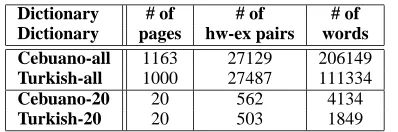
Dictionary # of # of # of
Dictionary pages hw-ex pairs words Cebuano-all 1163 27129 206149 Turkish-all 1000 27487 111334
Cebuano-20 20 562 4134
Turkish-20 20 503 1849
Table 1: Details of Data from Two Dictionaries Used in Experiments
Along with the headword–example of usage pairs from more than 1000 pages, we randomly selected 20 pages for detailed analysis. Table 1 provides
de-tails of the data from two dictionaries we use in our experiments.
Both Cebuano and Turkish are morphologically rich. Cebuano allows prefixes, suffixes, circumfixes, infixes, while Turkish is an agglunative language. The two dictionaries have different characteristics. The example of usages in CebEng are complete sen-tences given in italic font while TurEng has phrases, idioms, or complete sentences as examples of usages indicated in bold font.
6.2 Protocol
We ran our algorithm first on all of the data and then on a randomly selected 20 pages from each dictio-nary. We manually extracted the affixes from each of the 20 pages. We then evaluated the MIND re-sults with this ground truth. During the evaluation, even if the number of an affix in the ground truth and result are same, if they were extracted from different words, this is counted as an error. We also examined the cause of each error in this data.
We then compare our results from the whole TurEng data with the state-of-the-art Linguistica (Goldsmith, 2001) algorithm. Finally, we used the suffixes extracted by MIND and Linguistica to seg-ment words in a Turkish treebank.
6.3 Analysis
Dict. Affix Sample words
mu- galing/mugaling hik´uh´ık´u/muhik`uh´ık`u C nag- kisdum/nagkisdum kugkugl/nagkugkug E mi- iktin/miiktin k´ırus/mik´arus
B i- kunsuylu/ikunsuylu paz´ıha/ipar´ıha U na- p´ıl/nap´ıl ulatl/na´ulat
A gi- buga/gibuga d´alit/gid´adit N gi-an labuk/gilabukan ´ıkug/giik´ugan O -un gihay/gihayun g´ayung/gay´ungun
-a pisar/pisara sirnpul/simp´ula -ı ad/adı ilac¸/ilaeı
T -i heves/hevesi ilim/ilmi U -a saz/saza sonsuz/sonsuza R -e deniz/denize zmim/mime K -ına etraf/etrafına kolay/kolayına
I -ya hasta/hastaya orta/ortaya S -¨u ¨ust/¨ust¨u zy¨uz/y¨uz¨u H -ini bel/belini zevk/zevkini
-ine derin/derinine ic¸/ic¸ine
Table 3: Sample Affixes Extracted from Two Dictio-naries
Cebuano Turkish Whole dict. 20 pages Whole dict. 20 pages
Total 26106 542 27314 502
Root form 5727 180 18416 345
Prefix (diff. type) 10300 (180) 197 (26) 6 (6) 0 (0)
Suffix (diff. type) 1315 (253) 16 (8) 6983 (447) 128 (59)
Infix (diff. type) 25 (11) 0 (0) 1 (1) 0 (0)
Circumfix (diff. type) 717 (221) 18 (11) 9 (9) 0 (0)
App. Root form 1023 14 103 1
App. Prefix (diff. type) 1697 (116) 23 (9) 8 (8) 1 (1)
App. Suffix (diff. type) 2930 (199) 63 (19) 168 (100) 5 (5) App. Circumfix (diff. type) 1060 (207) 14 (5) 20 (20) 0 (0)
Couldn’t decide 1159 13 765 15
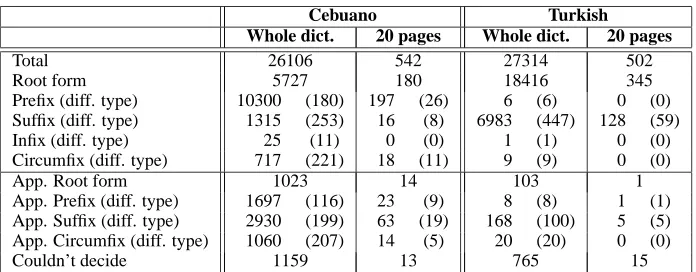
Table 2: Total Number and Different Types of Affixes Extracted from Two Dictionaries Using MIND
affixes (in parenthesis) are presented for two dictio-naries, CebEng and TurEng, and two data sets, the whole dictionary and 20 randomly selected pages. The top part of the table gives the exact match results and the bottom part shows the approximate match results. For Cebuano, approximate match part of the framework finds many more affixes than it does for Turkish. This is due to the different structures in the two dictionaries. We should note that although MIND incorrectly finds a few prefixes, circumfixes, and infixes for Turkish, these all have count one. Table 3 contains some of the most frequent ex-tracted affixes along with their exact and approxi-mate counts, and samples of headword–example of usage word pairs they were extracted from. Each word is segmented into one root and one suffix, therefore when a word takes multiple affixes, they are all treated as a compound affix.
Dictionary GT cnt. Res.cnt. Misses Additions
Cebuano 311 314 17 14
Turkish 155 142 8 10
Table 4: Detailed Analysis of Affixes from 20 Pages
Table 4 shows the number of affixes in ground truth and MIND results along with number of missed and incorrectly added affixes on 20 of these pages of data. MIND only missed 5% of the affixes in the ground truth in both data sets.
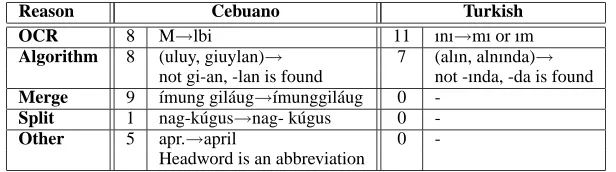
We also examined the causes of each miss and ad-dition. Table 5 presents the causes of errors in the output of MIND with an example for each cause. We should emphasize that a valid affix such as Turkish suffix mı is counted as an error since the suffix -ını should be extracted for that particular headword– example of usage pair. An OCR error such as the
misrecognition of a as d, causes both the miss of the prefix mag- and incorrect addition of mdg- for Ce-buano. There are some cases that cannot be correctly identified by the framework. These usually involve dropping the last vowel because of morphophone-mic rules. For the Cebuano dictionary, merge and split caused several errors, while Turkish data does not have any such errors. Main reason is the differ-ent structure and format of the original dictionaries. In the Cebuano dictionary, an italic font which may result in merge and split is used to indicate example of usages.
For the Cebuano data, five invalid suffixes, three invalid prefixes, and two invalid circumfixes are found, while one valid suffix and one valid circumfix are missed. For the Turkish data, three invalid suf-fixes, one invalid prefix, and two valid suffixes are found while two valid suffix are missed. When we look at the invalid affixes in the data, most of them (six of the Cebuano, and all of the Turkish ones) have count one, and maximum count in an invalid affix is five. Therefore, if we use a low threshold, we can eliminate many of the invalid affixes.
6.4 Comparison to Linguistica
We compared our system with Linguistica, a pub-licly available unsupervised corpus-based morphol-ogy learner (Goldsmith, 2001). Linguistica induces paradigms in a noise-free corpus, while MIND makes use of string searching algorithms and allows one to deal with noise at the cost of correctness. MIND emphasize segmenting a word into its root and affixes. We trained Linguistica using two dif-ferent data sets from TurEng7: 1) Whole
Reason Cebuano Turkish
OCR 8 M→lbi 11 ını→mı or ım
Algorithm 8 (uluy, giuylan)→ 7 (alın, alnında)→ not gi-an, -lan is found not -ında, -da is found Merge 9 ´ımung gil´aug→´ımunggil´aug 0
-Split 1 nag-k´ugus→nag- k´ugus 0
-Other 5 apr.→april 0
-Headword is an abbreviation
Table 5: The Distribution of the Causes of Errors in 20 Pages with Samples
example of usage sentence pairs, and 2) Headword-candidate example words that our algorithm returns. In the first case (Ling-all), Linguistica uses more data than our algorithm, so to avoid any biases re-sulting from this, we also trained Linguistica using the headword and candidate example word (Ling-cand). We only used the suffixes, since Turkish is a suffix-based language. The evaluation is done by a native speaker.
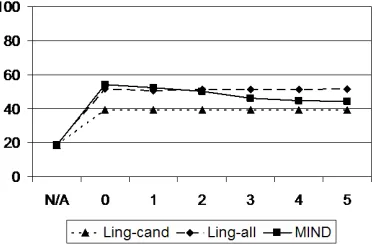
Figure 1 presents the analysis of the suffix lists produced by Linguistica using two sets of training data, and MIND. The suffix lists are composed of suffixes the systems return that have counts more than a threshold. The results are presented for six threshold values for all of the data. We use thresh-olding to decrease the number of invalid affixes caused primarily by the noise in the data. For the MIND results, the suffixes over threshold are the ones that have positive exact counts and total counts (sum of exact and approximate counts) more than the threshold. Although Linguistica is not designed for thresholding, the data we use is noisy, and we explored if suffixes with a corpus count more than a threshold will eliminate invalid suffixes. The ta-ble on the left gives the total number of suffixes, the percentage of suffixes that have a count more than a threshold value, the percentage of invalid suf-fixes, and percentage of missed suffixes that are dis-carded by thresholding for the whole TurEng dictio-nary. The number of affixes MIND finds are much more than that of Linguistica. Furthermore, number of invalid affixes are lower. On the other hand, the number of missed affixes is also higher for MIND since, for this particular data, there are many affixes with counts less than 5. 41% of the affixes have an exact count of 1. The main reason for this is the agglunative nature of Turkish language. The effect of thresholding can also be examined in the graph
for Cebuano.
on the right in Figure1 which gives the percentage of valid suffixes as a function of threshold values. MIND takes advantage of thresholding, and percent-age of valid suffixes rapidly decrease for threshold value 1.
System Th. Total Over Th. Invalid Missed
Ling-cand 0 6 100.00 0.00 0.00
Ling-all 0 4 100.00 0.00 0.00
MIND 0 60 96.67 1.72 0.00
Ling-cand 1 6 66.67 0.00 33.33
Ling-all 1 4 100.00 0.00 0.00
MIND 1 60 41.67 0.00 53.33
Ling-cand 2 6 50.00 0.00 50.00
Ling-all 2 4 75.00 0.00 25.00
MIND 2 60 18.33 0.00 76.67
Table 6: Total Number and Percentage of Over the Threshold, Invalid, and Missed Suffixes Found by Linguistica and MIND for Different Threshold Val-ues for 20 pages of Turkish Data
Table 6 presents the same results for 20 pages from TurEng for three threshold values. MIND per-forms well even with very small data and finds many valid affixes. Linguistica on the other hand finds very few.
6.5 Stemming
System Th. Total % Over Th. % Invalid % Missed
Ling-cand 0 116 100.00 18.10 0.00
Ling-all 0 274 100.00 34.67 0.00
MIND 0 499 89.58 13.20 3.61
Ling-cand 1 116 98.28 17.54 0.86
Ling-all 1 274 94.89 32.69 1.46
MIND 1 499 50.50 4.37 33.07
Ling-cand 2 116 92.24 16.82 5.17
Ling-all 2 274 87.96 31.12 4.74
MIND 2 499 38.48 4.17 44.49
Ling-cand 3 116 91.38 16.98 6.03
Ling-all 3 274 85.40 31.20 6.57
MIND 3 499 28.86 2.78 53.31
Ling-cand 4 116 81.03 12.77 11.21
Ling-all 4 274 81.39 30.94 9.12
MIND 4 499 25.65 3.13 56.51
Ling-cand 5 116 80.17 12.90 12.07
Ling-all 5 274 79.56 31.19 10.58
MIND 5 499 23.25 2.59 58.72
Figure 1: Total Number and Percentage of Over the Threshold, Invalid, Missed and Valid Suffixes Found by Linguistica and MIND for Different Threshold Values
in the dictionary, we repeatedly attempt to find the longest suffix that matches the end ofuf, and check the dictionary again. The process stops when a dic-tionary word is found or when no matching suffixes can be found at the end of the word. If the word the segmenter returns is same asrf in the treebank, we increase the correct count. Otherwise, this case is counted as an error.
In our stemming experiments we used METU-Sabanci Turkish Treebank8, a morphologically and syntactically annotated treebank corpus of 7262 grammatical sentences (Atalay et al., 2003; Oflazer et al., 2003). We skipped the punctuation and mul-tiple parses,9 and ran our word segmentation on 14950 unique words. We also used the headword list extracted from TurEng as the dictionary. Note that, the headword list is not error-free, it has OCR errors. Therefore even if the word segmenter returns the correct root form, it may not be in the dictionary and the word may be stripped further.
The percentage of correctly segmented words are presented in Figure 2. We show results for six threshold values. Suffixes with counts more than the threshold are used in each case. Again for MIND results, we require that the exact match counts are more than zero, and the total of exact match and
ap-8
http://www.ii.metu.edu.tr/ corpus/treebank.html
9Multiple parses are the cases where a suffix is attached not to a single word, but to a group of words. The suffix -ti in takip
etti is attached to takip et.
Figure 2: Percentage of Correctly Segmented Words by Different Systems for Different Threshold Values
by shorter affixes Linguistica finds.
7 Conclusion and Future Work
We presented a framework for morphology induc-tion from noisy data, that is especially useful for lan-guages which have limited electronic data. We use the information in dictionaries, specifically head-word and the corresponding example of usage sen-tences, to acquire affix lists of the language. We pre-sented results on two data sets and demonstrated that our framework successfully finds the prefixes, suf-fixes, circumsuf-fixes, and infixes. We also used the ac-quired suffix list from one data set in a simple word segmentation process, and outperformed a state-of-the-art morphology learner using the same amount of training data.
At this point we are only using headword and corresponding example of usage pairs. Dictionaries provide much more information. We plan to make use of other information, such as POS, to categorize the acquired affixes. We will also investigate how using all the words in example of usages and split-ting the compound affixes in agglunative languages can help us to increase the confidence of correct af-fixes, and decrease the number of invalid affixes. Finally we will work on identifying morphophone-mic rules (especially stem-interval vowel shifts and point-of-affixation stem changes).
Acknowledgments
The partial support of this research under contract MDA-9040-2C-0406 is gratefully acknowledged.
References
Nart B. Atalay, Kemal Oflazer, and Bilge Say. 2003. The an-notation process in the Turkish Treebank. In Proceedings of
the EACL Workshop on Linguistically Interpreted Corpora– LINC, Budapest, Hungary, April.
Robert Avery, Serap Bezmez, Anna G. Edmonds, and Mehlika Yaylalı. 1974. Redhouse ˙Ingilizce-T¨urkc¸e S¨ozl¨uk. Red-house Yayınevi.
Marco Baroni, Johannes Matiasek, and Harald Trost. 2002. Unsupervised discovery of morphologically related words based on orthographic and semantic similarity. In
Proceed-ings of the ACL-02 Workshop on Morphological and Phono-logical Learning, pages 48–57.
Michael R. Brent, Sreerama K. Murthy, and Andrew Lundberg. 1995. Discovering morphemic suffixes: A case study in minimum description length induction. In Proceedings of
the 15th Annual Conference of the Cognitive Science Soci-ety, pages 28–36, Hillsdale, NJ.
Michael R. Brent. 1993. Minimal generative models: A mid-dle ground between neurons and triggers. In Proceedings of
the 5th International Workshop on Artificial Intelligence and Statistics, Ft. Laudersdale, FL.
Mathias Creutz and Krista Lagus. 2002. Unsupervised discov-ery of morphemes. In Proceedings of the ACL-02 Workshop
on Morphological and Phonological Learning.
H. Dejean. 1998. Morphemes as necessary concepts for struc-tures: Discovery from untagged corpora. In Workshop on
Paradigms and Grounding in Natural Language Learning,
pages 295–299.
John Goldsmith, Yu Hu, Irina Matveeva, and Colin Sprague. 2005. A heuristic for morpheme discovery based on string edit distance. Technical Report TR-2205-04, Department of Computer Science, University of Chicago.
John Goldsmith. 2001. Unsupervised learning of the mor-phology of a natural language. Computational Linguistics, 27(2):153–198.
Zellig Harris. 1955. From phoneme to morpheme. Language, 31:190–222.
Huanfeng Ma, Burcu Karagol-Ayan, David Doermann, Dou-glas Oard, and Jianqiang Wang. 2003. Parsing and tag-ging of bilingual dictionaries. Traitement Automatique Des
Langues, pages 125–150.
Christian Monson. 2004. A framework for unsupervised nat-ural language morphology induction. In Proceedings of the
Student Research Workshop: ACL 2004, pages 67–72.
Sylvain Neuvel and Sean A. Fulop. 2002. Unsupervised learn-ing of morphology without morphemes. In Proceedlearn-ings of
the ACL-02 Workshop on Morphological and Phonological Learning, pages 31–40.
Kemal Oflazer, Bilge Say, Dilek Hakkani-T¨ur, and G¨okhan T¨ur. 2003. Building a Turkish Treebank. In Anne Abeill´e, edi-tor, Building and Using Parsed Corpora. Kluwer Academic Publishers.
Patrick Schone and Daniel Jurafsky. 2001. Knowledge-free induction of inflectional morphologies. In Second Meeting
of the NAACL, pages 183–191.
Ilya Segalovich. 2003. A fast morphological algorithm with unknown word guessing induced by a dictionary for a web search engine. In Proceedings of MLMTA, Las Vegas, NV. P.H. Sellers. 1980. The theory and computation of
evolution-ary distances: pattern recognition. Journal of Algorithms, 1:359–373.
Matthew G. Snover and Michael R. Brent. 2001. A bayesian model for morpheme and paradigm identification. In
Pro-ceedings of the 39th Annual Meeting of the ACL, pages 482–
490.
Robert A. Wagner and Michael J. Fischer. 1974. The string-to-string correction problem. Journal of the Association for
Computing Machinery, 21(1):168–173.
Richard Wicentowski. 2004. Multilingual noise-robust super-vised morphological analysis using the wordframe model. In Proceedings of the 7th Meeting of the ACL Special
In-terest Group in Computational Phonology, pages 70–77,
Barcelona, Spain.