Constraint-Based Question Answering with Knowledge Graph
Junwei Bao†∗, Nan Duan‡, Zhao Yan], Ming Zhou‡, Tiejun Zhao††Harbin Institute of Technology, Harbin, China ‡Microsoft Research, Beijing, China ]Beihang University, Beijing, China
‡{nanduan, mingzhou}@microsoft.com ][email protected]
Abstract
WebQuestions and SimpleQuestions are two benchmark data-sets commonly used in recent knowledge-based question answering (KBQA) work. Most questions in them are ‘simple’ ques-tions which can be answered based on a single relation in the knowledge base. Such data-sets lack the capability of evaluating KBQA systems on complicated questions. Motivated by this issue, we release a new data-set, namelyComplexQuestions1, aiming to measure the quality of KBQA systems on ‘multi-constraint’ questions which require multiple knowledge base relations to get the answer. Beside, we propose a novel systematic KBQA approach to solve multi-constraint questions. Compared to state-of-the-art methods, our approach not only obtains comparable re-sults on the two existing benchmark data-sets, but also achieves significant improvements on the ComplexQuestions.
1 Introduction
Knowledge-based question answering is a task that aims to answer natural language questions based on existing knowledge bases (KB). In the last decades, large scale knowledge bases, such as Free-base (Bollacker et al., 2008), have been constructed. Based on FreeFree-base, two benchmark data-sets, WebQuestions(Berant et al., 2013) andSimpleQuestions(Bordes et al., 2015) are constructed and used in most of KBQA work (Berant and Liang, 2014; Bordes et al., 2014a; Fader et al., 2014; Yang et al., 2014; Bao et al., 2014; Reddy et al., 2014; Dong et al., 2015; Yih et al., 2015).
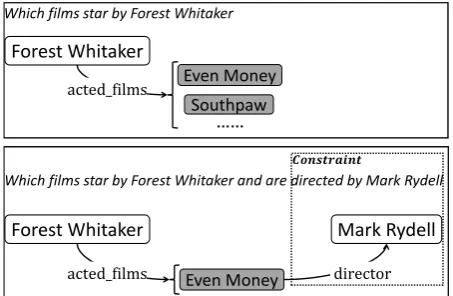
Forest Whitaker Mark Rydell
Even Money
acted_films director
𝑪𝒐𝒏𝒔𝒕𝒓𝒂𝒊𝒏𝒕
Forest Whitaker
acted_films Even Money Southpaw
…… Which films star by Forest Whitaker
[image:1.595.297.524.489.637.2]Which films star by Forest Whitaker and are directed by Mark Rydell
Figure 1: Simple and multi-constraint questions. However, about 85% of questions (Yao,
2015) of WebQuestions and all questions in SimpleQuestions are ‘simple’ questions, where a ‘simple’ question denotes that it can be answered based on a single KB relation. For example in Figure 1, “Which films star by Forest Whitaker” is a simple question that can be answered by the KB triples likehForest Whitaker,acted films,?iwith a single KB relation acted films. This leads
to the fact that such data-sets cannot measure the capability of KBQA systems on ‘multi-constraint’ questions, where ‘multi-‘multi-constraint’ means a question containing multiple semantic constraints expressed with different expressions
to restrict the answer set. To answer a multi-constraint question, we have to base on multiple KB re-lations. For example in Figure 1, “Which films star by Forest Whitaker and are directed by Mark Ry-dell” is a multi-constraint question with a constraint “directed by Mark RyRy-dell”, which requires multiple
∗
This work was finished while the author was visiting Microsoft Research Asia. 1https://github.com/JunweiBao/MulCQA/tree/ComplexQuestions
This work is licensed under a Creative Commons Attribution 4.0 International License. License details: http:// creativecommons.org/licenses/by/4.0/
Constraint Category Example Percentage
Multi-Entity which films star byForest Whitakerand are directed byMark Rydell? 30.6%
Type whichcitydid Bill Clinton born? 38.8%
Explicit Temporal who is the governor of Kentucky2012? 10.4% Implicit Temporal who is the us presidentwhen the Civil War started? 3.5%
Ordinal what is thesecond longestriver in China? 5.1%
[image:2.595.88.513.61.135.2]Aggregation how manychildren does bill gates have? 1.2%
Table 1: Constraint categories, examples, and distributions over a set of web queries. Note, a multi-constraint question may belong to not only one multi-constraint category. And there are still other relatively low frequency type of complex questions existing which we don’t take consideration in this work. So the sum of the Percentage for these constraints are not guaranteed to be 1.
KB tripleshForest Whitaker,acted films,Even MoneyiandhEven Money,director,Mark Rydelli
with two KB relationsacted filmsanddirectorto get the exact answer set.
Motivated by this issue, this work contributes to QA research in the following two aspects: (1) We propose a novel systematic KBQA approach to solve multi-constraint questions by translating amul
ti-constraintquestion (MulCQ) to amulti-constraint querygraph (MulCG); (2) A new QA data-set, name-lyComplexQuestions, is released, aiming to measure the quality of KBQA systems on multi-constraint questions. Compared to state-of-the-art approaches, our method obtains comparable results on the ex-isting benchmark data-sets WebQuestions and SimpleQuestions. Furthermore, we achieve significant improvement on the newly createdComplexQuestionsdata-set.
2 Multi-Constraint Question
2.1 Constraint Classification
A MulCQ is defined as a question which requires multiple KB relations or special operations to get the answer. Based on web query analysis, we classify constraints into 6 categories as follows:
(1)Multi-entity constraint. A question in this category denotes that multiple entities occur in it, which restrict the answer. For example, “Forest Whitaker” and “Mark Rydell” are two entity constraints in the first question in Table 1.
(2)Type constraint. A question in this category denotes that its answer should follow a type, which is explicitly mentioned by the question. For example, the answer to the second question in Table 1 should be a “city” name, instead of locations with other types such as country, town, etc.
(3)Explicit temporal constraint. A question in this category denotes that it contains explicit temporal expressions, such as “2012” in the third question in Table 1. Such questions are very common in web queries, which means handling them well will bring about significant improvements.
(4)Implicit temporal constraint. A question in this category denotes that it contains implicit temporal expressions. For example, “when the Civil War started” denotes an implicit temporal constraint in the fourth question in Table 1. We should transform it into an explicit temporal constraint before answering the question. Such constraints are usually expressed by subordinate clauses.
(5)Ordinal constraint. A question in this category denotes that its answer should be selected from a ranked set, based on ordinal numbers or superlative phrases as ranking criteria. For example, “second longest” in the fifth question in Table 1 denotes that the answer should be the second item in the ranked Chinese river set, based on their lengths.
(6) Aggregation constraint. A question in this category denotes that it asks for the number of a set, which often starts with phrases “how many” or contains “number of”, “count of”, etc.
2.2 Question Selection
We perform the following steps to select suitable multi-constraint question candidates for human anno-tators to label, based on Freebase.
Operation Trigger Description
Equal(y0, y1) N/A ReturnTrueify0is equal toy1, otherwiseFalse
<(y0, y1) “after” or “later then” ReturnTrueify0is smaller thany0, otherwiseFalse
>(y0, y1) “before” or “earlier then” ReturnTrueify0is larger thany0, otherwiseFalse
[image:3.595.82.520.63.135.2]MaxAtN(x, n) Maximize superlatives in WordNet Rank items ofxin descending order, return thenthone MinAtN(x, n) Minimize superlatives in WordNet Rank items ofxin ascending order, return thenthone Count(x) ”how many”, “count of” or “number of” Return the number of entity setx.
Table 2: Functional predicates defined in this work.
query set, which contains 20,999,951 distinct 5W1H questions2 that satisfy the following two rules: (i) each query should not contain pronouns (e.g., ‘you’, ‘my’, etc.), as questions with such words are usually non-factual questions, and (ii) each query’s length is between 7 and 20, as short queries seldom contain multi-constraints, and long queries are usually difficult to answer. Then, we further sample 10 percent of questions, and use an entity linking method (Yang and Chang, 2015) to detect entities. If no entity can be detected from a query, we simply remove it. Next, bothWebQuestionsandSimpleQuestionsare used to extract a set of words, without considering stop words and entity words. If a query does not contain any word in this word set, we simply remove it. This is intuitive, asWebQuestionsandSimpleQuestions are our training data, and we only consider queries that can be covered by the training data as query candidates. Last, we classify the remaining queries based on the following rules:
(1) If a question contains at least two non-overlap entities, then it belongs in the Multi-Entity category; (2) If a question contains a type phrase that comes from Freebase, then it belongs in the Type category; (3) If a question contains a time expression detected by an Named Entity Recognizer (NER) (Finkel et al., 2005), then it belongs in the Explicit Temporal category;
(4) If a question contains keywords “when”, “before”, “after” and “during” in the middle, then it belongs in the Implicit Temporal category;
(5) If a question contains ordinal number or superlative phrase from WordNet (Miller, 1995), then it belongs in the Ordinal category;
(6) If a question starts with “how many”, or includes “number of” or “count of”, then it belongs in the Aggregation category.
Note, a multi-constraint question may contain multiple types of constraints. We show constraint types, examples, and distributions in Table 1. Ten thousand questions from the above 6 categories are selected, according to their distributions. By manually labeling these questions according to Freebase, we obtain 878 multi-constraint question answer pairs.
2.3 Question Annotation
We release theComplexQuestionsdata-set, which consists of 2100 multi-constraint question answer pairs coming from 3 sources:
(1) 596 QA pairs selected fromWebQuestionstraining set, and 326 from the test set, (2) 300 QA pairs released by (Yin et al., 2015),
(3) 878 manually labeled QA pairs based on Section 2.2.
We then split it into two parts: a training set containing 1300 QA pairs and a test set including 800 QA pairs3.
3 Definition
3.1 Knowledge base
Kdenotes a knowledge base4(KB) that stores a set of facts. Each factt∈ Kis a triplehs, p, oi, wherep represents a predicate (e.g.,birthday), ands,o(e.g.,BarackObama,1961) represent an entity or a value,
25W1H questions are ones the start with “what”, “where”, “when”, “who”, “which” or “how”.
3We put QA pairs from the training (testing) set ofWebQuestionsstill in the training (testing) set ofComplexQuestions, and the same for the test part.
which are the subject and object oft.
3.2 Multi-Constraint Query Graph
Before introducing multi-constraint query graph (MulCG), we first define four basic elements:
Vertex There are two types of vertices: constant vertex (rectangle) and variable vertex (circle). A
constant vertex represents a grounded KB entity or a value, such asBarack Obamaor1961. A variable
vertex represents ungrounded entities or unknown values.
Edge There are two types of edges: relational edge and functional edge. A relational edge represents a predicate in the KB, such asbirthday. A functional edge represents a functional predicate of a truth,
such as<in the truthh2000,<,2001i. Functional predicates are defined in Table 2.
Basic Query Graph A basic query graph is defined as a triplehvs, p, voi, wherevsdenotes a constant
vertex as the subject that occurs in a given question,vo(shaded circle) denotes a variable vertex as hidden answers of the question,pdenotes the ‘path’ that linksvsandvoby one or two edges5(e.g.,officials
-holder).
Constraint A constraint is defined as a triplehvs, r, voi, wherevsis a constant vertex,vois a variable
vertex,ris a functional edge, and after instantiation based on a knowledge base, all instantiated entities fromvoshould satisfy the predicate ofrwith regard tovs.
MulCG A MulCG is constructed based on a basic query graph B of a question and an ordered
constraint sequenceC ={C1, ...,CN}by the following operations: (1) Treat the basic query graphBof the given question asG0; (2) Iteratively addCitoGi−1 to generateGi, by linking the variable vertex of Cito a vertex ofGi−1 with some possible path, or directly merge them as one variable vertex. (3) Output
GN.
Given a MulCG of a question, we can execute it based on the KB by instantiating all variable vertices according to the constraints in order. Specifically, we start from the constant vertex in the basic query graph and instantiate all variable vertices according to the constraints in order. During this procedure, each instantiated paired entities connected by an edge should satisfy the predicate of the edge based on Kand commonsense knowledge.
United States President
1
2000
officials
<
MaxAtN
holder Equal
𝐶1
𝐶3
𝐶2
𝑦0
𝑦1 𝑦2
𝑥 𝐵
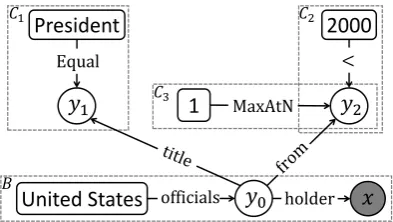
[image:4.595.301.498.448.559.2]Figure 2: MulCG for question “Who was the first president of United States after 2000?”
Figure 2 shows one possible MulCG for the given question. B is a basic query graph with a constant vertexUnited States, variable
vertices y0 and x, and two edges officials
and holder. {C1,C2,C3} is an ordered
con-straint sequence detected based on the ques-tion, whereC1 =hPresident,Equal,y1i,C2 =
h2000,<,y2i, C3 = h1,MaxAtN,y2i. By adding
C1,C2,C3in order, we can construct the MulCG
in Figure 2. Note, different constraint order can result in different MulCGs. We will introduce how to generate a MulCG in Section 4.
Compared to the stage graph in Yih et al. (2015), our MulCG has the following two
dif-ferences: (1) Entity constraints can be added beyond single KB fact, while stage graph only considers entities that connect to the CVT node of a single KB fact as constraints. (2) Non-entity constraints are defined and handled in a systematic way, while stage graph only considers limited non-entity constraints, i.e., type and gender.
4 Our Approach
Problem Formalization Given a MulCQQ and a KBK, the question is parsed into a set of MulCGs
Forest Whitaker
Mark Rydell Film
Equal
star Equal
𝐶1 𝐶2
𝑦1 𝑦2
𝑥 𝐵
𝑦0 film
(a) MulCG with entity and type constraint for question “Which films star by Forest Whitaker and are directed by Mark Rydell”.
United States
President 1861
officials
<
holder Equal
𝐶1 𝐶2
𝑦0
𝑦1 𝑦2
𝑥 𝐵
Civil War start_time 𝑥
𝑆
[image:5.595.100.502.64.210.2](b) MulCG with implicit temporal constraint for question “Who was U.S. president after the Civil War started”.
Figure 3: MulCGs examples for different type of constraints.
ranking score is selected. Finally, by executing the MulCG, we get the answersA.
4.1 Basic Query Graph Generation
We use the entity linking approach proposed by (Yang and Chang, 2015) to detect entities mentioned by the given question. For each detected entitys, we treat it as a subject constant vertex. Based on the KB, for each unique KB ‘path’ froms, where a KB ‘path’ means one hop predicatep0 or two hop
predicatesp1-p26, we construct a basic query graphhs, p0, xiorhs, p1-ycvt-p2, xi.ycvtandxare variable
vertices, andxdenotes the answer. For example, the basic query graphBin Figure 2 can be represented ashUnited States,officials-y0-holder, xi.
To measure the quality of each basic query graph constructed, we leverage a convolutional neural network (CNN)-based model that is similar to (Gao et al., 2015; Shen et al., 2014b; Shen et al., 2014a; Yih et al., 2015) to calculate the similarity between question and the path of the basic query graph. We will describe the training resource in Section 4.4.
4.2 Constraint Detection and Binding
Basic query graph is fit for single relation questions (Yih et al., 2014; Bordes et al., 2015), but not suffices to express a question with multiple constraints, such as the question in Figure 2. Hence, we propose to use constraints to restrict the answer set by adding them into the basic query graph.Adding a constraint contains two steps:Constraint DetectionandConstraint Binding. We explain how to add each of the six kinds of constraints respectively in the following parts.
Entity Constraint Entity constraint is designed to understand entities and relations which are often
expressed by noun phrases and verb phrases. A constraint with an entity as its constant vertex is an entity constraint. For instance, Figure 3(a) is a question with multiple entities such as “Forest Whitaker” and “Mark Rydell”. After the basic query graphG0 = B is generated, we detect a constraintC1 = hMark Rydell,Equal, y1iand bind it to G0 by an edge director. Generally, the two steps to add an entity
constraint are as follows: (1)Constraint Detection: For a detected entity e ∈ E (e.g., Mark Rydell), we construct a constraintCi =he,Equal, yii(e.g.,hMark Rydell,Equal, y1i); (2)Constraint Binding:
Given a MulCGGi−1 (e.g.,B), and a detected constraintCi (e.g.,hMark Rydell,Equal, y1i), we try to
bindCi toGi−1by linking the variable vertex ofCi (e.g.,y1 ofC1) to a vertex ofGi−1 (e.g.,xofB) by
a possible pathp(e.g., director). To measure the similarity between the path p(e.g., director) and
the ‘context pattern’7(e.g., “directed by e1”) of constraintCi, we adopt a convolutional neural network (CNN) model which is described in Section 4.4.
Note, a constraint can be linked to any vertex in the basic query graph. For example, the constraintC1
in Figure 2 is binding to a variable vertexy0. When a constraint is binding to a constant vertex, then it is
usually used for entity disambiguation.
Type Constraint Answer type is often explicitly expressed by nouns in questions. For instance, “film”
is the answer type of the question in Figure 3(a), which denotes a type constraint. (1)Constraint De-tection: Different from an entity constraint, we detect an answer type with simple but efficient rules as Yao and Durme (2014) for the question. For each KB type8, we construct a type constraint (e.g., C2=hFilm, Equal, y2i); (2)Constraint Binding: A type constraint is only added to the variable vertex
which denotes the answers with a specific edgetype.
Explicit Temporal Constraint Temporal constraint is designed to understand temporal expressions,
which are often expressed by numericals, prepositional phrases or clauses. An explicit time expression, such as “after 2000” in the question in Figure 2 indicates a temporal constraintC2. Through linking the
vertexy0 toy2 with a predicatefrom, functional constraintC2 =h2000, <, y2iselects the subset of the
grounded entities fory0 whose taking office time is later than 2000. Generally, the two steps to add
an explicit temporal constraint are as follows: (1)Constraint Detection: We use Stanford NER (Finkel et al., 2005) to detect a time phrase. If a time t(e.g., 2000) is detected, and a functional operationr
(e.g., <) is triggered by a lexicon which is partially listed in Table 2, we then construct a constraint Ci = ht, r, yii (e.g.,C2 = h2000, <, y2i); (2)Constraint Binding: If an explicit temporal constraint Ci (e.g., C2) is detected, then we executeGi−1 (e.g., Bwith C1) on the KB. If there is a KB path p from
grounded entities of the linking vertex (e.g.,y0) inGi−1satisfying the restriction thatp’s object KB type
isDate Time, then the temporal constraintCi is bound toGi−1 by an edge denotingp.
Implicit Temporal Constraint Time expressions such as the clause “after the Civil War started” in
the question in Figure 3(b) can also trigger a temporal constraint, but it is expressed with an implicit temporal adverbial clause. (1)Constraint Detection: A NER can not detect this kind of implicit temporal expressions, so the dependency information is adopted to detect temporal clause starting with predefined keywords9. We first use our system to answer the clause to get an explicit time (e.g., by a MulCGSto get
1861), then the detection falls into the same procedure as an explicit temporal constraint; (2)Constraint
Binding: It is same as an explicit temporal constraint.
Ordinal Constraint An ordinal constraint aims to understand the numerals and superlative forms of
adjectives or adverbs. For example, the question in Figure 2 contains an expression “first” which denotes that an ordinal constraintC3should be added to graphG2(Bwith constraintsC1andC2). After executing
G2, we rank the grounded values of vertexy2 and pick up the1st one by functional operationMaxAtN.
Generally, two steps are adopted to add an ordinal constraint: (1)Constraint Detection: We use a man-ually collected ordinal number list and superlative vocabulary from WordNet (Miller, 1995) to detect an ordinal numbern(e.g.,1) and a functional operationop(e.g.,MaxAtNorMinAtN) to construct an ordinal
constraintCi=hn, op, yii; (2)Constraint Binding: If an edgep(e.g., from) linking a vertex ofGi−1(e.g.,
y0ofG2) to the variable vertex of a constraintCi(e.g.,y210ofC3) satisfies the restriction that the object
entity of the predicate ofpis a numerical or time value, and the word embedding similarity between the superlative word and the binding path’s last word is the largest, thenCi is bound to Gi−1 with edge p
(e.g.,C3is bound toG2withfrom).
Aggregation Constraint An aggregation constraint is added when the question starts with phrase “how
many”, or contains “number of”, “count of”. For instance, the phrase “how many” in the question “how many children does bill gates have” trigger an aggregation constraint. We treat it specially by counting the number of the grounded entities of the answer vertex.
4.3 Search Space Generation
8A KB type is the type of an entity in the KB, such asPeople,Film. We extract entire KB types from Freebase. 9Such as “when”,“before”,“after”,“during”,etc.
10Note, since the linking edges forC
Algorithm 1:MulCG Generation
1 H(Q) =∅; 2 T =∅;
3 E=EntityLinking(Q); 4 foreachs∈ Edo
5 Gb=BasicQueryGraphGenration(s,K); 6 foreachgb∈ Gbdo
7 insertgbtoT; 8 insertgbtoH(Q);
9 end
10 end
11 foreachgb∈ T do
12 C=ConstraintDetection(gb,E,Q,K); 13 foreachI ∈P ermutation(C)do 14 gc=gb;
15 fori= 0to|I| −1do
16 gc=ConstraintBinding(gc,CIi);
17 end
18 insertgctoH(Q);
19 end
20 end
21 returnH(Q).
Given a MulCGQ, Algorithm 1 explains how to generate the search spaceH(Q). Firstly, we set H(Q) and a temp set T empty. A set of enti-tiesE are detected by entity linking component which takesQ as input. Secondly, for each en-titye∈ E, we generate all possible basic query graphsGbbased on the knowledge baseK. Each basic query graph gb ∈ Gb is added into both T andH(Q). Then, for each basic query graph gb ∈ T, based onQ,E,K, a set of constraintsC are detected through constraint detection com-ponent. Function P ermutation(C) returns all possible index sequences of permutations ofC. For each index sequenceI ∈P ermutation(C), constraints are bound recurrently. For each con-straintCIi, we try to bind CIi into a temporary
MulCGgc. Finally, a set of MulCG candidates H(Q)is generated.
4.4 Features and Ranking
|V| |V| |V| |V|
1000 1000 1000 1000
< 𝑆 > 𝑤1 𝑤𝑛 < 𝐸 >
One hot layer: Word embedding layer:
… … 1000 |V| 1000 𝑤2
1000 … 1000
max
max max
1000 1000
Convolutional layer: Max pooling operation: Max pooling layer: Semantic layer: Cosine Similarity operation: … 1 Similarity layer:
|V| |V| |V| |V|
1000 1000 1000 1000
< 𝑆 > 𝑤1′ 𝑤𝑚′ < 𝐸 >
… …
1000
|V| 1000
𝑤2′
1000 … 1000
[image:7.595.82.523.339.549.2]max max max 1000 1000 … … … Left Right
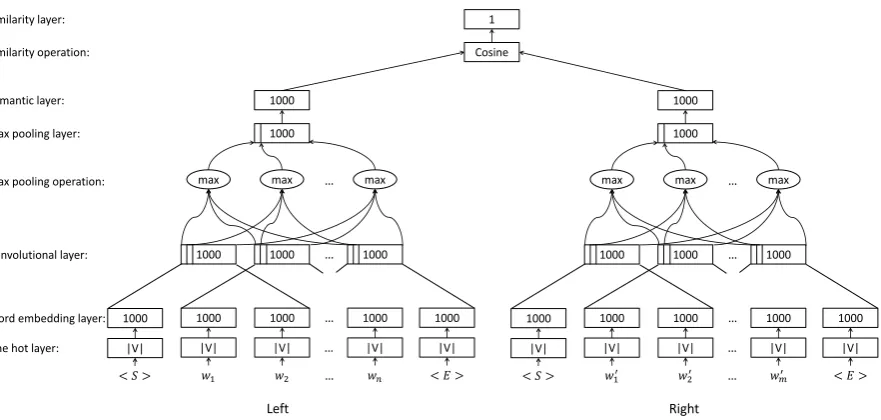
Figure 4: Siamese Convolutional Neural Network
In this work, we propose using Siamese convolutional neural networks (CNN) in Figure 4 to calculate the similarity of two sequences. The model consists of two neural networks taking two sequences as input and maps both of them to k-dimensional vectors. Similar models, such as CDSSM (Shen et al., 2014b; Gao et al., 2015) has been proved for web search. Besides, Yih et al. (2015) use similar frameworks for semantic parsing and question answering. This continuous space representation approach has shown better results compared to lexical matching approaches (e.g., word-alignment models).
vector. With a multi-layer perceptron (MLP) to map the max pooling layer to a semantic layer, we get HlandHr as the distributed representation of the left and right side. Finally, the semantic similarity is computed ascosine(Hl,Hr). To conclude, this model can be defined asSim(Sl,Sr).
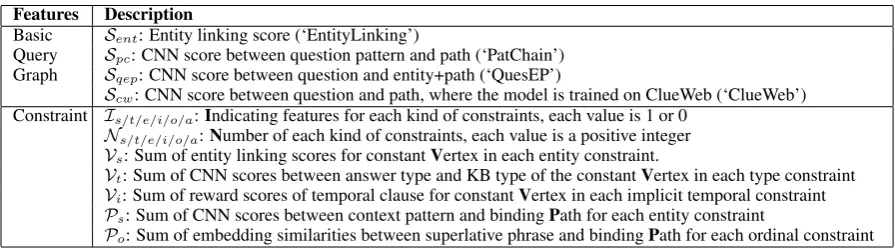
Based on the CNN model described above, we design four features in Table 3 for the basic query graph, and four types of features for each kind of constraints, namely indicating featuresIs/t/e/i/o/a, count fea-turesNs/t/e/i/o/a, constraint detection featuresVs/t/e/i/o/aand constraint binding featuresPs/t/e/i/o/a. Given a MulCQ Q and a MulCG candidate Gi ∈ H(Q) , Fk(Q,Gi) represents the kth feature of hQ,Gii. A liner scoring function is adopted to calculate the reward score of each hQ,Gii as Score(Q,Gi) = Pkλk· Fk(Q,Gi). A learning to rank method lambda-rank (Burges, 2010) is used to learn the each feature weightλk.
Features Description
Basic Sent: Entity linking score (‘EntityLinking’)
Query Spc: CNN score between question pattern and path (‘PatChain’) Graph Sqep: CNN score between question and entity+path (‘QuesEP’)
Scw: CNN score between question and path, where the model is trained on ClueWeb (‘ClueWeb’) Constraint Is/t/e/i/o/a:Indicating features for each kind of constraints, each value is 1 or 0
Ns/t/e/i/o/a:Number of each kind of constraints, each value is a positive integer
Vs: Sum of entity linking scores for constantVertex in each entity constraint.
Vt: Sum of CNN scores between answer type and KB type of the constantVertex in each type constraint
Vi: Sum of reward scores of temporal clause for constantVertex in each implicit temporal constraint
Ps: Sum of CNN scores between context pattern and bindingPath for each entity constraint
[image:8.595.75.523.215.340.2]Po: Sum of embedding similarities between superlative phrase and bindingPath for each ordinal constraint
Table 3: Features and their description.
5 Experiment
We introduce experiment part on these aspects. We first introduce the settings of our experiments, es-pecially the three data sets containing question/answer (QA) pairs. On these data sets, the results of our method are given, and based on the results we analyze drawbacks.
5.1 Set Up
System Components We use the entire Freebase dump which is same as Berant et al. (2013) and host
it with Virtuoso engine11. Besides, an entity linker (Yang and Chang, 2015), the Stanford NER (Finkel et al., 2005), and an in-house implementation of shift-reduce dependency parser (Zhang and Nivre, 2011) with Stanford dependency (De Marneffe et al., 2006) which is used in detecting temporal clause are adopted in this work.
Data Sets We evaluate our approach on three data sets.
(i) ComplexQuestions(CompQ): It is a new data set which includes 2100 QA pairs released by this work with the details in Section 2.
(ii) WebQuestions (WebQ): It contains 3778 QA pairs on training set and 2032 on test set which is released by Berant et al. (2013). The questions are collected from query log and the answers are manually labeled based on Freebase.
(iii)SimpleQuestions(SimpQ): Each question inSimpleQuestionsis written by a human with reference to a knowledge base triple.
CNN Training Data To train a CNN model, we first use our systemS0to enumerate all possible basic
query graphs for each question, and pick up the ones with theF1 score larger then 0. We then get a set
of question-path pairs to train the initial CNN models. Then we use these CNN models to train a system S1. GivenS1, we use it to answer each question to get all MulCGs and pick up the ones with the F1
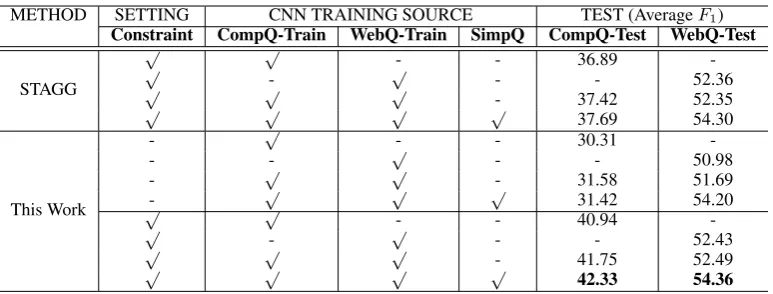
METHOD SETTING CNN TRAINING SOURCE TEST (AverageF1)
Constraint CompQ-Train WebQ-Train SimpQ CompQ-Test WebQ-Test
STAGG
√ √
- - 36.89
-√
- √ - - 52.36
√ √ √
- 37.42 52.35
√ √ √ √
37.69 54.30
This Work
- √ - - 30.31
-- - √ - - 50.98
- √ √ - 31.58 51.69
- √ √ √ 31.42 54.20
√ √ - - 40.94
-√ - √ - - 52.43
√ √ √
- 41.75 52.49
√ √ √ √
[image:9.595.107.494.60.207.2]42.33 54.36
Table 4: Average F1 score on CompQ-Test and WebQ-Test which stand for the test sets of
Com-plexQuestionsandWebQuestionsrespectively. CompQ-Train,WebQ-Trainstand for the training sets ofComplexQuestionsandWebQuestionsrespectively, andSimpQrepresents theSimpleQuestions.
Con-straintmeans whether to add constraints or not.
5.2 Results and Analysis
We re-implement STAGG method (Yih et al., 2015) as our baseline. STAGG method considers some constraints, such as entity constraint on CVT vertex, type constraint and ordinal constraint triggered by “first” and “oldest”. To evaluate our method compared to the baseline on different settings, we design experiments shown in Table 4. The results show that our method outperforms the baseline on the test set ofComplexQuestionsand have comparable result on the test set ofWebQuestions.
Specifically, the Constraint column in Table 4 indicates using constraints or not. Through these settings, we can see how important the constraints are for answering multi-constraint questions. Besides, SpcandSqep are in-domain features that the CNN models they relay on vary from the training data. So we train different CNN models forSpcandSqepon different combinations of training resource. By these settings, we can know how does the amount of CNN training data effect on the results.
5.2.1 Results onComplexQuestions
Table 4 shows that, when using the same CNN training sources, our method outperforms the STAGG method about4.35±0.30points (40.94-36.89, 41.75-37.42 and 42.33-37.69) onComplexQuestions. This result indicates that our systematic constraint solving method is more suitable for answering questions with multiple constraints than the baseline. Besides, adding constraints can bring about10.54±0.37 points’ (40.94-30.31, 41.75-31.58 and 42.33-31.42) gain on ComplexQuestions which tells that con-straints as an important feature can help to bring a significant improvement for multi-constraint ques-tions. Since the training set ofComplexQuestions contains a relative small size of QA pairs (1300), we addWebQuestionsandSimpleQuestionsto enlarge the CNN training data. So another improvement is gained from adding new CNN training resource. STAGG achieves a 0.8 points’ gain, our method improves with 1.39 and 1.11 points with or without constraint respectively.
5.2.2 Results onWebQuestionsandSimpleQuestions
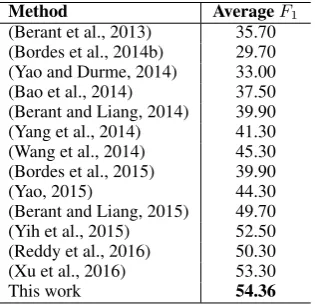
We also evaluate our method on the test setWebQuestions. From Table 4 we can see that, our method has comparable results with STAGG by comparing 52.43 to 52.3612, 52.49 to 52.35, and 54.36 to 54.30. This indicates that adding constraints can get a small improvement on theWebQuestionsbecause most of the questions in theWebQuestionsare simple questions, each of which can be solved by a single KB relation. So adding more CNN training resource bring about 1.93 (54.36-52.43) point improvement for our method. Table 5 also shows the results of recent work onWebQuestions, and this work outperforms the others.
11http://virtuoso.openlinksw.com/
12We get a similar result with Yih (2015)’s 52.50F
Besides, the result also shows that our system performs stable, which not only works well on multi-constraint questions, but also simple questions. To further prove the stability of our system, we al-so test on the test set of SimpleQuestions, by using a dictionary based entity linker, our method achieves 72.78 on accuracy. This is because all the SimpleQuestions are single relation questions.
Method AverageF1
(Berant et al., 2013) 35.70 (Bordes et al., 2014b) 29.70 (Yao and Durme, 2014) 33.00 (Bao et al., 2014) 37.50 (Berant and Liang, 2014) 39.90 (Yang et al., 2014) 41.30 (Wang et al., 2014) 45.30 (Bordes et al., 2015) 39.90
(Yao, 2015) 44.30
(Berant and Liang, 2015) 49.70 (Yih et al., 2015) 52.50 (Reddy et al., 2016) 50.30 (Xu et al., 2016) 53.30
[image:10.595.369.527.132.284.2]This work 54.36
Table 5: QA result onWebQ. 6 Related Work and Discussion
Knowledge-based question answering (KBQA) works with lex-ical features (Yao, 2015) or convolutional neural network fea-tures (Yih et al., 2015) already achieve good results on single relation questions. WebQuestions(Berant et al., 2013) and Sim-pleQuestions(Bordes et al., 2015) are two data sets for KBQA task. Based on our analysis, more than 84% and almost all ques-tions inWebQuestionsandSimpleQuestions are single relation questions.
Previous KBQA work (Yao and Durme, 2014; Bordes et al., 2014a; Yang et al., 2014; Fader et al., 2014; Reddy et al., 2014; Dong et al., 2015; Bordes et al., 2015) testing on these two data sets do not solve multiple constraints systematically. Different methods such as specificbridgingoperator (Berant et al., 2013),
semantic templatep.(p1.e1up2.e2)(Berant and Liang, 2014) are used to treat questions with multiple entities specially. Yih et al. (2015) have already done some work to handle questions with constraints, such as considering entity constraints on CVT vertice or ordinal constraints triggered by “first” or “old-est”. But these methods haven’t specifically evaluated their KBQA systems or presented solutions to multi-constraint questions in a systematic manner.
We propose a novel method to answer questions with multi-constraints by multiple-constraint query graphs. By evaluating it on theComplexQuestionsreleased by this work, we find our method works well on multi-constraint questions.
7 Conclusion
We release a QA data-setComplexQuestionswhich contains multi-constraint questions, and propose a novel systematic KBQA method using multi-constraint query graph to answer multi-constraint questions. Experiments show that, compared to state-of-the-art approaches, our method obtains comparable results on the existing benchmark data-setsWebQuestionsandSimpleQuestions. Furthermore, we achieve sig-nificant improvement on the newly created ComplexQuestions data-set. Besides, we put learning the matching between constraint expressions and semantic constraints from massive data in future work.
References
Junwei Bao, Nan Duan, Ming Zhou, and Tiejun Zhao. 2014. Knowledge-based question answering as machine translation. InProceedings of the 52nd Annual Meeting of the Association for Computational Linguistics
(Vol-ume 1: Long Papers), pages 967–976, Baltimore, Maryland, June. Association for Computational Linguistics.
Jonathan Berant and Percy Liang. 2014. Semantic parsing via paraphrasing. InProceedings of the 52nd Annual Meeting of the Association for Computational Linguistics, ACL 2014, June 22-27, 2014, Baltimore, MD, USA,
Volume 1: Long Papers, pages 1415–1425.
Jonathan Berant and Percy Liang. 2015. Imitation learning of agenda-based semantic parsers.Transactions of the Association for Computational Linguistics, 3:545–558.
Kurt Bollacker, Colin Evans, Praveen Paritosh, Tim Sturge, and Jamie Taylor. 2008. Freebase: a collaboratively created graph database for structuring human knowledge. InProceedings of the 2008 ACM SIGMOD
interna-tional conference on Management of data, pages 1247–1250. ACM.
Antoine Bordes, Sumit Chopra, and Jason Weston. 2014a. Question answering with subgraph embeddings. In
Proceedings of the 2014 Conference on Empirical Methods in Natural Language Processing, EMNLP 2014,
October 25-29, 2014, Doha, Qatar, A meeting of SIGDAT, a Special Interest Group of the ACL, pages 615–620.
Antoine Bordes, Jason Weston, and Nicolas Usunier. 2014b. Open question answering with weakly supervised embedding models. InMachine Learning and Knowledge Discovery in Databases, pages 165–180. Springer. Antoine Bordes, Nicolas Usunier, Sumit Chopra, and Jason Weston. 2015. Large-scale simple question answering
with memory networks. arXiv preprint arXiv:1506.02075.
Christopher JC Burges. 2010. From ranknet to lambdarank to lambdamart: An overview. Learning, 11:23–581. Marie-Catherine De Marneffe, Bill MacCartney, Christopher D Manning, et al. 2006. Generating typed
depen-dency parses from phrase structure parses. InProceedings of LREC, volume 6, pages 449–454.
Li Dong, Furu Wei, Ming Zhou, and Ke Xu. 2015. Question answering over freebase with multi-column con-volutional neural networks. InProceedings of the 53rd Annual Meeting of the Association for Computational Linguistics and the 7th International Joint Conference on Natural Language Processing (Volume 1: Long Pa-pers), pages 260–269, Beijing, China, July. Association for Computational Linguistics.
Anthony Fader, Luke Zettlemoyer, and Oren Etzioni. 2014. Open question answering over curated and extracted knowledge bases. InProceedings of the 20th ACM SIGKDD international conference on Knowledge discovery
and data mining, pages 1156–1165. ACM.
Jenny Rose Finkel, Trond Grenager, and Christopher Manning. 2005. Incorporating non-local information into information extraction systems by gibbs sampling. InProceedings of the 43rd Annual Meeting on Association for Computational Linguistics, pages 363–370. Association for Computational Linguistics.
Jianfeng Gao, Li Deng, Michael Gamon, Xiaodong He, and Patrick Pantel. 2015. Modeling interestingness with deep neural networks, December 17. US Patent 20,150,363,688.
George A Miller. 1995. Wordnet: a lexical database for english. Communications of the ACM, 38(11):39–41. Siva Reddy, Mirella Lapata, and Mark Steedman. 2014. Large-scale semantic parsing without question-answer
pairs. Transactions of the Association for Computational Linguistics, 2:377–392.
Siva Reddy, Oscar T¨ackstr¨om, Michael Collins, Tom Kwiatkowski, Dipanjan Das, Mark Steedman, and Mirella Lapata. 2016. Transforming dependency structures to logical forms for semantic parsing. Transactions of the Association for Computational Linguistics, 4:127–140.
Yelong Shen, Xiaodong He, Jianfeng Gao, Li Deng, and Gr´egoire Mesnil. 2014a. A latent semantic model with convolutional-pooling structure for information retrieval. InProceedings of the 23rd ACM International
Conference on Conference on Information and Knowledge Management, pages 101–110. ACM.
Yelong Shen, Xiaodong He, Jianfeng Gao, Li Deng, and Gr´egoire Mesnil. 2014b. Learning semantic representa-tions using convolutional neural networks for web search. InProceedings of the companion publication of the
23rd international conference on World wide web companion, pages 373–374. International World Wide Web
Conferences Steering Committee.
Zhenghao Wang, Shengquan Yan, Huaming Wang, and Xuedong Huang. 2014. An overview of microsoft deep qa system on stanford webquestions benchmark. Technical report, Technical report, Microsoft Research.
Kun Xu, Siva Reddy, Yansong Feng, Songfang Huang, and Dongyan Zhao. 2016. Question answering on freebase via relation extraction and textual evidence. InProceedings of the 54th Annual Meeting of the Association for
Computational Linguistics (Volume 1: Long Papers), pages 2326–2336, Berlin, Germany, August. Association
for Computational Linguistics.
Yi Yang and Ming-Wei Chang. 2015. S-mart: Novel tree-based structured learning algorithms applied to tweet entity linking.
Xuchen Yao and Benjamin Van Durme. 2014. Information extraction over structured data: Question answering with freebase. InProceedings of the 52nd Annual Meeting of the Association for Computational Linguistics,
ACL 2014, June 22-27, 2014, Baltimore, MD, USA, Volume 1: Long Papers, pages 956–966.
Xuchen Yao. 2015. Lean question answering over freebase from scratch. InProceedings of NAACL-HLT, pages 66–70.
Wen-tau Yih, Xiaodong He, and Christopher Meek. 2014. Semantic parsing for single-relation question answer-ing. InACL (2), pages 643–648. Citeseer.
Wen-tau Yih, Ming-Wei Chang, Xiaodong He, and Jianfeng Gao. 2015. Semantic parsing via staged query graph generation: Question answering with knowledge base. In Proceedings of the 53rd Annual Meeting of the Association for Computational Linguistics and the 7th International Joint Conference on Natural Language
Processing (Volume 1: Long Papers), pages 1321–1331, Beijing, China, July. Association for Computational
Linguistics.
Pengcheng Yin, Nan Duan, Ben Kao, Junwei Bao, and Ming Zhou. 2015. Answering questions with complex semantic constraints on open knowledge bases. InProceedings of the 24th ACM International on Conference
on Information and Knowledge Management, pages 1301–1310. ACM.