T h e C o r r e c t P l a c e o f L e x i c a l S e m a n t i c s
in
I n t e r l i n g u a l M T
l,off LEVIN and Scrgei NIRENBURG
Center fur Machine Translation
C a r n e g i e M e l l o n U n i v e r s i t y P i t l s b u r g h , I'A 1 5 2 1 3 , U . S . A .1. l n t r o d u c t i ( m
Inlerlingual M T has tyl)ically come to incltLde a syntac- tic analysis of source language (SI ,) text followed hy its semm~tic interpretation ~.uld representation in terms of a text meaning representation (TMR) scheme, an interlin- gu,'t. Recently two distinct views of the nattzre of lhe inlerlingua have become current - one based on a worhl model (e.g., Nirenburg et al., 1992) and another one based on the notion of lexieal conceptual structure (LCS) (e.g., Dorr, 1992). In this paper we analyze the role of LCS in the extraction of text memfing and argue that, thotlgh it cannot be considered an interlingua when used by itself, it etmtribtltes signilic+mtly 1o the Sl)eciiication of an ac~ teal interlingua. The task of ;el interlingual MT system btfilder is, then, to lind tt way to integrate the informalion provided in LCS into an ontology-molivaled text mean- ing representation serving as interlingua. In this paper, we propose a model for Ibis integration mid illustrate the pro- cesses and static knowledge sources involved, centrally including tile lexicon.
In Section 2 wc propose a model of M T that involves both an LCS-based lexical semantic slruclure and a 'FMR that is not b:tsed on LCS. Because our lexicon lbrmal- ism does not represent L e S s , but semantic role names that serve ~us labels for LCS variables, we will use Ihe abhreviation SDI+S (for synlax-driven lexical semanlies, Nirenburg grad Levin, 1992) in reference 1o our system instead of LCS. We argue that TMR and SI)LS are both necessary and that they are distinct. This model forms the basis of lexical-semanlic treatment of lexls in the multi- lingual MTl)rojectMikrokosmos. In Seclion 3 we present specific exmnples as analyzed in Mikrokosmos. Wc illus- trate the static knowledge sources (primarily the lexicon) and the representations that are l)roduccd (syntax, lexical semantics, and TMR). The Mikrokosmos model is based on a Iheory of form-to-meaning corrcsl)ondence which relies on the concept of a society of microlheories inle- grated in a noLi-Slratiticational manner. We brielly sketch
the main points of this theory in the [inal SeCliOn of this paper,
2.
The model
Traditionally, intcrlingual MT systems which employ a full-Iflown syntactic module (e.g., KBMT-g9 (Goodman •
~tnd Nircifl)mg, 1992) or K A N T (Carl~onell et al., 1992))
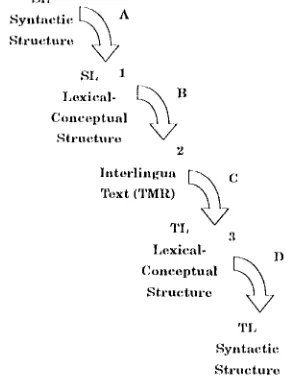
use a single mapping between syntactic structure and in- lerlingua. In Mikrokosmos, we propose a different model, as illustrated in Figure 1. Lexical-cotlcel~lual SlrUCtures (LCSs) have been suggested its meaning represenlalions for n,'ilural language sentences produced in accordance with the semantic theory developed by I lale and Jaekend- o11" (e.g., Jackendoff, 1983) and used in MT-related exper- imenls by Dorr (l)orr, 1993). The inlerlingtmtext (or texl meaning representation, TMR) is a slructt~re which repre- sents meaning of texts in accor(laL~ce with Ihe ontology-
oriented ;.ipl)roach to COml)tllational seitlantit:s (see Ni,cn- burg and Lcvin, 1992).
It is convenient 1() sh-LlCttlre oLlr ,argtHlicLlt for Otis mo(lel arotmd the tmcstions below (refcrrine to labels in Figure 1), which we will discuss one-hy-onc in lhe following subs
Sl,
Syntae|je [ . ~ , ~ A ~t~, l l'U Ct tl t't~
.qL 1 /mxieal- [ . ~ 11 Conceptual
~ 4i-tl,t+t,tni+e
2
lnterlingua ~ N ~ C Text (TMR)
TI, 3
Lexlcal-
(',olieeptuli| ~ l)
~q t'l'uetu t'e , ~
TL ,qynt ae tit'. S,h-uc t ul+e
F i g u r e 1. Data H o w in a KBMT System with 2 Semantic Modules.
I. l l o w similm are structures I and 3? flow are they different?
2. lie)v+, similar are mappings A and D'? Ih),,v are they (lill'crenf.~
3. lh)w is slrtlctlne 2 diffcrenl from slrilCltlres l and 3'? 4. WILy are rel)tesentalions l, 2, .~llld 3 all lleCessary?
2.1. Are L e x i c a I - C o n e e p l u a l S t r u c t u r e s I , : m g u a g e - U n i v e r s a l ?
Attempts have been made to use I+CSs as interlitlgtias for M'I' (notably, Dorr, 1993). The impetus Ibr such work
is provided by obserwttions that in mlmy cases LCSs for translation equivalents are, in fact, identical. The many cases in which LCSs are not identical across lan+
gtmI,es pose prol)lems for this apprt)ach. Methodologi- cally, therefore, tile type o1' work in LCg-as-itlterlingua
projects is tinding ways of resolving e'ich such cane, based on observing cross-linguistic divergences in re- alizing meanings. There is a danger Ihat some of the divergences will prove unlreatable at the LCS level and, alternatively, that solulions for some problems will neces- silale changes I() tile naltH'e of the L'epreseEIlalion which will make the resulting struclurc resemble tile original LCS in progressively smaller ways. The problematic cases will be those in which translation equivalenls can
[image:1.612.334.482.237.427.2]have differerit lexical sem,'mtics. We will inention two snch cases here.
The first problem arises in the context of a complex event, such as a merger of two companies, which can lie described by mentioning ,'my o f its llarts (bids, tie- gotiations, etc.). This is particularly problematic when different langnages, by convention or for ease of expres- sion, refer to dill'ereut parts of the complex event. In fact, snch divergences exist even within one language. For ex- ample, you c:m go to a lneeting (directed motion), attend a meeting (activity), or be at a lneeting (state). Similarly, while in English one takes a taxi, using a mmsitive verb, the
cor,esponding
Japmlese for the stone event it takusi ni noru (get on, board, ride in a taxi), using an intrmlsi- tive verb with a gem argument. Even seemingly atomic events and states can be broken down into their :tspectual components to consist of events leading np to changes of slate that result in new slates. For exgmlple, lhe silu- ation of knowing something can be expressed in English using the stative verb know or in Japanese using a non- stalive verb siru (come to know) in its restlltative Ibznl site iru (Lit: have coine to know). In examples snch as these, there will be no direct correspondence at the level of lexical semantics in individual lmlguages.The second circumstance in which translation eqniva- lents have different lexical selmmtics is that an element of metaling tllat is expressed as :m m'gnment-taking predicale in one l~mguage might not be expressed as an argument- taking predicate in ~mother langnage. Well-knowu ex- amples from MT literature include like vs. germ verlir
de vs. just, etc. However, lhis phenomenon is much
more widespread than normally acknowledged in the MT literature. Things that are expressed as ln:dn or auxil- iary verbs in English, but are not verbs at all in Japanese inchlde m~my high-frequency meaning elements sucli as phase (begin, continue, finish), modality (mt4stlshottld, plan, expect, try), mid evidentiality (seem, appeal; look
like). In fact, thesyntactic means for encoding these types
of megming vary wildly among lmlguages, going far be- yond the well-known verb-adverb divergences. This is why ill the Mikrokosmos intcrlingua we represent snch elements of meaning as features or operators that scope over clauses mid propositions.
2.2. Ilow is an l n t e r l i n g u a Different from an SI)LS Oittput?
In the cases described above in which a sitlgle event is described witll different lexical sem~mtics the meaning shared by each member in the set of paraphrases makes a better c,'mdidale for the interlingu~d semautic represen- tation thml does the lexic~d semantics; and it is lhis type of meaning that we are striving to extract ,'rod represent ill the interlingna text in Mikrokosmos. Additionally, while SDLS concentrales on the "who-did-what-to-whom" as- pect of text meaning, TMRs cont~dn additional meaning facets, such as ,'tspect, modality, evidentiality, speech acl, reference, etc. Finally, as TMRs ~u'e not based on lhe lexic:d semantics of one particular lmlguage, there is no special benetit to be accrued from the imposition of the requirement to preserve predicate-~u'gument stnlctures.
2.3. Universals of Semantic Role Assignment It is very enticing to be able to apply principles of lexi- cal mapping theory cross-lingnistic:dly. Similarities that have been observed across languages inv01ve linkings of
semantic rotes to syntactic positions or gramnialical fnnc- lions, transitivity alternations,and verb el:roses. The latter have been described if+ soln¢ detail for English by B. Levin (1¢)93) ~md others. Thns, to ltte extent flu+l the hypothesis of cross-linguistic equivalence holds, the descriptioli of similar phenomena in other l+mguages, for the pnrposes of M'I, becomes much simpler, it not ntterly trivial.
l lowever, langnages, as :t rn[e, have different transi- tivity altern'ltions (Mitamura 1999) and even when they have a similar transitivity alternalion, the classes of verbs to which they ;tpply may be different. See Mahmoud 1999 for a discussion of the differences in the verbs Ih:lt nndergo the cansative-inchoative altern:ttion in English and Arabic) It is, of course, desirable to take advantage of universals, bill it is also necessary to have a syslem that is tlexible enongh to accommodate cross-linguistic
V,+lriation.
7.4. hliegl+allon of SI)I+S into h i l e r l i n g i l a l M T
Taking a l)osition on the necessity of both SDLS and TMR has to be based on a general approach 1o nnraveling the form-nleaning correspondence. For example, to make a TMR for John began to read we need to identify a nnm- bcr of meaning elements, prilnarily Ihat something look place hefore the time of speech, which was the begin- ning plut,;e of a re<iding evenl carried ont by John. 2 I low do we lind tllese pieces of information? Tinle before the time of speecll is indicated by the mos7Jfiolog j of"began". The beginning phase is typically intlicnled h, xically by the verb begin in English. We know that it is the beginning phase of reading becanse the syntax module tells us thai
to reed is the complement of begin. We know Ihat John is
reading because John is the snbject of begin (once again, the sytllaelic module produced this element of informa- lion), whose lexical properties tell us thai John is also nnderstood as the subject of the complcment clause. In oilier words, it is the predicate argnnienl structure of be- gin (prodnced by the synlax-to-S DLS mapping procedure ill the lexicon entry for begin) Ihat tells ils where to lind
ulany of the relevant pieces o f information.
l laving lhns served the purpose of identifying a part of the selnanlic dependency Io be represeuled in tile linal
TMR (just as the liudings of other syslenl modtnles played their assigned roles as clnes for delermining paris of Ihe TMR strnctnre), Ihe predicate :u'gulnent slnctnre can then be disc:tided. In Ihe l%~llowing seclion we give sonic delailed exanlplcs of Ihe nlappings involved in prodncing SDLS OUllnll strnctures and TMl,ts :ts well :is relevant paris of lexicon erllries.
3. S o m e E x a m p l e s
Examples in Figures 2, 3 and 4 contaiu a ntnnl'~er of rep- resentative phenomena which nnderscore the diflerences between SDLSs aud TMRs :is well ~ts ilhistrale how tile two structures co-exist in the Mikmkosmos processing model. In doing so, we also describe a lexicon design
which accommodates both Stl'nctures. In all three exam- pies the SDLS is jilSi one o f the cities for dclcrtnining a COlilponcnl of nlealling, and is not pre, served is01norphi-
I[l~cidcntally, therefore verb clilsses are nell suilable its sc- lnantio hierarchies fi~r ontology (Mitamura 1989).
. . . .
it COliN also be the I)eglllllllll~ p I se ofa i I citer I'etldlng iII- stesld jtlgl cite instance of reading-- Ihei'e is no way l{i tlelerlnine which in the abSellCe (if coillexl.
cally ill tile TMR. Tile examples also illustrate the use o f constructions (Filhnore et al. 19gg, Filhnore and Kay 1992) as a nnit o f analysis alongside words, and show that treatment o f MT divergences in this apl)roaeh simply falls out o f tile general iltodel. The languages used ior illustration are English, RussimL and Japanese. Since the system is symmelrical, we do not identify which is the source langtlage and which is the target langnage ill each exmnple.
Pot" each example, we list a TMR, which is the s;une for all o f tile l{mguages, as well as synlaclic slruclures, semmltic role ~tssignments (SDLS), and lexicifl entries for each lmlguage. It should be appment that tile TMR is not necessarily isomorphic Io the SDLS o f any of the languages, and that sentences Irom different languages cml correspond to the same T M R even if their syntac- tic ,'uld SDLS representations are not isomorphic. The Mikrokosmos TMR structure consists o f clauses which roughly correspond to the " w h o did what to whont" com- ponent o f meaning but also includes such components as speech acts, speaker altitudes, indices o f the speech situ- alien, slylistic factors its well Its relalions (e.g., temporal titles) allIOtlg amy el + the above, alld other elements.
The lexical enlries include three zones---syntax, se- mantic role ,qssignment, and maPlting to TMR. (The lirsl and third zones are discussed by Meyer et aI. 199 t .) The lirst zone specilies an LFG-style (Bresnan
1982)
syntactic subcategorizalion frame o f a predicate, including which grammatical functions (subject, object, COmlllentcnt, etc.) the predicate mtlst appear with and any requirements the predicate has o f those funclions (case, syntactic calegory, specilic lexical items, etc.). The second zone, also in the spirit of LFG, specilies a mapping belween tile gralnlnal- ical fair,talons governed by it pfcdic.'ttc arRl the sctllatltiC roles it ~.tssigns. Semantic 1olo :kssignmenl is indicated by coindexing o f a sy111actic slol and a semantic role slot. The semantic role munes used in lhe exantples are simply labels lot argument positions in lexical conceptual slrtlc- Itlres, which are not showtl here. The syntax iuld selnallliC role assignlnent Zotles serve+ the pllr[)ose of Iocaling the imporlant participators in the sentence. For example, they might tell us thal the experiencer :u'gLnltcnt is in the SLIbjCCl slot with dative case, or Ihat the phrase functioning as file lheme argument is lound ill the object position. They arc also imporlalll ill capltniltg bolh Inrlgtiagc-specilic gcncr- alizalions about verb classes and universals o f SClllttnlic role ilSs[gnllle[l[. For these leaSOl/S, the syntax and Selllilll- tic role zones are entcial, and therefore ii/tlSl be inch]deal even in cases in which they differ drastically from the TMR.The third zone o f tile lexical entry spccilies portion of T M R that is associated wilh a lexical item and how the componcnls o f the TMR corrcsltond to the compo- nents of the syntactic alld Semanlic role zones. We have chosen examples in which the T M R is not isomorphic to the synlactie and lexical senlantic zones, ill tnost of the examples, a lexical item specilies Ihat title of its cmlt- plemenls heads Ihe associated TMR. Ill these cases, Ihe syntactic head o f the sentence corresponds 1o some kind o f scope-taking operator or a simple feature-vahm pair ill TMR..
The examples, inci(lcnttdly, illustrate our treatment o f MT divergences--situations in which It source langlmgc sentence and its target lmlguage translation differ sig- nilicanlly in synlactic structure, syntaclic category, or
l)ret`licale-argun/ent slrttcltnc. No special mechanisms are needed to lreat MT divergences ill o l n IllO(JCL All lhat is needed in order to translate a sentence involving a divergence are source and target language lexical enlries o f tile sort ilhlstrated here Ihat mall dil]erent synlaCliC strtlcttnes elite lhe S[llllO TMR. "File reitreseltlillions i|lld nlechanisnts shown ill the lexical enhies are tllotivaled lor non-divergelll ex:tnlples and do nol have lo lie IllOdifled to deat with divergent examples. This is because source and larger language sentences :.Ire not normally eXl;Ccled 1o be isomorllhic to tile "FMR or to each other.
Another inlportanI fealuxe of ottr model is that it con- siders constructions to be basic lexical unils ah)ng with words. Following Filhnore el al., 19gg, we deline con- structions as (possibly, discontiguous) synlaclic structure or produclive synlaclic pattern whose meaning it is often impossible to derive solely based on the meanlings o f its components. In other words, a COllSlrtlction is a COlIIbJll,'t- It(lit o f a syl/laCfiC Sll'll(:lln'e :ll/d tile associaled sgln~|n[]c altd pragmatic representations which, once dereliCt`l, tie not have Io lie composiliortally itroduced by a 'I'MP, ex- Iraclof. CotlSlrllCtions are typically ways o f expressing it ilteillling that are CttllvenliOll:ll ill tile sense thai they are I'rozcn, lind t/or synchronically deriwdlle from general prhlciplcs, even il' they once were. Note thltl il Iorlnalisllt Stlch its the I IPSG-IIke siglt of tile dictitlllal+y slrucltlre of tile A C Q U I L E X project can lie nlatle to SUpF, Oft such an idea, its lqlhnore and Kay (1992) show.
4. l ~ e x i c a l S e m a n t i c s in a n ( ) v e r a l l T h e o r y
t f f F o r m - M e a n i n g C o r r e s l m m l e n c e
The MikrokosmcJs project is based on a theory of form- meaning cc, rrcspondcnce, whose underlying assumptions can Im statcd as follows:
• Meanings are exlrac/ed from lexls on lho basis of all and any available clues (e.g., syntactic, mof]/ho- logical, illltl lexical properties of an ilttelance). The exl.la¢liotl o f i|leallir~g consists of collslrtlcling Ihe most platlsible, thollgh usually delbasilile, hyl)othe- sis that is conlpalible with tile evidence, makhlg il an abt`hlctive process (Hobbs, 1991).
• TIlE processing of clues in Mikrokosmos is grouped lille inicrolheorics for clcnlelllS ill' Illearlillg SIICll IIS predicatc-afglllllCllt relaliollS, aspect, lelnporill lel;.l- lions, modality, evidcltliality, etc. Elicit nlicrolhcory spccilics the ways to COllSlrllcI "I'MRs for some :.is- pccl of nlcallhlg by idcnlifying the Val'it/llS SylIIacIiC, morphologic'd, :rod lexical clues Ior Ihal element o f meillling ill individual lallgtlagcs.
• Ill integrating the microtheories, Mikrokc, smos re- jects lhe lnu'e slratilicaliona[ apprcmch shared by such otherwise diverse models its AI NLF' semantics (e.g., l [irsl, 1987)or Mel'~,uk's MTM (e.g., Mel'~uk, 19el). Knowledge from all kinds o f areas coexists in tile stone rules for the determinalion of meaning units.
• The clues (pieces o f evidence) for an element of meaning can interact in complex ways. Cities can reinforce or contradict each t)thel: Coercion is pos- sible in sittlations ill which tile clues conIlicI. Inlcr- prctalion o[ a clue can be dependent on which other lines are pl'cSellI.
e ~
8
v
o . ~
.~.~
a8
r j ~ O0~J• &~
~i
. ~
~ o
~; #
. ~ z ~ ~ ."-:.
o
° .
" 4 ~
~ o o ~
~
° "
i
~ Lo
,,4 , , 4 ~
~ * ~ '~ ~ ~ * "~ ,.z, ~" o ,,.,
Q~
,?,_1 ~ ~ J ' °~o~
b e
'5
~ 8 . : ~
~. o
o~
.,q
u~
~ o
. o o
o ~ '
~ ' o . ~
o " r ~
~ o
e4
° ~ o o
db~
©~ °
~'~
• ,' ~ ,
° ° ¢.1
~
~
.~ ~'~
. . 0 o
~
~a~.~
. °
• ~, [ ~
;2
r ~
o
, Z~ . ~
~ . ~ ~? ~ o . ~
s N
'-G ' ~ u
I::1 1 m
~ . ~ o
~
N S ~
=
~ . , m I=:1
~ .. ~ . ~
N
E
E
~ I~
i~ ~ ~
,1t
• =
~
. ~ .
~ ~ o - ~ . ~ ~.~.~
E
a,~
{ .
~ o
i ~
.~..~
~i
~
~ ~~
~
• !~
8 8~.~
~• ~ ~
s 2 ~.~N
.~ .~
o o _ . ~~ 8"~
~.~ ~ ~ . ~ . ~
• M i k r o k o s n l o s is anlonablo 1o w o r k i n g wilh inconi- l)lole in|i.)rlliatiOli. If IlOl all of lho hlpul condilioiis of lho rules are 1)rosenl, sonlo [inclines will slill be pos- sible, This properly is iniporlanl boCailSO we iilleiid Ill deal with real Io×ls, and we canllol tlol)t~ thai COlil- plote k n o w l e d g e w i l l he available. In the absence of spot(lie knowledge, M i k r o k o s i n o s falls back Oll probabilislic and statistical devices.
• An iilil)O)-lalli lilctor ht the design of lho iliicrolheo- ries is iho, idelllilication o f forms (above the Ioxical level) lhal are associalod with st)me aSl}Ot:l of moan- ing by convention, rathe, r than through conlposilional on-prt)(hlclivo rlllos. We l i / l l o w FilhilorO el al., 1988 in adopting lho conslruclion as a basic, unil o f al)aly-- sis.
lit COllChlSioll, ilOlO how the cxaniplos ill Figilres 2, 3 ~ul(l 4 relalc', It) the al)ovo backgroinld assilniptioils o [ Mikrokosnlos. The o×ainl/les ilhlslrate how SDLS is
i l s e d ~.IS ~1 SOllrUc c)l chios for various inicrolheorios, inohld- ing lhat of Ioxical-soniaillic dopelidenoy, aspect, nio(lalily, speech acts, olc. ]'lie nlajor lhiding of fills paper is lhal T M R s are not idonlical It) SDLS oulptit slruclilros, hill lhai the latlcr are slill nomess~u+y in Ihat they are essential li)r Ilio oxliiiclion t)f lllOaning [roll( a le×l. ]'lie OXalll- pies also ilhistrale the coniillox iillOracli()li o f lhe, wirii)llS cities ( l l o r i g l l c h i 1993). f;or it(sial(co, the Japanese verb
DlOl(lll Call sigiial a reqilOsl-acli()n Sl)oech act but olily f i l l appo~us in a spccilic niorpho-synlactic t~nvirolllnOlll 0ioli- pasl, qiloSlion, Slleakor is subjecl, hearer is second object). In this onvironlnonl, olhor chios lake t)ll Sllocial lileailings. l:or OXalilplo negation and poiOlllialily serve ollly It) st)f toil tile assertiveness of Ihe ieqileSl. C o n v o l l l i t ) l i a l i l y is also ilhislratcd in the abt)vo exalt(pies. M a l l y of the oxaniplcs illuslraic coilslructiolls lhal ai+o associated will) SClnantio alid llragltlalic nioanhlgs I)y coiivolllioll. We leave tllt~ iSSilOS of ll(ill-Slralilicationalily and w o r k i n g ,,villi inconl- plelo hifornialion It)r fllltlro papers which deal priniarily w i l h tile control slrucluro o f M i k r o k o s m o s .
Another iml)Orlanl Ct)lllribilliOn of this paper is to silg- gosl a l i a m o w o r k in which M T divergoliOOS arc lieu(+ died tlsiiig Ollly 1he liiochaniSlilS Ihal are, noodt',(I for liOll- divergent solllences, ( ) u r l h e o r y l}loclicls that divergences will arise bocailSO the SalllO olclli¢lll of tl/Oaliiiig ill dif- forolll lal)gilages will ilOl Ileeossariiy be expressed will) ist)tnorphic synlax, nlo)])hl, flogy, and lexicai itch(S. Tile MikrokoSllli)S T M R and Iho sot of nlicrothoorios for all lho rolOvalll languages naturally liandlo 1he so-called tli+ vorgencos w i t h o u t any addilional lnecli;,inisnls.
i l e f e r e n c e s
[11 Ihesilan, J. 1982. The Menial llepresenialion of (;ra- inalnlical Ilelalions Canlbridge, MA: MIT l'rcss. 121 Carbenell, J,, T. Milannira and F,. Nyborg. I992. ]'lie
KANT MT Project. Ih'()ceedings ol TMI-92. Monheal. [3] l)orr, II. 1993. The Use c)I Lexical Senmntics in Inlerlill- gual Machine Tianslalilm, Machine "l)'anslation, 7:135- 194.
[41 I)orr, II. 1992. Classil]catiut~ t)l" tnachine h'allslalion di- vcrgellces at/el a pU)l)()sod sohlli(lll. (7O,il~Utationa] Lm- guisUcs.
151 (h~odnlan, K. and S. Niienhur1~ (eds.) 1992. KIIIMT-89:
A Case Sillily in Knowledge-llased Maehhle Teans- lalkm. San Mateu: Mmgan Kalllmal(tl.
[61 Fillmore, 11., P. Kay and M.C. ()'ConJifn. 1988. I<teguhu- ity and ldioniaticily it( Oranlll)alical ConslitlcliOllS: the
Case rifLer Alone. Language, 64:501-38.
[7] Filtmclre, C. and I: Kay. 1992. Cmlstrucli{)n Olallllll~l.i. Course Materials. University {)f California at Beikeley. [8] llirst, (3. 1987. Senlantie hlterprelation and Res~lhu-
tiull of Amlfiguity. Cambridge Univcrsfly l'rcss. 19] ttohbs, J. 199 I. hiteiprelatim) as Ahd)lclilm. l'u()ceedings
of ACL-91.
[ 101 1 loriguchi, K. 1993. Extraction {)f t'ragm alic Inli:)rnlati~l n
in a CALL System. NLP 111 Piojecl l~epoI[, Carnegie Melhm l.lniversily.
[11] Jackendoll, R. 1983. Selnantics and C(igniiion. Cam. bridge, MA: MIT h e s s .
[12] Levm, B. 1993. English Verb Classes and AIlernao lions: A Prelilliinary Investigation.Chicago: The [Jni velsily of Chicago l'ress.
[131 [,cvin, L. and S. Nirenburg. 1994 (to appear). Ccmshuctiml-liased MT Lexicons. in M. Palmer, led.)
[ 141 Mahl(ulud, A.T. 1989. A (]llmpan'aiive Study (if Middle alid lncholitive Allernalions in Arable and l,'Aiglish. l'h.I). ])isserhdion. Univelsity of l)itlsburgh.
I151 Malsllliioto, Y. 1992. (in the Wordliolid ()f ,|al)alle,se Complex I~l'eilieales. Ph.I). Dissertatiun, Stanf(ml Uni versiiy.
[161 Mel'~.uk, I.A. 1981. Meaning-Text Models: A Reccnl '['iend in Soviet Linguistics. 7'lie Annual Review of An. thrrq)ology.
[171 Meyer, i., 11. ()nystikevych and L. Carls(m. 1990. Lex- icogial~hic l'linciples and Design for Knowledge-Bascd Machine Transhdiml. CMU CMT Technical Repel( 90 118.
1181 Mitalllura, T. 1989. The llierarchical Orwulizalion (if P)'edielile Fl'allieS for |illerpl'elive Mallpil)14 in Natll- ral Languilge P)'oeessilill. Pti.D. Disseltati()n. {]nivei'+ sily uf l>ittsburgh,
1191 Nirellbmg> S,, J. farbonell, M. qim/ita and K, (J(md I)l<<tl(. 1992, Knowledge-Ilas~d Maehil)e Tralislalhin. ~al( Maleo, CA: M(itgan Ktiill'lllatll).
[201 Nirenbuig, S. and L. Levin. 1992. Syntax-Ill(yen aild Ont(flogy-1)rivcn Lexical Semantics. In J. Pustejovsky and S. [3ergler (eds.) Lexieal Semantics and Kll(iV!.'l- edge Representation. llerlin: Springer-Verlag. t'ages 5-2O.