An Application Model for the Effective Implementation
of a Project Quality Plan
Abdul Hakim Mohammed
1,Mat Naim Abdullah
1and L. Jawahar-Nesan
21Department of Property Management, Faculty of Geoinformation Science & Engineering
Universiti Teknologi Malaysia, 81310 Skudai, Johor, Malaysia
2Department of Construction Engineering, Materials Engineering and Industrial Design, College of Engineering and Applied Sciences,
Western Michigan University, Kalamazoo, Michigan 49008-5064, USA
Abstract
This paper reports the development of an application model for effective implementation of a project quality plan in large construction projects. The model was derived out of a case study undertaken at Kuala Lumpur International Airport (KLIA), a prestigious multibillion dollars project commissioned by the government of Malaysia. The complete history of the ISO implementation in KLIA starting from the inception of the project until its completion was studied through several means including a series of interviews with staff, and archival studies of quality records and voluminous implementation documents. This paper, while initially highlighting the pitfalls observed in the implementation stage and other major problems as identified from the quality records, finally focuses on the application model. Having observed the overall problem background and success and failure stories from the case studies, the application model was developed. The key participants of the KLIA including the Client’s Representative (KLIAB - Kuala Lumpur International Airport Berhad), Quality Consultants, Quality Management Department, and Contractors were involved in the research. The application model is conceptual and it broadly addresses the major issues that are critical to the implementation of the Project Quality Plan (PQP) in large construction projects. It should be seen as an aiding mechanism to improve the quality performance of the construction participants. It must also be noted that the model has been developed from the perspective of the Client (Owner).
Keywords : Quality Management System, ISO 9000, Quality in Construction, Performance Improvement, Owner’s Role in Quality Management
1. Introduction
For the past decade, the Malaysian construction sector has been going through a radical change driven by the (ISO) quality policy of the Malaysian government. Recently, the number of contractors obtaining certification of ISO 9000 Quality Management System (QMS) is ever increasing. This progress seems to be a drastic response to the constant pressure and reminder made by the Ministry of Works and quality awareness and Do It Yourself (DIY) program organised by the Construction Industry Development Board (CIDB). However, with insufficient experience on ISO quality implementation within the Malaysian environment, the construction participants are
staggered with several performance-related problems. As observed by Hock (2000), for instance, poor ISO quality management practices in Public Works in Malaysia have resulted in low productivity, cost overrun, time overrun and poor quality. His study suggested that best practices conducive to the Malaysian construction environment have to be developed so that the present chaotic situation attributed to the ISO implementation in public works could be managed.
countries such as United Kingdom, Singapore and Hong Kong revealed that QMS implementation was very encouraging at the initial stage but over a time period became burdensome to all parties involved if the right approaches were not adopted (Giles, 1997; Chong, 1994; Kam and Tang, 1997; Low and Goh, 1994). In the United Kingdom, some of the construction industry clients made it compulsory that the contractors implement ISO quality system in their organisations to qualify for participating in the bids (Giles, 1997). As a result, a tremendous impact was observed with more and more contractors seeking ISO certification. Consequently, marketing and customers’ insistence have become the key factors driving the ISO implementation, which are generally short-lived (Pateman, 1994). The quality consultants might further worsen the situation as many of them are not from the construction background, hence do not understand the construction process (Giles, 1997). The organisations will normally trap in the vicious circle of compliance that creates lack of flexibility, emphasis on bureaucracy and paperwork and deficiency in quality improvement (Karapetrovic, 1999). In addition, resistance to change in implementing the new system will create a chaotic situation (Al-Nakeeb and Mustapha, 1994). As a result, the implementation of the ISO system will neither earn benefit to the company nor bring satisfaction to the customer.
In order to learn more about this problem, a detailed investigation has become imminent so that the current pressing problems faced by the construction industry relating to the QMS implementation could be identified and the most expedient and effective way of implementing QMS could be developed. With this backdrop, a strong research team, comprised of several leading researchers in Malaysia, studied the ever-great recent Malaysian construction project, KLIA (Kuala Lumpur International Airport), which implemented ISO quality system right from the early period of the project. It had been a great challenge for the KLIA Construction Management Team to implement the ISO quality system in the great project, which involved nearly 150 major contracts with more than 110 major contractors and 1600 interfaces between participants.
2. Construction process according to QMS
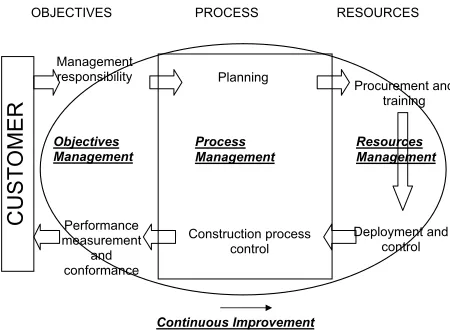
By adopting Karapetrovic’s (1994) quality loop as a reference to suit with the requirements of the elements of the ISO 9000 and to chart the construction activities in a process flow format, the main quality elements in managing the construction project can be said to consist of:
• Management responsibility – the requirement of setting up policy, objectives of the project, the
project organisation with clear responsibilities and authorities and the project quality system documentation by all parties involved in the project according to the contract obligations. It also include the requirement of reviewing the clients’ need, contract drawings, specifications and contract conditions by all parties involved according to the contract document. The outcome of the process will be used to planning the execution of the contract and also to manage by deploying the resources.
• Planning – the requirement to plan for the resources and the construction work such as to provide the work programme, cost programme, project quality plan, labour, material and plant programmes, construction method statement, inspection and test plan and audit plan which all are based on the output of the management responsibility process. The results of the planning process will become the main reference for construction process control and conformance and performance measurement processes.
• Resources management – the requirement to procure, deploy and control the resource such as construction personnel, subcontractors and suppliers or in specific the labour, materials and machinery according to the plan and the project requirements. It also includes the enablers such as appropriate facilities and infrastructure and the requirement to administer the project information and documentation such as the drawings, specification, instructions, method statements, project quality plan, inspection and testing plan and correspondences. Provision for training the labour and construction personnel in any aspect that could enhance their knowledge and capabilities shall also be included. The results of the process will ensure the construction process to be executed smoothly.
• Conformance and performance measurement – the requirement to inspect and test the materials, machinery and workmanship of the construction works according to the inspection and testing plan, to monitor the construction progress through daily, weekly or monthly site meeting and submission of the progress report, the cash flow in and out through the monthly site evaluation, to monitor the performance of the parties against the PQP through the quality audit that should be based on the audit plan. The outcomes of the process will be reviewed by the project management team to evaluate the achievement of the quality objectives of the project, consequently to make necessary improvement (if any) to the implementation of the QMS.
The compatibility of the above elements of the construction process with ISO 9000 Quality Loop can be seen from Figure 1.
The above elements are important for developing a project quality system or PQP for construction project. Therefore the elements and their descriptions are adopted as the propositions of the research. According to Yin (1994) and Simister (1994) the propositions will narrow down the process of investigating relevant information for the research question and guide the investigator to collect the data that relevant to the objectives of the research only.
3. Objectives
The objectives of this study are as follows:
(a) To identify the problems faced by the parties in the implementation process, and
(b) To develop the Project Quality Plan application
model that takes into account both the elimination of all those problems and quality performance improvement.
4. Methodology
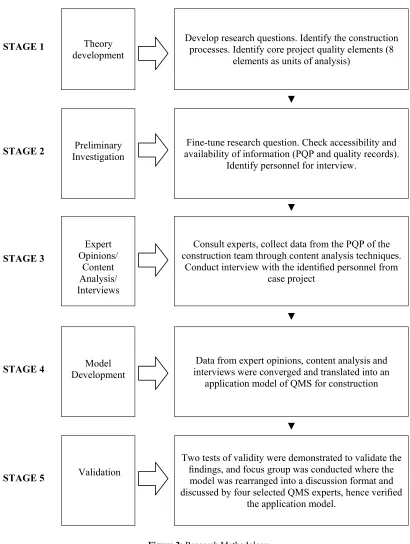
The methodology adopted in this project is divided into five stages that are theory development; preliminary investigation; Expert opinions, Content Analysis and interviews; model development; and validation. The discussion on the research methodology is summarised in the Figure 2. Each of these stages is described below.
Stage one: Theory development
Various literatures relating to QMS implementation and their applications to manufacturing, education, information technology and construction environments were reviewed. The review had identified two objectives of the research which were developed into the form of research questions that have been discussed before. The theory, upon which the case study investigation was to be established, was also established from the review. This theory development also signified the propositions for the case study. Propositions relating to the research questions are very important to narrow down the process of investigating relevant information for the question (Yin, 1994; Simister, 1994). Without such propositions, an investigator might tempt to collect everything that might not relevant to the objectives of the research.The propositions of the research were discussed in the Section on Construction process according to QMS.
Stage two: Preliminary investigation
The preparation for case study is important to ensure subsequent activities of the method are executed effectively and efficiently. This stage is named as a preliminary investigation on the case project. This stage dealt with familiarising the researched case, observing the working environment and building relationship with the project personnel. A series of visit to the case project was performed in the early year 2000. The main objectives were to explore the possibilities of doing research on the subject and to refine the area of concerns. This had enabled the researcher to decide on the specific area to be studied in tandem with the accessibility and availability of the required information, taking into account with the limitation of the existed information. For instance, the sources of data collection were limited to interview and archival technique i.e. content analysis of the quality records as the case project was physically completed and at the final stage of handing over.
Stage three: Expert Opinions, Content Analysis and Interviews
Before conducting the case study, expert opinions were consulted on the validity of the unit of analysis. Four experts in QMS in construction were contacted and a set of questionnaire was sent to them. Two objectives were expected to be achieved from the questionnaire that are to validate the theoretical elements (unit of analysis) of the QMS for construction derived from the literature review and to seek their agreement to be interviewed. The preliminary investigation implied the possibility of using multiple sources of evidence of documentation and interviews. The documents available and accessible from the case (KLIA project) were PQP of the Project Manager, the consultants and the contractors and the audit reports. Most of the documents in the office of the KLIA Berhad (KLIAB), the Project Manager of the KLIA project were treated as confidential and were not allowed to be taken out. Due to this reason the researchers had to make ten series of a day visit throughout the research period to KLIAB office to gather the information and to conduct the interview. Interview time was set at approximately two hours. Information was recorded by both note taking and tape recording. This had enabled the researcher to refer to the data in same detail, so that everything that was discussed could be fully understood.
Stage 4: Model Development
Three types of modelling techniques were considered that are System Flow Chart, Data flow diagram (DFD), and IDEF0 (IDEF0 is an abbreviation of ICAM DEFinition). IDEF0 approach was found most appropriate in attempting to model the QMS implementation in an efficiently map processes/activities and their linkages. It is user friendly and easy to understand. It also suitable for modelling efficacy information through its components such as the process, input, output, controls and mechanism (means) to implement the QMS. Thus, the research adopted the IDEF0 modelling technique to develop the QMS application model.
Stage 5: Validation
There are four tests that have been commonly used to establish the quality of any empirical research. Case study is also subjected to these four tests. The four tests are construct validity, internal validity, external validity and reliability. Construct validity dealt with the establishment of a sufficiently operational set of measures and that subjective judgements are used to collect the data. To meet the test of construct validity an investigator must be sure to cover two steps i.e. 1. Select the specific types of changes that are to be studied (in relation to the original objectives of the study) and; 2.
Figure 2: Research Methodology
5. Findings
The findings of this study consist of two parts, that are (a) The problems faced by the parties in the implementation process and (b) The Project Quality Plan application model.
5.1 The problems faced by the parties in the implementation process
The Contractors
The major elements contained in the contractors’ quality plans were;
1. the scope and techniques to execute the work, 2. testing and investigation,
3. provision of qualified personnel,
4. provision of fit for purpose plant and equipment, and
5. documentation of the implementation.
These elements were considered to be the minimum and salient requirements that should be implemented by the contractors. In the initial stage of the construction period, i.e. in 1995, contractors were naïve about the implementation of the QMS. Most of these contractors did not submit their quality plan for KLIAB’s approval although that was clearly indicated in the agreement. Without this key document it was impossible to implement the QMS. Consequently many works were carried out not in accordance with the Contracts and KLIAB’s requirements due to the said quality plan being unavailable. The consultants frequently issued the Non Conformance Requirements (NCR) to the contractors for the failure and non-compliance with the stipulated QMS procedures. For instance, in June 1995, the consultants issued eleven NCRs to the contractors due to their ignorance of the procedures and in November 1995, an average of thirty Notices Of Deviation (NOD) were issued to the respective contractors.
Mainly, the NCR and NOD were issued to the contractors for the following reasons:
1. the contractors did not submit or were late in submitting the quality plan,
2. the works were not in accordance with the specification and KLIAB’s requirements, 3. the records of work were inconsistent with the
work executed on site,
4. non-compliance with the stipulated rules, 5. non-conformance with the quality plan
procedures, and 6. lack of documentation.
By 1996, the contractors were becoming aware of the importance of PQP and started to give attention to its procedures. Most of the contractors had submitted their comprehensive quality plans, and gained approval for the plan from KLIAB although some contractors faced difficulties in materialising the quality requirements into reality. Analysis of the contractors’ performance of this particular year shows that contractors were facing problems with:
1. non-conformance with the quality plan
procedures,
2. the records of work were inconsistent with the work executed on site, and
3. non-compliance with the stipulated specification.
In spite of the inconsistency, the efforts showed by the contractors to fulfil the quality plan’s requirements were regarded as a positive development. The main contributing factor to the improved performance of the contractors was the training offered by the KLIAB. A year later that is in 1997, the contractors’ performance were much better. They began to implement most of the quality plan procedures. There remained however several deficiencies to be remedied such as non-compliance, no documentation on the implementation of certain procedures and a great number of NCRs.
In conclusion, the contractors were continually learning the implementation of the PQP. They were undergoing a change process from the traditional methods of managing their construction works to an efficient and systematic way through the PQP. The contractors could not be blamed solely for the shortcomings as they had no prior experience in implementing the PQP and it is comparatively new as well to the construction industry in Malaysia.
The Consultants
Similar to the contractors, the performance of the consultants was evaluated using the requirements contained in their approved quality plan. The requirements were;
1. checking the contractors’ method statements and testing procedures covering all scope of works under their obligation,
2. checking the contractors’ corrective procedures,
3. conducting audit and instigating other checks of the contractors’ work to ensure the contractors exercise quality control,
4. setting up procedures to determine the conformance of the construction materials to the specification,
5. develop procedures for keeping and controlling records and documents,
6. develop procedures to control and handle substandard works, and
7. develop control system for managing variations in works.
the PQP and had similar difficulties as the contractors in adopting a new system of supervising construction works. The consultants reacted positively however, to improve the situation. In the second half of 1995 they started to fulfil all the requirements by beginning to develop the procedures but as the construction work commenced, a lot of works were done without proper auditing and checking.
Auditing of the contractors’ work was inconsistent, as a result, construction works were not able to be efficiently evaluated to check for the conformance of the specified requirements. Documentation systems were not properly exercised including the critical activities such as procedures for testing materials, which resulted in difficulty in checking the reference and controlling the documents. The shortcomings of the consultants had a negative impact on the total implementation of the PQP.
In conclusion, the capability of the consultants in 1996 was considered poor and the extent of the implementation of the PQP was unsatisfactory. KLIAB as the project manager who was responsible in initiating the PQP had taken a stringent effort to improve the consultants’ level of understanding and awareness of the PQP by giving them regular advice, training and seminars.
In 1997, the working culture of the consultants towards the PQP had changed significantly. Their works were in accordance with their quality plans. Auditing against the contractors’ works was undertaken properly. Despite the outstanding performance, there were some minor drawbacks such as poor documentation. Even though these minor drawbacks were negligible but they were fairly important in order to enable the consistent achievement of high quality of works. The key lesson is that it is imperative to train the consultants before they begin supervising the contractors’ works because they are the critical agents to ensure the success of the implementation of the PQP.
The Project Manager (KLIAB)
The main responsibility of the KLIAB was to ensure that the PQP was executed efficiently. As a leader of the project the KLIAB produced its quality manual before the commencement of construction stage. The elements contained in KLIAB’s quality plan were;
1. clear definition of the project, 2. structure of the organisation,
3. the responsibility of each management level, 4. the process involved,
5. necessary resources,
6. implementation procedures, and
7. methods to ensure implementation and project control.
KLIAB had exercised all procedures stated in its quality plan, including documenting processes and procedures, auditing against the consultants, and verifying the audit done by the consultants against the contractors. Several faults, weaknesses and unnecessary procedures had been identified through this process and corrective measures were applied according to the procedures stated in the quality plan. To improve the performance of the parties, the KLIAB conducted training through series of conferences, seminars, workshops and meetings. The purpose of the training was to educate the consultants and the contractors to appreciate the importance of the QMS, to clarify their function and the responsibility, and to guide them towards effective ways of conducting audits. The training given by KLIAB had boosted the level of understanding of the consultants and the contractors of the implementation of the PQP and had changed their working culture.
Notwithstanding the fact that the KLIAB had complied with all the requirements stipulated in its quality plan and had claimed considerable success in implementing their quality plan, there were a few hindrances and shortcomings apparent on its part as well. Through a series of interviews with the managers of KLIAB, it was found that at the initial stage of the implementation of the PQP, the KLIAB staff were so sceptical to comply with the quality plan. However it managed to overcome the situation through the awareness programs. Even though KLIAB had planned for a matrix organisational structure, where, a quality manager should report to the project manager and at the same time to his/her head of department, in practice, it was not achieved. In practice the quality manager reported to his head of department, in turn, the head of department reported to the project manager. In addition, responsibility and decision making authority was not sufficiently delegated to the subordinate organisations, which resulted in slow resolution of even the most minor of problems.
5.2 The Project Quality Plan application model
To over come the above problem and help construction parties to efficiently implement the PQP in construction project, a generic framework of PQP has been developed. The model has been developed after several iterations based on the case study findings and a series of brainstorming sessions conducted with participants from case projects. The IDEF0 system-modelling tool has been used to develop the model.
The application model as shown in Figure 3 shows all relevant elements; where, the process is represented by the box, the factors that are listed at the top of the box are constraints and those at the bottom are mechanisms, those at the left hand side of the box are the input and those emerge out of the box are the outputs. Having this model one can easily understand the complete system and the environment in which it works, respective procedures and respective involvement of the parties. The model shows the complex relationships between the major components of the QMS and their respective inputs, outputs, and control mechanisms. The model together with a set of guidelines forms a framework for the Malaysian construction industry to implement QMS in construction project specifically at the construction stage. The major components of the QMS and their guidelines are presented as follows.
Management Responsibility
Senior management role is key to the success of the QMS implementation. Starting from the establishment of the quality policy and project specific quality plan, right through the implementation including employee training, monitoring and until the final auditing, the management has a greater responsibility without which the success of the programme is quixotic. The key input for this process as stated above shows that at the earlier stage of the project, the management focuses all its efforts in incorporating the customer’s requirements, which is available in many forms including briefing and contractual requirements. This in turn is compared with the capability of the organisation as to whether the organisational resources are capable to undertake the activities to achieve the client’s requirements. The company QMS becomes the key path to achieve the end goal and that throughout the project several coordination meetings are organized by the management to develop plans and solutions, review progress and facilitate the functioning of the whole QMS programme. The key output of this process is project programme and cost programme established in tune with the project quality plan. This together with the other outputs including the service of the management, suggestions and other tangible contributions become input to both the processes
quality planning and resources management.
Guidelines – Management Responsibility
• Capture and define the client’s requirements in order to establish quality policy
• Ensure that all levels of management and staff understand the quality policy
• Cross-refer the procedures within the text of the quality manual
• Define the responsibilities and authority using suitable methods
• Periodically review the quality system and policy whether it fulfils the intended objective
• Management reviews should be documented and the action list formulated must be implemented
• Arrange for and implement training for those who lack proper understanding and skills
Quality Planning
The senior management in conjunction with other parties such as quality consultants hold series of quality meetings to produce suitable quality plan specific to the project. Since it is a project specific plan, the plan should reflect the objective and expectations of that particular project. Therefore, project specific information including project scope, contractual requirement, and resources availability are considered to develop the plan. Experience from the past projects becomes a valuable input to this plan development process. Customer requirement captured at the early stage is translated into quality requirements of that project and it forms key to define quality of the particular project. The development of the plan should simultaneously consider the existing quality standards (e.g. ISO 9000) available in the market. Company quality manuals, contractual specifications, project programme and cost programme all become directives, and within their context, the plan need to be developed. Otherwise, the Project Quality Plan (PQP) may not reflect and be suitable to the project requirements. The key outputs of this process are quality plan, inspection and test plan and audit plan. The content of the PQP not only dictates the quality system required of the project concerned but also it incorporates the scope and expectations of the project and the project control mechanism. The output of this process becomes input for most of the other processes including process control, inspection and testing and
auditing.
Guidelines – Quality planning
• Ensure that all relevant parties including consultants, if any, required are included in the task of quality planning for the project
• Establish and define the purpose of the quality system
• In the plan, minimize the effort required to amend copies of documents
team, as it will give a sense of ownership to the team so that the team can produce an effective plan
• Ensure that the customer requirements are constantly focused throughout the quality planning task
Resources Management
Resources management includes identifying, analysing, deploying and monitoring the resources required to undertake the project activities. Right from the early stage of the project, resources are analysed taking into account the project and cost programme. The company capability becomes a key information that answers many questions such as resources availability within the organisation and checking the available resources for the necessary skills required to undertake the work task. It is commonly understood that inefficient resources analysis leads to poor productivity and quality in the later stages of the project. Project management team or the project manager is the key person responsible for this task. Proper recruitment procedures must be adopted to recruit the right personnel and or hire right equipment and other infrastructure at right time. Resources being capable of undertaking multiple tasks are key to the successful completion of the project, therefore, all necessary measures must be undertaken to develop the resources capable of handling different trades. Quality plan, contractual specifications and other statutory requirements must be considered in the resource management process so that the result of that management will comply with the project requirements.
Guidelines – Resources Management
• Ensure that resources are analysed in advance onto their availability, skills and capability
• Establish programmes to develop the multi-skill of the labour resource
• Ensure that resources are properly trained to undertake the respective tasks in the project
Process control
It involves a detailed analysis of the construction business process as to the delivery, resources requirement, and value it is likely to offer to its customer. First, each process must be identified for its owner so that it will have a definite person to control it. Customers’ requirement can be achieved only when the process related to the business is constantly improved. Process improvement can be effectively undertaken by adopting some established proven techniques such as SPC, business process reengineering, value engineering, and corrective and preventive actions. All the process improvement and controlling efforts must be directed towards the overall achievement of the project objectives which can be effectively achieved only when such controlling activities are done within the constraints of the PQP
and the contractual specifications. The techniques as mentioned above are for the improvement of the ongoing processes, but in the long run, processes can be improved and effectively controlled by gathering data from the ‘auditing’ process and analyse them for the future use. Resources management initiatives as explained above are important for effectively controlling the process. The data or the information obtained from both the on-going processes and the analysis of the past data should be recorded for future use.
Guidelines – Process control
• Ensure that the work is carried out at controlled conditions
• Define the process specification and workmanship standards to be achieved
• In-process monitoring and in-process inspection and test are key to control the process
• All processes should be capable of performing the task for which they are designed.
• Train and qualify site/construction workers with special and specific skills
Auditing
The auditing process is comprised of a series of tasks to be performed periodically throughout the project. It includes planning and preparing for the audit, doing the audit, reporting the result, and taking a follow-up on them. PQP should set a guideline on how to perform audit. Resources required for the audit have to be provided by the process of resources management. Apart from the auditing of the relevant elements, the construction process itself has to be audited for its performance output and non-conformance. This requires the process owner to be involved in the auditing process. Audit plan and PQP will form the norms for systematically undertaking auditing. The data collected from the audit and the results obtained from the analysis will be used by several other processes for improvement including the process controlling, inspection and testing. Finally, all the information including audit reports are recorded for future use.
Guidelines – Auditing
• Ensure that the auditing process is directed towards the process and performance improvement
• Ensure that the auditing process does not intend to punish the parties for failure
• Publicize the audit results so that everyone is aware of the overall outcome of the project
Inspection and testing
The process of observing, verifying and evaluating the completed work is called inspection and testing. The inputs required to this process are varied and originated from different sources including resources management, quality planning, and auditing. The PQP becomes the main source for inspection and testing procedure and the resources management being the source for the deployment of the equipment and infrastructure required for undertaking testing activity. Both the input (raw materials) and the output including final products and services are tested for conformance and requirements. Apart from this, the on-going process is continuously checked for its performance, which is called in-process inspection. Audited data on past processes forms input as a referral material for the current inspection. Contractual specifications, inspection and test plan control the ‘inspection and testing’ activity to ensure that testing are not unnecessarily performed and are done right towards the overall objective of the project. All data and results obtained through this process are recorded for future use.
Guidelines – Inspection and testing
• Define the criteria for acceptance of goods
• Prepare procedures for inspecting and testing of incoming goods
• Document inspections and tests
• Provide a means for improving the inspections and tests and for identifying those responsible for carrying them out
• Define what is to be inspected at each stage and identify inspection and test equipments to be used
Quality recording
Quality records containing the results of quality-related activities need to be maintained to demonstrate the effectiveness of the system and for developing strategies for performance improvement. All results and reports produced from process control, auditing and inspection and testing activities must be recorded and maintained for future retrieval. The filing system forms the main base for recording the data. However, while recording the data, the appropriate protocol as stated in the PQP and other statutory requirements must be adopted.
Guidelines – Quality recording
• Identify and decide on all quality records that are required to be documented
• Provide submission and collection instructions in relevant procedures
• Records should be filed in sequence
• Maintain the registers listing the records in numerical order
• Proper conditions of storage should be ensured
to prevent loss
• Proper records disposal system should be maintained
• Security of quality records should be ensured
• Establish conventions for numbering, dating and revision status
• Users should participate in the documentation planning process
• Provide labelled binders for range of documents
• Invalid and obsolete documents should be promptly removed
• Establish standard ways for identifying obsolete documents
• Document custodians should be provided with stamps for the receipt of records and issuance of the same
• Create a formal change request mechanism for initiating changes to controlled documents
Data analysis and reporting
At every stage in the implementation of the PQP, respective data need to be collected and analysed. All data need to be analysed appropriately using the right approach and techniques. Finally, the results of the analysis should be reported to the right department or the authority. Several techniques including SPC and benchmarking can be used. One of the major objectives of this analysis is to assess the overall performance of the PQP implementation system, which can be effectively performed by reviewing the QMS collectively by having all relevant data from respective sources. PQP should have set the norms to undertake this process. Properly established reporting system should be able to channelize the documents to respective people and authority. The results of the analysis will form the basis for the overall improvement of the programme.
Guidelines – Data analysis and reporting
• Periodically, conduct survey amongst customers to assess their expectations and complaints and use the data in the overall assessment of the performance
• Establish clearly the source and sink of the results and reports that emerge out of the analysis
• Publicize the overall performance result
• Take corrective actions and formulate future improvement strategy immediately once discrepancies are identified from the analysis
6. Conclusion
have highlighted the present chaotic situation attributed to the ISO implementation in public works and sought for best practices specific to the Malaysian construction environment. This paper has addressed this pressing problem and produced a generic model along with the best practices to efficiently implement the ISO quality systems in Malaysian construction environment. It is important to note here that the outcome of this study were based on the detailed investigation of the KLIA (Kuala Lumpur International Airport), the prestigious multibillion dollar project recently completed in Malaysia. Initial observation showed that inadequate understanding of the ISO Quality Management System along with lack of best practices led to initial setbacks in the implementation of QMS at project level. Although the generic model discussed in this paper has been developed from the experience of a large construction project, later analysis (brainstorming with construction professionals) proved that it could be considered even for small projects. The model can be flexibly used with little or no modifications to design the QMS for construction projects, while the best practice guidelines can be considered for effective implementation of the QMS.
References
Al Nakeeb, A.A.R. and Mustapha, F.H. (1994) Quality assurance in construction – does it really works?.
Quality Management in Building and Construction: Proceedings of Eureka Conference, Hamar/ Lillehammer, June, 242-247.
Besterfield, D.H. (1998) Quality Control. Prentice Hall, USA.
Chong, T.T. (1994) Quality management in the construction industry – the Singapore experience.
Quality Management in Building and Construction: Proceedings of Eureka Conference, Hamar/ Lillehammer, June, 55-60
Colquhoun, G., Baines, R. and Crossley, R. (1993) A state of the art review of IDEF0. International journal of computer integrated manufacturing, 6(4): 252-264. Giles, R.. (1997) ISO 9000 Perspective For The Construction Industry In The UK. Training for Quality, 5 (4): 178-181.
Hassan, T.M. (1996). Simulating information flow to assist building design management. Ph.D thesis, Loughborough University of Technology, Loughborough, UK.
Kam, C.W. and Tang, S.L. (1997) Development and
implementation of quality assurance in public construction works in Singapore and Hong Kong.
International Journal of Quality & Reliability Management, 14 (9): 909-928.
Karapetrovic, S. (1999) ISO 9000: The system emerging from the vicious circle of compliance. The TQM Magazine, 11 (2): 111-120.
Low, S.P. and Goh, K.H. (1994) Construction quality assurance: problems of implementation at infancy stage in Singapore. International Journal of Quality & Reliability Management, 11 (1): 22-37.