R E S E A R C H
Open Access
Multi-feature shape regression for face
alignment
Wei-Jong Yang, Yi-Chen Chen, Pau-Choo Chung and Jar-Ferr Yang
*Abstract
For smart living applications, personal identification as well as behavior and emotion detection becomes more and more important in our daily life. For identity classification and facial expression detection, facial features extracted from face images are the most popular and low-cost information. The face shape in terms of landmarks estimated by a face alignment method can be used for many applications including virtual face animation and real face classification. In this paper, we propose a robust face alignment method based on the multi-feature shape regression (MSR), which is evolved from the explicit shape regression (ESR) proposed in Cao et al. (Int, Vis, 2014, 107:177–190, Comput). The proposed MSR face alignment method successfully utilizes color, gradient, and regional information to increase accuracy of landmark estimation. For face recognition algorithms, we further suggest a face warping algorithm, which can cooperate with any face alignment algorithm to adjust facial pose variations to improve their recognition performances. For performance evaluations, the proposed and the existing face alignment methods are compared on the face alignment database. Based on alignment-based face recognition concept, the face alignment methods with the proposed face warping method are tested on the face database. Simulation results verify that the proposed MSR face alignment method achieves better performances than the other existing face alignment methods.
Keywords:Face alignment, Face warping, Face recognition, Pose variation, Shape regression
1 Introduction
For smart living applications, the identification and behavior and emotion detection of a person become more and more important in our daily modern life. For identity verification and facial expression detection, the facial features extracted from the captured images are the most popular and low-cost information. The face shape in terms of the positions of landmarks is one of the important features. Once the face shape is extracted, the landmarks can be used for many applications including face animation for argument reality (AR) and virtual reality (VR) and emotion detection and face recognition for smart living services. Face recognition has been widely investigated in academic and industrial commu-nities due to the extraordinary demands of security controls in sensitive areas, device and machine accesses, internet secure usages, etc. In practical face recognition systems, for example, a low-computation and accurate system could be operated under various challenges, such as pose variations,
illumination changes, and partial occlusions. To overcome the problem of facial pose variations, a suitable face alignment algorithm figured with an appropriate warping method becomes essential for face recognition.
Face alignment, which could locate the semantic key facial landmarks, such as facial contour, eye and mouth shapes, and nose and chin positions, is a necessary tool to estimate face contour and key facial characters in face images. From a captured facial image, the goal of face alignment is to minimize the difference between the esti-mated and ground true shapes defined by a set of facial landmarks. Over past decades, the shape estimation along the outer facial contour of a given facial image has been widely investigated for face alignment. The alignment algorithms can be generally categorized into based and regression-based approaches. The optimization-based algorithms depend on the design of error func-tions and optimization iterafunc-tions. The most popular optimization-based algorithms include the active shape models (ASMs) [1,2] and their extensions, called active
appearance models (AAMs) [3–6]. For both ASM and
AAM, the generative landmark positions from rough
* Correspondence:[email protected]
Department of Electrical Engineering, Institute of Computer and Communication Engineering, National Cheng Kung University, Tainan, Taiwan
initial estimations are trained by the point distribution to iteratively refine the results. The parametric shape models utilized to keep shape constraints are not flexible enough to fit the faces with large variations and partial occlusions. The regression-based algorithms [7, 8] utilize regression functions to directly map an image appearance to the target output. Because the complex variation is trained from a large dataset, the testing process becomes efficient in general. In 2012, Cao et al. proposed the explicit shape regression (ESR) method [9] and realized the shape constraint to attain a good face alignment in non-parametric manners.
As to face recognition, numerous successful algorithms were proposed [10–14]. Over the past years, the subspace projection optimizations (SPO) with linear and non-linear approaches are the main research trends. The principal component analysis (PCA) [10–13] and linear discrimin-ant analysis (LDA) [14] with linear approaches attempt to seek a low-dimensional subspace for computation
reduction and performance improvement. The kernel
PCA (KPCA) [15–17] and kernel LDA (KLDA) [18–21]
with non-linear projection approaches can uncover the underlying structure when the samples lie on a nonlinear manifold structure. The linear regression classification (LRC) proposed in [22] is simple in nature and effective in performance while the modular linear regression classifi-cation (MLRC) can deal with the occlusion problems. Simple computation in both training and testing proce-dures is the advantage of the above methods. Without re-training the existing candidates, the SPO face recogni-tion methods can add the hyperplane of any new identity in the system directly. However, without any assistance, the SPO face recognition methods cannot achieve suc-cessful recognition in uncontrollable variations. Currently, some researches focused on contextual information and learning-based algorithms [23–25]. In [23], the context-aware local binary feature achieves better robustness than the local feature descriptor such as LDA. The convolutional Fig. 1Flow diagram of the explicit shape regression method
neural networks [24,25] were introduced for face recogni-tion to show better performance than the SPO approaches if a suitable deep network with a large tagged database is learnt. However, the learning approaches, which need in-tensive computation for training and testing computation, may not be suitable for real-time applications in current handheld devices.
The rest of the paper is organized as follows. In Section2, the proposed methods in this paper are described. In
Section 2.1, the explicit shape regression (ESR) face
alignment method is first reviewed. Section2.2introduces the proposed multi-feature shape regression (MSR) face alignment method in details. In Section2.3, the alignment-based face recognition with cross face warping is suggested to improve the performances of SPO face recognition methods. The detailed procedure of the cross warping method is described. To demonstrate the effectiveness of the methods, the performances of the proposed and existing face alignment methods are first evaluated on
the famous face alignment database in Section 3. The
face recognition performances with pose variations are then demonstrated on the face recognition database by using different SPO face recognition methods and different face alignment algorithms. In Section 4, the conclusions about this paper are finally addressed.
2 Methods
In this paper, we propose a robust face alignment method, which can estimate the positions of facial parameters and a cross face warping method to adjust the position of facial parameters. Thus, we can apply all SPO face rec-ognition methods to the adjusted face image to achieve better recognition performance. The robust face alignment method is based on multi-feature shape regression (MSR) to achieve robust landmark estimation. With the estimated landmarks, a face cross warping method is proposed to reduce the pose variation of facial images such that the SPO face recognition methods can be improved to obtain better recognition performances.
2.1 Face alignment with shape regression
The face shape is generally defined by the positions ofM
selected landmarks as
S¼½x1;y1;x2;y2; :…;xM;yM ¼½p1;p2; :…;pM; ð1Þ
where pm= (xm, ym) denotes the position of the mth
landmark in the facial image. To estimate M landmarks from a given facial image, we should design an effective face alignment method to estimate (xm,ym),m= 1, 2,….,
M. The explicit shape regression (ESR) algorithm [9] is a famous learning-based regression method. Figure1shows the basic framework of the ESR algorithm with a boosted regression process [26, 27], which combines T weak regressors, R1, R2, ….,RT, in an additive manner. Each
regressor computes a shape increment δS from image features and updates the face shape as
St¼St−1þRtI;St−1;t¼1;2;…;T: ð2Þ
Given N training data ðIi;S^iÞ for i= 1, 2, …, N, the regressors, R1, R2, …., RT, are sequentially learnt
until the training error no longer decreases. The tth
regressor Rt is learnt by minimizing the regression error as
estimated shape obtained from the previous (t−1)th regressor.
Fig. 3Characteristics of the landmark includingapixel value,b
regional block, andcgradient magnitude of a pixel
Fig. 4Eight neighboring pixels in 3 × 3 and 5 × 5 windows aroundpk
However, a simple weak regressor has the limited performance to reduce the error. For this reason, the two-level cascaded regression with the selected feature
extraction as shown in Fig. 1 is proposed, and each
weak regressorRtis learnt by the second-level boosted regression, i.e.,Rt ¼ ½rt1;rt2;…;rt
k;…;rtK. Thus, the selected
features are extracted by shape-indexed methods at each outer stage. Afterwards, each fern selectsFof these features to infer an offset based on the correlation-based feature selection method. The fern-based regressor, shape-indexed feature, and correlation-based feature selection will be described in details as follows.
The fern is firstly applied for classification [26] and later used for regression [27]. In the ESR, each fern is composed ofFfeatures and thresholds. And the threshold is used to divide all the training samples into 2Fbins. After classification of all training samples, the regression output
δSb in each bin b minimizes the alignment error ofΩb.
The training samples falling into the bin as:
δSb¼ arg min δS
X
i∈Ωb ^
Si−ðSiþδSÞ
; ð4Þ
where Si denotes the estimated shape in the previous
step. According to (4),δSbcan be estimated by:
δSb¼
1
Ωb X
i∈Ωb ^
Si−Si
2
: ð5Þ
The training samples falling to the same bin own the same regression output, δSb. Each outer stage regressor
gener-ates P pixels, I(qk), k= 1, 2, …, P randomly which are indexed relative to the nearest landmark of mean shape, as shown in Fig.2. TotalP2pixel-difference features, Training
Images
Testing Images Skin Color
Detection
Skin Color Detection
Viola-Jones Face Detection
Viola-Jones Face Detection
Face Alignment Computation
Face Alignment Computation
Face Warping Computation
Face Warping Computation
Face Collection and Training
Face Recognition
Recognition Results
Fig. 5Flow diagram of typical alignment-based face recognition
Fig. 6Seven selected key landmarks for face alignment
fk;j¼I qð Þ−k I qj ; ð6Þ between all possible two pixels are generated. The local features are more discriminative than the global ones. Pixels indexed by the same local coordinates have the same semantic meaning, but pixels indexed by the same global coordinates have different semantic meanings due to face pose variation. Most of the useful features are distributed around salient landmarks such as eyes, nose, and mouth. To form a fern, F out of P2 features are selected by calculating the correlation between the fea-tures and the regression target, which is the difference between the ground truth shape and the current estimated shape. The optimization can be achieved while we generate a random unit vector, then project each regression target onto it. We finally estimate the correlation coefficient between feature values and the lengths of projections to find the optimal shape.
2.2 Multi-feature shape regression
The ESR algorithm detects the similarity of landmarks by the intensity difference of pixels as stated in (6);
however, the characteristics of the landmarks are dif-ferent not only with its pixel value. As shown in Fig. 3, we should further check the similarity of their surroundings to improve the detection performance. The multi-feature shape regression (MSR) method re-places the pixel difference feature with the multiple features to achieve more robust landmark detection than the ESR method. In the first feature set, as shown in Fig. 3a, the color values of the pixel at pk is defined as
vp
k¼½r pð Þ;k g pð Þ;k b pð Þk ; ð7Þ
where r(pk), g(pk), and b(pk) denote the red, green, and
blue values of the pixel at pk for the kth selected
land-mark of the image, respectively. To achieve reliable re-sults, the intensities of eight neighboring pixels in 3 × 3 and 5 × 5 windows as shown in Fig.4can be used for de-tecting the similarity of the landmarks. Thus, for the sec-ond feature set as shown in Fig.3b, we use the regional values,vr
k, atpkas
Fig. 8Four major deformations based on detected cross in face images.aLeft-tilted face.bRight-tilted face.cRotation left face.dRotation right face
vr
k ¼½I zð Þ;1 I zð Þ; ::2 …;I zð Þ8 : ð8Þ
For the last feature set, as shown in Fig.3c, we choose the gradient magnitudes atpkdefined as
vg
k ¼ ∇xðI pð Þk Þ;∇yðI pð Þk Þ
; ð9Þ
where∇x(I(pk)) and ∇y(I(pk)) denote the gradients along
xandydirections are computed by horizontal and vertical Sobel filters, respectively. With pixel, region, and gradient features, the total difference between thejth pixel and the
kth landmark atpkis expressed by
dTk;j¼wpdpk;jþwrdrk;jþwgdgk;j ð10Þ
wherewp,wr, andwgare the selected weights for the pixel,
region, and gradient differences, respectively. In (10),dpk;j,
drkj, anddgkjare given as
dkp;j¼ vpk−vpj ; ð11Þ
dkjr ¼ vrk−vrj ; ð12Þ and
dkjg ¼ vgk−vgj : ð13Þ which denote the pixel, region, and gradient differences between the kth and jth pixels, respectively. Thus, the feature fk,j stated in (6) suggested in EST method is
changed to the total difference as
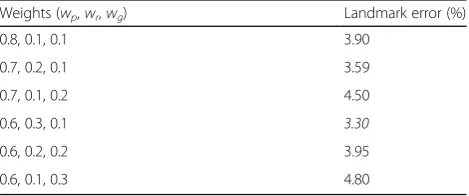
fk;j¼dTk;j; ð14Þ in the proposed MSR method. To determine the weights depicted in (10), Table1 shows the experimental results that exhibit landmark errors with different sets of weights. The pixel difference, which plays the main role in shape regression, is with the largest weight while the region and gradient differences, which are used for the feature refinements, are with slightly smaller weights. By experiments, we found that the weights with 0.6, 0.3, and 0.1 for pixel, region, and gradient differences, respectively, achieve the best performance for shape regression. It is noted that the above MSR concept can be extended to more features and can be applied for any landmark esti-mation of target objects.
2.3 Face warping method for alignment-based face recognition
Once the positions of the key landmarks are extracted by a face alignment method, they can be used for many Fig. 10Top view and detected cross lines related to the nose point ofaright-rotation,bnormal, andcleft-rotation faces
(a) (b)
Fig. 11Alignment face images.aFacial image after rotating.bFacial
applications such as face animation for argument reality (AR) and virtual reality (VR) and emotion detection and face recognition for smart living services. In this section, we can use the face alignment to improve the perform-ance of face recognition. Figure5shows the flow diagram of a typical alignment-based face recognition, which includes four major functions of face detection, face alignment, face warping, and face recognition. The face detection includes skin color detection, morphological operations, and Viola-Jones face detector [28]. The skin color is a simple and distinct feature for face detection
to reduce the computation [29]. The morphological
erosion and dilation are used to remove the noises of the detected skin areas. After morphological operation, the final face detection could be performed in large connected skin areas by Viola-Jones face detector. To
improve SPO face recognition methods [10–21], the
alignment-based face recognition approach needs a good selection of landmarks and acquires a good warping algo-rithm to adjust the pose variation of face images.
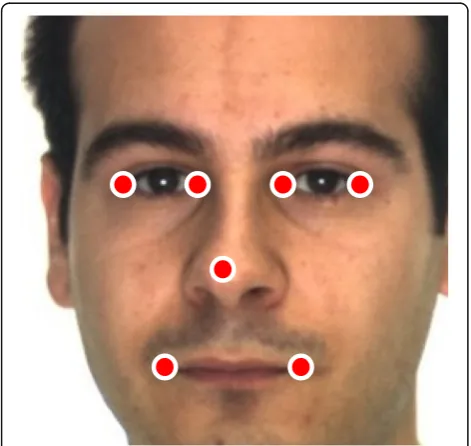
Figure 6 shows seven selected landmarks, including
four eye canthi, one nose tip, and two mouth corners, which are used in the face warping method. After seven key landmarks are extracted by a face alignment method, we suggest a cross warping method to adjust the facial image with possible pose variation. First, three fitting lines are obtained by the least square method as shown in Fig. 7b. The horizontal eye (HE) line is detected by fitting four positions of landmarks on the canthi of eyes. The horizontal mouth (HM) line is obtained by two positions of landmarks on two mouth corners. The vertical nose (VN) line is found by fitting the position of the landmark at the nose and orthogonal to the HE
and HM lines in the least square sense. Figure8 shows
the typical cross shapes, which are composed of VN and HE lines, of straight front, left-tilted, right-tilted, left-rotation, and right-rotation faces, will be used for adjusting the face alignment. The proposed cross warping method is described as follows.
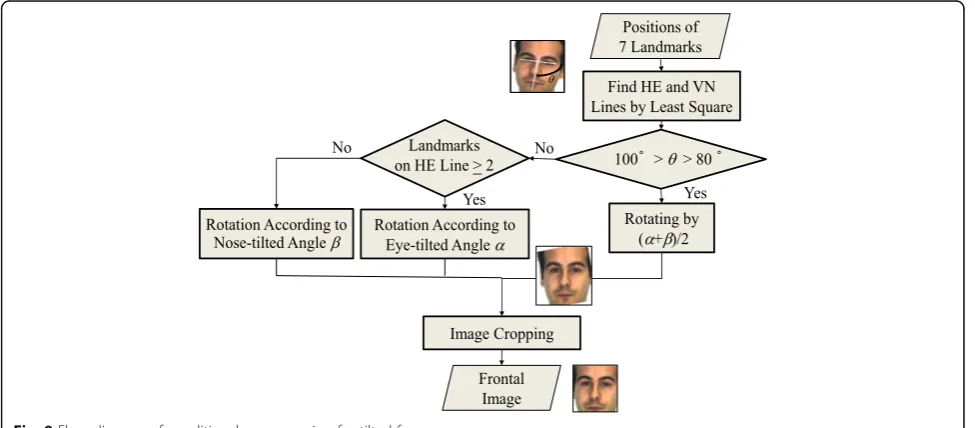
For general facial images, the deformations could be mixed with tilted and rotated faces. The flow diagram of the cross warping method for correcting the face alignment is shown in Fig.9. Since the estimated land-marks could not be always correct, we need to detect the reliability of all the landmarks at the same time. It is rational that the two cross lines should be nearly
orthogonal if the estimated landmarks are correct.
Thus, the cross angleθ between the cross HE and VN
lines is computed as
which can characterize the HE and VN lines with slopes of m1 and m2, respectively. The dot operator in (15)
denotes the inner product. Before the warping process, we first compute the eye-tilted and nose-tilted angles. The eye-tilted angleαbetween the horizontal and the HE line is expressed as
α¼ tan−1ð Þ;m1 ð16Þ while the nose-tilted angle β between the vertical and the VN lines is depicted by
β¼ tan−1ð Þ−m2 90: ð17Þ
If the angle of the cross is in range of 80°≥θ≥100°, the rotation angle for face alignment is the average of eye-titled and nose-tilted angles as
θrot¼ðαþβÞ=2: ð18Þ
By setting the nose position as the center, the face
image is rotated by affine transform with θrot degrees
and cropped. If the cross angle is out of 80°≥θ≥100°, the rotation angle is determined either by eye-tilted angle or nose-tilted angle. If there more than two landmarks on the HE line, the rotation angle will be determined by eye-tilted angle, α, if not, the rotation angle becomes β, the nose-tilted angle.
As to rotation left and right deformations as depicted in Fig. 8c, d, the image faces slightly rotate toward the left and right directions, respectively.
Fig-ure 10 exhibits three top views of rotation faces. For
the normal face, the VN line will evenly divide the
HE line into two equal arms as shown in Fig. 10b.
However, the right-rotation face will produce a longer
right arm and a shorter left arm as shown in Fig. 10a
while the left-rotation face will produce a shorter
Table 2Landmark errors and failure rates compared with different features of the MSR method on LFPW database
Methods MSR (pd) MSR (pd + rd) MSR (pd + rd + gd) Landmark error (%) 4.06 3.78 3.30
Failure rate (%) 7.27 3.63 3.60
Table 3Landmark errors and failure rates compared with different features of the MSR method on HELEN database Methods MSR (pd) MSR (pd + rd) MSR (pd + rd + gd) Landmark error (%) 4.31 4.17 3.83
right arm and a longer left arm as shown in Fig. 10c. For simplicity, we only allow the pointing face in + 6°
and −6°, The true angle warping angles, which is
actu-ally related to camera distance and focus length, with re-spect to the VN line, could be detected as−6, −3, 0, + 3 and + 6 by the ratio of segmented HE lengths separated by the VN line. If the face image is mixed with tilted and ro-tated variations, we should perform the adjustment of the tilt rotation first and then conduct the adjustment of rota-tion warping.
After warping transform of the face image, the facial image is adjusted to become a straight frontal face as Fig. 11a. Since the white (unknown) regions after affine transform are possibly yielded, the images are further cropped to 80% of the face image. Finally, the finally adjusted face image as shown in Fig.11bwill be used for face recognition.
3 Experimental results and discussion
For performance assessments of the proposed MSR face alignment, the experiments are divided into two main parts. For face alignment, the first part of simula-tions is performed to verify the alignment performance of the proposed MSR face alignment method while the second part is conducted to evaluate the recognition performance of alignment-based face recognition in use of the proposed MSR face alignment and cross warping methods.
3.1 Experiments for face alignment
In face alignment experiments, the proposed multi-feature shape regression (MSR), the explicit shape regression (ESR) [8], and the other face alignment methods are com-pared on the LFPW [29] and HELEN [30] face alignment databases. The LFPW database contains 792 facial images for the training phase and 220 facial images for the testing phase. These facial images were taken at different poses, facial expression, and head rotation. Each facial image has 68 landmarks which were annotated manually. The HELEN face database contains 1000 facial images for the training phase and 330 facial images for the testing phase. Each facial image contains 194 landmarks which were also annotated manually.
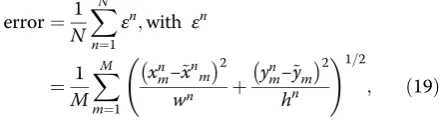
In order to evaluate the performances, the average landmark error and failure rate are the two important criteria to assess the face alignment algorithms. The aver-age landmark error for allNtesting images is defined as
error¼ 1
N
XN
n¼1
εn;with εn
¼ 1
M
XM
m¼1
xnm−~xnm
2
wn þ
ynm−~ym
2
hn
!1=2
; ð19Þ
where (xnm,ynm) and (~xnm,~ynm) respectively represent positions of the mth estimated landmark and themth ground truth landmark, (wn,hn) is the image size of thenth image, and
M denotes the number of landmarks. If the average of K
Fig. 13Selected face alignment results by usingathe ESR method (top row),bthe MSR method with pixel and region difference features (bottom row), andcthe MSR with pixel, region, and gradient difference features (final row)
Table 4Comparisons of different face alignment methods on FRGC database
Methods LPCM ERT RCPR SDM ESR MSR
Error 0.040 0.038 0.035 0.035 0.040 0.033
Table 5Comparisons of different face alignment methods on HELEN database
Methods ERT RCPR SDM ESR MSR
landmarks of the testing image is more than 0.1, it will be treated as a fail case, and the number of the fail cases,f, is denoted as
f ¼X
N
n¼1
δðfailnÞ; δðfailnÞ ¼ 1; ifε
n>0:1;
0;ifεn≤0:1:
ð20Þ
Thus, the failure rate is defined as
failure rateð Þ ¼% f
N100%: ð21Þ
In addition, the experimental results for face alignment with AR and FRGC databases will also be presented. Since the two databases do not provide the ground truth shapes, we just can show some selected samples of facial images and their estimated shape.
The proposed multi-feature shape regression (MSR) method considers total differences of pixel difference (pd), region difference (rd), and gradient difference (gd). The three compositions of the multiple features for MSR
are shown in Fig. 12. As shown in Tables 2 and 3, the
landmark errors and failure rates by using different com-binations of multiple features for the proposed MSR are tested on LFPW and HELEN databases, respectively. Some selected facial images with the detected landmarks by the proposed MSR methods and the ESR method are
also shown in Fig. 13. Thus, the MSR face alignment
method will use pixel difference (pd), region difference (rd), and gradient difference (gd) with 0.6, 0.3, and 0.1 weights for reminding simulations. For the comparisons of different face alignment methods, the LPCM (Localizing Parts of faces using a Consensus of Exemplars) [29], ERT
(Ensemble of Regression Trees) [31], RCPR (Robust
Cascaded Pose Regression) [32], and SDM (Supervised
Descent Method) [33] are shown in Tables4and5. The results show that the proposed MSR is better than other methods.
3.2 Experiments for face recognition
For face recognition experiments on AR database [34],
we select 100 subjects as shown in Fig. 14, which are
used for performance evaluation. Each subject contains Fig. 14Face images in AR database (AR1–6) and the synthesized images (AR7–18) for a sampled identify
18 images, where AR1–AR6 face images are the original
images, while AR7–AR18 are the synthesized ones. In
face recognition experiments on FRGC database [35], as
shown in Fig. 15, we also pick 100 subjects, which are
used for performance evaluation. Each subject contains
12 images, where FRGC1–FRGC4 face images are the
original images, while FRGC5–FRGC12 images are the
synthesized ones. Each facial image is downsampled to 20 × 20 pixels.
To validate the proposed alignment-based face recog-nition system, the recogrecog-nition performances achieved by the different algorithms will be simulated. The other face recognition algorithms used in the experiments include principal component analysis (PCA) [10,11], linear discrim-inant analysis (LDA) [15], linear regression classification (LRC) [22], modular linear regression-based classification (MLRC) [22], sparse representation classification (SRC) [36, 37], locality preserving projection (LPP) [38],
neighboring preserving embedding (NPE) [39], improved
principal component regression (IPCR) [40], unitary
regression classification (URC) [41], linear discriminant regression classification (LDRC) [42], and kernel linear
regression classification (KLRC) [43] methods. From
Fig. 14, six original face images, AR1, AR3, AR4, and
AR5 for each identity are used for training while two original images AR2 and AR6 and four synthesized images
are randomly selected for testing. From Fig. 15, three
original face images, FRGC2, FRGC3, and FRGC4, for each identity are used for training while the original image FRGC1 and two synthesized images are randomly selected for testing.
In face recognition experiments, the abovementioned face recognition algorithms are compared in three cat-egories: (1) without alignment, (2) with ESR alignment, and (3) with MSR alignment. After face alignment by using the ESR and MSR methods, the face images both are adjusted by using the proposed conditional cross
warping method for fair comparisons. Figure 16 shows
the detected seven landmarks of some tested (normal and synthesized) images achieved by the ESR and MSR methods. The results also show that the MSR method has higher precision than the ESR method in landmark estimation on AR and FRGC databases.
If the testing face images are the normal face images,
Tables 6 and 7 show the recognition performances on
AR (AR2, AR6) and FRGC (FRGC1) databases, respect-ively. For the normal face images, it is noted that the ESR and the proposed MSR methods without any prior knowledges will still perform face alignment and face warping processes. The recognized results show that the proposed alignment-based face recognition systems are quite reliable while the proposed MSR shows better than the ESR method. For posed face images (synthesized face
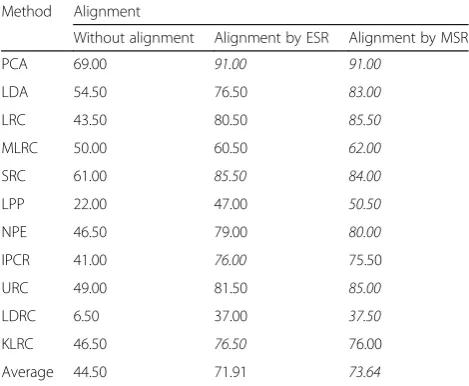
images), Tables 8 and 9 show the recognized rates on
AR and FGGC databases, respectively. The simulation results show that the proposed MSR face alignment and
ESR MSR ESR MSR ESR MSR
ESR MSR ESR MSR ESR MSR
(a) AR Database
(b) FRGC Database
Fig. 16Face alignment results (seven landmarks) achieved by ESR and MSR methods.aAR database.bFRGC database
Table 6Recognition performances (%) on AR database (normal faces)
Method Alignment
Without alignment Alignment by ESR Alignment by MSR
conditional cross warping processes can effectively over-come the problems of pose variations. The proposed MSR method achieves better performances than the ESR method not only in face alignment but also in face recognition. Among all face recognition algorithms, the SRC and URC methods in conjunction with the proposed alignment-based face recognition system perform better than the other face recognition methods.
4 Conclusions
In this paper, the multi-feature shape regression (MSR) method, which considers pixel difference, region difference, and gradient difference together, is first proposed. For face
recognition applications, a cross warping method is suggested to achieve alignment-based face recognition. The proposed MSR face alignment method can help to precisely estimate seven key landmarks of face images. Simulation results show that the multi-feature shape regression (MSR) method, which utilizes more features computed from surrounding pixels, shows better alignment performance than the explicit shape regression (ESR) algo-rithm, which only uses pixel difference. With seven selected face key landmarks, including four eye canthi, one nose tip, and two mouth corners, we can use the positions of seven landmarks to find a cross shape, which is defined by the estimated horizontal-eye (HE) and vertical-nose (VN) lines. By the cross warping process, we can adjust the tilted face image back to normal face image to overcome the problem of pose variations for face recognition. The experimental results show that the MSR method performs better than the ESR and other face alignment algorithms on face alignment database. For alignment-based face recognition, the MSR face alignment algorithm with the cross warping method can help the SPO face recognition methods to achieve better recognition performances. Simulation results show that the proposed multi-feature shape regression (MSR) face alignment method achieves better perfor-mances in both face alignment and face recognition than the existing face alignment methods.
Abbreviations
AAM:Active appearance model; AR: Argument reality; ASM: Active shape model; ESR: Explicit shape regression; IPCR: Improved principal component regression; KLDA: Kernel LDA; LDA: Linear discriminant analysis; LPP: Locality preserving projection; LRC: Linear regression classification; MLRC: Modular linear regression classification; MSR: Multi-feature shape regression; NPE: Neighboring preserving embedding; PCA: Principal component analysis; SPO: Subspace projection optimizations; URC: Unitary regression
classification; VR: Virtual reality
Table 8Recognition performances (%) on FRGC database (Synthesized Faces)
Method Alignment
Without alignment Alignment by ESR Alignment by MSR
PCA 46.25 78.29 80.00
Table 9Recognition rates on FRGC with different face recognition algorithms (synthesized faces)
Method Alignment
Without alignment Alignment by ESR Alignment by MSR
PCA 69.00 91.00 91.00
Table 7Recognition performances (%) on FRGC database (normal faces)
Method Alignment
Without alignment Alignment by ESR Alignment by MSR
This work acknowledged the Editor, anonymous Reviewers and Professor Din-Yuen Chan for criticizing the presentations and writings of the manuscript.
Funding
This work was supported by the Ministry of Science and Technology, Taiwan, under Grant MOST 105-2221-E-006-065-MY3.
Availability of data and materials
The face alignment data is obtained from the LFPW and HELEN face alignment databases provided in [29,30], respectively. The face recognition data is retrieved from the AR and FRGC databases delivered in [34,35], respectively. As to the augment face images, the datasets generated for the current study are available from the corresponding author on reasonable request.
Authors’contributions
W-JY carried out image processing studies, participated in the proposed system, assembled formulations, and drafted the manuscript. Y-CC carried out software simulations and face data augmentation by warping parameters. P-CC and J-FY conceived of the study, participated in its design and coordination, and helped to draft the manuscript. All authors read and approved the final manuscript.
Authors’information
W-J Yang received a B.S. degree in Computer Science from Tunghai University, Taiwan, in 2012 and an M.S. degree in Computer Science and Information Engineering from National University of Tainan, Taiwan, in 2015. Currently, he is a Ph.D. student with the Graduate Institute of Computer and Communication Engineering in National Cheng Kung University, Taiwan. His current research interests include pattern recognition, machine learning, and deep learning for designs of smart systems.
Y-C Chen received a B.S. degree in Electrical Engineering and an M.S. degree in Computer and Communication Engineering from the National Cheng Kung University, Tainan, Taiwan, in 2014 and 2016, respectively. Her current research interests include face recognition and machine learning.
P-C Chung received a Ph.D. degree in Electrical Engineering from Texas Tech University, Lubbock, TX, USA, in 1991. She was with the Department of Electrical Engineering, National Cheng Kung University (NCKU), Tainan, Taiwan, in 1991 and became a Full Professor in 1996. She applies most of her research results to healthcare and medical applications. Dr. Chung is a member of the Phi Tau Phi Honor Society, was a member of the Board of Governors of CAS Society from 2007 to 2009 and from 2010 to 2012, and is currently an ADCOM Member of the IEEE CIS and the Chair of CIS Distinguished Lecturer Program. She also is an Associate Editor of IEEE Transaction on Neural Networks and the Editor of Journal of Information Science and Engineering, the Guest Editor of Journal of High Speed Network, the Guest Editor of IEEE Transaction on Circuits and Systems-I, and the Secretary General of Biomedical Engineering Society of China. She is one of the Co--Founders of Medical Image Standard Association (MISA) in Taiwan and is cur-rently on the Board of Directors of MISA. Her research interests include image/ video analysis and pattern recognition, bio signal analysis, computer vision, and computational intelligence. She is an IEEE fellow.
J-F Yang received a Ph.D. degree in Electrical Engineering from the University of Minnesota, Minneapolis, MN, USA, in 1988. He joined the National Cheng Kung University (NCKU), Taiwan, in 1988 and was promoted to Distinguished Professor in 2004. Dr. Yang was the Distinguished Lecturer in the Program by the IEEE Circuits and Systems Society (CAS) from 2004 to 2005. He was the Chair of the IEEE CAS Multimedia Systems and Applications Technical Committee from 2008 to 2009. He was an Associate Editor of IEEE Transaction on Circuits and Systems for Video Technology and EURASIP Journal of Advances in Signal Processing. He is an IEEE Fellow. Currently, he is an Associate Editor of IET Signal Processing. He was a recipient of the NSC Excellent Research Award in Taiwan in 2008. He has published over 135 journals and 216 conference papers. Currently, his research interests include multimedia processing, coding, and recognition.
Competing interests
The authors declare that they have no competing interests.
’
Springer Nature remains neutral with regard to jurisdictional claims in published maps and institutional affiliations.
Received: 27 November 2017 Accepted: 17 July 2018
References
1. TF Cootes, CJ Taylor, inProc of the British Machine Vision Conference. Active shape models—‘smart snakes’(1992), pp. 266–275
2. D Cristinacce, TF Cootes, inProc of the British Machine Vision Conference. Boosted regression active shape models (2007)
3. TF Cootes, GJ Edwards, CJ Taylor, inEuropean Conference on Computer Vision. Active appearance models (1998)
4. I Matthews, S Baker, Active appearance models revisited. Int. J. Comput. Vis. 60(2), 135–164 (2004)
5. P Sauer, TF Cootes, CJ Taylor, inProc of the British Machine Vision Conference. Accurate regression procedures for active appearance models (2011) 6. J Saragih, R Goecke, inProc. of IEEE 11th International Conference on
Computer Vision. A nonlinear discriminative approach to AAM fitting (2007) 7. P Dollár, P Welinder, P Perona, inProc. of IEEE Conference on Computer Vision
and Pattern Recognition. Cascaded pose regression (2010)
8. M Valstar, B Martinez, X Binefa, inProc. of IEEE Conference on Computer Vision and Pattern Recognition. Facial point detection using boosted regression and graph models (2010)
9. X Cao, Y Wei, F Wen, J Sun, Face alignment by explicit shape regression. Int. J. Comput. Vis.107(2), 177–190 (2014)
10. M Turk, A Pentland, Eigenfaces for recognition. J. Cogn. Neurosci.3(1), 71–86 (1991)
11. P. N. Belhumeur, ,J. P. Hespanha, and D. J. Kriegman, Eigenfaces vs. fisherfaces: recognition using class specific linear projection IEEE Trans. Pattern Anal. Mach. Intell., vol. 19, no. 7, pp. 711–720, 1997. 12. B Moghaddam, A Pentland, Probabilistic visual learning for object
representation. IEEE Trans. Pattern Anal. Mach. Intell.19(7), 696–710 (1997) 13. J Yang, D Zhang, AF Frangi, J-Y Yang, Two-dimensional PCA: a new
approach to appearance-based face representation and recognition. IEEE Trans. Pattern Anal. Mach. Intell.26(1), 131–137 (2004)
14. AM Martínez, AC Kak, PCA versus LDA. IEEE Trans. Pattern Anal. Mach. Intell. 23(2), 228–233 (2001)
15. J Shawe-Taylor, N Cristianini,Kernel methods for pattern analysis(Cambridge University Press, Oxford, 2004)
16. B Schölkopf, A Smola, K-R Müller, Nonlinear component analysis as a kernel eigenvalue problem. Neural Comput.10(5), 1299–1319 (1998)
17. M-H Yang, inProc. of the Fifth International Conference on Automatic Face and Gesture Recognition. Kernel eigenfaces vs. kernel fisherfaces: face recognition using kernel methods (2002)
18. B. Scholkopft and K.-R. Mullert, Fisher discriminant analysis with kernels Neural networks for signal processing IX, 1 1 1999.
19. G Baudat, F Anouar, Generalized discriminant analysis using a kernel approach. Neural Comput.12(10), 2385–2404 (2000)
20. J Lu, KN Plataniotis, AN Venetsanopoulos, Face recognition using kernel direct discriminant analysis algorithms. IEEE Trans. Neural Netw.14(1), 117–126 (2003) 21. J Huang, PC Yuen, WS Chen, JH Lai, Choosing parameters of kernel
subspace LDA for recognition of face images under pose and illumination variations. IEEE Trans. Syst. Man Cybern. B Cybern.37(4), 847–862 (2007) 22. I Naseem, R Togneri, M Bennamoun, Linear regression for face recognition.
IEEE Trans. Pattern Anal. Mach. Intell.32(11), 2106–2112 (2010)
23. Y Duan, J Lu, J Feng, J Zhou, Context-aware local binary feature learning for face recognition. IEEE Trans. Pattern Anal. Mach. Intell.40(5), (2018) 24. W-Y Liu, Y-D Wen, Z-D Yu, M Li, B Raj, L Song, inIEEE Conference on
Computer Vision and Pattern Recognition (CVPR). SphereFace: deep hypersphere embedding for face recognition (2017)
25. W Wu, M Kan, X Liu, Y Yang, S Shan, X Chen, inIEEE Conference on Computer Vision and Pattern Recognition (CVPR). Recursive spatial transformer (rest) for alignment-free face recognition (2017)
26. N Duffy, D Helmbold, Boosting methods for regression. Mach. Learn.47(2), 153–200 (2002)
27. JH Friedman, Greedy function approximation: a gradient boosting machine. Ann. Stat.29(5), (2001)
29. PN Belhumeur, DW Jacobs, DJ Kregman, N Kumar, Localizing parts of faces using a consensus of exemplars. IEEE Trans. Pattern Anal. Mach. Intell. 35(12), 2930–2940 (2013)
30. V Le, J Brandt, Z Lin, L Bourdev, JS Huang, inProc. of European Conference on Computer Vision. Interactive facial feature localization (2012) 31. V Kazemi, J Sullivan, inProc. of the IEEE Conference on Computer Vision and
Pattern Recognition. One millisecond face alignment with an Ensemble of Regression Trees (2014)
32. XP Burgos-Artizzu, P Perona, P Dollár, inProc. of the IEEE International Conference on Computer Vision. Robust face landmark estimation under occlusion (2013)
33. X Xiong, F De la Torre, inProc. of the IEEE Conference on Computer Vision and Pattern Recognition. Supervised descent method and its applications to face alignment (2013)
34. AM Martinez, inCVC Technical Report. The AR face database, vol 24 (1998) 35. PJ Phillips, FJ Flynn, T Scruggs, KW Bowyer, J Chang, K Hoffman, J Marques,
J Ming, W Worek, inProc. of IEEE Computer Society Conference on Computer Vision and Pattern Recognition (CVPR'05). Overview of the face recognition grand challenge (2005)
36. J Wright, A-Y Yang, A Ganesh, Robust face recognition via sparse representation. IEEE Trans. Pattern Anal. Mach. Intell.31(2), 210–227 (2009) 37. X Jiang, J Lai, Sparse and dense hybrid representation via dictionary
decomposition for face recognition. IEEE Trans. Pattern Anal. Mach. Intell. 37(5), 1067–1079 (2015)
38. X He, S Yan, Y Hu, P Niyogi, J-J Zhang, Face recognition using
Laplacianfaces. IEEE Trans. Pattern Anal. Mach. Intell.27(3), 328–340 (2005) 39. X He, D Cai, Y Yang, H-J Zhang, inProc. of Tenth IEEE International
Conference on Computer Vision (ICCV'05). Neighborhood preserving embedding, vol 1 (2005)
40. S-M Huang, J-F Yang, Improved principal component regression for face recognition under illumination variations. IEEE Sig. Process. Lett.19(4), 179– 182 (2012)
41. S-M Huang, J-F Yang, Unitary regression classification with total minimum projection error for face recognition. IEEE Sig. Process. Lett.20(5), 443–446 (2013) 42. S-M Huang, J-F Yang, Linear discriminant regression classification for face
recognition. IEEE Sig. Process. Lett.20(1), 91–94 (2013)