R E S E A R C H
Open Access
A novel non-negative matrix factorization
technique for decomposition of Chinese
characters with application to secret
sharing
Chih-Yang Lin
1, Li-Wei Kang
2*, Tsung-Yi Huang
3and Min-Kuan Chang
3,4*Abstract
The decomposition of Chinese characters is difficult and has been rarely investigated in the literature. In this paper, we propose a novel non-negative matrix factorization (NMF) technique to decompose a Chinese character into several graphical components without considering the strokes of the character or any semantic or phonetic properties of the components. Chinese characters can usually be represented as binary images. However, traditional NMF is only suitable for representing general gray-level or color images. To decompose a binary image using NMF, we force all of the elements of the two matrices (obtained by factorizing the binary image/matrix to be decomposed) as close to 0 or 1 as possible. As a result, a Chinese character can be efficiently decomposed into several components, where each component is semantically unreadable. Moreover, our NMF-based Chinese character decomposition method is suitable for applications in visual secret sharing by distributing the shares (different character components) among multiple parties, so that only when the parties are taken together with their respective shares can the secret (the original Chinese character(s)) be reconstructed. Experimental results have verified the
decomposition performance and the feasibility of the proposed method.
Keywords: Chinese characters, Matrix decomposition, Non-negative matrix factorization (NMF), Secret sharing
1 Introduction
A Chinese character is usually composed of several graphical components, including a radical and several other different parts. Radicals are the graphical compo-nents used to index Chinese characters in a dictionary. Characters with the same component may share similar semantic or phonetic properties [1–3]. The analysis and processing of Chinese characters have enjoyed a long history [4], and recently have garnered much attention with the development of artificial intelligence techniques, such as machine learning [5] and deep learning [6] as well as several related applications (e.g., recognition of Chinese
characters [7] and natural language understanding of
Chinese documents [8]).
1.1 Chinese character decomposition
To online process Chinese documents stored as binary images, it would be helpful if the Chinese characters
could automatically be efficiently decomposed in
advance. However, automatically decomposing a Chinese character (represented as a binary image) into different components is difficult and has rarely been investigated in the literature.
Based on our explorations of works relating to Chinese characters, most prior research has aimed at extracting Chinese character strokes via automatic character
decomposition [9–13]. Strokes are the fundamental
building blocks of Chinese characters and are needed to
write Chinese characters in regular script [14]. To
decompose a Chinese character into a set of strokes, a mathematical morphology-based method was proposed
© The Author(s). 2019Open AccessThis article is distributed under the terms of the Creative Commons Attribution 4.0 International License (http://creativecommons.org/licenses/by/4.0/), which permits unrestricted use, distribution, and reproduction in any medium, provided you give appropriate credit to the original author(s) and the source, provide a link to the Creative Commons license, and indicate if changes were made.
* Correspondence:[email protected];[email protected]
2
Department of Electrical Engineering, National Taiwan Normal University, Taipei, Taiwan
3Department of Communications Engineering, National Chung Hsing
University, Taichung, Taiwan
in [11]. A model of stroke extraction for Chinese charac-ters was also proposed in [9] to extract primary strokes. In [13], a Chinese character is decomposed into isolated stroke structures based on the connections. Then, shape contexts of stroke structures are extracted, and the matched counterparts in a standard database are found
through shape matching. Moreover [10], was proposed
building a font skeleton manifold so that the most simi-lar character could be always found as a template by traversing the locations in the manifold learned for the application of stroke extraction for Chinese characters. Meanwhile [12], was proposed starting with automatically decomposing a Chinese character image into strokes, and then separately resizing those strokes under the guidance of structure information to achieve structure-aware image resizing for Chinese characters.
These works on decomposing Chinese characters into strokes were mainly designed for applications in charac-ter recognition, writing style analysis, and new font synthesis [15]. Such methods usually rely on a standard database consisting of standard Chinese character templates or standard strokes, used for shape/template matching.
On the other hand, to better capture semantics of natural language words, low-dimensional distributed word representations, also known as word embeddings, were introduced recently [16,17]. For example, a method, called cw2vec, for learning Chinese word embeddings with
stroke n-gram information was proposed in [16]. More
specifically, a minimalist approach was designed to exploit the stroke n-grams, which can capture semantic and morphological level information of Chinese words. More-over, to improve word embeddings, a hybrid learning method, integrating compositional, and predictive models for word embeddings was presented in [17]. In general, word embedding techniques have been shown to be applicable in the tasks of word similarity, word analogy,
text classification, and named entity recognition. However, the main goal of word embeddings is usually to better capture semantics of natural language words, which is essentially different from that of the proposed method described in the next subsection.
1.2 Main objective of this paper
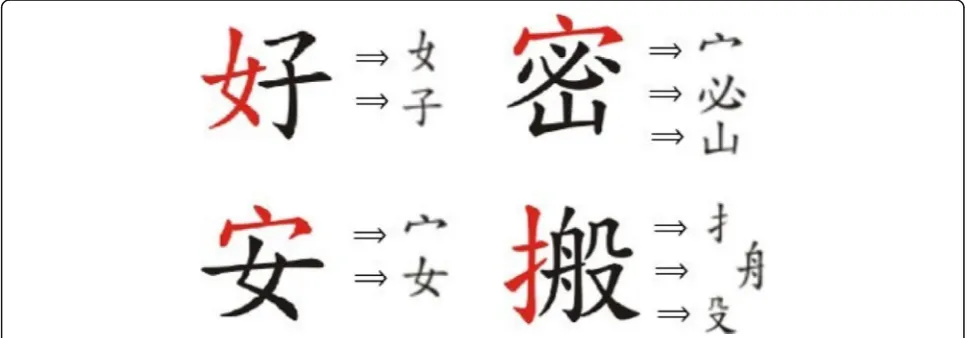
In significant contrast to the goals and approaches of the above-mentioned works, the goal of this paper is to develop an automatic Chinese character decomposition framework to decompose a Chinese character into several graphical components without considering the strokes of the character or any semantic or phonetic properties of the components, as in the examples illus-trated in Fig. 1. For example, the Chinese character‘好’ will be automatically decomposed into the components
‘女’and ‘子’ without considering the semantic or phon-etic properties of either of the two components. That is, we intend to automatically achieve graphical decompos-ition of Chinese characters represented as binary images without the need for any prior knowledge of semantic and phonetic properties of Chinese character compo-nents or character strokes.
To achieve our goal, we propose applying non-negative matrix factorization (NMF) technique to decompose a Chinese character into different components. In general,
NMF (or non-negative matrix approximation) [18–21]
intends to factorize a matrix into two matrices, with all three matrices having no negative elements. The prop-erty of non-negativity makes the resulting matrices easier to inspect; therefore, NMF has been successfully applied to several source decomposition applications in digital audio signals [22–24], digital visual signals [25–29], and document clustering [30].
However, from the viewpoint of image signal
decom-position using NMF [15, 26–29], the standard NMF
technique [18,19] is only suitable for processing general
digital grayscale or color images, not for binary images. In general, Chinese characters are usually presented in binary tones, black and white. Therefore, this paper pre-sents a novel NMF framework to factorize a Chinese character represented as a binary image (or matrix). Furthermore, we evaluate the performance of the pro-posed NMF technique by applying it to the application of visual secret sharing (a visual cryptographic technique [31–35] in information security [36–38]) that securely shares secret messages encoded as binary images of partial Chinese characters.
1.3 Main contributions of this paper
The major innovations and contributions of this paper are three-fold: (a) to the best of our knowledge, we are among the first to propose an automatic Chinese character de-composition framework to break a character into graph-ical components without a need for prior knowledge of semantic or phonetic properties of Chinese character components or character strokes; (b) to achieve this goal, we propose a novel NMF framework to factorize a binary image into two matrices while forcing all of the elements of the two matrices as close to 0 or 1 as possible; and (c) we successfully apply our NMF-based Chinese character decomposition technique to visual secret sharing for the secure transmission of secret messages encoded by binary images of Chinese characters.
The rest of this paper is organized as follows. In Section2, the standard NMF technique [18, 19] is briefly reviewed, followed by a presentation of the proposed novel NMF framework in Sections 3 and 4, we present the evaluation results by applying the proposed NMF-based Chinese char-acter decomposition method to the application of visual secret sharing. Finally, Section7concludes this paper.
2 Standard non-negative matrix factorization algorithm
Non-negative matrix factorization (NMF) technique has been shown to be useful for the decomposition of multivariate data, where the ‘non-negativity’ is a use-ful constraint for matrix factorization being able to learn a part-based representation of the data. The learned non-negative basis vectors are used in distrib-uted or sparse combinations to generate
expressive-ness in the data reconstructions [18, 19]. The basic
NMF problem can be formally described as follows.
Given a non-negative matrix V of size n×m, the goal
is to find two non-negative matrix factors, W of size
n×r, and H of size r×m such that
V ≈WH; ð1Þ
where Vcan be viewed as a matrix consisting of m data vectors (of dimensionnfor each) from a dataset. The term
ris usually selected to be smaller thannorm, so that the two matrices, W and H, are smaller than the original matrix V. Based on Eq. 1, each data vector (column)
v of V is approximated by a linear combination of the columns of W, weighted by the components of the corresponding column h of H. That is, W can be viewed as containing a basis that is optimized for the linear approximation of the data in V.
To solve Eq. 1, the standard NMF problem can be
formulated as follows:
min
W∈Rnr;H∈RrmkV−WHk 2
F;subject toW;H≥0; ð2Þ
The function defined Eq. 2 is convex in W only or
H only, and therefore, it is not convex in both
vari-ables together. However, it has been found that the
“multiplicative update rules” expressed below
achieve a good compromise between convergence speed and ease of implementation for solving the problem [19]. denote the matrix indices. The multiplicative update rules were also verified in [20]. The constraints of non-negativity allow for interpretation of the basis elements in image forms.
3 Proposed novel non-negative matrix factorization algorithm
To extend standard NMF to process a binary image (stored as a binary matrix), we propose forcing all of the elements of the two factorized matrices (e.g., Wand H, defined equation1) as close to 0 or 1 as possible. Similar to the basic NMF problem defined in Eq.1, given a non-negative matrix V of size n×m, our goal is to find two
non-negative matrix factors, W of size n×r, and H of
size r×m, such that V≈WH, and all of the elements in
W and H are approximately 0 or 1. We first define our
objective function as
To realize the proposed idea, we introduce two
increase the closeness between each Wia or Hbj to 0
It should be noted that the main novelty of the pro-posed NMF algorithm is to enforce all of the elements
in the matrices, W and H, to be approximately 0 or 1,
for achieving the decomposition of the binary matrix. The idea is realized in our method by formulating it as Eq.6. To solve the problem defined in Eq.6, our frame-work performs the steps outlined below.
4 Proposed NMF algorithm for binary image factorization
1. Randomly initialize all of the elements inWandH to 0 or 1, and initialize a predefined numberKof iterations for the algorithm to be performed. 2. UpdateWandHas defined in Eq.6based on the
steepest descent method [39], described later. 3. IfðH2
bj−HbjÞ2þ ðWia2−WiaÞ2<ε, or the number (K) of target iterations is reached, stop the algorithm, whereεis a predefined threshold. Otherwise, go to step 2.
In step 2 of our NMF algorithm, we apply the
steepest descent method to iteratively update W and
H, derived as follows. We first take the derivative of
LðW;HÞ, defined in Eq. 6, with respect to H, and
the update rule ofHcan be defined as
Hkþ1
where the superscriptkdenotes the number of iterations (similar to the termk in Eqs. 3 and 4). To simplify the notations, from Eq.5to8, the superscriptkis ignored.
In the same way,Wcan be updated by
Wkþ1
The two update rules defined in Eqs.910, respectively, will be used in step 2 of the proposed NMF algorithm for each iteration.
5 Proposed visual secret sharing method for Chinese characters via non-negative matrix factorization with experimental results
In this section, we apply the proposed NMF algorithm
for binary image decomposition (described in Section3
to visual secret sharing of Chinese characters, and present the experimental results to demonstrate the performance of our novel NMF algorithm.
5.1 Visual secret sharing
Visual cryptography is a kind of cryptographic technique allowing visual information (e.g., images, texts) to be
encrypted in such a way that it becomes someone’s job
to decrypt the ciphertext via sight reading without a need for complex decryptographic computation. Visual secret sharing is a visual cryptographic technique, origin-ally proposed in [34], where an image that is to be
visu-ally encrypted can be decomposed into nshares, so that
only someone with all n shares can decrypt the image,
while anybody withn−1 shares cannot decrypt the
ori-ginal image. Based on this idea, several generalizations of the basic framework including t-out-of-n (or (t, n )-threshold) visual cryptography [31] were also developed. That is, anytshares can decrypt the secret, but no group oft−1 or fewer can do so, wheret≤n.
5.2 Visual secret sharing for Chinese characters via proposed NMF algorithm
follows. First, the secret message to be shared in this paper should be a binary image containing a set of Chinese characters. Second, to reconstruct the secret message, all of the shares are required.
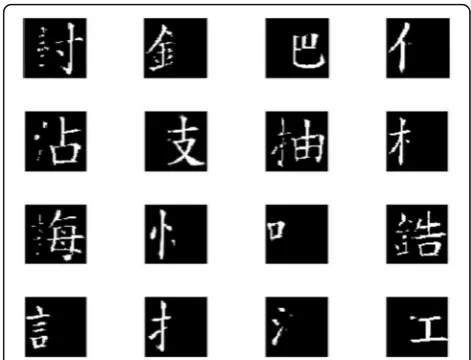
In the training stage of our method, it is necessary for our NMF model to learn a basis (or dictionary) for Chinese character decomposition. Therefore, we first randomly selected 30 Chinese characters represented by their corresponding 30 binary images, as shown in Fig.2. Each binary image of a Chinese character is represented by a 100 × 100 matrix. To establish the matrix (V) to be factorized, each 100 × 100 matrix of a character is trans-formed to a column of size 10,000. As a result, the matrix (V) consists of 30 columns of size 10,000 each, where each column represents a training sample of a Chinese charac-ter, denoted byVn×m,n= 10,000, andm= 30. By applying the proposed NMF algorithm to factorizeVn×minto two matrices,Wof sizen×r, andHof sizer×m, and setting r= 16, we can obtain the two matrices, whereWn×r repre-sents the basis (or dictionary), andHr×mcontains the cor-responding weights (coefficients) for constituting the
Chinese characters. Figure 3 illustrates the r columns
(basis elements or dictionary atoms) ofW. It can be ob-served from Fig.3that the Chinese characters can be ac-tually decomposed into several parts, which is consistent with the concept of recognition for human brains [40].
To achieve visual secret sharing of Chinese characters, we consider the problem that the secret message to be shared is represented by the Chinese characters shown
in Fig. 2, and a set of shares can be obtained by the
proposed NMF algorithm, shown in Fig. 3. Then, the
shares can be distributed among a group of participants (or parties). That is, a set of Chinese characters (to be
securely shared) forms the matrix V. By applying our
NMF algorithm to factorize V, the two matrices, W
(representing the basis) and H (including the
corre-sponding coefficients), can be obtained. Finally, each
column (basis element) ofWcan be viewed as a share to
be distributed.
To decrypt the secret message to be shared, shares from different subsets of the set of shares printed on transparent slides only needs to be stacked upon each other, and then Chinese characters in the secret message can be revealed. For example, by stacking the shares (i.e., slides) of ‘口’ and ‘支’ the character ‘吱’ can be
revealed, while stacking the shares ‘口’ and ‘巴’, the
character ‘吧’ can be revealed.
To evaluate our method’s performance on
computa-tional reconstruction, we multiply the two matrices, W
and H, to reconstruct the original message (V). The
results are shown in Fig. 4. It is evident in Fig. 4 that good visual quality for the reconstruction results can be obtained. It should be noted that for the reconstruction of the secret message in visual secret sharing applica-tions, the message can be visually decrypted by stacking the proper shares without any computation.
In the case of real applications for visual secret shar-ing, once the basis (or dictionary, say, the matrix“W”) is learned offline, it will be directly used to factorize the message formed by the Chinese character(s) to be shared to get the matrix “H”. Inspecting the coefficients of H can then determine which shares should be distributed. For each column, (a basis element) ofW, when its corre-sponding coefficient in His close to 1, it will be consid-ered a share of the secret message for distribution. This means that the basis element has a significant contribu-tion to the original message to be shared. Otherwise, that basis element will not be selected as a share.
Fig. 2Examples of training samples (binary images of Chinese characters) used in our experiments.
Fig. 3Visualized basis elements (or dictionary atoms) in the matrix
5.3 More experimental results
This subsection presents more experimental results on the decomposition of Chinese characters when applied to visual secret sharing based on our method.
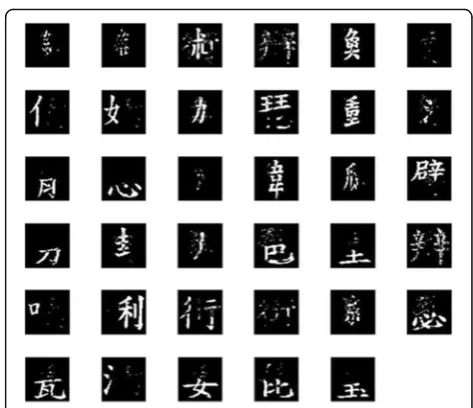
Figure 5 depicts a set of Chinese characters forming
the matrix V. By applying the proposed NMF
algo-rithm, the basis matrix (W) can be obtained to
become the shares of the message, as shown in Figure
6. It can be observed from Figs. 5 and 6 that the
proposed NMF algorithm is able to properly factorize a binary matrix formed by a set of Chinese characters to find the basis matrix for determining a set of shares to be distributed for secret sharing applications.
6 Discussion
Most prior research has aimed at extracting Chinese character strokes and these Chinese characters are needed to write in regular script. In contrast, the pro-posed method is to develop an automatic Chinese character decomposition framework to decompose a Chinese character into several graphical components without the need for any prior knowledge of semantic and phonetic properties of Chinese character compo-nents or character strokes. On the other hand, to compare the proposed method with traditional visual
scrambling approaches (e.g. [41, 42],), the proposed
method aims at decomposing a Chinese character into several graphical components, while the traditional visual scrambling approaches are designed to scram-ble image pixels to achieve image encryption. Further-more, the proposed method is suitable to visual secret sharing applications for Chinese character messages, while the general image scrambling approaches (for encryption) cannot be directly used for visual secret sharing.
In this paper, we propose applying NMF technique to decompose a Chinese character in a binary image format into different components. However, conven-tional NMF technique is only suitable for processing general digital grayscale or color images, not for binary images, so the NMF framework should be to-tally redesigned. The above experimental results show the feasibility of the proposed method. We do not compare with other methods in this section because to the best of our knowledge, we are the first to propose an automatic Chinese character decomposition Fig. 4Reconstruction results based on the two matrices,WandH,
for the matrixV, formed by the Chinese characters displayed in Fig.2
Fig. 6Visualized basis elements in the matrixW, obtained by factorizing the matrixV, formed by the Chinese characters displayed in Fig.5
framework to break a character into graphical compo-nents without considering character strokes.
7 Conclusions and future work
In this paper, we have proposed a novel NMF algorithm for the decomposition of Chinese characters into differ-ent compondiffer-ents. Relying on our key idea to force all of the elements from the two matrices (obtained by factor-izing the image/matrix to be decomposed) as close to 0 or 1 as possible, our NMF algorithm can properly factorize a binary image, and furthermore, can be suc-cessfully applied to visual secret sharing of Chinese char-acters represented as binary images. Secret messages can be visually decrypted without performing computations, based on the collected distributed shares formed by the basis elements obtained by our NMF method. Moreover, the performance on computational reconstruction for the original message has been verified via matrix multi-plication. Finally, as deep learning for NMF has recently been preliminarily investigated (e.g. [43],), deep NMF models for binary image representation and decompos-ition would be worth investigating in future work.
Abbreviations
NMF:Non-negative matrix factorization
Authors’contributions
In this paper, the idea and primary algorithm were proposed by CYL, LWK, and MKC. TYH conducted the simulation results. All authors read and approved the final manuscript.
Funding
This work was supported in part by Ministry of Science and Technology (MOST), Taiwan, under the Grants MOST 106-2218-E-468-001, MOST 107 -2221-E-155-048-MY3, MOST 108-2634-F-008-001, MOST 105-2628-E-224-001 -MY3, and MOST 108-2221-E-003-027-MY3. This work was also financially supported by the“Artificial Intelligence Recognition Industry Service Research Center”from The Featured Areas Research Center Program within the framework of the Higher Education Sprout Project by the Ministry of Education (MOE) in Taiwan.
Availability of data and materials Please contact authors for data requests.
Ethics approval and consent to participate
This study does not involve human participants, human data, or human tissue.
Consent for publication
In the manuscript, there is no any individual person’s data.
Competing interests
The authors declare that they have no competing interests.
Author details
1Department of Electrical Engineering, Yuan-Ze University, Taoyuan, Taiwan. 2
Department of Electrical Engineering, National Taiwan Normal University, Taipei, Taiwan.3Department of Communications Engineering, National
Chung Hsing University, Taichung, Taiwan.4Department of Electrical
Engineering, National Chung Hsing University, Taichung, Taiwan.
Received: 31 May 2019 Accepted: 6 August 2019
References
1. P. Shinkina,The Chinese character decomposition guidance, 2nd edn. (Lulu Press, North Carolina, 2018)
2. T.-R. Su, H.-Y. Lee, Learning Chinese word representations from glyphs of characters.Conference on Empirical Methods in Natural Language Processing(2017) 3. S.-L. Yeh, W.-L. Chou, P. Ho, Lexical processing of Chinese sub-character
components: Semantic activation of phonetic radicals as revealed by the Stroop effect.Sci. Rep.7(2017)
4. Z. Wu, J.D. White, Computer processing of Chinese characters: An overview of two decades‘research and development.Inf. Process. Manag.26, 681–692 (1990) 5. H. Fujioka, W. Zhu, A. Hidaka, H. Kano,Reconstructing dynamic font-based
Chinese characters using support vector machine(IEEE International Conference on Systems, Man, and Cybernetics (SMC), Banff, 2017) 6. X.-Y. Zhang, F. Yin, Y.-M. Zhang, C.-L. Liu, Y. Bengio, Drawing and
recognizing Chinese characters with recurrent neural network.IEEE Trans. Pattern Anal. Mach. Intell.40, 849–862 (2018)
7. X.-Y. Zhang, Y. Bengio, C.-L. Liu, Online and offline handwritten Chinese character recognition: A comprehensive study and new benchmark.Pattern Recogn.61, 348–360 (2017)
8. Y. Zhang, Z. Liu, W. Zhou, Event recognition based on deep learning in Chinese texts.PLoS One11, 1–18 (2016)
9. R. Cao, C.L. Tan, A model of stroke extraction from Chinese character images. Int. Conf. Pattern Recognition (2000)
10. X. Chen, Z. Lian, Y. Tang, J. Xiao,An automatic stroke extraction method using manifold learning(Annual Conf. European Association for Computer Graphics, Lyon, 2017)
11. J.W. Kim, K. InKim, B.J. Choi, H.J. Kim, Decomposition of Chinese character into strokes using mathematical morphology.Pattern Recogn. Lett.20(3), 285–292 (1999)
12. C. Liu, Z. Lian, Y. Tang, J. Xiao, Structure-aware image resizing for Chinese characters.Conf. Multimedia Modeling, 379–390 (2017)
13. Z. Xu, Y. Liang, Q. Zhang, L. Dong, E. Izquierdo,Decomposition and matching: Towards efficient automatic Chinese character stroke extraction
(IEEE Visual Communications and Image Processing, Chengdu, 2016) 14. S.C. Leung, C.K. Tsui, W.L. Cheung, M.W.L. Chung, A comparative approach
to the examination of Chinese handwriting—The Chinese character.J. The Chartered Society of Forensic Sciences25, 255–267 (1985)
15. Z. Lian, B. Zhao, J. Xiao, Automatic generation of large-scale handwriting fonts via style learning.ACM SIGGRAPH Conf. and Exhibition on Computer Graphics and Interactive Techniques in Asia Technical Briefs(2016) 16. S. Cao, W. Lu, J. Zhou, X. Li, inProceedings of AAAI Conf. Artificial Intelligence.
cw2vec: Learning Chinese word embeddings with stroke n-gram information (2018), pp. 1–9
17. W. Chen, W. Sheng, inProceedings of Workshop on Representation Learning for NLP. A hybrid learning scheme for Chinese word embedding (2018), pp. 84–90
18. D.D. Lee, H.S. Seung, Learning the parts of objects by non-negative matrix factorization.Nature401, 788–791 (1999)
19. D.D. Lee, H.S. Seung, inInt. Conf. Neural Information Processing Systems. Algorithms for non-negative matrix factorization (2000), pp. 535–541 20. C.-J. Lin, On the convergence of multiplicative update algorithms for
nonnegative matrix factorization.IEEE Trans. Neural Netw.18, 1589
–1596 (2007)
21. M.W. Berry, M. Browne, A.N. Langville, V.P. Pauca, R.J. Plemmons, Algorithms and applications for approximate nonnegative matrix factorization.
Computational Statistics & Data Analysis52, 155–173 (2007)
22. J. Mairal, F. Bach, J. Ponce, G. Sapiro, Online learning for matrix factorization and sparse coding.J. Mach. Learn. Res.11, 19–60 (2010)
23. A. Ozerov, C. Fevotte, Multichannel nonnegative matrix factorization in convolutive mixtures for audio source separation.IEEE Trans. Audio, Speech & Language Processing18, 550–563 (2010)
24. M. Zibulevsky, B.A. Pearlmutter, Blind source separation by sparse decomposition in a signal dictionary.Neural Comput.13, 863–882 (2001) 25. L.-W. Kang, C.-W. Lin, Y.-H. Fu, Automatic single-image-based rain streaks removal
via image decomposition.IEEE Trans. Image Process.21, 1742–1755 (2012) 26. Z. Li, J. Tang, X. He, Robust structured nonnegative matrix factorization for
27. H. Liu, Z. Wu, X. Li, D. Cai, T.S. Huang, Constrained nonnegative matrix factorization for image representation.IEEE Trans. Pattern Anal. Mach. Intell. 34, 1299–1311 (2012)
28. C.-H. Yeh, L.-W. Kang, Y.-W. Chiou, C.-W. Lin, Shu-Jhen, F. Jiang, Self-learning -based post-processing for image/video deblocking via sparse
representation.J. Vis. Commun. Image Represent.25, 891–903 (2014) 29. C.-H. Yeh, C.-Y. Lin, K. Muchtar, P.-H. Liu, Rain streak removal based on non
-negative matrix factorization.Multimed. Tools Appl.77, 20001–20020 (2018) 30. W. Xu, X. Liu, and Y. Gong, Document clustering based on non-negative
matrix factorization,Int. ACM SIGIR Conf. Research and Development in Information Retrieval, pp. 267–273, 2003.
31. T.-H. Chen, K.-H. Tsao, Threshold visual secret sharing by random grids.J. Syst. Softw.84, 1197–1208 (2011)
32. Y. Cheng, Z. Fu, B. Yu, Improved visual secret sharing scheme for QR code applications.IEEE Trans. Information Forensics and Security13, 2393–2403 (2018) 33. Y.-C. Hou, Visual cryptography for color images.Pattern Recogn.36,
1619–1629 (2003)
34. M. Naor, A. Shamir, inWorkshop on the Theory and Application of Cryptographic Techniques. Visual cryptography (1994)
35. M. Sasaki, Y. Watanabe, Visual secret sharing schemes encrypting multiple images.IEEE Trans. Information Forensics and Security13, 356–365 (2018) 36. M.E. Whitman, H.J. Mattord,Principles of information security, 3rd edn.
(Course Technology, 2007)
37. A. Shamir, How to share a secret.Commun. ACM22, 612–613 (1979) 38. X. Zhang, S.-H. Seo, C. Wang, A lightweight encryption method for privacy
protection in surveillance videos.IEEE Access6, 18074–18087 (2018) 39. J. Fliege, B.F. Svaiter, Steepest descent methods for multicriteria
optimization.Math. Meth. Oper. Res.51, 479–494 (2000)
40. J. Luo, K. Niki, G. Knoblich, Perceptual contributions to problem solving: Chunk decomposition of Chinese characters.Brain Res. Bull.70, 430–443 (2006) 41. Z. Chai, S. Liang, G. Hu, L. Zhang, Y. Wu, C. Cao, Periodic characteristics of
the Josephus ring and its application in image scrambling.EURASIP J. Wirel. Commun. Netw.2018(162), 1–11 (2018)
42. G. Ye, Image scrambling encryption algorithm of pixel bit based on chaos map.Pattern Recogn. Lett.31(5), 347–354 (2010)
43. X.-R. Feng, H.-C. Li, J. Li, Q. Du, A. Plaza, W.J. Emery, Hyperspectral unmixing using sparsity-constrained deep nonnegative matrix factorization with total variation.IEEE Trans. Geoscience and Remote Sensing(in press56, 6245–6257 (2018)
Publisher’s Note