R E S E A R C H
Open Access
Adaptive parameter particle CBMeMBer
tracker for multiple maneuvering target
tracking
Jinlong Yang
1,2*, Le Yang
1, Zhiyong Xiao
1and Jianjun Liu
1Abstract
Cardinality-balanced multi-target multi-Bernoulli (CBMeMBer) filter has been demonstrated as a promising algorithm for multi-target tracking, and the multi-model (MM) method has been incorporated into the CBMeMBer filter to solve the problem of multiple maneuvering target tracking. However, it is difficult to construct a proper set of models due to the unknown maneuvering parameters of the targets. Moreover, the number of models may increase exponentially if more unknown parameters have to be taken into account to match the target motion modes, which may lead to prohibitive computational complexity. To address this aspect, this paper proposes to incorporate the adaptive parameter estimation (APE) method in the framework of CBMeMBer filters, so that the model with unknown maneuvering parameter can be modified adaptively by using the selected parameter particles. Moreover, a particle labeling technique is introduced in the proposed algorithm in order to obtain the individual target track, which results in the adaptive parameter particle filter CBMeMBer (APPF-CBMeMBer) tracker. Simulation results show that the proposed algorithm can effectively track multiple maneuvering targets with abruptly changing parameters and exhibit better robustness than those of the well-known MM-based approaches.
Keywords:Multi-target multi-Bernoulli filter, Adaptive parameter estimation (APE), Multi-model (MM) method, Multiple maneuvering target tracking
1 Introduction
In recent years, random finite set (RFS) [1–3] is an elegant formulation of the multi-target tracking (MTT) problem and has generated substantial interest due to the develop-ment of the probability hypothesis density (PHD) filter [2] and the cardinalized PHD (CPHD) filter [3]. The PHD and CPHD filters were proposed as Poisson RFS density approximations of the multi-target posterior, which can be used to estimate the target states by recursively computing the first-order moment of the multi-target posterior prob-ability distribution. The existing closed-form solutions of PHD mainly include particle filter PHD (PF-PHD) [4, 5] and the Gaussian mixture PHD (GM-PHD) filter [6], which have opened the door to numerous novel
exten-sions and applications as shown in [7–13]. Moreover,
being different from the PHD and CPHD filters, the multi-target multi-Bernoulli (MeMBer) [1] recursion was recently proposed by Mahler as a tractable approxi-mation to the Bayesian multi-target recursion under low clutter density scenarios, which can achieve multi-target tracking by directly propagating the approximate posterior density of the targets. Unfortunately, the MeM-Ber filter has significant cardinality bias. To tackle this problem, the cardinality-balanced MeMBer (CBMeMBer) filter and its improved versions, such as theδ-generalized labeled multi-Bernoulli (δ-GLMB) and LMB filters, were developed in [14–18]. They eliminate the posterior car-dinality bias by modifying the measurement-updated track parameters. These algorithms exhibit good MTT performance only when the model parameters are known precisely. In the presence of unknown measure-ment noise variances, clutter and detection probability, improved RFS filters capable of jointly estimating target states, and unknown parameters were proposed (see e.g., [9, 15, 19] and references therein). These methods
* Correspondence:[email protected]
1School of Internet of Things Engineering, Jiangnan University, Wuxi 214122, China
2Key Laboratory of Advanced Process Control for Light Industry (Ministry of Education), Wuxi 214122, China
would also suffer from performance degradation if the targets make maneuvers with unknown abruptly chan-ging maneuvering parameters.
For maneuvering target tracking, the jump Markov sys-tem (JMS) has proved to be an effective method, which switches among a set of candidate models in a Markovian fashion [20, 21]. Pasha et al. introduced the linear JMS into the PHD filters and derived a closed-form solution for the PHD recursion in [22]. Furthermore, the unscented trans-form (UT) and the linear fractional transtrans-formation (LFT) are combined with the closed-form solution for the nonlin-ear jump Markov multi-target models in [23, 24]. In [25], a GM-PHD filter for jump Markov models is developed by employing the best-fitting Gaussian (BFG) approximation approach. These algorithms assume the Gaussianity of the PHD distribution, which may limit the scope of their appli-cations. The multiple-model PHD (MM-PHD) filter and the MM-CPHD filter implemented using the sequential Monte Carlo (SMC) method were presented in [26, 27], and a corrected version, also known as the jump Mar-kov multi-target Bayes filter, was later proposed in [28]. However, the MMP-CBMeMBer filter [29] has a higher accuracy than the MM-PHD filter due to the fact that the multi-Bernoulli-based method propagates the pa-rameterized approximation to the posterior cardinality distribution. Most of the MM-based filters track multiple maneuvering targets through the interaction of multiple models, which is realized via combining estimates from different models according to their respective model likeli-hoods. The difficulty of applying them in tracking targets with abruptly changing parameters comes from the need to specify priorly the set of candidate models. The number of models may increase exponentially if more unknown parameters have to be taken into account to match the target motion modes, which may lead to prohibitive com-putational complexity.
In this work, we attempt to incorporate the adaptive parameter estimation (APE) technique into the framework of the CBMeMBer filter for addressing the problem of multiple maneuvering target tracking. The adaptive Liu and West (LW) filter is adopted to propagate the posterior marginal of the time-varying parameters as a mixture of multivariate Gaussian distributions [30–32]. The ob-tained adaptive parameter particle filter CBMeMBer (APPF-CBMeMBer) filter can track multiple maneuvering targets in the presence of unknown model parameters. Simulation results show that the proposed algorithm ex-hibits better robustness and improved tracking perform-ance over the MMP-CBMeMBer algorithms. Furthermore, in order to obtain the individual target tracks, the particle labeling technique is introduced in the proposed algorithm.
The remainder of the paper is organized as follows. Section 2 formulates the problem of tracking a target in the presence of unknown model parameters. It also briefly
reviews the APE technique and the CBMeMBer filter. Section 3 proposes the APPF-CBMeMBer algorithm with the closed-form solution and describes the track mainten-ance method. Simulation results are given in Section 4. Finally, conclusions are provided in Section 5.
2 Backgrounds
2.1 Formulation of the problem
The state-space models for tracking a single target moving on a two-dimensional plane are given by
xkþ1¼FxkþGvk ð1Þ
yk¼hð Þ þxk wk ð2Þ
where xk¼ xk;vxk;yk;vyk
T
denotes the target state at time k, (xk,yk) and vxk;vyk
denote its position and vel-ocity.FandGare the state transition matrices of the state vector and the process noise gain matrix.ykis the
meas-urement vector. vk and wkare the process noise and the
measurement noise, respectively. They are independent with each other and modeled as zero-mean Gaussian ran-dom vectors with covarianceQkandRk, respectively.
In many practical applications, the state-space model in (1) and (2) may contain unknown parameters. For ex-ample, if the motion of a target follows a coordinated-turn (CT) model [26], the state transition matrix would become
Fð Þ ¼ω
1 sinωT
ω 0 −
1−cosωT
ω 0 cosωT 0 −sinωT
0 1−cosωT
ω 1
sinωT
ω 0 sinωT 0 cosωT 2
6 6 6 6 4
3 7 7 7 7
5 ð3Þ
The maneuvering parameter (turn rateω) may be
un-known and time-varying. In this case, joint estimating the posterior distribution of the target state and the un-known maneuvering parameter from the measurements is needed.
Let θk be a time-varying parameter in the state-space model. The posterior probability density function (PDF) of the target state vectorxkand the unknown parameter
vectorθkconditioned on the measurements up to timek
is, according to Bayes’rule,
pðxk;θkjy1:kÞ ¼
pðykjxk;θkÞpðxk;θkjy1:k−1Þ
Z
pðykjxk;θkÞpðxk;θkjy1:k−1Þdxkdθk
ð4Þ
pðxk;θkjy1:k−1Þ ¼
Z
pðxkjxk−1;θk−1Þpðxk−1;θk−1jy1:k−1Þdxk−1dθk−1
ð5Þ
Deriving exact recursive solutions for the posterior dis-tribution p(xk,θk|y1 :k) from (4) and (5) is in general in-tractable and as a result, approximate solutions are usually resorted to. One such approach is the particle filter (PF) [4, 14, 31].
2.2 Adaptive parameter estimation
In [30, 31], the Liu and West (LW) filter was proposed for the joint identification of static parameters and the target states. In particular, the marginal posterior distribution of the unknown parameters is approximated and propagated using a mixture of multivariate Gaussian distributions. In [32], the particle learning technique was introduced into the LW filter. The obtained APE filter can handle both static and time-varying parameters.
The development of the APE method starts with factor-izing the predicting PDFp(xk,θk|y1 :k−1) into
pðxk;θkjy1:k−1Þ ¼pðxkjy1:k−1;θk−1Þpðθkjy1:k−1Þ ð6Þ
The predicting distribution p(θk|y1 :k−1) of the time-varying parameter vectorθkcan be approximated via
pðθkjy1:k−1Þ≈ sociated weight. Here,βis introduced to model the tem-poral evolution ofθk. It is defined as the probability that
θk is subject to an abrupt change at time k, or
equiva-lently speaking, time instantkis a changepoint [32]. The time-varying vector θk is assumed to be piecewise
con-stant between two neighboring changepoints. As shown in (7), if there is no abrupt change in θk, its predicting
PDF follows a Gaussian mixture model of N compo-nents. The mean and covariance of each component are obtained by rect for the over-dispersion of the Gaussian mixture model.
In the case that time instant k is a changepoint, the predicting distribution of the time-varying vectorθkwill be
reset topθ(θ0), its prior distribution.
With the predicting PDF given in (7), the APE filter utilizes the PF to produce an approximation of the posterior distribution p(xk,θk|y1 :k) in (4). Suppose at timek−1, the posterior distribution is represented byN
particles xi
each particle is given two weights [32]
ωi
which essentially leads to 2Nparticles.ωi
k;1and ωik;2 cor-respond to the probability of the current measurement
yk when there is no changepoint and when there is a
changepoint. In the former case, the value of time-varying parameter vectorθik is drawn from the Gaussian distributionΝ ξkjmik−1;h2Vk−1
while for the latter case, its value γi
k is produced using the prior distribution
pθ(θ0) (see also (7)). Resampling is then performed on the basis of the weights 1ð −βÞωi
k;1 and βωik;2 to selectN particles out of 2Nparticles and propagate them to gen-erate the approximation of the posteriorp(xk,θk|y1 :k) at
time k. For more details on the APE filter for tracking a single maneuvering target, please refer to [32].
2.3 Cardinality-balanced MeMBer filter
The CBMeMBer filter was proposed in [14], which elim-inates the posterior cardinality bias existed in the MeM-Ber filter [1] by modifying the measurement-updated tracks parameters. The CBMeMBer recursion is summa-rized as follows.
Prediction: Assume the posterior multi-target density
at time k−1 can be presented by the multi-Bernoulli
parameter set, i.e., ity and probability density of the i th Bernoulli compo-nent, respectively. Mk−1 denotes the number of the posterior hypothesized tracks at timek−1.
πkjk−1¼ r denote the parameter sets of the multi-Bernoulli RFS of the surviving targets and the spontaneous births, respectively. Mk−1 and MΓ,k denote the predicted
hy-pothesized track number of the surviving targets and the spontaneous births, respectively. density andpS,kdenotes the target survival probability.
As can be seen from Eq. (13), in essence, the multi-Bernoulli parameter set for the predicted multi-target
density πk|k−1 is formed by the union of the
multi-Bernoulli parameter sets for the surviving targets and the spontaneous births. The total number of predicted hypothesized tracks is Mk|k−1=Mk−1+MΓ,k.
Update: Assume the predicted multi-target density at
timekcan be expressed by a known multi-Bernoulli
par-ameter set as follows:
πkjk−1¼ rð Þkjki −1;pð Þkjki −1
n oMkjk−1
i¼1 ð16Þ
Then, the posterior multi-target density can be ap-proximated by the union of the multi-Bernoulli par-ameter sets for the legacy tracks [the first term in Eq. (17)] and measurement-corrected tracks [the second term in Eq. (17)], i.e.,
pk(y|x) is the single target measurement likelihood, pD,k(x) is the target detection probability,Ykis the
meas-urement set, and κk(y) is the intensity of clutter which
follows the Poisson distribution. The total number of posterior hypothesized tracks isMk=Mk|k−1+ |Yk|.
3 APPF-CBMeMBer tracker 3.1 Adaptive parameter particle filter
In this section, we propose the adaptive parameter particle filter to implement the CBMeMBer filter. Notice that the particles consist of the state and maneuvering parameter with associated weights. The detailed processes of particle implementation are described as follows.
(1) Prediction: Suppose that at timek−1, the posterior
multi-target density is described as πk−1¼
rð Þki−1;pkð Þi−1ðx;θÞ Bernoulli component. Then, the predicted multi-target
density πk|k−1 can be expressed as πkjk−1¼
(2) Parameter particle selection:
(2.1) Predict parameter particles nwð Þki−;j1;xð Þki−;j1;θð Þki−;j1oL
ith component at time k−1 and can be obtained in
the following step of parameter update (see
Eq.(47)~(49)). Given important densities qkð jxkxð Þki−;j1;
θð Þi;j
k−1;YkÞ, the steps of parameter particle prediction
are as follows:
At timek, each particle is given another weight which is proportional to the predictive likelihood correspond-ing to no changepoint parameterθð Þki−;j1, i.e.,
ωð Þi;j
1 ∝p Ykjxð ÞPi;;kjkj −1;θð Þki−;j1
ð27Þ
(2.2) In order to obtain better parameter particles, produce new parameter particles with random par-ameter sampled from the initial distribution, i.e.,
wð Þki−;j1;xð Þki−;j1;γð Þki;j
of new parameter particle prediction are as follows:
xð Þi;j
At time k, each particle is also given another weight which is proportional to the predictive likelihood corre-sponding to changepoint parameterγð Þki;j, i.e.,
, whereβis the probability that
an abrupt change occurred and it is assumed to be known.
(b)Iflj∈ 1;…;Lð Þki−1
n o
, then update the time-varying
par-ameter particles usingθð Þpi;;kjjk−1¼θð Þpi;;kljjk−1.
(c) Iflj∈ Lð Þki−1þ1;…;2Lð Þki−1
n o
, then set the time-varying
parameter particles to beθð Þpi;;kjjk−1¼γ i;l i
ð Þ k
(2.4) Relabel the selected particles with indices j¼1;
⋯;Lð Þki−1, i.e., xPð Þi;;kjjk−1¼x i;l
sampleLð ÞΓi;k new-born particles from the proposal
distri-butionbkð j⋅γΓð Þi;;kj;YkÞvia
(3) Update: Assume the predicted multi-target density
at time kis πkjk−1¼ rð Þkijk−1;pð Þkijk−1ðx;θÞ
Then, the updated multi-target density πk¼
rð ÞLi;k;pLð Þi;kðx;θÞ
can be computed as follows:
rU;kð Þ ¼y
(4) Resampling: To alleviate the effect of the particle
de-generacy, the updated particle set w~ð Þki;j;xð Þki;j;θð Þki;j
step can effectively eliminate the particles with low weights and multiply the particles with high weights to focus on the important zones of the state space. The resampling process is similar to that of the CBMeMBer filter [14]. Notice that the number of the particles in-creases due to the spontaneous births in the prediction
and the averaging of the hypothesized tracks in the up-date. Therefore, the hypothesized tracks need to be pruned by discarding those with existence probabilities
below a threshold η, which can reduce the number of
particles effectively.
The posterior density of each Bernoulli component can be obtained by
(5) Parameter update: The mean and covariance of each component are obtained by
The parameter of each particle can be updated by
θð Þi;j [33] to correct for the over-dispersion of the Gaussian mixture model.
(6) State estimation: The estimated number of the tar-gets is the cardinality mean, which can be obtained by
^
Individual state estimates can be obtained by calculating the means of the posterior densities of the hypothesized tracks with existence probabilities exceeding a given threshold (e.g., 0.5) [14], which is inexpensive and scales linearly with the number of hypothesized tracks.
3.2 Track maintenance
Since the MMP-CBMeMBer algorithm cannot give the tracks, the track maintenance algorithm is proposed by introducing the particle labeling method, which can ef-fectively achieve the track continuity for the multiple maneuvering target tracking. The detailed process of the track maintenance is described as follows.
(1) Prediction: Suppose at time k−1 (k≥2), the par-ticle label of each multi-Bernoulli component can be described as
at timek−1, andNjdenotes the number of the particles
of thejth Bernoulli component.
The labels of the prediction Bernoulli components can be expressed as
Lkjk−1¼Lk−1∪Lγ ð52Þ
whereLγdenotes the labels of the Bernoulli components of the spontaneous births and can be expressed as
Lγ ¼ Lð Þγi n oJγ
i¼1¼ l
i ð Þð Þ1 k−1 ;l
i ð Þð Þ2 k−1 ;⋯;l
i ð Þð ÞNγ k−1
Jγ
i¼1
ð53Þ
where Jγ denotes the number of the Bernoulli compo-nents of the spontaneous births, and Nγ denotes the number of the particles of each Bernoulli component.
(2) Update: In the update state, there will appear |Yk| + 1 Bernoulli components due to the measurements, where |Yk| denotes the number of the measurements. At
time k, measurement-updated components are assigned
the label of the predicted track, i.e., the label can be expressed as
Lkjk¼Lkjk−1∪L1kjk−1∪⋯∪L Yk
j j
kjk−1 ð54Þ
whereLn
kjk−1¼Lkjk−1; n¼1;⋯;j jZk.
(3) Resampling: Resample each component of the |Zk| + 1 Bernoulli components. The resampling particles need to keep the same label as their father particles and the label of the remaining Bernoulli components are given as
Lk ¼L1k∪⋯∪L Jk
k ð55Þ
whereJkis the number of the remaining Bernoulli
com-ponents at timek,
Ljk¼ Lð Þkjð Þ1;Lkð Þjð Þ2;⋯;Lð Þkjð ÞNj
; j¼1;⋯;Jk ð56Þ
(4) Track continuity: Track continuity can be com-pleted according to the particle labels by the data associ-ation technique [34], i.e., the track can be obtained by comparing the number of particles with the same labels in each component.
3.3 Simulations
In order to demonstrate the performance of the pro-posed APPF-CBMeMBer algorithm, a two-dimensional tracking example is simulated. The benchmark tech-nique is the MMP-CBMeMBer algorithms [29]. In the considered scenario, the measurements are obtained at four stationary sensors located at (0, 0) m, (0, 1 × 10⁴
) m, (1 × 10⁴, 0) m, and (1 × 10⁴, 1 × 10⁴) m. At time k, each sensor outputs the measured bearing of the received sig-nal, which is given by
ySi
k ¼tan−
1 zk−zSi
xk−xSi
þwk ð57Þ
where ðxSi;zSiÞdenotes the location of the i th sensor,
i= 1, 2, 3, 4. wk is the zero-mean Gaussian distributed
measurement noise with varianceσ2w ¼110−4rad2. There are four maneuvering targets. Targets 1 and 2 appear throughout the tracking process, and they are traveling from their initial positions (−1 × 10³, 4 × 10³) m and (1.4 × 10⁴, 1 × 10⁴) m. Target 3 is a spontaneous
birth at 10th minute with initial position (2 × 10³, 10.5 ×
103) m and disappears at 50th minute. Target 4 is a
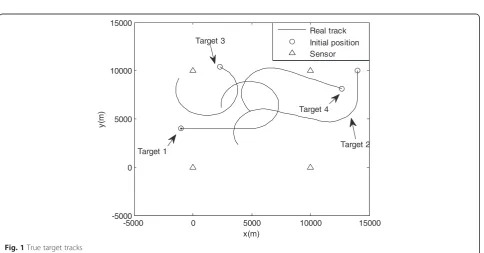
spontaneous birth at 13th minute with initial position (1.3 × 10⁴, 8 × 10³) m and disappears at 53th minute. The true trajectories of the four targets are depicted in Fig. 1. We model the birth process using a Poisson RFS with intensity
Γð Þi k ð Þ ¼x
X3
i¼1
0:2N x;mð ÞΓi;Pð ÞΓi
; i¼1;2;3 ð58Þ
where mð ÞΓ1 ¼ð−1103m;0m=s;4103m;0m=sÞ, mð ÞΓ2
¼ð1:4104m;0m=s;1104m;0m=sÞ,mΓð Þ3 ¼ð2103m;
0m=s; 10.5 × 10³m, 0m/s), mð ÞΓ4 ¼ð2103m; 0m=s;10:5
103m;0m=sÞ , and Pð ÞΓ1 ¼Pð ÞΓ2 ¼Pð ÞΓ3 ¼Pð ÞΓ4 ¼diag 400;1;400;1
ð Þ. The clutter is modeled as a Poisson RFS with the mean rate r= 10 over the observation space.
The probabilities of the target survival and detection are
pS,k= 0.99 andpD,k= 0.98.
To contrast the performance of different algorithms, two performance metrics are used. One is the statistics of the target number estimates. The other one is the optimal subpattern assignment (OSPA) distance [35], which is recently developed and defined as
dð ÞpcðX;YÞ ¼
1 n πmin∈Qn
Xm
i¼1
dð Þc xi;yπð Þi p
þcpðn−mÞ
!!1=p
ð59Þ
whereX= {x1,⋯,xm} and Y= {y1,⋯,yn} are arbitrary
fi-nite subsets, 1≤p<∞, c> 0, m,n∈No= {0, 1, 2,⋯}. If m>n,dð ÞpcðX;YÞ ¼dð ÞpcðY;XÞ. In the simulation, the pa-rameters of OSPA distance are set asp= 2 and c= 1000. Fig. 2Target number estimates
0 10 20 30 40 50 60
0 200 400 600 800 1000
Time (min)
O
SPA d
is
ta
n
c
e
APPF-CBMeMber MMP-CBMeMber( =0, 7) MMP-CBMeMber( =0, 4)
The simulation results are obtained from Monte Carlo experiments of 200 ensemble runs.
In this experiment, we compare the performance of multiple abruptly maneuvering targets tracking with
different algorithms. The turn rate ω is considered as
unknown and time-varying model parameter for the proposed APPF-CBMeMBer algorithm and the MMP-CBMeMBer algorithm. Moreover, the MMP-MMP-CBMeMBer algorithm uses a constant velocity (CV) model and two
coordinated-turn CT models, and the turn rate ω is
as-sumed a known value priori. We compare the proposed APPF-CBMeMBer algorithm with the MMP-CBMeMBer
(ω= 0, ± 4) algorithm and the MMP-CBMeMBer (ω=
0, ± 7) algorithm. It is noted that in the tracking
sce-nario, the real turn rates are ω= ± 7. The simulation
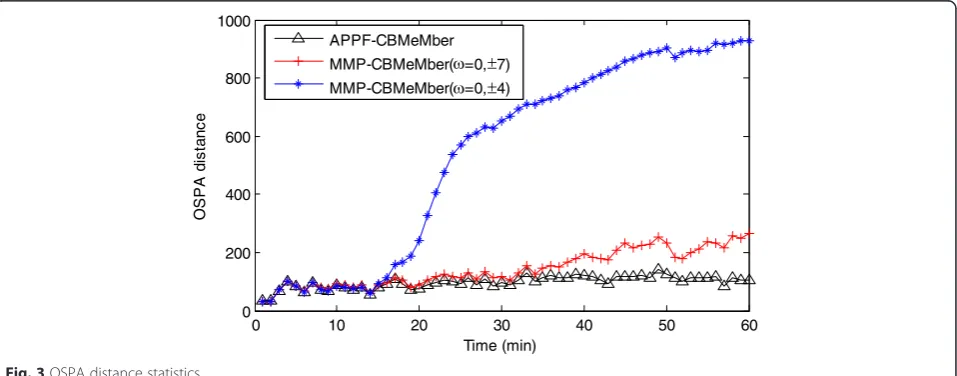
results for this experiment are shown in Figs. 2, 3, 4, 5, 6, and 7.
Figure 2 shows the averaged target number estimates of the APPF-CBMeMBer and MMP-CBMeMBer algorithms. It can be seen that the proposed APPF-CBMeMBer algo-rithm provides more accurate target number estimates than the benchmark MMP-CBMeMBer algorithm. The behind reason is that the proposed algorithm can ef-fectively joint estimate the unknown model parameter
ωwhich can be well matched with the motion model of
each target. While for the MMP-CBMeMBer algorithm, the tracking accuracy depends on the matching degree of the prior designed multiple model sets with the real target motion models. Unfortunately, the prior parame-ters of the various models are unknown; thus, the models cannot be well matched with the real motion model of each target (such as ω= 0, ± 4). Moreover,
al-though the MMP-CBMeMBer (ω= 0, ± 7) algorithm
in-cludes the real turn rates, the tracking accuracy is slightly lower than the proposed algorithm due to the disturbance of each model.
Figure 3 compares the OSPA distances of the two simu-lated algorithms, and it is clear that the proposed algorithm again outperforms the MMP-CBMeMBer algorithm. This is also due to the fact that the proposed method can adapt to the temporal evolution of the target maneuvering pa-rameters via estimating them with the target states.
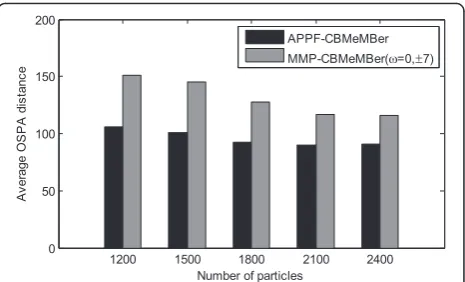
Figures 4 and 5 show the average RMSEs of target number estimates and the average OSPA distances under different number of particles. It is clear that the tracking accuracy of the two algorithms increase with the increase of the particle number. In addition, the ac-curacy of the APPF-CBMeMBer algorithm is always higher than that of the MMP-CBMeMBer algorithm. However, in Fig. 6, we can see that the proposed algo-rithm has a higher run time than the MMP-CBMeMBer algorithm, the reason is that the propose algorithm needs to select the parameter particles from the doubled particles, and the steps of parameter update occupy some time. However, for MM-based methods, the com-putational complexity may become prohibitive as the number of models needed would increase exponentially if more unknown parameters have to be taken into ac-count to match the possible target motion modes.
Fig. 4Average RMSEs of target numbers
Fig. 5Average OSPA distances with different number of particles
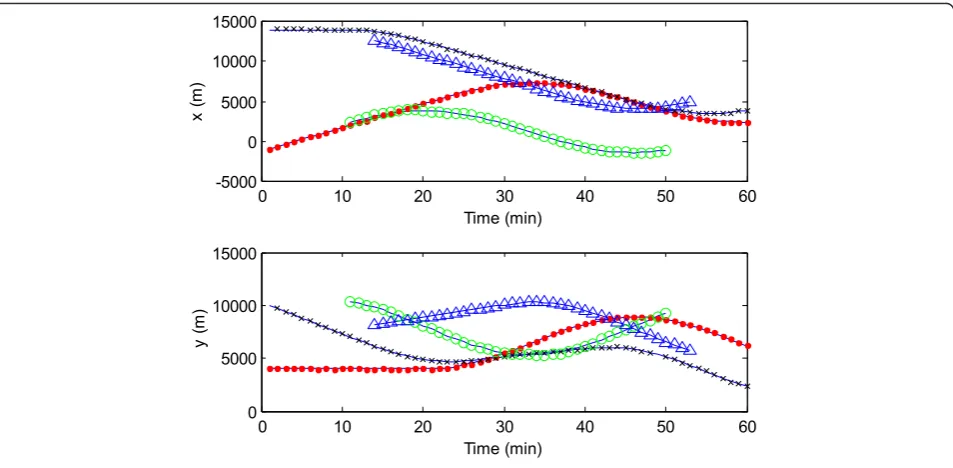
Figure 7 shows the track estimates of the proposed APPF-CBMeMBer algorithm. It is clear that the proposed algorithm has a good track maintenance performance due to its good performance in terms of the state estimates and their number estimates.
4 Conclusions
In this paper, we developed a new multiple maneuvering target tracker algorithm, referred to as the APPF-CBMeMBer tracker, to handle the presence of unknown and time-varying maneuvering parameter. In the pro-posed algorithm, the APE technique was incorporated to achieve online maneuvering parameter estimation, and the selected parameter particles were utilized to derive the approximation closed solution. Simulations showed that the newly proposed algorithm can offer higher tracking accuracy in the case of multiple maneuvering targets over the existing MMP-CBMeMBer algorithm. Furthermore, in order to obtain the individual target tracks, the particle labeling technique is introduced in the proposed algorithm.
In the future works, we shall consider introducing the APE technique into the LMB filter to obtain a better al-gorithm for tracking multiple targets with unknown but abruptly changing parameters.
Competing interests
The authors declare that they have no competing interests.
Acknowledgements
This paper is supported by the National Natural Science Foundation of China (Nos. 61305017, 61304264) and the Natural Science Foundation of Jiangsu Province (No. BK20130154).
Received: 1 March 2016 Accepted: 10 May 2016
References
1. R Mahler,Statistical multisource-multitarget information fusion(Artech House, Norwood, MA, 2007)
2. R Mahler, Multi-target Bayes filtering via first-order multi-target moments. IEEE Trans. Aerosp. Electron. Syst.39(4),1152–1178 (2003)
3. R Mahler, PHD filters of higher order in target number. IEEE Trans. Aerosp. Electron. Syst.43(4), 1523–1543 (2007)
4. BN Vo, S Singh, A Doucet, Sequential Monte Carlo methods for multi-target filtering with random finite sets. IEEE Trans. Aerosp. Electron. Syst. 41(4),1224–1245 (2005)
5. D Clark, J Bell, Convergence results for the particle PHD filter. IEEE Trans. Signal Process.54(7), 2652–2661 (2006)
6. BN Vo, WK Ma, The Gaussian mixture probability hypothesis density filter. IEEE Trans. Signal Process.54(11),4091–4104 (2006)
7. BT Vo, BN Vo, A Cantoni, Analytic implementations of the cardinalized probability hypothesis density filter. IEEE Trans. Signal Process.55(7),3553– 3567 (2007)
8. R Mahler,Approximate multisensor CPHD and PHD filters. Proceedings of the 13th International Conference on Information Fusion, Edinburgh, UK, 2010, pp. 1152–1178
9. R Mahler, BT Vo, BN Vo, CPHD filtering with unknown clutter rate and detection profile. IEEE Trans. Signal Process.59(8),3497–3513 (2011) 10. N Whiteley, S Singh, S Godsil, Auxiliary particle implementation of
probability hypothesis density filter. IEEE Trans. Aerosp. Electron. Syst. 46(3),1437–1454(2010)
11. M Yazdian-Dehkordi, Z Azimifar, MA Masnadi-Shirazi, Penalized Gaussian mixture probability hypothesis density filter for multiple target tracking. Signal Process.92(5),1230–1242 (2012)
12. ZX Liu, LJ Li, WX Xie et al., Sequential measurement-driven multi-target Bayesian filter. EURASIP Journal on Advances in Signal Processing43,1– 9 (2015)
13. ZX Liu, LJ Li, WX Xie et al., Two implementations of marginal distribution Bayes filter for nonlinear Gaussian models. AEU - International Journal of Electronics and Communications69(9),1297–1304 (2015)
14. BT Vo, BN Vo, A Cantoni, The Cardinality balanced target multi-Bernoulli filter and its implementations. IEEE Trans. Signal Process. 57(2),409–423 (2009)
15. BT Vo, BN Vo, R Hoseinnezhad et al., Robust multi-Bernoulli filtering. IEEE J. Sel. Top. Sign. Proces.7(3),399–409 (2013)
16. BT Vo, BN Vo, Labeled random finite sets and multi-object conjugate priors. IEEE Trans. Signal Process.61(13),3460–3475 (2013)
17. S Reuter, BT Vo, BN Vo et al., The labeled multi-Bernoulli filter. IEEE Trans. Signal Process.62(12),3246–3260 (2014)
18. MA Beard, BT Vo, BN Vo, Bayesian multi-target tracking with merged measurements using labelled random finite sets. IEEE Trans. Signal Process. 63(6),1433–1447 (2015)
19. JL Yang, HW Ge, An improved multi-target tracking algorithm based on CBMeMBer filter and variational Bayesian approximation. Signal Process. 93(9),2510–2515 (2013)
20. ML Hernandez, B Ristic, A Farina et al., Performance measure for Markovian switching systems using best-fitting Gaussian distributions. IEEE Trans. Aerosp. Electron. Syst.44(2),724–747 (2008)
21. XR Li, VP Jilikov, Survey of maneuvering target tracking. Part V: multiple-model methods. IEEE Trans. Aerosp. Electron. Syst.41(4),1255–1321 (2005) 22. A Pasha, BN Vo, HD Tuan et al.,Closed-form PHD filtering for linear jump
Markov models. Proceedings of the 9th International Conference on Information Fusion, Florence, Italy, 2006
23. SA Pasha, BN Vo, HD Tuan et al., A Gaussian mixture PHD filter for jump Markov system models. IEEE Trans. Aerosp. Electron. Syst.45(3),919–936 (2009) 24. SA Pasha, HD Tuan, P Apkarian,The LFT based PHD filter for nonlinear jump
Markov models in multi-target tracking. Proceedings of the IEEE Conference on Decision and Control, Shanghai, China, 2009, pp. 5478–5483 25. WL Li, YM Jia, Gaussian mixture PHD filter for jump Markov models based on
best-fitting Gaussian approximation. Signal Process.91(4), 1036–1042 (2011) 26. K Punithakumar, T Kirubarajan, A Sinha, Multiple-model probability
hypothesis density filter for tracking maneuvering targets. IEEE Trans. Aerosp. Electron. Syst.44(1), 87–98 (2008)
27. R Georgescu, P Willett, The multiple model CPHD tracker. IEEE Trans. Signal Process.60(4), 1741–1751 (2012)
28. R Mahler,On multitarget jump-Markov filters. Proceedings of the 15th International Conference on Information Fusion, Singapore, 2012, pp. 149–156 29. JL Yang, HB Ji, HW Ge, Multi-model particle cardinality-balanced multi-target
multi-Bernoulli algorithm for multiple manoeuvring target tracking. IET Radar Sonar Navig.7(2),101–112 (2013)
30. J Liu, M West, Combined parameter and state estimation in simulation-based filtering, inProceedings of the sequential Monte Carlo Methods in practice, Springer, New York, 2001, pp. 197–223
31. C Carvalho, M Johannes, H Lopes et al., Particle learning and smoothing. Stat. Sci.25(1),88–106 (2010)
32. C Nemeth, P Fearnhead, L Mihaylova, Sequential Monte Carlo methods for state and parameter estimation in abruptly changing environments. IEEE Trans. Signal Process.62(5),1245–1255 (2014)
33. M West, Approximating posterior distributions by mixture. J. R. Stat. Soc. 55(2),409–422 (1993)
34. DE Clark, J Bell, Multi-target state estimation and track continuity for the particle PHD filter. IEEE Trans. Aerosp. Electron. Syst.43(4),1441–1452 (2007) 35. D Schuhmacher, BT Vo, BN Vo, A consistent metric for performance evaluation
of multi-object filters. IEEE Trans. Signal Process.56(8),3447–3457 (2008)
Submit your manuscript to a
journal and benefi t from:
7 Convenient online submission
7Rigorous peer review
7 Immediate publication on acceptance
7Open access: articles freely available online
7 High visibility within the fi eld
7Retaining the copyright to your article