EFFECTIVITY AND PHYSICOCHEMICAL STABILITY OF NANOSTRUCTURED LIPID
CARRIER COENZYME Q10 IN DIFFERENT RATIO OF LIPID CETYL PALMITATE AND ALPHA
TOCOPHERYL ACETATE AS CARRIER
ASTRIDANI RIZKY PUTRANTI
1, RIESTA PRIMAHARINASTITI
2, ESTI HENDRADI
3*
1Department of Pharmaceutical, Faculty of Pharmacy, Airlangga University, Dharmawangsa Dalam, Surabaya 60286, East Java, Indonesia. 2Departement of Pharmaceutical Chemistry, Airlangga University, Dharmawangsa Dalam, Surabaya 60286, East Java, Indonesia. 3Department of Pharmaceutics, Faculty of Pharmacy, Airlangga University, Dharmawangsa Dalam, Surabaya 60286, East Java, Indonesia.
Email: [email protected]
Received: 23 August 2016, Revised and Accepted: 01 November 2016
ABSTRACT
Objective: The aim of this study was to investigate physical characteristics of nanostructured lipid carriers (NLCs) mixture of alpha tocopheryl acetate, cetyl palmitate, Tween 80 and propylene glycol using high shear homogenization technique on NLC preparation to predict the optimum ratio of alpha tocopheryl acetate-cetyl palmitate to produce good characteristics of NLC loaded coenzyme, higher % EE, good penetration, controlled release, and stable.
Methods: Lipid characterizations were conducted by diffraction scanning calorimetry, X-ray diffraction, and Fourier transforms infrared spectrophotometry. Coenzyme Q10 concentration was measured by spectrophotometer at 275 nm. NLC characteristics based on their morphology was determined using transmission electron microscope, particle size, and its polydispersity index which were measured with Delsa Nano™ particle size analyzer. Percentage of coenzyme Q10 entrapped in NLC was determined by dialysis bag method. Coenzyme Q10 release profile was measured using with Franz cell for 12 hrs. The penetration depth of NLC coenzyme Q10 in abdominal skin of Wistar rat was determined with fluorescence microscopy using rhodamine B as marker. NLC physical stability based on minimum of particle size variation, pH and viscosity during 90 days storage.
Results: The result showed that formula with ratio of cetyl palmitate-alpha tocopheryl acetate 70:30 (% w/w) produce good characteristics of NLC loaded coenzyme, higher % EE, good penetration, controlled release, and stable in 90 days storage.
Conclusion: The coenzyme Q10 NLC system with cetyl palmitate and alpha tocopherol acetate as lipid matrixare characterized by small particle size, low crystallinity, spherical morphology of particle and high coenzyme Q10 entrapment efficiency. Crystal modification led to the formation of a more amorphous thereby increasing the drug entrapment
Keywords: Coenzyme Q10, Nanostructured lipid carrier, Cetyl palmitate, Alpha tocopheryl acetate, High shear homogenization.
INTRODUCTION
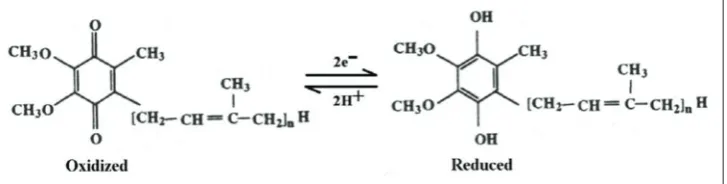
Coenzyme Q10 (also called ubiquinone, ubidecarenone, coenzyme Q10 or Q10) is a lipid soluble compound found naturally in plants and animals, as well as in microorganisms. The chemical structure of coenzyme Q10 consists of a quinone ring attached to an isoprene side chain. The number of isoprene units in the side chain varies with each species of plants and animals. Coenzyme Q10 in humans has 10 isoprene units, therefore, it is known as coenzyme Q10 [1]. Coenzyme Q10 plays an important role in the mitochondrial electron transport chain as an electron carrier. It exists in two redox forms, an oxidized and a reduced form. The reduced form of coenzyme Q10, ubiquinol, is the only endogenously synthesized fat-soluble antioxidant protecting cellular membranes and plasma lipoproteins from lipid peroxidation [2]. Therefore, roles of coenzyme Q10 in the biological system could be categorized into two important purposes, one involving in the oxidative phosphorylation process to generate ATP and the other being involved in preventing lipid oxidation and scavenging superoxide [1,3].
Coenzyme Q10 is known as an endogenous cellular antioxidant. It is composed of a long side chain containing 10 isoprenoid units. Due to its structure, the aqueous solubility is very low, causing a low oral bioavailability [4]. In terms of cosmetic applications, this active has shown the ability to reduce photoaging in vivo with a corresponding decrease in wrinkle depth [5-7].
Coenzyme Q10 shaped crystalline powder, insoluble in water, has a high lipophilicity properties. Coenzyme Q10 solubility in water is very
not stable in the presence of light and oxidizing substances present in the air. One of the main issues of the use of coenzyme Q10 is related to the potential efficacy as determined by absorption and bioavailability. Coenzyme Q10 has a complex chemical structure that formulations do have to get an effective product with good stability [4].
Nanostructured lipid carriers (NLCs) have many advantages such as occlusion and skin hydration, absorption-increasing effects, active penetration enhancement, and controlled-release properties. NLC was developed by exchanging the liquid lipid (oil) of oil-in-water (o/w) emulsions by a solid lipid, which can bring many advantages in comparison to a liquid core. The concept of NLC was developed by nanostructuring the lipid matrix, to give more flexibility for modulation of drug release, increasing the drug loading and preventing its leakage. The result is a less ordered lipid matrix with many imperfections, which can accommodate a higher amount of drug. The other advantages of using lipids as carrier systems for skin administration are related to their physiological and well-tolerated nature, which reduces the risk of toxicological problems and local irritancy [9,10]. NLCs are lipid nanoparticles that can increase the penetration of lipophilic drug substance, as it has occlusive properties and improves skin hydration. Therefore, Coenzyme Q10 encapsulated in the NLC system to increase its penetration into the skin [11,12].
MATERIALS AND METHODS Materials
Coenzyme Q10 was obtained from Xi’an Future Biotechnology, Co., © 2017 The Authors. Published by Innovare Academic Sciences Pvt Ltd. This is an open access article under the CC BY license (http://creativecommons. org/licenses/by/4. 0/) DOI: http://dx.doi.org/10.22159/ajpcr.2017.v10i2.14835
propylene glycol was obtained from Dow Chemical Pacific, Tween 80 was obtained from KAO corporation, Ethanol p.a, NaOH (sodium hydroxide) and NaH2PO4 (natrium dehydrogenate phosphate) p.a were product
of Merck. Aquabidestilata was gift sample from PT. Widatra Bhakti, Pasuruan, Indonesia. All other ingredients used were analytical grade.
Methods
Preparation of coenzyme Q10 NLC system
The method of this research is using high shear homogenization. Coenzyme Q10 NLC system was made by melting the lipid phase (cetyl palmitate and alpha tocopheryl acetate) with different lipid ratio (70:30, 80:20, and 90:10), and Coenzyme Q10 at 65°C temperature. At the same time, the surfactant solution (propylene glycol, Tween-80, and pH phosphate buffer 6.0±0.05) was prepared and heated at the same temperature. Then, this heated surfactant solution is dispersed into heated lipid phase by using Ultra-Turax at 24,000 rpm speed for 2 minutes. Subsequently, the NLC dispersions were formed simply by cooling the warm pre-emulsion precursor to room temperature in the same container [3,13]. The composition of coenzyme Q10 NLC system can be seen in Table 1.
Physical and chemical characterization of coenzyme Q10 NLC system
Fourier transforms infrared (FTIR) spectroscopy
The sample was combined with KBr and pressed into a pellet (ratio 1:1). The solid pellet was analyzed using spectroscopy FTIR Jasco 4200; the examination was conducted in wave number range of 4000-400/cm. Infrared spectra obtained were compared with literature.
pH
The electrode was inserted into 10 ml coenzyme Q10 NLC; the electrode must be sinked into sample. The pH values observed until the screen showed a stable number.
Viscosity
Viscosity observed to know the thickness of coenzyme Q10 NLC system. It was analyzed with cone and plate viscometer. 2.0 ml amount of coenzyme Q10 NLC system placed on the sample cup, then the viscometer is turned on. Viscosity measured when the value is showed stable.
Particle size and size distribution
Examination of particle size and size distribution has done by Delsa™Nano Submicron 2.0 ml amount of sample coenzyme Q10 system
dilute with 10.0 ml aquadest. Particle size analyzer. The tool will measure it over 10 minutes. The observed data are the average droplet diameter and polydispersity index (PI). PI illustrates the variation on
the sample. The small value of PI (<0.3) indicates that the sample is monodisperse [9].
Zeta potential
Zeta potential was measured using Malvern Instrument® with cell and
the appropriate procedure. The instrument can measure on 0.001-40% concentration. The sample is dispersed into water until it gets the concentration on optimum intensity of the instrument. The suspension was sonicated for approximately 2 minutes to break agglomerate, then it is measured [10].
Particle morphology
This evaluation used to determine the form of particle contained in NLC. Coenzyme Q10 NLC system was dispersed in 1% CMC Na gel and spreaded on glass platesm then the sample dried to loss the water content in NLC system. The dry NLC system coated with Aurum before counted in vacuum condition. Particle morphology examination observed at 10.000× magnification [4].
Cristallinity
Different scanning calorimetry (DSC)
Sample weighed at 2-8 mg of coenzyme Q10 and cetyl palmitate. Sample inserted into an aluminum pan that is impermeable to air. This pan is heated to the temperature 30-300°C at calorimeter with the temperature rise 10°C every minutes Melting temperature measurement observed with thermogram peak.
X-ray diffraction (XRD)
The sample is inserted to the holder glass and the surface is trimmed by plate glass. This sample is placed in X-ray Philips X’Pert diffractometer. The measurement condition was: 40 kV voltage; 30 mA; 0.5° Divergent and scatter slits; 0.15 mm receiving slit. Then, it observed over a range
of 2θ angle from 5° to 50°.
Entrapment efficiency of coenzyme Q10
Drug E.E was calculated by determining the amount of drug unentrapped (Cf) after removal of NLC system by dialysis bag. Coenzyme Q10 which is unentrapped in NLC system would be dispersed in phosphate buffer with pH 6.0±0.05 as a supernatant. The obtained sample was filtered using Millipore Whatman 0.2 µm filter paper. This evaluation used ultraviolet (UV) spectrophotometer. Furthermore, it is calculated using this following formula:
EE (%) = (Ct-Cf/Ct) × 100%.
Where Ct is the total amount of drug added in the formulation. The concentration of drug was determined by double beam UV-VIS
Table 1: Composition of coenzyme Q10 NLC system Formulation code Coenzyme Q10 (%b/b) Cetyl
palmitate (%b/b) Alpha tocopherol acetate (%b/b) Tween 80 (%b/b) Propyleneglycol (%b/b)
F1 2.4 70 30 20 11
F2 2.4 80 20 20 11
F3 2.4 90 10 20 11
NLC: Nanostructured lipid carrier
Tables 2: Penetration depth of coenzyme Q10 NLC System in each formula
Formula F1
Location Penetration depth after 2nd hrs Penetration depth after 4th hrs Penetration depth after 6th hrs
Epidermis 1137.85 µm (0.11378 mm) -
-Epidermis–Dermis - 1346.15 µm (0.13615 mm) 1367.95 µm (0.136795 mm) Formula F2
Location Penetration depth after 2nd hrs Penetration depth after 4th hrs Penetration depth after 6th hrs
Epidermis 820.54 µm (0.082054 mm) 867.61 µm (0.086761 mm) 881.27 µm (0.088127 mm) Formula F3
Location Penetration depth after 2nd hrs Penetration depth after 4th hrs Penetration depth after 6th hrs
spectrophotometer (Shimadzu UV-1800) with multiple wavelenght method [14].
In vivo penetration study of cenzyme Q10 NLC system
Preparation of membrane test
Wistar rat prepared in accordance with the inclusion criteria. Anesthetic solution prepared in mice, then anesthetized about 5 minutes, the mice will collapse (±45 minutes). Mice placed on a table and four legs dipijat with plaster. f. Hair shaved rat abdominal section, it was confirmed that the skin after the rats were shaved uninjured. Rat skin area divided by hepafix. Weighed 200 mg of the test sample, then gets applied to the abdomens of mice, the breadth of 2×3 cm2. After 2 and 4 and 6 hrs,
mice were killed by cervical dislocation. The skin of the applied sample is cut with an area of 1×4 cm2. Thickness of 200 µm using the tool
dermatomization. After that, the skin tissue was washed three times with absolute alcohol. Embedding using samples grown in liquid paraffin on beam inert paper. Objects placed in accordance with the orientation of the cutting, left to freeze and then stored in the block holder. Samples are cut transversely and horizontally using cryotome (Tissue-Tek Cryo3,
Sakura) at a temperature of −59°C with a size of 1 mm2 and a thickness
of 5 lm/l. Sliced visualized to determine the depth of penetration by using Rhodamine B using a red filter with a fluorescent microscope [8].
Observations with fluorescence microscope
Abdominal skin membrane of male Wistar Rat was examined by fluorescence microscope (FSX 100, Olympus). Visualization is done to observe the distribution of the stocks that have been given a marker Rhodamine B in the skin layer. Images recorded with the integrity of
camera time is set to 10 m. The sample rate is 4.0 μ detik/pixel. The
objective lens in the magnification of 20× (7).
Statistical analysis
Characterization evaluation (pH, viscosity, particle size, zeta potential, and entrapment efficiency of drug) of Coenzyme Q10 NLC system has statistically analyzed using one-way analysis of variance (ANOVA) method at 95% level. Then, significantly difference of NLC system formula obtained by post-hoc Bonferroni test.
RESULTS AND DISCUSSION
Physical and chemical characterization of meloxicam NLC system FTIR spectroscopy
The analysis of functional group change in coenzyme Q10 NLC system was done by comparing the infrared spectrum of coenzyme Q10 NLC system with the material infrared spectrum, which can be seen in Figs. 1 and 2.
Coenzyme Q10 NLC system with some ratios of the lipid matrix concentration has a similar FTIR spectrum profile. This condition shows that there is no difference in the interaction of some components when forming the NLC system. This condition shows that there was a possibility of intermolecular hydrogen bonds with average strength with a hydroxyl group of some component. In addition, there is no new characteristic peak that appears in the FTIR spectrum of coenzyme Q10 NLC system. Based on FTIR spectrum result, it could be seen that there was no chemical interaction between Coenzyme Q10 with a constituent component of NLC system. There was only physical reaction in NLC system formation. The formation of Coenzyme Q10 NLC system with lipid matrix of cetyl palmitate and alpha tocopherol acetate can be identified from characteristic peak in finger print area.
pH parameter
The pH parameter of coenzyme Q10 NLC system has a connection with the pH stability of active ingredient and the convenience in topical administration. Topical dosage forms pH applied on the skin should has a value on 4.5-6.5.
The obtained NLC system had a pH value in the range of 6.26-6.38. The histogram of average pH in some formulas of NLC system can be seen in Fig. 3.
Statistically analysis using ANOVA showed that there was no significant difference between pH in each formula of NLC system (*p>0.05). Based on this results, could be concluded that the ratios of solid and liquid lipid matrix did not affect the pH value of NLC system.
Fig. 1: Oxidized and reduced forms of coenzyme Q: In humans, the number of isoprene units (n) is 10
Viscosity test
Coenzyme Q10 NLC system which has been produced had viscosity values from 37.83 to 88.38 c.Ps. The histogram of average viscosity in some formulas of NLC system can be seen in Fig. 4.
Statistically analysis using ANOVA showed that there was significantly differences (*p<0.05) in ech formula. From post-hoc test result (Bonferroni), it could be known that F1 is significantly different from F2 and F3 From this result, it can be proved that the increased number of liquid lipid which is added to the formula is capable to decrease the viscosity values of NLC system.
Viscosity is a barrier of liquid to flow, if the viscosity of the sample is higher, the barrier to flow is also high. The viscosity of NLC system is affected by the composition of NLC system formula.
Particle size and size distribution of NLC
From the particle examination result of all NLC system formulas, the particle size was about <1000 nm. The particle size of Coenzyme Q10 NLC system was about 145.27 to 178.3 nm. In addition, the histogram of average particle size in some NLC formulas can be seen in Fig. 5.
Statistically analysis using ANOVA showed that there was significant differences (*p<0.05) in ech formula. From post-hoc test result (Bonferroni), it could be known that F1 is significantly different from F2 and F3. The particle size of NLC prepared using cetyl palmitate (solid lipid) depended on liquid lipid content. A trend toward the decrease in particle size with the increase in content was observed. Cetyl palmitate is a wax lipid group, has a highly ordered crystal lattice and alpha tocopheryl acetate having less ordered crystal lattice. Differences in chemistry, physics and crystallographic characteristics of the system will affect the NLC.
Statistically analysis of PI using ANOVA showed that there was significant differences (*p<0.05) in ech formula. From post-hoc test result (Bonferroni), it could be known that F1 is significantly different from F2 and F3. The phenomenon of polymorph rapid change affects the instability of NLC system, such as the transformation of structure particle, agglomeration, and sedimentation in aqueous phase. This condition can affect the formation of NLC system with polydisperse particle size distribution and higher tendency to agglomeration.
Zeta potential
Zeta potential measurement is an indirect measurement of NLC physical stability and it also affects the release kinetics and biological process of nanoparticle. Zeta potential is the electrical potential on sliding area, which is defined as the electrical charge of outer particle surface where the opposite charge still able to strongly bound with other particles when they move in an electrical field.
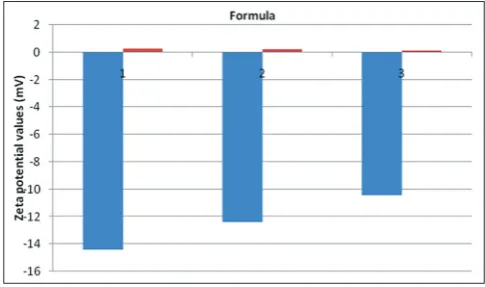
Zeta potential measurement obtained 10.4-15.4 as a negative value. The histogram of average zeta potential in all NLC system is shown in Fig. 6.
Statistically analysis of PI using ANOVA showed that there was significant differences (*p<0.05) in ech formula. From post-hoc test result (Bonferroni), it could be known that F1 is significantly different from F2 and F3.
The examination of crystallinity The XRD data
XRD analysis is used to know the crystallinity change of active substance and lipid component in NLC system. XRD’s pattern of coenzyme Q10, cetyl palmitate, and some NLC formulas can be seen in Fig. 7.
Fig. 3: The histogram of average pH in some formulas of nanostructured lipid carrier system
Fig. 4: The histogram of average viscosity in some formulas of nanostructured lipid carrier system
Fig. 5: The histogram of average particle size in some nanostructured lipid carrier formulas in aqueous media by
using DelsaNano®
Fig. 6: The histogram of some nanostructured lipid carrier formulas average zeta potential in aqueous media using Malvern
At the results of all formulas with different ratio of solid lipid and liquid lipid, it was known that NLC system peak intensity has decreased. The result showed that NLC system was amorphous form. The condition indicated that coenzyme Q10 was entrapped in NLC system.
DSC
DSC analysis provides the data such as thermogram to determine the melting point of a sample. The result of this data can be seen in Fig. 8.
The melting point of NLC has decreased when it is compared with melting point of the bulk lipid. This decrease occurs because there is a foreign molecule (molecule of the active substance or surfactant) which is dissolved in lipid matrix. The melting point and crystallinity will change after they are formed in NLC system. The DSC of NLC system
result shows that enthalpy result (ΔH) is lower than enthalpy (ΔH) bulk
lipid. Based on DSC result, the melting point of NLC system was bigger than the bulk lipid.
The examination of particle morphology in NLC system
The examination result of particle morphology in NLC using scanning electron microscopy (SEM) can be seen in Fig. 9.
Based on the observation of particle morphology using SEM with a magnification of 10,000 times, each formula showed that the particle
is almost spherical-shaped in F2 and F3 but very spherical in F1. This particle size could produce the controlled release and avoid the agglomeration. Particle with a sphere shape has a little contact with media which causeslonger diffusion process than non-spherical particle. Spherical surface particle has little contact between particlesthat causes agglomeration risk between particles is smaller.
Coenzyme Q10 entrapment efficiency
In a number of drugs, the solubility in liquid lipid is greater than in solid lipid, and the addition of liquid lipid to solid lipid can damage the crystal lattice in the matrix of lipid nanoparticle, then it can increase the entrapment efficiency of active ingredient. Entrapment efficiency increases by increasing the concentration of liquid lipid. In NLC system, high solubility of active ingredient in liquid lipid plays an important role in increasing the entrapment efficiency of the active ingredient.
The measurement of entrapment efficiency in the sixth formulas of NLC system showed the high result (>70%). The measurement result of entrapment efficiency of coenzyme Q10 in NLC system was 79.19-95.56. The histogram of average % entrapment efficiency of some NLC formulas can be seen in Fig. 10
Statistically analysis of particle size using ANOVA showed that there was a significant difference between the formulas of NLC system. From
Fig. 7: The examination result of X-ray diffraction. (a) F3, (b) F2, (c) F1, (d) coenzyme Q10, (e) cetyl palmitate
post-hoc test (Bonferroni), it could be known that there were significant differences between the percents of entrapment efficiency in F1 with F2 and F3. F1 had the highest percent of entrapment efficiency, and F3 had the lowest percent of entrapment efficiency. This result is consistent with the concentration theory of liquid lipid which can produce the big entrapment efficiency because of the active substance solubility in liquid lipid increases.
Study of in vivo penetration hasil uji penetrasi coenzyme Q10 NLC system in abdominal skin of male Wistar rat using fluorescence microscopy
Rhodamine B is used as a fluorescence label has properties that solubility to organic solvents and high lipids that can be used as a lipophilic dye. Rhodamine B has large conjugated aromatic groups that triggered floresensinya properties. Rhodamine B measured at the maximum wavelength of 573 nm.
Spherical particle morphology can affect the increase in the surface area of particles that contact with skin. Small particle size between particles can cause the densed structure, causing occlusifity increased due to an increase in particle surface area in contact with the skin. Occlusifity led to skin hydration. The hydration of the stratum corneum can affect the rate of penetration of the skin [15-17]. The overview of in vivo penetration coenzyme Q10 nanostructured lipid carrier in the abdominal skin of Wistar rat with fluorescent microscopy can be seen in Fig. 11.
CONCLUSION
The coenzyme Q10 NLC system with cetyl palmitate and alpha tocopherol acetate as lipid matrixare characterized by small particle size, low crystallinity, spherical morphology of particle and high coenzyme Q10 entrapment efficiency. Crystal modification led to the formation of a more amorphous thereby increasing the drug entrapment [1].
Trapping efficiency can be affected by the merger of the liquid lipid and solid lipid. This merger affect the crystal lattice imperfections and leave enough space for entry and trapping drug [3].
The addition of liquid lipid in the formula may affect the solubility of the drug substance in the system and imperfections of the crystal lattice so that when you experience the lipid phase drug compaction many were trapped in the system. Increasing the liquid lipid concentration can also reduce the viscosity of the NLC system and improve the entrapment efficiency. The low viscosity effect on the high rate of release of drug substance caused by of constraints (steric barrier) intermolecular loose so that the drug molecule is easier to out. Concentration ratio also affects the pH, PI, and the zeta potential but the value is not equal with the addition of a lipid component [14,18].
Spherical particle morphology can affect the increase in the surface area of particles that contact with skin. Small particle size between particles can cause the densed structure, causing occlusifity increased due to an increase in particle surface area in contact with the skin. Occlusifity led to skin hydration. The hydration of the stratum corneum can affect the rate of penetration of the skin [8,11].
REFERENCES
1. Hargreaves IP. Coenzyme Q10 as a therapy for mitochondrial disease. Int J Biochem Cell Biol 2014;49:105-11.
2. Kovacevic A, Savic S, Vuleta G, Müller RH, Keck CM. Polyhydroxy surfactants for the formulation of lipid nanoparticles (SLN and NLC): Effects on size, physical stability and particle matrix structure. Int J Fig. 10: The histogram of average % entrapment efficiency of all
nanostructured lipid carrier system formulas
Fig. 9: The test result of particle morphology in nanostructured lipid carrier system with 10.000× magnification using scanning
electron microscopy ZEISS. (a) F1; (b) F2; (c) F3
a b
c
Fig. 11: Overview in vivo penetration coenzyme Q10 nanostructured lipid carrier in the abdominal skin of Wistar
rat with fluorescent microscopy Olympus FX-100 with 10× magnification. (a) Penetration of FI in 2 hrs. (b) Penetration of F1 in 4 hrs (c) penetration of F1 in 6 hrs (d) penetration of F2 in 2 hrs (e) penetration of F2 in 4 hrs (f) penetration of F2 in 6 hrs (g) penetration of F3 in 2 hrs (h) penetration of F3 in 4 hrs
(i) penetration of F3 in 6 hrs
a
d
g
b
e
h
c
f
Pharm 2011;406(1-2):163-72.
3. López-García R, Ganem-Rondero A. Solid lipid nanoparticles (SLN) and nanostructured lipid carriers (NLC): Occlusive effect and penetration enhancement ability. J Cosmet Dermatol Sci Appl 2015;5:62-72. 4. Loo CH, Basri M, Ismail R, Lau HL, Tejo BA, Kanthimathi MS, et al.
Effect of compositions in nanostructured lipid carriers (NLC) on skin hydration and occlusion. Int J Nanomedicine 2013;8:13-22.
5. Brugè F, Damiani E, Puglia C, Offerta A, Armeni T, Littarru GP,
et al. Nanostructured lipid carriers loaded with Coq10: Effect on human dermal fibroblasts under normal and UVA-mediated oxidative conditions. Int J Pharm 2013;455(1-2):348-56.
6. Fan H, Liu G, Huang Y, Li Y, Xia Q. Development of a nanostructured lipid carrier formulation for increasing photo-stability and water solubility of phenylethyl resorcinol. Appl Surf Sci 2014;288:193-200. 7. Agmo Hernández V, Eriksson EK, Edwards K. Ubiquinone-10 alters
mechanical properties and increases stability of 2 phospholipid membranes. Biochim Biophys Acta 2015;1848:2233-43.
8. Pardeike J, Schwabe K, Müller RH. Influence of nanostructured lipid carriers (NLC) on the physical properties of the Cutanova Nanorepair Q10 cream and the in vivo skin hydration effect. Int J Pharm 2010;396(1-2):166-73.
9. Almeida MM, Bou-Chacra NA, Conte JD, Kaneko TM, Baby AR, Velasco MV. Evaluation of physical and chemical stability of nanostructured lipid carries containing ursolic acid in cosmetic formulation. J Appl Pharm Sci 2013;3(01):005-8.
10. Castelli F, Puglia C, Sarpietro MG, Rizza L, Bonina F. Characterization of indomethacin-loaded lipid nanoparticles by differential scanning
calorimetry. Int J Pharm 2005;304(1-2):231-8.
11. Piao H, Ouyang M, Xia D, Quan P, Xiao W, Song Y, et al. In vitro–in vivo study of CoQ10-loaded lipid nanoparticles in comparison with nanocrystals. Int J Pharm 2011;419(1-2):255-9.
12. Teeranachaideekul V, Souto EB, Junyaprasert VB, Muller RH. Cetyl palmitate-based NLC for topical delivery of Coenzyme Q10 – Development, physicochemical characterization and in vitro release studies. Eur J Pharm Biopharm 2007;67(1):141-8.
13. Gupta RB. Fundamentals of Drug Nanoparticles in Nanoparticle Technology for Drug Delivery. Vol. 159. New York: Taylor and Francis; 2006. p. 124-30.
14. Lucangioli S, Tripodi V. The importance of the formulation in the effectiveness of coenzyme Q10 supplementation in mitochondrial disease therapy. Der Pharm Sin 2012;3(4):406-7.
15. Teeranachaideekul V, Boonme P, Souto EB, Müller RH, Junyaprasert VB. Influence of oil content on physicochemical properties and skin distribution of Nile red-loaded NLC. J Control Release 2008;128(2):134-41.
16. Yue Y, Zhou H, Liu G, Li Y, Yan Z, Duan M. The advantages of a novel CoQ10 delivery system in skin photo-protection. Int J Pharm 2010;392(1-2):57-63.
17. Zhai Y, Xiaoye Y, Zhao L, Wang Z, Zhai G. Lipid nanocapsules for transdermal delivery of ropivacaine: In vitro and in vivo evaluation. Int J Pharm 2014;471(1-2):103-11.