Volume 2008, Article ID 765803,13pages doi:10.1155/2008/765803
Research Article
An Efficient Addressing Scheme and Its Routing Algorithm for
a Large-Scale Wireless Sensor Network
Soojung Hur,1Jaehyen Kim,1Jeonghee Choi,2and Yongwan Park1
1Mobile Communication Laboratory, Yeungnam University, Gyeongsan, Gyeogbuk 712-749, South Korea
2School of Computer Communication Engineering, Daegu University, Gyeongsan, Gyeongbuk 712-714, South Korea
Correspondence should be addressed to Yongwan Park,[email protected]
Received 31 December 2007; Revised 5 June 2008; Accepted 22 September 2008
Recommended by Athanasios Vasilakos
So far, various addressing and routing algorithms have been extensively studied for wireless sensor networks (WSNs), but many of them were limited to cover less than hundreds of sensor nodes. It is largely due to stringent requirements for fully distributed coordination among sensor nodes, leading to the wasteful use of available address space. As there is a growing need for a large-scale WSN, it will be extremely challenging to support more than thousands of nodes, using existing standard bodies. Moreover, it is highly unlikely to change the existing standards, primarily due to backward compatibility issue. In response, we propose an elegant addressing scheme and its routing algorithm. While maintaining the existing address scheme, it tackles the wastage problem and achieves no additional memory storage during a routing. We also present an adaptive routing algorithm for location-aware applications, using our addressing scheme. Through a series of simulations, we prove that our approach can achieve two times lesser routing time than the existing standard in a ZigBee network.
Copyright © 2008 Soojung Hur et al. This is an open access article distributed under the Creative Commons Attribution License, which permits unrestricted use, distribution, and reproduction in any medium, provided the original work is properly cited.
1. INTRODUCTION
Large-scale events such as disaster relief or rescue efforts require the most effective and highly available communi-cation capabilities. To provide better communicommuni-cation and monitoring capabilities, such applications may be tremen-dously benefited from the use of self-organizing networks over wireless medium [1]. Existing wireless sensor networks (WSNs) such as ZigBee network, however, do not scale well, because many of them have targeted smaller deployments, typically less than hundreds of sensors. Real world deploy-ments identified several limitations in the existing WSNs and reported that certain physical topologies would run out of address space quickly [2].
We recognized that such limitations were closely related with the addressing schemes and the routing methods of WSN standards. To uniquely identify sensor nodes through their addresses in an ad hoc and mesh-style wireless network, standard address schemes such as ZigBee Cskip algorithm [3] utilize available address space sparsely, thus causing significant wastage of address space [2,4,5]. In a large-scale WSN, flat routing methods are unsuitable because of their
flooding nature for routing path construction [6–8]. On the other hand, tree-based routing methods, at the expense of robustness, achieve acceptable routing performance because of their low routing overhead [9,10].
In this study, we focus on an efficient address assignment scheme by using n-dimensional address subspacing and its tree-based routing algorithm for a large-scale WSN. Especially, we are interested in tackling the address wastage problem for a ZigBee network. We also present a location-aware routing algorithm that also uses our address subspac-ing and discuss its pros and cons.
This article is organized as follows. InSection 2, various addressing assignment schemes and their routing algorithms are presented. Section 3introduces the addressing scheme and its routing policy of early ZigBee standard, addresses its problem, and reports several proposals to cope with the problem. In Section 4, we describe our n-dimensional addressing scheme and its routing algorithm that reuses the existing address scheme. In the same section, we also discuss the potential of the location-aware routing algorithm that is also newly devised to improve wireless performance.
scheme and our scheme through simulations. Finally, we describe our contributions and future research direction in
Section 6.
2. RELATED WORKS
Addressing and routing have been extensively studied in the literature for decades. It will be too ambitious to cover all the issues in rather a short section. Instead, we present general ideas and trends in these areas for WSNs. For a better presentation, we separate issues into two parts: addressing and routing.
2.1. Addressing
Existing addressing policies in WSNs fall into two groups: tree based and ad hoc based. The tree-based addressing uses hierarchical addressing policy [11, 12], while the ad hoc addressing is originated from the addressing schemes for wireless ad hoc network [13–15].
PalChaudhuri et al. proposed a robust, stateless address-ing, and routing architecture called TreeCast [11]. Unlike what the name implies, its address assignment is the most crucial step, while its routing procedure is trivial. It is because the address of a newly joining node is determined on demand and the address in itself encapsulates the path to a parent. Therefore, routing from a source to a sink becomes trivial. A new node joins the network by choosing its parent among candidate parents randomly. Its new address is incrementally allocated by combining the parent address with a locally unique identifier. However, its addressing scheme is only optimized for a single sink node. To support multiple sink nodes, the algorithm requires multiple addresses per node, each of which is originated from individual sink node. Thus, it is useless for the applications that use end-to-end communication between two arbitrary nodes.
Huynh and Hong suggested a hybrid architecture that has both hierarchical and mesh-style routing features [12]. Firstly, it is a layered architecture. Every sensor node should reside in one of the layers and needs a unique parent in its above layer, maintaining a hierarchical structure. Once a parent node is chosen, TreeCast-like incremental address assignment is applied, that is, the address of a newly joined node includes its parent address. Therefore, a node in a higher layer always has a smaller address length than other node in a lower layer. Secondly, every node residing in the same layer is interconnected with each other in the form of a de Bruijn graph, a special case of mesh structure. Therefore, if a source and a destination have the same address length, intralayer routing along mesh topology will be performed. Otherwise, interlayer routing along tree topology would then be firstly executed. While it allows arbitrary end-to-end communication, its applicability is limited to indoor applications, where all sensor nodes are immovable.
The naive address assignment policy is to use a central-ized scheme, where a single server in a network is dedicated to assign addresses for a new node with no conflict. As long as the server operates, uniqueness of allocated addresses is
guaranteed. In spite of its simple design, a single-point-of-failure problem has been the biggest obstacle in its popular use in ad hoc environments. In a decentralized addressing scheme, each node configures its address and then announces the address through flooding mechanism [13]. If any address conflict is detected, all the other nodes in the network will negotiate to resolve the address conflict to validate the uniqueness of the address through global agreement.
IPAA [14] adopts a trial and error policy to find an available IP address for a new node [14]. A new node selects two random IP addresses from the IP address block, which is divided into two categories, a temporary address for duplicate address detection (DAD) and the actual address to use for communication. The node then creates a dummy message with the source address of the temporary IP that inquires whether the address is used by any other and floods it to the network. If there is no reply during a given period, the node will consider that it is free and thus will take the address as its own address. Otherwise, it selects another address and iterates the previous procedures again until any free address is found.
In the token-based scheme, a special node is assigned to a token holder, which takes in charge of address allocation for a new node [15]. Similar to the centralized scheme, a new node contacts the token holder to get a unique address. However, every node in the network should keep track of the latest address of the holder.
2.2. Routing methods
Current routing protocols for WSNs can be grouped into two categories: flat routing [6–8] and hierarchical routing [9,10]. The flat routing assumes that every node runs the same communication strategy and collaborates the forwarding of data packets toward a sink node with other nodes. In this routing, there is no discrimination on the routing role among sensors. The hierarchical routing, however, imposes a special mission on specially chosen nodes (i.e., cluster headers). Cluster headers collect newly generated packets from noncluster header nodes, aggregate them, and forward them to a sink node. To do so, the cluster headers operate continuously with no idle time, thus consuming more energy than ordinary nodes.
Directed diffusion is a new paradigm that shifted our attention from node-centric routing to data-centric routing [6].Figure 1illustrates the schematic view of its three steps. First, a sink node sends its interest to sensors, using flooding (interest propagation). Next, every intermediate node sets up communication paths from a source to a sink, allowing multiple paths (gradients setup). Finally, an optimal path such as lowest-delay path among the multiple paths is chosen to deliver data efficiently (reinforcement).
Event
Source
Interests Sink
(a) Interest propagation
Event
Source
Gradients Sink
(b) Initial gradients set up
Event
Source
Sink
(c) Data delivery along reinforced path
Figure1: Schematic illustration of directed diffusion.
C 0
1 14 27 28
12 13 25 26
Figure2: An example ZigBee network built byCskip algorithm, whereCm=4,Rm=4, andLm=3.
at a time. Every path is assigned a probability to be chosen and it should be evaluated continuously to reflect current link condition.
LEACH [9] is the most popular among existing hierar-chical routing protocols. It is a self-organizing and adaptive clustering protocol. In LEACH, once a cluster is formed, one of nodes in the cluster is periodically elected as a cluster header randomly and probabilistically to shred energy load among the nodes evenly. Then, the chosen cluster header aggregates the data packets sent from its member nodes and transmits the compressed packets to a sink node.
Lindsey and Raghavendra suggested an optimized ver-sion of LEACH called PEGASIS [10]. The authors reported that it achieves up to three times more energy reduction than LEACH protocol. Their idea is that it builds a single chain that connects all nodes, where every node is connected to its geographically neighboring node, instead of building multiple clusters for data fusion. Data packets are aggregated over passing one node to another along the chain. And periodically, only one of the nodes in the chain is chosen as a special node that is in charge of final transmission of aggregated data packets to a sink node. To create a chain, the algorithm, however, assumes that all nodes have the global knowledge of the network, which is too optimistic in error-prone wireless networks.
3. ADDRESSING AND ROUTING FOR ZigBee NETWORK
This section introduces a fully decentralized addressing and routing policy that was adopted as a standard body for early ZigBee products, issues its address wastage problem, and describes several remedies to solve the problem. Recent
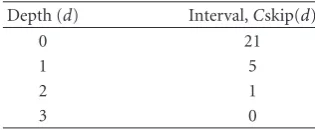
Table1: Interval values of every depthCskip(d), whereCm=4,
Rm=4, andLm=3.
Depth (d) Interval,Cskip(d)
0 21
1 5
2 1
3 0
ZigBee standard, ZigBee Pro by now, claimed that the newest standard could handle thousands of sensors. However, we believe that our proposal, although originally designated for general WSNs, can be immediately applicable to the ZigBee network with a better use that supports tens of thousands of sensor nodes.
A device, working as a coordinator or a router, should have a priori knowledge on three network configuration parameters before assigning an address: the maximum number of children that a parent may have (Cm), the maximum depth in the network (Lm), and the maximum number of routers that a parent may have as children (Rm). The interval of the distributed address of a given node depth in a tree is computed by
Cskip(d)= ⎧ ⎪ ⎪ ⎨ ⎪ ⎪ ⎩
1 +Cm×(Lm−d−1), ifRm=1 1+Cm−Rm−Cm×RmLm−d−1
1−Rm , otherwise.
(1) The newly assigned address of annth child node is calcu-lated by
An=Aparent+Cskip(d)×Rn+n, 1≤n≤Cm, (2) where Rn is the nth router, Aparent is the address of one’s
parent,Anis the address of thenth child node ofAparent, and
dis the node depth.
Figure 2 shows an example of addressing assignment, where Cm is 4, Rm is 4, and Lm is 3.Table 1 presents the intervals per depth for the same configuration parameters.
between the router’s address and its maximal address scope as shown in
Ar< D < Ar+Cskip(d−1), (3)
whereAr is the address of a router andDis the destination address.
If the condition holds true, the router will transmit the packet to a corresponding child until the final destination node is discovered. Otherwise, it would send the packet to its parent and repeat these procedures.
ZigBee address assignment scheme is the hierarchical addressing architecture. Under this scheme, a parent allo-cates a segment of its own address space to a newly joining child in a network. A special node, called ZigBee coordinator (ZC), which starts the network, initially owns the whole address space. As new nodes join the network, ZC allocates chunks of address space to the new nodes. SinceCmis a given, fixed configuration parameter, it is possible to systematically determine the segment of address space that will be allocated to a new node. Therefore, it will also be acceptable for a parent (including ZC) to have grandchildren before the address segment reserved for its children is used up. In other words, the underlying network tree may not be necessarily a symmetric one. That, in fact, causes a problem. While ZigBee address assignment scheme is very efficient in that it has a fully distributed and reliable mechanism that imposes a very low overhead cost, it has a static nature, thus being very inflexible. As a result, it wastes chunks of address space if the geographical location of sensor nodes is rather skewed. For example, a node that already used up the address segment cannot accept a new joining node, even though a chunk of free addresses is still available for other nodes that are out of communication range of the new node. This address wastage problem has become a widely known problem [2,4,5].
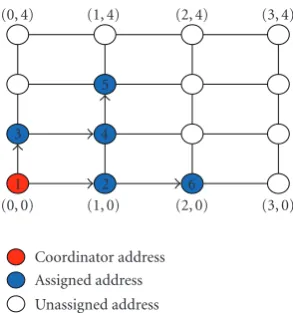
Bhatti and Yue proposed an n-dimensional subspace representation for a given address space [4]. It is designed to provide full utilization of available address space. When a new node joins the network, it obtains a unique address from unused space, by navigating a least used dimensional axis. Therefore, any node in the network can have up tonchildren.
Figure 3 demonstrates how to allocate a new address in a two-dimensional space. A network started at the origin— that is, (0, 0) in Figure 3—and can grow in any direction that is mostly suited to a physical distribution. The range of address values needs not be the same and depends on how many bits are allocated to each address dimension. If a given address consists of 16 bits and is partitioned equally, every dimension will have the range of 0 and 255. Similarly, two address dimensions may be arbitrarily allocated—say, 10 bits forx-axis and 6 bits fory-axis. In that case,xvalues range from 0 to 1023 whileyvalue from 0 to 63.
Jeon suggests a simple address assignment and update strategy [5]. It assumes that every router (and the coordi-nator) stores the last address assigned (LAS). This value is the address number that has been lastly used. Once used by any node, its use event will be propagated to all the other routers through a flooding-like mechanism over a given tree topology to make the value consistent. As shown inFigure 4,
(0, 4) (1, 4) (2, 4) (3, 4)
(0, 0) (1, 0) (2, 0) (3, 0)
Coordinator address Assigned address Unassigned address
1 2 6
3 4
5
Figure3: Illustration of incremental address assignment in a two-dimensional subspace partitioning.
[0, 1]
[1, 2] [1, 3] [1, 4]
[2, 5] [2, 6] PNC LAA update request command
LAA update request command
A
B C D
E F H I
J
Figure4: An example of the address assignment based on LAA.
a node A initiates the creation of a new ZigBee network by assigning itself as a coordinator. Thus, its LAS will be 0. As nodes B, C, and D join the network, the node A assigns 2, 3, and 4 as their address, respectively, and updates the LAA value to 5. The LAA values of B, C, D will then be accordingly updated. When a node E joins, it may contact B. B will look up its LAA value, immediately assign the address of E as the value plus one, and inform the use event to all the others. In this way, this address scheme can fully utilize all available address space. When nodes B and D are routing, they use a separate routing table that stores their children addresses.
Figure 4 shows that when nodes B and D receive a data packet, they look up its destination address in their table. If the destination node is found, the routers will transmit the data packet to the destination. Otherwise, it will send the packet to a parent node. However, this scheme is not scalable, since the separate routing table will grow proportionally as network size grows.
D=1 Certain network topologies exceed
maximum tree depth and run out of addresses on branches
Stochastic addressing assigns addresses randomly, avoiding topology constrains on network
deployments
Figure5: Tree-based addressing and stochastic addressing [5].
with minimal impact to the network. Its first deployments reported that this new standard could handle thousands of devices in an Asian metering product [2].
4. N-DIMENSIONAL ADDRESSING SCHEME AND ITS ROUTING ALGORITHM
In this section, we introduce a new addressing assignment scheme and its tree-based routing algorithm, TRAACS.
4.1. Address assignment by using coordinate system (AACS)
It is designed to support a full utilization of available addressing space without losing any addresses. To achieve this goal, we propose then-dimensional partitioning of the space. Our partitioning approach, while similar to that of ASAS in terms of space partitioning, is different in that we purposely reserve higher partitions for assigning router nodes.
For example, 16-bit address space may be divided into two subspaces, where first unsigned 8 bits are assigned for
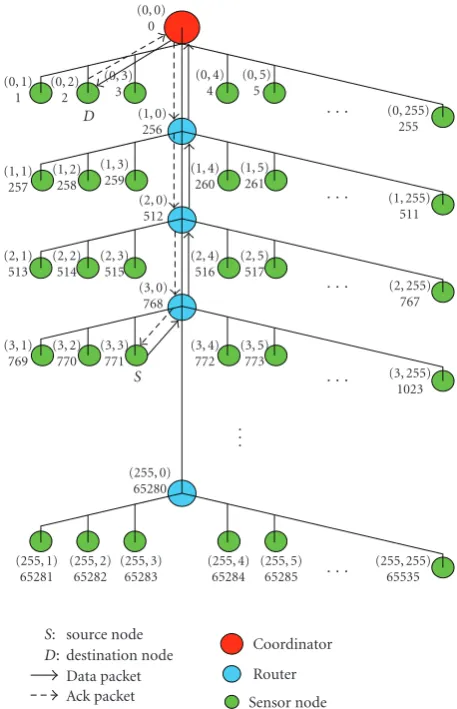
x-axis while the latter unsigned 8 bits for y-axis—that is, a single address space is expressed as (x,y) in two-dimensional coordinate system. In a two-dimensional AASC algorithm, thex-axis value refers to the router number on a tree-based routing network and the y-axis value corresponds to the node number of a regular sensor node that is connected to the router whose number is specified in thex-axis.Figure 1
illustrates typical example of our addressing scheme. As shown in this figure, a newly entered node, if there is no response from other nodes, determines that there is no available node, thus initializing a new network by assigning itself as a coordinator node. Especially, (0, 0) is assumed to be reserved for a coordinator node. When sensors join a ZigBee network, they are classified as either a full function device (FDD) or reduced function device (RFD). If a sensor node is an FFD, it can perform routing function; its address value will be set to (x, 0), wherexis a nonzero value. Otherwise, it will not work as a routing node. Its address will have
(0, 0)
Figure6: Best possible addressing configuration of our two-dimen-sional scheme.
a form of (x,y), where x and y are both nonnegative. It also implies that the address of its parent routing node should be (x, 0). The coordinator node may have 255 regular sensor children—(0, 1), (0, 2),. . ., (0, 255)—and one router child (1, 0). Similarly, a router node (1, 0) can have 255 regular children—(1, 1), (1, 2),. . ., (1, 255)—and one router child (2, 0). The last router node, (255, 0), may only have 255 regular sensor nodes—(255, 1), (255, 2),. . ., (255, 255). Using this strategy, any given address space can be guaran-teed fully utilized when sensors are deployed in real-world environments.
One of disadvantages of 2D partitioning, however, is that any router may not hold as many children as proposed, since sensor nodes tend to be connected to a geographically nearby router. In such heavily skewed distributions of the sensor nodes, the 2D partitioning will be ineffective. To overcome this problem, we extend our original 2D subspacing to a three-dimensional subspacing. A 3D partition remaps the 2D space into three subspaces alongx,y, andz-axis. For example, 16 bit address space can be divided into 8 bits, 4 bits, and remaining 4 bits forx-,y-, andz-axis, respectively.Figure 7
(0, 0, 0)
65522 (255, 15, 15) 65535
Figure7: Illustration of address assignments for three-dimensional AACS approach.
As exemplified inFigure 7, a coordinator node starts the address of (0, 0, 0). When a new FFD A is going to be attached to the coordinator, its address will be allocated to (0, 1, 0), meaning that it is the first router that is directly connected to the coordinator. If another FFD B enters into the network, it will be attached to A horizontally and its address will then be (0, 2, 0). Similarly, any FFD whose address is (0,i, 0) will be attached to its previously attached FFD (0,i−1, 0), where
i is in the range of 1 and 15, recursively. After consuming all the bits in y-axis, a newly joined FFD will be attached to the coordinator vertically rather than horizontally; its address thus becomes (1, 0, 0). Next FFDs (1,i, 0) will again be connected to their previous FFDs (1,i−1, 0). To identify such different assignment procedures, we call routers that use horizontal attachment as subrouter, and the ones that use vertical attachment as root router. Consequently, the coordinator may well be viewed as a special root router of its subrouters whose addresses are (0, 1, 0),. . ., (0, 15, 0). A newly incoming regular sensor node whose address starts from (0, 0, 1) will be attached to a router who has an empty slot for a child. Availability of routers is examined from a root router to its subrouters. We can generalize above intuition for any sensor node (x,y,z). It is expected that the sensor node is the zth child of a subrouter (x,y, 0). Ifyequals to zero, it will then be thezth child of a root router (x, 0, 0). Ifx
also equals to zero, it will finally be directly connected to the coordinator node (0, 0, 0). In the example shown inFigure 7, a single ZigBee network may have one coordinator and 255 root routers; each of them can have 15 subrouters; and every subrouter can host up to 15 regular sensor nodes.
Our 3D AACS address scheme can be extended to a generic addressing scheme for WSN by varying the bit lengths of each dimension. Assume that a given address length (x+ y+z) is partitioned into x bits, y bits, andz
bits, where x bits are assigned for root routers,y bits for subrouters, andzbits for ordinary sensor nodes. From this assumption, the maximum numbers of sensor nodes are computed as follows:
2x−1: the number of the root router; 2x×2y−1: the number of the subrouter; 2x×2y×2z−1: the number of the sensor node.
(4) For example, in a 12-bit network address space and four bits reserved for each dimension, the number of possible root routers, subrouters, and regular sensor device is
24−1=15: the number of the root router;
24×24−1=240: the number of the subrouter;
24×24×24−1=3840: the number of the sensor node.
(5) Our scheme allows network administrators to reconfigure bit lengths for every dimension, depending on their different requirements.
4.2. Tree-based routing algorithm, TRAACS
source address and the destination address at its header.
S sends the message to its parent node. The parent node reads the message header to extract the destination address whether it matches any of its children. If so, the parent router will simply deliver the message packet to a designated child node and terminate message routing. Otherwise, it would reroute the message to its parent node (upward) or its child routing node (downward) until the message is finally reached toD.
Typically, routers maintain a small memory footprint that stores the addresses of its children that are used during a message routing. In general, smaller number of children takes lesser time for the matching operation. If a routing table size is growing bigger (meaning that a router hosts more children), memory size will accordingly grow. Consequently, the matching operation becomes more crucial for time-critical operations. The existing ZigBee standard avoids this possible performance degradation by adopting Cskip algorithm. It eliminates the iterative matching operations, since a simple computation tells whether a given address is inside a router’s address scope. Besides, the router does not require any memory space, because matching operations are no longer necessary. As explained earlier, theCskip approach, unfortunately, spends the actual address space by assigning addresses in a dispersed manner.
Our AACS algorithm tackles address wastage problem while achieving no memory requirements by eliminating the matching operations. In our addressing scheme, end-nodes can only communicate with their parent node that has routing capability. Such hierarchical nature can easily be applied to a tree-based routing. In this section, we will detail the operation scenario for our tree-based routing. We illustrate the case of 2D AACS scheme and later cover the case for 3D scheme.
Suppose that a network is configured to be addressable by 16 bits and our 2D AACS scheme is being used. A router node, during a tree routing, examines thex-axis value of a destination address inside a message packet. If the value is the same as itsx-value, it will forward the packet to one of its children, since the destination host is one of its children. Otherwise, it send the message to upward router if the x -value is less than that of the router or to a downward router until thex-value matches that of a router.
Figure 8shows the example routing path of a message whose source and destination addresses are (3, 3) and (0, 2), respectively. The source node (3, 3) creates a message that should be sent to the destination node (0, 2). The source first sends the message to its parent (3, 0). The parent then compares its ownx-axis value with that of the destination. Since its value is larger than that of the destination, it forwards the message to its parent (2, 0). Again, the parent (2, 0) compares thexvalue and forwards the message to its parent (1, 0). Since itsxvalue is still greater than, it relays the packet to a coordinator (0, 0). Finally, the coordinator recognizes that the given destination address belongs to its address scope and broadcasts the packet to its children. The destination node (0, 2) upon a reception of the message sends back an ACK message to the coordinator to confirm that it successfully receives the packet. This feedback message will
(0, 0)
D: destination node Data packet
Figure8: A sample example of a tree-based routing under 2D AACS scheme in a 16-bit network.
eventually reach to the source node by traversing the routing path in an opposite direction.
Similar routing procedures can be easily adapted to a 3D AACS addressing scheme. A 3D AACS-based tree routing algorithm is slightly different in that a root router compares the x-axis value of a destination node with its
(0, 0, 0)
65522 (255, 15, 15) 65535 S
D
S: source node
D: destination node Data packet
Figure9: The expected routing path of a message from a source node (0, 1, 15) to a destination node (2, 15, 2) under 3D AACS scheme.
y-values. Since the y value of the destination is bigger than that of current subrouter, the data packet is trans-mitted to a next subrouter (2, 2, 0). In this way, hori-zontally connected subrouters are contacted in a sequence of (2, 1, 0), (2, 2, 0),. . ., (2, 14, 0), (2, 15, 0). At the subrouter (2, 15, 0), x and y values match exactly with those of the destination. The router, eventually, completes the message routing by finally delivering the packet to the destination. The destination node, in return, sends an ACK message to the source node along the same traversal path in a reverse order.
In the 3D AACS routing algorithm, a root router and a coordinator compare the x values of a destination and coordinator whether a packet is to be sent to a parent root router or a child root router. A root router and a subrouter compare the x values first. If the values are equal, they compare the y values to decide whether the packet should be forwarded to its next subrouter or to the destination sensor node. The routing will be over if the packet is finally transmitted to the destination from the router whosexand
yvalues are the same as those of the destination. We call this routing algorithm as TRAACS, an abridged version of Tree Routing algorithm based on AACS scheme.
The TRAACS, compared with ZigBee’sCskip algorithm, is very promising in that it is expected to require smaller
numbers of routing nodes during any communication between two arbitrary nodes. Unlike flat routing algorithms such as AODV which require expensive flooding overhead when establishing a new routing path, our algorithm does not mandate any explicit expensive routing setup procedures for a new connection.
4.3. Location-aware routing algorithm
(0, 0, 1) 1
(0, 0, 0) 0
(0, 0, 3) 3
(0, 0, 2) 2
(0, 1, 4) 20
(0, 1, 2) 18
(0, 1, 3) 19
(0, 1, 1) 17 (0, 1, 0)
16
(0, 2, 3) 35
(0, 2, 0) 32
(0, 2, 1) 33
(0, 2, 2) 34
(0, 3, 0) 48
(0, 3, 1) 49
(0, 3, 2) 50
(1, 0, 1) 257
(1, 0, 0) 256
(1, 0, 2) 258
(1, 0, 3) 259 (2, 0, 1)
513
(2, 0, 0) 512
(2, 0, 2) 515
(1, 1, 3) 275
(1, 1, 4) 276 (1, 1, 0)
272
(1, 1, 1) 273 (1, 1, 2)
274
(1, 2, 1)
289 (1, 2, 2)290 (1, 2, 3)
291
(1, 2, 5) 293 (1, 2, 4)
292 (1, 2, 0)
288
Coordinator Root-router
Sub-router Sensor node
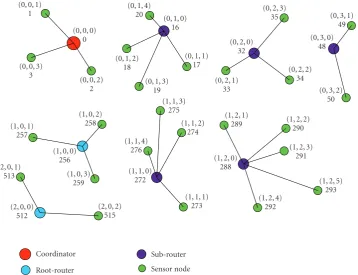
Figure10: A sample irregular ZigBee network, using 3D AACS scheme.
The location-aware routing algorithms perform routing operations under the assumption that sensor nodes know the locations of other nodes a priori. To detect their own location, the sensor devices may be equipped with posi-tioning devices such as GPS. Many location-aware routing algorithms, however, typically require a sensor node to be aware of the location of other nodes to talk with. To do so, a sensor node continues to talk to a server database to notify its location update periodically and to resolve the location of other nodes, which is a rather expensive approach. If relaxing the assumption that we do not need to know the exact location of a destination node for communication purpose, we may take advantage of using the proximity table that has already been widely studied in many distributed environments.
To begin, let us assume an AACS-enabled ZigBee net-work. When a new node joins the network, it obtains a unique address by attaching to its parent node. Only by communicating with the parent node, it can resolve all the addresses of currently available nodes. Therefore, the location-based routing algorithm can be applied without installing any additional resources.Figure 10exemplifies an irregular ZigBee network, whose addressing scheme is based on our 3D AACS. This irregular network is formed by the coordination of (0, 0, 0). Every sensor address is uniquely assigned by the combination of join order and response order from candidate parent nodes.
If a router node is allowed to cache neighboring nodes in a proximity routing table and maintain them by their close-ness to it, a suboptimal location-aware routing can be achiev-able. For example, a router (1, 1, 0) stores geographically
neighboring router nodes such as (1, 2, 0), (1, 0, 0), (2, 0, 0), (0, 0, 0), (0, 1, 0), and (0, 2, 0) in the proximity-based routing table. Instead of performing tree-based routing, routers may route to an alternative path that is aware of geographical closeness. Location-aware node selection scans the routing addresses in the proximity tables, computes their distances to the destination, chooses the minimal node, and then forwards a message to the node. Since the node selection is done at the router level, we only assume to use x- andy -axis values while ignoring z-values. In addition, we prefer selecting the nodes that are the closest x-axis value to the destination first. If multiple nodes are retrieved, we will refine the selection by choosing the closesty-axis node.
This selection strategy guarantees to reach to the final destination without any looping, since resulting distance to the destination always decreases as visited hop counts are increased. However, it does not guarantee the optimality. It is because, in some cases, a routing path should be inevitably rolled back to complete the routing. As a result, the location-aware routing algorithm works well only in well-spaced sensor distributions.
InFigure 11, a source node (2, 0, 1) sends a message to (0, 3, 2). Our location-unaware routing algorithm, TRAACS, has a total of seven hops for the following routing sequence: (2, 0, 1) → (2, 0, 0) → (1, 0, 0) → (0, 0, 0) → (0, 1, 0) →
(0, 0, 1) 1
(0, 0, 0) 0
(0, 0, 3) 3
(0, 0, 2) 2
(0, 1, 4) 20
(0, 1, 2) 18
(0, 1, 3) 19
(0, 1, 1) 17 (0, 1, 0)
16
(0, 2, 3) 35
(0, 2, 0) 32
(0, 2, 1) 33
(0, 2, 2) 34
(0, 3, 0) 48
(0, 3, 1) 49
(0, 3, 2) 50
(1, 0, 1) 257
(1, 0, 0) 256
(1, 0, 2) 258
(1, 0, 3) 259 (2, 0, 1)
513
(2, 0, 0) 512
(2, 0, 2) 515
(1, 1, 3) 275
(1, 1, 4) 276 (1, 1, 0)
272
(1, 1, 1) 273 (1, 1, 2)
274
(1, 2, 1)
289 (1, 2, 2)290 (1, 2, 3) 291
(1, 2, 5) 293 (1, 2, 4)
292 (1, 2, 0)
288
S
D
S: source node
D: destination node Data packet Ack packet
Coordinator Root-router Sub-router Sensor node
Figure11: A sample location-aware routing path from (2, 0, 1) to (0, 3, 2) for 3D AACS.
than (1, 0, 0). Thus, the node (1, 1, 0) is then chosen as a next router. Similarly, at (1, 1, 0), a next router (1, 2, 0) will be selected toward the destination. In this way, the message reaches to a router (0, 3, 0), which terminates the routing by finally delivering the data to the destination node. As a result, the final routing sequence is (2, 0, 1) → (2, 0, 0) →
(1, 1, 0) → (1, 2, 0) → (0, 3, 0) → (0, 3, 2). Compared with TRAACS algorithm, the location-aware routing algorithm saves two hop counts. A feedback packet reverses the routing sequence in a similar fashion.
5. PERFORMANCE EVALUATION
In this section, we present the evaluation results of our TRAACS algorithm and traditionalCskip based tree-based routing algorithm for ZigBee network. TheCskip algorithm assumes two network parameters, Cm and Rm. A perfor-mance metric used for this evaluation is the average hop count, one of the most crucial performance metrics when evaluating WSNs. For example, a smaller average count may reflect a higher probability that a data is successfully delivered over loss-prone wireless channels, and reduction of power consumption.
For fair comparisons, we fix the following network parameters: the same number of maximum hop counts, the same number of populated nodes, and maximum network size (up to 65536). The number of maximum hop count is the maximum hops along a path between two arbitrary
nodes. Figure 12 shows several network topologies that satisfy the above constraints.
In Figure 12, MHN refers to a specific node that attributes to the maximum hop counts. In other words, it is defined as a node that has the maximum number of hops with any other arbitrary node (another MHN by definition) in tree architecture. The average hop count is the summation of every hop count from any arbitrary node to any other arbitrary node in a tree topology. By intuition, we can infer that the number of MHN is proportional to the average hop count. As seen in Figure 12, the end nodes in ZigBeeCskip-based tree topologies become MHN, while the leaf nodes of a coordinator and the lowest router in 2D AACS tree topologies become MHN. For example, 31 nodes can be constructed to have the maximum hop count of eight as in Figure 12. The number of MHN by
Cskip algorithm is 16 and that by our 2D AACS is 8. From the sample topologies, we observed that the numbers of MHN in the ZigBee Cskip topologies tend to grow more rapidly than those in the 2D TRAACS topologies. Table 2
shows more complete, convincing results that depict such tendency.
ZigBee tree architecture 2 dimension ACCS architecture
When the number of nodes equals 3
=⇒The number of
MHN: 2 =⇒
The number of MHN: 2
(a)
ZigBee tree architecture 2 dimension ACCS architecture
When the number of nodes equals 7
=⇒The number of
MHN: 4 =⇒
The number of MHN: 3
(b)
ZigBee tree architecture 2 dimension ACCS architecture
When the number of nodes equals 15
=⇒The number of MHN: 8
=⇒The number of MHN: 4
(c)
ZigBee tree architecture
2 dimension ACCS architecture
When the number of nodes equals 31
=⇒The number of MHN: 16
=⇒The number of MHN: 8
Coordinator Sensor node
MHN (the node given maximum multi-hops) (d)
Figure 12: Several network topologies assigned by individual address assignment algorithms.
As observed inFigure 13, the difference of the average hop count will be insignificant in a smaller network size such as 10. As the network sizes are incremented gradually, the difference becomes more obvious. For larger network sizes,
Table2: The numbers of MHN of different topologies as a function of network size.
Network size # of MHN byCskip # of MHN by 2D ZigBee network TRAACS network
3 2 2
7 4 3
15 8 4
31 16 8
63 32 12
127 64 22
255 128 38
511 256 67
1023 512 120
2047 1024 214
4095 2048 388
8191 4096 712
16383 8192 1310
32767 16384 2426
65535 32768 4520
Comparison of the average number of multi-hops
The
av
er
age
n
u
mber
of
m
ulti-hops
0 5 10 15 20 25 30
The number of nodes
0 1 2 3 4 5 6 7
×104
ZigBee tree routing 2 dimension TRAACS
Figure13: The average hop counts as a function of network size.
our TRAACS algorithm outperformed theCskip algorithm by two and more.
source nodes send by to be delivered to the destination node. Considering this point, if there are many routers for the packets to pass by on the way to the destination, the packets should go through the lower source nodes. In the event, the totality sensor network system increase energy consumption of the relevant source nodes as well as that of the router nodes.
This is the reason that the less the average number of the multihops from the source nodes to the destination node, the longer the durability of the network due to the reduced energy consumption. Of course, there are other parameters that should be considered in terms of energy consumption such as end to end delay, packet delivery rate, routing overhead, and so forth. And yet these parameters are also significantly influenced by the average number of the multihops in the sensor network. For example, the less the average number of the multihops, the shorter the end to end delay, that is, the delayed time between each node due to the reduction of the traffic in the sensor network. In terms of packet delivery rate, the more the hops that the packets generated in the source nodes should go through the way to the destination node, the higher the possibility that the packets drop. Therefore, higher average number of multihops means the lower packet delivery rate. In terms of routing overhead, the increasing average number of the multihops is expected to bring about the network overload due to the increase in the number of packets treated inside the network. Without operating a simulation for the demonstration, it is anticipated that the smaller the number of multihops is, the shorter the end to end delay is, the higher the packet delivery rate is, and the smaller the routing overhead is.
For the average number of the multihops considerably influences on other parameters, it seems sufficient to sim-ulate only the average number of the multihops in order to discuss the efficiency of the sensor network and the validity of the address assignment methods which decided the network efficiency.
6. CONCLUSIONS AND FUTURE DIRECTION
In this study, we have investigated the problem of exist-ing addressexist-ing schemes and their routexist-ing algorithms by exemplifying the case of ZigBee network. In particular, we have concentrated on our discussion on the wastage of address space. To overcome this problem, we have proposed a three-dimensional addressing scheme by mapping a single address space into a three-dimensional coordinate space. Another benefit of this scheme is that it does not require any additional routing memory space, since it uses an implicit tree-based routing algorithm. Moreover, it can save a lot of energy by shortening the average hop count during a routing. Compared with legacy ZigBee standard, our new addressing and routing scheme reported two times lesser average hop count for a larger network.
Next research should study an area of applying the ZigBee sensor network. Also, it should generalize this algorithm which is to be applied by the other sensor networks.
ACKNOWLEDGMENTS
The authors are very grateful to the anonymous reviewer for their useful comments. This research was financially supported by the Korea Industrial Technology Foundation (KOTEF) through the Human Resource Training Project for Regional Innovation and the Daegu Gyeongbuk Institute of Science and Technology (DGIST).
REFERENCES
[1] J. Eriksson, M. Faloutsos, and S. V. Krishnamurthy, “DART: dynamic address routing for scalable ad hoc and mesh networks,”IEEE/ACM Transactions on Networking, vol. 15, no. 1, pp. 119–132, 2007.
[2] A. Wheeler, “Commercial applications of wireless sensor networks using ZigBee,”IEEE Communications Magazine, vol. 45, no. 4, pp. 70–77, 2007.
[3] Zigbee Specification Version 1.0.
[4] G. Bhatti and G. Yue, “A structured addressing scheme for wireless multi-hop networks,” Tech. Rep., Mitsubishi Electric Research Laboratories, Cambridge, Mass, USA, 2005. [5] H.-I. Jeon, “Efficient address assignment for mesh nodes in
real-time,” 15-06-0437-01-0005 efficient real time network address allocation mechanisms based naa concept in mesh network, IEEE 802.15.5 Wireless PAN Mesh Network Task Group Face-to-Face meeting, November 2006.
[6] C. Intanagonwiwat, R. Govindan, and D. Estrin, “Directed diffusion: a scalable and robust communication paradigm for sensor networks,” in Proceedings of the 6th Annual International Conference on Mobile Computing and Networking (MOBICOM ’00), pp. 56–67, Boston, Mass, USA, August 2000. [7] C. Schurgers and M. B. Srivastava, “Energy efficient routing in wireless sensor networks,” inProceedings of IEEE Military Communications Conference (MILCOM ’01), vol. 1, pp. 357– 361, McLean, Va, USA, October 2001.
[8] R. C. Shah and J. M. Rabaey, “Energy aware routing for low energy ad hoc sensor networks,” inProceedings of IEEE Wireless Communications and Networking Conference (WCNC ’02), vol. 1, pp. 350–355, Orlando, Fla, USA, March 2002.
[9] W. R. Heinzelman, A. Chandrakasan, and H. Balakrish-nan, “Energy-efficient communication protocol for wireless microsensor networks,” in Proceedings of the 33rd Hawaii International Conference on System Sciences (HICSS ’00), vol. 8, p. 8020, Maui, Hawaii, USA, January 2000.
[10] S. Lindsey and C. S. Raghavendra, “PEGASIS: power-efficient gathering in sensor information systems,” inProceedings of IEEE Aerospace Conference, vol. 3, pp. 1125–1130, Big Sky, Mont, USA, March 2002.
[11] S. PalChaudhuri, S. Du, A. K. Saha, and D. B. Johnson, “TreeCast: a stateless addressing and routing architecture for sensor networks,” in Proceedings of the 18th International Parallel and Distributed Processing Symposium (IPDPS ’04), vol. 18, pp. 3045–3052, Santa Fe, NM, USA, April 2004. [12] T. T. Huynh and C. S. Hong, “A novel multi-layer architecture
for wireless sensor networks,” inProceedings of the 7th Inter-national Conference on Advanced Communication Technology (ICACT ’05), vol. 2, pp. 1143–1146, Phoenix Park, Korea, February 2005.
[14] C. Perkins, J. Malinen, R. Wakikawa, E. Belding-Royer, and Y. Sun, “IP address auto-configuration for ad hoc networks,” IETF Internet draft, draft-ietfmanet-autoconf-01.txt, Novem-ber 2001.