R E S E A R C H
Open Access
Practical designs for out-of-band emission
suppression and adjacent channel interference
rejection for orthogonal frequency division
multiplexing-based cognitive radios
Juan Fang
*and I-Tai Lu
Abstract
Opposite to the conventional wisdom, practical considerations for out-of-band emission (OOBE) suppression and adjacent channel interference (ACI) rejection in orthogonal frequency division multiplexing (OFDM) -based cognitive radio systems are not completely alike. For example, ACI will increase after discarding the cyclic prefix (CP) because the interference signal is also truncated during the CP removal process. Furthermore, effective OOBE is much larger than the estimated OOBE if there is a timing offset (TO) between the primary and secondary users. To the best of our knowledge, these and some other practical issues have not been well addressed. Various important practical issues (including multipath delay spread, high peak-to-average power ratio (PAPR), spectral efficiency loss, high complexity, sensitivities to frequency and timing offsets, non-contiguous and dynamically changing spectrum, CP removal, spectral containment, etc.) concerning OOBE suppression and ACI rejection are studied in this paper. Numerical results show that none of the existing approaches can deal with all practical issues satisfactorily. Hybrid combinations of frequency-domain approaches (spectral precoding and PAPR precoding) and time-domain approaches (windowing and filtering) are developed to maintain the merits and mitigate the drawbacks of each constituent approach in order to deal with these practical challenges. It is shown that a combination of filtering and precoding provides the best OOBE suppression and a combination of windowing and precoding provides the best ACI rejection characteristics in our numerical examples.
Keywords:OOBE; ACI; Cognitive radio; OFDM
1 Introduction
Cognitive radio (CR), as a promising solution to the spectrum congestion problem brought by the rapid ad-vance of wireless communication techniques and the drastic increase of wireless devices, has drawn a lot of attentions recently (e.g., see [1–3]). In CR systems, the secondary users (SUs) are allowed to dynamically access to the spectrum resources, which are not occupied by the primary users (PUs) and could be non-contiguous, without causing interference to the PUs or other SUs transmitted over adjacent channels. However, it is hard to achieve synchronization or any type of coordination
between PUs and SUs or among SUs since they transmit independently. Therefore, on one hand, waveform shap-ing for spectral containment by a SU transmitter is needed to minimize its out-of-band emission (OOBE) in order to reduce interference to its neighboring PUs and/ or SUs. On the other hand, an efficient adjacent channel interference (ACI) rejection approach that can reduce the ACI from neighboring PUs and/or SUs is needed at a SU receiver. Although ACI rejection is equally import-ant as OOBE suppression, there are much more work on OOBE suppression than ACI rejection. This may be due to the fact that, for the conventional approaches (windowing and filtering), the principle of ACI rejection is very similar to that of OOBE rejection. However, this is not always true. Take orthogonal frequency division multiplexing (OFDM) as an example. If the ACI rejection * Correspondence:[email protected]
NYU WIRELESS, Department of Electrical and Computer Engineering, Polytechnic School of Engineering of New York University, 6 MetroTech Center, Brooklyn 11201, USA
is done before the removal of cyclic prefix (CP) at the OFDM receiver without special considerations, ACI will regenerate because the processed interference signal is also truncated during the CP removal process. In addition, since OFDM signal is demodulated symbol by symbol, a timing offset (TO) between the desired and interfering transmitters can enhance the equivalent OOBE of the interfering transmitter greatly. These issues have not been addressed so far. Thus, considerations of OOBE suppres-sions and ACI rejection are not all alike, and it is important to find out which approach is better for OOBE suppression and which approach is better for ACI rejection.
OFDM technology, which divides the total bandwidth into several orthogonal subbands, provides the flexibility for deactivating specific subcarriers simply by using zeros as the corresponding input values. In addition, OFDM has several favorable properties like high spectrum efficiency, robustness to channel fading, multipath delay spread toler-ance, efficient digital signal processing implementation, and granular resource allocation, etc. (for example, in [4, 5]). Because of these merits, OFDM has been considered as a candidate for CR in the first CR-based standard IEEE 802.22 [6]. However, OFDM has shortcomings such as high peak-to-average power ratio (PAPR), high sensitivity to frequency offset (FO) and TO, large carrier inter-ference (ICI) at high Doppler’s, and large OOBE and/or ACI originating from large side lobes of the rectangular pulse shape. Among these shortcomings, the high OOBE and/or ACI is the main technical challenge for CR applica-tions (although the other shortcomings may induce OOBE and/or ACI as well).
Various approaches have been proposed to suppress OOBE of OFDM signals. These approaches can be classi-fied into two categories: the time-domain and frequency-domain approaches. The time-frequency-domain approaches include windowing [7] and filtering [8] where the OOBE suppres-sion processes are carried out in the time domain (after the inverse fast Fourier transform (IFFT) operation). The frequency-domain approaches include subcarrier weight-ing [9], carrier cancellation [10, 11], and spectral precod-ing [12, 13], where the OOBE suppression processes are carried out in the frequency domain (before the IFFT op-eration). As mentioned before, the time-domain OOBE suppression approaches (windowing and filtering) at the transmitter can also be used at the receiver to reject ACI [14, 15]. However, it is not obvious that the spectral de-coder at the receiver (which corresponds to the frequency-domain spectral precoding at the transmitter for OOBE suppression) can also reject ACI as well.
Each of the abovementioned approaches has merits and drawbacks. For the time-domain examples, the win-dowing approach has low complexity and no spectral ef-ficiency loss. It can be used to suppress OOBE or reject ACI as long as the roll-off portion of the windowing
function is long enough. However, a long roll-off portion will induce inter-symbol interferences (ISI) and subse-quently seriously degrade the bit error rate (BER) per-formance if the CP length is not long enough. Therefore, the performance of windowing approach is limited by the CP length. Like windowing, the filtering approach has no spectral efficiency loss, and its performance is limited by the CP length. However, unlike windowing, it is less sensitive to the TO between PU and SUs when it is used to suppress OOBE of OFDM signal and has high complexity when the spectrum is non-contiguous or dy-namically changing. For the frequency-domain example, spectral precoding approach is very efficient for reducing OOBE and can be easily extended to reduce PAPR sim-ultaneously by combining with PAPR precoding [16]. However, it suffers spectral efficiency loss and has high computational complexity when the number of subcar-riers is large or when the spectrum is non-contiguous or dynamically changing. In addition, its BER performance will degrade when there is TO between PU and SU. In summary, none of the existing approaches can deal with all practical issues and a study of these approaches under various practical conditions would be very valuable.
However, in most of published works for OOBE/ACI suppression, these existing approaches are evaluated in their favorable conditions (which are not practical) and therefore the suitability of these approaches in practical situations has not been properly addressed. For examples, firstly, in most of publications about the time-domain ap-proaches, the CP length was oftentimes extended so long that the effects of delay spread is minimized. But the CP length is fixed in practice (e.g., in Long-Term Evolution (LTE) [17]), and a large delay spread will cause both ISI and ICI if a windowing or filtering approach is employed. Secondly, for the spectral precoding approach, the com-plexity and implementation issues for broadband channels have not been addressed. But, in reality, the CR system is usually broadband. Thirdly, the effects of other impair-ments (such as PAPR, TO, FO, etc.) on OOBE or ACI are usually not assessed. However, these impairments may cause significant increases of OOBE and ACI. Fourthly, the implications of non-contiguousness and time variations of the available spectrum on the complexity issues are mostly unaddressed. However, the available spectrum in CR is usually non-contiguous and dynamically changing.
practical issues. Detailed analyses are made on the com-plexity, spectral efficiency, spectral containments, PAPR and BER of the windowing, filtering, and spectral precod-ing approaches, and their possible combination schemes under practical conditions (broadband channels with radio impairments such as FO and TO). Simulation results show that the proposed hybrid approaches indeed main-tain the merits and mitigate the drawbacks of their con-stituent approaches. Particularly, since windowing process can be carried out conveniently to deal with the CP removal issue, a hybrid combination of precoding and widowing is more appropriate for ACI rejection. On the other hand, since filtering is less sensitive to TO, a hybrid combination of precoding and filtering is more appropri-ate for OOBE suppression for OFDM systems.
This paper is organized as follows. In Section 2, we present the frequency and time-domain OOBE suppres-sion approaches and the hybrid approaches. In Sections 3 and 4, we deal with various practical issues and present numerical examples. Conclusion remarks are made in Section 5. The notation of this paper is as follows. All boldface letters indicate vectors (lowercase) or matrices (uppercase). AH and AT stand for the conjugate trans-pose and transtrans-pose of A, respectively. [A]i,jdenotes the
element ofAat theith row and jth column. a* andE(a) denotes the conjugate and expectation ofa, respectively. diag […] denotes the diagonal matrix with elements […] on the main diagonal. Ir represents an r by r identity
matrix.a⊗bdenotes the convolution ofaandb.
2 Formulation
2.1 Conventional CP-OFDM transmit signal
The lth time-domain conventional CP-OFDM trans-mit symbol ϕl(t) of N contiguous subcarriers can be
expressed as:
ϕlð Þ ¼t XNn¼N0þN−1
0 dl;npnðt−lTÞ;lT≤t<ðlþ1ÞT ð1Þ
wheredl,nis thelth data symbol transmitted on the nth
subcarrier, and
pnð Þ ¼t ej2π n
Tstgð Þt ð2Þ
The pulse shape function
gð Þ ¼t 10;;−TotherwiseCP≤t<Ts;
ð3Þ
where Ts and TCP is the symbol and the CP durations,
respectively. In (1), T=TCP+Ts is the effective symbol
duration.
2.2 General framework for OOBE and ACI suppression approaches
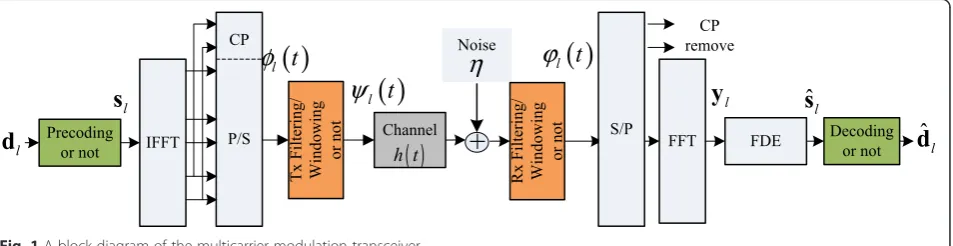
Both time-domain and frequency-domain approaches can be used to suppress the OOBE at the transmitter and reject the ACI at the receiver. The block diagram in Fig. 1 is used to describe not only the time-domain and frequency-domain approaches but also the hybrid ap-proaches which combine the processes in both frequency and time domains.
2.2.1 OOBE suppression at the transmitter
For the frequency-domain OOBE suppression ap-proach at the transmitter, the precoded data vector
sl¼ sl;N0;…;sl;N0þN−1
T
with N correlated elements is obtained by precoding theM(M≤N) uncorrelated elements of the original data vector dl¼ dl;N0;…;dl;N0þM−1
T
by a semi-unitary precoding matrix G with dimension of (N×M),
sl¼Gdl; withGHG¼IM ð4Þ
Instead of dl, sl is fed into IFFT to generate the lth
OFDM symbol. Note that, in essence, only M data ele-ments are transmitted per OFDM symbol in the avail-able frequency band, reserving N−M degrees of freedom for shaping the spectrum of the transmitted signal.
For the time-domain OOBE suppression approach at the transmitter, either a bandpass filter ftx(t) or a
win-dowing function wtx(t) is employed and the lth transmit
signal is
ψlð Þ ¼t ϕl t
Thelth signal received at the receiver is
zlð Þ ¼t ψlð Þt ⊗h tð Þ þηð Þt ; ð6Þ
where h(t) is the channel impulse response and η(t) is the additive white Gaussian noise with power spectral density (PSD) N0. Considering a filtering or windowing
process at the front end of the receiver as shown in Fig. 1, the resultant signal is
φlð Þ ¼t ϕlð Þt ⊗heffð Þ þt ηeffð Þt ð7Þ
whereheffandηeffare effective channel (see (12)) and
ef-fective noise (see (13)), respectively. If the CP duration TCPis larger than the delay spread of the effective
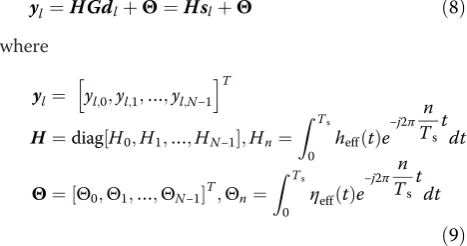
chan-nel, the symbol can be estimated at the receiver without ISI. Using (4), the dataylcan be written as
If a minimum mean square error (MMSE) frequency-domain equalizer (FDE) is used, the estimated ŝl can be
obtained by
2.2.3 ACI rejection at the receiver
For the time domain ACI rejection approach at the re-ceiver, either a bandpass filterfrx(t) or a windowing
func-tionwrx(t) is employed, the effective channel in (7) is
heffð Þ ¼t h tð Þ⊗ftxð Þt ⊗frxð Þt filtering
h tð Þwtxðt−lTÞwrxðt−lTÞ windowing
ð12Þ and the effective noise in (7) is
ηeffð Þ ¼t ηt
ð Þ⊗frxð Þt filtering
ηð Þt wrxðt−lTÞ windowing
ð13Þ
When filters and windowing functions are used at the receiver as the time-domain process to reject ACI, the effective noise PSD in (11) are
E ΘnΘn
The frequency-domain ACI rejection at the receiver, corresponding to the OOBE suppression at the transmit-ter, is implemented using GHand the estimated d^l can be obtained by the hard decision made after decoding
^
The block diagram in Fig. 1 is a general framework for not only the hybrid approaches but also the individual time or frequency-domain approaches. When filters are employed at both the transmitter and receiver as the time-domain process, the hybrid approach is named filtered-precoded-OFDM (F-P-OFDM). Similarly, when windowing functions are employed at both the transmit-ter and receiver as the time-domain process, the hybrid approach is named windowed-precoded-OFDM (W-P-OFDM). If there is no time-domain process,
heffð Þ ¼t h tð Þ and ηeffð Þ ¼t ηð Þt ð17Þ
the hybrid approaches (F-P-OFDM and W-P-OFDM) are reduced to precoded-OFDM (P-OFDM). If there is no frequency-domain process,
G¼IN ð18Þ
2.3 Frequency-domain approaches: P-OFDM
Two different precoding techniques, spectral precoding and PAPR precoding, are employed to suppress OOBE and PAPR, respectively. In order to distinguish these two precoded-OFDM (P-OFDM), they are named as spectral precoded (SP)-OFDM and PAPR precoded (PP)-OFDM in this paper. Our research in [16] shows that these two pre-coding techniques can be combined to achieve satisfactory spectral containments and PAPR performance simultan-eously. (The spectrum containment of a waveform is satis-factory when the stopband attenuation is larger than 55 dB, as in the spectral mask requirement of Federal Communications Commission (FCC) TV white space when the effective isotropic radiated power is +36 dBm [18].) The combination of SP-OFDM and PP-OFDM will be denoted as PMix-OFDM. Also, for convenience, let P-OFDM represent general precoded-P-OFDM which includes PP-OFDM, SP-OFDM, and PMix-OFDM.
The main idea of spectral precoding Gs is to project the M-dimensional data symbol vector,dl, into anN
-di-mensional linear subspace [19] that ensures the desired spectral containment. Denote the frequency-domain rep-resentation ofϕl(t) in (1) at frequencyfas Using matrix expressions, the frequency responsesxat K selected out-of-band frequencies (called notched fre-quencies), {fk,k= 0, 1,…,K−1}, can be written as
OOBE suppression can then be done by projecting dl
into a linear subspace with the form:
ℒð Þ ¼P fsljPsl¼0g ð22Þ
The solution to this problem is to use a semi-unitary precoding matrix Gs whose columns constitute an
orthogonal basis ofℒ(P). Performing the singular value
decomposition (SVD) onP:
P¼UΣVH ð23Þ
where U is aK×K unitary matrix,Σ is a K×N diagonal matrix containing the singular values ofPin non-increasing order on its diagonal and V is an N×N unitary matrix whose columns arev0,v1,⋯,vN−1. The lastMcolumns of Vare collected to construct theN×Mprecoding matrix
GS¼½vN−Mþ1⋯ vN−2 vN−1 ð24Þ
Define λ¼MN as the coding rate andR=N−M as the coding redundancy. Better spectral containments can be achieved at the cost of higher coding redundancy. IfR≥K,
x= 0 for any arbitrary data vectordldue to the fact thatsl
is in the null space ofP. In this paper, we chooseR≤K. The main idea of PAPR precoding is to project theM -dimensional data symbol vector dlinto aN-dimensional
linear subspace that ensures the desired PAPR perform-ance. The transmit signal in (1) can be rewritten as:
ϕlð Þ ¼t XNm¼N0þM−1
0 dl;mp ′
mðt−lTÞ ð25Þ
where p′mð Þt is the inverse discrete Fourier transform (IDFT) of themth column of the precoderGPAPR
p′mð Þt ≡ m occurs at different times within an OFDM symbol. The waveform design has been investigated in [20, 21], and goes beyond the scope of this paper. For simplicity, we use the discrete Fourier transform (DFT) precoding matrixGDFTin [22] with elements:
GPAPR
which makes different p′mð Þt as sinc functions with their peaks at different times.
Note that, the precoding matrix in (24) can be easily extended to reduce the PAPR by multiplying the spectral precoding matrixGSby the DFT matrixGDFT:
GMix¼GSGDFT ð28Þ
2.4 Time-domain approaches: F-OFDM and W-OFDM
Two main time-domain OOBE suppression approaches are summarized here. For F-OFDM, to suppress the OOBE at the transmitter, the CP-OFDM signal is con-volved with a transmit filter,ftx(t), with a length ofαtxTs,
reject the ACI at the receiver, the received signal is con-volved with a receive filter, ftx(t), with a length of αrxTs,
where αrx is the normalized receive filter length. For
convenience, an identical filter is used at both the trans-mitter and receiver, i.e., ftx(t) =frx(t). An example of the
identical filter is a square root raised cosine filter. For W-OFDM, to suppress OOBE at the transmitter, the CP-OFDM signal is point-to-point multiplied with a transmit windowing function,wtx(t), before transmission,
and to reject ACI at the receiver, the received signal is point-to-point multiplied with a receive windowing function,wrx(t). An example ofwtx(t) is given below:
in Fig. 2, the CP-OFDM signal is extended with CP and cyclic suffix (CS), then is point-to-point multi-plied with the windowing function wtx(t). In order to
keep the symbol duration of OFDM symbol un-changed after windowing, the ending βtxTs portion of
the current windowed-OFDM symbol overlaps with the beginning βtxTs portion of the next
windowed-OFDM symbol.
At the receiver, as the CP is discarded before FFT to reduce ISI, the windowing process should be carried out on the signal portion that goes through the FFT for rejecting ACI. Thus, an example of the windowing func-tion is:
where βrxTs is the roll-off duration (see Fig. 3). Note
that, in order to keep the orthogonality of OFDM symbol, the windowing function is chosen to satisfy
wrxð Þ þt wrxðtþTsÞ ¼1;TCP−βrxTs≤t<TCP ð31Þ
so that, as shown in Fig. 3, the roll-off section of OFDM symbol after windowing can be added back to the tail section (the lastβrxTs) of the OFDM symbol before FFT.
2.5 Hybrid approaches: F-P-OFDM and W-P-OFDM
According to Fig. 1, the F-P-OFDM can be simply con-structed by using the filters presented in Section 2.4 and the spectral decoder presented in Section 2.3. Similarly, the W-P-OFDM can be simply constructed by using the window functions presented in Section 2.4 and the spec-tral decoder presented in Section 2.3.
3 Practical issues and numerical examples: without ACI
Various practical issues including non-contiguous and dynamically changing spectrum, multipath delay spread, radio impairments (FO and TO), implementation com-plexity, spectral efficiency, PAPR, spectral containment, interference rejection, etc., will be addressed in this sec-tion and Secsec-tion 4. The performances of CP-OFDM (without any OOBE or ACI suppression approach), P-OFDM, F-P-OFDM, OFDM, F-P-P-OFDM, and
W-P-CP Symbol
(l-1)thOFDM symbol after windowing
+
+
lthOFDM symbol after windowing
+
lthwindowed-OFDM symbol
CS
CS
OFDM are evaluated in terms of complexity, coding rate, spectral containment, PAPR, and BER based on a LTE-like system. Specifically, results shown in this sec-tion are without ACI and results shown in Secsec-tion 4 are with ACI. The simulation parameters are specified in Table 1, if not otherwise indicated.
3.1 Complexity and coding rate analysis
In this subsection, the coding rates and computational complexities of various OOBE suppression or ACI rejec-tion approaches are presented. The analysis of coding rate λis straight forward. For approaches involving pre-coding (P-OFDM, F-P-OFDM, and W-P-OFDM), their coding rates are 1−R/N. However, for approaches with-out precoding (CP-OFDM, F-OFDM, and W-OFDM), their coding rates are 1. The analysis of complexity is much more involved. Here, the computational complex-ity for each approach is evaluated in terms of the num-ber of real multiplications needed for completing the transmission of one quadrature amplitude modulation (QAM) input symbol vector dl from the transmitter to
the receiver. But the multiplications with ±1 and ±jare not included since they are merely flips of sign and/or flips of real and imaginary parts. In addition, since the channel and equalizer coefficients are assumed known,
the computational efforts for channel estimation and equalizer design are not included.
Note that the complexity of an L-point FFT/IFFT (via split radix FFT [23]) withLcomplex inputs isLlog2L−
3L+ 4. And the complexity of a scalar 1-tap MMSE FDE equalization is 4Nfor Nsubcarriers. Therefore, the complexity of the CP-OFDM without any OOBE or ACI suppression approach is 2(Llog2L−3L+ 4) + 4N.
For P-OFDM, including SP-OFDM, PP-OFDM, and PMix-OFDM, the complexity of precoding and decoding is 8N(N−R). For a matrix MMSE FDE, the complexity is 4N2since a matrix product is required. Thus, including the complexity for IFFT and FFT, the complexity for P-OFDM is 2(Llog2L−3L+ 4) + 8N(N−R) + 4N2, which is
proportional toN2ifNis large.
For F-OFDM, it is assumed that the transmit filtering and addition of the CP could be combined such that the filtering is only done once for the CP samples [24]. Therefore, the complexity of transmit filtering is 2LLαtx.
But the filtering at the receiver is done for all symbol duration. Therefore, the complexity of receive filtering is 2(L+LCP)Lαrx. Thus, including the complexity of IFFT
and FFT, the complexity of F-OFDM with a scalar 1-tap MMSE FDE is 2(L log2L−3L+ 4) + 2L2αtx+ 2(L+
LCP)Lαrx+ 4N. Note that, the complexity increases asαtx
orαrxincreases.
For W-OFDM, the complexity of point-to-point multi-plication of CP-OFDM signal and windowing at the trans-mitter and receiver is 2Lβtxand 2Lβrx, respectively, which
are relatively small. Including the complexity of IFFT and FFT, the complexity of for W-OFDM with a scalar 1-tap MMSE FDE is 2(L log2L−3L+ 4) + 2L(βtx+βrx) + 4N.
Therefore, the complexity of W-OFDM is very close to that of CP-OFDM.
For F-P-OFDM, including F-SP-OFDM, F-PP-OFDM, and F-PMix-OFDM, the complexity, including IFFT/FFT, filtering, precoding, decoding and equalization using a matrix MMSE FDE, is 2(L log2L−3L+ 4) + 2LLαtx+
2(L+LCP)Lαrx+ 8N(N−R) + 4N2which is proportional
toN2ifNis large.
For W-P-OFDM, including W-SP-OFDM, W-PP-OFDM and W-PMix-OFDM, the complexity, including IFFT/FFT, windowing, precoding, decoding and equalization using a matrix MMSE FDE, is 2(Llog2L−3L+ 4) + 2L(βtx+βrx) +
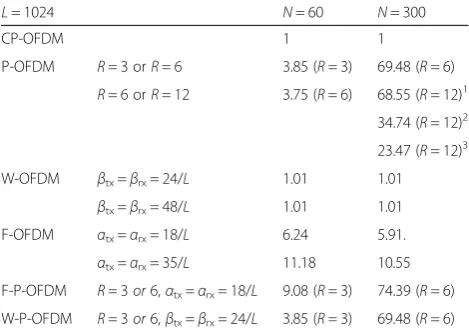
8N(N−R) + 4N2which is proportional toN2ifNis large. Table 2 shows the per-symbol normalized complexities (with respect to the complexity of CP-OFDM) of various approaches forN= 60 and 300. As discussed before, for W-OFDM, the complexity is very close to that of CP-OFDM no matter how many subcarriers are used. For F-OFDM with the fixed subcarrier number, the complexity increases as the filter length increases and are almost in-dependent of the number of subcarriers. Therefore, for low complexity, a filter with a minimum length is
Fig. 3Illustration of a W-OFDM receiver symbol
Table 1LTE-like systems
System parameters
Symbol duration:Ts= 1/Δf
Subcarrier spacing:Δf= 15 kHz
Number of samples per symbol duration:L= 1024
Active subcarrier index = [−300:−1,1:300]
CP parameters
One subframe: 2 slots/subframe
One slot: 7 data symbols (7Tsand half additional symbol duration (0.5Ts
is used for CP, with CP durationTcp1= 80Ts/1024Lcp1= 80L/1024 for the
first symbol andTcp2= 72Ts/1024Lcp2= 72L/1024 for the other symbols.
desired if OOBE and ACI can be kept within the specs. For precoding related approaches, the complexities of P-OFDM, F-P-P-OFDM, and W-P-OFDM for N= 300 are very high because they are proportional toN2whenNis large. Fortunately, the complexity can be reduced by dividing the big spectrum block into several smaller spectrum blocks. For example, forN= 300, the normalized complexity of P-OFDM is 68.55 for one spectrum block (which requires one precoder/decoder pair for 300 subcar-riers). The normalized complexity is reduced to 34.74 (or 23.47) for two (or three) spectrum blocks where we use two (or three) precoder/decoder pairs, and each pair is designed to precode/decode 150 (or 100) subcarriers. (The three cases of one, two, and three spectrum blocks are denoted by the superscripts 1, 2, and 3 in Table 2, re-spectively.) However, the reduction of complexity may cause degradation in spectral containment if the coding rate is kept unchanged (an example will be discussed in the next subsection).
3.2 Implications for non-contiguous and dynamic changing spectrum
In CR, the available bandwidth may be non-contiguous and dynamically changing. Among the approaches dis-cussed in Section 2, only the windowing approach can adapt to the changes or the non-contiguousness of the frequency bands easily. However, the performance of windowing is limited by the constraint on the CP length and is not always satisfactory as shown in the simulation result in Section 4. For the filtering and pre-coding approaches, the computational complexity is high if a single pair of transmit/receive filters or preco-der/decoder is employed to deal with the entire pos-sible band (which includes all pospos-sible stopbands and
passbands). In addition, the design of filters or preco-der/decoder has to change whenever the available spectrum changes. To deal with these problems caused by non-contiguous and dynamically changing spectrum, a resource block (RB) strategy for the filtering approach is proposed in [14]. Similarly, we have also proposed a RB strategy for the precoding approach (see Appendix and [25]) to adapt to the non-contiguous and dynamically changing spectrums.
3.3 Spectral containment and PAPR
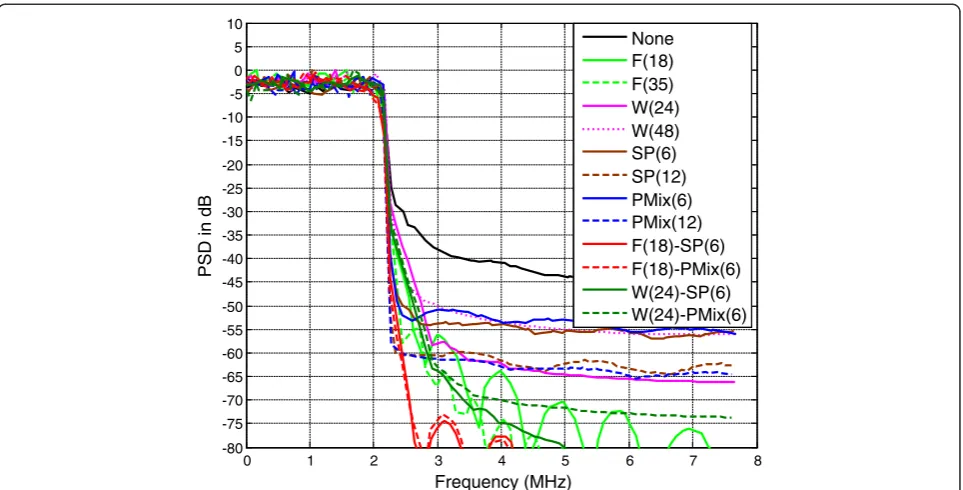
In this subsection, PSD and PAPR of various approaches based on the parameters defined in Tables 1 and 2 with N= 300 are evaluated and compared. In the legends of Figs. 4 and 5: for F(k),kis the transmitter filter length in samples; for W(k), k is the roll-off length of transmit windowing function in samples; for SP(R), only spectral precoding is used andRis the redundancy length of spec-tral precoding; and for PMix(R), the combination of spec-tral precoding and PAPR precoding in (28) is used andR is the redundancy length of the spectral precoding.
For F-OFDM, as shown in Fig. 4, the longer the filter is, the larger the stopband attenuation can be achieved. For W-OFDM, similar to F-OFDM, better spectral con-tainments can be achieved at the cost of a longer roll-off portion of the windowing function. However, W-OFDM has a slower fall-off rate (i.e., larger transition bands) than CP-OFDM (denoted as “None”; representing the case where there is no OOBE suppression process at the transmitter), as shown in Fig. 4. We aim to use a filter with the longest filter length or a windowing function with the longest possible roll-off portion length to re-duce inter-user interference as long as the performance loss caused by ISI is below a threshold. For SP-OFDM, the higher the spectral efficiency loss (i.e., the smaller coding rate) is, the larger the stopband attenuation can be achieved. Therefore, better spectral containment is at the cost of higher spectral efficiency loss. For the given examples, comparing with SP, filtering has a slower fall-off rate near the edges of the passband but a smaller PSD in the stopband away from the edges, and window-ing has a slower fall-off rate and a larger fall-off PSD in the stopband away from the edges.
Generally, a hybrid approach outperforms its individ-ual constituent approaches. For example, F(18)-SP(6)-OFDM is better than SP(6)-F(18)-SP(6)-OFDM and F(18)-F(18)-SP(6)-OFDM in terms of spectral containment. Furthermore, it is less sensitive to ISI compared with F(35)-OFDM. Similar ob-servations can also be made for W(24)-SP(6)-OFDM. Furthermore, comparing PMix with SP, it is remarkable that the spectral containment performances of PMix-OFDM, F-PMix-PMix-OFDM, and W-PMix-OFDM are almost the same as (or even better than) those of SP-OFDM, F-SP-OFDM, and W-F-SP-OFDM, respectively. Thus, we
Table 2Normalized complexity (with respect to CP-OFDM) for N= 60 and 300. Note that P-OFDM represents SP-OFDM, PP-OFDM, or PMix-OFDM and W/F-P-OFDM represents W/F-SP-OFDM, W/F-PP-OFDM, or W/F-PMix-OFDM
L= 1024 N= 60 N= 300
CP-OFDM 1 1
P-OFDM R= 3 orR= 6 3.85 (R= 3) 69.48 (R= 6)
R= 6 orR= 12 3.75 (R= 6) 68.55 (R= 12)1
34.74 (R= 12)2
23.47 (R= 12)3
W-OFDM βtx=βrx= 24/L 1.01 1.01
βtx=βrx= 48/L 1.01 1.01
F-OFDM αtx=αrx= 18/L 6.24 5.91.
αtx=αrx= 35/L 11.18 10.55
F-P-OFDM R= 3or6,αtx=αrx= 18/L 9.08 (R= 3) 74.39 (R= 6)
conclude that PMix outperforms SP in spectral contain-ment and PAPR (to be shown in Fig. 5).
The effects of RB on PSD will be briefly discussed below. Note that the PSD curve for SP(12)-OFDM in Fig. 4 is derived by using one precoder to precode the entire spectrum block of 300 subcarriers where the 12 redundancies are employed to nullify the frequency re-sponses at 12 notched frequencies (in which, six in the upper stopband and six in the lower stopband). For the
two-precoder case discussed in the previous subsection, the passband is divided into two blocks and each preco-der is to precode a spectrum block of 150 subcarriers. In this case, the precoder for the upper spectrum block has six notched frequencies in the upper stopband and zero notched frequencies in the lower stopband and the pre-coder for the lower frequency block has six notched fre-quencies in the lower stopband and zero notched frequencies in the upper stopband. The PSD result of
0 1 2 3 4 5 6 7 8
-80 -75 -70 -65 -60 -55 -50 -45 -40 -35 -30 -25 -20 -15 -10 -5 0 5 10
Frequency (MHz)
PSD in dB
None F(18) F(35) W(24) W(48) SP(6) SP(12) PMix(6) PMix(12) F(18)-SP(6) F(18)-PMix(6) W(24)-SP(6) W(24)-PMix(6)
Fig. 4Spectral containments. In the legends, for F(k),kis the filter length; for W(k),kis the windowing roll-off length; and for SP(R) and PMix(R), Ris the redundancy length of the spectral precoding
4 5 6 7 8 9 10 11
10-3 10-2 10-1 100
PAPR0(dB)
Pr
(PAPR
>
PAPR
0
)
None F(18) F(35) W(24) W(48) SP(6) SP(12) PMix(6) PMix(12) F(18)-SP(6) F(18)-PMix(6) W(24)-SP(6) W(24)-PMix(6)
this case is essentially the same as that shown in Fig. 4 (i.e., the one precoder for the entire spectrum block of 300 subcarriers). There is no degradation in spectrum contain-ment, but the normalized complexity is reduced from 68.55 to 34.74 as shown in Table 2. For the three-precoder case which is also discussed in the previous subsection, the OOBE increases 5 dB if the redundancy number Ris kept at 12. Thus, the reduction of the normalized com-plexity from 68.55 to 23.47, as shown in Table 2, is at the expense of an OOBE increase of 5 dB. Similar results have been shown in [25] and are omitted here.
The PAPRs of various approaches are plotted in Fig. 5. It is shown that the PAPRs of W-OFDM and F-OFDM are almost the same as that of CP-OFDM. However, for SP-OFDM, W-SP-OFDM, and F-SP-OFDM, their PAPR performances degrade compared with that of CP-OFDM and the degradation increases asRincreases. This is due to the fact that the precoded elements insbecome cor-related. As mentioned in Section 2.3, SP-OFDM, F-SP-OFDM, and W-SP-OFDM can be easily extended to re-duce the PAPR drastically by using (28). As shown in Fig. 5, at Pr (PAPR > PAPR0) = 10− 3, the PAPRs of
SP-OFDM, W-SP-SP-OFDM, and F-SP-OFDM are reduced by more than 3 dB if PMix-OFDM, F-PMix-OFDM, and W-PMix-OFDM are used respectively. Therefore, con-cluding from Figs. 4 and 5, the combination of spectral and PAPR precoding in (28) can suppress the OOBE and reduce the PAPR at the same time without adding extra complexity (compared with spectral precoding in (24)).
3.4 BER
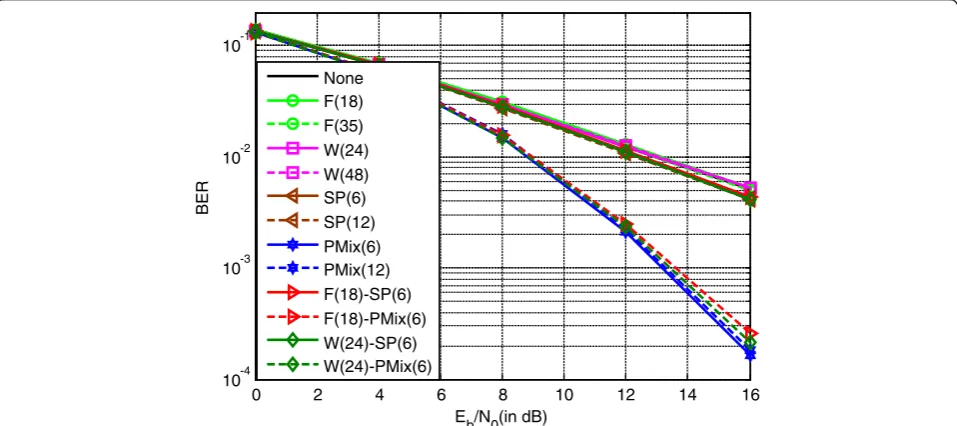
In an ideal situation where there is no ACI, FO, or TO, Fig. 6 shows the raw BER versus the Eb/N0(the energy
per bit to noise PSD ratio) for various approaches. The transmitter is transmitting on subcarriers [−144:−1, 1:156] where QPSK (or 4QAM) modulation is used. The system parameters defined in Tables 1 and 2 (N= 300), and a multipath channel with delay spread of 39 samples are used in the simulation. It is assumed that the channel is perfectly known and a 1-tap MMSE FDE is used at the receiver. Each BER point is obtained by averaging over 10,000 subframes.
In Fig. 6, the BERs of F-OFDMs and W-OFDMs are slightly worse than that of CP-OFDM (denoted as None; representing the case where there is no OOBE suppres-sion process at the transmitter and no ACI rejection at the receiver), due to ISI caused by delay spread. The BER performance degradation mainly depends on the fil-ter or windowing roll-off length, i.e., the F/W-OFDM with longer filter or windowing roll-off length has larger ISI and therefore worse BER performance. On the contrary, all approaches using precoding have small but noticeable BER performance improvements over CP-OFDM due to frequency diversity gain, since each data symbol is modu-lated by all the subcarriers due to the precoding.
It is remarkable that, with the same amounts of spectral coding rate, the performances of approaches with PMix are much better than approaches with SP. For example, PMix-OFDM, F-PMix-OFDM, and W-PMix-OFDM are much better than those of SP-OFDM, F-SP-OFDM, and W-SP-OFDM (the improvement is larger than 8 dB at BER = 10−3) due to the higher diversity gains provided by PMix. This is demonstrated in Fig. 7 which shows the PSDs of several arbitrarily selected modulated data sym-bols in SP-OFDM and PMix-OFDM. We can see that, in PMix-OFDM, each data symboldl,i is modulated by all
0 2 4 6 8 10 12 14 16
10-4 10-3 10-2 10-1
Eb/N0(in dB)
BER
None F(18) F(35) W(24) W(48) SP(6) SP(12) PMix(6) PMix(12) F(18)-SP(6) F(18)-PMix(6) W(24)-SP(6) W(24)-PMix(6)
the subcarriers with almost equal power. However, there is frequency selectivity in SP-OFDM, where the power of each data symbol is spread mainly only on several subcarriers. Thus, in the following simulations where ACI is present, approaches with SP (spectral pre-coding only) will not be shown since PMix (combined spectral and PAPR precoding) has better BER perform-ance when SP and PMix have the same redundancy length (note that the redundancy length for PAPR pre-coding is zero).
4 Practical issues and numerical examples: with ACI
Various practical issues are addressed in this section and the previous section (Section 3) based on a LTE-like sys-tem. Specifically, results shown in this section are with ACI, and results shown in Section 3 are without ACI. The simulation parameters are specified in Table 1, if not otherwise indicated. To examine the effects of ACI on a given receiver, consider two transmitters: one trans-mitter is desired and generates the desired signal, and the other transmitter is not desired and generates ACI. Presented in this section are the following three scenar-ios. In the first scenario, the reference receiver belongs to a PU, the desired transmitter belongs to another PU, and the interfering transmitter belongs to a SU. In the second scenario, the reference receiver belongs to a SU, the desired transmitter belongs to another SU, and the interfering transmitter belongs to a PU. In the third sce-nario, the reference receiver belongs to a SU, the desired transmitter belongs to another SU, and the interfering transmitter belongs to a third SU.
In our simulations, CP-OFDM is used in all PU and SU transmitter-receiver pairs. Note that a PU transmitter does not need to suppress its OOBE to the SU receivers and a PU receiver does not need to have special design to reject ACI from interfering SUs. However, a SU
transmitter needs to suppress its OOBE to the PU or non-designated SU receiver, and a SU receiver needs to have special design to reject ACI from the interfering PU and SU transmitters. Thus, we assume no transmit filtering, windowing, or precoding for suppressing OOBE in the PU transmitter. We also assume that in the PU receiver, there is a standard low-pass filter with the cutoff frequency of 4.5 MHz and the filter length of 35 samples (note that the minimum CP length is 72 samples and the channel impulse response length is 39 samples). For the SU transmitters and receivers, any of the approaches tested in Section 3 can be employed. For simplicity, we assume that the SU transmitters and re-ceivers use the same filtering, windowing, precoding, or hybrid approach.
4.1 OOBE suppression by a SU transmitter
Consider an example where a transmit-receive pair of PUs are operating in the frequency band with subcar-riers [−144:−1, 1:156] and a transmit-receive pair of SUs are operating in the adjacent frequency band of the same bandwidth. The frequency separation of the two bands is 1.5 times of subcarrier spacing (i.e., 22.5 kHz) where the 0.5 (in 1.5) implies that there is FO between the PU pair and SU pair. Two cases are investigated. In the first case, TO = 0, where the PU pair and SU pair are perfectly syn-chronous in time. In the second case, TO = 200/1024 Ts,
where there is a 200-sample delay between the PU pair and SU pair.
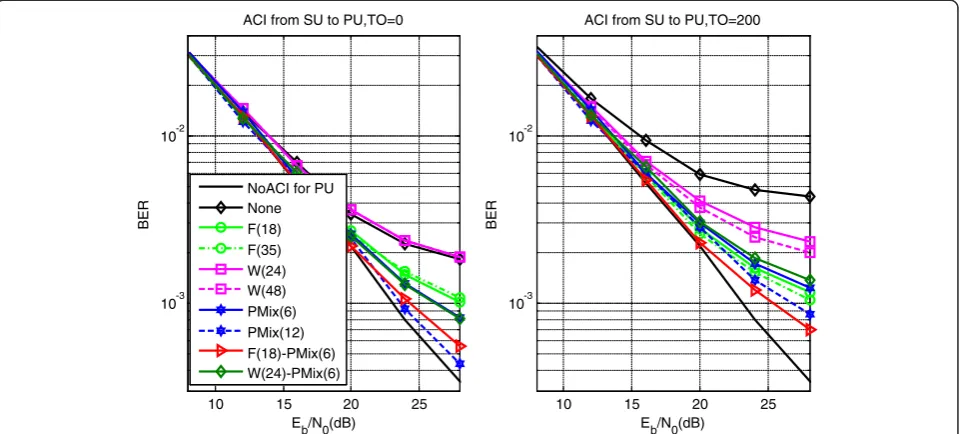
The OOBE suppression performance of W-OFDM, F-OFDM, PMix-F-OFDM, F-PMix-F-OFDM, and W-PMix-OFDM by the SU transmitter will be investigated by evaluating the raw BER performance of the PU receiver. In this simulation, the power of the SU transmitter is 10 dB higher than that of the PU transmitter. Figure 8 shows the BER performance of the PU receiver for TO = 0 and TO = 200 when the SU transmitter uses various
Fig. 7PSDs ofXN−1
OOBE suppression approaches. For comparison, the best possible performance (denoted as“No ACI for PU”; repre-senting the case where the interfering SU pair is absent) and the worst possible performance (denoted as None; representing the case where there is no OOBE sup-pression process in the interfering SU transmitter) are included in Fig. 8. It is clear that this is an interference-limited system because error floors exist for all approaches at high signal to noise ratios (SNRs).
When TO = 0, Fig. 8 shows that W-OFDM has almost the same OOBE suppression performance as None (i.e., windowing does very little in suppressing OOBE in this example where the frequency spacing of the desired and interfering signals is 22.5 kHz). This is because W-OFDM has larger stopband attenuation but a slower fall-off rate than None (see Fig. 4). For F-OFDM, we ob-serve that the F-OFDM with longer filter length has a slightly worse BER performance, which seems contrary to the spectral containment result in Fig. 4. In fact, there is no contradiction because the BER performances are affected not only by OOBE but also ISI. A filter with longer filter length has smaller OOBE but causes larger ISI. So, the ISI effects dominate the ACI effects in this example. Comparing F-OFDM with W-OFDM, we ob-serve that F-OFDM outperforms W-OFDM. Comparing F-OFDM and W-OFDM with PMix-OFDM, we observe that PMix-OFDM has the best OOBE suppression re-sults but at the cost of a small spectral efficiency loss and a significant complexity increase. Furthermore, the PMix-OFDM with more redundancy has smaller OOBE and causes less interference to the PU. It is remarkable that PMix(6)-OFDM outperforms both F(18)-OFDM and PMix(6)-F(18)-OFDM but at the cost of a small
spectral efficiency loss and a significant complexity in-crease. As W-OFDM did little to suppress OOBE in this example, W(24)-PMix(6)-OFDM has the same BER performance as PMix(6)-OFDM. All these obser-vations are consistent with the spectral containment results in Fig. 4.
When TO between the desired and interfering signals changes from 0 to 200, the BER performances of all ap-proaches degrade in different degrees. As shown in Fig. 8, the degradation of None is profound because the ability to reject interferences of the PU receiver depends very much on correct sampling of each interfering OFDM symbol. The degradation of “PMix” is also quite signifi-cant because, to a certain extent, the OOBE suppression ability of the interfering SU transmitter requires the PU receiver to have correct samples of each interfering OFDM symbols. Windowing has small degradations be-cause its OOBE suppression ability does not depend a lot on the OFDM symbol structure. However, as shown in TO = 0 case, windowing is not a good choice since it did very little to suppress OOBE. Filtering has the least degradation because its OOBE suppression ability de-pends very little on the OFDM symbol structure. As expected, the hybrid approach F-PMix (or W-PMix) has the combined features of filtering (or windowing) and PMix.
In practice, as PU and SU will generally not be syn-chronized, filtering is then a good choice for OOBE sup-pression because of its low complexity and robustness to TO. However, filtering alone is usually not adequate to produce sufficient OOBE suppression because the filter length of F-OFDM is limited by the CP length. In order to satisfy the OOBE suppression requirement and to 10 15 20 25
10-3 10-2
Eb/N0(dB)
BER
ACI from SU to PU,TO=0
NoACI for PU None F(18) F(35) W(24) W(48) PMix(6) PMix(12) F(18)-PMix(6) W(24)-PMix(6)
10 15 20 25 10-3
10-2
Eb/N0(dB)
BER
ACI from SU to PU,TO=200
minimize the sensitivity with respect to TO, the combin-ation of filtering with precoding would be necessary if the CP length is not long enough to allow a sufficient long filtering function. Thus, we conclude from this ex-ample that the combination of filtering with precoding would be the most efficient way to suppress OOBE of OFDM signal but at the cost of a small spectral efficiency loss and a significant complexity increase. This can be seen in Fig. 8 where, among all results shown, the hybrid approach F(18)-PMix(6)-OFDM for the SU has the best OOBE suppression performance when TO = 200.
4.2 ACI rejection by a SU receiver
Consider the same example as in the previous subsec-tion (Secsubsec-tion 4.1) where a transmit-receive pair of PUs are operating in the frequency band with subcarriers [−144:−1, 1:156] and a transmit-receive pair of SUs are operating in the adjacent frequency band of the same bandwidth. The frequency separation of the two bands is 1.5 times of subcarrier spacing where the 0.5 (in 1.5) im-plies that there is FO between the PU pair and SU pair. Two TO cases are investigated. In the first case, TO = 0, where the PU pair and SU pair are perfectly synchron-ous in time. In the second case, TO = 200/1024 Ts,
where there is a 200-sample delay between the PU pair and SU pair.
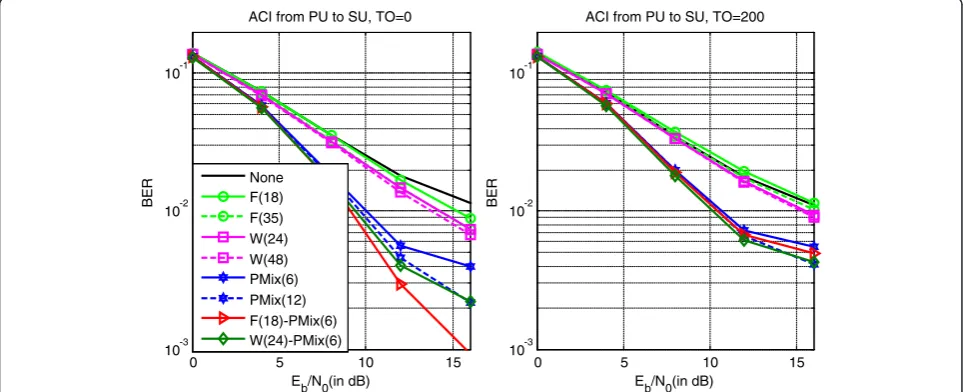
The performances of W-OFDM, F-OFDM, PMix-OFDM, F-PMix-PMix-OFDM, and W-PMix-OFDM used by the SU receiver to reject the ACI from the PU transmit-ter will be investigated by evaluating the BER performance of the SU receiver. For comparison, the worst possible per-formance (denoted as None; representing the case where there is no OOBE suppression or ACI rejection process in the SU transmitter and receiver) are included in Fig. 9. In
this simulation, the power of the PU transmitter is 10 dB higher than that of the SU transmitter.
When TO = 0, the ACI rejection performance of F-OFDM/W-OFDM mainly depends on the filtering/win-dowing length (the longer the filter length/winfiltering/win-dowing roll-off length, the better the ACI rejection perform-ance), and the performance of PMix-OFDM depends on the redundancy length (the longer the redundancy length, the better the ACI rejection performance). In addition, PMix outperforms F-OFDM and W-OFDM. These ob-servations are similar to those made for the OOBE sup-pression results in Fig. 8. However, unlike the OOBE suppression results in Fig. 8, windowing outperforms filtering for ACI rejection in Fig. 9. This is due to the fact that, at the SU receiver, the process of discarding CP generates discontinuities of the received signal. Since discontinuities usually cause spread in the fre-quency, the ACI caused by the interfering signal before discarding CP is smaller than that after discarding CP. Now that filtering is done before discarding CP, the ACI rejection ability of filtering approaches is greatly reduced by CP removal. On the other hand, windowing process is carried out on the signal portion that goes through the FFT for rejecting ACI, and the ACI rejection ability of windowing approaches is unaffected by CP re-moval because the discarded portion is compensated (see Fig. 3). For hybrid approaches, F(18)-OFDM outperforms both F(18)-F(18)-OFDM and PMix(6)-OFDM but at the cost of a small spectral efficiency loss and a significant complexity increase. Similarly, W(24)-PMix(6)-OFDM outperforms both W(24)-OFDM and PMix(6)-OFDM but at the cost of a small spectral efficiency loss and a significant complexity increase. Remarkably, F(18)-PMix(6)-OFDM outperforms W(24)-PMix(6)-OFDM
0 5 10 15
10-3 10-2 10-1
Eb/N0(in dB)
BER
ACI from PU to SU, TO=0
None F(18) F(35) W(24) W(48) PMix(6) PMix(12) F(18)-PMix(6) W(24)-PMix(6)
0 5 10 15
10-3 10-2 10-1
Eb/N0(in dB)
BER
ACI from PU to SU, TO=200
even though W(24)-OFDM outperforms F(18)-OFDM. It seems that the combination of filtering and spectral precod-ing work better than the combination of windowprecod-ing and spectral precoding at TO = 0 since both filtering and spec-tral precoding approaches suppress the unwanted signal in the frequency domain.
When TO changes from 0 to 200, the BER perfor-mances of all approaches in Fig. 9 degrade in different degrees. Similar to Fig. 8, the degradation of PMix is sig-nificant because, to a certain extent, the ACI rejection ability of the SU receiver requires to have correct sam-ples of each interfering OFDM symbols. Windowing and filtering have smaller degradations because their ACI re-jection ability does not depend a lot on the OFDM symbol structure. However, as shown in TO = 0 case, fil-tering is not a good choice since it does not deal with the ACI regeneration due to the CP removal. As ex-pected, the hybrid approach F-PMix (or W-PMix) has the combined features of filtering (or windowing) and PMix. What is remarkably different from the results in Fig. 8 is that BERs for TO = 0 and TO = 200 are similar for None because TO = 200 does not introduce more ACI than TO = 0 when no ACI suppression technique is employed.
In practice, as PU and SU will generally not be syn-chronized, windowing is then a good choice for ACI re-jection because of its low complexity, robustness to TO, and insensitivity to CP removal. However, windowing alone is usually not adequate to produce sufficient ACI rejection because the roll-off portion length of the win-dowing function in W-OFDM is limited by the CP length. In order to satisfy the ACI rejection requirement and to minimize the sensitivity with respect to TO, the combination of windowing with precoding would be
necessary if the CP length is not long enough to allow a sufficient long windowing function. Thus, we conclude from this example that the combination of windowing with precoding would be the most efficient way to reject ACI from interfering OFDM signal but at the cost of a small spectral efficiency loss and a significant complexity increase. This can be seen in Fig. 9 where, among all re-sults shown, the hybrid approach W(24)-PMix(6)-OFDM for the SU has the best ACI rejection performance when TO = 200.
4.3 OOBE suppression and ACI rejection by a SU (with respect to other SU, with FO and TO)
In this scenario, there are two transmit-receive pairs of SUs operating in adjacent (non-overlapping) frequency bands with the same bandwidth of 4.5 MHz. For con-venience, we assume that all SUs use the same OOBE/ ACI suppression approach with the parameters defined in Table 2. The frequency separation of the two bands is 1.5 times of subcarrier spacing where the 0.5 implies there is FO between the two pairs. Two cases are investigated. In the first case, TO = 0, the two pairs of SUs are perfectly synchronous in time. In the second case, TO = 200, there is a 200-sample delay between the two pairs of SUs.
We will evaluate the BER performances of one of the two SU receivers to study the combined effects of OOBE suppression and ACI rejection for various approaches. Among the two SU transmitters, one is chosen to be as desired and the other as unwanted (i.e., an interferer). We assume that the transmit power of the interferer is 10 dB higher than that of the desired SU transmitter. Any of the approaches discussed in Section 2 can be employed.
Figure 10 shows the BER performances of the desired SU pair with various approaches when TO = 0 and 200.
0 5 10 15
10-4 10-3 10-2 10-1
Eb/N0(in dB)
BER
ACI from interfering SU to receiving SU, TO=0
None F(18) F(35) W(24) W(48) PMix(6) PMix(12) F(18)-PMix(6) W(24)-PMix(6)
0 5 10 15
10-4 10-3 10-2 10-1
Eb/N0(in dB)
BER
ACI from interfering SU to receiving SU, TO=200
Among all, None is the worst because nothing is done to suppress OOBE or reject ACI; F(18)-PMix(6)-OFDM is the best but at the cost of spectral efficiency loss. For W-OFDM, W(24) and W(48) have the same BER performance. For F-OFDM, that with a longer filter length has a better performance. As we have designed, W(24)-PMix(6)-OFDM and F(18)-PMix(6)-OFDM both achieve better performance than W(24)-OFDM, W(48)-OFDM, F(18)-W(48)-OFDM, F(35)-W(48)-OFDM, PMix(6)-W(48)-OFDM, and PMix(12)-OFDM.
When TO is changed from 0 to 200, there is very little degradation on the performances of None, F-OFDM, and W-OFDM. On the contrary, the degradations on the per-formance of PMix-OFDM are significant. For the hybrid approaches, the degradations are visible but not significant. Comparing the BERs of the corresponding approaches in Figs. 9 and 10, the BERs in Fig. 10 (for two pairs of SUs) are smaller than those in Fig. 9 (for one pair of PU and one pair of SUs). This is due to the fact that the transmit interferer in Fig. 10 (i.e., a SU) performs OOBE suppression but the transmit interferer (i.e., a PU) in Fig. 9 does not perform OOBE suppression.
5 Conclusions
If the signaling structures are not known, windowing and filtering are the two primary designing principles for
the conventional OOBE suppression and ACI rejection approaches. However, when the signaling structures are known, new designs can be added into the conventional designs. For OFDM cognitive radio systems, precoding approaches can be employed to exploit the OFDM sig-naling structures before IFFT at the transmitter and after FFT at the receiver. In addition, a lot of non-trivial con-siderations need to be factored into the design. For ex-ample, the removal of CP at the receiver causes ACI regeneration if the truncation of interference signal due to the CP removal process is not properly taken into consideration by the adopted ACI rejection approach. On the other hand, effective OOBE is much larger than the estimated OOBE if there is a timing offset (TO) be-tween PU and SU. Thus, among the two conventional approaches, windowing is more appropriate for ACI re-jection since the windowing process is carried out on the portion that goes through the FFT and proper com-pensation for the discarded portion has been made, and filtering is more appropriate for OOBE suppression since it is less sensitive to TO.
In this paper, both time-domain (before FFT at the re-ceiver and after IFFT at the transmitter) and frequency-domain (after FFT at the receiver and before IFFT at the transmitter) OOBE suppression and ACI rejection ap-proaches for OFDM cognitive radio systems are examined
Fig. 12Precoding and decoding of RB-P-OFDM
fRB1
fRB0
fRB2
fRB11
fRB15
fRB16
fRB21
in details. Through the evaluation of the OOBE suppres-sion (a SU transmitter to suppress its OOBE) and ACI re-jection (a SU receiver to reject ACI caused by an interfering PU or SU transmitter) performances of all these approaches and their possible combinations under practical conditions (broadband channels with radio im-pairments such as FO and TO), we see that all of them can be used at the SU transmitter to minimize OOBE or at the SU receiver to reject the ACI. However, each of the existing approaches has some merits and some shortcom-ings, none of them alone can deal with all practical chal-lenges (such as long multipath delay spread, finite CP length, requirements of low PAPR, low BER, low complex-ity and high spectral efficiency, robustness with respect to FO and TO, ability to adapt to non-contiguous and dy-namically changing spectrum, etc.) alone. The two time-domain approaches, filtering and windowing, are proved to be efficient approaches to reduce OOBE at the SU transmitter and reject ACI at the OFDM-based SU ceiver, respectively, because of their robustness with re-spect to TO. However, their performance will be limited by the CP length. The developed hybrid precoding ap-proach PMix, which combines spectral precoding and PAPR precoding in the frequency domain, can provide satisfactory performances on OOBE suppression, ACI rejection, PAPR reduction, low BER and robustness with respect to FO, etc., but with the drawbacks of spectral efficiency loss, high complexity (when the available spectrum is broadband, non-contiguous, or time-varying), and being sensitive to TO. Fortunately, the complexity of PMix can be reduced with the re-source block scheme introduced in our previous work. Furthermore, to reduce spectral efficiency loss and TO sensitivity of PMix, the idea of combining the frequency-domain PMix with a time-frequency-domain approach (filtering or windowing) is presented in details in this paper with simu-lation results. The combination of PMix with filtering or windowing can mitigate not only the shortcomings of PMix (i.e., high complexity, spectral efficiency loss, and performance loss due to TO) but also the shortcomings of filtering and windowing (i.e., sensitivity to delay spread). Simulation results show that F-PMix-OFDM provides the best OOBE suppression and W-PMix-OFDM provides the best ACI rejection characteristics in our numerical examples.
6 Appendix
6.1 Resource block scheme
In a multicarrier modulation system, a RB consists of a fixed number of contiguous subcarriers, which is des-ignated to be the smallest dynamically available trans-mission band. All the assigned transtrans-mission bands or opportunistically detected frequency bands are consist-ing of one or multiple RBs. As depicted in Fig. 11, a
non-contiguous spectrum may be divided into RBs of the same size. Based on the concept of RB, it is pos-sible to remove the dependence of precoding approach on the allocated spectrum.
The main idea of RB-P-OFDM is to precode all RB by a predetermined precoding,GRB, independently. Once
NB, the size of each RB, the spacing between the central
frequency of each RB, and the notched frequencies,fi,i=
0, 1,..,K−1, are determined, the matrixPRBis fixed.
Then, a unique precoding matrix GRB with coding
re-dundancyRBcan be obtained by (24). In addition, since
the dimension of GRB is decreased from N to NB, the
computational complexity of the precoding and decod-ing operations is greatly reduced.
A block diagram of RB-P-OFDM is shown in Fig. 12. At the transmitter, the data of each RB, dl[k], k ∈℧, is
precoded by GRB independently to form a per-RB
pre-coded datasl[k]. Then, all the precoded datasl[k] instead
of dl[k] are modulated by the assigned subcarriers. At
the receiver, the demodulated data of each RB, ŝl[k], is
decoded independently by GHRB to recover the per-RB transmitted data d^l½ k . The extension of the RB ap-proach to the W-P-OFDM is straightforward. The exten-sion to the F-P-OFDM is a bit involved but can be done by applying the RB approach to the filtering process as well. However, the RB approach may degrade the spectrum containment unless the redundancy order is increased (which increases the spectral efficiency loss) as discussed in Section 3.2.
Competing interests
The authors declare that they have no competing interests.
Received: 21 January 2015 Accepted: 4 May 2015
References
1. J Mitola, GQ Maguire Jr, Cognitive radio: making software radios more personal. IEEE Personal Comm.6(4), 13–18 (1999)
2. TA Weiss, FK Jondral, Spectrum pooling: an innovative strategy for the enhancement of spectrum efficiency. IEEE Comm. Mag.42(3), 8–14 (2004) 3. F Meucci, O Cabral, FJ Velez, A Mihovska, NR Prasad, Spectrum aggregation
with multi-band user allocation over two frequency bands, inProc. IEEE Mobile WiMAX Symp, 2009, pp. 81–86
4. Y Wu, WY Zou, Orthogonal frequency division multiplexing: a multi-carrier modulation scheme. IEEE Trans. Consum. Electron.41(3), 392–399 (1995) 5. S Alamouti, A simple transmit diversity technique for wireless
communications. IEEE J. Sel. Areas Comm.16(8), 1451–1458 (1998) 6. C Cordeiro, K Challapali, D Birru, N Sai Shankar, IEEE 802.22: an introduction
to the first wireless standard based on cognitive radios. J. Commun.1, 1 (2006) 7. A Sahin, H Arslan, Edge windowing for OFDM based systems. IEEE
Commun. Lett.15(11), 1208–1211 (2011)
9. I Cosovic, S Brandes, M Schnell, Subcarrier weighting: a method for sidelobe suppression in OFDM systems. IEEE Commun. Lett.10(6), 444–446 (2006) 10. S Brandes, I Cosovic, M Schnell,Sidelobe suppression in OFDM systems by
insertion of cancellation carriers. IEEE 62nd Vehicular Technology Conference (VTC), 2005, pp. 152–156
11. X Fu, J Wang, SQ Li,Sidelobe suppression for OFDM based cognitive radio systems. 4th International Conference on Communications and Networking in China (ChinaCOM), 2009, pp. 1–5
12. CD Chung, Spectrally precoded OFDM. IEEE Trans. Comm.54(12), 2173–2185 (2006)
13. J Van de Beek, Sculpting the multicarrier spectrum: a novel projection precoder. IEEE Comm. Lett13(12), 881–883 (2009)
14. J Li, E Bala, R Yang, Resource block filtered-OFDM for future spectrally agile and power efficient systems. Phys. Commun11, 36–55 (2014)
15. E Bala, J Li, R Yang, Shaping spectral leakage: a novel low-complexity transceiver architecture for cognitive radio. IEEE Vehicular Magazine
8(3), 38–46 (2013)
16. J Fang, L I-Tai, Precoder designs for jointly suppressing out-of-band emission and peak-to-average power ratio in an orthogonal frequency division multiplexing system. IET Commun.8(10), 1705–1713 (2014) 17. TS 36.211 Evolved Universal Terrestrial Radio Access (E-UTRA); Physical
channels and modulation; Release 9, 2010
18. FCC 12–36, Third Memorandum Opinion and Order in the TV white spaces proceeding, ET Docket Nos. 04–186 and 02–380, April 4, 2012.
19. J Van de Beek, Orthogonal multiplexing in a subspace of frequency well-localized signals. IEEE Comm. Lett14(10), 882–884 (2010)
20. SB Slimane, Reducing the peak-to-average power ratio of OFDM signals through precoding. IEEE Trans. Veh. Tech.56(2), 686–695 (2007)
21. I Baig, V Jeoti,PAPR reduction in OFDM systems: Zadoff-Chu matrix transform based pre/post-coding techniques(Second International Conference on Computational Intelligence, Communication Systems and Networks (CICSyN), 2010), pp. 373–377
22. HG Myung, L Junsung, DJ Goodman, Single carrier FDMA for uplink wireless transmission. IEEE Veh. Technol. Mag.1, 30–38 (2006)
23. HS Malvar,Signal processing with lapped transforms. 357 pages, Artech House, 1992 ISBN 0890064679
24. D Noguet, M Gautier, V Berg, Advances in opportunistic radio technologies for TVWS. EURASIP J. Wireless Commun. Networking170, 1–12 (2011) 25. J Fang, Z You, I-T Lu, J Li, R Yang,Resource block based precoding schemes
for suppressing out-of-band emission. Military Communications Conference (MILCOM), 2013, pp. 1570–1575
Submit your manuscript to a
journal and benefi t from:
7Convenient online submission
7Rigorous peer review
7Immediate publication on acceptance
7Open access: articles freely available online
7High visibility within the fi eld
7Retaining the copyright to your article