R E S E A R C H
Open Access
Workload-dependent queuing model of an
AQM-controlled wireless router with TCP
traffic and its application to PER-based link
adaptation
Onur Ozturk
*and Nail Akar
Abstract
We propose a novel workload-dependent queuing model for a wireless router link which employs active queue management (AQM) and is offered with a number of persistent Transmission Control Protocol (TCP) flows. As opposed to existing work that focus only on the average queue occupancy as the performance metric of interest, the proposed analytical method obtains the more information-bearing steady-state queue occupancy distribution of the wireless AQM link. Simulations are performed to demonstrate the accuracy of the proposed model in both wireline and wireless scenarios. With the intention of maximizing TCP throughput, this analytical method is used to obtain guidelines for setting the target wireless packet error rate (PER) for a PER-based traffic-agnostic link adaptation scheme.
Keywords: Workload-dependent queues; TCP; Active queue management; Link adaptation; Cross-layer analysis
1 Introduction
Transmission Control Protocol (TCP), along with User Datagram Protocol (UDP), has been the most dominant transport protocol used in the Internet today. The tra-ditional technique of using buffer management based on tail drop at wireline router links carrying TCP traffic leads to the so-called ‘full queues’ and ‘lock-out’ prob-lems described in [1]. The full queues problem refers to the buffer being full most of the time, introducing large queuing delays which in turn impact adversely the TCP level throughput. The lock-out problem refers to a situ-ation in which a single or a few flows monopolize the queue space while starving others as a result of synchro-nization or other timing effects. To avoid the full queues problem, active queue management (AQM) mechanisms drop packets before the queue becomes full [1]. Typi-cally, the AQM drop decision is probabilistic on certain queue parameters to mitigate the lock-out problem [1]. For various AQM mechanisms proposed in the literature, we refer the reader to [1-5]. More recently, Adams [6]
*Correspondence: [email protected]
Electrical and Electronics Engineering Department, Bilkent University, Bilkent, Ankara 06800, Turkey
presents a comprehensive survey of AQM along with an elaborate classification and comparison of its proposed variants and its use in the wireless context. Lakkakorpi et al. [7] conclude that the standards-based Worldwide Interoperability for Microwave Access (WiMAX) tech-nology can indeed benefit from AQM in reducing its downlink latency, and we use the WiMAX physical layer in the numerical experiments of this paper.
An analytical expression, the so-called PFTK formula, is provided for the steady-state throughput of a persistent or long-lived TCP flow (i.e., a flow with a large amount of data to send such as FTP transfers) as a function of its packet loss rate and the round-trip time (RTT) in [8]. The PFTK formula takes into account both the fast retransmit mechanism of TCP Reno and the effect of TCP time-out on throughput. For a related study on a simpler TCP throughput expression which ignores certain features of TCP, the so-called square-root formula, see [9]. Lassila et al. [10] further integrate the square-root model with a generalized processor sharing model to analyze non-persistent TCP flows as well. Using fixed-point iterations, the PFTK formula can be used to approximate the abso-lute throughput of a TCP flow sharing an AQM router
link with other TCP flows and also in a network of AQM routers with persistent and dynamic traffic scenarios [11]. However, the focus in [11] is the mean queue occupancy in router links, not the queue occupancy distribution. For related work on how to approximate the flow-level TCP throughput when the flows share a network of AQM routers using an M/M/1/K model, we also refer the reader to [12].
In wireline router links, errors due to transmission are negligible. However, in wireless router links, packet errors due to transmission are inevitable. Therefore, in addi-tion to congesaddi-tion losses stemming from AQM drops, we also have non-congestion (or wireless) losses aris-ing due to channel errors. TCP suffers substantially from non-congestion losses since it responds to all losses by invoking congestion control and avoidance algorithms which results in degraded end-to-end performance on paths with lossy links [13]. A comparison of different approaches for improving TCP performance over wire-less links is provided in [13]. Barakat and Altman [14] use the square-root formula to analytically study the inter-action between TCP and the amount of forward error correction (FEC) to be used in wireless links. This study is then extended to the interaction of TCP and automatic repeat request with selective repeat (ARQ-SR), and in-order delivery of packets to the IP layer, using the PFTK formula. Optimal design and analysis of hybrid FEC/ARQ schemes in TCP context is also studied in [15] and [16] with Rayleigh fading. In these studies, the AQM mech-anism is not taken into consideration. A recent work in [17] studies an AQM-controlled wireless link with FEC and ARQ using fixed-point approximations and the PFTK formula in an M/M/1/K setting. One of the goals of this paper is to introduce a novel queuing model for AQM-controlled wireless links with the specific goal of obtaining the steady-state queue occupancy distribution.
While AQM focuses on buffer management address-ing the full queues and lock-out problems, link adaptation (LA) adapts the transmission parameters of the wireless system to changing channel conditions with the inten-tion of increasing the spectral efficiency of the wireless transmission system [18]. The key parameters to adapt are the modulation and coding levels also known as adap-tive modulation and coding (AMC), transmission power, spreading factors, etc., or a hybrid of the above. One of the topics we study in the current paper is AMC-based LA without power control for which in real implementations, the values for the transmission parameters are quantized and grouped together into a finite set of modulation and coding schemes (MCSs). The basic goal of an LA algo-rithm is to choose the best possible MCS over varying channel conditions [18], whereas the main principle is to use in this decision a certain channel state informa-tion (CSI) representative of the quality of the wireless
channel. CSI may be in the form of SNR or signal-to-noise-plus-interference ratio (SINR) that is available from the physical layer [18]. Additionally, the wireless chan-nel is assumed to match a particular stochastic model, whichever suits, to indirectly obtain packet error rate (PER) which is crucial for MCS selection [19]. Mapping estimated SNR values to MCSs, however, presents a chal-lenge in multipath fading channels for which the perfor-mance of a given MCS of interest may exhibit significant variation across different channel models. It is shown in [20] and [21] that the average throughput can be sig-nificantly increased if the MCS selection is based on an accurate prediction of PER to be expected for the current channel conditions. However, to obtain a reliable estimate of PER, a large number of packets need to be transmitted, making the adaptation relatively slower when compared to SNR-based LA [18].
high target PER increases the queue service rate, but it becomes quite possible that the queue would occasionally be empty due to substantial wireless losses stemming from TCP reaction to such losses. Note that TCP throughput optimization is shown to be dependent not only on PER but also on traffic-related parameters such as the number of TCP flows and their RTT values. However, estimat-ing the number of active TCP connections and their RTT values is computationally difficult to implement. In this paper, we study only traffic-agnostic PER-based LA.
The two main contributions of this paper are presented below:
• We introduce a novel workload-dependent M/D/1 queuing model for an AQM-controlled wireless link with Bernoulli packet losses using the PFTK formula taking into account both the fast retransmit
mechanism of TCP Reno and the effect of TCP timeout on throughput to obtain the entire queue occupancy distribution. In most existing work, the focus has been on the mean queue occupancy as well as the average packet loss probability due to
congestion, and moreover, fixed packet sizes are generally not taken into account. The proposed model is validated by ns-3 [22] simulations. The following are the main features of the proposed model: (i) The proposed model provides a good match with simulations even in the vicinity of empty queues as opposed to other existing models. The ‘empty queues’ scenario is particularly important when an MCS is used with high wireless loss rates, and TCP sources throttle back relatively aggressively in a way that they cannot keep the queue full all the time. (ii) Some of existing models suffer when the workload-dependent AQM packet drop probability is discontinuous with respect to the workload, whereas the performance of our proposed method is
insensitive to such behavior. (iii) The proposed method can further be used in the analysis of quality of service (QoS) differentiation mechanisms relying on per-class buffer management such as weighted random early detection (WRED) [23,24].
• We present a novel cross-layer framework based on the proposed queuing model to obtain a range of target PERs that needs to be maintained by a traffic-agnostic PER-based LA scheme for TCP throughput optimization. By being traffic-agnostic, optimality is shown to be sacrificed but the proposed range of target PERs allows one to obtain robust TCP performance for a wide range of traffic parameters including the number of TCP flows, their RTTs, etc. In this description, a robust policy refers to one that does not deviate much from an optimal policy that requiresa priori information about the underlying
traffic parameters. For the cross-layer framework, we use the IEEE 802.16e Wireless-Metropolitan Area Network (MAN) Orthogonal Frequency Division Multiplexing Access (OFDMA) Physical (PHY) air interface as the underlying PHY layer technology, but the framework allows other technologies to be used [25].
HARQ/ARQ techniques for which the errored packets at the receiver are retransmitted by the transmitter until either they are successfully decoded or a retransmission limit is reached are not considered in this paper. From TCP perspective, they prove to be powerful techniques to combat with multipath fading in wireless channels at the expense of increased delay and jitter caused by random retransmissions. Out-of-order packet delivery is another natural consequence of HARQ/ARQ which can be detri-mental to TCP throughput if left uncompensated at the receiver [26]. Out-of-order packets force TCP receivers to send duplicate ACKs to TCP transmitters as if the miss-ing packets have been lost which in turn throttles back the transmitter’s packet injection rate to the network. To cope with out-of-order packet arrivals, wireless receivers optionally resequence the arriving packets from the air interface before their delivery to the network [27]. For the analysis of TCP performance over links deploying HARQ/ARQ, one should additionally model the complex effects of the retransmission delays as well as resequenc-ing delays. TCP modelresequenc-ing for AQM-controlled links with HARQ/ARQ is left for future research.
The paper is organized as follows. In Section 2, the workload-dependent queuing model for an AQM-controlled wireless link with Bernoulli wireless packet losses is presented. In Section 3, the model is validated in both wireline and wireless scenarios using simulations. Section 4 addresses the framework we introduce using the proposed queuing model to obtain the target PER for TCP throughput optimization for a wide range of scenarios. We conclude in the final section.
2 Analytical model
2.1 Workload-dependent M/G/1 queue
The following description of workload-dependent M/G/1 queues and the accompanying notation is based on [28]. We consider a Markovian workload process in which the server drains the queue according to a workload-dependent service rate function r(x) (in units of bps) where x denotes the current workload (in units of bits) in the queue. On the other hand, the packet arrivals to the queue are governed by a Poisson pro-cess with a workload-dependent intensity functionλ(x). We assume r(0) = 0, r(x) is strictly positive, left-continuous, and has a strictly positive right limit on
job size (in units of bits) whose cumulative distribu-tion funcdistribu-tion (CDF) is denoted by B(·) with mean job size β. Under the condition lim sup
x→∞ β
λ(x)
r(x) < 1,
the workload process is ergodic and possesses a stationary probability density function (PDF) denoted byv(x),x>0. The workload process may also have a probability mass (atom) at zero denoted byV(0). It is shown in [28] that the steady-state workload density v(·)satisfies the following integro-differential equation forx>0:
r(x)v(x)=λ(0)V(0)(1−B(x)) atx= 0. A closed form solution to (1) for the workload-dependent M/M/1 queue is given in [28]. For persistent TCP flows, packet sizes are generally fixed rather than being variable for a given flow. Therefore, the specific case of the workload-dependent M/D/1 queue and a numerical solution for finding the stationary densityv(x) is crucial for TCP modeling which is described next. For this pur-pose, we fix the deterministic packet length toLbits. The buffer occupancy is then discretized with a discretiza-tion intervalsuch thatl = L/ >> 1 is an integer. We then definevi = v(i) fori > 0 and discretize the
integro-differential equation (1) to obtain
vi=
Note that the identity (2) enables us to calculate vi as a
weighted sum ofvj’s forj<iwhich lends itself to an
itera-tive procedure. We propose to setV(0)=1 and iteratively calculatevifor 1≤ i ≤Kas in (2) for some large choice
ofK. Note thatKshould be chosen such that∞K+1vi should be small enough to yield an acceptable approxima-tion error. Finally, we first defineV = V(0)+Ki=1vi and then normalize as follows:
V(0):=V(0) V ,vi:=
vi
V, 1≤i≤K. (3) 2.2 Equation-based TCP model
In line with the majority of the existing work on TCP mod-eling, we propose to use the so-called PFTK TCP model of [8] to relate the throughput of a TCP flow to the packet loss rate seen by the flow. For details, we refer the reader to [8]. Letp,λ, andT0denote the packet loss rate, packet send rate, and the retransmission timeout parameter of a TCP source, respectively. In our model, we use the fol-lowing relationship used in the implementation of TCP in [22]:
T0=max(T0,min, RTT+4σRTT), (4)
where RTT andσRTT are the smoothed estimates for the round-trip time (RTT) and its standard deviation, respec-tively, and T0,min is a minimum limit imposed on the timeout parameter. Let Wu denote the random variable
associated with the unconstrained window size of the TCP source. Also, letWmax=W/Landbdenote the maximum window size in units of packets and the number of pack-ets to wait before sending a cumulative ACK packet by the TCP receiver, respectively, whereWis the receiver’s buffer size. Padhye et al. [8] propose the following equation for the TCP send rateλif the TCP flow is exposed to a packet loss rate ofp:
Throughout our numerical studies, we fixT0,min=0.2s as in [29], b = 2, L = 1, 500 bytes (unless otherwise stated), andW =64 Kbytes. With these, the equation (5) provides a closed-form expression for the TCP send rateλ in terms ofp, RTT, andσRTT.
2.3 Active queue management
queue defined by certain thresholds. Performance of RED is known to exhibit considerable variation with respect to the particular choices for these thresholds [30]. As a remedy, the so-called gentle variant of RED, called GRED, is proposed to make RED less sensitive to the choice of these parameters [31]. Moreover, stochastic model-ing of the autoregressive filtermodel-ing operation used in such RED-like schemes is generally known to be difficult and costly [32,33]. We therefore propose to use early ran-dom detection (ERD) [3] for which an arriving packet is dropped with probabilityp(x)when the instantaneous queue length takes the value x. The gentle variant of the ERD discipline we study in this paper refers to the particular choice ofp(x)as follows:
p(x)= respectively, in units of bits, andpmaxis set to 0.1.
2.4 Proposed model
We envision a wireless router link that is offered with persistent TCP flows with the following assumptions:
• Npersistent TCP flows share the wireless link using first-in-first-out (FIFO) queuing.
• All flows use the same packet sizeL.
• Incoming packets from the TCP flows are dropped according to the specific ERD AQM scheme given in (9) with the drop decision depending solely on the instantaneous queue occupancyx.
• The link serves the waiting packets in the queue with a fixed transmission ratermdictated by the
underlying MCS. We assumeMdifferent physical layer MCSs denoted byMCSm,m∈ {0, ...,M−1} that are supported by the link’s air interface. For this study, we will be given a fixedMCSmand SNR level denoted bySNRs,s∈ {0, ...,S−1}, and we will assume
that transmitted packets are errored at the receiver with a probability denoted byPERm,s. Lost packets are not retransmitted, and loss events are assumed to be independent and identically distributed (iid) following the Bernoulli wireless loss model. • Flowi,i∈ {0, ...,N−1}is exposed to
– an average packet loss probabilitypi accounting for losses generated by both the ERD scheme and wireless transmission. – an instantaneous workload-dependent
queuing delayD(x)=x/rmat the router
when the instantaneous queue occupancy takes the valuex. Without loss of generality,
DT =L/rmandDFaccount for the transmission and one-way framing delays, respectively, the latter including other processing delays of any wireless
communication system.DFis multiplied by a factor of 2 to account for both forward and reverse (TCP ACK messages) path delays.
• Queuing and transmission delays as well as the error rates of the TCP ACK packets are assumed to be negligibly small and will be ignored by the analytical model assuming that TCP ACK prioritization is deployed [34] and enhanced wireless protection is established in the reverse path of the flows [35]. • In addition to the delay encountered at the router,
each flow has an additional fixed round-trip delay denoted byRTT0,i,i∈ {0, ..,N−1}taking into account the propagation delays of all links on the path of the flow.
• We assume that either all flows are bottlenecked at the particular wireless link of interest or their bottleneck bandwidths at other links are known in advance and they remain unaffected by the dynamics of the wireless link. Packet error rates on other links are assumed to be negligible. We therefore do not attempt to model networks of AQM router links but rather focus on a single AQM link.
• The packet send process for each flow is Poisson with intensityλiwhich will be shown to depend on the instantaneous queue occupancyxin our proposed model. We note that the Poisson assumption has successfully been used for TCP modeling in previous studies [17].
• All TCP flows use the same minimum timeout parameterT0,min.
The central idea of this paper is to use the PFTK TCP model given in (5) to write λi as a function of the single independent parameter x so that the stationary queue density can be obtained by solving the workload-dependent M/D/1 queue described in Section 2.1. For this purpose, let the workload-dependent round-trip delay of flowibe denoted by RTTi(x)which can be expressed as the sum of the following components:
RTTi(x)=RTT0,i+2DF+L/rm+x/rm. (10)
Furthermore, letT0,i(x) denote the workload-dependent
timeout parameter for flowiwhich can be expressed via (4) as
T0,i(x)=max(T0,min, RTTi(x)+4σRTT,i), (11)
where σRTT,i stands for the standard deviation of the
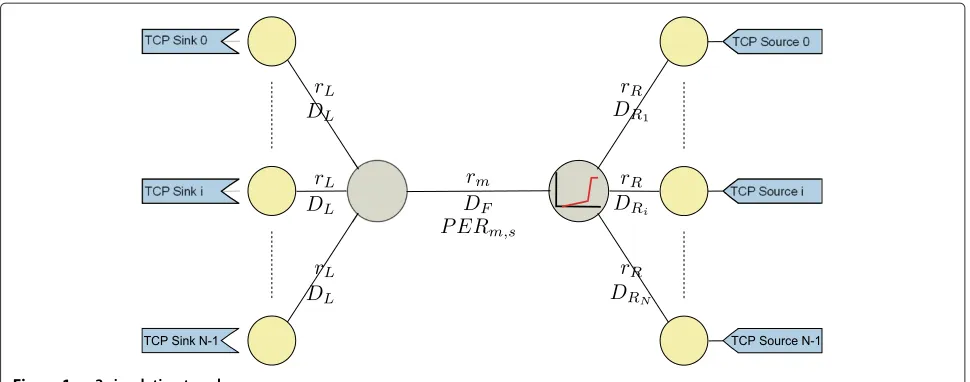
Figure 1ns-3 simulation topology.
20 40 60 80 100 120 140 160 180
0 0.02 0.04 0.06
uk
N = 10
proposed fixed−point ns3
20 40 60 80 100 120 140 160 180
0 0.02 0.04 0.06
uk
N = 20
proposed fixed−point ns3
20 40 60 80 100 120 140 160 180
0 0.02 0.04 0.06
k (number of packets)
uk
N = 30
proposed fixed−point ns3
that are admitted into the queue denoted byλ(x)can then be written as
λ(x)=
N−1
i=0
κi(x), (12)
where
κi(x)=(1−p(x))λi(x), (13)
is the rate of packets belonging to individual flowithat is admitted into the queue. In our proposed model,λi(x)is the send rate of flowiwhen the queue occupancy takes the valuex, and we propose to use the PFTK TCP model (5) to writeλi(x) with RTT andT0being replaced with their per-flow based workload-dependent counterparts RTTi(x) and T0,i(x), respectively, and p being replaced with its per-flow counterpart pi which is the average
packet loss probability for flow i. We put λi,max as an upper bound onλi(x) representing the maximum send rate imposed on flowiby the links it traverses other than
the one under analysis.λi,maxis assumed to be known and set to∞throughout this paper unless otherwise stated. We note that the delay terms in (5) are taken as a function of the instantaneous queue occupancyx, whereas the loss probability term is obtained by averaging out over all pos-sible values ofx. We also studied alternative formulations for which the loss probability term is allowed to depend onxwhich produced much less favorable results and are therefore not given in this study. We plug (12) into (1) and employB(x) = 1 forx ≥ Land zero otherwise. More-over, for a given MCSm, we setr(x)=rmwhich then leads
us to the framework of the workload-dependent M/D/1 queuing with fixed service speed. Sincep(x)=1 and thus
λ(x) = 0 forx ≥2thmaxbits, the condition onR˜(x)for a stationary solutionv(x)with an atom at zero can be shown to be satisfied for this particular model. Since the station-ary densityv(x) =0 forx >xmax =(2thmax+L), we set K =xmax/in our numerical examples where=1 bit unless otherwise stated.
20 40 60 80 100 120 140 160 180
0 0.02 0.04 0.06
u k
N = 10
proposed fixed−point ns3
20 40 60 80 100 120 140 160 180
0 0.01 0.02 0.03 0.04 0.05
u k
N = 20
proposed fixed−point ns3
20 40 60 80 100 120 140 160 180
0 0.01 0.02 0.03 0.04 0.05
k (number of packets)
u k
N = 30
proposed fixed−point ns3
Let λi and κi denote the average packet arrival and acceptance rates, respectively, into the queue from flow i. We can then write by queue-averaging arguments the following two identities:
Assuming AQM and wireless packet losses to be indepen-dent from each other, the average packet loss probability for flowistemming from both ERD buffer management and wireless losses, denoted by pi, can be written as
follows:
pi=1−(1−PERm,s)(1−qi), (16)
whereqi, average packet loss probability for flowi
stem-ming only from ERD, is obtained via queue averaging:
qi=
Furthermore, letD¯idenote the average queuing delay in
the router seen by flowi. Then, we can write
¯
If we know the workload-dependent intensity of packet arrivalsλ(x), then we can find the stationary densityv(x) and the atom at zero V(0) with the algorithm outlined before. However, λ(x) depends on RTTi(x) and T0,i(x), the latter depending on σRTT,i for all i. Moreover, λ(x)
depends on pi. Recognizing that σRTT,i and pi can be
obtained provided v(x) andV(0) are available, we pro-pose a fixed-point algorithm for obtaining the stationary density of the queue occupancy. For this purpose, we defineσRTT,(k) iandpi(k)to denote the estimates for the
cor-responding quantities at iteration k. At iterationk +1,
λ(x) is obtained using σRTT,(k) i andpi(k). Via the solution
of the workload-dependent M/D/1 queue with intensity function λ(x), we obtain v(x) and V(0). The new val-ues of σRTT,i andpi are obtained at this iteration using
the identities (19) and (16), respectively, but exponentially smoothed with smoothing parametersα1andα2, respec-tively, to obtain σRTT,(k+1i) and pi(k+1). Iterations continue
until the following two conditions are simultaneously sat-isfied:
for some normalized tolerance parameters 1 and 2. For numerical experimentation with the fixed-point algo-rithm, we fix 1 = 2 = 0.01, α1 = 0.7, and α2 = 0.9. We finalize this section by expressing the aggregate TCP throughput, the key parameter to be studied in our numerical examples, as(1−PERm,s)LNi=−01κi.
k (number of packets)
uk
N = 10
proposed ns3
3 Model validation
The so-calledproposed analysis method of this paper is validated using the ns-3 network simulator [22] for both wireline and wireless scenarios. We use the dumb-bell topology involvingN TCP Reno flows in Figure 1 in our simulations. The ingress link for flowi, 0 ≤ i < N, has capacityrR and one-way propagation delayDRi, whereas the egress link for the same flow has capacity rL and
one-way propagation delay DL. The central link in the
middle is the wireless bottleneck link with one-way prop-agation delayDF using an MCSm yielding a capacityrm
and a wireless loss rate PERm,s at SNR level SNRs. TCP
flow statistics are obtained using theFlowMonitorwhich is a monitoring framework developed for ns-3 [36]. The RateErrorModelclass of ns-3 is used whenever a non-zero PERm,sis to be simulated. In ns-3, it is more appropriate
to probe queue occupancy in units of packets as opposed to the unfinished work densityv(x)obtained through the
workload-dependent M/G/1 queuing model. Therefore, for the sake of comparing our results to those obtained by ns-3, we approximate the steady-state queue occu-pancy probability mass function (PMF) in units of packets denoted byukas follows:
uk=
xmax/L
i=1
iL
y=((i−1)L)+v(x)dx
δ(k−i), k>0
V(0), k=0
(21)
whereδ(·) denotes the Dirac-delta function. Simulations are terminated after 5 min, but the first 30 s corresponding to transients are ignored. Each simulation is repeated ten times unless otherwise stated, and the average results are reported together with the associated confidence intervals computed for 95% confidence level.
0 2 4 6 8 10
0 0.2 0.4 0.6 0.8
uk
N = 1
proposed ns3
0 2 4 6 8 10
0 0.2 0.4 0.6 0.8
uk
N = 4
proposed ns3
0 2 4 6 8 10
0 0.1 0.2 0.3 0.4 0.5
k (number of packets)
uk
N = 16
proposed ns3
We compare the proposed analysis method with the one presented in [11] which is referred to as the fixed-pointmethod for the wireline scenario for which we set PERm,s = 0. The method fixed-point pursues a similar
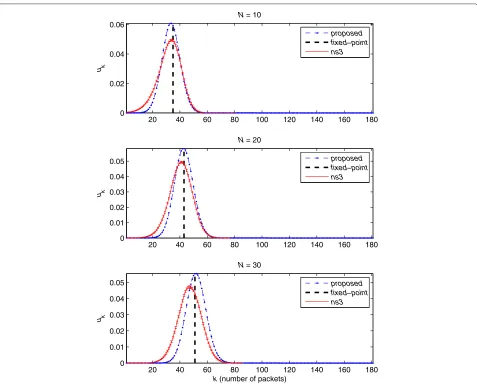
approach to the proposed in relating the TCP through-put to the queue occupancy by the PFTK formula, but it uses a fluid model to obtain only the average queue occu-pancy, not its distribution. Moreover, fixed-point does not take wireless losses into account. We set (rL,rm,rR) = (1, 000, 10, 1, 000)Mbps, ensuring that the central link is the bottleneck link. In Figure 2, the PMF uk is obtained
using proposed, fixed-point, and ns-3 simulations for sce-nario A which refers to(DL,DF,DRi) = (5, 0, 5)ms and depicted for three different values of N. In Figure 3, the PMF uk is depicted for scenario B which refers to (DL,DF,DRi) = (15, 0, 5 + 5 i/(N/10)) ms again for three values of N. It is clear that the method proposed matches the PMF obtained by ns-3 simulations in both shape and magnitude especially for smaller number of
flows. The deviation from the simulation results for larger number of flows is probably due to the fact that the instan-taneous queuing delay is used in our workload-dependent queuing model although in actual TCP implementations, this information would be slightly delayed. Consequently, proposed improves upon fixed-point as far as the queue occupancy PMF is concerned.
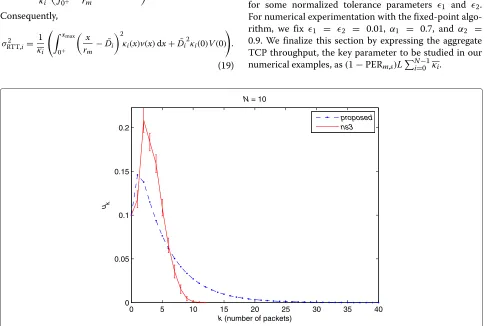
For scenario B, we now setN =10 andrL =0.9 Mbps
(corresponding toλi,max = rL/Lof proposed), for which the numerical results are given in Figure 4. We also increase the number of ns-3 simulations to 120 to obtain more reasonable confidence intervals. In this case, fixed-point ends up with an always-empty queue, whereas the proposed captures the actual PMF acceptably well. In par-ticular, the probability mass at zero V(0) is found to be 0.1000188, 1, and 0.0999987, using proposed, fixed-point, and simulations, respectively. In a network of queues, it is likely that most of the links will be operating at an empty queue regime. We believe that the PMF-capturing
0 5 10 15
0 0.2 0.4 0.6
u k
N = 1
proposed ns3
0 5 10 15
0 0.05 0.1 0.15 0.2
uk
N = 4
proposed ns3
0 20 40 60 80 100 120 140 160 180
0 0.02 0.04 0.06
k (number of packets)
uk
N = 16
proposed ns3
capability of proposed in the empty-queue regime will be crucial in the analysis of such systems.
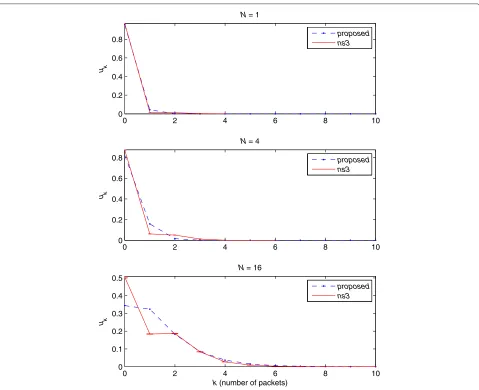
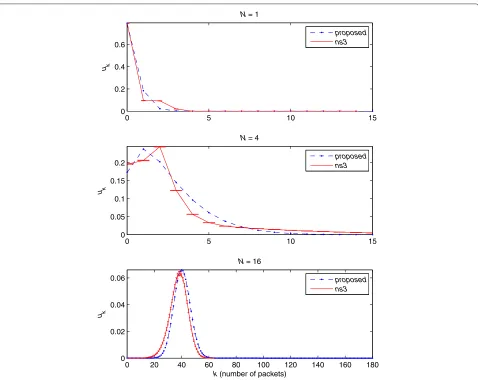
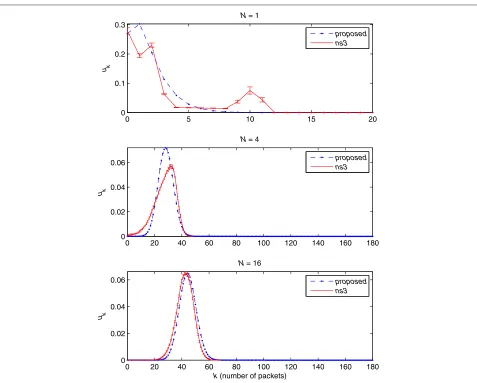
For the final validation example in the wireless con-text, we study scenario C which refers to(DL,DF,DRi) = (5, 5, 10) ms employing non-zero PERm,s. Queue
occu-pancy PMF results using proposed and simulations are provided in Figures 5, 6, and 7 for PERm,sbeing equal to
0.1, 0.01, and 0.001, respectively, each for three values of N, i.e.,N = 1, 4, 16. ForN = 4 and PERm,s = 0.01 in
Figure 6, the number of simulations is again set to 120 in order to increase the reliability of simulations. The simu-lation PMF appears to be captured well by the proposed analysis method for a wide range of packet error rates. For N=1 and PERm,s=0.001, ns-3 simulations show a peak
which is caused by alternating on and off times during which the queue is on and off, respectively, and the Pois-son assumption does not hold as well as the other cases. However, the general shape of the PMF is still captured for this challenging scenario.
4 Cross-layer framework
The physical layer Wireless-MAN OFDMA PHY speci-fies a cellular system comprising a base station (BS) and attached mobile stations (MSs) [25]. In this section, we perform cross-layer analysis of the IEEE 802.16 Wireless-MAN OFDMA PHY air interface which can also alter-natively be used for a point-to-point (PTP) wireless link [37,38]. We study this wireless link carrying long-lived TCP traffic flows for different values of N, RTT0,i, and
SNRsand for two different wireless channel models. This analysis suits well to the OFDM-based air interfaces which became viable for PTP wireless links [39,40] while also being applicable to the downlink of a cellular system with FIFO queuing.
We run physical layer simulations with Coded Mod-ulation Library (CML) to obtain the PERm,s values for
given MCSmand SNRs[41]. For this purpose, we choose
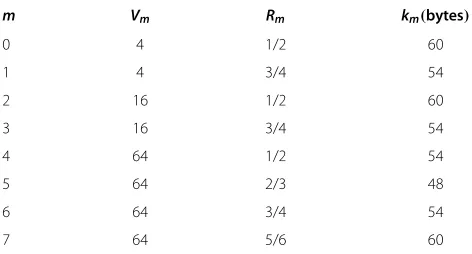
the MCSs that use convolutional turbo codes (CTC). There exist 32 MCSs for CTC out of whichM = 8 are
0 5 10 15 20
0 0.1 0.2 0.3
uk
N = 1
proposed ns3
0 20 40 60 80 100 120 140 160 180
0 0.02 0.04 0.06
u k
N = 4
proposed ns3
0 20 40 60 80 100 120 140 160 180
0 0.02 0.04 0.06
k (number of packets)
u k
N = 16
proposed ns3
Table 1 Modulation and coding schemes of IEEE 802.16 to be used in this study
m Vm Rm km(bytes)
0 4 1/2 60
1 4 3/4 54
2 16 1/2 60
3 16 3/4 54
4 64 1/2 54
5 64 2/3 48
6 64 3/4 54
7 64 5/6 60
enumerated in Table 1 for use in the current paper which differ according to their modulation order Vm (i.e., the
number of points in the constellation diagram), code rate Rm, and forward error correction (FEC) block lengthkm.
Assuming FEC block error events of a packet to be iid Bernoulli distributed, PERm,scan be derived from the FEC
block error rate FERm,sas follows:
PERm,s=1−(1−FERm,s)L/km. (22)
On the other hand, the FERm,s values in (22) can be
obtained using CML. For the sake of completeness, we present all FERm,svs SNRscurves in Figures 8 and 9 for the
additive white Gaussian noise (AWGN) and International Telecommunication Union (ITU) Vehicular-A channels, respectively, the latter corresponding to an MS with a velocity of 90 km/h, which is referred to as ITU-A channel for the rest of the paper [42]. SNR ranges of [0 dB, 22 dB]
and [0 dB, 40 dB] are sampled with a resolution of 0.5 and 2 dB to obtain the corresponding SNRsvalues for AWGN
and ITU-A channels, respectively. At least 107FEC blocks are decoded to reach the FEC block error rates shown. Once the PERm,svalues are obtained, they are fed into the
workload-dependent M/D/1 queuing model to estimate the aggregate TCP throughput for given MCSmand SNRs. For the sake of fairness in throughput comparisons between different MCSs,Lin (22) is set to the least com-mon multiple of thekmvalues form∈ {0, ..,M−1}, which
is equal to 2,160 bytes to avoid padding for any MCSm. Discretization intervalof the queue is set to 9.6 bits for this section which amounts to the packet sizeLdivided by 1,800. Time division duplex (TDD) mode as specified by WiMAX [43] dictates 35 downlink (DL) OFDM symbols, each having 768 data subcarriers for a channel bandwidth of 10 MHz [25] within a TDD frame duration of 5 ms, resulting in an average PHY rate ofr= 5.376×10⁶ sub-carriers/s. Based on these parameters, the raw bit rate rm of the IEEE 802.16 Wireless-MAN OFDMA PHY air
interface can be calculated in bps as follows:
rm=rlog2(Vm)Rm. (23)
In order to account for transmission, framing, and pro-cessing delays of the system,DT +2DFis set to 5 ms. For
the remaining set of parameters, we study scenarios for both AWGN and ITU-A channels spanning a wide range ofN, RTT0,i, and SNRsvalues wheres ∈ {smin, ..,S−1} and smin is such that PER0,smin < 0.1 for each channel
type. In particular, we study two groups of scenarios hav-ing fixed and uniformly spaced RTT0,i denoted by SFN,F
0 5 10 15 20 25
10−7 10−6 10−5 10−4 10−3 10−2 10−1 100
SNR (dB)
FER
m = 0 m = 1 m = 2 m = 3 m = 4 m = 5 m = 6 m = 7
0 5 10 15 20 25 30 35 40 10−7
10−6 10−5 10−4 10−3 10−2 10−1 100
SNR (dB)
FER
m = 0 m = 1 m = 2 m = 3 m = 4 m = 5 m = 6 m = 7
Figure 9Simulated FEC block error rates (FER), ITU-A channel.
and SUN,F, respectively, where N ∈ {1, 4, 16} and F ∈ {1, 5, 10, 20, 40, 80, 120, 160}ms. In scenario SFN,F, there
areN long-lived TCP flows and all flows have the same RTT0,i of F ms. On the other hand, in scenario SUN,F,
there are againN flows but each with a different RTT0,i.
ForN = 4, flowi , 0 ≤ i ≤ 3, has its RTT0,i set to
2(i+1)F/5, leading to an average fixed RTT ofFms. For
example, in SU4,10, flows have individual fixed RTT val-ues of 4, 8, 12, and 16 ms, with an average of 10 ms. For N = 16, each RTT0,ivalue for theN = 4 case is further
mapped to four different fixed RTTs in a similar fashion to obtain the same average fixed RTT ofFms. For exam-ple, in SU16,10, flows have individual fixed RTT values of 1.6, 3.2, 4.8, 6.4, 3.2, 6.4, 9.6, 12.8, 4.8, 9.6, 14.4, 19.2, 6.4,
0 5 10 15 20
0 1 2 3 4 5 6 7
SNR (dB)
m
* (Index of Optimal MCS)
N =1
N =4
N = 16
5 10 15 20 25 30 35 40 2
4 6 8 10 12 14 16
Average Aggregate TCP Throughput (Mbps)
idx
optimum policy TAGLA, th
PER= 0.0001 TAGLA, th
PER= 0.001 TAGLA, th
PER= 0.01 TAGLA, th
PER= 0.1
Figure 11Average aggregate TCP throughput.This is achieved by the optimum policy and TAGLA averaged over SNRsfor each scenario of Table 2 for the AWGN channel.
12.8, 19.2, and 25.6 ms, again with an average of 10 ms. Note that scenarios represented by SF1,F and SU1,F are
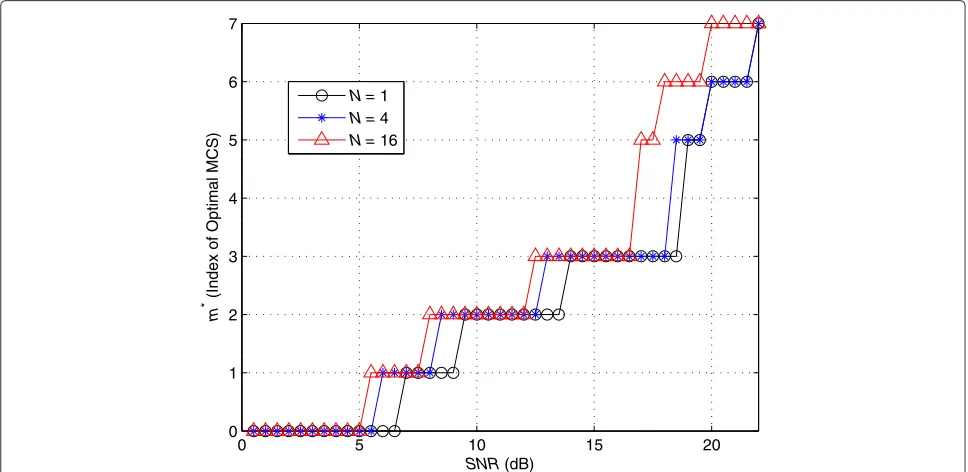
identical, thus leading to an overall of 40 unique scenarios. In the first example, we study the particular scenarios SFN,160 for different values of N by solving the pro-posed queuing model and calculating the aggregate TCP throughput for each MCSm,N, and SNRsfor the AWGN
channel. We present the optimal MCS index, denoted by m∗, leading to the highest aggregate TCP throughput in Figure 10 as a function of the channel SNR for all val-ues of N. We observe that as N increases, the benefit of increasing the spectral efficiency by choosing a higher order MCS outweighs the penalty of increasing wireless loss rate at certain SNR values. It is therefore clear that
5 10 15 20 25 30 35 40
0 2 4 6 8 10 12 14 16 18
Average Aggregate TCP Throughput (Mbps)
idx
optimum policy TAGLA, th
PER= 0.0001 TAGLA, th
PER= 0.001 TAGLA, th
PER= 0.01 TAGLA, thPER= 0.1
the optimal decision on MCS relies ona prioriknowledge on the number of TCP flows sharing the link. Obtaining the optimum MCS in an online setting requires the esti-mation ofN and RTT0,i which is generally known to be
difficult. As a remedy, we propose the so-called traffic-agnostic link adaptation (TAGLA) scheme which does not require the estimation of traffic parameters but takes into consideration only the spectral efficiency and FER values of the MCSs that its physical layer has to offer. In partic-ular, TAGLA chooses the MCS with the highest spectral efficiency whose resulting PERm,s ≤ thPERfor a thresh-old parameter thPER. In case of plurality of such MCSs with the same spectral efficiency, TAGLA chooses the one with the lowest PER. At the limiting casesthPER = 0 and thPER = 1, TAGLA resorts to MCS0and MCS7, respec-tively, regardless of the SNRsvalue. The TAGLA scheme
only requires a mapping between the target PER values and the FER values to be continuously fed back by the PHY layer. Choice of the target PER parameterthPER is then crucial for the performance of the TAGLA scheme which we now study.
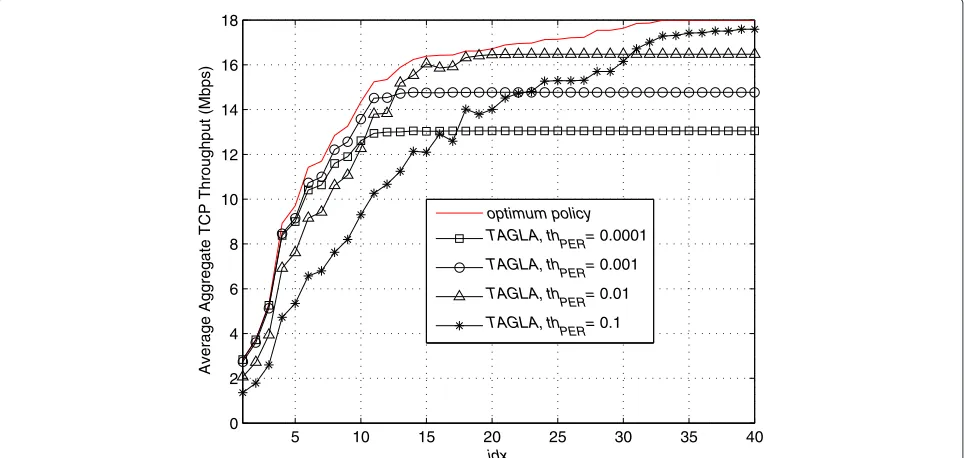
Averaging the results of the proposed model over all possible SNR values we study, the average aggregate TCP throughput as a function of these 40 scenarios is depicted in Figures 11 and 12 for various values of the thPER
Table 2 Scenarios SFN,Fand SUN,Findexed by increasing
throughput of optimum policy for the AWGN channel
idx Scenario idx Scenario
1 SF1,160 21 SU16,160
parameter and for both channel models. The optimum aggregate TCP throughput obtained by choosing the best possible MCS, given SNRs,N, and RTT0,i, is also averaged
in the same way and presented as a benchmark. The sce-narios are indexed with a parameter calledidxas shown in Tables 2 and 3, for increasing throughput of the so-called optimum policyin AWGN and ITU-A channels, respec-tively. Low values ofidx, corresponding to relatively low values forN and large values for RTT0,i, are
representa-tive of situations in which the TCP flows cannot keep the queue always full. In such cases, the throughput is lower and the penalty of using larger values ofthPERis apparent. Conversely, large values foridxare indicative of a situa-tion in which TCP can keep the queue full all the time despite wireless losses, and the optimum policy is to use the MCS with the best spectral efficiency but with larger wireless loss rates. This observation remains intact for both channel models.
In order to assess the sensitivity of throughput tothPER in different scenario settings, we form two groups among the scenarios studied so far, namely Glow andGhigh, by partitioning the range of idx into subsets [1, .., 15] and [26, .., 40], respectively. We also let Gall represent the group of all scenarios withidx ∈[1, .., 40]. First, we nor-malize the throughput of TAGLA with that of optimum
Table 3 Scenarios SFN,Fand SUN,Findexed by increasing
throughput of optimum policy for the ITU-A channel
idx Scenario idx Scenario
10−5 10−4 10−3 10−2 10−1 100 0.6
0.65 0.7 0.75 0.8 0.85 0.9 0.95 1
Average Normalized Aggregate TCP Throughput
thPER G
all
Glow
Ghigh
Figure 13Average normalized aggregate TCP throughput.This is achieved by TAGLA averaged over SNRsfor scenariosGall,Glow, andGhighfor the AWGN channel.
policy for each SNRsandidxto avoid a bias favoring MCSs with high spectral efficiency. Then, we average the nor-malized throughput values over SNRsandidxwithin the ranges of each group to obtain the average normalized aggregate TCP throughput shown in Figures 13 and 14 for AWGN and ITU-A channels, respectively. The choice
of thPER = 5 × 10⁻³ turns out to be a robust operat-ing point for the three groups resultoperat-ing in at most 4% and 12% performance penalties with respect to the opti-mum policy for AWGN and ITU-A channels, respectively. Targeting higher (lower) wireless loss rates has a nega-tive impact on the TCP throughput especially for Glow
10−5 10−4 10−3 10−2 10−1 100
0.2 0.3 0.4 0.5 0.6 0.7 0.8 0.9 1
Average Normalized Aggregate TCP Throughput
th PER G
all G
low Ghigh
(Ghigh). The reduction in TCP throughput around the proposedthPERvalue is more pronounced for the ITU-A channel which can be accounted for its relatively flat FER vs SNR curves shown in Figure 9. For a given SNR, FER values of the ITU-A channel are relatively closer to each other on the average. For this reason, the performance of TAGLA is more sensitive to the choice of thPER for this multipath fading channel model. The TAGLA scheme appears to have a potential for improvement provided that the threshold parameter thPER could be adaptively changed based on an estimation of the underlying traffic parameters which is left for future research.
5 Conclusions
In this study, we develop a novel workload-dependent queuing model for AQM-controlled wireless routers car-rying persistent TCP flows. One of the contributions of this model is in its ability to capture the entire queue occu-pancy distribution as opposed to simpler performance measures of interest such as the mean queue length. The proposed queuing model is validated using ns-3 simula-tions in both wireline and wireless scenarios. This analyt-ical method is then used to obtain guidelines for setting the target wireless packet error rate (PER) for a PER-based traffic-agnostic link adaptation scheme. Assuming wireless channel SNR to be uniformly distributed over the presented ranges of interest and packet losses to be concentrated on the wireless link (i.e., wireline losses are negligible), we show that targeting a PER around 5×10⁻³ irrespective of the underlying traffic parameters provides robust and acceptable average TCP performance for a wide range of scenarios and for the given AQM setting. Future work will consist of the study of traffic-aware link adaptation policies and HARQ/ARQ techniques in more depth for TCP throughput optimization in wireless links.
Competing interests
The authors declare that they have no competing interests.
Acknowledgments
This work is supported in part by the Science and Research Council of Turkey (Tübitak) under project grant EEEAG-111E106.
Received: 26 October 2013 Accepted: 6 April 2014 Published: 27 April 2014
References
1. B Braden, D Clark, J Crowcroft, B Davie, S Deering, D Estrin, S Floyd, V Jacobson, G Minshall, C Partridge, L Peterson, K Ramakrishnan, S Shenker, J Wroclawski, L Zhang, Recommendations on queue management and congestion avoidance in the internet. RFC 2309 (1998). http://www.rfc-editor.org/rfc/rfc2309.txt. Accessed 21 April 2014
2. S Floyd, V Jacobson, Random early detection gateways for congestion avoidance. Netw. IEEE/ACM Trans.1(4), 397–413 (1993)
3. ES Hashem, Analysis of random drop for gateway congestion control. MSc thesis, Massachusetts Inst of Tech Cambridge Lab for Computer Science, (1989)
4. S Athuraliya, SH Low, VH Li, Q Yin, REM: Active queue management. Netw. IEEE.15(3), 48–53 (2001)
5. M Hassan, R Jain,High Performance TCP/IP Networking: Concepts, Issues, and Solutions. (Pearson, US, 2004)
6. R Adams, Active queue management: a survey. Commun. Surv. Tutorials, IEEE.15(3), 1425–1476 (2013)
7. J Lakkakorpi, A Sayenko, J Karhula, O Alanen, J Moilanen, Active queue management for reducing downlink delays in WiMAX, inVehicular Technology Conference, 2007. VTC-2007 Fall. 2007 IEEE 66th,Baltimore, MD, USA, September 2007, pp. 326–330
8. J Padhye, V Firoiu, D Towsley, J Kurose, Modeling TCP throughput: a simple model and its empirical validation. SIGCOMM Comput. Commun.
Rev.28(4), 303–314 (1998)
9. M Mathis, J Semke, J Mahdavi, T Ott, The macroscopic behavior of the TCP congestion avoidance algorithm. Comput. Commun. Rev.27(3), 67–82 (1997)
10. P Lassila, H van den Berg, M Mandjes, R Kooij, ed. by J Charzinski, R Lehnert, and P Tran-Gia, An integrated packet/flow model for TCP performance analysis, inProviding Quality of Service in Heterogeneous Environments. Teletraffic Science and Engineering, vol. 5a (Elsevier Amsterdam, 2003), pp. 651–660
11. T Bu, D Towsley, Fixed point approximations for TCP behavior in an AQM network. SIGMETRICS Perform. Eval. Rev.29(1), 216–225 (2001) 12. RJ Gibbens, SK Sargood, CV Eijl, FP Kelly, H Azmoodeh, RN Macfadyen,
NW Macfadyen, Fixed-point models for the end-to-end performance analysis of IP networks, inProceedings of the 13th ITC Specialist Seminar: IP
Traffic Measurement, Modeling and Management,Monterey, CA, USA,
September 2000
13. H Balakrishnan, VN Padmanabhan, S Seshan, RH Katz, A comparison of mechanisms for improving TCP performance over wireless links. Netw. IEEE/ACM Trans.5(6), 756–769 (1997)
14. C Barakat, E Altman, Bandwidth tradeoff between TCP and link-level FEC. Comput. Netw.39(2), 133–150 (2002)
15. F Vacirca, A De Vendictis, A Baiocchi, Optimal design of hybrid FEC/ARQ schemes for TCP over wireless links with Rayleigh fading. IEEE Trans. Mobile Comput.5(4), 289–302 (2006)
16. K-C Go, J-R Cha, SK Oh, J-H Kim, End-to-end performance analysis based on cross-layer retransmission scheme in wireless communication system. Int. Conf. Inform. Netw. 2013 (ICOIN)0, 141–144 (2013)
17. D Moltchanov, A study of TCP performance in wireless environment using fixed-point approximation. Comput. Netw.56(4), 1263–1285 (2012) 18. S Catreux, V Erceg, D Gesbert, RW Heath Jr, Adaptive modulation and
MIMO coding for broadband wireless data networks. Comm. Mag.40(6), 108–115 (2002)
19. M Lampe, H Rohling, W Zirwas, Misunderstandings about link adaptation for frequency selective fading channels, inPersonal, Indoor and Mobile Radio Communications, 2002. The 13th IEEE International Symposium on, vol. 2, Lisbon, Portugal, September 2002, pp. 710–714
20. M Lampe, T Giebel, H Rohling, W Zirwas, PER-prediction for PHY mode selection in OFDM communication systems, inIEEE Global
Telecommunications Conference, GLOBECOM ’03,San Francisco, CA, USA,
December 2003, pp. 25–29
21. G Martorell, F Riera-Palou, G Femenias, Cross-layer fast link adaptation for MIMO-OFDM based WLANs. Wirel. Pers. Commun.56(3), 599–609 (2011) 22. Ns-3. http://www.nsnam.org/. Accessed 21 April 2014
23. QoS: Congestion avoidance configuration guide, Cisco IOS release 15.0M. Technical report (Cisco Systems, Inc., San Jose, 2011)
24. M Wurtzler, Analysis and simulation of weighted random early detection (WRED) queues. Master’s thesis. University of Kansas, 2003
25. IEEE standard for local and metropolitan area networks part 16: Air interface for broadband wireless access systems. IEEE Std 802.16-2009 (Revision of IEEE Std 802.16-2004), 1–2080 (2009)
26. M Laor, L Gendel, The effect of packet reordering in a backbone link on application throughput. Netw. IEEE.16(5), 28–36 (2002)
27. J Li, YQ Zhao, Resequencing analysis of stop-and-wait ARQ for parallel multichannel communications. Netw. IEEE/ACM Trans.17(3), 817–830 (2009)
28. R Bekker, SC Borst, OJ Boxma, O Kella, Queues with workload-dependent arrival and service rates. Queueing Syst.46(3–4), 537–556 (2004) 29. V Vasudevan, A Phanishayee, H Shah, E Krevat, DG Andersen, GR Ganger,
30. H Abdel-jaber, F Thabtah, AM Daoud, J Ababneh, M Baklizi, Performance investigations of some active queue management techniques using simulation. Int. J. New Comput. Architectures Appl. (IJNCAA). 2(1), 286–301 (2012)
31. S Floyd, Recommendation on using the Gentle variant of RED. Technical report (The ICSI Networking and Security Group, March 2000) 32. E Kuumola, J Resing, J Virtamo, Joint distribution of instantaneous and
averaged queue length in an M/M/1/K system, inProceedings of the 15th ITC Specialist Seminar Internet Traffic Engineering and Traffic Management, Wurzburg, Germany, July 2002, pp. 58–67
33. A Misra, TJ Ott, The window distribution of idealized TCP congestion avoidance with variable packet loss, inINFOCOM ’99. Eighteenth Annual Joint Conference of the IEEE Computer and Communications Societies.
Proceedings. IEEE,vol. 3, New York, NY, USA, March 1999, pp. 1564–1572
34. H Balakrishnan, VN Padmanabhan, G Fairhurst, M Sooriyabandara, TCP performance implications of network path asymmetry. RFC 3449, RFC Editor (December 2002). http://www.rfc-editor.org/rfc/rfc3449.txt. Accessed 21 April 2014
35. TJ Speight, Efficient TCP ACK prioritization in wireless networks. US20080080464 A1, April 2008
36. G Carneiro, P Fortuna, M Ricardo, FlowMonitor: a network monitoring framework for the network simulator 3 (NS-3), inProceedings of the Fourth International ICST Conference on Performance Evaluation Methodologies
and Tools.VALUETOOLS ’09, ICST (Institute for Computer Sciences,
Social-Informatics and Telecommunications Engineering), Brussels, Belgium, 2009, pp. 1–1110
37. DT Chen, On the analysis of using 802.16e WiMAX for point-to-point wireless backhaul, inRadio and Wireless Symposium, IEEE,Long Beach, CA, USA, January 2007, pp. 507–510
38. JARP de Carvalho, H Veiga, P Gomes, AD Reis, R Costa, A contribution to experimental performance evaluation of point-to-point WiMAX links, in Signal Processing and Information Technology. ISSPIT 2008. IEEE International
Symposium On,Sarajevo, December 2008, pp. 150–153
39. PTP solutions guide Motorola fixed point-to-point wireless bridges. http://www.motorolasolutions.com/. Accessed 21 April 2014 40. RDL-3000 System. http://rdlcom.com/. Accessed 21 April 2014 41. Coded Modulation Library (CML). http://www.iterativesolutions.com/.
Accessed 21 April 2014
42. Guidelines for evaluation of radio transmission technologies for IMT-2000. Recommendation ITU-R M.1225 (International Telecommunications Union (ITU), 1997)
43. WiMAX Forum mobile system profile: Release 1.5 TDD specific part. Technical report (WiMAX FORUM, March 2009)
doi:10.1186/1687-1499-2014-67
Cite this article as:Ozturk and Akar:Workload-dependent queuing model of an AQM-controlled wireless router with TCP traffic and its application to
PER-based link adaptation.EURASIP Journal on Wireless Communications and
Networking20142014:67.
Submit your manuscript to a
journal and benefi t from:
7Convenient online submission
7Rigorous peer review
7Immediate publication on acceptance
7Open access: articles freely available online
7High visibility within the fi eld
7Retaining the copyright to your article