Why development NGOs in the North work
with the poor in their own communities:
Does Everyone Matter?
Susannah Pickering-Saqqa
Submitted for award of Phd
University of East London
Abstract
This research seeks to understand how, why and with what implications development NGOs based in the global ‘North’ (NDNGOs) establish and maintain domestic poverty programmes, working with poor communities in their own countries.
This is an under-researched dimension of NDNGO work. There is considerable empirical work analysing the work of NDNGOs in the global ‘South’, particularly assessing their impact on poverty alleviation. However, research into their work with their domestic communities is scarce. There are also a number of critiques of NDNGOs, which highlight the need for them to re-think their future roles, but little research or empirical data to evaluate how they have responded to these challenges. This study situates itself in debates about the future role of NDNGOs, development ethics, theories of poverty and institutional practice, exploring the hypothesis that these issues may be the drivers of the domestic programmes.
Using semi-structured interviews (UK and India), archive and corporate material from four case study NDNGOs (Oxfam GB, Islamic Relief UK, Save the Children, Denmark and Oxfam America), the study takes a perspectivist qualitative approach to data collection and analysis. It makes use of AtlasTi software for data coding, informed by Bourdieu’s concepts of habitus, domains and doxa and Gaventa’s model of three- dimensional power.
Findings highlight the utility of the initial hypothesis as a heuristic device for
understanding domestic programmes. This has potential application for scholars and practitioners in the analysis of other NDNGO programmatic decisions. The study also indicates a disruption in the notion of what ‘development’ is, moving away from the binaries of ‘them and us’, ‘here and there’, ‘developed and developing’ into a
development ethic that affirms that everyone matters, where ever they live. The research contributes to the literature examining the nature of development in an increasingly interdependent world in which geographical and disciplinary boundaries are
increasingly blurred.
Table of contents
Pages
Chapter 1 Introduction1.1 Why this question and why now? 1
1.2 Outline of introductory chapter 5
1.3 Conceptual starting points 5
1.4 Research objectives 11
1.5 Outline of content 12
Chapter 2 Insights from the NGO literature
2.1 Introduction 18
2.2 NGOs and NDNGO futures 19
2.3 NDNGOs: their decisions and practices 25
2.4 Theories of poverty 28
2.5 Development ethics 33
2.6 ‘Domains’ of Development 37
2.7 Conclusion 41
Chapter 3 Theory and Methodology
3.1 Introduction 47
3.2 Ontology and Epistemology 50
3.3 Theoretical Framework 53
3.4 Case Study Design 61
3.5 Method 63
3.6 Sampling 67
3.7 Analysis 72
3.8 Ethics 74
3.9 Challenges, cautions and caveats 76
3.10 Conclusion 79
Chapter 4 Research findings from Oxfam GB case study
4.1 Introduction 80
4.2 Background to OXFAM GB 81
4.3 Working in the UK 84
4.4.1 Theory of poverty 92
4.4.2 Development ethic 105
4.4.3 NDNGO futures 114
4.4.4 Institutional practice 120
4.5 Impact on Southern partners 131
4.6 Confounding variables 135
4.7 Going beyond the literature: fresh insights 138
4.8 Conclusion 140
Chapter 5 Further Insights from Practice
5.1 Introduction 144
5.2 Islamic Relief 146
5.2.1Background 146
5.2.2 Supporting the hypothesis 148
5.2.3 Beyond the hypothesis 155
5.2.4 Findings 158
5.3 Red Barnet 159
5.3.1 Background 159
5.3.2 Supporting the hypothesis 160
5.3. 3 Beyond the hypothesis 163
5.3.4 Findings 165
5.4 Oxfam America 166
5.4.1 Background 166
5.4.2 Supporting the hypothesis 169
5.4.3 Beyond the hypothesis 175
5.4.4 Findings 178
5.5 Conclusion 179
Chapter 6 NDNGO futures: UKPP as a working model
6.1 Introduction 182
6.2 The significance of added value 184
6.3 The dimensions of UKPP’s added value 187
6.3.1 Intellectual consistency 188
6.3.4 Highlighting the agency of the poor 194
6.3.5 Neo-colonial distancing 197
6.3.6 Civic rootedness 198
6.3.7 Early warning system 202
6.3.8 Everyone matters 203
6.4 A new domain of development 207
6.5 Conclusion 217
Chapter 7 Findings and conclusions
7.1 Introduction 220
7.2 Research Objective 1 221
7.3 Research Objective 2 223
7.4 Research Objective 3 224
7.5 Research Objective 4 226
7.6 Research Objective 5 227
7.7 Research Objective 6 228
7.8 Research Objective 7 229
7.9 Research Objective 8 230
7.10 Research Objective 9 231
7.11 Conclusions 237
7.12 Summary observations for practitioners 240
List of tables, figures and appendices
Tables Page
1.1 Mapping of research question, objectives and chapters 12
2.1 Summary of literature review and contributions to
knowledge 44
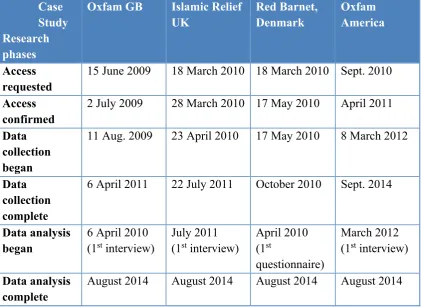
3.1 Case study data collection schedule 63
3.2 Oxfam GB case study: planned and actual interviews
undertaken between April 2010 and January 2011 65
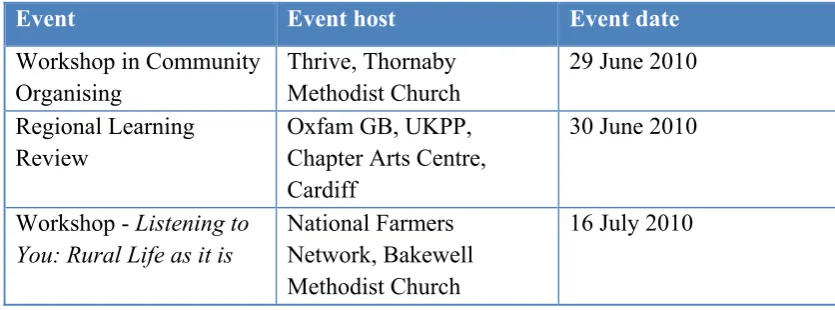
3.3 Ethnographic observation 66
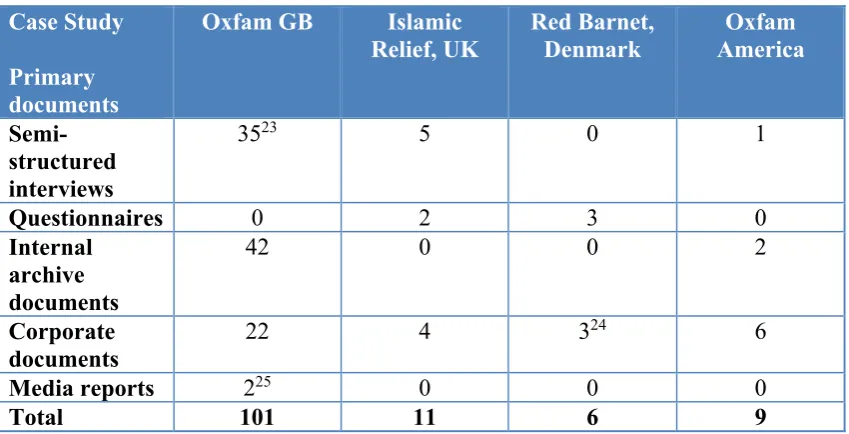
3.4 AtlasTi documents by case study 67
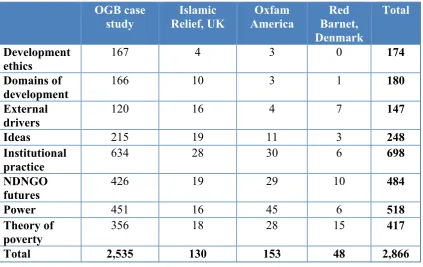
3.5 AtlasTi quotations for each code family and case study 73
3.6 Male/ female and south/north research participants 75
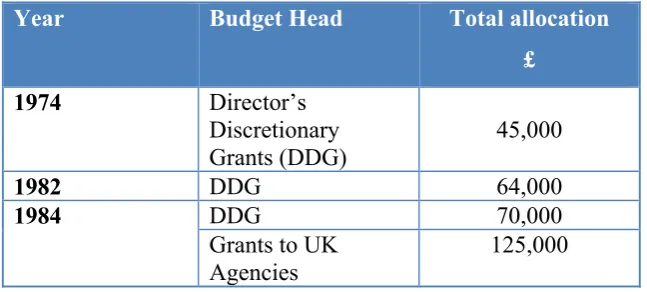
4.1 OXFAM GB budgets for work in the UK, 1974 – 1990 84
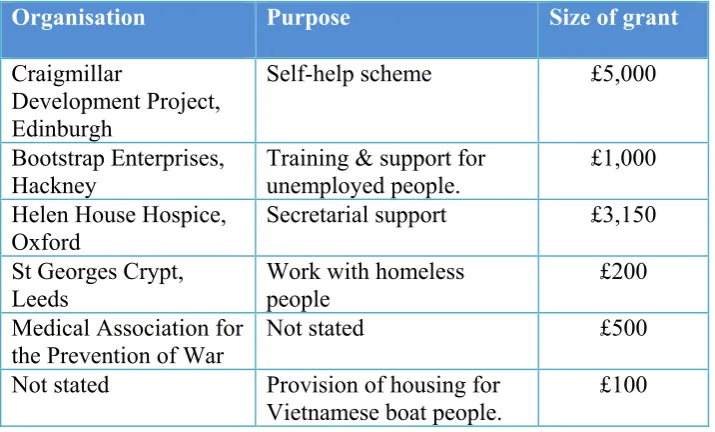
4.2 Examples of grants awarded to UK partners, 1980s 85
4.3 Oxfam GB case study: showing numbers of quotations for each code family and type of data source (primary
document family)
90
4.4 Oxfam GB case study: showing number of quotations for
each code family against interview groups 91 4.5 Oxfam GB case study: Theory of poverty code family and
its data sources 92
4.6 Using model of three-dimensional power to understand the
realities of living in poverty 101
4.7 Contrasting the views of OXFAM GB and the media: Who
are the poor? 102
4.8 Oxfam GB case study: Development ethic code family and
its data sources 105
4.9 Oxfam GB case study: NDNGO Futures code family and
its data sources 114
4.10 Oxfam GB case study: Institutional Practices code family
4.11 The work of organisational identity for and against the
UKPP 122
4.12 Organisational identity as institutional practice: a ‘matrix
of perceptions, appreciations and actions’ 123
5.1 Small case study summaries 145
5.2 OA programme expenditure by region, 2010 167
6.1 Quotations for NDNGO futures and sub-codes across all
data source families 184
6.2 Mapping the SDGs against the work of the three small case
study domestic programmes 215
6.3 Mapping the SDGs against the work of Oxfam GB’s
UKPP partners 216
7.1 Summary of contribution to knowledge against the nine
research objectives 233
Figures
3.1 Worked example of Gaventa’s three-dimensional power
using Oxfam GB UKPP examples 60
4.1 Dignity: Quotations from two UK and two India partners 108
4.2 The International Development domain from SNGO
critical perspective 134
5.1 Islamic Relief habitus: Multiple domain model 156
5.2 Red Barnet habitus: Nested domain model 164
5.3 Oxfam America: dynamics of the habitus 176
5.4 Oxfam America’s domestic programme habitus: Ruptured
domain model 178
6.1 Added value and accountability 185
6.2 Conceptualisation of future NDNGO organisational
habitus 207
6.3 Conceptualisation of the current International Development
domain 210
6.4 Conceptualisation of UKPP challenge to the International
Appendices
1 Full list of OXFAM GB archive documents 266 2 Central research question – Research objective – Interview
question protocol 333
3 AtlasTi primary documents 337
4 AtlasTi full coding structure and definitions 348
5 RESPECT risk mitigation plan 350
6 UKPP formation chronology 355
7 Oxfam GB UK partners summary information 357 8 Oxfam GB India partners summary information 361 9 Development ethics: analysis of SNGO perspectives 365
List of Abbreviations
ATD Fourth World All Together for Development Fourth World (UK)
BME Black and minority ethnic
BOAG British Overseas Aid Group
BOND British Overseas NGOs for Development
BRIC Brazil, Russia, India, China
CAP Church Action Against Poverty
CMT Corporate management team
DAC Development Assistance Committee
DANIDA Danish International Development Agency
DEC Disasters Emergency Committee (UK)
DfID Department for International Development (UK)
ECHO EC’s Directorate General for Humanitarian Aid and Civil
Protection
FBO Faith-based organisation
GLA Greater London Authority
IDS Institute of Development Studies (University of Sussex)
IR Islamic Relief
MDG Millennium Development Goal
MINT Mexico, Indonesia, Nigeria, Turkey
MSI Multi-stakeholder initiative
NDNGO Northern Development NGO
NFN National Farmers’ Network (UK)
NREGA National Rural Employment Guarantee Act
OA Oxfam America
OAOHP Oxfam Archive Oral History project
ODA Overseas DevelopmentAdministration (DfID’s predecessor)
OECD Organisation for Economic Cooperation and Development
OGB Oxfam GB
OPT Occupied Palestinian Territories
PPP Purchasing power parity
PRDF Peak District Rural Development Forum (UK)
RB Red Barnet (Save the Children Denmark)
RCDC Regional Centre for Development Cooperation (Orissa)
SCS Small case study
SDG Sustainable Development Goal
SNGO Southern NGO
SRCDC South Riverside Community Development Centre (Cardiff)
SWAD Society for Women Action and Development (Orissa)
UKPP United Kingdom Poverty Programme
US United States (of America)
USRO United States Regional Office
Acknowledgements
Researching and writing this dissertation has been an effort of collective will. My grateful thanks go to the whole team. The time and encouragement in the early stages of this research from past and present members of staff in Oxfam GB spurred me on and reinforced my conviction I was onto something. I am especially grateful to them for the time they took from busy days to meet informally or be interviewed. I am indebted to the staff of NGOs in Orissa who not only agreed to participate in the research but have stayed in touch. They ensured both visits to Orissa in 2010 and 2011 were packed full of insights, hospitality and incredible train journeys. My UK interviews likewise took me to church halls in the Peak District and Thornaby, to Trade Union House. Thank you for sharing with me your very personal stories.
My parents have frequently reminded me of Robert the Bruce and the spider,
provided respite, groans and laughs. My friends have hardly seen me and, when they have, listened patiently. Thanks to Charles for his quick and efficient translations from Danish and Swedish. In life, my Auntie Jean was supportive yet bemused by this project while her legacy allowed me the luxury of my unpaid leave to write-up. My supervisory team have chivvied, challenged and, above, all had confidence in me throughout the five years – thanks to all three of them for their distinctive
contributions. Dr Meera Tiwari for her drive and encouragement, Professor Trevor Parfitt for his insights and support from Malaysia and Professor Massimo De Angelis for early acknowledgement that I had something important to say.
None of this would have been possible without Aser’s unwavering support, patience and love throughout.
Chapter 1: Introduction
_____________________________________________________________________
1.1 Why this question and why now?
This research addresses a neglected corner of the work of development NGOs in the global North: the work they undertake with the poor in their own home communities. This study refers to this work as ‘domestic programmes’1. There is a vast and varied literature on the work of development NGOs more broadly, which explores issues ranging across accountability, participation, values, relationships with donors and partners, project management methodologies and effectiveness. Campaign and advocacy work, such as Make Poverty History, is also the focus of much recent research which considers how development NGOs work with their public
constituencies (Sireau, 2009). However, there is very little attention given to the work of the domestic programmes of Northern Development NGOs (NDNGOs)2, which focus on poverty alleviation ‘at home’. By asking why these organisations choose to establish domestic programmes, this study makes a contribution to this
under-researched area of NDNGO work.
The second aspect of the rationale for this research focus is the potential for fruitful links with some academic literature, which appear to call for a greater emphasis on domestic programming. In 1999 Gaventa concluded, as a result of his study of the links and learning between Community Based Organisations (CBOs) in the North and South that many northern-based CBOs had not engaged with issues of power and poverty in their own communities in the global North. This would need to be rectified, he contends, for more equal partnerships to develop between northern and southern CBOs and if the views of each were to be ‘de-mythologized’ (Gaventa, 1999, p. 34). Likewise, Malhotra issued a similar warning, proposing that if northern NGOs were to survive in the twenty-first century they must be:
…seriously and more substantially engaged with the poverty and social justice problems of their own countries, especially as these continue to escalate and become more explicit and visible. (Malhotra, 2000, p. 663)
1 This is in line with current usage by Oxfam International (Burrows, 2003).
2 This term is used throughout this research to denote development NGOs with their headquarters and
However, although subsequent events indicate that some NDNGOs have begun to heed this advice, little scholarly attention has been paid to this work. For example, in 1995 Oxfam GB established its UK Poverty Programme after decades of internal debate. In 2003 Red Barnet (SCF Denmark) launched a ground-breaking report on child poverty in Denmark, which called for the Danish government to undertake more research into child poverty and to end the different levels of benefits for refugees and Danish citizens (Hussain, 2004). In January 2008, Muslim Aid and Oxfam GB agreed jointly to organise a sponsored walk in London for their supporters during Ramadan in aid of the global food crisis. It was clear that the reason Oxfam GB were interested in work with Muslim Aid was that they needed to create a greater diversity in their support base in order for their advocacy and campaigning work to have greater legitimacy and representational force3. In contrast with Oxfam GB, Muslim Aid’s support base is particularly strong among the Bangladeshi community in London, considered to be one of the poorest and most socially excluded communities in London measured according to indicators of child poverty, education, employment and housing (Howes, 2004, Finella, 2005, Piggott, 2006). To-date there has been no significant research on any of these programmes.
The third and final element of the study’s rationale is that before the start of this research in 2009, there was little attempt by any NDNGO to publicise their domestic work. For example, the researcher first became aware of Oxfam GB’s domestic programme as a result of a passing mention in a footnote (Fowler, 1995, p. 183). This clearly raises questions about why organisations that usually aim for maximum exposure and publicity for their work, would choose to keep such a low profile for domestic programmes. However, since the beginning of the global economic crisis, there have been a number of high profile initiatives by development NGOs such as Oxfam GB and Save the Children Fund addressing issues of poverty in the UK. The increased visibility of these campaigns begs the question as to why NDNGOs are now keen to publicise their domestic programmes. Their profile also enhances the
significance and timeliness of this research.
3 This was conveyed during a conversation between author and the member of Oxfam GB staff leading
In April 2009, Save the Children Fund UK ‘better known for its work helping children in war-torn or famine-struck countries’ (Gentleman, 2009) launched a fundraising campaign to help families in the UK struggling to cope with the rising cost of food. This was closely followed by Oxfam GB launching a report and a nationwide campaign, which claimed that the UK is becoming a nation of the
‘forgotten, ripped-off, excluded and debt-ridden’ (Haddad and Bance, 2009a). In 2012 Save the Children launched a new campaign to raise funds for work with children in food poverty. It was accused of an ‘obscene political stunt’ (Murray, 2012). Likewise, Oxfam GB’s 2014 ‘perfect storm’ campaign highlighting the combined effects on families in poverty in the UK of public spending cuts and the rising cost of living, was met with calls for intervention by the Charity Commission (Haddad, 2012, Hope, 2014). The following comment typifies the tone of much of the media response to the above campaigns.
Conservative backbencher Conor Burns slammed the ‘highly political campaign,’ saying people who support Oxfam will be left ‘shocked and saddened.’ ‘Most of us operated under the illusion that Oxfam’s focus was on the relief of poverty and famine overseas’. (Meredith, 2014)
These campaigns have responded to and tapped into the growing public discomfort at visible indicators of the presence of poverty, such as the use of food banks and the young ‘working poor’ (Cooper and Dumpleton, 2013, Cooper et al., 2014, MacInnes et al., 2014, Milmo, 2014). All of these campaigns were accompanied by criticisms from politicians and the media accusing the organisations of political meddling and distorting the meaning of poverty.
in a context in which understandings of poverty and development are deeply contested in the academic and public realms (for example see Carr, 2008, Alcock, 2006, Ibrahim and Tiwari, 2014, Nederveen Pieterse, 2010, Harman and Williams, 2014, Olukoshi, 2007). The research also considers how practices such as NDNGO communications with the public and supporters are constrained by this context. Thus, the study locates itself in debates about the role of NDNGOs, their practices and their understandings of poverty and development ethics.
Drawing on the development ethics framework of Goulet (Goulet, 1997, Gasper, 2008), the research is able to use its empirical data to consider issues of significance beyond that of NDNGOs. It looks at whether the ‘project’ of international
development is broadening to include more than the development of the ‘other’, to an approach which incorporates the ethical imperative for change in communities globally where ‘agents’ and ‘sites’ of knowledge are not always to be found in the global North (Bell, 2002). Drawing on Said’s work (2003), development scholars have identified the process of ‘othering’ as one of the challenges of development practice and theory. It is fundamental to much development planning (Escobar, 1992) while also present in NGO campaigning images (Wilson, 2012, Kothari, 2014), always distancing the ‘object’ of development from the development agencies and the societies of the global North on whose behalf they act (Mitchell, 1995). The domestic programmes appear to challenge deep-rooted understandings about the geographical spaces in which development takes place, suggesting the boundaries of ‘home’ and ‘overseas’ are still embedded in the domain of international development practice.
The geographical focus of development is of particular significance in 2014 as the post-2015 Sustainable Development Goals provide further evidence of the blurring of boundaries between the global North and South4. The focus on overcoming
international and intra-national inequalities creates a framework in which the ‘objects’ (Mitchell, 1995) and spaces of development are in both global North and South. In this new global context most of the poor live in Middle Income Countries (Sumner,
4 These terms are used conscious of their imperfections as overly simplistic descriptions of a
2012) and the economies of the global South are rapidly changing (UNDP, 2013) to the extent that some emerging economies are becoming donor nations (Mawdsley, 2012). NDNGOs need to consider their role in this new context. This study argues that domestic programmes offer a mechanism through which NDNGOs adjust and demonstrate their adjustment to new operating contexts. Having established the rationale for the research and its potential significance to the current global context, the study moves on to introduce the remaining contents of this chapter.
1.2 Outline of Introductory chapter
The main purpose of this chapter is to frame the central research question and outline the research parameters. The next section (1.3) summarises the conceptual starting points of the research, including researcher positionality. Section 1.4 examines the central research question and objectives, mapping these against each of the
dissertation chapters. Finally, Section 1.5 summarises the main arguments of each of the remaining six chapters.
1.3 Conceptual starting points
The research adopts a perspectivist ontology which allows for partial knowledge claims and is well-suited to working with contested understandings, which the study has already seen are made visible by the domestic programmes of NDNGOs. This approach enables the research to avoid the definitional hazards of NGOs, preferring instead to use Hilhorst’s concept of ‘NGO-ing’ (Hilhorst, 2003). The study situates itself in debates about the future role of NDNGOs, development ethics, theories of poverty and institutional practice, setting out a provisional hypothesis, drawn from the literature, that these issues may be the drivers of the domestic programmes.
The selection of the theoretical framework with which to explore the hypothesis and analyse data was premised on the requirements of the research question and
objectives. Bourdieu’s theory of practice, specifically the concepts of habitus and field5 offer the capacity to consider how and why an organisational habitus is maintained and ruptured (Bourdieu and Nice, 1977, Bourdieu, 1989, Bourdieu and Thompson, 1991, Bourdieu, 1994, Bourdieu, 1996, Bourdieu and Ferguson, 1999).
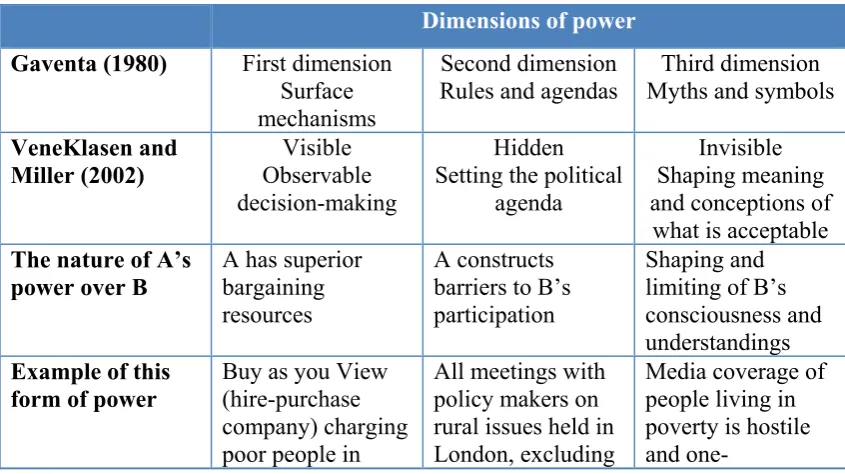
These provide rich analytical possibilities in exploring the NDNGO domestic programmes. The study uses these tools to examine the effects of the domestic programmes on the organisational habitus and their impact on the domain of international development. Gaventa’s model of three-dimensional power (Gaventa, 1980, Gaventa, 2006) is used to allow for a more nuanced understanding of how power is mobilised and resisted by the domestic programmes using myths and symbols.
Informed by an epistemology which privileges the field of practice (Krause, 2008, 2014), our research data is qualitative and almost entirely taken from semi-structured interviews with staff and partners of NDNGOs in the UK and India, archive and corporate documents for NDNGOs6. A multiple explanatory case study design is used to address the research question and objectives (Yin, 2003). The major case study is that of Oxfam GB’s UK Poverty Programme (UKPP), which was selected because it was the initial source of researcher’s curiosity about domestic programmes. The sampling strategy for the three smaller case study NDNGOs was based on a rationale, which sought to provide sufficient exploratory comparisons with the Oxfam GB case study. The three small case studies are: Islamic Relief, UK; Red Barnet7, Denmark and Oxfam America.
From a perspectivist starting point, it is important to identify the normative theories and agendas underpinning this research. Inevitably, the dynamic process of researcher reflexivity could lead to infinite unravelling of layers of assumptions and agendas. The aim here is to define those issues which, when made explicit, will act as a counter weight to knowledge claims when considering conclusions, their reliability and validity. The key issues are by no means exhaustive and can be clustered as follows: debates about the domain and nature of development and development ethics; the diversity and role of NGOs as actors in development, and the constructed nature of understandings of poverty. Chapter 2 reviews the literature on these issues in more detail but they are captured here in brief so as to highlight researcher positionality.
6 Both Hilhorst and Krause’s approaches were, in turn, informed by the ‘actor-oriented’ theory of
Norman Long.
In the debates about the meaning and purpose of ‘development’, there has been a tendency, as the ‘field’ and teaching of development studies emerged and
consolidated within Universities, to focus on the lives of ‘other people in other places’ (Kothari, 2005, p. 48) as the point of reference. This research queries and examines this claim, both as an ethical and empirical proposition. Can it really be the case that, if everyone matters (Appiah, 2006), our ‘development’ concerns, including bilateral and multilateral aid and the vast fundraising efforts of the non-governmental sector, are only directed at an area of the world labelled ‘developing’, ‘Third World’ or ‘the South’?
In addition to these normative arguments, empirical evidence indicates the growth of social inequalities in the ‘North’ and the ‘South’, with some to referring to the ‘souths in the north’ and the ‘norths in the south’ (Gaventa, 1999). With the realisation for NGOs, such as Oxfam India, that there are major opportunities to fundraise from a growing middle class in emerging economies (Oxfam India, 2010a), does the notion of ‘development’ applying just to one area of the world make sense? This complexity is further compounded by research, which shows that the majority of the world’s poor now live in Middle Income Countries such as India, Pakistan, Indonesia and Nigeria (Sumner, 2012). Globalisation and interconnectedness allow development researchers to consider actions ‘delinked from the concepts of territory’ (Gaventa and Mayo, 2009, p. 13), enabling us to interrogate the current ‘domain’ of development (Cowen and Shenton, 1996). The details below of the researcher’s career illustrate the
motivations, which have shaped an interest in querying the domains of development and reveal a tendency to hope that everyone matters.
literature in establishing the diverse realities of development NGOs as a dynamic part of civil society, capable of resisting easy characterisations as either over
professionalized bureaucracies or informal organisations lacking in professionalism (Smillie and Helmich, 1993). These characterisations are often grounded in the normative traditions of either positivist-empiricism (seeking evidence of NGO effectiveness to demonstrate its worth in the development sector) or post-modernism and post-developmentalism, questioning the whole enterprise of ‘development’ engaged in by NGOs as ‘dead’ and a counter-productive perpetuation of colonial power masquerading as assistance (Kapoor, 2013, Gronemeyer, 1992). This research rejects both positions as statements of ‘where we are now’ but situates itself within the quest for alternatives in response to this post-modern critique (Bebbington et al., 2008).
This study and its analysis are also shaped by work undertaken by the researcher for the British Council in UK, Bangladesh and Palestine from 1990 to 1998 at a time when the UK’s Overseas Development Administration (ODA)- funded Technical Cooperation Training Programme was subject to pressures of the New Public Management (Kerr, 2008). The internal processes of change that transformed the British Council and its NGO partners in Namibia, Bangladesh, Jordan and Palestine into contracting parties each providing a service to the other, including Service Level Agreements between internal departments, were observed. This in turn led to enquiry into the deeply interconnected programmes of UK government development
assistance, foreign policy, trade and investment objectives and for-profit contracts in which the British Council was embedded. The socio-historical and political context in which development work takes place was inescapable working for a British agency in the Gaza Strip immediately after the Oslo Accords of 1994.
governments to account (Commonwealth Foundation, 2005) and against policies which sold the public goods of water and electricity to the private sector
(Commonwealth Foundation, 2003), revealed the limits of civil society agency.
Working for the Greater London Authority (GLA) for an Executive Mayor in programmes dedicated to creating linkages between London and major cities of the global south with which London has diasporic ties, reinforced the researcher’s awareness of the contested nature of the ‘development’ label and of the multiple layers of agencies, governmental and non-governmental, which have a role to play in ‘development’, whether or not this is their preferred label. It also exposed, at a key juncture in London’s governance history, the workings of metropolitan government with an explicitly socially progressive agenda and a specific analysis of the structured nature of deprivation among key stakeholder communities in London, such as those living with disabilities, Muslim and traveller communities and the elderly (Spence, 2003, Howes, 2004, Vaid, 2005, Piggott, 2006). The possibility and process of how a particular political analysis and agenda could be driven through to implementation was vividly exposed. Interest in the notion that certain ideas and ideologies can take on different functions at different socio-economic moments, becoming relegated to the periphery or becoming dominant (Watts, 1995, p. 56), was developed during this period. This study’s provisional four-part hypothesis detailed in Chapter 2 is,
therefore, informed by an approach to policy and decision-making in which ideas and interests compete (John, 1998).
Notably, the work undertaken by the researcher at Muslim Aid (2006-2009), a UK-based relief and development NGO, was the only period of her career in which the ‘development’ label was formally ascribed. Here, as a member of the senior management team, the researcher was immersed fully in the ‘development’
community, involved in meetings with other development NGOs, with the Disasters Emergency Committee (DEC), with DfID, the Charity Commission, private donors, potential partners, colleagues from field offices, representatives of southern partner NGOs, other faith-based development NGOs and those wishing to understand the Muslim faith-based development sector. As work at Muslim Aid began while
Leading a team to develop a more strategic approach to Muslim Aid’s programme work in the UK, the researcher was exposed to divergent views about what
‘development’ is and what is the role of a development NGO with its roots in both the UK and the global south (Hossain and Sengupta, 2009). Within Islamic jurisprudence, eight categories of people are considered appropriate recipients of zakat8 and are explicitly defined. These have informed the structure of programmes within Muslim development NGOs . The key concept underpinning the relationship between the payer and recipient of zakat is justice, with the rights and duties of each at the heart of this redistributive process (Ramadan, 2004, p. 179, Tripp, 2006, p. 125). This explicit statement of ‘who matters’ led to a consideration of how other development NGOs assess and conclude ‘who matters’.
Although not the first time the researcher had worked and lived within a dominant culture different to her English, non-conformist tradition, Muslim Aid was an
environment in which she was frequently ‘othered’ as both a woman and non-Muslim. A range of normative approaches were encountered, from those which applied
‘universal, totalising theory’ to those who embraced a ‘plurality of forms of
knowledge and conceptions of change’ (Escobar, 1992, p. 143). The latter conception was operationalized in a partnership formed between Muslim Aid and the United Methodist Committee on Relief in Sri Lanka in 2006. The partnership was the subject of published research (Clarke, 2010) which made use of Appiah’s image of the
‘shattered mirror’ (2006) to describe the cosmopolitan approach to knowledge claims. This study also makes use of Appiah’s work to interrogate the ethics of development NGOs to ask if ‘everyone matters’ (2006, p. 144).
In summary, the following agendas and assumptions can be extracted from the above and are expected to have some influence on this research. Firstly, although contacts with Oxfam GB and other NGOs have eased research access, NGOs are
conceptualised not as the ‘magic bullet’ (Edwards and Hulme, 1996) in development but as one of a number of potential actors with considerable but no monopoly of agency. Secondly, the traditional twentieth century dynamic of development, either
immanent or intentional (Cowen and Shenton, 1996), as something ‘done’ to the global south by the north is seen as problematic, because of its ‘othering’ function, its implicit ranking of lives and their value and its denial of the interconnectedness of lives in both the global North and South. This concern informs the shaping of the research objective, which asks whether the implication of the NDNGO domestic programmes is that everyone matters equally across the world whether located in the global north or south. Thirdly, the experiences which reveal how poverty is structured by processes such as conflict, and socially constructed notions of how work with communities living in poverty is defined and who these communities are, underpins the perspectivist ontology and epistemology. Finally, the deeply political nature of the development ‘project’ (Mitchell, 1995) is fundamental to understandings in this research, especially the power of ideas and ideology, to drive policy and action as a force for change.
1.4 Research Objectives
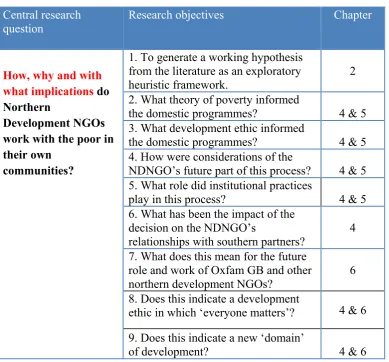
The aim of this study is to understand how, why and with what implications Northern Development NGOs work with the poor in their own communities. The nine related research objectives are itemised below. Table 1.1 maps each of the seven chapters of the thesis against the research objectives, indicating where each objective is
addressed. The first objective seeks to identify from the literature on previous research a provisional heuristic framework. This work is undertaken in Chapter 2, building a four-part framework. This suggests that the driving factors behind the domestic programmes are: the organisation’s theory of poverty; its development ethic; anxiety about its future as an NDNGO and institutional practices.
Objectives
1. To generate a working hypothesis from the literature to be used as an exploratory and provisional heuristic framework for analysing the four case studies.
6. To investigate the impact of the domestic programmes on the NDNGOs’ southern partners.
7. To consider what are the implications of the domestic programmes for the future role of NDNGOs.
[image:24.595.93.483.231.593.2]8. To consider whether this indicates an ethic of ‘everyone matters’? 9. To consider whether this indicates a new ‘domain ‘of development.
Table 1.1 Mapping of research question, objectives and chapters Central research
question
Research objectives Chapter
How, why and with what implications do Northern
Development NGOs work with the poor in their own
communities?
1. To generate a working hypothesis from the literature as an exploratory
heuristic framework. 2
2. What theory of poverty informed
the domestic programmes? 4 & 5 3. What development ethic informed
the domestic programmes? 4 & 5 4. How were considerations of the
NDNGO’s future part of this process? 4 & 5 5. What role did institutional practices
play in this process? 4 & 5 6. What has been the impact of the
decision on the NDNGO’s
relationships with southern partners?
4
7. What does this mean for the future role and work of Oxfam GB and other northern development NGOs?
6
8. Does this indicate a development
ethic in which ‘everyone matters’? 4 & 6 9. Does this indicate a new ‘domain’
of development? 4 & 6
Thus, research objectives 1 – 5 relate to the questions why and how NDNGOs work with the domestic poor and research objectives 6 – 9 explore the implications of this work. Having summarised the research rationale, conceptual starting points,
researcher positionality and the research objectives, the chapter now outlines the arguments put forward in each chapter.
Chapter 2 reviews the relevant sub-literatures and constructs an exploratory heuristic framework, offering potential insights into the decision in each of the four case study NDNGOs to establish domestic programmes. In doing so, it addresses the first research objective to generate a working hypothesis, considering how and why the decision was made. The review also identifies the contributions this research makes to moving forward understandings in these knowledge domains. Given the major case study ‘lens’ through which this study addresses the research question, the chapter briefly considers the range of literature available on Oxfam GB itself. The heuristic framework developed outlines four factors to be considered when assessing why NDNGOs choose to work with the poor in their own communities: 1) considerations of their futures in response to critiques of NDNGOs; 2) institutional practices; 3) the organisation’s theory of poverty 4) the organisation’s development ethic. This begins to address research objectives 2, 3, 4 and 5.
The chapter identifies a number of methodological contributions made by this research, specifically the construction of a heuristic framework informed by both ideas and practices and the application of analytical tools such as the concepts of habitus and doxa to NDNGO decision-making. The research brings fresh empirical data from domestic programmes to apply to considerations of NDNGOs’ future role and to the debates about the possibility of ‘emancipatory’ development. The study argues that domestic programmes sit within a broader theme of the dynamic and changing domains of development to which this case study research contributes further understandings, bringing a new perspective to the literature on the shifting geographies of poverty and development. Generating a new empirical data set facilitates further theorisation of the phenomenon of the new domains of development.
Chapter 3 sets out the theoretical and methodological tools with which the provisional working hypothesis is explored. The study locates itself within the field of
Development Studies in which a range of ontological and epistemological positions have been used since the 1950s, with a turn since the 1970s towards relativist caution from certainty and imposition of single realities (Escobar, 1992, Chambers, 1997, Sumner and Tribe, 2008). It establishes the perspectivist ontological and
NDNGOs (and NGOs more generally) as a diverse set of organisations beyond characterisations as either co-opted by a neo-liberal system through contracting (Edwards et al., 1999, Fowler, 2000b, Manji and O’Coill, 2002, Ebrahim, 2005) or as informal structures incapable of coherent decision-making (Heyse, 2006). This approach also acknowledges and accommodates the different social, political and economic contexts of the industrial nations of the global ‘North’ while allowing for meaningful knowledge claims.
Fundamentally, the central research question and research objectives drive the design and methodology. This also holds for the selection of the analytical tools of
Bourdieu’s theory of practice (Bourdieu and Nice, 1977, Bourdieu, 1989, Bourdieu and Thompson, 1991, Bourdieu, 1994, Bourdieu, 1996, Bourdieu and Ferguson, 1999) and Gaventa’s model of three-dimensional power (Gaventa, 1980, Gaventa, 2006). The iterative process by which early readings and analysis of the data led to the development of the hypothesis which was then used as an analytical tool and further developed are detailed in this chapter.For example, an initial analysis of the data using the four-part hypothesis revealed thatit was capable ofenhancing
deliberations. The chapter concludes by identifying the ethical and practical challenges faced in undertaking the research and how these were managed.
Chapter 4 presents the analysis of the empirical data from the main case study of Oxfam GB’s UK Poverty Programme (UKPP), addressing directly each element of the research question: how, why and with what implications the UKPP was
established. It begins by providing the background to Oxfam GB’s work, examining in particular its approach to partnership, which contextualises the introduction to Oxfam GB’s domestic programme. The UKPP partners and those Oxfam GB partners in India involved in this research are introduced. The chapter moves to explore the working hypothesis. It assesses the evidence, using the analytical tools developed in Chapter 3, for a connection between the UKPP debates and Oxfam GB’s theory of poverty, development ethic, institutional practices and considerations of its future role as an NDNGO. Each element of the hypothesis is defined using the coded data.
The heuristic framework is enhanced using the concepts of third dimensional or invisible power (Gaventa, 1980, Gaventa, 2006), habitus, domain and doxa (Bourdieu and Nice, 1977, Bourdieu, 1989, Bourdieu and Thompson, 1991, Bourdieu, 1994, Bourdieu, 1996, Bourdieu and Ferguson, 1999). With these analytical tools, the study observes that third dimensional power is active in the UKPP debates, mobilising and challenging the myths and symbols around questions such as: who is poor? What are the ‘ends’ of development? Where does development take place? What are
appropriate development interventions for a NDNGO? These perceptions and preferences can, through their boundary work, maintain the status quo. Equally, arguments that make visible the third dimensional power of myths and symbols can resist and challenge. Thus, the study sees in the UKPP an attempt to expose the third dimensional power of assumed organisational identity, to re-shape the organisation’s habitus, with the potential to disrupt the domain and doxa of international
development. The chapter moves from the enhanced hypothesis to address research objectives 8 and 9.
contextual details about the founding of the organisations, levels of income and expenditure in 2009 and 2010, and size and focus of the domestic programmes. The study finds there is empirical evidence within each case of the enhanced four-part hypothesis outlined above. As with the case of Oxfam GB’s UK Poverty Programme, what appears to be a decision to establish a new programme (or, in the case of RB, to continue an existing programme) has much wider significance for understandings of the organisational habitus and the domains in which they operate. In addition the study argues that each organisation displays a distinct and dynamic relationship between its habitus, the domains within which it operates and the domain and doxa of international development. The domestic programmes of each organisation are
located within these different models, characterized as multiple, nested and ruptured domain models. The ability to explore each case through this set of models, takes the study a step nearer to answering the question ‘does everyone matter?’
Chapter 6 takes forward this understanding of organisational habitus and explores the implications of a domestic programme, asking what might be the role and features of a future NDNGO. It provides further insights as to the challenges and anxieties faced by NDNGOs and how Oxfam GB’s UKPP has responded to them. First, the concept of ‘added value’ is introduced and its significance explored using the research data and scholarly literature. Secondly, eight features or ‘assets’ are identified in the UKPP, which, it is argued, provide added value for Oxfam GB and constitute a new organisational habitus. These assets illustrate what a future NDNGO might look like and include a development ethic, focussing on inequalities, in which everyone matters.
considering the implications of the working model of a future NDNGO situated in a new domain of development, arguing that, in this transformed context, a development ethic in which ‘everyone matters’ is an important asset. This moves understandings of development away from ideas of ‘them and us’, ‘here and there’, ‘developed and developing’.
Chapter 7 draws together the conclusions as to how far this research has progressed understandings of the central research question: How, why and with what implications
Northern Development NGOs work with the poor in their own communities? It also highlights the research’s contributions to academic knowledge across a variety of sub-literatures, highlighting in particular five key findings. It concludes with summary observations of relevance to practitioners and those working in and with NDNGOs.
Chapter 2: Insights from the NGO literature
___________________________________________________________
2.1 Introduction
Having introduced the central research question, research objectives and parameters in Chapter 1, this chapter surveys the literature from which the research derives its hypothesis. At the centre of this study is the research question: How, why and with what implications do Northern Development NGOs work with the poor in their own communities? To respond adequately to this and the nine inter-connected research objectives, requires access to a variety of knowledge domains, which are briefly reviewed here with their empirical and theoretical literatures. The selection of these knowledge domains is itself contingent on ontological and epistemological starting points9. In order to address the first research objective of generating a working hypothesis, the chapter begins by locating understandings of NGOs in development studies, defining them and outlining the specific debates that relate to Northern Development NGOs (NDNGOs). The extent of and limits to current understandings of the work of NDNGOs, how they respond to critiques of their role and make decisions is assessed, drawing on decision-making literature and Bourdieu’s work on practice and habitus (Bourdieu and Nice, 1977, Bourdieu and Thompson, 1991, Bourdieu, 1994, Bourdieu and Ferguson, 1999). Given the major case study ‘lens’ through which this study addresses the research questions, the chapter also briefly considers the range of literature available on Oxfam GB itself.
The chapter moves on to consider understandings of poverty and development ethics, concluding that there is more work to be done in identifying the way in which ideas (John, 1998), ideologies (Jennings, 1998) or values (Moyles, 2012) shape decisions within NGOs, specifically the decision to establish domestic programmes. It is precisely the use of terms such as ‘domestic’, ‘Northern’, ‘their own’ which
demonstrate the relevance of sub-literatures within development, voluntary sector and geographical studies, which now actively explore the blurring of boundaries between
the tidy binary categories of ‘north’ and ‘south’ (Silvey and Rankin, 2010) and disciplinary categories of ‘development’ and ‘voluntary sector’ (Lewis, 2014).
The contribution of this study in moving forward understandings emerges from the following review of the relevant sub-literatures10. Additionally, the outline of an exploratory heuristic framework is constructed, offering potential insights into the decision in each of the four case study NDNGOs to establish domestic programmes. This hypothesis posits that the main drivers of the domestic poverty programmes are: the organisations’ theory of poverty and development ethic, institutional practices and concerns over their future role as NDNGOs. The theoretical tools with which this hypothesis is explored are developed in Chapter 3 with a fuller exposition of the application of Bourdieu’s theory of practice to this study.
2.2 NGOs and Northern Development NGO futures
The literature on the rise of Non Governmental Organisations (NGOs) as actors in development is extensive, grounded in an acknowledgement of the sector’s growth, power and its subsequent required accountability (Smillie and Helmich, 1993,
Fernando, 2011, Hulme and Edwards, 2013). The scholarly attention this brings to the sector offers both definitional clarity and complexity as it wrestles with this contested category (Alcock, 2010, Salemink, 2006) and with rival terminologies (Najam, 1996). This study makes use of the approach in which NGOs belong to the ‘third sector’, alongside foundations and trade unions, which are driven by a desire for social change of some kind (Lewis, 2007b). However, it also acknowledges that due to the diversity of the sector (Heyse, 2006) and the questions at the centre of this study it may be more meaningful to consider NGOs as processes rather than things, prioritising the question of how ‘NGO-ing’ is done (Hilhorst, 2003, p. 5). This study also uses the term Northern Development NGO in referring to the four case study organisations with home bases in the global ‘north’, recognising that this is used interchangeably with international NGOs (INGOs), big international NGOs (BINGOs) and
transnational NGOs (TNGOs) (Ahmad, 2006, Anderson, 2007, McPeak, 2001, Balboa, 2014, Shutt, 2009).
There have been warnings since the early-1990s of the impending crisis of legitimacy for Northern Development NGOs (NDNGOs), as the global context in which they work changes and challenges them to reconsider their role and mode of operation. The context within which this future is debated is characterised by: globalisation (Lindenberg and Bryant, 2001, Murphy, 2000); changing but unequal relations between Northern and Southern NGOs (Hossain and Sengupta, 2009, Elbers and Schulpen, 2013); donor power (Ebrahim, 2005, Barber and Bowie, 2008); the questionable impact of Northern NGO work on poverty alleviation (Ibrahim and Hulme, 2010), and the changing aid paradigm (Agg, 2006, Mawdsley, 2012, Fugere, 2001, Engberg-Pedersen, 2008, Severino and Ray, 2009). The extent to which these warnings have remained consistent, and perhaps unheeded, over the last two decades is illustrated by the following sets of recommendations for them.
The power of NGOs in the third –value driven –sector will depend to an important degree on their ability to form coalitions across ethnic, class, spiritual, geographical and national boundaries. (Fowler, 1991, p. 16)
…NGOs as bridging organisations geographically (sitting between different countries and levels of local-global action), institutionally (working in the spaces between civil, society, government and the market), functionally (committed to social justice but flexible in how to realise it in practice), and philosophically (being ‘pragmatic visionaries’ that embody their values in concrete action). (Banks et al., 2013, p. 296)
As with the above prescriptions for NGO effectiveness, there is a rich literature of advice for NDNGOs in how to organise their future work. This is articulated in terms of: ‘adding value’ (Jennings, 1995, Taylor, 1996, Fowler, 1995); improving impact (Jakimow, 2012, Ibrahim and Hulme, 2010), and transformation, re-focus or reinvention (Fowler, 1997, Gaventa, 1999, Edwards et al., 1999, Tandon, 2000, Malhotra, 2000, Lindenberg and Bryant, 2001, Ahmad, 2006, Elbers and Schulpen, 2014). A sub-set of this literature uses the ‘development alternatives’ approach, arguing that NGOs (and by default NDNGOs) were initially privileged as
and Kapoor, 2013), or that NGOs can strategize to (re)-identify their alternative identity and role. The future alternatives include but are not limited to: better engagement with the private sector (Lindenberg, 2001, Ahmad, 2006); changes in governance structures (Jayawickrama, 2010); more focus on advocacy work (Rugendyke and Ollif, 2007); creating space for critical reflection on norms of neo-liberal practice (Wallace and Porter, 2013), and time-bound organisations (Berlan and Bruno-van Vijfeijken, 2013). Indeed, a special issue of Third World Quarterly (2000) offered a range of alternative NDGDO futures.
There is a tendency in some of the ‘alternatives’ literature to theorise the role of NGOs through a ‘heroic’ (Lewis and Opoku Mensah, 2006) ideal of civil society action. This contributes to a shortage of empirical studies into how NGOs respond to the transformation agenda. Noteworthy exceptions are a study of NGO initiatives for global citizenship (Desforges, 2004) and research into the transformation of ICCO, one of the largest Dutch development NGOs (Elbers and Schulpen, 2014, Fowler, 2012). One of the contentions of this study is that the move to establish domestic programmes was influenced by the above considerations and concerns about what the future role of NDNGOs is. This research hypothesises that the Oxfam UK Poverty Programme (UKPP) and other domestic programmes are, therefore, part of a strategy, which seeks to identify with the alignment of NGOs as an‘alternative’ development. This strategy amongst NDNGOs is characterised by an anxiety to be seen to respond to changes in the external policy environment and demonstrate innovation. This contributes towards what is referred to as ‘trend jumping’ (Walsh, 2014) and ‘a continuous and heightened self-criticism in development circles’ (Nederveen Pieterse, 2010, p. 89).
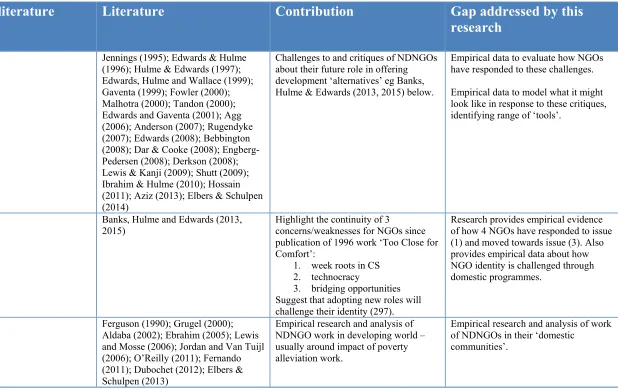
(Ahmad, 2006), impotence (Zadek and Gatward, 1996) and inability to bring about lasting change (Balboa, 2014).This research will contribute to the empirical data available on how NDNGOs respond to these challenges about their future role and will use the analysis to offer a model of what a future NDNGO might look like. It is, for example, interesting to note that a recent critique of NDNGOs identifies weak roots in civil society and a potential bridging role in which NGO identity will be challenged (Banks et al., 2013). These are all themes picked up from the empirical data in this research, which brings new evidence to bear on this growing body of knowledge on future NDNGO roles.
There are three specific yet interconnected areas of NDNGO critique that call for further attention, as they appear to offer useful and interesting insights into domestic programmes such as Oxfam GB’s UKPP and the other case studies addressed here. These are the themes of credibility and legitimacy, civic rootedness and north-south relations.11 Firstly, one of the most serious criticisms directed at NDNGOs is that they lack credibility and legitimacy. These are standards applied to all NGOs, regardless of location (see for example the study of NGO credibility in Uganda, Omona and Mukuye, 2013). However, the literature generally reflects the power asymmetries between NDNGOs and southern NGOs (SNGOs) (Fowler, 1991, Elbers and Schulpen, 2013) and focuses its critique on NDNGOs in this regard. NDNGO credibility is undermined by the fact that NDNGOs frequently shape the terms of partnership agreements and do not provide the same level of institutional information as SNGOs are expected to. Work by Gourevitch and Lake (2012) clarifies the
distinction between the two concepts and provides evidence that credibility, or the NGO’s capacity to be believed, is an asset, which is actively shaped by the NGO. Likewise, the legitimacy (for which credibility is a pre-requisite) of an NGO also requires active maintenance by the organisation. Their study, for example, presents a framework of action, which is mobilised by the NGO to proactively maintain or reclaim the organisation’s credibility. This includes, along with the more common- place strategy of adopting autonomous governance structures, the interesting idea of ‘costly effort’. There are many approaches an NGO could take to mobilising the ‘costly effort’ strategy but they should be visible, such as staff taking lower salaries to
demonstrate the organisation’s commitment to donor priorities, otherwise they risk alienating some supporters and donors. This concept has resonance and potential explanatory power for the domestic programmes of NDNGOs, which, in the cases of OGB’s UKPP, Islamic Relief and Oxfam America are not universally understood or welcomed by their supporters.
The second critique of NDNGOs is their lack of ‘rootedness’ in the societies of the industrial ‘North’ in which they are based. Again, this standard is applied to NGOs in the global South (Fowler and James, 1994). However, as the literature tracks the requirement of NDNGOs to demonstrate impact, ‘scale up’ (Edwards, 1993, Edwards and Hulme, 1996) and move into advocacy work (Anderson, 2000, Watson, 2001, Rugendyke and Ollif, 2007), there is a loud call for NDNGOs particularly to engage more creatively and deeply with their domestic publics. There are suggestions that this is to maintain sustainable funding streams (Smillie and Helmich, 1993) but the primary focus is on maintaining legitimacy and re-thinking their role. As significant actors in society often funded by public donations and government contracts, it is argued that NDNGOs need to justify their mandate as non-membership based
organisations. Evidence of the lack of engagement (beyond fundraising) by UK-based NDNGOs with the public is cited as one of the reasons for an overly simplistic
understanding of development issues amongst the general public (Glennie et al., 2012, p. 25).
The legitimacy of a social actor comes from their rootedness in their own society, from a more engaged and supportive domestic constituency, and from the alliances they develop with other parts of civil society. (Edwards et al., 1999, p. 133)
argues that ultimately their success will be measured by the systemic change they can initiate and this will only be possible if they are rooted within their community. Preliminary data from the Oxfam GB (OGB) case study points to echoes of the concern about OGB’s rootedness in the UK in interventions from southern partners prior to the UKPP. The concern was mobilised by staff in making the case for the programme. This is reflected in all three of the smaller case studies in this research. As with the issues of credibility and legitimacy, this study provides empirical data from four NDNGO domestic programmes to support the findings in the literature with regards to the quest for legitimacy in NDNGOs. It enhances understandings of the programmes as strategies to respond to these critiques and allows for an assessment of its success.
The final critique, which has possible explanatory power for NDNGO domestic programmes, is that of relations between the global north and south. Gaventa’s proposition that that there are ‘Souths within the North just as there may be Norths within the South’ (1999, p. 257) suggests an entirely different way of conceptualising stereotypical views of North and South. This approach has implications for practice too and, if considered alongside the idea of ‘costly effort’ (Gourevitch and Lake, 2012), could offer fuller understanding of how NDNGOs make programmatic decisions. For example, a decision to locate NDNGO programme work in the global North may be a response to changing understandings of where ‘the souths’ are. In addition, a visible signal that the NDNGO is choosing a difficult path, such as paying staff below the market rate or losing potential funds to maintain a core value or principle, may boost credibility. The changing global structures which blur the traditional boundaries between ‘north’ and ‘south’, recipients and donors, and where the poor live are another dimension of the literature explored later in this chapter. For now, it is sufficient to note that this dynamic is part of the context in which NDNGOs had and continue to have an identity crisis about their future role.
time as evidenced in the negative media coverage. Reading this article was, in fact, the first time this researcher encountered the UKPP. Subsequent searches identify only four articles which touch on the OGB UKPP in the scholarly literature
(Thekaekara, 2000, Eyben et al., 2008, Matheson and Matheson, 2008, Ellis, 2004), two of which are written by Oxfam staff and another by a former Trustee who played a central role in the early debates about the programme. No evidence is found of scholarly literature on any other NDNGO domestic programme. Research into the major case study organisation, Oxfam GB, has been much more extensive (Jennings, 1998, Rahman, 1998, Blackler, 2008, Harrison, 2008, Wong, 2013) but this has focussed entirely on Oxfam GB’s ‘overseas’ programming outside the UK. This mirrors the pattern of empirical research and analysis of NDNGO work more generally which focuses on their work in the global south (Ferguson, 1990, Grugel, 2000, Kontinen, 2007, Cumming, 2008, Barber and Bowie, 2008). There is also recent scholarly work on the re-structuring, de-centralising and governance work of NDNGOs such as ACORD, Action Aid, ICCO and Oxfam International
(Jayawickrama, 2010, Elbers and van Leeuwen, 2013, Elbers and Schulpen, 2014, Fowler, 2012). NDNGOs themselves have made attempts to capture their own history and organisational development, which make passing reference to their domestic programmes, such as the Oxfam Archive Oral History Project (see also Roper, 2010, Joffe, 2009). This research, therefore, makes a contribution to this considerable gap in understandings of NDNGOs’ domestic programmes, asking new questions about the significance of these programmes, specifically those of Oxfam GB, Oxfam America, Islamic Relief and Red Barnet.
2.3 NDNGOs: their decisions and practices
As with the theme of NDNGO futures, the survey of literature in the area of decision-making and institutional practice has two functions. First, it serves to identify gaps in understandings of why and how these organisations make programming decisions, such as that to establish domestic programmes. Secondly, it suggests tested theoretical and methodological tools, to be explored in more depth in Chapter 3.
In asking the question why NDNGOs choose to work with the poor in their own communities, it is suggested that they make decisions about programmes and
sole criterion of decision-making about where to work, it is unlikely that any of the case study NDNGOs would have established domestic programmes. That is not to say that considerations of levels of poverty in the UK, US and Denmark were not part of debates around the domestic programmes of the case study organisations. They were (see for example Bennett, 1994). Nevertheless, it acknowledges and builds on the research to-date around decision-making in NGOs. There are three distinct strands to this research. Some are concerned with locating NGO decision-making within or across particular traditions, querying, for example, whether it is distinct from the private or government sectors as a result of multiple bottom-lines and accountabilities (Tandon, 1996, Anheier, 2000, Hudson, 2009)and values (Brass, 2012, Krause, 2014),or is a hybrid pulling from each of the three sector approaches (Lewis, 2003). The focus of the second strand, which this research is informed by, is on the inherent diversity of the NGO sector which requires a nuanced approach to understanding how decisions are made (Harris et al., 2009, Heyse, 2006, Hilhorst, 2003).
Two particular contributions to this literature have considerable potential for the understanding of why NDNGOs establish and maintain domestic programmes. Hilhorst’s study of NGOs in the Philippines rejects arguments from the post-development critique (Dar and Cooke, 2008, Choudry and Kapoor, 2013), which suggest that NGOs are an outcome and manifestation of a single neo-liberal framework, demonstrating instead that ‘their practices reveal how these different frameworks intertwine’ (2003, p. 216). This echoes the analysis in Chapter 5 on the three smaller case studies and points to the need for an analytical framework that can respond to and capture such diversity. The second contribution is premised on the multiple-accountabilities approach and shows how strategic planning processes are shaped by and actively shape an NGO’s response to these, suggesting the need for:
…nuanced understanding of how managers might use the language, metaphors, and deliberative arenas of strategic planning to influence, gradually and subtly, organizational change, even at the expense of realism and implementation of formal strategies. (Harris et al., 2009, p. 425)
research and informs this study’s epistemology in which the perspectives and understandings of those working within the case study NDNGOs are privileged.
The final strand in literature on NGO decision-making is implicit and does not always sit within research focused on decision-making. Ideas and evidence appear across the sub-literatures on development ethics and development and NGO management. Fowler, for example, argues that many NGOs’ performance in poverty alleviation work is hampered by the fact they do not have a coherent theory of poverty (1995, p. 304), suggesting, therefore, that this is an important element of NDNGO of decision-making. Development ethics (for which there is a significant sub-literature discussed below) also offers insights into decision-making, sometimes rejecting claims that because development management is flawed it is, therefore, an impossible means to emancipatory ends.
Development agencies have to act, and they have to choose between values and priorities, however crudely they make these choices. (McCourt and Johnson, 2012, p. 534)
For the purposes of this study, this highlights the significance of the realm of development ethics, ideas (John, 1998) and ideology (Jennings, 1998) for NDNGO decision-making. Using the same argument, the study constructs a heuristic
framework from dimensions of development studies, NGO and development management literature that offer the potential for richer understandings of why domestic programmes are established and maintained. Considerations of the future of NDNGOs and development ethics are two elements of this framework.
received much attention with a broad consensus that many, although not all, practices are associated with exclusionary results (Cleaver, 1999, Cooke and Dar, 2008,
McGee, 2002). The rival power of NGO campaigners and fundraisers is vividly brought to life by Sireau’s (2009) study of the Make Poverty History campaign. Likewise, marketing practices combined with the constraints of public opinion
(Desforges, 2004) and the demands of donor reporting(Ebrahim, 2005) are significant dimensions of what collectively this study refers to as ‘institutional practices’.
Some development studies and NGO management research has recently utilised Bourdieu’s theory of practice (1970, 1977, 1991, 1994, 1996, 1999) addressing the past trend of overly normative research with a lack of theoretical engagement (Lewis and Opoku Mensah, 2006). These studies have drawn attention to the way power can work in organisations (Gaventa, 2006, Bevan and Pankhurst, 2007, Ebrahim, 2004) and to the significance of researchers’ understanding of the habitus and field of practice in which an organisation operates (Bristow, 2008, Krause, 2014, Moyles, 2007). Although there are debates about whether Bourdieu’s concept of habitus can be applied to institutions (Atkinson, 2011), the approach is used with considerable effect in Ebrahim’s study of NGOs and organisational change (2005). In conjunction with the above evidence from NGO research to-date that institutional practices are of analytical significance in understanding the dynamics and decisions of NDNGOs, the successful application of Bourdieu’s theory of practice, specifically the notion of habitus, is one element of the rationale for its further use in this research.The findings of this study provide further evidence in the debate as to the utility of a theory of practice to development and NGO studies. Having provided a brief rationale for the application of Bourdieu’s theory of practice to this study, Chapter 3 details how these theoretical tools are used to test the working hypothesis.
2.4 Theories of Poverty