R E S E A R C H
Open Access
On solving some functional equations
Dmitry V Kruchinin
**Correspondence:
[email protected] Tomsk State University of Control Systems and Radioelectronics (TUSUR), Tomsk, Russia National Research Tomsk Polytechnic University (TPU), Tomsk, Russia
Abstract
Using the notion of composita and the Lagrange inversion theorem, we present techniques for solving the following functional equationB(x) =H(xB(x)m), whereH(x),
B(x) are generating functions andm∈N. Also we give some examples.
MSC: Primary 05A15; secondary 65Q20; 39B12
Keywords: composita; generating function; Lagrange inversion theorem; functional equation
1 Introduction
In this paper we study the coefficients of the powers of an ordinary generating function and their properties. Using the notion of composita, we get the solution of the functional equationB(x) =H(xB(x)m), which is based on the Lagrange inversion equation, where
H(x),B(x) are generating functions andm∈N.
In the papers [–], the author introduced the notion ofcompositaof a given ordinary generating functionF(x) =n>f(n)xn.
SupposeF(x) =n>f(n)xnis the generating function, in which there is no free term
f() = . From this generating function we can write the following equation:
F(x)k=
n>
F(n,k)xn. ()
The expressionF(n,k) is thecomposita, and it is denoted byF(n,k).
Definition Thecompositais the function of two variables defined by
F(n,k) = πk∈Cn
f(λ)f(λ)· · ·f(λk), ()
whereCnis a set of all compositions of an integern,πkis the composition
k
i=λi=ninto
kparts exactly.
The expressionF(n,k) takes a triangular form
F ,
F
, F,
F
, F, F,
F
, F, F, F,
..
. ... ... ... ...
F
n, Fn, . . . Fn,n– Fn,n
2 Lagrange inversion equation
First we consider a solution of the functional equation
A(x) =xHA(x), ()
whereA(x) andH(x) are generating functions such thatH(x) =n≥h(n)xnandA(x) =
n>a(n)xn.
In the following lemma, we give the Lagrange inversion formula, which was proved by Stanley [].
Lemma (The Lagrange inversion formula) Suppose H(x) =n≥h(n)xnwith h()= ,
and let A(x)be defined by
A(x) =xHA(x). ()
Then
nxnA(x)k=kxn–kH(x)n, ()
where[xn]A(x)kis the coefficient of xnin A(x)kand[xn–k]H(x)nis the coefficient of xn–kin
H(x)n.
By using the above Lemma , we now give the following theorem.
Theorem Suppose H(x) =n≥h(n)xnis a generating function,where h()= ,H x(n,k)
is the composita of the generating function xH(x),and A(x) =n>a(n)xnis the
generat-ing function,which is obtained from the functional equation A(x) =xH(A(x)).Then the following condition holds true:
A(n,k) =k
nH
x(n–k,n). ()
Proof According to Lemma , for the solution of the functional equationA(x) =xH(A(x)), we can write
nxnA(x)k=kxn–kH(x)n.
On the left-hand side, there is the composita of the generating functionA(x) multiplied byn:
nxnA(x)k=nA(n,k).
We know that
xH(x)k=
n≥k
Then
H(x)k=
n≥k
Hx(n,k)xn–k.
If we replacen–kbym, we obtain the following expression:
H(x)k=
m≥
H
x(m+k,k)xm.
Substitutingnforkandn–kform, we get
xn–kH(x)n=Hx(n–k,n).
Therefore, we get
A(n,k) =k
nH
x(n–k,n).
According to the above theorem, for solutions of the functional equation A(x) =
xH(A(x)), we can use the following expression:
A(x)k=
n≥k
A(n,k)xn=
n≥k
k nH
x(n–k,n)xn,
whereH
x(n,k) is the composita of the generating functionxH(x). Therefore,
A(x) =
n≥
nH
x(n– ,n)xn. ()
Since the composita is uniquely determined by the generating function, formula () pro-vides a solution of the inverse equationA(x) =xH(A(x)), whenA(x) is known andH(x) is unknown. Hence,
Hx(n,k) = k k–nA
(k, k–n).
It should be noted that forn=k,
Hx(n,n) =A(n,n).
Next we give some examples of functional equations.
Example Let us find an expression for coefficients of the generating functionA(x) =
n>a(n)xn, which is defined by the functional equation
A(x) =x+xA(x) +xA(x)+ xA(x).
The generating functionxH(x) has the form
The composita ofxH(x) is
According to formula (), the coefficients ofA(x) are
a(n) =
Example Let us find an expression for coefficients of the generating function B(x) =
Next we introduce the following generating functionA(x) =xB(x). Considering the func-tional equation, we can notice that
A(x) =x +A(x) +A(x)
–A(x) .
Then we get the following functional equation:
Hence, using Theorem , we get the composita ofA(x),
3 The generalized Lagrange inversion equation
Next we generalize the caseA(x) =xH(A(x)).
ReplacingA(x) byxB(x) in the functional equation (), we get
B(x) =HxB(x). ()
Let us introduce the following definitions.
Definition The left composita of the generating functionB(x) in the functional equa-tion () is the composita
H
Definition The right composita of the generating functionH(x) in the functional equa-tion () is the composita
Bx(n,k) =k
There exists the left composita for every left composita and there exists the right com-posita for every right comcom-posita.
Formula () can be generalized for the case when a generating function is the solution of a certain functional equation. Let us prove the following theorem.
Theorem Suppose H(x) =n≥h(n)xnand B(x) =
n≥b(n)xnare generating functions
such that B(x) =H(xB(x)m),where m∈N;H
x(n,k)and Bx(n,k)are the compositae of the
generating functions xH(x)and xB(x),respectively.Then
Bx(n,k) = k
im–
Hx(im,im–), ()
Proof Form= , we have
B(x) =HxB(x)=G(x), im–=k,im=n.
Then we obtain the identity
B x(n,k) =
k kH
x(n,k).
Form= , we have
B(x) =G
xB(x)
, im–=n,im= n–k.
Then we obtain
Bx,(n,k) = k
nH
x(n–k,n)
that satisfy Theorem .
By induction, we put that formthe solution of the equation
Bm(x) =H
xBm(x)m
()
is
Bx,m(n,k) = k
im–
Hx(im,im–).
Then we find the solution form+ ,
Bm+(x) =H
xBm+(x)m+
.
For this purpose, we consider the following functional equation:
Bm+(x) =Bm
xBm+(x)
.
Instead ofBm(x), we substitute the right hand-side of ()
Bm+(x) =H
xBm+(x)
Bm
xBm+(x)
m
;
from whence it follows that
Bm+(x) =H
xBm+(x)m+
.
We note thatB
x,m+(n,k) is the right composita ofBm(x),
Bx,m+(n,k) =k
nB
x,m(n–k,n),
whereB
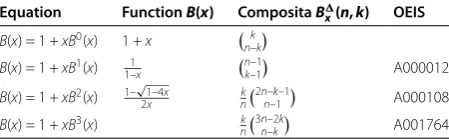
Table 1 Table of functional equations
Equation FunctionB(x) CompositaBx(n, k) OEIS
B(x) = 1 +xB0(x) 1 +x k n–k
B(x) = 1 +xB1(x) 1 1–x
n–1 k–1
A000012
B(x) = 1 +xB2(x) 1–√1–4x 2x
k n
2n–k–1 n–1
A000108
B(x) = 1 +xB3(x) k n
3n–2k n–k
A001764
Then
Bx,m+(n,k) = k
(m+ )n–mkH
x
(m+ )n– (m+ )k, (m+ )n–mk.
Therefore, for the functional equation
Bm+(x) =Bm
xBm+(x)
,
we obtain the required condition
Bx,m+(n,k) = k
im
Hx(im+,im),
whereim= (m+ )n–mk.
In Table we present a sequence of functional equations for the generating function
H(x) = +x, where OEIS means the On-Line Encyclopedia of Integer Sequences [].
Competing interests
The author declares that they have no competing interests.
Acknowledgements
The author wishes to thank the referees for their useful comments. This work was partially supported by the Ministry of Education and Science of Russia, government order No. 1220 ‘Theoretical bases of designing informational-safe systems’.
Received: 30 October 2014 Accepted: 25 December 2014
References
1. Kruchinin, VV, Kruchinin, DV: Composita and its properties. J. Anal. Number Theory2(2), 1-8 (2014) 2. Kruchinin, DV, Kruchinin, VV: A method for obtaining generating function for central coefficients of triangles.
J. Integer Seq.15, 1-10 (2012)
3. Kruchinin, DV, Kruchinin, VV: Application of a composition of generating functions for obtaining explicit formulas of polynomials. J. Math. Anal. Appl.404, 161-171 (2013)
4. Stanley, RP: Enumerative Combinatorics, vol. 2. Cambridge Studies in Advanced Mathematics. Cambridge University Press, Cambridge (1999)