Constant-Round Concurrent Zero-knowledge from
Indistinguishability Obfuscation
Kai-Min Chung∗ Huijia Lin† Rafael Pass‡ December 18, 2014
Abstract
We present a constant-round concurrent zero-knowledge protocol for NP. Our protocol relies on the existence of families of collision-resistant hash functions, one-way permutations, and indistinguishability obfuscators forP/poly (with slightly super-polynomial security).
∗
Academia Sinica,[email protected] †
University of California, Santa Barbara,[email protected].
‡
1
Introduction
Zero-knowledge (ZK) interactive proofs [GMR89] are paradoxical constructs that allow one player (called the Prover) to convince another player (called the Verifier) of the validity of a mathematical statement x ∈ L, while providing zero additional knowledge to the Verifier. Beyond being fasci-nating in their own right,ZKproofs have numerous cryptographic applications and are one of the most fundamental cryptographic building blocks.
The notion of concurrent zero knowledge, first introduced and achieved in the paper by Dwork, Naor and Sahai [DNS04], considers the execution of zero-knowledge proofs in an asynchronous and concurrent setting. More precisely, we consider a single adversary mounting a coordinated attack by acting as a verifier in many concurrent executions (called sessions). ConcurrentZK proofs are significantly harder to construct and analyze. Since the original protocol by Dwork, Naor and Sahai (which relied on so called “timing assumptions”), various other concurrentZKprotocols have been obtained based on different set-up assumptions (e.g., [DS98, Dam00, CGGM00, Gol02, PTV12, GJO+12]), or in alternative models (e.g., super-polynomial-time simulation [Pas03, PV10]).
In the standard model, without set-up assumptions (the focus of our work,) Canetti, Kilian, Petrank and Rosen [CKPR01] (building on earlier works by [KPR98, Ros00]) show that concurrent
ZKproofs for non-trivial languages, with “black-box” simulators, require at least ˜Ω(logn) number of communication rounds. Richardson and Kilian [RK99] constructed the first concurrent ZK
argument in the standard model without any extra set-up assumptions. Their protocol, which uses a black-box simulator, requires O(n) number of rounds. The round-complexity was later
improved in the work of Kilian and Petrank (KP) [KP01] to ˜O(log2n) round. More recent work by Prabhakaran, Rosen and Sahai [PRS02] improves the analysis of the KP simulator, achieving an essentially optimal, w.r.t. black-box simulation, round-complexity of ˜O(logn); see also [PTV12] for an (arguably) simplified and generalized analysis.
The central open problem in the area is whether a constant-round concurrentZKprotocol (for a non-trivial language) can be obtained. Note that it could very well be the case that all “clas-sic” zero-knowledge protocols already are concurrent zero-knowledge; thus, simply assuming that those protocols are concurrent zero-knowledge yields an assumption under which constant-round concurrent zero-knowledge (trivially) exists—in essence, we are assuming that for every attacker a simulator exists. Furthermore, as shown in [GS12] (and informally discussed in [CLP13b]) un-der various “extractability” assumptions of the knowledge-of-exponent type [Dam91, HT98, BP04], constant-round concurrent zero-knowledge is easy to construct. But such extractability assump-tions also simply assume that for every attacker, a simulator (in essence, “the extractor” guaranteed by the extractability assumption) exists. In particular, an explicit construction of the concurrent zero-knowledge simulator is not provided—it is simply assumed that one exists. For some applica-tions of zero-knowledge such asdeniability (see e.g., [DNS04, Pas03]), having an explicit simulator is crucial. Rather, we are here concerned with the question of whether constant-round concurrent zero-knowledge,with an explicit simulator exits.
1.1 Towards Constant-round Concurrent Zero-Knowledge
Recently, the authors [CLP13b] provided a first construction a constant-round concurrent zero-knowledge protocol with an explicit simulator, based on a new cryptographic hardness assumption— the existence of so-called P-certificates, roughly speaking, succinct non-interactive arguments for languages inP. An issue with their approach, however, is we only have candidate constructions of
Additionally, whereas the assumption that a particular proof system is aP-certificates is a falsifiable assumption [Pop63, Nao03], it is unclear whether the existence ofP-certificates itself can be based on some more natural hardness assumption.
A very recent elegant work by Pandey, Prabhakaran and Sahai [PPS13] takes a different ap-proach and instead demonstrates the existence of constant-round concurrent zero-knowledge pro-tocol with an explicit simulator based on the existence of differing-input obfuscation (diO) for (restricted classes of)P/poly[BGI+01, BCP14, ABG+13]. Whereas the assumption that a partic-ular scheme is a diOis an “extractability” assumption (similar in flavor to knowledge-of-exponent type [Dam91, HT98, BP04] assumptions), the intriguing part of the scheme of Pandey et al [PPS13] is that the extractability assumption is only used to prove soundness of the protocol; concurrent zero-knowledge is proved in the “standard” model, through providing an explicit simulator. Never-theless,diOis a strong and subtle assumption—as shown by recent work [BP13, GGHW13, IPS14], unless we restricting the class of programs for whichdiOshould hold, we may end up with a notion that is unsatisfiable. Additionally, there are currently no known approaches for basingdiOon more “natural” (or in factany) hardness (as opposed to extractability) assumption.
1.2 Our Results
In this paper, we combine the above-mentioned two approaches. Very roughly speaking, we will use obfuscation to obtain a variant of the notion of a P-certificate, and we next show that this variant still suffices to obtain constant-round concurrent zero-knowledge (where the soundness conditions holds also against non-uniform PPT attackers). More importantly, rather than using diO, we are able to useindistinguishability obfuscation (iO)[BGI+01, GGH+13]. Following the groundbreaking work of Garg et al [GGH+13], there are now several candidate constructions ofiOthat can be based on hardness assumptions on (approximate) multilinear maps [PST14, GLSW14].
Theorem. Assume the existence of indistinguishability obfuscation forP/poly(with slightly super-polynomial security), one-way permutations (with slightly super-super-polynomial security) and collision-resistant hash function. Then there exists a constant-round concurrent zero-knowledge argument for NP.
In more details, our approach proceeds in the following steps:
• We first observe that a warm-up case considered in [CLP13b]—which shows the existence of constant-round concurrent zero-knowledge based on, so-called,unique P-certificates (that is,P-certificates for which there exists at most one accepting certificate for each statement) directly generalizes also to uniqueP-certificates in the CommonRandomString model (a.k.a. the Uniform Random String model (URS)) satisfying anadaptive soundness property (where the statement to be proved can be selected after the URS).
• We next consider a more relaxed variant of unique P-certificates in the CRS model—which we refer to as delegatable unique P-certificates—where the CRS is allowed to be statement dependent but only a “small” (in particular, independent of the statement length) part of the CRS generation requires using secret coins. By relying oniO forP/poly, we next show that the protocol can be generalized to work also with such delegatable unique P-certificates.
• We finally leverage recent results on delegation of computation based oniO from [BGL+14, CHJV14, KLW14] and show that the beautiful protocol of Koppula, Lewko and Waters [KLW14] can be modified into a delegatable unique P-certificate (also with non-uniform soundness).
1.3 Outline of Our Techniques
We here provide a detailed outline of our techniques. As mentioned, our construction heavily relies on a “warm-up” case of the construction of [CLP13b], which we start by recalling (closely following the description in [CLP13b]). The starting point of the construction of [CLP13b] is the construction is Barak’s [Bar01] non-black-box zero-knowledge argument forNP. We start by very briefly recalling the ideas behind his protocol (following a slight variant of this protocol due to [PR03b]).
Barak’s protocol Roughly speaking, on common input 1n and x ∈ {0,1}poly(n), the Prover P and Verifier V, proceed in two stages. In Stage 1, P starts by sending a computationally-binding commitmentc∈ {0,1}nto 0n;V next sends a “challenge”r∈ {0,1}2n. In Stage 2,P shows (using
a witness indistinguishable argument of knowledge) that either x is true, or there exists a “short” string σ∈ {0,1}n such that cis a commitment to a program M such thatM(σ) =r.1
Soundness follows from the fact that even if a malicious prover P∗ tries to commit to some program M (instead of committing to 0n), with high probability, the string r sent by V will be different from M(σ) for every string σ ∈ {0,1}n. To prove ZK, consider the non-black-box
simulator S that commits to the code of the malicious verifierV∗; note that by definition it thus holds that M(c) = r, and the simulator can use σ = c as a “fake” witness in the final proof. To formalize this approach, the witness indistinguishable argument in Stage 2 must actually be a witness indistinguishable universal argument (WIUA) [Mic00, BG08] since the statement that c
is a commitment to a program M of arbitrary polynomial-size, and that M(c) = r within some arbitrary polynomial time, is not in NP.
Now, let us consider concurrent composition. That is, we need to simulate the view of a verifier that startspoly(n) concurrent executions of the protocol. The above simulator no longer works in this setting: the problem is that the verifier’s code is now a function ofall the prover messages sent in different executions. (Note that if we increase the length ofr we can handle a bounded number of concurrent executions, by simply lettingσ include all these messages).
So, if the simulator could commit not only to the code of V∗, but also to a program M that generates all other prover messages, then we would seemingly be done. And at first sight, this doesn’t seem impossible: since the simulatorSis actually the one generating all the prover messages, why don’t we just let M be an appropriate combination of S and V∗? This idea can indeed be implemented [PR03b, PRT11], but there is a serious issue: if the verifier “nests” its concurrent
1
We require that C is a commitment scheme allowing the committer to commit to an arbitrarily long string
m ∈ {0,1}∗
executions, the running-time of the simulation quickly blows up exponentially—for instance, if we have three nested sessions, to simulate session 3 the simulator needs to generate aWIUA regarding the computation needed to generate aWIUAfor session 2 which in turn is regarding the generation of theWIUAof session 1 (so even if there is just a constant overhead in generating aWIUA, we can handle at most lognnested sessions).
Unique P-certificates to The Rescue: The “Warm-Up” Case from [CLP13b] As shown in [CLP13b], the blow-up in the running-time can be prevented using UniqueP-certificates. Roughly speaking, we say that (P, V) is a P-certificate system if (P, V) is a non-interactive proof system (i.e., the prover send a single message to the verifier, who either accepts or rejects) allowing an efficient prover to convince the verifier of the validity of any deterministic polynomial-time com-putation M(x) =y using a “certificate” of some fixed polynomial length (independent of the size and the running-time of M) whose validity the verifier can check in some fixed polynomial time (independent of the running-time ofM). TheP-certificate system isunique if there exists at most one accepted proof for any statement.
The protocol proceeds just as Barak’s protocol except that Stage 2 is modified as follows: instead of havingP prove (using aWIUA) that eitherxis true, or there exists a “short” stringσ ∈ {0,1}2n
such that c is a commitment to a programM such that M(σ) =r, we now askP to use a WIUA
to prove that eitherx is true, or
• commitment consistency: cis a commitment to a program M1, and
– input certification: there exists a vector λ = ((1, π1),(2, π2), . . .) and a vector of messages m~ such thatπj certifies that M1(λ<j) outputs mj in its j’th communication
round, whereλ<j = ((1, π1), . . . ,(j−1, πj−1)), and
– prediction correctness: there exists a P-certificate π of length ndemonstrating that
M1(λ) =r.
Soundness of the modified protocol, roughly speaking, follows since by the unique certificate prop-erty, for every programM1 it inductively follows that for everyj,mj is uniquely defined, and thus
also theunique (accepting) certificateπj certifying M1(λ<j) =mj; it follows thatM1 determines a unique vectorλthat passes the input certification conditions, and thus there exists a singler that make M1 also pass the prediction correctness conditions. Note that we here inherently rely on the fact that theP-certificate is unique to argue that the sequenceλis uniquely defined. (Technically, we here need to rely on a P-certificate that is sound for slightly super-polynomial-time as there is no a-priori polynomial bound on the running-time of M1, nor the length of λ.)
To prove zero-knowledge, roughly speaking, our simulator will attempt to commit to its own code in a way that prevents a blow-up in the running-time. Recall that the main reason that we had a blow-up in the running-time of the simulator was that the generation of the WIUA is expensive. Observe that in the new protocol, the only expensive part of the generation of the WIUA is the generation of the P-certificates π; the rest of the computation has a-priori bounded complexity (depending only on the size and running-time of V∗). To take advantage of this observation, we thus have the simulator only commit to a program that generates prover messages (in identically the same way as the actual simulator), but getting certificates~π as input.
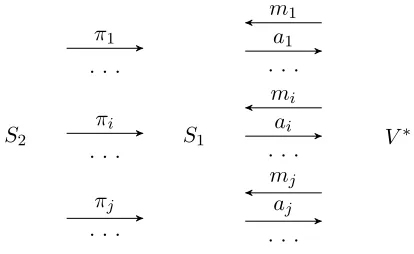
In more detail, to describe the actual simulatorS, let us first describe two “helper” simulators
S1, S2. S1 is an interactive machine that simulates prover messages in a “right” interaction with
S2 S1 V∗
πj
πi
π1
mj
aj
mi
ai
m1
a1
· · ·
· · ·
· · ·
· · ·
· · ·
· · ·
Figure 1: Simulation using P-certificates.
“left” messages will later be certificates provided by S2. See Figure 1 for an illustration of the communication patterns between S1, S2 and V∗.
S1 proceeds as follows in the right interaction. In Stage 1 of every session i,S1 first commits to a machine ˜S1(j0, τ) that emulates an interaction betweenS1andV∗, feedingS1 inputτ as messages on the left, and finally ˜S1 outputs the verifier message in the j0’th communication round in the right interaction withV∗. (Formalizing what it means forS1 to commit to ˜S1 is not entirely trivial since the definition of ˜S1 depends onS1; we refer the reader to the formal proof for a description of how this circularity is broken.2 S1 next simulates Stage 2 by checking if it has received a message (j, πj) in the left interaction, where j is the communication round (in the right interaction with
V∗) where the verifier sends its random challenge and expects to receive the first message of Stage 2; if so, it uses M1 = ˜S1 (and the randomness it used to commit to it), j and σ being the list of messages received by S1 in the left interaction, as a ”fake” witness to complete Stage 2.
The job of S2 is to provide P-certificatesπj for S1 allowingS1 to complete its simulation. S2 emulates the interaction between S1 and V∗, and additionally, at each communication roundj,S2 feedsS1 a message (j, πj) whereπj is aP-certificate showing that ˜S1(j, σ<j) =rj, whereσ<j is the
list of messages already generated byS2, andrj is the verifier message in thej’th communication
round. Finally, S2 outputs its view of the full interaction.
The actual simulatorSjust runsS2and recovers from the view ofS2the view ofV∗ and outputs it. Note that since S1 has polynomial running-time, generating each certificate about ˜S1 (which is just about an interaction between S1 and V∗) also takes polynomial time. As suchS2 can also be implemented in polynomial time and thus alsoS.
Finally, indistinguishability of this simulation, roughly speaking, follow from the hiding prop-erty of the commitment in Stage 1, and the WI propprop-erty of the WIUA in Stage 2. (There is another circularity issue that arises in formalizing this—as S1 in essence needs to commit to its own randomness—but it can be dealt with as shown in [CLP13b]; in this overview, we omit the details as they are not important for our modifications to the protocol, but they can be found in the formal proof.)
Generalizing to Unique P-certificates in CRS model The key technical contribution in [CLP13b] was to generalize the above approach to deal also with “non-unique”P-certificates. Here we instead aim to generalize the above approach to work withP-certificates in the CRS model, but still relying on the uniqueness property.
2
Let us first note that if we had access to unique P-certificate in the URS (i.e., the uniform reference string) model satisfying an adaptive soundness property (where the statement to be proved can be selected after the URS, then above-mentioned protocol almost directly generalized to work with them (as opposed to using unique P-certificates in the “plain” model) by simply having the Verifier send the URS ρ along with its first message of the protocol.3 The only issue that needs to be addressed in implementing this change is to specify what it means that “πj certifies
that M1(λ<j) outputs mj” in the input certification step in Stage 2, since this certification needs
to be done with respect to some URS. We modify Stage two to require that M1 outputs not only messagesmi, but also reference stringsρi. Let us remark that to ensure that soundness still holds,
we require theP-certificate system to satisfy a strong uniqueness property: uniqueness of accepting proofs needs to hold forall reference strings ρ.
We next note that the protocol can be further generalized to handle also unique P-certificates in the URS model satisfying even just a static soundness condition (where the statement needs to be selected before the URS is picked) by proceeding as follows:
• We add a Stage 1.5 to the protocol where the Prover is asked to provide a commitment c2 to 0n and then asked to provide a WIUARG that either x ∈L orc2 is a commitment to a “well-formed” statement (but not that the statement is true) for the P-certificate in use in Stage 2.
• Stage 2 of the protocol is then modified to first have the Verifier send the URS for the P -certificate, and then requiring that the prover uses aP-certificate for the statement committed to in c2. In other words, we require the Prover to commit in advance, and prove knowledge of, the statement to be used in theP-certificate and thus static soundness suffices.
Additionally, this approach generalizes also to deal with unique P-certificates in the Common Reference String (CRS) model (where the reference string no longer needs to be uniform), by having the Verifier provide a zero-knowledge proof that the CRS was well-formed.4 Let us again remark that to ensure that soundness still holds, we require the uniqueness property of the P-certificate system to hold for all reference stringsρ,even invalid ones.
Generalizing to Delegatable P-certificates The notion of a P-certificate in the CRS model requires that the same CRS can be used to prove any statement q of any (polynomially-related) length. We will now consider a weaker notion of a P-certificate in the CRS model, where the CRS is “statement-dependent”—that is, the CRS is generated as a function of the statement q
to be proved—in essence, such P-certificates can be viewed as specific instances of a two-round delegation protocol. But whereas the CRS may depend on the statement, we still restrict it in several important ways:
• As before, the length of the CRS is “short” (independent of the length of the statement q).
• Additionally, only a “small” part of the generation procedure relies on secret coins. More precisely, the CRS generation procedure proceeds in three steps: 1) first, secret coins are used
3To make this work, we need to rely onP-certificates in the URS model with perfect completeness. This require-ment can be removed by additionally performing a coin-tossing to determine the URS. For simplicity of exposition, we here simply assume perfect completeness.
4
to generate a public parameter P P and a secret parameter K (this is done independently of the statement q), 2) next, only P P is used to deterministically process the statement q
into a “short” digest d (independent of the length of q), and 3) the digest dand the secret parameter K is efficiently processed to finally generate the CRS (independent of the length of q). To emphasize, only step 2 requires work that is proportional to the length of q, but this work only requires public information.
We now generalize the above approach to also work with delegatable unique P-certificates.
• Instead of having the Verifier send the CRS in the clear (which it cannot compute as it does not know the statementqon which it will be run), it simply runs part 1 of the CRS generation procedure to generateP P and K and sends just the public-parameterP P to the Prover.
• The Prover is then asked to provide a third commitmentc3to 0nand provide a WIUARG that eitherx∈Lorc3 is a correctly computed digestd(w.r.t.,P P) to the statementq committed to inc2. (In essence, the Verifier is delegating the computation ofdto the Prover.)
• Next, the Verifier sends an indistinguishability obfuscation ˜Π = iO(Π) of a program Π that on input a decommitment (d0, r0) to c3 processes d0 and K into a CRS ρ and outputs it. (The reason that the Verifier cannot generate ρ in the clear is that digestd cannot be sent to the Verifier in the clear; recall that the honest prover will never compute any such digest, it is meant to commit to 0n and prove that x ∈ L.) Additionally, the verifier gives a
zero-knowledge proof that the obfuscation is correctly computed (and using the same random coins that were used to generateP P).
• Then, the Prover provides a commitmentc4 to 0nand provides a WI proof of knowledge that
x∈L orc4 is a commitment to a CRS ρ computed by applying the obfuscated code ˜Π to a proper decommitment ofc3.
• Finally, in Stage 2 of the protocol, we require the Prover to provideP-certificates w.r.t to the CRSρ committed to in c4.
Note that ifc3 is perfectly binding, then byiO security of the obfuscation, we can replace Π with a program that has the CRS ρhardcoded and does not depend onK, and this suffices for arguing that soundness of the protocol still holds. On the other hand, the simulation can proceed just as before except that the simulator now uses the obfuscated code ˜Π to generate the CRS ρ and commits to it inc4.
This completes the informal description of our protocol and its proof of security. In the for-mal description of the protocol in Section 4, we directly provide a construction using delegatable unique P-certificates, without going through the intermediary, simpler, cases mentioned above. As mentioned above, the above description ignores certain subtleties required to prevent circular-ities in the simulation and the proof of security. To deal with these issue (already considered in [CLP13b]) as well as to streamline the description of the final protocol (to enable a better concrete round-complexity) the formal description slightly difference from what is outlined above.
Let is point out that, just as [CLP13b], our protocol requires the use of P-certificates that satisfy a slightly strong soundness condition—namely, we require soundness to hold against circuits of sizeT(·) whereT(·) is some “nice” (slightly) super-polynomial function (e.g.,T(n) =nlog log logn). To achieve such (delegatable)P-certificates, we thus need to rely on iO forP/poly secure against
T(·)-size circuits.
1.4 Other Related Work
Since the work of Barak [Bar01], non-black-box simulation techniques have been used in sev-eral other contexts: For example, non-malleability [Bar02, Pas04, PR05a, PR05b], resettable-soundness [BGGL01, DGS09, BP12, CPS13, COPV13, COP+14], concurrent secure computation [Lin03, PR03a, Pas04, BS05], covert secure computation [GJ10] and more. We believe our tech-niques may yield improved constructions also in these settings.
We also mention recent work of [CLP13a, Goy13] that constructs public-coin concurrent zero-knowledge protocols using non-black-box simulation; these protocols are not constant-round but instead rely on “standard” assumptions. Let us finally mention that the constant-round concurrent zero-knowledge protocol of [CLP13b] (which relies on non-interactive P-certificates) actually also is public-coin, whereas our protocol is not. We leave open the question of basing public-coin concurrent zero-knowledge on iO.
2
Preliminaries
LetN denote the set of positive integers, and [n] denote the set {1,2, . . . , n}. We denote by PPT probabilistic polynomial time Turing machines. We assume familiarity with interactive Turing machines, denoted ITM, interactive protocols. Given a pair of ITMs, A and B, we denote by (A(x), B(y))(z) the random variable representing the (local) output ofB, on common inputz and private input y, when interacting with A with private input x, when the random tape of each machine is uniformly and independently chosen, and ViewBhA(x), B(y)i(z) the random variable
representing B’s view in such an interaction. The term negligible is used for denoting functions that are (asymptotically) smaller than one over any polynomial. More precisely, a function ν(·) from non-negative integers to reals is callednegligible if for every constantc >0 and all sufficiently largen, it holds that ν(n)< n−c.
2.1 Statistically Binding Commitment Schemes
Commitment protocols allow asender to commit itself to a value while keeping it secret from the receiver; this property is calledhiding. At a later time, the commitment can only be opened to a single value as determined during the commitment protocol; this property is calledbinding. Com-mitment schemes come in two different flavors, statistically (or perfectly) binding and statistically (or perfectly) hiding; we only make use of statistically (and perfectly) binding commitments in this paper. Below we sketch the properties of a statistically (and perfectly) binding commitment; full definitions can be found in [Gol01].
Non-interactive perfectly-binding commitment schemes can be constructed using any one-to-one one-to-one-way function (see Section 4.4.1 of [Gol01]). Two-message statistically binding commitment schemes, in which the receiver first sends a single random initialization message, can be obtained from any one-way function [Nao91, HILL99].
2.2 Interactive Proofs and Arguments
We recall the standard definitions of interactive proofs [GMR89] and arguments (a.k.a computa-tionally sound proofs) [BCC88].
Definition 1 (Interactive Proof System). A pair of interactive machines(P, V) is called an inter-active proof system for a language L if there is a negligible function ν(·) such that the following two conditions hold:
• Completeness: For every n∈N, x∈L, and every w∈RL(x),
Pr[(P(w), V)(1n, x) = 1] = 1
• Soundness: For every pair of machinesB1, B2 and every n∈N,
Pr[(x, z)←B1(1n) :x /∈L∧(B2(z), V)(1n, x) = 1]≤ν(n)
If the soundness condition only holds against all non-uniform polynomial-time machines B1, B2, the pair (P, V) is called an interactive argument system.
2.3 Witness Indistinguishability
An interactive protocol iswitness indistinguishable(WI) [FS90] if the verifier’s view is “indepen-dent” of the witness used by the prover for proving the statement.
Definition 2 (Witness-indistinguishability). An interactive protocol (P, V) for L∈NP iswitness indistinguishable for RL if for every PPT adversarial verifier V∗, and for every two sequences
{w1
n,x}n∈N,x∈L∩{0,1}poly(n) and {w2n,x}n∈N,x∈L∩{0,1}poly(n), such that wn,x1 , w2n,x ∈ RL(x) for every
n∈N and x∈L∩ {0,1}poly(n), the following ensembles are computationally indistinguishable over
N:
• {ViewV∗
P(w1
n,x), V∗(z)
(1n, x)}
n∈N,x∈L∩{0,1}poly(n),z∈{0,1}∗
• {ViewV∗
P(w2n,x), V∗(z)(1n, x)}n∈N,x∈L∩{0,1}poly(n),z∈{0,1}∗
2.4 Special-sound WI proofs
A 4-round public-coin interactive proof for the language L ∈ N P with witness relation RL is
special-sound with respect toRL, if for any two transcripts (δ, α, β, γ) and (δ0, α0, β0, γ0) such that
2.5 Universal Arguments
Universal arguments (introduced in [BG08] and closely related to the notion of CS-proofs [Mic00]) are used in order to provide “efficient” proofs to statements of the universal language LU with witness relationRU defined in [BG08, Mic00]. A triplety= (M, x, t)∈LU if the non-deterministic machine M accepts input X within t < T(|x|) steps, for a slightly super-polynomial function
T(n) = nlog logn. We denote by TM(x, w) the running time of M on input x using the witness w.
Notice that every language inNPis linear time reducible toLU. Thus, a proof system forLU allows us to handle allNP-statements. Below we recall the definition in [BG08].
Definition 3 (Universal argument). A pair of interactive Turing machines (P, V) is called a uni-versal argument system if it satisfies the following properties:
• Efficient verification: There exists a polynomialpsuch that for anyy= (M, x, t), the total time spent by the (probabilistic) verifier strategy V, on common input 1n, y, is at mostp(n+|y|). In particular, all messages exchanged in the protocol have length smaller than p(n+|y|).
• Completeness by a relatively efficient prover: For every n∈N, y = (M, x, t)∈LU and w in
RU(y),
Pr[(P(w), V)(1n,(M, x, t)) = 1] = 1
Furthermore, there exists a polynomial q such that the total time spent byP(w), on common inputs 1n and (M, x, t), is at most q(n+|y|+TM(x, w))≤q(n+|y|+t).
• Computational Soundness: For every polynomial size circuit family {Pn∗}n∈N, there is a
neg-ligible function ν, such that, for every n∈N and every triplet (M, x, t)∈ {0,1}poly(n)\L U,
Pr[(Pn∗, V)(1n,(M, x, t)) = 1]< ν(n)
• Weak proof of knowledge: For every positive polynomial p there exists a positive polynomial
p0 and a probabilistic polynomial-time oracle machine E such that the following holds: for every polynomial-size circuit family {P∗
n}n∈N, every sufficiently large n ∈N and every y =
(M, x, t)∈ {0,1}poly(n) ifPr[(P∗
n, V)(1n, y) = 1]>1/p(n) then
Prr[∃w=w1, . . . wt∈RU(y) s.t. ∀i∈[t], EP
∗
n
r (1n, y, i) =wi]>
1
p0(n)
where RU(y) def
= {w : (y, w) ∈RU} and EP
∗
n
r (·,·,·) denotes the function defined by fixing the
random-tape ofE to equal r, and providing the resulting Er with oracle access to Pn∗.
The weak proof-of-knowledge property of universal arguments only guarantees that each indi-vidual bitwi of some witness wcan be extracted in probabilistic polynomial time. Given an input
1n and y = (M, x, t) in L
U ∩ {0,1}poly(n), since the witness w ∈ RU(y) is of length at most t, it follows that there exists a extractor running in time polynomial in poly(n)·t that extracts the whole witness; we refer to this as theglobal proof-of-knowledge property of a universal argument.
2.6 Concurrent Zero-Knowledge
An interactive proof is said to be zero-knowledge if it yields nothing beyond the validity of the statement being proved [GMR89].
Definition 4 (Zero-knowledge). An interactive protocol (P, V) for language L iszero-knowledge if for every PPT adversarial verifier V∗, there exists a PPT simulator S such that the following ensembles are computationally indistinguishable over n∈N:
• {ViewV∗hP(w), V∗(z)i(1n, x)}n∈N,x∈L∩{0,1}poly(n),w∈RL(x),z∈{0,1}poly(n)
• {S(1n, x, z)}
n∈N,x∈L∩{0,1}poly(n),w∈RL(x),z∈{0,1}poly(n)
In this work we consider the setting of concurrent composition. Given an interactive protocol (P, V) and a polynomial m, an m-session concurrent adversarial verifier V∗ is a PPT machine that, on common input x and auxiliary inputz, interacts with up tom(|x|) independent copies of
P concurrently. The different interactions are calledsessions. There are no restrictions on howV∗
schedules the messages among the different sessions, and V∗ may choose to abort some sessions but not others. For convenience of notation, we overload the notationViewV∗hP, V∗(z)i(1n, x) to
represent the view of the cheating verifier V∗ in the above mentioned concurrent execution, where
V∗’s auxiliary input is z, both parties are given common input 1n, x ∈L, and the honest prover has a validw witness ofx.
Definition 5 (Concurrent Zero-Knowledge [DNS04]). An interactive protocol(P, V) for language
L is concurrent zero-knowledge if for every concurrent adversarial verifier V∗ (i.e., any m-session concurrent adversarial verifier for any polynomial m), there exists a PPT simulator S such that following two ensembles are computationally indistinguishable over n∈N.
• {ViewV∗hP(w), V∗(z)i(1n, x)}
n∈N,x∈L∩{0,1}poly(n),w∈R
L(x),z∈{0,1}poly(n)
• {S(1n, x, z)}n∈N,x∈L∩{0,1}poly(n),w∈R
L(x),z∈{0,1}poly(n)
2.7 Forward Secure PRG
We recall the definition of forward secure PRG from [CLP13b]. Roughly speaking, aforward-secure pseudorandom generator (PRG) (first formalized by [BY03], but early usages go back to [BH92]) is a pseudorandom generator where the seed is periodically updated—thus we have a sequence of seedss1, s2, . . . generating a pseudorandom sequenceq1, q2, . . .—such that if the seedst is exposed
(and thus the “later” sequence qt+1, qt+2, . . . is also exposed), the “earlier” sequence q1, . . . , qt still
remains pseudorandom.
We provide a simple definition of a forward secure pseudorandom generator, where the “expo-sure” timetis statically selected.5
Definition 6 (Forward-secure Pseudorandom Generator). We say that a polynomial-time com-putable function G is a forward secure Pseudo-Random Generator (fsPRG) if on input a string
s, and ` ∈ N, it outputs two sequences (s1, s2, . . . s`) and (q1, q2, . . . , q`) such that the following
properties hold:
• Consistency: For every n, `∈N, s∈ {0,1}n, the following holds
– if G(s, `) = ((s1, ~s),(q1, ~q)), then G(s1, `−1) = (~s, ~q).
• Forward Security: For every polynomial p, the following ensembles are computationally in-distinguishable
– {s←Un,(s, ~~ q)←G(s, `) :st, ~q≤t}n∈N,`∈[p(n)],t∈[`]
– {st←Un, ~q ←(Un)` :st, ~q≤t}n∈N,`∈[p(n)],t∈[`]
where Un is the uniform distribution over {0,1}n and ~q≤t= (q1, . . . , qt).
Any (traditional) PRG implies the existence of a forward secure PRG; thus by the result of [HILL99] the existence of forward secure PRGs are implied by the existence of one-way functions. In our application of forward secure PRGs, we will use the outputs of the PRG in reverse order, and thus write G(s, `) = (s`, s`−1, . . . s1),(q`, q`−1, . . . , q1). As a consequence, we may reveal a seed st “explaining” the “earlier” sequence ((st−1, . . . s1),(qt−1, . . . , q1)) while guaranteeing that the “later” sequence (q`, . . . qt) still is indistinguishable from random.
2.8 Indistinguishability Obfuscation
We recall the definition of indistinguishability obfuscation for polynomial-sized circuits of [BGI+01].
Definition 1(Indistinguishability Obfuscator (iO)). A uniform machineiO is a indistinguishabil-ity obfuscator for a class ofdeterministic circuits{Ck}k∈
N, if the following conditions are satisfied:
Correctness: For all security parameters k∈N, for all C∈ Ck, for all input x, we have that
Pr[Λ←iO(1k, C) : Λ(x) =C(x)] = 1
Security: For everynon-uniformPPTsamplable distributionDover the support
Ck× Ck× {0,1}poly(k) , and adversary A∗, there is a negligible function µ, such that, for sufficiently large k∈N, if
Pr[(C1, C2, z)← D(1k) : ∀x, C1(x) =C2(x)]>1−µ(k)
Then, the following holds
|Pr[(C1, C2, z) $
← D(1k) : A∗(iO(1k, C1), z)]
−Pr[(C1, C2, z) $
← D(1k) : A∗(iO(1k, C2), z)]| ≤µ(k)
Furthermore, we say that iO issuper-polynomially secure if there is a super-polynomial function
T, such that, the above condition holds for all T-time adversaryA∗.
Definition 2. A uniformPPTmachineiO(·,·)is an indistinguishability obfuscator for polynomial-sized circuits if it is an indistinguishability obfuscator for the class of circuits {Ck}k∈N containing all circuits of size at most k.
3
P-certificates
3.1 P-certificates in the CRS model
We consider the following canonical languages forP: for every constantc∈N, letLc={(M, x, y) :
M(x) =y within |x|c steps}. LetT
M(x) denotes the running time ofM on inputx.
Definition 7(P-certificate in the CRS model). A tuple of probabilistic interactive Turing machines, (Gen,Pcert,Vcert), is a P-certificate system in the CRS model if there exist polynomials lCRS, lπ,
and the following holds:
Syntax and Efficiency: For every c ∈ N, every q = (M, x, y) ∈ Lc, and every k ∈ N, the
verification of the statement proceed as follows:
CRS Generation: CRS←$ Gen(1k, c), whereGen runs in time poly(k). The length of CRS
is bounded by lCRS(k).
Proof Generation: π←$ Pcert(1k, c,CRS, q), wherePcertruns in timepoly(k,|x|,min(TM(x),|x|c))
with TM(x) ≤ |x|c the running time of M on input x. The length of the proof π is
bounded bylπ(k).
Proof Verification: b=Vcert(1k, c,CRS, q, π), where Vcert runs in timepoly(k,|q|).
(Perfect) Completeness: For every c, d ∈ N, there exists a negligible function µ such that for every k∈N and every q= (M, x, y)∈Lc such that|q| ≤kd, the probability that in the above
execution Vcert outputs 1 is 1.
Definition 8 (Selective Strong Soundness of P-certificate in CRS model). We say that a P -certificate system (Gen,Pcert,Vcert) is (selectively) strong sound if the following holds:
• Strong Soundness: There exists some “nice” super-polynomial function6 T(k) ∈ kω(1) and some “nice” super-constant function7 C(·) ∈ω(1) such that for every probabilistic algorithm
P∗ with running-time bounded by T(·), there exists a negligible function µ, such that, for every k∈N, c≤C(k),
Pr
(q,st) ←$ P∗(1k, c)
CRS ←$ Gen(1k, c)
π ←$ P∗(st,CRS)
: Vcert(1k, c,CRS, q, π) = 1∧q 6∈Lc
≤µ(k)
Definition 9 (Uniqueness of P-certificate in the CRS model). We say that a P-certificate system (Gen,Pcert,Vcert) is unique if for every k ∈ N, every constant c ∈ N, string CRS ∈ {0,1}∗ and string q∈ {0,1}∗, there existsat most one stringπ ∈ {0,1}∗, such that V
cert(1k, c,CRS, q, π) = 1.
3.2 Two-message P-certificates
The only difference of a two-message P-certificate system from aP-certificate system in the CRS model is that the generation of the CRS (or more precisely the message from the verifier) depends on the statement to be proven. We describe the syntax and efficiency requirement below, with the difference highlighted with underline.
6
Definition 10 (Two-Message P-certificate). A tuple of probabilistic interactive Turing machines, (Gen,Pcert,Vcert), is a (Two-Message) P-certificate system if there exist polynomials lCRS, lπ, and
the following holds:
Syntax and Efficiency: For every c ∈ N, every q = (M, x, y) ∈ Lc, and every k ∈ N, the
verification of the statement proceed as follows:
CRS Generation: CRS←$ Gen(1k, c, q), where Gen runs in timepoly(k,|q|). The length of
CRS is bounded by lCRS(k).
Proof Generation: π←$ Pcert(1k, c, q,CRS), wherePcertruns in timepoly(k,|x|,min(TM(x),|x|c))
with TM(x) ≤ |x|c the running time of M on input x. The length of the proof π is
bounded bylπ(k).
Proof Verification: b=Vcert(1k, c,CRS, q, π), where Vcert runs in timepoly(k,|q|).
(Perfect) Completeness: The same as in Definition 7.
The selective strong soundness property of a two-message P-certificate system is the same as in Definition 8 except that now the CRS generation algorithm Gen will take the statementq that
P∗ chooses as an input. Additionally, the uniqueness property is identical to that of Definition 9.
3.3 Delegatable CRS Generation
Definition 11(Delegatable CRS Generation). We say that a (two-message)P-certificate(Gen,Pcert,Vcert) has delegatable CRS generation if the CRS generation algorithm Gen consists of three subroutines (Setup,PreGen,CRSGen), and there are polynomials ld and lκ, such that, the following holds:
Delegatable CRS Generation: Gen(1k, c, q) proceeds in the following three steps:
1. Generate parameters: (P P , K)←$ Setup(1k, c), whereSetupis probabilistic and runs
in time poly(k). We callP P the public parameter and K the key.
2. (Public) statement processing: d=PreGen(P P , q), where PreGen is deterministic
and runs in time poly(k,|q|), and the length of d is bounded by ld(k). We call d the
digest of the statement.
3. (Private) CRS generation: κ ←$ CRSGen(P P , K, d), where CRSGen is probabilistic
and runs in timepoly(k), and the length of κ is bounded by lκ(k).
Finally, Gen outputsCRS= (P P , κ).
Simple Verification Procedure: Finally, we define an additional property of P-certificates: We say that the verification algorithm of a P-certificate system is simple ifVcert only depends on the security parameter 1k, the CRSCRS and the proofπ (independent of the statementq and the language index c). Naturally, the uniqueness property of this instantiation is that for any 1k and CRS string CRS, there is at most one unique accepting proof.
In the next subsection, we show how to instantiate a delegatable P-certificate system, using the recent construction of “message hiding encoding” by [KLW14]. Since the instantiation does have a simple verification system, for convenience, in the rest of the paper, we assume by default that a delegatable P-certificate system has a simple verification algorithm. We remark that this simplification makes the construction of CZK protocols slightly simpler, but is not necessary.
3.4 Instantiation of P-certificates with Delegatable CRS Generation
Our instantiation relies on the “message hiding encoding” introduced in the recent work by Kop-pula, Lewko and Waters [KLW14], as a step towards constructing (succinct) indistinguishability obfuscation for Turing machines. Roughly speaking, a message hiding encoding scheme proceeds as follows: Given any message msg (usually generated at random in applications), it transforms a Turing machine computation, M on input x (with time bound T), into an encoding enc, which when decoded yieldsmsg ifM(x) = 1 (inT steps) and⊥otherwise; on the other hand, the security of the message hiding encoding guarantees that the encodingencfor a non-accepting computation (M, x) hides the message msg. Below, we recall their definition: Let ΠTM(x) denote the Turing machine that runsM(x) for T steps and outputs 1 if the computation accepts and⊥otherwise.
Definition 3(Message Hiding Encoding [KLW14]). A message hiding encoding schemeMHE con-sists of two PPT algorithms (MHE.enc,MHE.dec) satisfying the following properties
Syntax and Efficiency: For any Turing machine M, input inp∈ {0,1}∗, messagemsg∈ {0,1}∗, time boundT ∈N, and security parameterk∈N,
1. Encoding: The encoding algorithm MHE.enc(1k, M, T,inp,msg) outputs an encoding enc, in timepoly(k,|M|,|inp|,|msg|,logT) (independent of the running time of the computa-tion.)
2. Decoding: The decoding algorithm MHE.dec(1k, M,inp, T,enc)outputs a message msg or
⊥, in time poly(k,|M|,|inp|,logT,min(TM(x), T)), where TM(x) is the running time of
M on input x.
Correctness: For any Turing machineM, inputinp∈ {0,1}∗, messagemsg∈ {0,1}∗, time bound
T ∈N, and security parameterk∈N, if ΠTM(x) = 1, then
MHE.dec(1k, M,inp, T,MHE.enc(1k, M, T,inp,msg)) =msg
Definition 4(Message Hiding Property). A message hiding encoding scheme MHEis secure if for every PPT adversary A∗, and polynomial Γ, there is a negligible function ε, such that, for every security parameter k ∈N, every messages msg0,msg1 ∈ {0,1}k, M of description size at most k,
time boundT ≤p(k), and input inp∈ {0,1}p(k), such that, ΠT
M(inp) = 0, it holds that,
Pr
b← {$ 0,1}
(st,msg0,msg1, M, T,inp)←$ A∗(1k)
enc←$ MHE.enc(1k, M, T,inp,msgb) :
|msg0|=|msg1|=k ∧ T ≤Γ(k)
∧ A∗(st,enc) =b
Furthermore, MHEis super-polynomially secure if there exists a super-polynomial functions Γ0, such that the above condition holds for every Γ0-time adversary and function Γ0.
The message hiding encoding is similar to and can be viewed as a weakening of randomized encoding [IK00] in the following sense: The encoding enc forM, x with message msg, can also be viewed as an encoding for the augmented Turing machine ˜M(x,msg) that outputs msgifM(x) = 1 and ⊥otherwise; while randomized encoding guarantees the privacy of the whole input (x,msg), the message hiding encoding only guarantees privacy of a part of the input msg.
In [KLW14], a construction of a message hiding encoding is proved assuming the existence of indistinguishability obfuscation for circuits and one-way function.
Theorem 1. Assume the existence of an indistinguishability obfuscation for P/poly and an in-jective pseudo-random generator (that are super-polynomially secure)8, there is a message hiding encoding scheme (that is super-polynomially secure).
P-certificates from Message Hiding Encoding: In is known that randomized encoding (and its slightly enhanced variant of garbling schemes) can be used to ensure the correctness of a com-putation, as explored in many previous works, for example in [GGP10, BHR12b, BHR12a] for delegation of computation. In fact, for ensuring correctness, it suffices to use a “message hid-ing encodhid-ing” as observed in [KLW14]. Here, the message msg can be viewed as the correctness proof, and the message hiding property ensures that a prover can only obtainmsgif the underlying computation is accepting, which implies computational soundness. This naturally suggests a two message proof system for P: LetVer(c, q) for q = (M, x, y) be the universal verification algorithm that verifies if M(x) =y in|x|c steps; it outputs 1 if so and 0 otherwise; it is easy to see that the
run time ofVer is bounded byα|x|c with a universal constantα.
CRS Generation Gen(1k, c, q): Sample π ← {$ 0,1}k at random. Compute the message hiding
encoding enc←$ MHE.enc(1k, M =Ver, T =α|x|c,inp=q,msg =π), withπ as the message.
Additionally compute y = f(π) using a injective one-way function f. Outputs CRS string
CRS= (enc, y).
Proof Generation Pcert(1k, c, q,CRS): ParseCRS= (enc, y). Decodez=MHE.dec(1k,Ver,|q|c, q,enc).
Iff(z) =y, output proofπ=z; otherwise, output⊥.
Proof Verification Vcert(1k,CRS, π): Parse CRS = (enc, y). Accept if f(π) = y, and reject
otherwise.
Efficiency: The proof verification algorithm Vcert runs in strict polynomial time. The complexity of the CRS and proof generation is determined by the complexity of the encoding and decoding algo-rithm of the message hiding encoding scheme: It follows from the the efficiency ofMHE.encthatGen
runs in time poly(k,|Ver|,|q|,|π|,log(α|x|c)) = poly(k,|q|), and from the efficiency ofMHE.decthat
Pcert runs in time poly(k,|Ver|,|q|,|π|,log(|q|c),min(t∗, α|x|c)) = poly(k,|q|,min(t∗,|x|c)), wheret∗ is the running time of M on input x. Moreover, the length of the proof is exactly |π| = k. In summary, the above system satisfies the efficiency requirement ofP-certificates.
Strong Soundness: It follows directly from standard techniques that the message hiding property of MHE implies that for any constant c, the above system is secure against any PPT cheating
8
The construction of [KLW14] makes use of an IO forP/poly, injective PRG, (selectively secure) puncturable PRF, and an IND-CPA secure public key encryption scheme. All the building blocks exist assuming IO forP/poly
prover trying to prove a statically chosen false statement q w.r.t. languageLc. This is because, for
a false statement, the computation Ver(c, q) is not accepting. Thus, it follows form the message hiding property of MHE that, the honest encoding enc of Ver with input (c, q) and message π is indistinguishable from an encodingenc0 ofVer,(c, q) and a different message, say, 0n. Therefore, if a cheating prover can produce a valid proof forq when receiving an honestCRS= (enc, f(π)) with polynomial probability, it can still produce a valid proof when receivingCRS0 = (enc0, f(π)). Since a valid proof isπ, the cheating prover violates the one-wayness of f. Thus soundness holds.
To obtain strong soundness, we rely on complexity leveling. Assume thatMHEand the injective one-way function is super-polynomially secure w.r.t. to a super-polynomial function Γ. There must exist another super-polynomial function Γ0 and a super-constant functionβ0, such that, Γ0(k)β0(k)≤
Γ(k) (for example, let Γ0 be equal to 2β(k) logk for β(k) = ω(1); set β0(k) = β(k)1/2 and Γ0(k) = 2β0(k) logk). It follows from the same argument that the above argument system is sound against all Γ0-time cheating provers who chooses false statement q w.r.t. any language Lc forc < β0(k). This
implies that the system is strong sound.
Uniqueness: For any CRS string CRS(enc, y), it follows from the injectiveness of the one-way functionf, that there is at most one stringπ, such that, Ver(1k,CRS, π) = 1, that is, f(π) =y.
Summarizing, we have,
Theorem 2. Assume the existence of a message hiding encoding scheme and an injective one-way function (that are both super-polynomially secure), there is a (two-message) P-certificate system with (strong) soundness and uniqueness.
Delegatable CRS Generation. The message hiding encoding scheme of [KLW14] has certain special structure, such that, the resulting construction of P-certificates directly have delegatable CRS generation. The special property is that their encoding algorithm can be divided into three steps matching exactly the three steps in delegatable CRS generation:
(i) First, it generates certain public parameters and a key, depending only on the security pa-rameter k and the time bound T. (Namely, this step runs their Setup-Acc and Steup-Itr
algorithms; letP P denote the output of these two algorithms and K is a randomly sampled puncturable PRF key).
(ii) Then, the input of the computation x is processed using the security parameter and public parameters to produce a digest of the input; this step is deterministic. (Namely, this step runs theirWrite-Store,Prep-Write, andUpdatealgorithms iteratively with the inputxand the public parameters P P, to compute a digestw of the input. Note that their input processing step also produces a processed input denoted asstore, which in an overly simplified view, is similar to a Merkle Hash tree built with leaves x9; and storeis also a part of the encoding. However, we notice that the rest of the encoding does not depend on store, and since it can be re-computed by the decoder given x and the public parameter, it can hence be omitted from the encoding.)
(iii) Finally, the encoding is produced depending only on the security parameter, the digest of the input, the public parameter, and the key. (Namely, this step runs the Setup-Spl,Sign-Spl
using the PRF keyK and the digestw, and then obfuscates using IO a program that depends on the TMM, the time bound T, the public parameter P P and K.)
These three steps for generating an encoding corresponds exactly to theSetup,PreGenandCRSGen
algorithms in a delegatable CRS generation, with theCRSGenadditionally computes the imagey=
f(π). Thus, combining Theorem 2 with the construction of message hiding encoding of [KLW14], and noticing the special structure of its encoding algorithm, we have,
Corollary 1. Assume the existence of a message hiding encoding scheme and an injective pseudo-random generator (that are both super-polynomially secure), there is a (two-message)P-certificate system with (strong) soundness, uniqueness, and delegatable CRS generation.
4
Our Protocol
We proceed to describe formally our protocol, (P, V). The protocol relies on the following primitives:
• A non-interactive perfectly binding commitment scheme com. We assume without loss of generality thatcomonly needsnbits of randomness to commit to anyn-bit string, (as it can always expand thesenbits into a longer sequence using a PRG).
The requirement for aperfectly binding commitment scheme can be weakened to rely only on a statistically bindingcommitment scheme. See Remark 2 for more details.
• A strong (two-message)P-certificate system (Gen,Pcert,Vcert) with delegatable CRS genera-tionGen= (Setup,PreGen,CRSGen) (and simple verification). The strong soundness property is associated with parameterT(·) andC(·), whereT(·) is a “nice” super-polynomial function andC(·) is a “nice” super-constant function. The uniqueness property ensures that for every string CRS, there exists at most one proof π that is accepted by Vcert(1n,CRS, π) = 1. This allows us to define the following deterministic oracle On
V cert, which will be used in the CZK
protocol later.
OV certn (CRS) =
(
π If there exists uniqueπ s.t.Vcert(1n,CRS, π) = 1
⊥ otherwise
We call On
V cert the P-certificate oracle. Additionally, we consider a universal emulator
Emulatorn that on input (P, x, O) emulates the execution of a deterministic oracle machine
P on inputx with oracleOn
V cert as follows: It parses O as an vector; to answer theith query
CRSi fromP, it checks whetherOi is the right answer from this CRS (i.e.,Vcert(1n,CRSi, Oi)
= 1); if so, it returns Oi to P; otherwise, it aborts and outputs ⊥. Finally, the emulator
outputs the output ofP.
For simplicity, we assume that the lengths of theCRS, the proofπ, and the digest of statement
dare all bounded byn, the security parameter. This is without loss of generality, and can be achieved by scaling down the security parameter.
We assume by default that the two message P-certificate system has a simple verification procedure (i.e., Vcert depends only on 1k,CRS, π, but not the statement). This is without loss of generality, since our instantiation based on the message hiding encoding of [KLW14] satisfies this property. But this is not necessary. See remark 3 on how to avoid using this property.
• A family of hash functions {Hn}n: to simplify the exposition, we here assume that both
com and {Hn}n are collision resistant against circuits of size T0(·), where T0(·) is “nice”
As in [BG08], this assumption can be weakened to just collision resistance against polynomial-size circuits by modifying the protocol to use a “good” error-correcting codeECC (i.e., with constant distance and with polynomial-time encoding and decoding), and replace commit-ments com(h(·)) withcom(h(ECC(·))). See Remark 1 for more discussion.
• An indistinguishability obfuscatoriO for circuits.
• A constant-round WIUA argument system, a constant-round WISSP proof system, and a constant-roundZK argument system.
Let us now turn to specifying the protocol (P, V). The protocol makes use of three parameters:
m(·) is a polynomial that upper bounds the number of concurrent sessions; Γ(·) is a “nice” super-polynomial function such thatT(n), T0(n)∈Γ(n)ω(1), andD(·) is a “nice” super-constant function such that D(n)≤C(n). Letm=m(n), Γ = Γ(n) and D=D(n). In the description below, when discussing P-certificates, we always consider the language LD. For simplicity, below we do not
explicitly discuss about the length of the random strings used by various algorithms.
The prover P and the verifier V, on common input 1n and x and private input a witnesswto
P, proceed as follow:
Phase 1–Program Slot: P and V exchanges the following three messages.
(a) V chooses a randomly sampled hash functionh← Hn.
(b) P sends a commitment cto 0n using com, and random coins ρ
1.
(c) V replies with a random “challenge”r of length 4n.
We call (c, r) the program-slot.
Note: In the simulation, the simulator commits to a program S˜1.
Phase 2—Commit to Statement: P and V exchanges the following messages.
(a) P sends a commitment c2 to 0n using com, and random coinsρ2.
(b) P gives a WIUA argument of the statement that either x ∈ L OR there exists ˜S1 ∈
{0,1}Γ(n),j∈[m],s∈ {0,1}n,π ∈ {0,1}n,σ∈ {0,1}Γ(n),ρ,ρ
2 such that,
Knowledge of Statement: c2=com(h(q);ρ2), where q∈ {0,1}3Γ.
Correctness of Statement: The statement q satisfy the following properties:
• Use of Emulator: q can be parsed into (Emulatorn,( ˜S1,(1n, j, s), σ), r).
• Program Consistency: c=com(h( ˜S1);ρ).
If the argument is not accepting, V aborts.
Note: By definition of the emulatorEmulatorn, on input( ˜S1,(1n, j, s), σ), it will emulate the
execution of the deterministic oracle machine S˜1(1n, j, s) with oracle On
V cert using answers
stored in vector σ.
The purpose of this phase is twofold: First, it enforces a cheating prover to commit to the “trapdoor” statement before theCRSof theP-certificate is generated, and hence the soundness of the protocol only relies on the selective soundness of the P-certificate. Second, it checks whether the “trapdoor” statement has the right structure, in particular, the statement is about whether S˜OV cert
Note that the soundness of the protocol will crucially rely on the fact that the input to S˜1 has length at most 3n, much smaller than the length, 4n, of the output r (and the deterministic oracle OV cert is emulated correctly byEmulatorn). On the other hand, in the simulation, the
simulator will commit to the “trapdoor” statement, q = (Emulatorn,( ˜S1,(1n, j, s), σ), r) in order to “cheat”.
Phase 3—Delegate Public Statement Processing: V delegates the public statement process-ing toP:
(a) V generates (P P , K) =Setup(1n, D;ρSetup) using random coins rCRS, and sends P P. (b) P sends a commitment c3 to 0n using com, and random coinsρ3.
(c) P gives aWIUAargument of the statement that eitherx∈LOR there exists,d∈ {0,1}n,
q∈ {0,1}3Γ,ρ
2,ρ3, such that,
Statement Consistency: c2 =com(h(q);ρ2).
Digest Consistency: c3 =com(d;ρ3).
Correctness of Digest: d=PreGen(P P , q). If the argument is not accepting, V aborts.
Note: The purpose of this Phase is to allow the verifier to delegate the computation of the
digest of the statement toP. In simulation, the simulator will compute, commit to and prove correctness of d=PreGen(P P , q). V cannot compute ditself, since (1) it does not know the “trapdoor” statement q and (2) the computation takes poly(n,|q|), which is too expensive for the verifier.
Phase 4—Delegate Private CRS Generation: V delegates the private CRS generation toP:
(a) V sends the indistinguishability obfuscation Λ←$ iO(P) of programP=Pn,c3,P P ,K,ρCRSGen
withc4,K, and a random stringρCRSGenhardwired in. Pon input (d0, ρ0) checks whether
c3 =com(d0, ρ0) and outputsκ=CRSGen(P P , K, d;ρCRSGen) if it is the case, and⊥ oth-erwise. The functionality of Pis described formally in Figure 2.
Circuit P=Pn,c3,P P ,K,ρCRSGen: On input (d0, ρ0) whered0∈ {0,1}n andρ0∈ {0,1}n, does:
(a) Check ifc3=com(d0;ρ0); if not, output ⊥.
(b) Otherwise outputκ=CRSGen(P P , K, d0;ρCRSGen).
Circuit Q=Qn,c3,κ: On input (d0, ρ0) whered0∈ {0,1}n andρ0∈ {0,1}n, does:
(a) Check ifc3=com(d0;ρ0); if not, output ⊥.
(b) Otherwise outputκ.
The above circuits are padded to their maximum size.
Figure 2: Circuits used in the construction and proof of CZK protocol hP, Vi
(b) V gives a ZKargument of the statement that there existsK ∈ {0,1}n,ρ
Setup,ρCRSGen,
Correctness of Public Parameter: (P P , K) =Setup(1n, D;ρSetup).
Correctness of Obfuscation: Λ =iO(Pc3,P P ,K,ρCRSGen;ρ
iO)
If the argument is not accepting, P aborts.
(c) P sends commitment c4 of 0n using com and random coins ρ4.
(d) P gives a WISSP proof of the statement that either x ∈ L OR there exists CRS ∈ {0,1}n,d0 ∈ {0,1}n,ρ0,ρ4, such that,
CRS Consistency: c4 =com(CRS;ρ4).
Correctness of CRS: CRS= (P P , κ) and κ=P(d0, ρ0). If the proof is not accepting,V aborts.
Note: The purpose of this Phase is to allow the verifier to delegate the computation of
CRS to P. In simulation, the simulator will compute, commit to, and prove correctness of
CRS= (P P , κ), with κ=P(d, ρ3). V cannot compute κ itself, even though the computation takes only polynomial time in n, since d cannot be revealed to V in order to ensure the indistinguishability of the simulation. On the other hand, to ensure the “privacy” of the CRS computation, V delegates this computation via obfuscation.
Phase 5—Final Proof: P gives the final proof:
(a) P gives aWISSP proof of the statement that eitherx∈LOR there existsπ ∈ {0,1}n,
CRS∈ {0,1}n,ρ
4, such that,
CRS Consistency: c4 =com(CRS;ρ4),
Proof Verification: π verifies w.r.t. CRS,Vcert(1n,CRS, π) = 1.
V accepts if the proof is accepting.
Note: In the simulation, the simulator will compute the proof π ←$ Pcert(1k, D, q,CRS), and
succeed in the final proof by using π and CRS, ρ4 generated in the last phase as “trapdoor” witness.
Theorem 3. Assume indistinguishability obfuscation forP/poly, an injective pseudo-random gen-erator, and collision resistant hash functions that are super-polynomially secure. Then, the above protocol hP, Vi is a concurrent ZK argument system for NP.
The completeness of the protocol follows from the completeness of the WIUA argument of knowledge, WISSP, and the ZKargument. Below, we prove first the concurrent zero knowledge property and then the soundness of the protocol.
4.1 Proof of Concurrent Zero-Knowledge
In more detail, to describe the actual simulatorS, let us first describe two “helper” simulators
S1, S2. Roughly speaking,S1 is an interactive machine that simulates prover messages in a “right” interaction with V∗. Additionally, S1 excepts to have access to oracle OV cert on the “left”, in
particular, at any point, it can send a CRS string CRS and gets back the π = OV cert(CRS) the unique accepting certificate w.r.t. this CRS (or ⊥, if such a certificate does not exist); the oracle will be simulated byS2, who provides these “left” certificates.
Let us turn to a formal description of the S1 and S2. To simplify the exposition, we assume w.l.o.g thatV∗ has its non-uniform advicez hard-coded, and is deterministic (as it can always get its random tape as non-uniform advice).
On a high-level, S1(1n, x, M, s, `) acts as a prover in a “right” interaction, communicating with a concurrent verifierV∗, while accessing oracle on the “left”. (The inputx is the statement to be proved, the input M will later be instantiated with the code of S1, and the input (s, `) is used to generate the randomness for S1; s is the seed for the forward secure pseudorandom generator g, and `is the number of n-bit long blocks to be generated using g.) A communication round in the “right” interaction with V∗ refers to a verifier message (sent by V∗) followed by a prover message (sent byS1).
Procedure of simulator S1:Let us now specify howS1generates prover messages in its “right”
interaction with V∗. SOV cert
1 (1n, x, M, s, `) acts as follows:
Generate Randomness: Upon invocation,S1generates its “random-tape” by expanding the seed
s; more specifically, let (s`, s`−1, . . . s1), (q`, q`−1, . . . , q1) be the output ofg(s, `). We assume without loss of generality that S1 only needs n bits of randomness to generate any prover message (it can always expand thesenbits into a longer sequence using a PRG); in order to generate itsjth prover message, it usesq
j as randomness.
Simulate Phase 1—“Commit to its own code”: Upon receiving a hash functionhi in session
iduring thejthcommunication round,S
1provides a commitmentcito (the hash of) the
deter-ministic oracle machine ˜S1(1n, α, s0) =wrap(M(1n, x, M, s0, α), V∗, α), where wrap(A, B, α) is the program that lets A communicate with B for α rounds, while allowing A to access oracleOV cert, and finally outputtingB’s message in thejth communication round.
Note: That is, S˜1(1n, α, s0, τ) emulates α rounds of an execution between S1 and V∗ where
S1 expands out the seeds0 intoαblocks of randomness and additionally have access toOV cert.
Simulate Phase 2—“Commit to the trapdoor statement”: Upon receiving a challenge ri
in session i during the jth communication round, S1 needs to commit to the “trapdoor” statement it will later prove in the final proof. To do so, it prepares statement qi =
(Emulatorn,( ˜S1,(1n, j, sj), τj−1), ri), where τj−1 is the list of oracle answers received by S1 in the firstj−1 communication rounds.
Note: That is, the “trapdoor” statement is that the execution of S˜1(1n, j, sj), emulated by
Emulatorn, outputs r, when its kth oracle queries is answered using τj−1,k; additionally, the
validity of each answer is checked by Emulatorn (i.e., the answer must be an accepting proof w.r.t. the query CRS string).
By construction of S˜1, this means after j communication rounds between S1 and V∗, where
S1 uses randomness expanded out from sj, and oracle answersτj−1, V∗ outputsri in thejths
communication round. Note that since we only requireS˜1 to generate the jth verifier message, giving him the seed (sj, j) as input suffices to generate all prover messages in rounds j0 < j.
as seed will generate the exact same random sequence for the j−1 first blocks as if running ˜
S1 using (s, `) as seed. Therefore, the “trapdoor” statement holds.
In later communication rounds, whenS1 receives a message fromV∗ belonging to theWIUA in Phase 2 of session i, S1 proves honestly that it knows the statement qi it is committing
to in sessioni, and the statement is correctly formatted and consistent with the program ˜S1 committed to in Phase 1 of session i.
Simulate Phase 3— “Process the trapdoor statement”: Upon receiving a public parame-terP Piin sessioniduring thejthcommunication round,S1needs to commit to the digestdiof
the “trapdoor” statementqiof sessioni. To do so, it computes honestlydi
$
←PreGen(P Pi, qi)
and commits todi using com, and randomnessρi.
In later communication rounds, whenS1 receives a message fromV∗ belonging to theWIUA in Phase 3 of sessioni,S1 proves honestly that it knowsdi committed to in Phase 3 of session
i and it is computed correctly w.r.t. P Pi and a statement qi committed to in Phase 2 of
session i.
Simulate Phase 4— “Compute the CRS”: Upon receiving an obfuscated program Λi,S1acts as an honest verifier of theZKargument to verify thatP Pi and Λi in session iare correctly
generated. Upon receiving the last message of the ZKargument, in the jth communication round, S1 needs to commit to the CRSi of session i. To do so, it computes κi= Λi(di, ρi). If
the output is⊥,S1 aborts. Otherwise, it commits to CRSi = (P Pi, κi) using com.
In later communication rounds, whenS1receives a message fromV∗belonging to theWISSP in Phase 4 of sessioni,S1proves honestly that it knowsκi committed to in Phase 4 of session
iand it is computed correctly w.r.t. Λi and a digest di committed to in Phase 3 of session i.
Simulate Phase 5— “Prove the trapdoor statement using P-certificate”: Upon receiving the last message from V∗ in Phase 4 of session i, during the jth communication round, S1 needs to prove in the WISSP proof that there is a P-certificate that verifies the validity of the “trapdoor” statementqi w.r.t. the CRS stringCRSi committed to in Phase 4 of sessioni.
To do so, it sends queryCRSi to its oracleOV cert, and obtains answer πi. It aborts if πi=⊥.
Otherwise, S1 provides an honest WISSP that Vcert(1n,CRSi, πi) = 1 w.r.t. CRSi which is
the committed value in Phase 4 of sessioni.
Procedure of simulator S2: S2(1n, x, M, s, `) internally emulates ` messages of an execution
betweenS1(1n, x, M, s, `) andV∗, and simulates the oracleOV certforS1. In a communication round
j whenS1 sends an oracle queryCRSi for a sessioni,S2 generates a certificate πi of the statement
qi = (Emulatorn,( ˜S1,(1n, j0, sj0), τj0−1), rj0) w.r.t. CRSi, that is, πi ←$ Pcert(1n, D, qi,CRSi) (where j0 is the round in which the challenge ri is sent byV∗,qi andCRSi are generated byS1 (emulated internally by S2) in Phase 2 and 4 of session i). S2 checks if indeed Vcert(1n,CRSi, πi) = 1, it
outputsfailif this is not the case, and otherwise, feedsπi toS1. Finally,S2 outputs its view (which in particular, contains the view of V∗) at the end of the execution.
Procedure of the final simulator S:The final simulatorS(1n, x) simply runsS2(1n, x, S1, s, T(n+