_____________________________________________________________________________________________________
*Corresponding author: E-mail: [email protected];
(Past name: British Journal of Medicine and Medical Research, Past ISSN: 2231-0614, NLM ID: 101570965)
Mortality among Preterm Babies in a Resource-poor
Setting: What Time is Crucial?
Tinuade A. Ogunlesi
1*and Victor A. Ayeni
11Department of Paediatrics, Olabisi Onabanjo University Teaching Hospital,Sagamu, Nigeria.
Authors’ contributions
This work was carried out in collaboration between both authors. Author TAO conceived and designed the study. Author VAA collected the data. Author TAO performed the statistical analysis while both authors interpreted the data, managed the literature searches and drafted the manuscript. Both authors read and approved the final manuscript.
Article Information
DOI: 10.9734/JAMMR/2018/40833
Editor(s):
(1) Rui Yu, Environmental Sciences & Engineering, Gillings School of Global Public Health, The University of North Carolina at Chapel Hill, USA.
Reviewers:
(1) Mehmet Aksoy, Ataturk University, Turkey. (2)Oslinah B. Tagutanazvo, University of Swaziland, Swaziland. (3)Cynthia Mundy, Augusta University, USA. Complete Peer review History:http://www.sciencedomain.org/review-history/24133
Received 29th January 2018 Accepted 10th April 2018 Published 13th April 2018
ABSTRACT
Background: Preterm babies contribute the bulk of neonatal deaths globally. Neonatal deaths constitute about 46% of childhood deaths. Therefore, reduction of mortality among preterm babies is desired for reduction of childhood mortality.
Objective: To examine the pattern of mortality among preterm babies in a resource-poor tertiary facility setting and relate it to the place of birth and duration of admission when the deaths occurred.
Methods: A retrospective study of the hospital records of all preterm babies who died between 2011 and 2015 in a tertiary hospital in southwest Nigeria. Factors associated with death within 24 hours and 72 hours of admission were statistically determined.
Results: Out of a total of 1936 neonatal admission, 648 (33.5%) were preterm babies out of which 142 (21.9%) died. The preterm deaths formed 45.6% of all neonatal deaths during this period. The 142 preterm deaths comprised 59 (41.5%) out-born and 83 (58.5%) in-born babies. Death within 72 hours of admission occurred among 36% of in-born babies compared to 71.2% of out-born babies. A significantly higher proportion of babies who died within 24 hours were out-born (p <
0.0001) and less than 32 weeks of gestation (p = 0.025). Death occurring within 72 hours of admission was associated with out-born status (p < 0.0001) and presence of severe asphyxia (p = 0.045).
Conclusion: Most of the deaths within the first 72 hours of admission occurred among out-born preterm babies suggesting worse clinical state, especially with severe asphyxia. Special interventions required to minimise the delivery of preterm babies outside the hospital are desired.
Keywords: Asphyxia; early neonatal death; Nigeria; prematurity; referred babies; resource-constraint setting.
1. INTRODUCTION
Babies delivered before the 37th completed week of gestation are known to be highly vulnerable as a result of the complications of immaturity and the low birth weight [1] Therefore, the risk of mortality and chances of survival of such babies have been shown to be indirectly related to gestational age and birth weight [2]. A recent global epidemiological report (2016) suggested that neonatal mortality contributes up to 46% of under-five mortality, especially in the developing parts of the world [3]. By extension, preterm
births and the associated complications
contributed 1 million under-five deaths in 2015. [1].
The risk of neonatal deaths among preterm babies varies with the quality of specialized care available for preterm babies. A study conducted in Ireland reported Case Fatality Rate of 3.9% among preterm babies while preterm babies constituted 20% of total neonatal deaths in Trinidad and Tobago with Case Fatality Rate of 75% [4]. Indeed, the risk of mortality among preterm babies may be as high as seventeen times the risk of mortality among term babies as reported in a developing economy such as Nepal [5].
Neonatal mortality is currently topical because it appears to be a part of under-five mortality where significant reduction is yet to be achieved compared to post-neonatal infant mortality [6]. A previous study in a tertiary facility in Sagamu, Nigeria (covering 1996 to 2005 period) showed that more than 70% of neonatal deaths occurred within the first week of life and three-quarters of these early neonatal deaths occurred with the first 24 hours of life [7]. While preterm babies contributed 38.7% of all neonatal deaths with CFR of 42.3% and 37.7% among in-born and out-born preterm babies respectively in that study, [7] a more recent study in the same centre between 2010 and 2012 reported that preterm babies constituted 14.0% and 20.7% of in-born and out-born admissions and contributed 63.2%
of all neonatal deaths with CFR of 29.7% [8]. The figures on the proportion of neonatal deaths caused by preterm babies recorded from the same centre suggest a rise in the contribution of preterm babies to neonatal deaths over the two periods of study, although the CFR among preterm babies improved.
In the developing parts of the world where the rate of preterm births is relatively higher, the risk of preterm mortality is commensurably high. Given the fact that the bulk of neonatal deaths occur very early in life as described above, [7] in addition to the observed high contribution of preterm babies to neonatal deaths, it is important to examine the pattern of mortality in the same resource-poor setting with emphasis on, the place of birth and the duration of admission when deaths tend to occur among preterm babies. The emphasis on the timing of death of preterm babies is essential because most neonatal mortalities are known to occur early in the first week of life and preterm babies contribute significantly to neonatal mortality.
2. MATERIALS AND METHODS
This retrospective study was carried out at the Neonatal Unit of the Olabisi Onabanjo University Teaching Hospital, Sagamu, southwest Nigeria as part of a larger study of Childhood Mortality hence, permission to conduct the study was obtained from the Health and Research Ethics Committee of the hospital. The study covered all neonatal mortalities recorded between January 2011 and December 2015.
and radiant warmer, ventilatory supports using improvised nasal bubble Continuous Positive Airway Pressure ventilation, facilities for the management of hyperbilirubinaemia, partial parenteral nutrition and gavage feeding and basic laboratory supports. Kangaroo Mother Care (skin-to-skin care) is also used for the care of preterm babies preparatory to discharge from the unit. The unit lacks facilities for mechanical ventilation, blood gas analysis and total parenteral nutrition. Babies who desperately require these management strategies are referred to better-equipped centers within the neighborhood, when there are no appropriate technologies to serve the same purpose.
From the admissions register, the identities of all preterm deaths were recorded and the hospital
records were retrieved from the Health
Information Management Department of the hospital. All the babies were included in the study. The data obtained included the age on admission (in hours), estimated gestational age (derived from the Modified Ballard Method) [9], place of birth (categorized as in-born or out-born), sex, birth weight or body weight on admission, intra-uterine growth pattern as determined using the Lubchenco chart [10], clinical diagnoses and immediate outcome of hospitalization.
The total numbers of neonatal and preterm admission over the study period were recorded. The data were managed with the aim of determining the clinical and demographic factors associated with mortality within 24 hours and within 72 hours of admission in relation to places of birth.
3. RESULTS
Out of a total of 1936 neonatal admission, 648 (33.5%) were preterm babies; these comprised 328 (50.6%) in-born and 320 (49.4%) out-born babies. One hundred and forty-two deaths were recorded among the 648 preterm admissions giving a Case Fatality Rate of 21.9%. In all, there were 311 neonatal deaths with a mortality rate of 19.7%. Therefore, the deaths among the preterm babies formed 45.6% (142/311) of the total neonatal deaths. The 142 preterm deaths comprised 59 (41.5%) out-born and 83 (58.5%) in-born babies.
The age on admission ranged between 1 hour and 144 hours with a mean of 19.4 ± 7.6 hours. In addition, the EGA ranged from 27 weeks to 36 weeks with a mean of 32.7 ± 2.5 weeks while the
mean body weight was 1.3 ± 0.3kg (range: 0.75 kg to 2.2 kg).
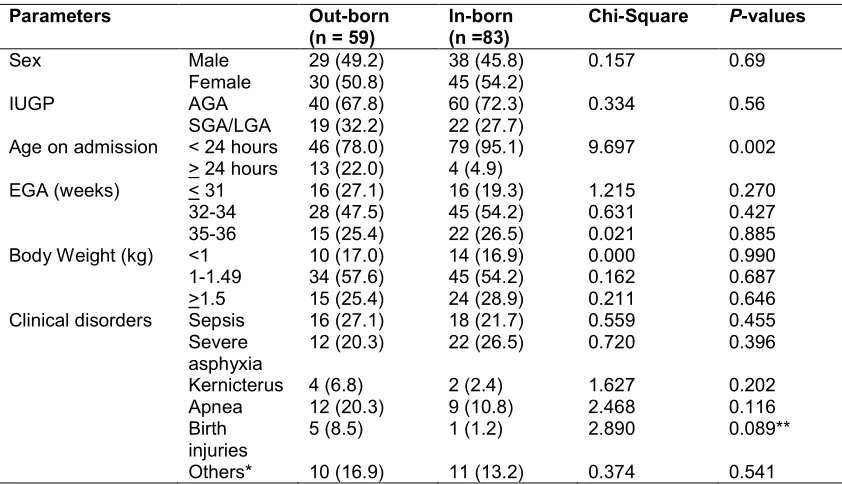
Comparison of in-born and out-born babies as depicted in Table 1 showed that most of the in-born and out-in-born babies had EGA 32-34 weeks (47.5% and 54.2% respectively) and weighed between 1.0kg and 1.49kg (57.6% and 54.2% respectively). Sepsis and severe asphyxia were the leading morbidities among both groups of babies (47.4% for out-born and 48.2% for in-born babies). The in-born and out-born babies were comparable in terms of intra-uterine growth pattern, EGA and body weight. Similarly, higher proportions of out-born babies had sepsis, kernicterus, apnea and birth injuries but without statistical significance. Severe asphyxia was more frequent among in-born babies but without statistical significance.
The duration of admission ranged from 4 hours to 504 hours with a mean of 104.4 ± 87.1 hours. The mean duration of admission was significantly shorter among out-born babies compared to in-born babies (70.3 ± 53.6 hours Vs 128.6 ± 97.8 hours; t = 4.15, p < 0.0001). Table 2 shows that 36.1% of in-born babies and 71.2% of out-born babies died within 72 hours of admission. In addition, a significantly higher proportions of out-born babies died within 24 hours and between 25 hours and 72 hours of admission (p = 0.022 and 0.01 respectively) whereas a significantly higher proportion of in-born babies died between 73 hours and 168 hours on admission (p = 0.002). A higher proportion of in-born babies died after 168 hours on admission but without statistical significance (p = 0.117).
In Table 3, a significantly higher proportion of babies who died within 24 hours were out-born (p < 0.0001) and less than 32 weeks of gestation (p = 0.025) while a significantly higher proportion of babies who died after 24 hours were appropriate for gestational age (p = 0.022). Babies who died within 24 hours and after 24 hours were comparable in terms of sex, age on admission, body weight and occurrence of severe asphyxia and sepsis.
Table 1. Comparison of the demographic and clinical parameters of the preterm babies distributed according to the places of birth
Parameters Out-born (n = 59)
In-born (n =83)
Chi-Square P-values
Sex Male 29 (49.2) 38 (45.8) 0.157 0.69
Female 30 (50.8) 45 (54.2)
IUGP AGA 40 (67.8) 60 (72.3) 0.334 0.56
SGA/LGA 19 (32.2) 22 (27.7)
Age on admission < 24 hours 46 (78.0) 79 (95.1) 9.697 0.002
> 24 hours 13 (22.0) 4 (4.9)
EGA (weeks) < 31 16 (27.1) 16 (19.3) 1.215 0.270
32-34 28 (47.5) 45 (54.2) 0.631 0.427
35-36 15 (25.4) 22 (26.5) 0.021 0.885
Body Weight (kg) <1 10 (17.0) 14 (16.9) 0.000 0.990
1-1.49 34 (57.6) 45 (54.2) 0.162 0.687
>1.5 15 (25.4) 24 (28.9) 0.211 0.646
Clinical disorders Sepsis 16 (27.1) 18 (21.7) 0.559 0.455
Severe asphyxia
12 (20.3) 22 (26.5) 0.720 0.396
Kernicterus 4 (6.8) 2 (2.4) 1.627 0.202
Apnea 12 (20.3) 9 (10.8) 2.468 0.116
Birth injuries
5 (8.5) 1 (1.2) 2.890 0.089**
Others* 10 (16.9) 11 (13.2) 0.374 0.541
*Others – Congenital malformations, Congenital pneumonia, Aspiration pneumonitis, Congenital Heart Diseases; Meningitis, Respiratory Distress Syndrome; Figures in parentheses are percentages of the total in each column
**Chi-Square Test with Yate’s Correction
Table 2. Relationship between places of birth and duration of admission
Duration (hours) In-born (n = 83) Out-born (n = 59) Chi-square P-values
<24 8 (9.6) 14 (23.7) 5.229 0.022
25-72 22 (26.6) 28 (47.5) 6.636 0.01
73-168 39 (46.9) 13 (22.0) 9.252 0.002
>168 14 (16.9) 4 (6.8) 2.452 0.117*
*Yate’s Correction applied. Figures in parentheses are percentages of the total in each column
4. DISCUSSION
The present study carried out in a resource-poor tertiary care setting showed Case Fatality Rate of 21.9% among hospitalized preterm babies over a five-year period. These deaths among preterm babies contributed 45.6% of all neonatal deaths. The contribution of preterm babies to overall neonatal mortality appear similarly high like previous documentations from other parts of the world such as 33.6% in China, [11] 46% in two separate reports from Bangladesh, [12,13] and 69% in Cameroon. [14] All the cited contributions of preterm babies to neonatal deaths are similarly high across the poor parts of the world compared to 3.9% [15] reported in Ireland, which
is more technologically advanced. These
observations highlight the economic basis of the burden of preterm mortality as a major challenge
in the poor parts of the world where the quality of obstetric and perinatal care services are expectedly sub-optimal. The care of preterm babies, by virtue of the problem of immaturity and low weight, often require a lot of technical supports which are almost non-existent in resource-poor settings and where they are available, are expensive. This is important in view of the pattern of health financing in most parts of the developing world where health insurance schemes are existent or non-efficient where they exist and families have to make out-of-pocket payments.
The places of delivery of the babies appear to make a big difference in the pattern of mortality as a large proportion of out-born babies received at this centre over the period studied were
Table 3. Comparison of the demographic and clinical parameters of the preterm babies who died within 24 hours and after 24 hours of admission
Parameters Duration<24 hours (n = 22)
Duration>24 hours (n = 120)
Chi-Square P-values
Sex Male 12 (54.5) 55 (45.8) 0.566 0.452
Female 10 (45.5) 65 (54.2)
Place of birth Out-born 14 (63.6) 45 (37.5) 19.873 <0.0001
In-born 8 (36.4) 75 (62.5)
IUGP AGA 11 (50.0) 89 (74.2) 5.213 0.022
SGA/LGA 11 (50.0) 31 (25.8)
Age on admission < 24 hours 20 (90.9) 105 (87.5) 0.205 0.651
> 24 hours 2 (9.1) 15 (12.5)
EGA (weeks) <32 8 (36.4) 24 (20.0) 5.035 0.025
>32 14 (63.6) 96 (80.0)
Body Weight (kg) <1.5 16 (72.7) 87 (72.5) 0.000 0.982
>1.5 6 (27.3) 33 (27.5)
Severe asphyxia Present 8 (36.4) 26 (21.7) 2.205 0.138
Absent 14 (63.6) 94 (78.3)
Sepsis Present 4 (18.2) 30 (25.0) 0.475 0.491
Absent 18 (81.8) 90 (75.0)
IUGP – Intra-Uterine Growth Pattern; EGA – Estimated Gestational Age. Figures in parentheses are percentages of the total in each column
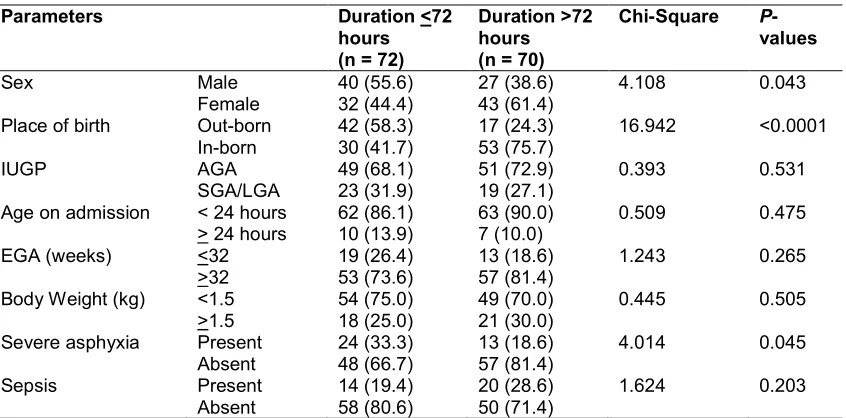
Table 4. Comparison of the demographic and clinical parameters of the preterm babies who died within 72 hours and after 72 hours of admission
Parameters Duration <72 hours (n = 72)
Duration >72 hours (n = 70)
Chi-Square P -values
Sex Male 40 (55.6) 27 (38.6) 4.108 0.043
Female 32 (44.4) 43 (61.4)
Place of birth Out-born 42 (58.3) 17 (24.3) 16.942 <0.0001
In-born 30 (41.7) 53 (75.7)
IUGP AGA 49 (68.1) 51 (72.9) 0.393 0.531
SGA/LGA 23 (31.9) 19 (27.1)
Age on admission < 24 hours 62 (86.1) 63 (90.0) 0.509 0.475
> 24 hours 10 (13.9) 7 (10.0)
EGA (weeks) <32 19 (26.4) 13 (18.6) 1.243 0.265
>32 53 (73.6) 57 (81.4)
Body Weight (kg) <1.5 54 (75.0) 49 (70.0) 0.445 0.505
>1.5 18 (25.0) 21 (30.0)
Severe asphyxia Present 24 (33.3) 13 (18.6) 4.014 0.045
Absent 48 (66.7) 57 (81.4)
Sepsis Present 14 (19.4) 20 (28.6) 1.624 0.203
Absent 58 (80.6) 50 (71.4)
IUGP – Intra-Uterine Growth Pattern; EGA – Estimated Gestational Age. Figures in parentheses are percentages of the total in each column
This may be related to the known fact that most babies in Nigeria, like other Low and Middle Income Countries (LMICs), are delivered outside the hospital. In the present study, 41.5% of the babies were referred to our hospital in agreement with previous reports from the same centre where out-born babies contributed between 61% and 85.7% of all neonatal admissions [7]. This
burden of morbidities among referred babies may be reduced using common community-based interventions prior to arrival in the referral hospital. These interventions have been reported to reduce preterm mortality by as much as 58% [16]. Such interventions include oil skin massage
and Kangaroo Mother Care (Skin-to-Skin
addition to prevention of sepsis. Therefore, it is attractive to recommend the inclusion of these practices in the referral process of newborn infants, particularly preterm babies.
In the present study, the proportion of out-born babies who died within twenty-four hours of admission was more than double the proportion of in-born babies who died within the same time frame and this disparity extended till the 72nd hour of admission. This implies that more in-born babies survived beyond 72 hours of admission compared to out-born babies. This earlier demise of out-born babies may be a reflection of the degree of organ damage they must have suffered prior to or during the referral to our hospital hence they are expected to be generally sicker compared to in-born babies. Delivery outside the hospital carries, in addition to the complication of prematurity, the risk of asphyxia and encephalopathy since such deliveries are poorly supervised or unsupervised as earlier highlighted [17]. Studies have shown that the need for high intensity resuscitation in the delivery room is associated with overall mortality, prolonged duration of hospitalization, occurrence of respiratory distress and sepsis [18,19]. This implies that when high-risk babies are delivered outside the hospital without skilled supervision, the risk of mortality may be exaggerated by their
compromised state since high intensity
resuscitation may not even be available at such moments. In the present study, severe asphyxia was recorded among a higher proportion of babies who died within 24 hours but without statistical significance but this attained statistical significance at the level of 72 hours or less. The implication of this observation is the higher likelihood of death within 72 hours of admission when preterm babies suffer severe asphyxia. Therefore, the management of preterm babies should be targeted at reducing the effect of
asphyxial brain damage. The current
recommendations of the World Health
Organisation on the use of neuro-protective agent such as magnesium sulphate may be useful in reducing the risk of brain damage among preterm babies. [1] The use of magnesium sulphate may be incorporated into the routine care of preterm babies in the LMICs barring the problem of late presentation in the hospital. Facilities which indulge in newborn
delivery within the community need to be trained on the need for early referral of preterm
babies or the use of magnesium sulphate within the first 24 hours of life when early referral is impossible.
5. CONCLUSION
In conclusion, this study showed that about one out of every five preterm babies died within 72 hours of admission, especially when they were delivered outside the hospital and suffered severe asphyxia. Specific interventions are required to facilitate the access of families to health facilities equipped to manage such high risk babies. This may include the use of cost-effective interventions such as the skin-to-skin contact as well as the introduction of neuro-protective therapies into the routine care of preterm babies as recommended by the WHO. The retrospective design of this study is acknowledged as a limitation. However, the study has highlighted the need to further examine the demographic and clinical factors associated with mortality among preterm babies in resource-constrained settings in relation to the duration of admission when death occur in order to design appropriate effective interventions.
CONSENT
It is not applicable.
ETHICAL APPROVAL
It is not applicable.
ACKNOWLEDGEMENT
Mrs R.O. Omotayo of the Health Information Management unit of the OOUTH, Sagamu, Nigeria is appreciated for assistance with data collection.
COMPETING INTERESTS
Authors have declared that no competing interests exist.
REFERENCES
1. World Health Organization. Prematurity. Available:www.who.int/mediacentre/factsh eets/fs363/en/
(Updated November 2017 and accessed on 12th March 2018)
2. Ogunlesi TA. Factors influencing the survival of newborn babies weighing less than 1.5kg in Sagamu, Nigeria. Arch Gynecol Obstet 2011;284:1351-1357.
3. World Health Organization. Neonatal
mortality; 2011.
Available:www.who.int/gho/child_health/m ortality/neonatal/en
4. Cupen K, Barran A, Singh V, Dialsingh I. Risk factors associated with preterm neonatal mortality: A case study using data from Mt. Hope Women’s Hospital in Trinidad and Tobago. Children (Basel). 2017;4(12):108.
5. Ashish KC, Johan W, Nelin V, Ewald U, Clark R, Malqvist M. Level of mortality risk for babies born preterm or with a small weight for gestation in a tertiary hospital of Nepal. BMC Public Health. 2015;15:877.
6. UNICEF, WHO, World Bank, UN-DESA
Population Division. Levels and trends in child mortality; 2015.
Available:www.who.int/maternal_child_ado lescents/documents/levels_trends_child-mortality_2015/en/
7. Ogunlesi TA, Ogunfowora OB, Adekanmbi AF, Fetuga MB, Runsewe-Abiodun IT, Ogundeyi MM. Neonatal mortality at Olabisi Onabanjo University Teaching Hospital, Sagamu. Niger J Paediatr. 2006; 33:40-46.
8. Ayeni VA, Oladipo AO, Ogunlesi TA,
Olowu AO, Ogunfowora OB, Fetuga MB, Adekanmbi AF, Olanrewaju DM. Childhood morbidity and mortality at the Olabisi Onabanjo University Teaching Hospital, Sagamu: Has anything changed? Int J Multidisc Res. 2012;5(1&2):15-20.
9. Ballard JL, Khoury JC, Wednig K, et al. New Ballard Score, expanded to include extremely premature infants. J Pediatr 1991;119:417.
10. Battaglia F, Lubchencho L. A practical
classification of newborn infants by weight and gestational age. J Pediatr.
1967;7:159.
11. Wang XL, Wang J, Yuan L, Shi WJ, Cao Y, Chen C. Trend and causes of neonatal mortality in a level III Children’s Hospital in Shanghai: A 15-year retrospective study. World J Pediatr; 2018.
DOI: 10.1007/s12519-017-0101-y
12. Baqul AH, Rosen HE, Lee AC, Applegate JA< El Arifeen S, Rahman SM et al. Preterm births and neonatal mortality in a rural Bangladeshi cohort; implications for health programmes. J Perinatol. 2013; 33(2):977-81.
13. Shah R, Mullany LC, Darmstadt GL,
Talukder RR, Rahmna SM, Mannan I, et al. Neonatal mortality risks among preterm births in a rural Bangladeshi cohort. Paediatr Perinat Epidemiol. 2014;28(6): 510-520.
14. Ndombo PK, Ekei QM, Tochie JN,
Temguoa MN, Angong FTE, Ntock FN. A cohort analysis of neonatal hospital ortality rate and predictors of neonatal mortality in a sub-urban hospital of Cameroon. Italian J Pediatr. 2017;43(1):52.
15. Lutomski J, Dempsey E, Molloy E. An epidemiological study of factors associated with preterm infant in-hospital mortality. Ir Med J. 2013;106(1):9-12.
16. Bhutta Z, Das JK, Bahl R, Lawn JE, Salam RA, Paul VK, et al. Can available interventions and preventable deaths in mothers, newborn babies and stillbirths and at what cost? The Lancet. 2014; 384(9940):347-370.
17. Ogunfowora OB, Ogunlesi TA, Fetuga MB,
Oyinlade AO. Clinical manifestations and outcome of hospitalized babies with birth asphyxia in Sagamu. Niger J Paediatr. 2009;35:12–18.
18. Bajaj M, Natarajan G, Shankaran S, Wyckoff M, Laptook AR, Bell EF, Stoll BJ et al. Delivery room resuscitation and short-term outcome in moderately preterm infants. J Pediatr; 2018.
DOI: 10.1016/j.jpeds.2017.11.039
19. Jiang S, Lyu Y, Yex Y, Monterossa L, Shah PS, Lee SK. Intensity of delivery room resuscitation and neonatal outcomes in infants born at 33-36 weeks gestation. J Perinatol. 2016;36(2):100-105.
_________________________________________________________________________________ © 2018 Ogunlesi and Ayeni; This is an Open Access article distributed under the terms of the Creative Commons Attribution License (http://creativecommons.org/licenses/by/4.0); which permits unrestricted use; distribution; and reproduction in any medium; provided the original work is properly cited.
Peer-review history: