Heavy baryon spectroscopy
Rudolf N.Faustov1and Vladimir O.Galkin1
1Institute of Cybernetics and Informatics in Education, FRC CSC RAS, Moscow, Russia
Abstract. Masses of heavy baryons are calculated in the relativistic quark-diquark picture. Obtained results are in good agreement with available experi-mental data including recent measurements by the LHCb Collaboration. Possi-ble quantum numbers of excited heavy baryon states are discussed.
1 Introduction
Recently significant experimental progress has been achieved in studying heavy baryon spec-troscopy. Many new heavy baryon states have been observed. The main contribution was made by the LHCb Collaboration. Thus last year the amplitude analysis of the decay
Λ0
b→D
0pπ−was performed in the region of the phase space containingD0presonant
contri-butions which revealed threeΛcexcited states and allowed to measure precisely their masses
and decay widths [1]: theΛc(2880)+with the preferred spinJ=5/2; the new stateΛc(2860)+
with quantum numbersJP =3/2+, its parity was measured relative to that of theΛc(2880)+;
theΛc(2940)+with the most likely spin-parity assignmentJP=3/2−but other solutions with
spins from 1/2 to 7/2 were not excluded. Then five new, narrow excitedΩcstates decaying to
Ξ+
cK−were observed [2]: theΩc(3000)0,Ωc(3050)0,Ωc(3066)0,Ωc(3090)0, andΩc(3119)0.
These states were later confirmed by Belle [3]. Soon the discovery of the long-awaited doubly charmed baryonΞ++cc was reported [4]. This year the newΞb(6227)−resonance was observed
as a peak in both theΛ0
bK
−andΞ0
bπ
−invariant mass spectra [5]. Finally, the first observation
of two structuresΣ(6097)±consistent with resonances in the final statesΛ0
bπ
−andΛ0
bπ+was
reported by the LHCb [6].
In this talk we compare these new data with the predictions of the relativistic quark-diquark model of heavy baryons [7–9].
2 Relativistic quark-diquark model of heavy baryons
Our approach is based on the relativistic quark-diquark picture and the quasipotential equa-tion. The interaction of two quarks in a diquark and the quark-diquark interaction in a baryon are described by the diquark wave functionΨd of the bound quark-quark state and by the
baryon wave functionΨB of the bound quark-diquark state respectively. These wave
func-tions satisfy the relativistic quasipotential equation of the Schrödinger type [7]
b2(M) 2µR
− p
2
2µR
!
Ψd,B(p)=
Z d3q
whereµR is the relativistic reduced mass,b2(M) is the center-of-mass relative momentum
squared on the mass shell,p,qare the off-mass-shell relative momenta, andMis the bound state mass (diquark or baryon).
The kernelV(p,q;M) in Eq. (1) is the quasipotential operator of the quark or quark-diquark interaction which is constructed with the help of the off-mass-shell scattering ampli-tude, projected onto the positive energy states. We assume that the effective interaction is the sum of the usual one-gluon exchange term and the mixture of long-range vector and scalar linear confining potentials, where the vector confining potential contains the Pauli term. The vertex of the diquark-gluon interaction takes into account the diquark internal structure and effectively smears the Coulomb-like interaction. The corresponding form factor is expressed as an overlap integral of the diquark wave functions. Explicit expressions for the quasipo-tentials of the quark-quark interaction in a diquark and quark-diquark interaction in a baryon can be found in [8]. All parameters of the model were fixed previously from considerations of meson properties and are kept fixed in the baryon spectrum calculations.
The quark-diquark picture of heavy baryons reduces a very complicated relativistic three-body problem to a significantly more simpler two step two-three-body calculation. First we deter-mine the properties of diquarks. We consider a diquark to be a composite (qq0) system. Thus
diquark in our approach is not a point-like object. Its interaction with gluons is smeared by the form factor expressed through the overlap integral of diquark wave functions. These form factors enter the diquark-gluon interaction and effectively take diquark structure into account [8,9]. Note that the ground state diquark composed from quarks with different flavours can be both in scalar and axial vector state, while the ground state diquarks composed from quarks of the same flavour can be only in the axial vector state due to the Pauli principle. Solv-ing the quasipotential equation numerically we calculate the masses, determine the diquark wave functions and use them for evaluation of the diquark form factors. Only ground-state scalar and axial vector diquarks are considered for heavy baryons. While both qround-state as well as orbital and radial excitations of heavy diquarks are necessary for doubly heavy baryons, since the lowest excitations of such baryons originate from the excitations of the doubly heavy diquark.
Next we calculate the masses of heavy baryons in the quark–diquark picture [8,9]. The heavy baryon is considered as a bound state of a heavy-quark and light-diquark. All excita-tions are assumed to occur between heavy quark and light diquark. On the other hand, the doubly heavy baryon is considered as a bound state of a light-quark and heavy-diquark. Both excitations in the quark-diquark system and excitations of the heavy diquark are taken into account. It is important to note that such approach predicts significantly less excited states of baryons compared to a genuine three-quark picture. We do not expand the potential of the quark–diquark interaction either inp/mq,Qor inp/mdand treat both diquark and quark fully
relativistically.
3 Heavy baryons
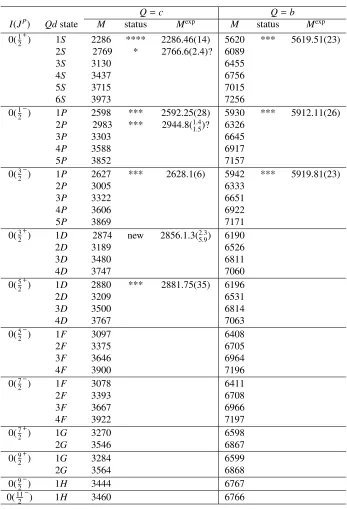
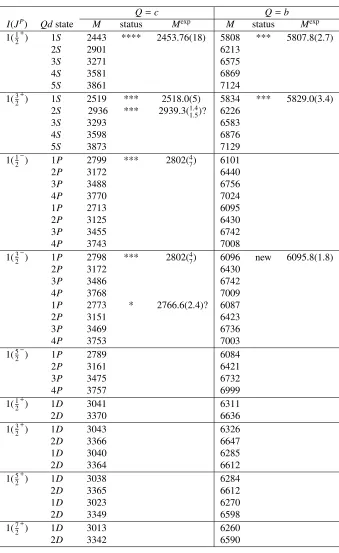
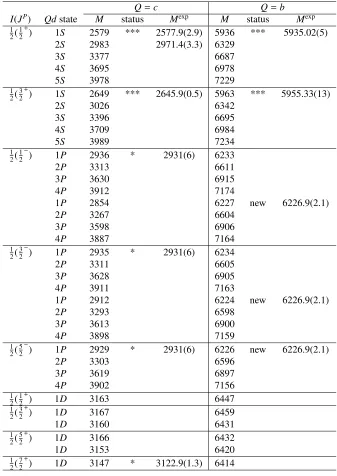
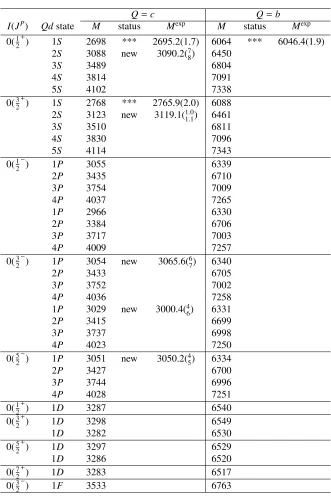
The calculated masses of heavy baryons are given in Tabs.1-5. In the first column we show the baryon total isospinI, spinJand parity P. The second column lists the quark-diquark state. The next three columns refer to the charm and the last there columns to the bottom baryons. There we first give our prediction for the mass, then available experimental data [10]: baryon status and measured mass. The charm and bottom baryon states recently dis-covered by the LHCb Collaboration [1,2,4–6] are marked as new.
From Tabs.1,2we see that theΛc(2765) (orΣc(2765)), if it is indeed theΛcstate, can
be interpreted in our model as the first radial (2S) excitation of theΛc. If instead it is theΣc
Table 1. Masses of theΛQ(Q=c,b) heavy baryons (in MeV)
Q=c Q=b
I(JP) Qdstate M status Mexp M status Mexp
0(12+) 1S 2286 **** 2286.46(14) 5620 *** 5619.51(23)
2S 2769 * 2766.6(2.4)? 6089
3S 3130 6455
4S 3437 6756
5S 3715 7015
6S 3973 7256
0(12−) 1P 2598 *** 2592.25(28) 5930 *** 5912.11(26) 2P 2983 *** 2944.8(1.41.5)? 6326
3P 3303 6645
4P 3588 6917
5P 3852 7157
0(3 2
−
) 1P 2627 *** 2628.1(6) 5942 *** 5919.81(23)
2P 3005 6333
3P 3322 6651
4P 3606 6922
5P 3869 7171
0(32+) 1D 2874 new 2856.1.3(2.35.9) 6190
2D 3189 6526
3D 3480 6811
4D 3747 7060
0(52+) 1D 2880 *** 2881.75(35) 6196
2D 3209 6531
3D 3500 6814
4D 3767 7063
0(52−) 1F 3097 6408
2F 3375 6705
3F 3646 6964
4F 3900 7196
0(72−) 1F 3078 6411
2F 3393 6708
3F 3667 6966
4F 3922 7197
0(72+) 1G 3270 6598
2G 3546 6867
0(92+) 1G 3284 6599
2G 3564 6868
0(92−) 1H 3444 6767
Table 2.Masses of theΣQ(Q=c,b) heavy baryons (in MeV)
Q=c Q=b
I(JP) Qdstate M status Mexp M status Mexp
1(12+) 1S 2443 **** 2453.76(18) 5808 *** 5807.8(2.7)
2S 2901 6213
3S 3271 6575
4S 3581 6869
5S 3861 7124
1(32+) 1S 2519 *** 2518.0(5) 5834 *** 5829.0(3.4)
2S 2936 *** 2939.3(1.41.5)? 6226
3S 3293 6583
4S 3598 6876
5S 3873 7129
1(1 2
−
) 1P 2799 *** 2802(4
7) 6101
2P 3172 6440
3P 3488 6756
4P 3770 7024
1P 2713 6095
2P 3125 6430
3P 3455 6742
4P 3743 7008
1(32−) 1P 2798 *** 2802(4
7) 6096 new 6095.8(1.8)
2P 3172 6430
3P 3486 6742
4P 3768 7009
1P 2773 * 2766.6(2.4)? 6087
2P 3151 6423
3P 3469 6736
4P 3753 7003
1(52−) 1P 2789 6084
2P 3161 6421
3P 3475 6732
4P 3757 6999
1(12+) 1D 3041 6311
2D 3370 6636
1(32+) 1D 3043 6326
2D 3366 6647
1D 3040 6285
2D 3364 6612
1(52+) 1D 3038 6284
2D 3365 6612
1D 3023 6270
2D 3349 6598
1(72+) 1D 3013 6260
Table 3. Masses of theΞQ(Q=c,b) heavy baryons with the scalar diquark (in MeV)
Q=c Q=b
I(JP) Qdstate M status Mexp M status Mexp
1 2(
1 2 +
) 1S 2476 *** 2470.88(3480) 5803 *** 5790.5(2.7)
2S 2959 6266
3S 3323 6601
4S 3632 6913
5S 3909 7165
1 2(
1 2
−
) 1P 2792 *** 2792.8(1.2) 6120
2P 3179 6496
3P 3500 6805
4P 3785 7068
5P 4048 7302
1 2(
3 2
−
) 1P 2819 *** 2820.22(32) 6130
2P 3201 6502
3P 3519 6810
4P 3804 7073
5P 4066 7306
1 2(
3 2
+) 1D 3059 *** 3055.9(0.4) 6366
2D 3388 6690
3D 3678 6966
4D 3945 7208
1 2(
5 2 +
) 1D 3076 * 3079.9(1.4) 6373
2D 3407 6696
3D 3699 6970
4D 3965 7212
Λc(2880) baryon corresponds to the second orbital excitation (2D) withJ = 52+in accord
with the LHCb analysis [1]. The other charmed baryon, denoted asΛc(2940), probably has
I =0, since it was discovered in thepD0mass spectrum and not observed in pD+channel, butI =1 is not ruled out [10]. If it is really theΛcstate, then it could be both an orbitally
and radially excited (2P) state withJ = 12−, whose mass is predicted to be about 40 MeV heavier. A better agreement with experiment (within few MeV) is achieved, if theΛc(2940)
is interpreted as the first radial excitation (2S) of theΣcwithJ = 32+. TheΣc(2800) can be
identified with one of the first orbital (1P) excitations of theΣcwithJ = 12
−
or 3 2
−
which have very close masses compatible with experimental value within errors (see Tab.2). The new stateΛc(2860) with quantum numbers 32
+[1] can be well interpreted as second orbital
excitation (2Dstate). In the bottom sector theΛb(5912) andΛb(5920) correspond to the first
orbitally excited (1P) states with 12−and 32−, respectively. The newΣb(6097) state [6] can be
the first orbital excitation (1P) with quantum numbers32−.
In the ΞQ baryon sector as we see from Tabs.3,4 the Ξc(2790) and Ξc(2815) can be
assigned to the first orbital (1P) excitations of theΞccontaining a scalar diquark withJ=12
−
andJ= 32−, respectively. On the other hand, the charmed baryonΞc(2930) can be considered
as either the J = 12−, J = 32− or J = 52−state (all these states are predicted to have close masses) corresponding to the first orbital (1P) excitations of the Ξ0
c with an axial vector
Table 4. Masses of theΞQ(Q=c,b) heavy baryons with the axial vector diquark (in MeV)
Q=c Q=b
I(JP) Qdstate M status Mexp M status Mexp
1 2(
1 2 +
) 1S 2579 *** 2577.9(2.9) 5936 *** 5935.02(5)
2S 2983 2971.4(3.3) 6329
3S 3377 6687
4S 3695 6978
5S 3978 7229
1 2(
3 2 +
) 1S 2649 *** 2645.9(0.5) 5963 *** 5955.33(13)
2S 3026 6342
3S 3396 6695
4S 3709 6984
5S 3989 7234
1 2(
1 2
−
) 1P 2936 * 2931(6) 6233
2P 3313 6611
3P 3630 6915
4P 3912 7174
1P 2854 6227 new 6226.9(2.1)
2P 3267 6604
3P 3598 6906
4P 3887 7164
1 2(
3 2
−
) 1P 2935 * 2931(6) 6234
2P 3311 6605
3P 3628 6905
4P 3911 7163
1P 2912 6224 new 6226.9(2.1)
2P 3293 6598
3P 3613 6900
4P 3898 7159
1 2(
5 2
−
) 1P 2929 * 2931(6) 6226 new 6226.9(2.1)
2P 3303 6596
3P 3619 6897
4P 3902 7156
1 2(
1 2 +
) 1D 3163 6447
1 2(
3 2
+) 1D 3167 6459
1D 3160 6431
1 2(
5 2
+) 1D 3166 6432
1D 3153 6420
1 2(
7 2 +
) 1D 3147 * 3122.9(1.3) 6414
of theΞ0c, theΞc(3055) andΞc(3080) baryons can be interpreted as a second orbital (2D)
excitations of theΞccontaining a scalar diquark withJ = 32
+andJ= 5 2 +
, and theΞc(3123)
can be viewed as the corresponding (2D) excitation of theΞ0
cwith J =
7 2 +
. The recently observed excited bottom baryonΞb(6227)−[5] can be one of the first radially excited states
Table 5. Masses of theΩQ(Q=c,b) heavy baryons (in MeV)
Q=c Q=b
I(JP) Qdstate M status Mexp M status Mexp
0(12+) 1S 2698 *** 2695.2(1.7) 6064 *** 6046.4(1.9) 2S 3088 new 3090.2(78) 6450
3S 3489 6804
4S 3814 7091
5S 4102 7338
0(32+) 1S 2768 *** 2765.9(2.0) 6088 2S 3123 new 3119.1(1.01.1) 6461
3S 3510 6811
4S 3830 7096
5S 4114 7343
0(1 2
−
) 1P 3055 6339
2P 3435 6710
3P 3754 7009
4P 4037 7265
1P 2966 6330
2P 3384 6706
3P 3717 7003
4P 4009 7257
0(32−) 1P 3054 new 3065.6(6
7) 6340
2P 3433 6705
3P 3752 7002
4P 4036 7258
1P 3029 new 3000.4(4
6) 6331
2P 3415 6699
3P 3737 6998
4P 4023 7250
0(52−) 1P 3051 new 3050.2(4
5) 6334
2P 3427 6700
3P 3744 6996
4P 4028 7251
0(12+) 1D 3287 6540
0(32+) 1D 3298 6549
1D 3282 6530
0(5 2
+) 1D 3297 6529
1D 3286 6520
0(72+) 1D 3283 6517
0(32−) 1F 3533 6763
Masses of theΩcandΩbbaryons are given in Tab.5. The ground state (1S) masses were
predicted [7] before experimental discovery and agree well with measured values. Recently observed [2] five new, narrow excitedΩcare also in accord with our predictions. Three lighter
statesΩc(3000)0,Ωc(3050)0andΩc(3066)0are well described as first orbital (1P) excitations
Figure 1.Proposed assignment of spins and parities of excitedΩcstates observed by LHCb Collabora-tion
in the low end ofΞ+cK− mass distribution (see Fig.1) can correspond to 12− state with the predicted mass 2966 MeV (see Tab. 5). The remaining two heavier states Ωc(3090)0 and
Ωc(3119)0 are naturally described as first radial (2S) excitations with quantum numbers 12+
and 32+, respectively. Their predicted masses coincide with the measured ones within a few MeV. The proposed assignment of spins and parities of excitedΩcstates observed by LHCb
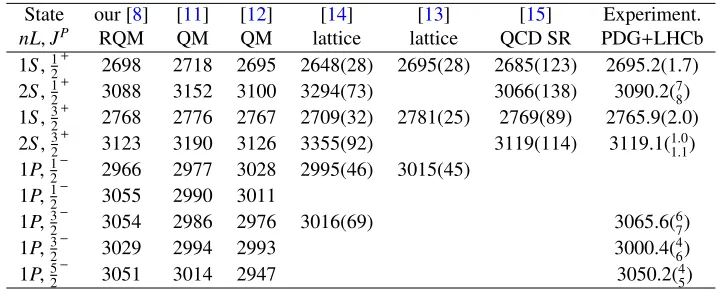
Collaboration is given in Fig.1. In Tab.6we compare different quark model (QM), QCD sum rules (QCD SR), lattice QCD predictions and available experimental data for the masses of theΩcstates.
Table 6.Comparison of theoretical predictions for the masses of theΩcstates
State our [8] [11] [12] [14] [13] [15] Experiment.
nL,JP RQM QM QM lattice lattice QCD SR PDG+LHCb
1S,12+ 2698 2718 2695 2648(28) 2695(28) 2685(123) 2695.2(1.7) 2S,12+ 3088 3152 3100 3294(73) 3066(138) 3090.2(78) 1S,32+ 2768 2776 2767 2709(32) 2781(25) 2769(89) 2765.9(2.0) 2S,32+ 3123 3190 3126 3355(92) 3119(114) 3119.1(1.01.1) 1P,1
2
−
2966 2977 3028 2995(46) 3015(45) 1P,12− 3055 2990 3011
1P,32− 3054 2986 2976 3016(69) 3065.6(67)
1P,32− 3029 2994 2993 3000.4(4
6)
1P,52− 3051 3014 2947 3050.2(4
5)
4 Doubly heavy baryons
Mass spectra of doubly heavy baryons was calculated in the light-quark–heavy-diquark pic-ture in [9]. The light quark was treated completely relativistically, while the expansion in the inverse heavy quark mass was used. Tab.7shows theΞccmass spectrum. Excitaions inside
doubly heavy diquark and light-quark–heavy-diquark bound systems are taken into account. We use the notations (ndLnql)JP, where we first show the radial quantum number of the
Table 7.Mass spectrum ofΞccbaryons (in GeV)
State Mass State Mass
(ndLnql)JP our [16] (ndLnql)JP our [16]
(1S1s)12+ 3.620 3.478 (1P1s)12− 3.838 3.702 (1S1s)32+ 3.727 3.61 (1P1s)32− 3.959 3.834 (1S1p)12− 4.053 3.927 (2S1s)12+ 3.910 3.812 (1S1p)32− 4.101 4.039 (2S1s)32+ 4.027 3.944 (1S1p)1
2
0−
4.136 4.052 (2P1s)1 2
−
4.085 3.972 (1S1p)52− 4.155 4.047 (2P1s)32− 4.197 4.104 (1S1p)320− 4.196 4.034 (3S1s)12+ 4.154 4.072
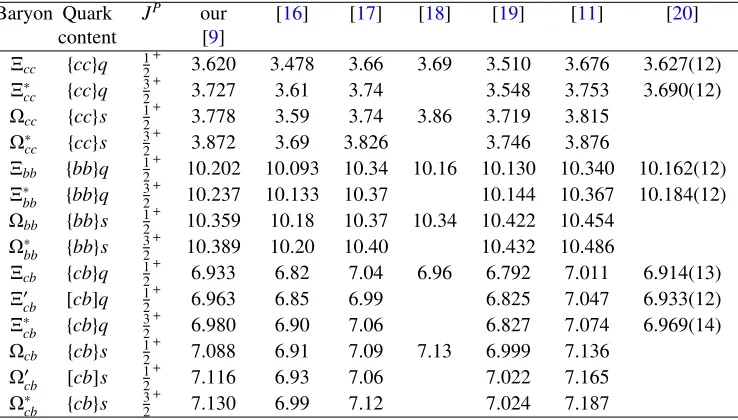
Table 8.Mass spectrum of ground states of doubly heavy baryons (in GeV).{QQ}denotes the diquark in the axial vector state and [QQ] denotes diquark in the scalar state
Baryon Quark JP our [16] [17] [18] [19] [11] [20]
content [9]
Ξcc {cc}q 12+ 3.620 3.478 3.66 3.69 3.510 3.676 3.627(12)
Ξ∗
cc {cc}q 32
+ 3.727 3.61 3.74 3.548 3.753 3.690(12)
Ωcc {cc}s 12+ 3.778 3.59 3.74 3.86 3.719 3.815
Ω∗
cc {cc}s 32 +
3.872 3.69 3.826 3.746 3.876
Ξbb {bb}q 12+ 10.202 10.093 10.34 10.16 10.130 10.340 10.162(12)
Ξ∗
bb {bb}q
3 2 +
10.237 10.133 10.37 10.144 10.367 10.184(12)
Ωbb {bb}s 12
+ 10.359 10.18 10.37 10.34 10.422 10.454
Ω∗
bb {bb}s
3 2 +
10.389 10.20 10.40 10.432 10.486
Ξcb {cb}q 12+ 6.933 6.82 7.04 6.96 6.792 7.011 6.914(13)
Ξ0
cb [cb]q
1 2 +
6.963 6.85 6.99 6.825 7.047 6.933(12)
Ξ∗
cb {cb}q
3 2 +
6.980 6.90 7.06 6.827 7.074 6.969(14)
Ωcb {cb}s 12+ 7.088 6.91 7.09 7.13 6.999 7.136
Ω0
cb [cb]s
1 2 +
7.116 6.93 7.06 7.022 7.165
Ω∗
cb {cb}s
3 2
+ 7.130 6.99 7.12 7.024 7.187
the radial quantum number of the light quark (nq =1,2,3. . .) and its orbital momentum by
a lowercase letter (l = s,p,d. . .), and at the end the total angular momentum Jand parity Pof the baryon. In Tab.8we compare different theoretical predictions for the ground state masses of the doubly heavy baryons. Our prediction (2002) for the mass of theΞccbaryon [9]
excellently agrees with its mass recently measured (2017) by the LHCb Collaboration [6]:
Mexp(Ξ++cc)=3621.40±0.72±0.27±0.14 MeV.
5 Conclusions
Recent observations of excited charm and bottom baryons confirm predictions of the rela-tivistic heavy-quark–light-diquark model of heavy baryons [7,8]. The new stateΛc(2860)
is in accord with the predicted 1D- state withJP = 3 2 +
. The experimentally preferred quan-tum numbersJP = 5
2 +
ofΛc(2880) agree with our assignment of this state to 1D- state with
JP = 5 2 +
. TheΛb(5912) andΛb(5920) are well described as the first orbitally excited (1P)
(1P) with quantum numbers32−. The recently observed excited bottom baryonΞb(6227)−can
be one of the first radially excited states (1P) of theΞ0
bbaryon with the axial vector diquark
and quantum numbers12−,32−,52−which are predicted to have very close masses. Observation of five new narrowΩcstates in the mass range 3000-3200 MeV agrees with our prediction
of orbitally excited 1P-states and radially excited 2S-states in this mass region: Ωc(3000),
Ωc(3066),Ωc(3050) can be 1P-states with JP = 32
−
,3 2
−
,5 2
−
whileΩc(3090) andΩc(3119)
states are most likely the first radially excited 2S states withJP= 12+,32+.
In the doubly heavy baryon sector, the mass of recently observedΞ++cc baryon is in
excel-lent agreement with our prediction made more than 15 years ago [9]. Masses of ground state doubly charm baryons are predicted to be in 3.5 - 3.9 GeV range. Masses of ground state doubly bottom baryons are predicted to be in 10.1 - 10.5 GeV range. Masses of ground state bottom-charm baryons are predicted to be in 6.8 - 7.2 GeV range. Rich spectra of narrow excited states below strong decay thresholds are expected. We strongly encourage experi-menters to search for new excited states of heavy baryons and especially for doubly heavy baryons.
Acknowledgments. We are grateful to I. Belyaev, D. Ebert, M. Ivanov, M. Karliner and A. Martin for valuable discussions and support. We thank the organizers of XXIV Interna-tional Baldin Seminar on High Energy Physics Problems.
References
[1] R. Aaij et al. [LHCb Collaboration], JHEP1705, 030 (2017)
[2] R. Aaij et al. [LHCb Collaboration], Phys. Rev. Lett.118(18), 182001 (2017) [3] J. Yelton et al. [Belle Collaboration], Phys. Rev. D97(5), 051102 (2018) [4] R. Aaij et al. [LHCb Collaboration], Phys. Rev. Lett.119(11), 112001 (2017) [5] R. Aaij et al. [LHCb Collaboration], Phys. Rev. Lett.121(7), 072002 (2018) [6] R. Aaij et al. [LHCb Collaboration], arXiv:1809.07752 [hep-ex]
[7] D. Ebert, R. N. Faustov and V. O. Galkin, Phys. Rev. D72, 034026 (2005). Phys. Lett. B 659, 612 (2008)
[8] D. Ebert, R. N. Faustov and V. O. Galkin, Phys. Rev. D84, 014025 (2011)
[9] D. Ebert, R. N. Faustov, V. O. Galkin and A. P. Martynenko, Phys. Rev. D66, 014008 (2002)
[10] M. Tanabashi et al. [Particle Data Group], Phys. Rev. D98(3), 030001 (2018) [11] W. Roberts and M. Pervin, Int. J. Mod. Phys. A23, 2817 (2008)
[12] Z. Shah, K. Thakkar, A. K. Rai and P. C. Vinodkumar, Chin. Phys. C40(12), 123102 (2016)
[13] Y. C. Chen et al. [TWQCD Collaboration], Phys. Lett. B767, 193 (2017) [14] P. Pérez-Rubio, S. Collins and G. S. Bali, Phys. Rev. D92(3), 034504 (2015) [15] S. S. Agaev, K. Azizi and H. Sundu, Eur. Phys. J. C77(6), 395 (2017)
[16] S. S. Gershtein, V. V. Kiselev, A. K. Likhoded and A. I. Onishchenko, Phys. Rev. D62, 054021 (2000)
[17] R. Roncaglia, D. B. Lichtenberg and E. Predazzi, Phys. Rev. D52, 1722 (1995) [18] I. M. Narodetskii and M. A. Trusov, Phys. Atom. Nucl.65, 917 (2002) [Yad. Fiz.65,
949 (2002)]
[19] A. P. Martynenko, Phys. Lett. B663, 317 (2008)