Predictive validity of the N2 and P3 ERP components to
executive functioning in children: a latent-variable analysis
Christopher R. Brydges1
*, Allison M. Fox1
, Corinne L. Reid1,2
and Mike Anderson1,2
1Neurocognitive Development Unit, School of Psychology, The University of Western Australia, Perth, WA, Australia 2School of Psychology and Exercise Science, Murdoch University, Perth, WA, Australia
Edited by:
John J. Foxe, Albert Einstein College of Medicine, USA
Reviewed by:
Steven Woltering, University of Toronto, Canada
Eric Drollette, University of Illinois Urbana-Champaign, USA Nicola Grossheinrich, University Hospital of the RWTH Aachen, Germany
*Correspondence: Christopher R. Brydges, Neurocognitive Development Unit, M304 School of Psychology, The University of Western Australia, 35 Stirling Hwy, Crawley, WA 6009, Australia
e-mail: christopher.brydges@ uwa.edu.au
Executive functions (EFs) are commonly theorized to be related yet separable constructs in adults, and specific EFs, such as prepotent response inhibition and working memory, are thought to have clear and distinct neural underpinnings. However, recent evidence suggests that EFs are unitary in children up to about 9 years of age. The aim of the current study was to test the hypothesis that peaks of the event-related potential (ERP) of specific EFs are related to behavioral performance, despite EFs being psychometrically indistinguishable in children. Specifically, N2 difference waveform (associated with cognitive control and response inhibition) and P3b peak (associated with updating of working memory) latent variables were created and entered into confirmatory factor analysis and structural equation models with a unitary executive functioning factor. Children aged 7–9 years (N =215) completed eight measures of inhibition, working memory, and shifting. A modified flanker task was also completed during which EEG data were recorded. The N2 difference waveform and P3b mean amplitude factors both significantly correlated with (and were predictors of) the executive functioning factor, but the P3b latency factor did not. These results provide evidence of the electrophysiological indices of EFs being observable before the associated behavioral constructs are distinguishable from each other. From this, it is possible that ERPs could be used as a sensitive measure of development in the context of evaluation for neuropsychological interventions.
Keywords: executive functions, children, working memory, inhibition, cognitive control, ERP, N2, P3
INTRODUCTION
Executive functions are higher-order cognitive functions that are associated with goal-directed behavior (Miller and Cohen, 2001). The development of executive functions throughout child-hood is of critical importance, as these functions are associated with academic achievement in children (St Clair-Thompson and Gathercole, 2006) and successful living (Garavan et al., 1999). Previous research has found electrophysiological correlates of specific executive functions in both adults and children (Polich et al., 1990; Van Veen and Carter, 2002; Walhovd and Fjell, 2002; Cragg et al., 2009; Krug and Carter, 2012), providing evidence of distinct neural substrates of these processes. However, these studies have not taken differences in the structure of executive functions between adults and children into account (Miyake et al., 2000; Lehto et al., 2003; Brydges et al., 2012b). Executive func-tions in adults are generally considered to be related yet separable constructs (Miyake et al., 2000); however, recent psychometric evidence suggests that the latent traits of inhibition, working memory, and shifting are indistinguishable from each other in typically developing children up to at least the age of 9 years (Brydges et al., 2012b). Given this, the current study aims to determine how these distinct components in the event-related potential (ERP) are related to aspects of executive functioning when incompletely developed in children.
One widely accepted model of executive functions was ini-tially proposed byMiyake et al. (2000), who used confirmatory factor analysis (CFA) on multiple measures of three commonly postulated executive functions (prepotent response inhibition, updating of working memory, and task switching). The use of CFA in this context is advantageous because measures of executive functions all have some degree of task impurity (Rabbitt, 1997). Non-executive processes (such as motor control) are a necessary part of any task that is designed to measure executive function-ing. CFA alleviates this problem by using several measures of each executive function and extracting the common variance between these measures, to create a “pure” latent variable, or factor, which can then be correlated with other factors. The resultant model reported by Miyake et al. provided evidence these three constructs were found to be related yet are distinct from one another, as evidenced by moderately strong correlations between each factor, ranging fromr=0.42 tor=0.63.
functions in young children, and reported a single factor was the best fit for the data at both 4 and 6 years of age. Additionally, Brydges et al. tested a group of 7-year-old and a group of 9-year-old children, and found that the structure of executive functions was invariant between groups, despite improved performance with age. However, as children develop past the age of 9 years, these executive functions are thought to become increasingly sep-arable.Lehto et al. (2003) reported three related yet separable executive functions in children aged 8–13 years (mean age of 10.5 years). Furthermore,Wu et al. (2011)andDuan et al. (2010)also both reported unity and diversity of executive functions in older children (mean ages of 10.9 years and 11.8 years respectively). Hence, it is possible that executive functions develop globally until about 9 years of age, before differentiation occurs in mid to late childhood. It should be noted, however, that the age at which executive functions are distinguishable is subject to some varia-tion, possibly due to the nature of the tasks used in each study (Van Der Sluis et al., 2007).
To further knowledge regarding the links between brain and behavior, previous research in both adults and children has attempted to examine the relationship between specific neu-ral processes associated with executive functions and behav-ioral performance on psychometric measures of these functions (Rushworth et al., 2002; Van Veen and Carter, 2002; Polich, 2007; Krug and Carter, 2012). Two components of direct relevance to the model of executive functions described above are the N2 and P3b peaks of the ERP.
The N2 peak is a fronto-central maximal negativity observed approximately 150–400 ms after stimulus onset (although often later in children), and has been repeatedly associated with the detection of response conflict in both children and adults (Jodo and Kayama, 1992; Van Veen and Carter, 2002; Cragg et al., 2009). Jodo and Kayama used an electroencephalogram to record elec-trophysiological activity in young adults during a Go/Nogo task, and reported larger N2 amplitudes were associated with fewer errors on Nogo trials. Cragg et al. reported a significantly larger N2 amplitude on Nogo trials than on go trials in typically devel-oping children aged 7–9 years, providing further evidence of the N2 being an electrophysiological correlate of response conflict and inhibition.
The P3b peak is a positivity seen at central and parietal scalp sites approximately 300–500 ms after stimulus onset (again, often observed later in children), and has been associated with updat-ing of workupdat-ing memory (Donchin and Coles, 1988; Polich, 2007). Walhovd and Fjell (2002) found positive associations between P3b amplitude, latency (both obtained during an auditory odd-ball task at central midline scalp sites) and performance on a digit span task in a sample of adults aged 21–94 years. These relation-ships were also observed in a sample of children and young adults aged 4–20 years (Polich et al., 1990), further highlighting a link between the P3b and working memory.
The central issue of the current study is that the ERP correlates of executive functions are observable in mid- to late-childhood (Polich et al., 1990; Cragg et al., 2009); however, psychomet-ric research suggests that the latent traits of these functions are not distinguishable from each other during this developmental period (Hughes et al., 2009; Brydges et al., 2012b). From this, it is possible that ERP components develop before specific executive
abilities. If associations between ERP components and executive functioning exist, ERPs could potentially be used as a more sensi-tive measure of neuropsychological development than traditional psychometric measures.
To the authors’ knowledge, no previous study has attempted to examine associations between ERPs and executive functions using structural equation modeling (SEM). The current study aimed to determine (a) if there is a correlational association between brain and behavioral measures of executive functions; and (b) if the electrophysiological activity predicts behavioral performance. Hence, it was predicted that both ERP latent variables would sig-nificantly correlate with an executive function latent variable in a CFA, and both be significant predictors of the executive function latent variable in a structural equation model.
MATERIALS AND METHODS
The data used in the current study merges two previously pub-lished datasets. The behavioral data have previously been reported inBrydges et al. (2012b), where full descriptions of the partici-pants, procedures, and eight executive functioning measures are provided. ERP data from the Flanker task (described below) of a subset of approximately 120 of these children have also been pre-viously reported by Richardson et al., (unpublished manuscript, The University of Western Australia). Approval for the study was provided by the Human Research Ethics Office of The University of Western Australia. Parents/guardians of the child participants provided written informed consent.
PARTICIPANTS
Participants were 215 typically developing children aged 7 years 1 month to 9 years 11 months (110 males and 105 females,
M=8 years 4 months, SD=1 year 1 month). These chil-dren were recruited through Project K.I.D.S. (Kids’ Intellectual Development Study) at the Neurocognitive Development Unit of the School of Psychology of the University of Western Australia. Advertisements were placed in newsletters of local schools, and interested parents/guardians were sent screening questionnaires to ensure the eligibility of their child. The measures used were part of a larger battery of tests designed to measure the cogni-tive, social, and emotional development of the children (Reid and Anderson, 2012). All participants were healthy at the time of test-ing, reported normal or corrected-to-normal vision and heartest-ing, and had no reported history of neurological or psychiatric con-ditions. Their WISC-IV (Wechsler, 2003) IQ scores were within normal range (M=107.05,SD=12.63).
APPARATUS
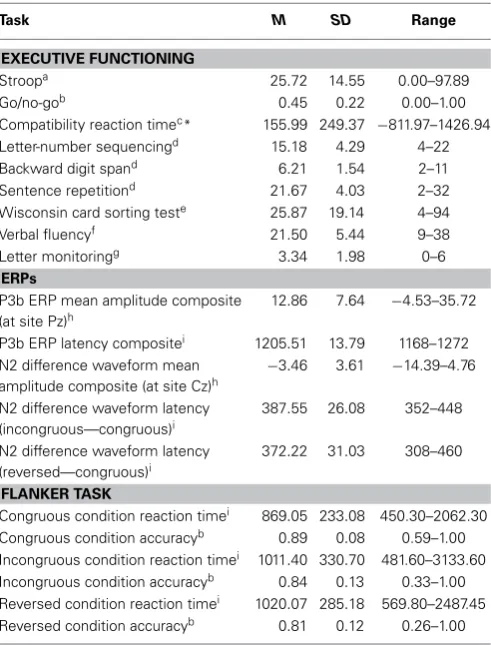
load onto the executive function factor. Removing the task did not have any effect, so it was excluded from all analyses (descrip-tive statistics and correlations for this task have been provided for reference inTables 1and2, respectively).
In order to obtain two variables of each ERP component, par-ticipants also completed a modified visual flanker task (Rueda et al., 2004; Richardson et al., 2011) whilst EEG data were recorded. Each stimulus consisted of five fish presented on a blue background (seeFigure 1). An arrow on the body of each fish indicated direction and the target was the central fish. Participants were instructed to press a response button situated on a key-board (red felt patches on the “Z” and “/” keys) corresponding to the direction of the central fish. There were three conditions: in the congruent condition (0.5 probability), the five fish were
Table 1 | Descriptive statistics of executive function and ERP
measures before transformation (N=215).
Task M SD Range
EXECUTIVE FUNCTIONING
Stroopa 25.72 14.55 0.00–97.89
Go/no-gob 0.45 0.22 0.00–1.00
Compatibility reaction timec* 155.99 249.37 −811.97–1426.94
Letter-number sequencingd 15.18 4.29 4–22
Backward digit spand 6.21 1.54 2–11
Sentence repetitiond 21.67 4.03 2–32
Wisconsin card sorting teste 25.87 19.14 4–94
Verbal fluencyf 21.50 5.44 9–38
Letter monitoringg 3.34 1.98 0–6
ERPs
P3b ERP mean amplitude composite (at site Pz)h
12.86 7.64 −4.53–35.72
P3b ERP latency compositei 1205.51 13.79 1168–1272 N2 difference waveform mean
amplitude composite (at site Cz)h
−3.46 3.61 −14.39–4.76
N2 difference waveform latency (incongruous—congruous)i
387.55 26.08 352–448
N2 difference waveform latency (reversed—congruous)i
372.22 31.03 308–460
FLANKER TASK
Congruous condition reaction timei 869.05 233.08 450.30–2062.30 Congruous condition accuracyb 0.89 0.08 0.59–1.00 Incongruous condition reaction timei 1011.40 330.70 481.60–3133.60 Incongruous condition accuracyb 0.84 0.13 0.33–1.00 Reversed condition reaction timei 1020.07 285.18 569.80–2487.45 Reversed condition accuracyb 0.81 0.12 0.26–1.00
aDifference between incongruous and neutral conditions (s).
bProportion correct.
cDifference between block 5 and blocks 1–4 (ms).
dTotal points scored.
ePerseverative errors.
fNumber of words.
gTotal items correct.
hμV. ims.
*Note that the SD for Compatibility Reaction Time are quite high, but decreased after trimming and transformation to−154.79 ms (SD=208.46).
green and all pointing in the same direction; an incongruent condition (0.25 probability), where all the fish were also green, however, the flankers pointed in the opposite direction to the cen-tral target; and a reversed condition (0.25 probability), in which the flanker fish were congruent, but all five fish were red, and required a response in the opposite direction to the central fish. Each fish subtended 0.9◦horizontally and 0.6◦vertically with 0.2◦ separating each fish and were randomly presented for 300 ms. A keyboard response was required before the next trial began. The task was presented as a game in which the participants had to feed the hungry central fish. Speed and accuracy were equally empha-sized. A practice block of 8 trials was administered to ensure the participants understood the task requirements. A total of 352 trials were presented in two blocks.
ELECTROPHYSIOLOGICAL ACQUISITION
The EEG was continuously recorded using an Easy-CapTM. Electrodes were placed at 33 sites based on Easy-Cap montage 24 (excluding TP9 and TP10; see http://www.easycap.de/easycap/e/ products/products.htm for more details). Eye movements were measured with bipolar leads placed above and below the left eye. The EEG was amplified with a NuAmps 40-channel ampli-fier, and digitized at a sampling rate of 250 Hz. Impedances were below 5 k prior to recording. During recording, the ground lead was located at AFz and the right mastoid was set as refer-ence. After recording, a linked mastoid reference was calculated offline, and Scan 4.3 was used to conduct the ERP process-ing. Offline, the EEG recording was digitally filtered with a 1–30 Hz zero phase shift band-pass filter (12 dB down). The vertical ocular electrodes enabled offline blink reduction accord-ing to the standard algorithm proposed by Semlitsch et al. (1986).
ERP DATA ANALYSIS
Epochs encompassing an interval from 100 ms prior to the onset of the stimulus and extending to 1000 ms post-stimulus were extracted and baseline corrected around the pre-stimulus inter-val. Epochs containing artifacts larger than 150μV or where an incorrect behavioral response was made were excluded from the ERP average. Additionally, the ERP data of participants who did not score significantly higher than chance on the congruous condition of the flanker task (n=2) or had fewer than 25 accept-able epochs in any condition (n=4) were excluded and treated as missing data. The average number of trials included in each grand-averaged waveform was 151 trials for the congruous con-dition, 71 for the incongruous concon-dition, and 70 for the reversed condition.
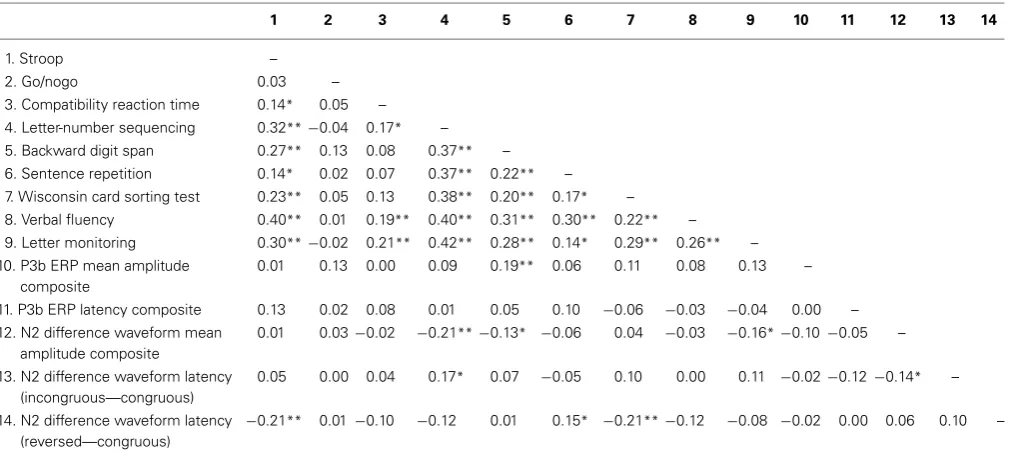
Table 2 | Correlations between measures of executive functioning and ERPs (N=215).
1 2 3 4 5 6 7 8 9 10 11 12 13 14
1. Stroop –
2. Go/nogo 0.03 –
3. Compatibility reaction time 0.14* 0.05 – 4. Letter-number sequencing 0.32**−0.04 0.17* –
5. Backward digit span 0.27** 0.13 0.08 0.37** –
6. Sentence repetition 0.14* 0.02 0.07 0.37** 0.22** –
7. Wisconsin card sorting test 0.23** 0.05 0.13 0.38** 0.20** 0.17* –
8. Verbal fluency 0.40** 0.01 0.19** 0.40** 0.31** 0.30** 0.22** –
9. Letter monitoring 0.30**−0.02 0.21** 0.42** 0.28** 0.14* 0.29** 0.26** – 10. P3b ERP mean amplitude
composite
0.01 0.13 0.00 0.09 0.19** 0.06 0.11 0.08 0.13 –
11. P3b ERP latency composite 0.13 0.02 0.08 0.01 0.05 0.10 −0.06 −0.03 −0.04 0.00 –
12. N2 difference waveform mean amplitude composite
0.01 0.03−0.02 −0.21**−0.13* −0.06 0.04 −0.03 −0.16*−0.10−0.05 –
13. N2 difference waveform latency (incongruous—congruous)
0.05 0.00 0.04 0.17* 0.07 −0.05 0.10 0.00 0.11 −0.02−0.12 −0.14* –
14. N2 difference waveform latency (reversed—congruous)
−0.21** 0.01 −0.10 −0.12 0.01 0.15* −0.21**−0.12 −0.08 −0.02 0.00 0.06 0.10 –
*p<0.05; **p<0.01.
FIGURE 1 | The six flanker task stimuli used in the present experiment.
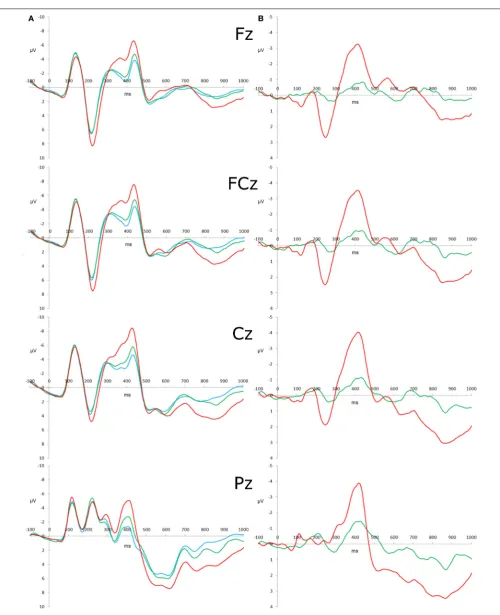
average from the congruous condition was subtracted from the individual ERP averages of the incongruous and reversed con-ditions. We calculated the interval over which the N2 inhibition effect was significant by comparing the amplitude of the differ-ence waveforms at each time point from 0 to 600 ms against a mean value of zero. To control for the number of comparisons conducted, we required a successive sequence of 12 statistically significant values based on an autocorrelation of 0.9 and graphi-cal threshold of 0.05, as detailed byGuthrie and Buchwald (1991). In the incongruous difference waveform, the N2 effect was sig-nificant over the interval 360–424, 348–468, and 348–472 ms at Fz, FCz, and Cz respectively. In the reversed difference waveform, the N2 effect occurred over the latency 316–496, 308–484, and 304–476 ms, at Fz, FCz, and Cz respectively. Visual inspection of the individual participants’ ERPs also revealed that not all of the participants displayed identifiable N2 peaks in the difference waveforms, meaning that analyses on peak amplitude values were not possible. As a result, mean amplitudes were calculated across the interval 352–456 ms for the incongruous condition and 308– 484 ms for the reversed condition, as these are the average latency windows for the two difference waveforms. Fractional area laten-cies for the P3b ERP components were measured by calculating the total positive area in the 584–648 ms measurement window
(extracted by the PCA), and then determining the earliest latency at which the summed positive area exceeded 25% of the total (Hansen and Hillyard, 1984). The same process was used for the N2 difference waveforms, except examining the negative area in the two intervals mentioned above. Difference waveforms were calculated for the N2 components, but not for the P3b, because it is argued that the N2 is an index of response conflict. As there is no conflict in congruous condition of the flanker task, then it fol-lows that any “extra” N2 amplitude is indicative of the response conflict presented within a trial (Van Veen and Carter, 2002; Nieuwenhuis et al., 2003, 2004; Lucci et al., 2013). Conversely, every trial of the flanker task requires the context to be updated, as new information is entering working memory (Polich, 2007). Hence, difference waveforms were not necessary.
TRANSFORMATION AND OUTLIER ANALYSIS
FIGURE 2 | Stimulus-locked ERP waveforms and difference waveforms. (A)Grand-averaged ERP in response to congruous (blue), incongruous (green), and reversed (red) stimuli with the amplitude (μV) as the y-axis and
time tasks, the Stroop task, and WCST were multiplied by−1 so that a higher score indicated better performance. When anal-yses were initially conducted, Heywood cases (i.e., models with standardized regression weights>1) occurred on each of the ERP latent variables (most likely due to multicollinearity, as correla-tions between indicators were generally very high). As a result of this, single indicator latent variables were created for each of the ERP factors, by adding the two related indicators together to form a composite variable (Landis et al., 2000) for each ERP index (i.e., the incongruous—congruous and reversed—congruous N2 amplitudes were added to make an N2 amplitude composite, the incongruous and reversed P3b amplitudes were added to make a P3b amplitude composite, and the incongruous and reversed P3b latencies were added to make a P3b latency composite). The N2 latencies were not included in the final analyses as every model with them included reported an inadmissible solution. Additionally, a single indicator latent variable could not be created with the two latencies as the correlation between them was very low (seeTable 2). The other three composite variables all achieved a satisfactory level of normality without any transformations.
As CFA and SEM are very sensitive to outliers, univariate and multivariate outlier analyses were conducted on the eleven dependent variables. Specifically, a test score was considered a univariate outlier if it was greater than 3 SDs from the between-subjects variable mean, and was replaced with a value that was 3 SDs from the mean. This affected no more than 1.9% of the observations for each task. No multivariate outliers were iden-tified when using a Cook’s D value of>1 (Cook and Weisberg, 1982). Forty-eight participants had missing data for one or more tasks; however, Little’s (1988) MCAR test was non-significant [χ2(125)=141.86;p=0.14], indicating that the data were miss-ing completely at random. These scores were estimated usmiss-ing the expectation maximization method.
STATISTICAL ANALYSIS
Amos 19 (Arbuckle, 2010) was used to estimate the latent vari-able models. In both CFA and SEM, several fit indices were used to evaluate the fit of each model to the data. Theχ2 statistic is commonly used in latent variable analysis to measure good-ness of fit; a non-significantχ2indicates that data entered into a theorized model does not significantly deviate from the model, inferring good model fit (Blunch, 2008). Bentler’s comparative fit index (CFI), the root-mean-square error of approximation (RMSEA), and the standardized root mean residual (SRMR) were also used to measure model fit. The criteria for excellent model fit based on these indices is greater than 0.95, less than 0.05, and less than 0.05 respectively (Blunch, 2008). Significance of correlation and path coefficients was determined using the same technique asFriedman et al. (2006). Specifically,χ2 difference tests were conducted when removing an individual parameter. If the dif-ference was significant, it indicated that the removed coefficient was statistically significant, and should be kept in the model. This technique is more reliable than using test statistics that are based upon standard errors (Gonzalez and Griffin, 2001).
PROCEDURE
A maximum of 24 children at a time attended Project K.I.D.S. for two consecutive days over a two week period during the school
holidays. All testing was presented in a child friendly manner, and each testing session lasted no longer than 25 min. Meals and activities (such as games and art) were scheduled between ses-sions to ensure the participants enjoyed themselves and did not become fatigued. All participants were given a Project K.I.D.S. t-shirt as a memento of their participation at the end of the second day.
RESULTS
DESCRIPTIVE STATISTICS
Descriptive statistics of raw scores of the eleven measures (as well as Go/Nogo and flanker behavioral performance and N2 latencies) before any transformation procedures were conducted are presented inTable 1, and the correlations between the mea-sures (after transformation, outlier analysis, and missing data estimation) are presented inTable 2. Additionally, the N2 ampli-tude variables were both found to be maximal at Cz, and the P3b component amplitudes were all maximal at Pz (see Figure 2).
LATENT VARIABLE ANALYSIS
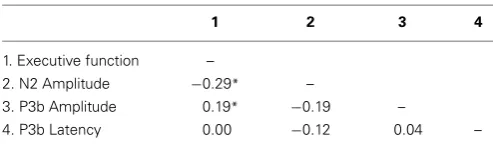
To test that the P3b and N2 amplitudes and P3b latency are associ-ated with a unitary executive function, a four-factor CFA was con-ducted with correlations between the P3b amplitude, N2 ampli-tude, P3b latency, and executive function factors allowed to vary freely and alternative nested models tested afterwards. The full four-factor model had very good model fit statistics (χ2=58.75, df =44,p=0.07, CFI=0.94, RMSEA=0.040, SRMR=0.049). However, after testing the significance of parameter estimates, the best model only included correlations between P3b ampli-tude and executive functioning (p=0.025), and N2 amplitude and executive functioning (p=0.012). This final model had very good model fit statistics (χ2=61.94, df =48, p=0.09, CFI=0.95, RMSEA=0.036, SRMR=0.051), and was not a sig-nificantly worse fit for the data than the full three-factor model (χ2=3.19, df =4, p=0.53). All other correlations were non-significant (seeTable 3).
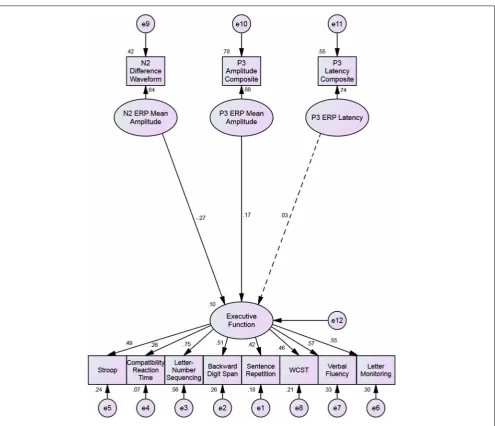
From this, an SEM was conducted, as this allows us to cal-culate the unique predictive contribution of each ERP factor on the executive function factor. The distinction between this anal-ysis and the CFA is that SEM allows us to determine the unique contribution of each predicting factor after common variance has been accounted for.Figure 3shows that, consistent with the find-ings of the CFA, both the P3b amplitude and N2 amplitude factors were significant predictors of the executive function factor, but the P3b latency factor was not (p=0.049,p=0.026, andp=0.77, respectively).
Table 3 | Inter-factor correlations extracted from the CFA.
1 2 3 4
1. Executive function –
2. N2 Amplitude −0.29* –
3. P3b Amplitude 0.19* −0.19 –
4. P3b Latency 0.00 −0.12 0.04 –
FIGURE 3 | Structural equation model predicting executive functioning with the N2 amplitude, P3b amplitude, and P3b latency. Single-headed arrows have standardized factor loadings next
to them. The dotted regression weight from the P3 latency factor to the executive function factor is non-significant. All other coefficients are significant to p<0.05.
DISCUSSION
The current study aimed to examine associations between com-ponents of the ERP and executive functioning. Previous research has reported associations between the P3b peak and working memory in both adults and children (Polich et al., 1990; Walhovd and Fjell, 2002), and between the amplitude of the N2 and response conflict/inhibition in adults and children (Jodo and Kayama, 1992; Van Veen and Carter, 2002; Cragg et al., 2009). The latent variable analyses used in the CURRENT study revealed that the N2 difference waveform and the P3b mean amplitudes are associated with executive functioning, but not the latency of the P3b component.
Previous research has found associations between behavioral performance on working memory tasks and P3b amplitude (Polich et al., 1990; Walhovd and Fjell, 2002), and between
executive function in children. However, whilst the N2 amplitude associated with performance on Nogo tasks in adults is typically maximal at frontal scalp sites (Folstein and Van Petten, 2008), our results support the notion that the N2 amplitude is maximal at more central scalp sites in children (Jonkman, 2006).
It is also worth noting that the current analysis only used mean amplitude values of the two electrophysiological variables, as no clear peaks were identifiable. As a result of this, peak latency could not be included as a predictor of executive functioning, and it usually accounts for a significant proportion of variance in executive functioning (Walhovd and Fjell, 2002). However, when fractional areas latencies were calculated, no associations between latency and executive functioning were observed. This leads to the speculation that these ERPs begin to develop clear peaks around the same time as specific executive abilities develop, although, having said this, the deflections in the ERP were observ-able (even without any clear peak), yet the behavioral constructs were indistinguishable from each other. That is, whilst execu-tive functioning is unitary in younger children, the N2 difference waveform and P3b component of the ERP are apparent. However, the change in the structure of executive functions, from uni-tary in children up to 9 years (Wiebe et al., 2008; Brydges et al., 2012b), to related yet separable functions in children aged around 11 years (Lehto et al., 2003; Duan et al., 2010) may be due to changes in the propagation of neural impulses—the peaks in the ERP become apparent before the specific behavioral abilities emerge. This could have important implications for the diagnosis of dysexecutive syndromes in samples where executive functions are psychometrically indistinguishable, as the ERP components may be a more sensitive measure of cognitive development. A longitudinal study would be required to test this conclusively.
Alternatively, using latent variables to test for associations between ERP components and executive functions in adults may be an informative area of future research. If the development of clear ERP peaks is associated with the development of abilities specific to single executive functions, then correlations between ERP and executive functioning factors should increase from the relatively low (but still significant;r= −0.29 andr=0.19) val-ues reported in this sample of children.
Additionally, the predictive power of other ERP peaks may have been missed in this study. For instance,Fjell et al. (2007) found associations between both P3a amplitude and latency (commonly associated with novelty detection, although generally not associated with any specific executive function) were both associated with higher-order cognitive functions in a sample of adults. Considering that the N2 difference waveform and P3b factors only accounted for 10% of the variance in the executive function factor (although both factors predicted a significant pro-portion of variance), it may be fruitful to also consider other predictor ERP peaks.
Another possible avenue of research involves examining differ-ences between behavioral and electrophysiological development of individual executive functions. For instance, researchers have proposed taxonomies of both inhibition and working memory (Nigg, 2000; Oberauer et al., 2003). Specifically, Nigg proposed four subtypes of inhibition, which are all separate yet related constructs. From an electrophysiological perspective, previous
research has suggested some common neural regions of activa-tion, including the dorsolateral prefrontal cortex and the anterior cingulate cortex (Ridderinkhof et al., 2004; Chambers et al., 2006; Carter and Van Veen, 2007; Chambers et al., 2009). A few stud-ies have examined two of these subprocesses (response inhibition and interference suppression), and have also found differential patterns of activation (Bunge et al., 2002; Brydges et al., 2012a, 2013). Bunge et al. reported multiple differences in regions of neural activation between task conditions requiring response inhibition and interference suppression. From a behavioral per-spective, however, previous research has suggested that two of these subprocesses are actually indistinguishable (Friedman and Miyake, 2004). It may fruitful to further examine any poten-tial differences (from both behavioral and neural perspectives) between subtypes of EFs such as inhibition to further our under-standing of the architecture of EFs, and how these subtypes contribute to behaviors on complex tasks.
In conclusion, the present study has added evidence of the development of ERP correlates of executive functioning being observable before the specific executive functions themselves are psychometrically distinguishable. Additionally, evidence of the predictive qualities of ERPs on executive functioning from a latent variable perspective adds to the predominantly correlational-based knowledge of associations between brain and behavior (Polich et al., 1990; Walhovd and Fjell, 2002; Cragg et al., 2009). SEM analyses found that both the N2 difference wave-form and P3b (thought to be electrophysiological correlates of response conflict/inhibition and updating of working memory, respectively) were significant predictors of executive function-ing. Theories of developmental cognition would greatly benefit from the integration of neuroscientific techniques with behavioral evidence.
AUTHOR CONTRIBUTIONS
Conceived and designed the experiment: Christopher R. Brydges, Mike Anderson and Allison M. Fox. Analyzed the data: Christopher R. Brydges and Allison M. Fox. Wrote the paper: Christopher R. Brydges. Reviewed final manuscript: Allison M. Fox, Corinne L. Reid and Mike Anderson. Trained and super-vised ERP testers: Allison M. Fox. Conceived and designed the methodology for mass testing of children in a holiday program: Mike Anderson and Corinne L. Reid. Supervised the research group: Mike Anderson. Trained and supervised testers in child assessment and recruited participants: Corinne L. Reid.
ACKNOWLEDGMENTS
This research was supported by an Australian Research Council grant DP0665616 awarded to Mike Anderson, Allison M. Fox, Corinne L. Reid, and Professor Dorothy V.M. Bishop. We wish to thank Aoibheann O’Brien and Catherine Campbell for their help with coordination of Project K.I.D.S.
REFERENCES
Arbuckle, J. L. (2010).IBM SPSS® Amos™ 19 User’s Guide. Crawfordville, FL: Amos Development Corporation.
Blunch, N. J. (2008).Introduction to Structural Equation Modelling Using SPSS and
Brydges, C. R., Anderson, M., Reid, C. L., and Fox, A. M. (2013). Maturation of cognitive control: delineating response inhibition and interference suppression.
PLoS ONE8:e69826. doi: 10.1371/journal.pone.0069826
Brydges, C. R., Clunies-Ross, K., Clohessy, M., Lo, Z. L., Nguyen, A., Rousset, C., et al. (2012a). Dissociable components of cognitive control: an event-related potential (ERP) study of response inhibition and interference suppression.PLoS
ONE7:e34482. doi: 10.1371/journal.pone.0034482
Brydges, C. R., Reid, C. L., Fox, A. M., and Anderson, M. (2012b). A unitary exec-utive function predicts intelligence in children.Intelligence40, 458–469. doi: 10.1016/j.intell.2012.05.006
Bunge, S. A., Dudukovic, N. M., Thomason, M. E., Vaidya, C. J., and Gabrieli, J. D. E. (2002). Immature frontal lobe contributions to cognitive control in children:
evidence from fMRI.Neuron33, 301–311. doi: 10.1016/s0896-6273(01)00583-9
Carter, C., and Van Veen, V. (2007). Anterior cingulate cortex and conflict detec-tion: an update of theory and data.Cogn. Affect. Behav. Neurosci.7, 367–379. doi: 10.3758/cabn.7.4.367
Chambers, C. D., Bellgrove, M. A., Stokes, M. G., Henderson, T. R., Garavan, H., Robertson, I. H., et al. (2006). Executive “Brake Failure” following
deactivation of human frontal lobe. J. Cogn. Neurosci. 18, 444–455. doi:
10.1162/jocn.2006.18.3.444
Chambers, C. D., Garavan, H., and Bellgrove, M. A. (2009). Insights into the neural basis of response inhibition from cognitive and clinical neuroscience.Neurosci. Biobehav. Rev.33, 631–646. doi: 10.1016/j.neubiorev.2008.08.016
Cook, R. D., and Weisberg, S. (1982).Residuals and Influence in Regression. New York, NY: Chapman and Hill.
Cragg, L., Fox, A., Nation, K., Reid, C., and Anderson, M. (2009). Neural correlates of successful and partial inhibitions in children: an ERP study.Dev. Psychobiol.
51, 533–543. doi: 10.1002/dev.20391
Donchin, E., and Coles, M. G. H. (1988). Is the P300 component a
manifestation of context updating? Behav. Brain Sci. 11, 357–374. doi:
10.1017/S0140525X00058027
Duan, X., Wei, S., Wang, G., and Shi, J. (2010). The relationship between executive functions and intelligence on 11- to 12-year-old children.Psychol. Test Assess. Model.52, 419–431.
Duncan, J., Emslie, H., Williams, P., Johnson, R., and Freer, C. (1996). Intelligence and the frontal lobe: the organization of goal-directed behavior.Cogn. Psychol.
30, 257–303. doi: 10.1006/cogp.1996.0008
Elliott, C. D., Smith, P., and McCullouch, K. (1997).British Abilities Scales II. Windsor: NFER-Nelson.
Fjell, A. M., Walhovd, K. B., Fischl, B., and Reinvang, I. (2007). Cognitive function, P3a/P3b brain potentials, and cortical thickness in aging.Hum. Brain Mapp.28, 1098–1116. doi: 10.1002/hbm.20335
Folstein, J. R., and Van Petten, C. (2008). Influence of cognitive control and mis-match on the N2 component of the ERP: a review.Psychophysiology45, 152–170. doi: 10.1111/j.1469-8986.2007.00602.x
Friedman, N. P., and Miyake, A. (2004). The relations among inhibition and inter-ference control functions: a latent-variable analysis.J. Exp. Psychol. Gen.133, 101–135. doi: 10.1037/0096-3445.133.1.101
Friedman, N. P., Miyake, A., Corley, R. P., Young, S. E., Defries, J. C., and Hewitt, J. K. (2006). Not all executive functions are related to intelligence.Psychol. Sci.17, 172–179. doi: 10.1111/j.1467-9280.2006.01681.x
Garavan, H., Ross, T. J., and Stein, E. A. (1999). Right hemispheric dominance of inhibitory control: an event-related functional MRI study.Proc. Natl. Acad. Sci. U.S.A.96, 8301–8306. doi: 10.1073/pnas.96.14.8301
Gonzalez, R., and Griffin, D. (2001). Testing parameters in structural equation modeling: every “one” matters.Psychol. Methods6, 258–269. doi: 10.1037/1082-989x.6.3.258
Guthrie, D., and Buchwald, J. S. (1991). Significance testing of difference
potentials.Psychophysiology 28, 240–244. doi: 10.1111/j.1469-8986.1991.tb0
0417.x
Hansen, J. C., and Hillyard, S. A. (1984). Effects of stimulation rate and attribute cuing on event-related potentials during selective auditory attention.
Psychophysiology21, 394–405. doi: 10.1111/j.1469-8986.1984.tb00216.x Heaton, R. K., Chelune, G. J., Talley, J. L., Kay, G. G., and Curtiss, G. (1993).
Wisconsin Card Sorting Test Manual: Revised and Expanded. Odessa, FL: Psychological Assessment Resources.
Hughes, C., Ensor, R., Wilson, A., and Graham, A. (2009). Tracking execu-tive function across the transition to school: a latent variable approach.Dev. Neuropsychol.35, 20–36. doi: 10.1080/87565640903325691
Jodo, E., and Kayama, Y. (1992). Relation of a negative ERP component to response inhibition in a Go/No-go task.Electroencephalogr. Clin. Neurophysiol.
82, 477–482. doi: 10.1016/0013-4694(92)90054-L
Jonkman, L. M. (2006). The development of preparation, conflict monitoring and inhibition from early childhood to young adulthood; a Go/Nogo ERP study.
Brain Res.1097, 181–193. doi: 10.1016/j.brainres.2006.04.064
Judd, C. M., and McClelland, G. H. (1989).Data Analysis: A Model-Comparison
Approach. San Diego, CA: Harcourt Brace Jovanovich.
Korkman, M., Kirk, U., and Kemp, S. (1997).NEPSY. New York, NY: Psychological
Corporation.
Krug, M. K., and Carter, C. S. (2012). “Cognitive control loop theory of cognitive
control,” inThe Neuroscience of Attention,ed G. R. Mangun (New York, NY:
Oxford University Press), 229–249.
Landis, R. S., Beal, D. J., and Tesluk, P. E. (2000). A comparison of approaches
to forming composite measures in structural equation models.Organ. Res.
Methods3, 186–207. doi: 10.1177/109442810032003
Lehto, J., Juujärvi, P., Kooistra, L., and Pulkkinen, L. (2003). Dimensions of exec-utive functioning: evidence from children.Br. J. Dev. Psychol.21, 59–80. doi: 10.1348/026151003321164627
Little, R. J. A. (1988). A test of missing completely at random for
multi-variate data with missing values. J. Am. Stat. Assoc. 83, 1198–1202. doi:
10.1080/01621459.1988.10478722
Lucci, G., Berchicci, M., Spinelli, D., Taddei, F., and Di Russo, F. (2013). The effects of aging on conflict detection.PLoS ONE8:e56566. doi: 10.1371/jour-nal.pone.0056566
Miller, E. K., and Cohen, J. D. (2001). An integrative theory of prefrontal
cor-tex function.Annu. Rev. Neurosci.24, 167–202. doi: 10.1146/annurev.neuro.
24.1.167
Miyake, A., Friedman, N. P., Emerson, M. J., Witzki, A. H., Howerter, A., and Wager, T. D. (2000). The unity and diversity of executive functions and their contribu-tions to complex “Frontal Lobe” tasks: a latent variable analysis.Cogn. Psychol.
41, 49–100. doi: 10.1006/cogp.1999.0734
Nieuwenhuis, S., Yeung, N., and Cohen, J. D. (2004). Stimulus modality,
per-ceptual overlap, and the go/no-go N2.Psychophysiology 41, 157–160. doi:
10.1046/j.1469-8986.2003.00128.x
Nieuwenhuis, S., Yeung, N., Wildenberg, W., and Ridderinkhof, K. R. (2003). Electrophysiological correlates of anterior cingulate function in a go/no-go task: effects of response conflict and trial type frequency.Cogn. Affect. Behav. Neurosci.3, 17–26. doi: 10.3758/CABN.3.1.17
Nigg, J. T. (2000). On inhibition/disinhibition in developmental psychopathol-ogy: views from cognitive and personality psychology and a working inhibition taxonomy.Psychol. Bull.126, 220–246. doi: 10.1037/0033-2909.126.2.220 Oberauer, K., Süß, H.-M., Wilhelm, O., and Wittman, W. W. (2003). The multiple
faces of working memory: storage, processing, supervision, and coordination.
Intelligence31, 167–193. doi: 10.1016/S0160-2896(02)00115-0
Polich, J. (2007). Updating P300: an integrative theory of P3a and P3b.Clin.
Neurophysiol.118, 2128–2148. doi: 10.1016/j.clinph.2007.04.019
Polich, J., Ladish, C., and Burns, T. (1990). Normal variation of P300 in chil-dren: age, memory span, and head size.Int. J. Psychophysiol.9, 237–248. doi: 10.1016/0167-8760(90)90056-J
Rabbitt, P. (1997). “Introduction: methodologies and models in the study of exec-utive function,” inMethodology of Frontal and Executive Function, ed P. Rabbitt (Hove: Psychology Press), 1–38.
Reid, C., and Anderson, M. (2012). “Left-brain, right-brain, brain games and
beanbags: neuromyths in education,” inBad Education: Debunking Myths in
Education, eds P. Adey and J. Dillon (Berkshire: McGraw-Hill Education), 179–197.
Richardson, C., Anderson, M., Reid, C. L., and Fox, A. M. (2011). Neural indicators of error processing and intraindividual variability in reaction time in 7 and 9 year-olds.Dev. Psychobiol.53, 256–265. doi: 10.1002/dev.20518
Ridderinkhof, K. R., Van Den Wildenberg, W. P. M., Segalowitz, S. J., and Carter, C. S. (2004). Neurocognitive mechanisms of cognitive control: the role of prefrontal cortex in action selection, response inhibition,
perfor-mance monitoring, and reward-based learning.Brain Cogn.56, 129–140. doi:
10.1016/j.bandc.2004.09.016
Rueda, M. R., Posner, M., Rothbart, M., and Davis-Stober, C. (2004). Development of the time course for processing conflict: an event-related potentials study
with 4 year olds and adults. BMC Neurosci. 5:39. doi: 10.1186/1471-22
Rushworth, M. F. S., Passingham, R. E., and Nobre, A. C. (2002). Components
of switching intentional set. J. Cogn. Neurosci. 14, 1139–1150. doi:
10.1162/089892902760807159
Semlitsch, H. V., Anderer, P., Schuster, P., and Presslich, O. (1986). A solution for reliable and valid reduction of ocular artifacts, applied to the P300 ERP.
Psychophysiology23, 695–703. doi: 10.1111/j.1469-8986.1986.tb00696.x St Clair-Thompson, H. L., and Gathercole, S. E. (2006). Executive functions and
achievements in school: shifting, updating, inhibition, and working memory.
Q. J. Exp. Psychol.59, 745–759. doi: 10.1080/17470210500162854
Stroop, J. R. (1935). Studies of interference in serial verbal reactions.J. Exp. Psychol.
Gen.18, 643–662. doi: 10.1037/0096-3445.121.1.15
Van Der Sluis, S., De Jong, P. F., and Van Der Leij, A. (2007). Executive functioning in children, and its relations with reasoning, reading, and arithmetic.Intelligence
35, 427–449. doi: 10.1016/j.intell.2006.09.001
Van Veen, V., and Carter, C. S. (2002). The timing of action-monitoring pro-cesses in the anterior cingulate cortex.J. Cogn. Neruosci.14, 593–602. doi: 10.1162/08989290260045837
Walhovd, K. B., and Fjell, A. M. (2002). The relationship between P3 and neu-ropsychological function in an adult life span sample.Biol. Psychol.62, 65–87. doi: 10.1016/S0301-0511(02)00093-5
Wechsler, D. (2003).Manual for the Wechsler Intelligence Scale for Children. San Antonio, TX: The Psychological Corporation.
Wiebe, S. A., Espy, K. A., and Charak, D. (2008). Using confirmatory factor analysis to understand executive control in preschool children: I. Latent structure. Dev. Psychol.44, 575–587. doi: 10.1037/0012-1649.44.2.575
Willoughby, M. T., Wirth, R. J., Blair, C. B., and Greenberg, M. (2012). The measurement of executive function at age 5: psychometric properties and
relationship to academic achievement. Psychol. Assess. 24, 226–239. doi:
10.1037/a0025361
Wu, K. K., Chan, S. K., Leung, P. W. L., Liu, W.-S., Leung, F. L. T., and Ng, R. (2011). Components and developmental differences of executive
func-tioning for school-aged children. Dev. Neuropsychol. 36, 319–337. doi:
10.1080/87565641.2010.549979
Conflict of Interest Statement:The authors declare that the research was con-ducted in the absence of any commercial or financial relationships that could be construed as a potential conflict of interest.
Received: 20 December 2013; accepted: 01 February 2014; published online: 20 February 2014.
Citation: Brydges CR, Fox AM, Reid CL and Anderson M (2014) Predictive validity of the N2 and P3 ERP components to executive functioning in children: a latent-variable analysis. Front. Hum. Neurosci.8:80. doi: 10.3389/fnhum.2014.00080