PAPR Reduction in Overloaded MIMO
OFDM System with Turbo Decoding
Anphy Jose , Anooja.
Student, Dept. of ECE., MCET, Desamangalam, Kerala, India
Assistant Professor, Dept. of ECE., MCET, Desamangalam, Kerala, India
ABSTRACT: Nowadays communication has become an integral part of our lives and the demand for wireless communication is growing along with the rapid growth of various digital communication techniques. The main requirement of a good communication system is high speed of data transmission with high accuracy. Multiple Input Multiple Output Orthogonal Frequency Division Multiplexing (MIMO - OFDM) system has a major role in the wireless communication. MIMO has multiple arrays of antennas in both side of transmitter and receiver. For that reason, MIMO provide high speed data communication. In addition to achieve outstanding performance, the third generation partnership project (3GPP) long term evolution (LTE) implements turbo code as forward error correcting (FEC) standard. Also OFDM is the most popular and the most suitable technique for high data rate communication. OFDM will reduce the Inter Symbol Interference (ISI) effect in high speed data transmission in multipath fading channel. Although its advantages it has some impediment also. One of the major disadvantages in OFDM communication is the high peak-to-average power ratio (PAPR). This paper focus on reduction of PAPR in MIMO OFDM system by combining the hadamard transform with hann peak windowing method.
KEYWORDS: MIMO-OFDM, Turbo code, PAPR, Hadamard transform, Hann windowing.
I. INTRODUCTION
In the present scenario, the demands for wireless communication industry are growing. New sophisticated ideas are coming in to extant which needs to be implemented. Existing wireless communication technology cannot efficiently support high data rate. In order to meet the growing demand for high quality multimedia application like video and audio, the communication system must be implemented by high data rate transmission without additional transmit power and band width. In present days OFDM is most appropriate modulation technique. OFDM has many advantages in many areas such as high spectral efficiency, robustness, low computational complexity, frequency selective fading and ease of implementation using IFFT/FFT.
Latterly we use OFDM in combination with MIMO transceiver system. So it named as MIMO-OFDM system and it is used for increasing the diversity gain and system capacity. MIMO OFDM has a very auspicious feature since OFDM able to support multiple antennas. Spectral efficiency and link reliability in future wireless communications system is improved by the multiple antennas at the transceiver side (MIMO technology). Combination of MIMO technology with Orthogonal Frequency Division Multiplexing (MIMO OFDM) is a key technology for the next generation cellular communication. MIMO OFDM has good performance and BER [1]. MIMO is the most powerful method and provide better communication in fading over the wireless channel.
One of the major disadvantages of MIMO OFDM is high peak-to-average power ratio (PAPR) of the transmitter's output signal on different antennas. This phenomenon may outweigh all the potential advantages of MIMO OFDM system. A number of approaches have been proposed to for reducing the high PAPR. High PAPR will leads to power distortion and non-linearity in the receiver side. In order to avoid these issues PAPR reduction method is implementing in this paper.
II. RELATED WORK
increased, some mobile terminals does not satisfy this ideal condition. In overloaded MIMO system, the number of transmit antennas is larger than that of receive antennas, will become a general application for future broadband wireless communication. MIMO-OFDM system provides remarkable space diversity and it combat multi-path fading, [3] therefore it will become a general application in the near future wireless communication. MIMO-OFDM technique will defeat the acute inter symbol interference (ISI) resulting from the dispersive channel and it will enhance the capacity and quality of wireless mobile communication systems.
MIMO channels can be formed by using multiple transmit and receive antennas [4]. The MIMO-OFDM system uses two independent space-time codes for two sets of two transmit antennas. High code efficiency and good performance are the characteristics of space–time coding. OFDM systems efficiency and performance can be improved by space time coding. MIMO channels are used to improve the system capacity. In OFDM [5]–[7], the entire channel is divided into sub channels. Therefore it will increase the symbol duration and minimize or abolishing the ISI caused by the multipath. Therefore, OFDM will be promising technique for highly spectrally efficient wideband transmission.
For achieving excellent performance, LTE adopts turbo codes as its forward error correction (FEC) codes [8]. The first practical FEC code (turbo code) has a performance close to the Shannon limit [9]. The combination of turbo codes and MIMO systems has extremely good potential for high-data-rate communications with low power consumption [10], [11]. In a turbo-MIMO system, joint maximum a posteriori (joint MAP) detection-decoding gives an ideal performance in terms of the error rate. It has high computational complexity. For that reason, a more practicable decoding scheme for the turbo-MIMO system is required. Detection and decoding are done by two separate processes for conducting turbo-MIMO decoding. In this approach, decoding blocks receive the soft information from the MIMO detection block. In each decoding block, turbo decoding is conducted independently to each transmitted stream.
The main drawback of OFDM system is its high peak-to-average power ratio (PAPR). A high PAPR will lead to a high probability of the OFDM signal being clipped when passing through a power amplifier at the end of the transmit- ter. Clipping reduces the signal power, degrading bit error rate (BER) performance (in-band distortion) and causing nonlinear phenomena such as spectral spreading. Spectral spreading causes degradation of spectral efficiency [12].
In this paper, it mainly explicit performance of PAPR reduction in overloaded MIMO-OFDM with turbo decoding. Performance is analyzed by plotting graph between Bit Error Rate (BER) versus the / and PAPR versus / . Turbo encoding and OFDM modulation occurs in transmitter section of MIMO-OFDM by using antennas and reverse operation i.e. OFDM demodulation and turbo decoding using antennas occurs in receiver section. OFDM modulation and demodulation is done by different modulation scheme.
The remainder of this paper is organized as follows. Section III illustrate the proposed PAPR reduction method with MIMO-OFDM system. The simulations results are provided in section IV for demonstrating the performance analysis of PAPR reduction in turbo coding for overloaded MIMO-OFDM system. Conclusions are presented in Section V.
III.PROPOSED SYSTEM
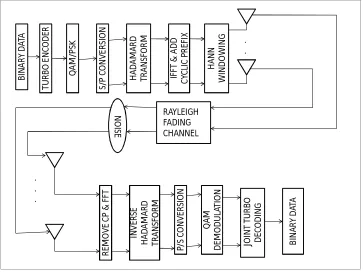
Transeiver section of MIMO OFDM with PAPR reduction technique is shown in figure1. Transmitter section contains antennas. Binary data is being inputted to the turbo encoder. Here we use systematic parallel concatenated convolutional codes with two 8-state encoders and one internal interleaver. LTE provide rate matching (RM) function for supporting higher data rate. Encoded outputs are modulated using QAM/PSK modulation. Afterward this modulation signal will be converted into parallel signal by serial to parallel converter. Hadamard transform is applied to the output from parallel converter. The Hadamard transform is a 2 *2 matrix, the Hadamard matrix scaled by a normalization factor 2 that transforms complex numbers into real numbers. The Hadamard transform can be defined as :
=√ −
block, because channel is in time domain. There is no interference occurs between the subcarriers, because samples generated by IFFT blocks are orthogonal to each other.
Cyclic prefix (CP) is being added to the output of IFFT block signal (i.e. time domain signal). Afterward this time domain signal is being travels through the multipath fading channel, the subcarriers may lose their orthogonality property and they interfere with each other. The main requirement of adding cyclic prefix or guard time techniques are to reduce the effect of ISI and inter carrier interference (ICI) introduced by the multipath fading channel. OFDM signal becomes more robust to the multipath delay spread effect by increasing the symbol period with help of Guard interval. Then Hann windowing is applied to the previous output. Hann function is defined by
w(n) = 0.5 (1- cos 2 )
T UR B O E N C O DE R Q A M/ P SK S/ P C O N V E R SI O N H A D A MA R D TR A N SF O R M IF FT & A DD C YC LI C P R EF IX H A N N W IN DO W IN G . . RA RAYLEIGH FADING CHANNEL R EMO V E C P & F FT IN V ER SE H A D A MA R D T R A N SF O R M P/ S C O N V E R SI O N Q A M DE MO DUL AT IO N . . . JO IN T TUR B O DE C O DI N G B IN A R Y DA TA B IN A R Y D A TA N O IS E
Figure 1: MIMO OFDM with PAPR reduction technique
For analysing the digital modulation schemes, we use Rayleigh fading channel. Channel adds a white Gaussian noise to the signal that passes through the channel. Rayleigh fading is most applicable when there is no line of sight between sender and receiver.
IV.SIMULATION RESULT
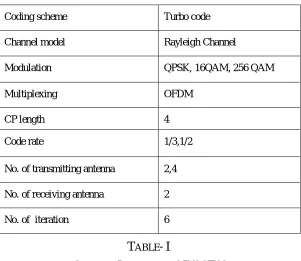
Simulation results are shown in this section. Simulation parameter for turbo codes in MIMO-OFDM system is shown in Table I.
Coding scheme Turbo code
Channel model Rayleigh Channel
Modulation QPSK, 16QAM, 256 QAM
Multiplexing OFDM
CP length 4
Code rate 1/3,1/2
No. of transmitting antenna 2,4
No. of receiving antenna 2
No. of iteration 6
T
ABLE-
I
SIMULATION PARAMETERS FOR MIMOOFDM
BER performance of data transmission for QPSK, 16-QAM and 256-QAM is analyzed in Matlab software. Figure 2 represent the BER analysis of MIMO-OFDM with turbo codes in Rayleigh channel for code rate 1/3.
From figure2, we analysed that the 256QAM modulation gives the highest bit error rate and QPSK modulation has low BER. For the case of two transmit antennas with QPSK at the BER value of 10 gives / value of 3.60 dB. For the case of four transmit antennas with QPSK at the BER value of 10 gives / value of 7.60 dB. For the case of 16 QAM and 256 QAM BER value of 10 gives / value of 12db and 13.4 db respectively.
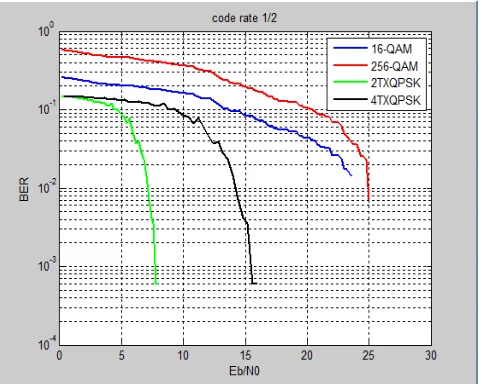
Transmission using multiple antennas has a greater advantage at a higher code rate. BER performance for code rate 1/2 is shown in figure 3.
Fig 3. BER performance for code rate 1/2
From figure3. we analysed that 256QAM modulation gives the highest bit error rate and QPSK modulation has low BER.. For the case of two transmit antennas with QPSK at the BER value of 10 gives / value of 7 dB. For the case of four transmit antennas with QPSK at the BER value of 10 gives / value of 15.40 dB. For the case of 16 QAM and 256 QAM BER value of 10 gives / value of 24.60 db and 25db respectively.
Figure 4 represent the PAPR of MIMO OFDM with and without Hadamard transform.
From this graph we analysed that PAPR can be reduced from 10 to 10 MIMO OFDM system without any power increase and side information.
V. CONCLUSION AND FUTURE WORK
In this paper, a PAPR reduction scheme which is basically based on combination of Hadamard transform and hann windowing techniques is proposed. MIMO-OFDM wireless system with 2x2, and 4x2 antenna configurations over Rayleigh fading channel has been developed, evaluated using SNR and BER. The simulation results showed that the proposed algorithm reduce the PAPR in overloaded MIMO OFDM system.
Further work can be extended with other error correction code (eg: LDPC code) and other fading channels with different higher order modulation techniques for reducing the BER and PAPR in MIMO OFDM.
REFERENCES
1. Mitalee Agrawal and Yudhishthir Raut, “BER Analysis of MIMO OFDM System for AWGN & Rayleigh Fading Channel”, International Journal of Computer Applications, vol.-34, no.-9, November 2011
2. Ilmiawan Shubhi, Yukitoshi Sanada "Joint Turbo Decoding for Overloaded MIMO-OFDM Systems", IEEE Transactions on Vehicular Technology, No. 99, pp.1- 10, Mar.2016.
3. Shiming Liu; Xing Zhang,”Analysis of Modulation and Coding Scheme Selection in MIMO-OFDM system”, International conference on communication and electronics, pp.240-245,2006
4. Y. Le, J. H. Winters and N.R.Sollenberger, “MIMO OFDM for Wireless Communications: Signal Detection with Enhanced Channel Estimation,” IEEE Trans. onCommunications, vol. 50, pp. 1471-1477
5. L. J. Cimini, Jr., “Analysis and simulation of a digital mobile channel using orthogonal frequency division multiplexing,” IEEE Trans. Commun., vol. COM-33, pp. 665–675, July 1985.
6. Vadivel, R and V. Murali Bhaskaran,’Energy Efficient with Secured Reliable Routing Protocol (EESRRP) for Mobile Ad-Hoc Networks’, Procedia Technology 4,pp. 703- 707, 2012.
7. S. B. Weinstein and P. M. Ebert, “Data transmission by frequency-division multiplexing using the discrete Fourier transform,” IEEE Trans. Commun. Tech., vol. COM-19, pp. 628–634, Oct. 1971.
8. Multiplexing and channel coding, 3GPP TS 36.212 V11.4.0, Jan. 2014
9. C. Berrou, A. Glavieux, and P. Thitimajshima, “Near Shannon limit error-correcting coding and decoding: Turbo-codes,” IEEE Int. Conf. Commun., vol. 2, pp. 1064–1070, May 1993.
10. M. Sellathurai and S. Haykin, “Turbo-BLAST for wireless communications: theory and experiments,” IEEE Trans. Signal Process., vol. 42, no. 10, pp. 48–53, Oct. 2004.
11. S. Haykin, M. Sellathurai, Y. de Jong, and T. Willink, “Turbo-MIMO for wireless communications,” IEEE Commun. Mag., vol. 42, no. 10, pp. 48–53, Oct. 2004.