University of Windsor University of Windsor
Scholarship at UWindsor
Scholarship at UWindsor
Electronic Theses and Dissertations Theses, Dissertations, and Major Papers
1-1-1970
The relationship between the Rod-and-Frame Test and Personality
The relationship between the Rod-and-Frame Test and Personality
Research Form traits.
Research Form traits.
Rhoderick P.E. Howitt University of Windsor
Follow this and additional works at: https://scholar.uwindsor.ca/etd
Recommended Citation Recommended Citation
Howitt, Rhoderick P.E., "The relationship between the Rod-and-Frame Test and Personality Research Form traits." (1970). Electronic Theses and Dissertations. 6855.
https://scholar.uwindsor.ca/etd/6855
THE RELATIONSHIP BETWEEN THE ROD-AND-FRAME TEST AND PERSONALITY RESEARCH FORM TRAITS
by
Rhoderick P.E. Howitt
B.A. (Honours); Lakehead University, 1969
A Thesis
Submitted to the Faculty of Graduate Studies through the Department of Psychology in Partial Fulfillment
of the Requirements for the Degree of Master of Arts at the
University of Windsor
Windsor, Ontario, Canada
UMI Number: EC52802
INFORMATION TO USERS
The quality of this reproduction is dependent upon the quality of the copy
submitted. Broken or indistinct print, colored or poor quality illustrations and
photographs, print bleed-through, substandard margins, and im proper
alignm ent can adversely affect reproduction.
In the unlikely event that the author did not send a com plete m anuscript
and there are missing pages, these will be noted. Also, if unauthorized
copyright material had to be removed, a note will indicate the deletion.
®
UMI
UMI M icroform EC52802
Copyright 2008 by ProQuest LLC.
All rights reserved. This m icroform edition is protected against
unauthorized copying under Title 17, United States Code.
ProQuest LLC 789 E. Eisenhower Parkway
APPROVED BY:
'L-'
, / ?
ABSTRACT
Witkin, Lewis, Hertzman, Machover, Meissner and Wapner
(1954), examining the construct of "field dependence,"
maintain that there is a relationship between personality
traits and perception.
Elliott (1961) proposes that field dependence has less
to do with personality traits as it does with a tendency on
the part of the perceiver to react with intellectual deficit
and affective disruption in the face of an external situa
tion lacking definite structure.
The present study seeks to contribute to the resolution
of the Witkin-Elliott dilemma by investigating the relation
ship between RFT performance and certain personality traits,
(achievement, affiliation and autonomy).
The results of this study were inconclusive but suppor
ted the Witkin position at least partially. A discriminant
function analysis was performed on the data. The resulting
two criterion groups, high (field dependent) and low (field
independent) RFT scorers, did not differ significantly on
their Personality Research Form profiles; however, the cor
rect classification rates of the subjects into the two cri
terion groups were statistically significant.
The weakness of some trends detected suggest the need
for replication with a larger number of subjects.
ACKNOWLEDGMENTS
I would like to thank Dr. Martin E. Morf for his guid
ance, patience and untiring efforts in all phases of the
s t u d y .
I would also like to express my thanks to Dr. Marvin
Kaplan for his contributions in those philosophical areas
per*tinent to the introduction.
Mr. Meyer Starr was especially helpful in the
inter-pretation of the results and other statistical analyses.
I am also grateful to Mr, William Krane who was most
prompt in the processing of all statistical manipulations.
He also contributed to the interpretation of the results.
Lastly, I wish to express my thanks to my wife, Marla
TABLE OF CONTENTS
Page
Certificate of Examination ... ii
ABSTRACT ... ... iii
ACKNOWLEDGMENTS ... . . 0 ... iv
LIST OF FIGURES ... vi
LIST OF TABLES ... vii
CHAPTER I INTRODUCTION 1 Historical Development of Field Dependence and the Rod-and-Frame (RFT) ... 1
E l l i o t t ’s Interpretation of Field Dependence in Terms of Momentary State of Disruption ... ...». 14
Objectives of the Study and Hypotheses ... 20
II METHOD 26 Subjects ... 26
Apparatus ... 26
Design ... 27
Procedure ... »... 27
III RESULTS 31 Discriminant Function Analysis ... 31
Achievement and RFT Performance ... 35
IV DISCUSSION 38 Linear Analysis of the Relationships between PRF Traits and RFT Scores ... 38
Curvilinear Analysis of the Relationship between Achievement as Measured by the PRF and the RFT Performance ... 41
APPENDIX A Diagrams of the Portable RFT ... 45
APPENDIX B Verbatim Instructions for the RFT ... 48
REFERENCES ... 51
LIST OF FIGURES
Figure Page
1 A graph showing the hypothesized
relationship bettvreen arousal and
disruption .... . . ... 22
2 A graph showing the hypothesized
relationship between arousal and in efficiency of performance in the RFT
situation ... 23
3 Theoretical projection of scores onto
a discriminant function Y ... o... 28
4 Projection of high and low RFT scorers
onto a discriminant function Y ... 29
5 A graph of observed and pr'edicted
values resulting from a polynomial regression analysis of RFT performance
LIST OF TABLES
Table Page
1 Personality Research Form Scales ... 15
2 Classification of Low and High RFT Scorers .... 33
3 Discriminant Function Coefficients and
Product Moment Correlations with RFT Scores
of the PRF Scales (N = 44) ... 34
4 Final Analysis of Variance for 4 Degree
INTRODUCTION
Historical development of field dependence and the
Rod-and-Frame (RFT)
Three theoretical approaches to perception. Witkin
(1949) summarized the research on perceptual processes under
two broad headings. The first approach focused on the
structure of the prevailing field and is exemplified by the
research of Benary (1924), Gottschaldt (1926) and Duncker
(1 9 2 9 ). Duncker (1929), for example, showed that as far as
psychophysical dynamics are concerned there is no difference
between stroboscopic and "real" motion, i.e. perceived motion
produced by actually moving objects. D u n c k e r fs (1929) re
search setting was a homogeneously darkened room with the
experimental stimuli providing the only light source. This
approach focuses on a perceptual process common to all sub
jects and ignores the individual differences of the
per-c e i v e r s .
The second approach focused on the stimulus (figure)
and the past experience with the stimulus; with particular
emphasis on the specific sense organs and associated neural
structures mediating the stimulus. Witkin does not speci
fically refer to any particular author in this connection
but an example might be found in the work of Hess (1956).
Hess resolved the issue as to whether a chick's visual per
ception of space as measured through its accuracy in pecking
a grain depends on learning or upon maturation of an innate
immediately after being hatched, for varying amounts of timej
Hess found that the naive chick as well as the experienced
one possess binocular depth perception and that this innate
organization for depth perception requires neither learning
nor continued use in the adult animal.
Witkin et aJL. (Witkin, Lewis, Hertzman, Machover,
Meissner & Wapner, 1954) emphasize that both of the approach
es above ignored the motivation and emotions of the
per-ceiver. They urged that the "overall psychological organiz
ation of the perceiver" and individual differences should be
considered. (Witkin et. al., 1954> p . 2). Bruner and Goodman
(1947) have shown that poor children tend to over-estimate
the size of coins more often than do rich children. The
experimenters stated "the reasonable assumption was made that
poor children have a greater subjective need for money than
rich children." (Bruner & Goodman, 1947, p . 39). The experi
menters also pointed out that the greater the value of the
coin the greater is the deviation of the apparent size from
the actual size.
The R F T . Asch and Witkin (1948a, 1948b) examined those
factors which determined the means by which a given impres
sion of the upright was formed. At that time ’body p o s i t i o n 1
and the ’visual f r a m e w o r k ’ were thought to be the two main
contributors. Although it was known that both ’body posi
t i o n ’ and the ’visual framework' contributed to a given
impression of the upright it was not known what they contri
Wertheimer (1912) first attempted to investigate these fac
tors in his classic mirror experiments in which a subject
stood erect and looked through a tube into a,tilted mirror.
The reflected scene was 45 degrees from the vertical and
Wertheimer's subjects perceived the scene as tilted on first
looking into the mirror. With continued inspection however,
the scene appeared to be upright and everything within it
looked normal, Wertheimer concluded that the perceived up
right was mainly determined by the visual framework rather
than by body position.
Gibson and Mowrer (1938) repeated the experiment with
fewer subjects and discovered that although the subject ex
perienced the mirror scene as less tilted, they did not come
to perceive it as fully upright. This led them to support
the argument that perception of the upright is based mainly
on body impressions.
Asch and Witkin (1948a, 1948b) in their efforts to
resolve the argument, to what extent body cues and to what
extent the visual framework determined the perceived upright
introduced a new piece of apparatus. A movable rod was in
cluded in the scene reflected by the mirror and the subject
while standing erect, looked at the mirror scene tilted 30
degrees. The subject was then required to adjust a movable
rod whose average initial setting was 21.5 degrees. This
new technique made finer measurement possible.
A second innovation was the replacing of the mirror by
the back wall of the room. The adjustment of the rod was
then carried out by the subject, standing erect or sitting
in a tilted chair.
With the subject standing erect, the results were simi
lar to those found with the tilted-mirror situation. But in
the tilting-chair situation, the visual framework took on
much greater importance with many subjects orienting them
selves almost completely with respect to the visual field.
Subsequently, the furnished room in which the apparatus
was contained was darkened and the frame and rod made lumin
ous. This "weak visual framework showed that the effect of
the visual field on perception of the position of items
Within this field tended to be greater and more consistent
in proportion to the degree of articulation of the field"
(Witkin et. aJL., 1954* p . 6),
W itk i n and Asch (1949a) also investigated how the dir
ection of the body itself and the field as a whole affected
the perceived upright. In these studies, a subject sat in
a chair which could be tilted right or left, situated in a
room that could be tilted right or l e f t . Subjects required
to straighten their body within a tilted framework, based
their adjustment on both postural experiences (body pressure
caused by the tilt) and on visual impressions (whether or
not the body appeared straight in relation to the surround
ing framework. Thus the perception of the position of one's
body in addition to an external object such as a rod is
which it is a part.
In order to determine the effect of altered forces on
the body in determining the perceived upright, Witkin (19 50a)
asked subjects to try to adjust the rod while seated in a
small, fully enclosed room propelled around a circular track.
Thus the forces acting on the body were both lateral and
centrifugal. The vehicle could move at one of two speeds
and the room was either darkened or lighted.
The results of these experiments indicated that under
everyday circumstances when a strong visual field is pres
ent, the upright is determined with relation both to the
axes of the visual field and to impressions received from
the body. Visual field factors tend to play a dominant role.
Thus the Wertheimer (1912), Gibson and Mowrer (1938) argument
was resolved by concluding that the visual framework provides
the dominant source of information in perceiving the upright
with body cues also contributing but to a lesser extent.
Various other generalizations emerged from this purely
perceptual as opposed to personality research on field dep
endence .
(1) There was so great a variation among subjects that
no conclusion about the nature of perception under a parti
cular condition derived from average values for the group
held true for all members of the group.
(2) To try and determine the extent of variation among
individuals in perception, the rod-and-frame situation (RFT)
situation and the rotating-room situation (Witkin, 1952) were
employed as standardized tests with large numbers of sub
jects. The results showed "a strikingly wide range of per
formances; ... the extremes of this variation featured at
one end those individuals who relied totally on the visual
field in perceiving the upright and at the other end extreme
those individuals who relied totally on body p o s i tion,1’
(Witkin et. a l .. 19 54. p . 9).
(3) Witkin et. al. (1954) further state that under a
given test condition each person performed in a consistent
way, and there was some evidence to support the idea that a
certain consistency of performance could be found across
different test conditions.
(4 ) Witkin (1948) also pointed out the deep-seatedness
of each individual’s manner of perceiving by trying to effect
changes in their mode or orientation through training.
W i tkin et. al, (1954) concluded that in terms of immediate
impressions, a p e r s o n ’s mode of perception is not subject to
c h a n g e .
(5 ) Lastly, women tend to be more dependent on the
visual field and use body cues less effectively than men
(Witkin e^ al.., 1954, p . 9).
Using three related techniques, the rod-and-frame test
• or RFT (Witkin, 1 9 4 8 ); the tilting -room-tilting-chair test
(Witkin, 1948); and the rotating-room test (Witkin, 1952),
Witk i n set about to study personality as correlated with
that each p e r s o n ’s mode of perception is deeply rooted and
associated with that person's psychological structure in
three ways:
1 . The nature of the individual's relation to his en
vironment which includes other people. Two more or less
opposite trends represented by passivity associated with
field dependence and activity associated with field indepen
dence emerge as indicators of a person's personality make-up.
The passive person is described as being unable to function
independently of the environment, unable to initiate activ
ity and submissive in the face of authority.
2. The way in which he manages his impulses and striv
ings. The field dependent personality could be character
ized by lack of inner awareness, fear of aggressive and
sexual strivings and poor control of his own sexual impulses.
3. The kind of conception of himself he h a s . The field
dependent person has low self-esteem, difficulty in accept
ing himself and low evaluation of his body.
The field independent person is pictured as being just
the opposite i.e. analytical, active and independent in
relation to his environment.
Witkin*s interpretation of field dependence as a broad
and stable perceptual s t y l e . Stagner (1961) describes
"perceptual style" much the same way Klein (1951) speaks of
"perceptual attitude." Stagner (1 9 6 1 ) mentions that "indiv
iduals develop characteristic ways of dealing with material
modality. This perceptual style is apparently an important
source of unity and consistency within the personality; it
cuts across specific expectancies, specific defense mechan
isms and complexes. It is consequently a factor making for
a characteristic way of dealing with the environment which
comes to be an identifying feature of the unique personality."
(p.138).
Witkin et aJL. (1954) found that the personality dimen
sion of coping as reflected by an index of Rorschach indica
tors, (combining whole, popular and colour responses), bears
a close relation to perceptual performance. For example,
empirical findings showed that the coping score reflects the
nature of the individual's relation to the environment and
his manner of handling his impulses and strivings. Active
coping involves a high level of activity, the capacity to
initiate and organize responses to the environment. A cen
tral factor in performance in the RFT situation is the abil
ity to break up a configuration to work against the struc
ture of the prevailing field in order to keep an item separ
ate from the field. The ability to treat the field analyt
ically is thus logically related to active coping with or
passive submission to the environment. Witkin et al.. (1954)
state that coping is related to all three types of a person's
psychological structure. Coping is related to how a person
manages his impulses and strivings. As an example of the
preceding Witkin ejt slI. (1954) maintains that one frequent
a masochistic pattern of dealing with aggressive impulses.
This inward turning of aggression was seen in many hospital
patients. These patients either turned the aggression inward
or took on the role of a non-assertive, passive individual.
This handling of aggressive impulses is related to the kind
of conception a person has of himself. Again in a hospital
setting, when a patient in the face of his own aggressive
impulses rejects any self-assertive role, and turns to pass
ivity as an alternative, he fosters feelings of inferiority
and dependency. Coping also relates to how a person func
tions in respect to his environment. If a person feels that
he is not confident and has low self-esteem, he cannot be
expected to take an active and independent attitude toward
the e nvironment.
Witkin et ajL. (1954) point out more generally that a
person's performance on these tests is related in varying
degrees to most major aspects of personality. The fact that
performance in one relatively limited task should prove to
be related to broad aspects of personality is undoubtedly
due to the interrelatedness of the different aspects of pe r
sonality itself. Thus, a particular way of perceiving
usually occurs in association with congruent personality
characteristics. Witkin et aj^. (1954) f e e l t h a t t h i s l i n e
of theorizing is in keeping with the most basic propositions
of such theorists as Allport ( 1 9 3 7) s who maintained that per
ception and memory and other mental functions were embedded
10
which an obsessive-compulsive neurosis leads to obsessive
thinking.
Various studies have sought to elaborate or verify
Witk i n et alU's (1954) findings with mixed results. Wertheim
and Mednick (1958) found a high positive correlation between
need achievement (coping) and field independence when the
measure of field dependency was the Embedded Figures Test
(EFT) and the measure of need achievement were stories
written by subjects in response to four slides shown previous
ly.
However, when Marlowe (1958) tried to find a similar
relationship between field dependence and need achievement,
autonomy, dominance and introception (as measured by the
Edwards Personal Preference Schedule [ E P P S D . The results
did not support the Witkin position. Only introception and
succorance as measured by the EPPS yielded significant cor
relations in the expected direction. Marlowe (1958, p . 334)
stated, "Most noteworthy is the failure of autonomy and
dominance to yield significant correlations." These needs
may be considered similar to Witkin*s active coping and m a s
tery of environmental forces. The fact that need achieve
ment and field independence were not highly correlated was
explained by Marlowe as being due to the differences in
measuring instruments - "In particular need achievement as
measured by fantasy materials may not be equivalent to need
achievement as measured by the EPPS" (p.334).
11
et a l . (19 54) work made two specific points concerning method
ological weaknesses of the Witkin position. First, he states
there was a lack of concern for the reliability of the per
sonality measures used in the Witkin studies. No estimates
of interscorer agreement were present nor were intra-test
or retest consistency data. Second, the protocols used in
the Witkin studies were first examined for pertinent varia
bles and only then included in the sample on which correla
tions between perceptual scores and personality indices were
o b t a i n e d .
Young (1959)3. in response to the Holtzman (1955) critic
isms, attempted to replicate Witkin et al. 's (.1954) essen
tial findings. He found (l) a common factor of field depen
dence reflected by the RFT, Jackson's short form of the EFT,
and the Chair-and-window test, (Barron, 1953); (2)
self-attitudes of passivity, dependence, distrust of one's own
feelings and bodily experiences as revealed protectively in
drawings of humans, are significantly related to field dep
endent perceptual performance;
(
3
)
responses to inkblot m aterials suggesting a lack of effectiveness in coping with
environmental demands and one's own needs are significantly
related to perceptual performance; and
(
4
)
responses toinkblots implying a lack of introspectiveness, an impover
ished inner life and self-distrust are related to field
dependent perceptual performance. The discrepancy, in terms
of magnitude of results between this study and the Witkin
ferences in measuring instr-uments, e.g. the Holtzman Inkblot
test and the Chair-window test vs. the Rorschach Inkblot test
and the RFT. Young also states agreement with Gruen (1955)
in that the dimension of field dependency is not as
factor-ally pure as Witkin believed. Goldbloom and Silverman (1964),
using a small sample found that in looking at the 5 most
field dependent and 5 most field independent subjects, that
the former had higher deviations on the F scale and all
clinical scales of the Minnesota Multiphasic Personality
Inventory (M.M.P.I.) with the exception of the Ma scale. Of
these scales, four exhibited statisticallj’- significant devia
tions (D, Pt, Sc and F). Also, a correlation of .36 betiveen
the size of RFT error and manifest anxiety as measured by
the Taylor Manifest Anxiety Scale (MAS) was obtained. When
this study was replicated by Goldbloom and Silverman (1 9 6 2 )
using 44 male college students, only one of the results of
the Goldbloom and Silverman (1962) study was replicated.
The only differentiating score separating field dependent and
field independent subjects was the F scale. The greater
elevation of the F scale of field dependents in both studies
may suggest, for these young adults, more uncertainty about
personal identification and hence more of a need on their
part to exhibit nonconformity in an attempt to define them
selves. This is similar to what Carlson (i9 60) calls the
beard-and-sandals variety of personality. However, addi
tional information concerning the personality of high F scale
Kristofferson (1961); Gough, McKee and Yandell (1955) sug
gests that these people are more changeable, restless, u n
stable and moody. According to Adevai, Silverman and
McGough (1968), this description fits that of Witkin, Dyk,
Ruth, Faterson, Goodenough and Karp (1962) of the field
dependent individual, in that this person has a less ade
quately developed sense of separate identity and shows more
frequent shifts in emotional a t t i t u d e . The fact that the
correlation between the MAS and field dependency as measured
by magnitude of deviation on the RFT did not occur in the
Adevai et. a_l. (1968) study was partially explained by the
point that there is considerable disagreement as to what the
MAS really measures. There is sufficient evidence to show
it does not demonstrate strong dependable relationships with
clinical ratings of overt anxiety (Siegman, 1956; Rubin &
Townsend, 1958; Bitterman & Iioltzman, 1952).
Adevai et aJL. (1968) explained the inability of the
M.M.P.I. to distinguish between the high and low field dep
endent groups in these ways: (l) the M . M . P 0I. requires
either affirmative or negative answers and does not exploit
the perceptual processes involved in projective techniques
used previously by Witkin ejt al.. (1954); (2) it may be that
proj'ective techniques suffer from perceptual contamination
and that the M 0M . P 0I 0 being an independent criterion for
personality assessment, has demonstrated that in terms of
personality, there are few differences between the field
14
studyj (3 ) it could also be that the M . M 0P.I. is geared to
picking up pathological signs and is less effective with
n o r m a l s .
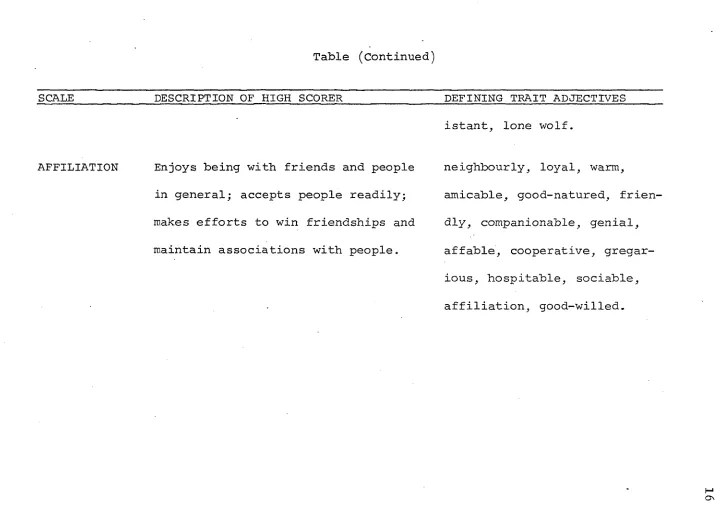
Looking at Table 1 and the description of the high
scorer on the achievement scale, Witkin's description of the
field independent person would suggest a high positive cor
relation between anxiety and field independence.
Autonomy would also seem to be logically related to the
idea expressed by Witkin as passivity. Here we would expect
that the person low on self-esteem and self-acceptance would
necessarily be low on independence of action and thought and
therefore swayed by the environment. Looking at the descrip
tion of the trait of autonomy in Table 1 we would expect a
high positive correlation between field independence and
au t o n o m y .
Finally, affiliation as described in Table 1 would also
seem to be related to field dependence. The description of
the high scorer on this scale would lead us to expect a high
positive correlation between the personality trait of affil
iation and field dependence.
Elliott's interpretation of field dependence in terms of
momentary state of disruption
Elliott (l96l) has challenged the Witkin interpretation
of field dependence as being related to dependence in p er
sonality and behaviour. Elliott hypothesized that field
in-R e p ro d u c e d w ith p e rm is sio n of the c o p y ri g h t o w n e r. F u rth e r re p ro d u c tio n p ro h ib ite d w it h o u t per m is s io n .
Table 1
Personality Research Form Scales
SCALE DESCRIPTION-OF HIGH SCORER DEFINING TRAIT ADJECTIVES
ACHIEVEMENT Aspires to accomplish difficult tasks;
maintains high standards and is will
ing to work toward distant goals;
responds positively to competition;
willing to put forth effort to attain
excellence.
striving, accomplishing, cap
able, purposeful, attaining,
industrious, achieving, aspir
ing, enterprising, self-improv
ing, productive, driving, am
bitious, resourceful, competi
tive .
AUTONOMY Tries to break away from restraints,
confinement, or restrictions of any
kind; enjoys being unattached, free,
not tied to people, places, or
obligations; may be rebellious when
unmanageable, free,
self-reliant, independent, autono
mous, rebellious, unconstrained,
individualistic, ungovernable,
R e p ro d u ce d w ith p e rm is sio n of the c o p y ri g h t o w n e r. F u rth e r re p ro d u c tio n p ro h ib ite d w it h o u t per m is s io n .
Table (Continued)
SCALE___________ DESCRIPTION OF HIGH SCORER_______________ DEFINING TRAIT ADJECTIVES______
istant, lone wolf.
AFFILIATION Enjoys being with friends and people neighbourly, loyal, warm,
in general; accepts people readily; amicable, good-natured,
frien-makes efforts to win friendships and dly, companionable, genial,
maintain associations with people. affable, cooperative, gregar
ious, hospitable, sociable,
17
tellectual disruption when the subject's situation is marked
by unusualness, incongruity, confusion or lack of structure
in general" (p.34). This disruption lasts until some system
or order is imposed upon the situation either by the subject
or some external agency such as the luminous frame. Elliott
relies on the work of Gross (1959), Block (1957) and Linton
(1955) in his interpretation of field dependence. Additional
support for his position is provided by Hustmyers and Karnes
(I9 6 4 ); Cohen, Silverman and Shmavonian (1963 ) 5 Shipman and
Heath (1 9 6 7 ); and Morf and Howitt (1970).
Physiological e v i d e n c e . Block (1957), using Galvanic
Skin Recordings (GSR), separated a group of 70 male medical
students (applicants) into groups he called reactors and non
reactors, The reactors were described in terms of an adjec
tive check list as cautious, dependent, dreamy, idealistic,
mannerly and suggestible. Non-reactors were described as
clever, cool, evasive, independent, ingenious, leisurely,
opportunistic, practical and realistic. The reactors p e r
formed more poorly on the RFT, i.e. were more field depend
ent. Block (1957) adds that the reactors were more open to
outside influence than the non-reactors who relied on prop
rioceptive cues. These two groups did not differ in the
Asch type situation in terms of yielding.
Lacey and Lacey (1958) related spontaneous autonomic
nervous system (ANS) activity logically to cortical electri
cal activity and experimentally to motor impulsivity. G.S.R.
18
relate to frame dependency. Silverman, Cohen and Shmavonian
(i9 60) suggest that Lacey and Lacey*s (1958) measure was
perhaps more concerned with gross fluctuations in autonomic
rhythms which are related to individual autonomic system
characteristics. This idea is reinforced by the fact that
Lacey and Lacey's (.1958) measure of ANS spontaneity was
obtained under resting conditions as opposed to B l o c k ’s lie
detection measure.
Using more sensitive equipment in a situation similar
to B l o c k ’s; Silverman, Cohen, Shmavonian and Greenberg (1961)
selected the 6 most field dependent and the 5 most field in
dependent subjects from a group of 109 subjects using succ
essive selection based on the Machover figure drawing and the
RFT. GSR recordings under a condition of sensory deprivation
showed that the field independent subjects had significantly
fewer spontaneous bursts. The subjects in the Silverman et
a l . (1 9 6 1 ) experiment could not be differentiated under the
pre-experimental "at rest" condition. Silverman, Cohen and
Shmavonian (i96 0 ) in a previous paper, suggested that their
measures may very well be more related to transient changes
in central nervous system arousal.
Hustmyers and Karnes (1967 ) decided to test Lacey and
La c e y ’s (1958) ANS spontaneity measure in a setting similar
to the lie detection situation that Block (1957) used. Their
results further established the link between a physiological
variable, ANS spontaneity, and a perceptual personality dim
19
in conjunction with those of Block (19 57)> and Silverman et
al. (i9 6 0 ) indicate a physiological basis for the field
dependence-independence continuum. Lacey and Lacey's (1958)
neurological model can be thus interpreted as supporting the
hypothesis that there is a physiological substrate to the
field dependence-independence continuum.
Shipman and Heath (1967 ) conclude from their data on
heart rates, that the field dependent person, in order to
avoid the anxiety of an unstructured situation, seeks out a
clearly defined situation and role, then settles down to a
very relaxed if not sluggish stage where even the heart beat
is slower.
Subject's reports. Linton (19 55) reported that design
dependence (field dependence as defined by the EFT) related
positively with increase in reported autokinetic movement in
the presence of influence exerted by a confederate. In a
post-experimental interview, the subjects were rated for
degree of negativism defined as a deliberate decision to
avoid being influenced by him. Both of these variables cor
relate to a significantly higher degree with the EFT, than
to autokinetic c h a n g e s . The relationship between design
dependence and autokinetic change vanishes when either inter
view variable is partialed out. It seems possible according
to Elliott, that field dependence is related more to some
kind of disruptive emotional response than to the conforming
situation per s e .
20
significantly in frame dependence did not differ in degree
of yielding in the Asch-like conformity task; but were m a r k
edly different in the degree of self-rated confidence with
which they made their decision.
Gross (1959) found that she could increase the frame
dependence of all her subjects using a fake lens. The author
stated that this occurred because of the increased uncertain
ty in the use of external c u e s . highly frame dependent sub
jects tended to check themselves as feeling uncertain signi
ficantly more often than frame independent subjects who in
turn checked themselves as feeling expectant.
Experimental manipulation of presumed d i s ruption. The
Gross (1959) study showed that it is possible to increase
the frame dependence of all subjects using a bogus distorting
lens. The subjects in this study were led to believe that a
special lens was being used to increase the ambiguity of the
stimulus; in reality clear glass was used.
Morf and Howitt (1970) using solvable and unsolvable
anagrams, and pre and post anagram RFT and palmar sweat dif
ferences scores, found that within a narrow range of inter
mediate arousal or disruption levels, the greater the physio
logically measured disruption, the greater the decremental
effect on RFT performance.
Objectives of the study and hypotheses
As the Witkin-Elliott controversy indicates, there is
21
study has two objectives pertaining to this question: (l)
to explore the relationship between personality traits as
measured by a reliable test, the PRF (Personality Research
Form, Jackson, 1 9 6 7 ), and RFT performance; and (2 ) to exam
ine in detail the relationship between need achievement and
RFT performance.
The relationship between PRF traits and RFT perfor m a n c e .
Since the personality traits of autonomy and affiliation as
measured by the PRF are thought to be stable and general,
Witkin's cognitive style theory suggests there should be a
high positive correlation between performance on the RFT and
scores on these two scales. It is hypothesized that subjects
can be classified accurately on the basis of their PRF p r o
file and that the PRF profiles of high and low RFT scores
will differ significantly, particularly in the scales of
autonomy and affiliation.
Need achievement, disruption and RFT p e rformance. If
the results do indicate a high positive linear correlation
between need achievement as measured by the PRF and field
independence in the RFT situation, then this will be inter
preted as support for the Witkin position. However, it is
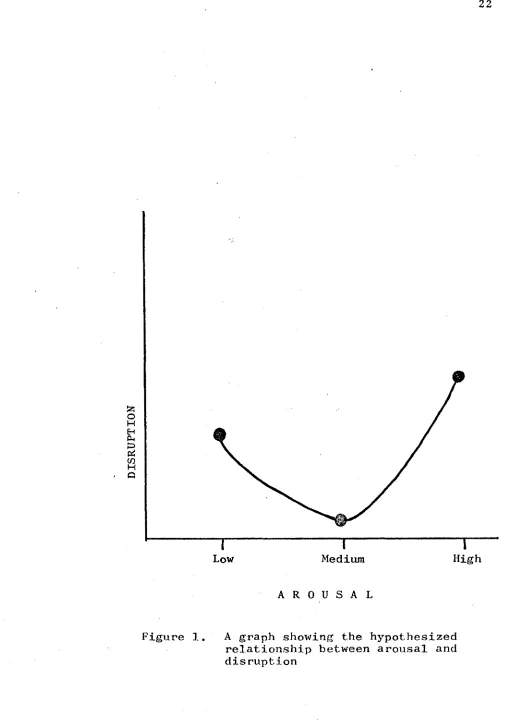
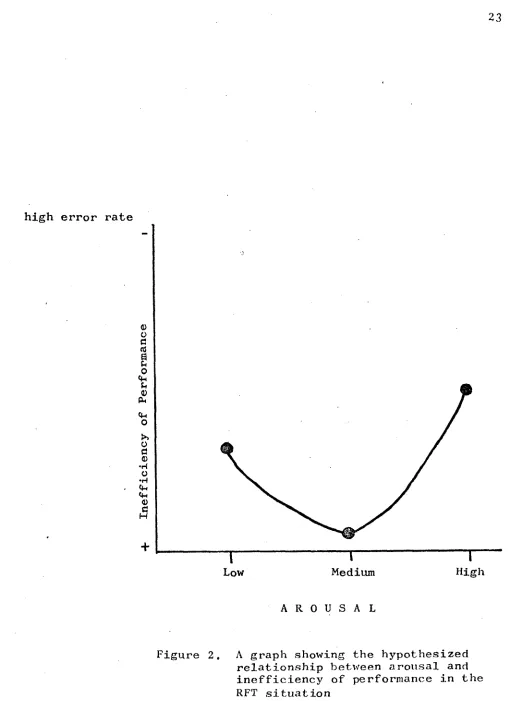
hypothesized that a curvilinear relationship as shown in
Figures 1 and 2 will result because this would be in
keeping with the Elliott position of momentary disruption.
Morgan (1965) states that the reticular activating sys
tem, (RAS) and the cerebral cortex form a closed loop in
22
525
O
H
(H Ck
t=>
Vi
CO
H
O
1---Medium r
L o w High
A R O U S A L
Figure 1. A graph showing the hypothesized
23
high error rate
4) O
e
«s S
Ch
o cm
<U
cm o
>> o
cs
<D •rf
O •H cm cm 0) C w
L o w Medium High
A R O U S A L
Figure 2. A graph showing the hypothesized
its name implies, responsible for arousal and sleep. During
periods of arousal the cerebral cortex is bombarded with im
pulses from the lower areas in the brain stem.
The physiological data of Block (1957); Silverman et al
(i960, I96I); Cohen et a l . (1963); Hustmyers and Karnes
(1964); and Lacey and Lacey (1958) suggest, in the Elliott
(1961) framework, that those subjects who are high achievers
will b e disrupted the most in an ambiguous situation such as
the RFT. The fact that high achievers do strive more con
tinuously in ambiguous situations is verified by Clark and
McClelland (1950). The high achiever is disrupted the most
because in a situation such as the RFT where he enters the
RFT in an aroused state to begin with, having higher expec
tations (Clark & McClelland, 1950), the added, anxiety elicit
ed by the unstructured test situation results in over stimu
lation of the cortex by the RAS. Because he is unable to
impose order on the situation autonomously, and the only
frame of reference he has is the luminous frame; he uses
this as an orienting point. Consequently his performance in
the RFT situation suffers the most in terms of deviations
off-centre. The low achiever is also disrupted but to a
lesser d e g r e e . Thus he adheres to the luminous frame as an
orienting point also, but because his level of arousal is
not as great to begin with as the high achiever he is less
disrupted. Consequently, his RFT performance suffers but
not to the same extent as the high a c h i e v e r ’s performance.
25
but is optimally aroused by the situation and makes the
smallest amount of errors because he is disrupted the least.
The second hypothesis thus follows: The relationship
between need achievement as measured by the PRF and RFT
performance will be curvilinear with those subjects scoring
highest on need achievement, exhibiting the poorest perfor
mance in the RFT situation in terms of degrees off-centre.
Those subjects who are lowest on achievement as measured by
the PRF will exhibit intermediate performance in the RFT
situation in terms of degrees off-centre. Those subjects
medium on achievement as measured by the PRF will be accur
ate in the RFT situation displaying little deviation in
METHOD
Subjects
The sample consisted of 22 males and 22 females, all
undergraduates at the University of Windsor. Their median
age was 20 with a range of from 18 to 27 years.
Apparatus
The RFT apparatus used was an adaptation of that d es
cribed by Witkin et a l . (1954). Correlations ranging from
.74 to .89 with the Witkin RFT (Witkin et. al.., 1954) have
been obtained with similar, portable RFT's of the type used
here (Kato, 1964; Morris, 1968; Oltman, 1967). The appara
tus consisted of a metal cylindrical tube 35.6 cm. in dia
meter, fitted at one end with external, adjustable and indep
endent positioners of an internal square frame and rod. At
the other end of the closed tube was a scuba diving face
mask (glass removed) surrounding two apertures 2.9 cm. in
diameter for viewing the inside of the tube. The length of
the tube from internal luminous rod and frame to the viewing
mask was 72,3 cm. The rod and frame were illuminated by a
concealed bulb emitting black light controlled by an on-off
switch. The entire apparatus was placed on a table 76.2 cm.
high and a subject seated in front of the apparatus had to
place his head into the face mask to see the rod and frame.
Diagrams showing the essential features of the apparatus are
presented in Appendix A ,
Design
Basically, the study was designed to permit a discrim
inant function analysis to separate the two criterion groups,
high and low RFT performers. The predictor variables were
the IS scales of the PRF. Thus, the RFT scores represented
the independent variables and the PRF scales the dependent
variables. A linear discriminatory analysis was used which
(see Nunnally, 1967, p . 391) maximized the discrimination
among groups through a system of weighting according to the
formula:
Y = a 1Xl + a 2x 2 + ... + a l 5x15
where Y = a s u b j e c t ’s score on the discriminant function
x x , x 2 = raw score variables (PRF scale scores)
a l, a 2 = weights for variables
The resulting new scores represent the projected loca
tions on the discriminant function as shown in Figure 3.
The weighting of the raw scores results in the m aximiz
ing of the ratio of variance between means over the variance
within means. This ratio serves the same function as the
ratio of "between" to within variance in a one-way classifi
cation of the analyses of variance.
Procedure
Each subject was seated in front of the RFT apparatus.
The subject was given a standardized set of instructions
(see Appendix B). If there were any questions asked by the
28
X 2
Low RFT For example
PRF scale 2
High RFT
Low RFT
Abasement High RFT
For example PRF scale 1
(The diagram indicates the discrimination between two criterion groups on the basis
of 2 PRF' scales. In fact, there were 15)
Figure 3« Theoretical projection of scores
29
High RFT
Low RFT
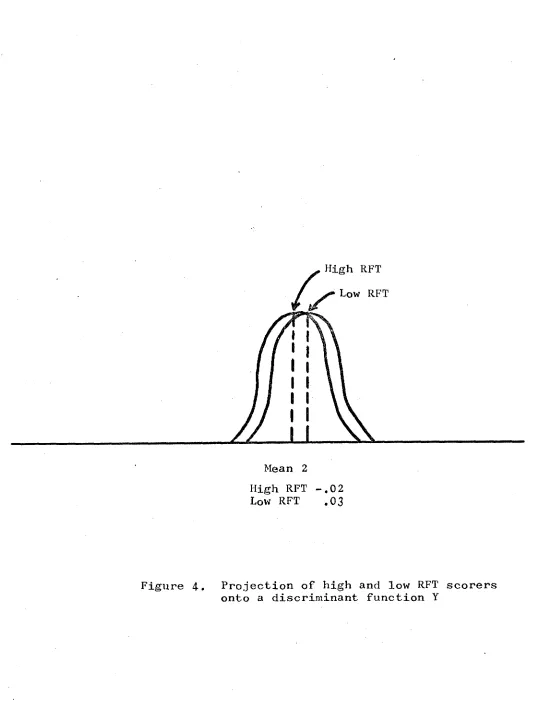
Mean 2
High RFT -.02
Low RFT .03
Figure 4. Projection of high and low RFT scorers
30
instruction sheet.
Upon completion of two sets of four trials with the RFT
apparatus, the subject was asked to go to the Uni v e r s i t y ’s
Psychological Centre at his convenience within certain spec
ified hours. There the subject completed Form A of the PRF
(Jackson, 1 967). Feedback was promised and given at the
RESULTS
Discriminant Function Analysis
Discrimination of the two criterion g r o u p s . The prog
ram used'*' computes the F ratio of the variance between means
on the discriminant function and the variance with each cri
terion group (Nunnally, 19&7, p . 392). The F obtained was
1.02. The number of degrees associated with the numerator
is IS; the number of degrees associated with the denominator
is 28, With these degrees of freedom, the F ratio would
have to be 2.75 to be significant at the .05 level of con
fidence. Thus the obtained F was not significant. The per
tinent results are presented in more detail in Figure 4.
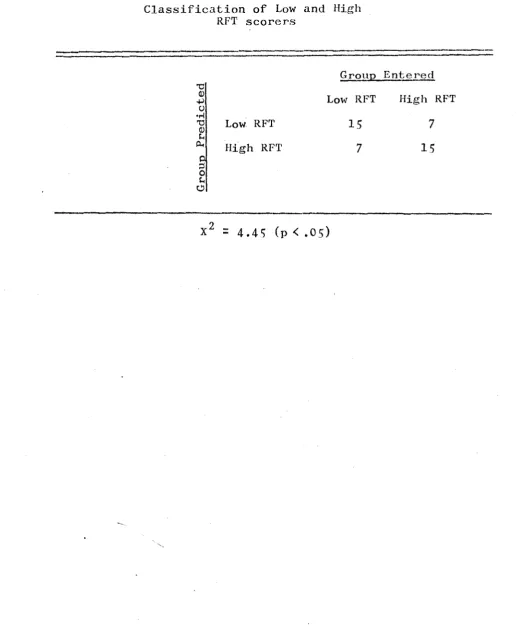
Classification of high and low RFT sc o r e r s . The class
ification of subjects into one or two criterion groups is a
useful procedure even when a non-significant F is obtained
(Brown, 1970). Kendall (1 961, v o l . 2, p . 1 59) gives three
alternatives to the question whether a discriminator is sig
nificant. It could be that there is a real difference b e t
ween the populations but they are so close together that a
discriminator is not very effective. This point can be
tested by checking the errors in misclassification, which
though minimal, may still be sufficiently large to cause an
insignificant F. Or it may be that the sample size was so
small that the real difference existing there was obscured,
i.e. the sample size was so small as not to produce a reli
able discriminator. Kendall (1961) feels this is overcome
by setting confidence intervals to the function or its co
efficients. The third alternative is that the two popula
tions are identical and discrimination is impossible. In
the present study, there was adequate classification rates
as shown in Table 2 and the first of Kendall's explanations
appears to apply. A chi square (with Yates' correction fac
tor) was computed on the classification rates. This value
4.45 was significant at the . 05 level of confidence. Also
the sample size in this study satisfied requirements for the
discriminant function a n a l y s i s . These results suggest that
subjects can be classified as high or low RFT scorers on the
basis of PRF profiles. Since the PRF profile reflects loca
tion on traits such as achievement, affiliation, abasement
... (15 in all) and since these traits are thought to be
stable, enduring and relatively fixed dimensions, this find
ing may provide some support for the trait interpretation of
field dependence as presented by Witkin et. aJL. (1954).
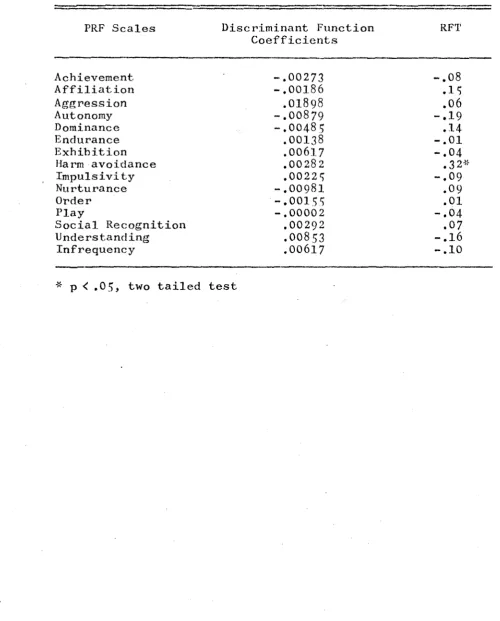
Individual PRF scales in relation to RFT perfor m a n c e .
The coefficients of the discriminant function are listed in
Table 3. These coefficients represent the weights applied
to the predictors in the discriminant function a n a l y s i s .
They are indicators of the importance of each predictor in
classifying subjects as high or low RFT scorers. The prod
uct moment correlations between PRF scales and RFT scores
re-33
TABLE 2
Classification of Low and High RFT scorers
T3 0 4->
O •f-l TS
CD
Cm
Oh
Cl S o Cm o
Group Entered
Low RFT High RFT
Low RFT 15 7
High RFT 7 15
34
TABLE 3
Discriminant Function Coefficients and Product Moment Correlations with RFT Shores
of the PRF Scales (N = 44)
PRF Scales Discriminant Function
Coefficients
RFT
Achievement -.00273 -.08
Affiliation -.00186 .15
Aggression .01898 .06
Autonomy -.00879 -.19
Dominance -.00485 .14
Endurance .00138 -.01
Exhibition .00617 -.04
Harm avoidance .00282 .32*
Impulsivity .00225 -.09
Nurturanee -.00981 .09
Order -.0015 3 .01
Play -.00002 -.04
Social Recognition .00292 .07
Understanding .00853 -.16
Infrequency .00617 -.10
3 5
latecl to but not the equivalent of the discriminant function
coefficients. The only significant correlation obtained was
that between the harm avoidance scale and the RFT. Neither
autonomy nor affiliation, two measures of personality depen
dence, were correlated significantly with the RFT.
Achievement and RFT performance
Need achievement and RFT performance. The non-signifi
cant correlation of .08 between achievement and the RFT,
presented in Table 3 > does not necessarily mean there is no
relationship between the two. It could be that there is a
significant curvilinear relationship (see for example Spence,
Underwood, Duncan & Cotton, 1954). A polynomial regression
analysis was performed on the data. The program^ used, c om
puted first the linear regression effect, then assigned a
portion of the error sum of squares (reflecting the devia
tions about the regression line) to a quadratic term, to a
cubic term and finally to a quartic term.
These components are shown in Table 4 . None of the
effects were significant at the .05 level.
This procedure yielded a fourth power polynomial reg
ression equation (i.e. a quadratic function) of the following
t y p e :
y = ax^ + bx^ t cx^ + dx + e .
2
36
TABLE 4
Final Analysis of Variance for 4 Degree Polynomial (BMD0 5R)
Source df MS F
Linear Term 1 19.30 0.24
Quadratic Term 1 1^6.17 2.01
Cubic Term 1 48.33 0.62
Quartic Term 1 107.07 1.38
Deviation about
Regression 39 77.41
TOTAL 43
■^Biomedical Computer Programs, B M D 05R, University of
In principle this higher order polynomial serves the
same purpose of prediction as the familiar linear regression
equation:
y : ax f b.
The general formula for a polynomial regression is:
= a + biY 4- b „ Y 2 + . . . b Ym (Ferguson, 1966,
2
p
.
3 46).
This general equation represents all the polynomial
expressions from the first degree to the m'th degree. For
example, if all the terms to the right of b^Y vanish, then a
linear equation remains. If all the terms to the right of
b 2Y 2 vanish, then a quadratic equation or a second order
polynomial remains.
Within this general framework, a represents the point
where the curve intercepts the X axis; b j , b 2 and bm are the
regression coefficients or weights which are found through
the method of least squares (Ferguson, 1966, p.ll8); and Y,
DISCUSSION
Linear analysis of the relationships between PRF traits and
RFT scores
The product moment correlations between RFT scores and
PRF scales (see Table 3) were all statistically non-signifi
cant except for Harmavoidance.
The fact that there was not a high positive correlation
between the traits of affiliation and autonomy as measured
by the PRF and the field dependency dimension as outlined by
Witkin et, a l . (1954) > may be interpreted as support for the
Elliott (I96I) position.
The method of measurement might .also have contributed to
the low correlations between those traits selected for obser
vation and RFT s c o r e s .
In this respect the achievement scale is of particular
interest in light of previous research. Wertheim and Mednick
(1958) found a significant relationship between field indep
endence and need achievement, when the measure of need ach
ievement was based on fantasy materials.
Marlowe (19 58) attempted to replicate the findings of
Wertheim and Mednick (1958) using an objective paper and
p e n c i l test, the EPPS. Marlowe hypothesized a positive cor
relation between field independence as measured by the
Thurstone adaptation of the Gottschaldt Embedded Figures
Test (EFT); and achievement, autonomy, dominance and
intra-ception as measured by the EPPS. Marlowe further hypothes
39
measured by the EFT and succorance as measured by the EPPS,,
Of the five needs hypothesized to be correlated with
field independence, only two yielded significant results,
intraception and succ o r a n c e . Marlowe points out that the
failure of autonomy and dominance to yield significant cor
relations was "most noteworthy" as these needs could be con
sidered similar to Witkin*s "active coping" and "mastery of
environmental forces" (19 58, p . 334).
Thus, the results of this study using the PRF and RFT
support the results obtained by Marlowe using the EPPS and
EFT.
However, these same results conflict with those obtained
by Wertheim and Mednick (19 58) using the EFT and projective
techniques and Witkin who used EFT, RFT and Rorschach indica
tors. Similar results to those obtained by the present in
vestigation were obtained by Kavanaugh (1970).
The difference between those studies just mentioned
seems to be one of measuring instruments or more specifically,
structured self-report tests versus perceptual assessment
techniques.
In terms of the Witkin-Elliott dilemma, is it possible
that structured tests such as the EPPS and PRF reflect the
stable p e r s o n a l i t y t r a i t s W i t k i n fo c u s e s o n , w h i l e t h e p e r
ceptual techniques which Witkin actually used are more sub
ject to Elliott's "disruption" theory? Witkin e_t al^. (1954)
are fairly specific about the consistency and stability of
40
these dimensions are already in the formative stage at 8
years after birth in children. Witkin et a l 0 (19 54) also
mention that the personality dimensions of field dependency
and field independency are so deep-seated that even training
is ineffective in bringing about change.
Concerning the discriminant function results, Kendall
(1961, v o l 02, p . 1 5 9 ) states that there are three possible
explanations for a non-significant F ratio. These were det
ailed in the results section. Despite the non-significant F,
statistically significant classification rates were obtained
in the present study and the first of K e n d a l l ’s explanations
seems appropriate, i.e. it is likely that there is a real
difference between the two populations but it is so small
that the discriminator is not very effective. This is inter
preted as meaning that there is at least a trend reflecting
a true difference between the criterion groups. If all the
differences were purely random then no significant classifi
cation rates could be o b t a i n e d .
In future research of this nature, it might be advisable
to use a multiple correlation coefficient to examine the re
lationship between PRF predictors and RFT criteria. The m u l
tiple correlation coefficient would yield the proportion of
RFT v a r ia n c e a c c o u n te d f o r b y a l l t h e PRF t r a i t s c o m b in e d .
This index can be significant when the F ratio of the discrim
inant function analysis is not. Cronbach (19 57) has summar
ized the differences between the experimentalist and the psy