A Performance of QOS Body Contribution
Using Wireless Network
Ms.S.Gandhimathi.,Mr.K.J.Jagdish, M.E2., Mr. K.Sivakumar M.E3.,
Research Scholar, Department of Computer Science, Gnanamani College of Engineering, Tamilnadu, India 1
Professor, Department of Computer Science, Gnanamani College of Engineering, Tamilnadu, India2
Professor, Department of Computer Science, Gnanamani College of Engineering, Tamilnadu, India 3
ABSTRACT: Cloud-Assisted Wireless Body Area Networks (WBANs) is some regarding the key rising applied
sciences because medical applications among the area on Internet-of-Things. In cloud-assisted WBANs, the WBANs are capable after get right of entry to the wind resources, as are geographically close in accordance with the native Access Points (APs). However, in the arrival regarding negative radio link-quality between cloud-assisted WBANs or APs, energy blasting and job prolong about the network dynamically changed. In order in accordance with resolve this problem, we advocate an energy-efficient Body-to-Body (B2B) communications among coexisting WBANs in accordance with relay the facts concerning the patients in accordance with APs in imitation of furnish real-time healthcare services. On the mean hand, the healthcare capabilities enabled because of cloud-assisted WBANs are popularly known as like Healthcare as a Service (He-aaS). In He-aaS, such is entirely challenging after finalize a cost settlement in WBAN observe a heterogeneous architecture. The current pricing mechanisms, which are restrained according to the identical, are now well suited after He-aaS. We proposed a greatest then powerfully built pricing coverage because He-aaS among system after increase the profit level over every WBAN together with the attention concerning the superior QoS and energy. Extensive effects indicate that our proposed schemes are able according to efficaciously turn to advantage confined resource including choicest QoS and electricity consideration.
KEYWORDS: Wireless Body Area Network, Smart Health, QoS, Cooperative Packet Scheduling.
I. INTRODUCTION
It implements the overview of the network model that mainly consists of three entities, the WBAN of a patient, a service provider (SP) and a user (e.g., a nurse, a doctor, a government agency or an insurance company). The WBAN consists of some sensor nodes and a controller. The sensor nodes can communicate with the controller and the controller can communicates with not only the sensor nodes but also the Internet. The SP deploys the WBAN that monitors a patient’s vital signs and environmental parameter. If a user hopes to access the WBAN, it must be authorized by the SP. The SP is responsible for the registration for both the user and the WBAN and producing a partial private key for the user and the private keys for the WBAN. That is, the SP plays the KGC in the CLC. We suppose that the SP is honest and curious (the SP follows the protocol but hopes to know the transmitted messages). That is, we do not need to fully trust the SP since it only knows the partial private key of the user. This is important advantage of the CLC than the IBC. When a user hopes to access the monitoring data of the WBAN, it first sends a query message to the WBAN. Then controller checks if the user has been authorized to access the WBAN. If yes, the controller sends collected data to the user in a secure way. Otherwise, the controller refuses the query request.
II. RELATED WORK
Non-repudiation prevents the denial of previous queries submitted by the user. That is, if the user has submitted a query message to the WBAN, it can not deny its action. In addition, we also hope that this communication satisfies public verifiability and ciphertext authenticity. The public verifiability means that a third party can verify the validity of a ciphertext without knowing the controller’s private key. The ciphertext authenticity means that a third party can verify the validity of a ciphertext without decrypting it.
Security issues in the WBANs must be solved before real development [7]. Some secure schemes for the
WBANs have been proposed for different security goals. In 2013, Hu et al. [8] discussed how to protect the
communication between external users and the WBANs. Their solution is attribute-based encryption (ABE) [9]. However, the ABE may not be a good choice since it requires some costly cryptographic operations. These costly
operations are a heavy burden for resource-limited sensor nodes [7]. Lu et al. [10] proposed a privacy preserving
opportunistic method for the WBANs. This method can obtain reliable data process and transmission with minimal
privacy disclosure. Zhao et al. [11] discussed the key management problem of the WBANs. In order to reduce the
energy consumption, they used energy-based multihop-routechoice method and biometrics synchronization mechanism.
He et al. [12] discussed how to provide a secure communication channel in the WBANs. They used the lightweight
one-way hash chain to establish session keys. Tan et al. [13] designed an efficient identity-based encryption (IBE)
scheme named IBE-Lite for the WBANs. Compared with the traditional public key infrastructure (PKI) that employs a digital certificate to bind an identity and an public key, the identitybased cryptography (IBC) [14] does not require digital certificates. A user’s public key is computed from its identity information, such as identification numbers, e-mail addresses and IP addresses. The user’s private key is produced by a trusted third party named private key generator (PKG). Authenticity of a public key is explicitly achieved without an attached certificate. Therefore, the IBC eliminates certificate management trouble of the traditional PKI, including generation, distribution, storage, verification and revocation. Although the lightweight IBC is very suitable for resourceconstrainedWBANs, it has key escrow problem since the PKG learns all users’ private keys. That is, the PKG is capable of decrypting a ciphertext in an IBE scheme and forging a signature for a message in an identity-based signature (IBS) scheme. Therefore, the IBC only fits small networks, such as the WBANs, and does not fit large-scale networks, such as the Internet.
CERTIFICATELESS ACCESS CONTROL SCHEME
In this section, we design an efficient certificateless access control scheme for the WBANs based on identity-based access control (IBAC) model that associates access privilege with specific users. Our methodology uses CLSC with public verifiability and ciphertext authenticity. Such design has the following advantages: (1) It has neither key escrow problem nor public key certificates. (2) It allows the controller to check the valid of query messages without decryption. Such design saves the computational cost and energy consumption. Now we describe a concrete access control scheme using the modified BDCPS scheme. This access control scheme is composed of four phases: the initialization phase, the registration phase, the authentication and authorization phase, and the revocation phase.
III. EXISTING SYSTEM
In a hospital environment, the volume wide variety concerning Wireless Body Area Network (WBAN) equipped patients asking for ubiquitous healthcare capabilities between a location increases significantly. Therefore, increased traffic burden yet group-based activity on WBANs degrades the performance of every WBAN significantly, regarding work lengthen then network throughput. In addition, the operation over WBANs affects connectivity between
a WBAN and an Access Point (AP) dynamically, who impacts the variation within link multiplication significantly.In
this paper dynamic connectivity establishment and cooperative scheduling scheme, which minimizes the custom transport delay or maximizes the network throughput First, in accordance with impervious the reliable connectivity
Disadvantages
• It can be access only limited patient;
• A network throughput is high;
• It can’t access group of patient because of delay an occurrence problem;
IV. PROPOSED SYSTEM
We proposed to an energy-efficient Body-to-Body (B2B) communications among coexisting WBANs in accordance with relay the facts concerning the patients in accordance with APs in imitation of furnish real-time healthcare services. On the mean hand, the healthcare capabilities enabled because of cloud-assisted WBANs are popularly known as like Healthcare-as-a-Service (He-aaS).It is support to all durability people bear a full-size strong in accordance with lengthen the current Internet of Things infrastructures by means of implementing true encyclopaedic healthcare, making sure somewhere yet whenever patients connectivity. Through the forwarding concerning sensing facts beside character according to person till reaching a connected clinical server, health becomes proper along the rising on future Body-to-Body Networks. Indeed, the coexistence over a couple of WBANs (Wireless Body Area Networks), the verbal exchange and interactions into to them extend the classic idea concerning WBAN yet existing the current footstep referred in conformity with namely Body-to-Body Network (BBN).
Advantages
• It is used more energy and high performance through B2B communication;
• It is a more secured and efficient;
• it is consistency to used a patient;
• The entire network is used to dynamically;
V. METHODOLOGIES
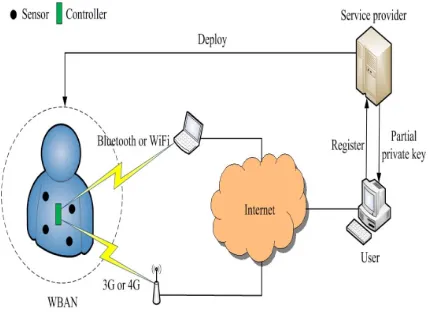
Figure shows the overview of the network model that mainly consists of three entities, the WBAN of a patient, a service provider (SP) and a user (e.g., a nurse, a doctor, a government agency or an insurance company). The WBAN consists of some sensor nodes and a controller. The sensor nodes can communicate with the controller and the controller can communicates with not only the sensor nodes but also the Internet. The SP deploys the WBAN that monitors a patient’s vital signs and environmental parameter. If a user hopes to access the WBAN, it must be authorized by the SP. The SP is responsible for the registration for both the user and the WBAN and producing a partial private key for the user and the private keys for the WBAN. That is, the SP plays the KGC in the CLC. We suppose that the SP is honest and curious (the SP follows the protocol but hopes to know the transmitted messages). That is, we do not need to fully trust the SP since it only knows the partial private key of the user.
Fig 5.1 System Architecture
WBAN
environmental parameter (e.g. temperature, humidity and light). The sensor nodes communicate with the controller and the controller acts as a gateway that sends the collected health data to the healthcare staffs and network servers. The WBANs increase the efficiency of healthcare since a patient is no longer required to visit the hospital frequently. The clinical diagnosis and some emergency medical response can also be realized by the WBANs. Therefore, the WBANs act as an important role in creating a highly reliable ubiquitous healthcare system.
Service Provider (SP)
The SP deploys the WBAN that monitors a patient’s vital signs and environmental parameter. If a user hopes to access the WBAN, it must be authorized by the SP. The SP is responsible for the registration for both the user and the WBAN and producing a partial private key for the user and the private keys for the WBAN. That is, the SP plays the KGC in the CLC. We suppose that the SP is honest and curious (the SP follows the protocol but hopes to know the transmitted messages). That is, we do not need to fully trust the SP since it only knows the partial private key of the user.
User
When a user hopes to access the monitoring data of the WBAN, it first sends a query message to the WBAN. Then controller checks if the user has been authorized to access the WBAN. If yes, the controller sends collected data to the user in a secure way. Otherwise, the controller refuses the query request.
Certificateless Access Control
In this Module, We design an access control scheme for the WBANs using the CLSC with public verifiability and ciphertext authenticity. In addition, the proposed scheme has neither key escrow problem nor public key certificates. The controller can verify the validity of a ciphertext without decryption. Compared with existing three access control schemes using signcryption, our scheme has the least computational cost and energy consumption for the controller.
VI. CONCLUSION AND FUTURE WORK
6.1 CONCLUSION
A modified certificateless signcryption scheme that satisfies public verifiability and ciphertext authenticity. We also gave a certificateless access control scheme for the WBANs using the modified signcryption. Compared with existing four access control schemes using signcryption, our scheme has the least computational time and energy consumption.
6.2 FUTURE WORK
In addition, our scheme is based on the CLC that has neither key escrow problem nor public key certificates. Future extension of this work includes studying and characterizing the dynamic behavior of link quality between WBANs and APs for the connectivity problem. Another extension of the work is to observe the performance of the proposed solutions in real-life setting for mobile edge computing applications. Consequently, in the presence of transient connectivity, the data rate adaption technique can be implemented to increase the overall performance of WBANs. On the other hand, we intend to address the security and privacy issues of cooperative packet scheduling among WBANs in critical emergency situations.
REFERENCES
[1] M. Chen, S. Gonzalez, A. Vasilakos, H. Cao, and V. C. Leung, “Body Area Networks: A Survey,” Journal of Mobile Networks and Applications, vol. 16, no. 2, pp. 171–193, 2011.
[2] A. Samanta and S. Misra, “EReM: Energy-Efficient Resource Management in Body Area Networks with Fault Tolerance,” in Proceedings of IEEE Global Communications Conference, 2017.
[4] J.-H. Hauer, “Leveraging Human Mobility for Communication in Body Area Networks,” ACM Transactions on Sensor Networks, vol. 10, no. 3, pp. 39:1–39:38, 2014.
[5] S. H. Cheng and C. Y. Huang, “Coloring-based Inter-WBAN Scheduling for Mobile Wireless Body Area Networks,” IEEE Transactions on Parallel and Distributed Systems, vol. 24, no. 2, pp. 250–259, 2013.
[6] Z. Xie, G. Huang, J. He, and Y. Zhang, “A Clique-based WBAN Scheduling for Mobile Wireless Body Area Networks,” Procedia Computer Science, vol. 31, no. 0, pp. 1092–1101, 2014.
[7] L. Wang, C. Goursaud, N. Nikaein, L. Cottatellucci, and J. Gorce, “Cooperative Scheduling for Coexisting Body Area Networks,” IEEE Transactions on Wireless Communications, vol. 12, no. 1, pp. 123–133, 2013.
[8] K. S. Prabh and J.-H. Hauer, “Opportunistic Packet Scheduling in Body Area Networks,” in Proceedings of European Conference on Wireless Sensor Networks, 2011, pp. 114–129.