
A BLARK extension for temporal annotation mining
Dafydd Gibbon
∗, Flaviane Romani Fernandes
†, Thorsten Trippel
∗∗Universit¨at Bielefeld, Germany
{gibbon,Thorsten.Trippel}@uni-bielefeld.de †Universitade Estadual de Campinas, Brazil
Abstract
The Basic Language Resource Kit (BLARK) proposed by Krauwer is designed for the creation of initial textual resources. There are a number of toolkits for the development of spoken language resources and systems, but tools for second level resources, that is, resources which are the result of processing primary level speech resources such as speech recordings. Typically, processing of this kind in phonetics is done manually, with the aid of spreadsheets multi-purpose statistics software. We propose a Basic Language and Speech Kit (BLAST) as an extension to BLARK and suggest a strategy for integrating the kit into the Natural Language Toolkit (NLTK). The prototype kit is evaluated in an application to examining temporal properties of spoken Brazilian Portuguese.
1.
Introduction
The original text–based Basic Language Resource Kit (BLARK) (Krauwer, 2005) is an initial specification of ba-sic tools for the development of Natural Language Process-ing tools which will ultimately support parsProcess-ing, generation, tagging, lexicon construction, information retrieval and ma-chine translation in local languages in a highly portable and interoperable fashion.
We extend the BLARK concept to spoken language by proposing a component for analysing temporal aspects of spoken language, with the aim of creating a “Basic Lan-guage and Speech Toolkit” (BLAST). To this end, we ad-dress the new area of Annotation Mining (AM) (Gibbon and Fernandes, 2005), proposing a subset of the basic tools required for developing databases for applications in pho-netics and speech technology.
AM originated in speech technology with the treatment of annotated speech recordings in which transcription seg-ments are aligned with segseg-ments of speech recordings in order to provide data for statistical word modelling in Auto-matic Speech Recognition and for unit selection techniques in Speech Synthesis.
AM uses a family of computational corpus linguistic and numerical techniques for creating second order speech re-sources by extracting and processing the two types of in-formation which are available in speech and multimodal signal annotations: Categorial Annotation Mining (CAM) from annotation labels, and Temporal Annotation Mining (TAM) from annotation time–stamps. We describe compo-nents of a language–independent TAM toolkit and an initial validation comparing datasets for Brazilian Portuguese. The background to this work is in the language resources paradigm represented by many European Commission funded projects, and in work in language archiving dis-cussed in (Bird and Simons, 2003). The following sec-tion deals with the issue of temporal annotasec-tion mining, followed by a discussion of the functional requrements for a temporal annotation toolkit. After this, phonetic require-ments are outlined in relation to a range of temporal prop-erties of annotated speech corpora. Subsequently, design issues are discussed, and components of the toolkit are
out-lined. After a brief discussion of the implementation strat-egy, a case study is presented, in which the tools are applied to Brazilian Portuguese, followed by a conclusion.
2.
Functional specification
The AM toolkit provides resources at a level suitable for further computational phonetic analysis and for Machine Learning (ML). This goal distinguishes AM in both con-tent and method from conventional manual investigations of speech signals and annotations, as still practised in many traditional phonetic studies. Additionally, AM for linguis-tic analysis and machine learning is also distinguished from techniques of large–scale statistical processing of annota-tions plus signals for system training in unit–based Text– To–Speech and Automatic Speech Recognition. In specific cases, AM methods and speech technology methods over-lap, but in general linguistic analysis and speech technol-ogy have different modelling requirements with respect to annotation data. We see AM toolkits as being extensions of a BLARK, the Krauwer “Basic LAnguage Resource Kit” (Krauwer, 2005) for spoken language research and develop-ment as a “Basic Language and Speech Toolkit” (BLAST). Examples of CAM are extensive, and are found mainly in computational corpus linguistic analyses in which tran-scription labels are extracted from the signal annotations and subjected ton-gram analysis, chunk parsing, concor-dancing procedures, etc. Examples of temporal TAM are not so common. The investigation of temporal information from speech signals has a long history in phonetics, but in general TAM techniques have only been applied sporadi-cally to this area so far (Bird, 1999). In (Gibbon et al., 2000) temporal relations are extracted automatically from multi–tier annotations on the basis of an event logic anal-ysis and implementation. Traditional phonetic analanal-ysis of temporal properties of speech, specifically rhythm, are eval-uated in (Gibbon and Fernandes, 2005) by applying imple-mentations of models of these approaches to a Brazilian Portuguese corpus and comparing the results.
tracks (of empirically observed events) and linguistic tiers (of theory–based predictions).
3.
Phonetic requirements
The linguistic and phonetic requirements for the TAM toolkit include determination of the following:
• speech rate in terms of units of different size on differ-ent annotation tracks;
• utterance–internal speech rate variation;
• timing evenness or equality (isochrony);
• periodicity of suprasegmental patterns as a basis for analysis of rhythm and other temporal structures;
• duration types: segmental (e.g. contrastive length), syllabic (e.g. in foot structure), focus–related (corre-lates of nuclear and related accentuation); utterance– related (e.g. final lengthening, parenthesis accelera-tion);
• precedence and overlap relations in different annota-tion tracks;
• syntchronisation of functionally related different an-notation tracks (e.g. duration and pitch in focus anal-ysis).
4.
Design of toolkit components
The toolkit contains tools for normalisation, comparision and statistical evaluation of data and of models of the above parameters. The following tool types are currently avail-able:
1. Format normalisation. Annotation formats such as Praat, Transcriber are converted into a standard XML format (TASX DTD). The lattice and table data struc-tures of annotations (Bird and Liberman, 2001), par-ticularly those with overlapping annotation tracks, are, strictly speaking, formally too complex for context– free XML–syntax, however, and require additional se-mantic specification (e.g. length of table rows, use of pointers/links). A wealth of different and essen-tially incompatible XML specifications for annotation description exit. Consequently, we normalise anno-tations more appropriately to a relation implemented by a tabular structure, in the simplest case the classic sequence of triples of labels and time–stamps, which is interpretable as an annotation graph. Exporting to XML (or other archiving formats) is left to choices specific to XML users. The choice of a “realistic” tab-ular format has the further advantage that it can easily be further processed with conventional scripting tech-niques or imported into a spreadsheet application for intial post–processing and easy visualisation.
2. Linear global and local models of speech timing. Variance–based phonetic models of speech timing (in-cluding PFD, RIM, PVI) are straightforward to im-plement, but time–consuming to investigate manually, even with basic computational help such as spread-sheet functions. These models have been shown to be inadequate as rhythm models (though this is what they have been claimed to be), but they are
still useful as measures of isochrony vs. irregularity (Gibbon, 2003a), (Gibbon, 2003b). Later, the TAM toolkit will contain experimental implementations of dynamic phonetic models of speech timing (incuding those of Barbosa, Cummins, Wachsmuth), which in-troduce periodicity criteria into temporal structuring.
3. Hierarchical models of speech timing. Linguistic models of prosodically relevant patterns are generally tree–structured. It is not trivial to relate these to tim-ing structures. Two algorithms for tree–buildtim-ing from time–stamp sequences are included, one which builds right–headed structures, one which builds left–headed structures. A tool for quantitative comparison of the resulting tree structures is included.
The first evaluation of the toolset was a form of field eval-uation by applying the tools to specific speech data and checking for linguistic and phonetic plausibility, originally designed for examining focus in Brazilian Portuguese (Gib-bon and Fernandes, 2005). Currently applications to Man-darin Chinese and to Ibibio (Lower Cross, Nigeria) are in progress. Further work in progress extends the annotation-based tools with automatic sonority–annotation-based processing (?) in order to move from symbol–based annotation–mining to signal–based annotation mining, and to incorporate re-lations between the TAM and CAM dimensions.
5.
Components
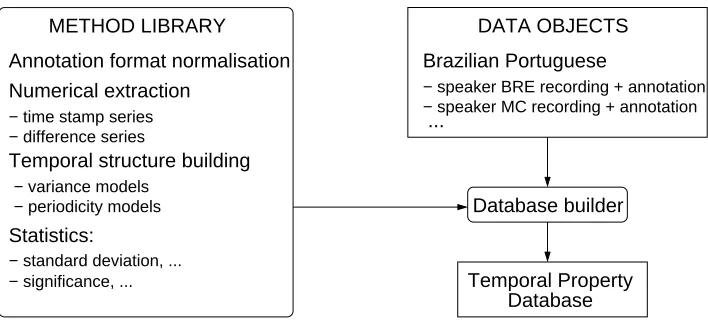
An overview of the architecture of the TAM toolkit library is shown in Figure 1. The tools fall into three main classes:
1. annotation preprocessing,
2. temporal models, 3. statistical tools.
5.1. Annotation preprocessing
There are many annotation formats. The use of a standard markup language such as XML is no guarantee of compati-bility. XML defines recursive tree structures with two main tree categories: objects modelled as embedded entities, and properties of objects, modelled by attribute-value pairs at-tached to entities. Consequently, there are two main sources of incompatibility between actual annotations in XML for-mat:
1. XML is a metasyntax:
(a) the choice of categories and properties im-plemented as entities and their properties is application–specific; different annotating person-nel may choose different representations.
(b) the choice of entities vs. properties for represent-ing properties of the speech signal may vary; a common example is the treatment of the annota-tion label as either an entity or as a value of an attribute of an entity.
Statistics:
Annotation format normalisation
Temporal structure building Numerical extraction
− difference series
− variance models − periodicity models
− standard deviation, ... − significance, ... − time stamp series
METHOD LIBRARY
Brazilian Portuguese
...
− speaker MC recording + annotation − speaker BRE recording + annotation
DATA OBJECTS
Temporal Property Database Database builder
Figure 1: Temporal Annotation Mining (TAM) library overview.
criteria but by different annotation tools, such as Tran-scriber or the TASX Annotator, are far from isomor-phic, and may only be partially converted into each other.
2. For non–tree–like objects, XML has to be supple-mented by additional devices. Non–tree–like objects of the following kinds occur in speech signal annota-tions:
(a) embedded tables (can be modelled informally by trees, but need more complex informal informa-tion such as identical row–branch count); (b) parallel annotation tiers with synchronised time–
stamps;
(c) overlapping dialogue turns.
Each of these cases requires an additional layer of in-formation over and above tree definitions, adding to the formal complexity of the annotation.
The solution taken in the TAM library is to convert annota-tion tiers into a flat database structure rather like tradiannota-tional SAM, HTK and esps/waves+ annotation conventions, con-sisting of triples< label, timestamp1, timestamp2>.
5.2. Temporal models
The development of the TAM library was based on acute research and development issues in the temporal modelling of speech, not as a programme for future applications, and evaluated on specific corpora, most extensively on Brazil-ian Portuguese.
The literature on timing and rhythm reveals a wide variety of phonetic models which are conventionally calculated by hand or with spreadsheets, but which can be relatively eas-ily calculated automatically. These methods are being con-tinually extended; a selection of specifications of models is shown in Table 1, together with notes on their properties (see also (Gibbon and Fernandes, 2005)).
The following basic properties of rhythm models are partly based on (Gibbon and Gut, 2001), on (Gibbon, 2003b; Gib-bon, 2003a) and on (Gibbon and Fernandes, 2005):
Base unit: a finite trajectory through an n-dimensional parameter space (pitch, segment, syllable, foot se-quence...).
Alternation: a dynamic, not flat base pattern trajectory, i.e. traversal through at least two positions in the parameter space (varying pitch pattern, CV syllable pattern, long–short or strong–weak syllable foot pat-tern,...).
Iteration the base patternP must repeat with at least two occurrences:P P+, i.e. any of
{< P1, P2>, < P1, P2, P3>, ...}.
Isochrony : equal length of the base pattern, i.e.
|Pi|=|Pi+1|.
The models which have been currently implemented in the TAM library toolkit concentrate on specific Base Units (e.g. syllable) and on the Isochrony criterion, rather than on more specifically rhythmic properties such as Alternation and It-eration.
6.
Implementation
The current implementation of the TAM library is in a bination of UNIX tools which can easily be ported to com-monly used scripting languages such as Perl or Python. For current purposes, Python is the best option, since it would ensure compatibility with the widely used Natural Language Tool Kit (NLTK), (Bird and Loper, 2004). The implementation of the Roach timing model (cf. Ta-ble 1) is implemented inawk(a less arcane predecessor of Perl):
#!/usr/bin/gawk -f # stat-roach-pfd.sh # D. Gibbon
# 2005-04-05
# Roach foot deviation model
BEGIN { n=ARGC-1;
for (i=1;i<ARGC;i++) { sum=sum+ARGV[i]; };
mean=sum/n;
for (i=1;i<ARGC;i++) {
meandiff=mean-ARGV[i];
• OO corresponds to an only object constituted by two elements to and SS,
• and SS (Scomp) corresponds to a complex subject constituted by four elements (two substantives and two adjectives, for example: ’o tatu russo e a abelha rainha’- ’the Russian armadillo and the queen bee’).
The sentences contain transitive verbs, unaccusative verbs or unergative verbs.
7.3. Speakers
The sentences were produced by five educated (graduate) female Brazilian speakers (age range 26 to 51 years) from different regions of Brazil:
1. Rio de Janeiro city (Rio de Janeiro State),
2. S˜ao Jos´e do Rio Preto city (S˜ao Paulo State),
3. Garc¸a city (S˜ao Paulo State) and
4. Itumbira city (Goi´as State).
Four speakers are in the age range 26 to 40 years old, and one of the speakers is 51 years old.
7.4. Methodology
The corpus creation procedure is as follows:
1. recording of the corpus sentences,
2. syllabic segmentation, phonetic transcription and an-notation of these sentences.
The speakers were asked to read two kinds of prompt sen-tence:
1. neuter sentences, in which no word was specifically constrained for focus by the context,
2. sentences with narrow focus on the subject.
These two types of sentences were produced by speakers on the basis of appropriate contextual triggers. The sentences with narrow focus on subject were produced as answers to questions like the following:
A: Quem correu? ‘Who runs?’
B: O Jos´e correu.
The Joe runs.
’Joe runs.’
The neutral sentences were produced as answers to ques-tions like:
A: O que aconteceu? ‘What happened?’
B: O Jos´e correu.
The Joe runs.
’Joe runs.’
The speakers were instructed to produce sentences natu-rally, neither slowly nor quickly. The complete corpus con-sists of 490 sentences (49 neuter sentences and 49 sentences with focus on subject, both types produced by the 5 speak-ers).
The recording of the sentences was made on a PC using the Praat speech analysis workbench1and with a good acoustic
capture microphone, Leson SM 48.
The syllabic phonetic annotation was made using Praat, ac-cording to conventions of the alphabet of International Pho-netic Association (IPA) represented by the SAMPA ASCII conventions. Two special conventions were adopted:
1. ‘N’ represents nasalization of the preceding vowel,
2. ‘R’ represents ‘r’ consonant in coda position.
The choice for ’R’ to indicate every variation of ’r’ in coda position was made because the speakers of different regions of Brazil showed some variations in the production of ’r’ in syllabic coda and this detail was not considered important to the objectives of the study.
7.5. Evaluation
In the present context, evaluation means the evaluation of the toolkit, rather than evaluation of the data; evaluation of the data is a means to an end, here, rather than an end in itself.
The data were successfully processed by the implemen-tations of speech timing (rhythm) models, producing the partly surprising result that the different models of speech rhythm did not correlate too well with each other. The result was unsurprising, in that different models might be expected to yield different results; on the other hand, the result was surprising in that the models claimed to model the same relationships between speech segments in terms of variation from isochrony.
The results are reported in (Gibbon and Fernandes, 2005).
8.
Conclusion and future prospects
In this study, we set out to extend the idea of the origi-nally text–based Basic Language Resource Kit (BLARK) (Krauwer, 2005) to spoken language resources proposing a set of tools for analysing the main characteristic formal property of spoken language, namely timing. In this re-spect, the study has continued work in the new area of An-notation Mining (AM), in proposing a subset of the basic tools required for developing databases for applications in phonetics and speech technology.The tools were both motivated by and evaluated against a Brazilian Portuguese corpus within the context of projects for investigating timing in neutral and focussed sentences, and also differences in rhythm-determining factors in Eu-ropean Portuguese and Brazilian Portuguese. In the course of this investigation, it was discovered that the formalisa-tion which the implementaformalisa-tion constraint on the tradiformalisa-tional approaches imposed led to the uncovering of both formal and empirical problems with the implemented models, due to incomplete specifications of concepts such as rhythm in the original approaches.
The broader implications of this work are situated within two main methodological areas:
Figure 2: Annotated Brazilian Portuguese sentence: O Mauro comprou livros. ‘[the] Mauro bought books.’ in focussed (left) and neutral (right) contexts, showing different temporal patterning.
1. the spoken language resource paradigm, with the goal of extending toolkit concepts such as the BLARK and NLTK which were discussed in the introduction, and, in the mid–term, integrating the tools into a seamless environment with well–defined databases as interfaces between tools, and interoperability determined by im-plementation in a generally used scripting language such as Python;
2. the subdiscipline of Computational Phonetics, with the goal of replacing laborious manual measurement and calculation with automatic procedures as far as pos-sible, initially on the basis of previously created an-notations, but ultimately also using automatic spoken language segmentation algorithms.
The current prototype toolkit is being extended by the ad-dition of other types of temporal analysis tool; on comple-tion of the initial development, the toolkit can be ported to Python and the feasibility of interfaces with NLTK tools will be examined, with a view to providing a spoken lan-guage oriented modules for NLTK. It is envisaged that the BLARK concept will be effectively defined as a subset of the extended NLTK, and that the spoken language oriented extensions to BLARK will constitute a “Basic Language and Speech Toolkit” (BLAST), comprising both written and spoken language elements of the NLTK.
9.
References
Steven Bird and Mark Liberman. 2001. A formal frame-work for linguistic annotation. Speech Communication, 33(1,2):23–60.
Steven Bird and Edward Loper. 2004. Nltk: The natural language toolkit. In Proceedings 42nd Meeting of the As-sociation for Computational Linguistics (Demonstration Track), pages 214–217, Barcelona.
Steven Bird and Gary Simons. 2003. Seven dimensions of portability for language documentation and description. Language, 79(3):557–582.
Steven Bird. 1999. Multidimensional exploration of online linguistic field data. Proceedings of the 29th Meeting of the North–East Linguistic Society, 26:33–50.
D. Duarte, A. Galves, N. Lopes, and R. Maronna. 2001. The statistical analysis of acoustic correlates of speech rhythm. The Sciences of Complexity Conference, ZiF, Bielefeld.
Sonia Frota and Maria Vig´ario. 2000. Aspectos de pros´odia comparada: ritmo e entoac¸˜ao no PE e no PB. In Rui v. Castro and Pilar Barbosa, editors, Actas do XV Encontro Nacional da Associac¸˜ao Portuguesa de Ling ¨uistica, volume 1, pages 533–555, Braga. APL. A. Galves, J. Garc´ıa, D. Duarte, and C. Galves. 2002.
Sonority as a basis for rhythmic class discrimination. In Speech Prosody 2002, Aix–en–Provence.
Dafydd Gibbon and Flaviane Romani Fernandes. 2005. Annotation–mining for rhythm model com-parison in brazilian portuguese. In Proceedings of INTERSPEECH–EUROSPEECH 2005, Lisbon.
Dafydd Gibbon and Ulrike Gut. 2001. Measuring speech rhythm in varieties of English. In Proceedings of EU-ROSPEECH 2001, pages 91–94, Aalborg.
Dafydd Gibbon, Harand L¨ungen, and Andreas Witt. 2000. Enhancing speech corpus resources with multiple lexical tag layers. In Proceedings of LREC 2000, Athens. Dafydd Gibbon. 2003a. Computational modelling of
rhythm as alternation, iteration and hierarchy. In Pro-ceedings of ICPhS 2003, Barcelona.
Dafydd Gibbon. 2003b. Corpus–based syntax-prosody tree matching. In Proceedings of EUROSPEECH 2003, Geneva.
Steven Krauwer. 2005. ELSNET and ELRA: a common past and a common future. http://www.elda.org/article48.html (14.10.2005 06:27:33).
![Figure 2: Annotated Brazilian Portuguese sentence: O Mauro comprou livros. ‘[the] Mauro bought books.’ in focussed(left) and neutral (right) contexts, showing different temporal patterning.](https://thumb-us.123doks.com/thumbv2/123dok_us/1073764.1134904/6.595.63.530.69.229/annotated-brazilian-portuguese-sentence-contexts-different-temporal-patterning.webp)
