Pitch Marking Based on an Adaptable Filter and a
Peak-Valley Estimation Method
Jau-Hung Chen and Yung-An Kao
Advanced Technology Center, Computer and Communication Research Laboratories,
Industrial Technology Research Institute, Chutung 310, Taiwan
Email: [email protected], [email protected]
Abstract
In a text-to-speech (TTS) conversion system based on the time-domain
pitch-synchronous overlap-add (TD-PSOLA) method, accurate estimation of pitch periods
and pitch marks is necessary for pitch modification to assure an optimal quality of the
synthetic speech. In general, there are two major issues on pitch marking: pitch detection
and location determination. In this paper, an adaptable filter, which serves as a bandpass
filter, is proposed for pitch detection to transform the voiced speech into a sine-like wave.
Based on the sine-like wave, a peak-valley decision method is investigated to determine
the appropriate part (positive part and negative part) of the voiced speech for pitch mark
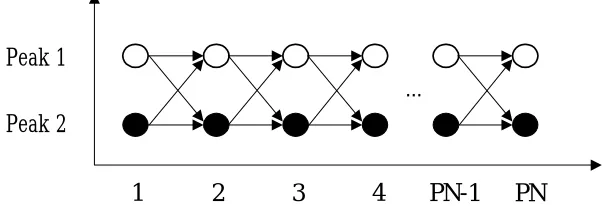
estimation. At each pitch period, two possible peaks/valleys are searched and the dynamic
programming is performed to obtain the pitch marks. Experimental results indicate that
our proposed method performed very well if correct pitch information is estimated.
1. Introduction
In past years, the approach of concatenative synthesis has been adopted by many
text-to-speech (TTS) systems [1]–[6]. The concatenative synthesis uses real recorded
speech segments as the synthesis units and concatenates them together during synthesis.
Also, the time-domain pitch-synchronous overlap-add (TD-PSOLA) [6] method has been
employed to perform prosody modification. This method modifies the prosodic features of
the synthesis unit according to the target prosodic information. Generally, the prosodic
information of the speech includes pitch (the fundamental frequency), intensity, and
duration, etc. For a synthesis scheme based on TD-PSOLA method, it is necessary to
It is useful to have a speech synthesizer with various voices for speech synthesis.
Sometimes it is also important for a service-providing company to have a synthesizer with
the voice of its own employee or the speaker of its favorite. For conventional TTS
systems, however, it is a professional but tedious job to create a new voice. Recently,
corpus-based TTS systems have been appreciated which use a large amount of speech
segments. Some approaches selected the speech segments as the candidates of synthesis
units. Establishing the synthesis units includes speech segmentation, pitch estimation,
pitch marking, and so on. However, pitch marking is very labor-intensive among them if
there involved no automatic mechanism.
In general, there are two major issues on pitch marking: pitch detection and location
determination. Compared to pitch detection [7]-[14], few papers have been presented for
pitch marking [15][16], which is also a difficult problem because of the great variability
of the speech signals. Moulines et al. [15] proposed a pitch-marking algorithm based on
the detection of abrupt changes at glottal closure instants. At each period, they assumed
that the speech waveform could be represented by the concatenation of the response of
two all-pole systems. On the other hand, Kobayashi et al. [16] used dyadic wavelet for
pitch marking. The glottal closure instant was detected by searching for a local peak in the
wavelet transform of the speech waveform.
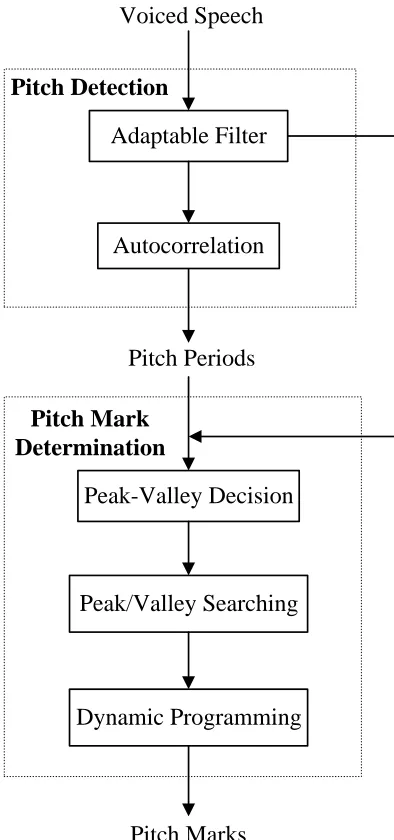
In this paper, we propose a pitch-marking method based on an adaptable filter and a
peak-valley estimation method. The block diagram is shown in Fig. 1. The input signals
are constrained to the voiced speech because only the periodic parts are interested. We
introduce an adaptable filter, which serves as a bandpass filter, to transform the voiced
speech into a sine-like wave. The autocorrelation method is then used to estimate the pitch
periods on the sine-like wave. Also, a peak-valley decision method is presented to
determine which part of the voiced speech is suitable for pitch mark estimation. The
positive part (the speech with positive amplitude) and the negative part (the speech with
negative amplitude) are investigated in this method. This is motivated from Fig. 2(a),
which displays an example of waveform having the negative part reveals explicit
periodicity. In general, it could synthesize better speech quality if the pitch marks are
labeled at the positions of extreme points (peaks and valleys) of the speech. At each pitch
period, two possible peaks/valleys are searched. Finally, the pitch marks are obtained by
Adaptable Filter Voiced Speech
Peak-Valley Decision
Pitch Marks Pitch Periods Autocorrelation Pitch Detection
Pitch Mark Determination
Peak/Valley Searching
Dynamic Programming
Figure 1: Block diagram of the proposed pitch-marking method.
2. Pitch Detection Using an Adaptable Filter Followed by
Autocorrelation Method
The proposed adaptable filter serves as a bandpass filter in which its pass band is from
50 Hz to the detected fundamental frequency, up to 500 Hz, of the voiced speech. The
adaptable filter is achieved by the following three steps.
Step 1. It computes the FFT (Fast Fourier Transform) to transform the voiced speech
into the frequency domain.
Step 2. The fundamental frequency, f0, is detected by searching the first peak of the
(a)
(b)
(c)
The first peak (d)
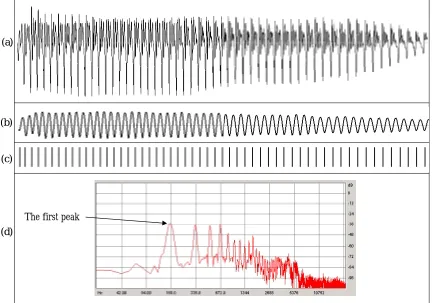
Figure 2: Results of the adaptable filter and pitch mark determination. (a) Waveform of
the voiced speech with explicit periodicity on the negative part. (b) Waveform of the
filtered speech. (c) Detected pitch marks. (d) Spectral contour (note that the frequency
axis is not linearly plotted).
An example of the adaptable filter is displayed in Fig. 2. Panel (a) and (b) shows the
waveforms of the original speech and the filtered speech, respectively. It can be seen that
the filtered speech is generally a sine-like wave that reveals clear periodicity than that on
the original speech waveform. For a frame in the middle of the voiced speech, the spectral
contour is depicted in panel (d). Note that the frequency axis is not linearly plotted for the
reason of inspecting the first spectral peak. The first peak was found at 168 Hz, which is
the fundamental frequency. Finally, the pitch periods are obtained by analyzing the
filtered speech using the conventional autocorrelation method.
3. Pitch Mark Determination Using a Peak-Valley Decision Method and
Dynamic Programming
pitch-marking program were visually displayed. The pitch marks were then checked and
corrected by an experienced person through a friendly interface. For the evaluation of the
experiments, we obtained 436 sets of human-labeled pitch marks, denoted as H, which
comprises 23868 pitch marks.
4-2 Performance of the pitch marking method
The results of the peak-valley decision were verified by human judgment on visual
displays. A success rate of 99.1% is obtained (4 of the 436 results were disagreed). For the
female speaker, we found that 97.2% of the voiced segments reveal clear periodicity on
the negative parts.
The proposed method generated 23860 pitch marks, denoted as I, without any
duplication. The success rate of the pitch marking method is defined as follows:
{
}
% 100 and
| rate
Correct = ∈ ∈ ×
H
H x I x x
(6)
As shown in Table 1, a success rate of 97.2% is obtained (baseline), in contrast with the
95% and 97% success rates of the methods of [15] and [16], respectively. However, we
found that most of the errors are resulted from the incorrect results of pitch detection.
Most of the pitch errors are due to large changes of pitch locating at the boundaries of the
voiced speech. Providing correct pitch information, our method leads to a success rate of
99.5%.
Table 1: Success rate of the pitch-marking method.
Condition Baseline Using correct pitch
Success rate 97.2% 99.5%
5 Conclusions
In this paper, a preliminary work on pitch marking has been proposed. We present the
adaptable filter combined with the autocorrelation method for pitch detection. On the
other hand, a peak-valley decision method is introduced to select either the positive or the
negative parts for evaluation of pitch mark. Also, a dynamic-programming-based pitch
Furthermore, a high success rate of 99.5% is obtained providing correct pitch information.
Acknowledgement
This paper is a partial result of Project 3XS1B11 conducted by ITRI under sponsorship of
the Ministry of Economic Affairs, Taiwan, R.O.C.
References
1. Hamon, C., E. Moulines, and F. Charpentier, “A diphone synthesis based on
time-domain prosodic modifications of speech,” in Proc ICASSP, 1989, pp.238-241.
2. Iwahashi, N. and Y. Sagisaka, “Speech segment network approach for optimization of
synthesis unit set,” Computer Speech and Language, 1995, pp.335-352.
3. Shih, C. L. and R. Sproat, “Issues in text-to-speech conversion for Mandarin,” in
Computational Linguistics and Chinese Language Processing, vol.1, 1996, pp.37-86.
4. Chen, S. H., S. H. Hwang and Y. R. Wang, “An RNN-based prosodic information
Synthesizer for Mandarin text-to-speech,” IEEE Trans. on Speech and Audio
Processing, Vol. 6, No. 3, 1998, pp. 226-239.
5. Chou, F. C. and C. Y. Tseng, “Corpus-based Mandarin speech synthesis with
contextual syllabic units based on phonetic properties,” in Proc. ICASSP, 1998,
pp.893-896.
6. Charpentier, F. J. and M. G. Stella, “Diphone synthesis using an overlap-add
technique for speech waveforms concatenation,” in Proc. ICASSP, 1986, pp.
2015-2020.
7. Rabiner, L. R., M. J. Cheng, A. E. Rosenberg, and C. A. McGonegal, “A Comparative
performance study of several pitch detection algorithms,” IEEE Trans. Acoust.,
Speech, Signal Processing, vol. ASSP-24, 1976, pp. 399-417.
8. Rabiner, L. R., “On the use of autocorrelation analysis for pitch detection,” IEEE
Trans. Acoust., Speech, Signal Processing, Vol. ASSP-25, 1977, pp. 24-33.
9. Noll, A. M., “Cepstrum pitch determination,” J. Acoust. Soc. Amer., Vol. 47, 1967,
pp. 293-309.
10. Markel, J. D., “The SIFT algorithm for fundamental frequency estimation,” IEEE
11. Barnard, E., R. A. Cole, M. P. Vea, and F. A. Alleva, “Pitch detection with a
neural-net classifier,” IEEE Trans. On Signal Processing, vol. 39, No. 2, 1991, pp.
298-307.
12. Kadambe, S., G. F. Boudreaux-Bartels, “A comparison of a wavelet functions for
pitch detection of speech signals,” in Proc. ICASSP, 1991, pp.449-452.
13. Barner, K. E., “Colored L-l filters and their application in speech pitch detection,”
IEEE Trans. On Signal Processing, Vol. 48, No. 9, 2000, pp. 2601-2606.
14. Huang, H. and F. Seide, “Pitch tracking and tone features for Mandarin speech
recognition,” in Proc. ICASSP, 2000, pp.1523-1526.
15. Moulines, E., F. Emerard, D. Larreur, J. L. Le Saint Milon, L. Le Faucheur, F. Marty,
F. Charpentier, and C. Sorin, “A real-time French text-to-speech system generating
high-quality synthetic speech,” in Proc. ICASSP, 1990, pp.309-312.
16. Kobayashi, M., M. Sakamoto, T. Saito, Y. Hashimoto, M. Nishimura, and K. Suzuki,
“Wavelet analysis used in text-to-speech synthesis,” IEEE Trans. on Circuits and
Systems-II, Analog and Digital Signal Processing, Vol. 45, No. 8, 1998, pp.