Speech-Based Emotion Recognition: Feature Selection by Self-Adaptive
Multi-Criteria Genetic Algorithm
Maxim Sidorov
1, Christina Brester
2, Wolfgang Minker
3, Eugene Semenkin
4 1,3Institute for Communications Engineering, University of Ulm, Germany2,4Insitute for System Analysis, Siberian State Aerospace University, Krasnoyarsk, Russia 1,3{maxim.sidorov, wolfgang.minker}@uni-ulm.de,2[email protected],4[email protected]
Abstract
Automated emotion recognition has a number of applications in Interactive Voice Response systems, call centers, etc. While employing existing feature sets and methods for automated emotion recognition has already achieved reasonable results, there is still a lot to do for improvement. Meanwhile, an optimal feature set, which should be used to represent speech signals for performing speech-based emotion recognition techniques, is still an open question. In our research, we tried to figure out the most essential features with self-adaptive multi-objective genetic algorithm as a feature selection technique and a probabilistic neural network as a classifier. The proposed approach was evaluated using a number of multi-languages databases (English, German), which were represented by 37- and 384-dimensional feature sets. According to the obtained results, the developed technique allows to increase the emotion recognition performance by up to 26.08% relative improvement in accuracy. Moreover, emotion recognition performance scores for all applied databases are improved.
Keywords:speech-based emotion recognition, feature selection techniques, multi-criteria genetic algorithm
1.
Introduction
Machines are still quite bad at recognizing human emo-tions, meanwhile such an opportunity might be useful in various applications, including improvement of the spoken dialogue systems (SDSs) performance or call centers qual-ity monitoring.
Speech-based emotion recognition (ER) is a classification problem which can be solved by various methods based on the supervised learning approach. One may extract a lot of numerical features out of speech waveforms. A feature selection procedure results in trade-off between time-consuming feature extraction and the accuracy of the model. However, some of features could be highly-correlated or their variability level could be dramatically low, therefore some attributes could not bring a beneficial impact to the system or they even could lower its perfor-mance. That is why, an effective feature set for the ER task (but also for the problems of speech-based speaker (SI) and gender (GI) identification) should be both rep-resentative and compact. Moreover, removing irrelevant attributes could significantly improve the performance of speech-based ER, SI and GI models.
Our proposal uses a multi-objective genetic algorithm (MOGA), which is a heuristic algorithm of pseudo-boolean optimization, in order to maximize the ER accuracy and minimize the number of items in feature sets simultane-ously. We also propose here a self-adaptive scheme of MOGA, which exempts from the necessity of algorithm’s parameters choosing.
In this study, two feature sets of speech signals (37- and 384-dimensional) have been used to represent 3 emotional speech databases of 2 languages (English, German), acted and non-acted recordings. It turns out, that the usage of a self-adaptive MOGA could improve the accuracy of the ER procedure up to 26.08% (for the 384-dimensional feature set) for some of the databases.
The rest of the paper is organized as follows: the 2. Section
presents significant related work. The 3. Section describes the applied corpora and renders their differences. Our ap-proach to automated emotion recognition improvement is proposed in the 4. Section having its results of numerical evaluations in the 5. Section. Conclusion and future work are described in the 6. Section.
2.
Significant Related Work
One of the pilot experiments which deals with speech-based emotion recognition is in (Kwon et al., 2003). The au-thors compared the emotion recognition performance of various classifiers: support vector machine, linear discrim-inant analysis, quadratic discrimdiscrim-inant analysis and hidden Markov model on SUSAS (Hansen et al., 1997) and AIBO (Batliner et al., 2004) databases of the emotional speech. The following set of speech signal features has been used in the study: pitch, log energy, formant, mel-band ener-gies, and mel frequency cepstral coefficients (MFCCs). The authors have managed to achieve the highest value of the accuracy (70.1% and 42.3% on the databases, correspond-ingly) using Gaussian support vector machine.
Table 1: Databases description
Database Language Full length (min.)
Number of emotions
File level duration Emotion level duration
Notes Mean(sec.) Std. (sec.) Mean (sec.) Std. (sec.)
Berlin German 24.7 7 2.7 1.02 212.4 64.8 Acted
SAVEE English 30.7 7 3.8 1.07 263.2 76.3 Acted
VAM German 47.8 4 3.02 2.1 717.1 726.3 Non-acted
3.
Corpora
In the study a number of speech databases have been used and this section provides their brief description.
Berlin The Berlin emotional database (Burkhardt et al., 2005) was recorded at the Technical University of Berlin and consists of labeled emotional German ut-terances which were spoken by 10 actors (5 female). Each utterance has one of the following emotional la-bels: neutral, anger, fear, joy, sadness, boredom or dis-gust.
SAVEE The SAVEE (Surrey Audio-Visual Expressed Emotion) corpus (Haq and Jackson, 2010) was recorded as a part of an investigation into audio-visual emotion classification, from four native English male speakers. The emotional label for each utterance is one of the standard set of emotions (anger, disgust, fear, happiness, sadness, surprise and neutral).
VAM The VAM database (Grimm et al., 2008) was created at the Karlsruhe University and consists of utterances extracted from the popular German talk-show ”Vera am Mittag” (Vera in the afternoon). The emotional la-bels of the first part of the corpus (speakers 1-19) were given by 17 human evaluators and the rest of the utter-ances (speakers 20-47) were labeled by 6 annotators on the 3-dimensional emotional basis (valence, activa-tion and dominance). To produce the labels for classi-fication task we have used just valence (or evaluation) and arousal axis. The corresponding quadrant (coun-terclockwise, starting in positive quadrant, assuming arousal as abscissa) can also be assigned emotional labels: happy-exciting, angry-anxious, sad-bored and relaxed-serene (Schuller et al., 2009).
Two corpora (Berlin, SAVEE) consist of acted emotions, whereas VAM database comprises real ones. Acted and non-acted emotions have been considered for the German language, but only non-acted emotions are in English ut-terances. In comparison with Berlin and SAVEE corpora, VAM database is highly unbalanced (see Emotion level du-ration columns in Table 1).
Emotions themselves and their evaluations have subjective nature. That is why it is important to have at least sev-eral evaluators of emotional labels. Even for humans it is not always evident to make a decision about an emotional label. Each study, which proposes an emotional database, provides also an evaluators’ confusion matrix and statistical description of their decisions.
There is a statistical description of the used corpora in Ta-ble 1.
4.
Statistical Approach
The baseline set of the 37-dimensional feature vector, as well as the feature set used for the Interspeech 2009 Emo-tion Challenge (384 features) (Kockmann et al., 2009), which were extracted with the Praat (Boersma, 2002) and the openSMILE (Eyben et al., 2010) systems, were used in this study.
Average values of the following speech signal features were included into the baseline set of features: power, mean, root mean square, jitter, shimmer, 12 MFCCs and 5 for-mants. Mean, minimum, maximum, range and deviation of the following features have also been used: pitch, intensity and harmonicity (the 37-dimensional feature vector for one speech signal file, in total).
In this investigation a probabilistic neural network (PNN) was used as a classification algorithm (Specht, 1990) for building emotion models.
A genetic algorithm (GA), which is an effective pseudo-boolean optimization procedure, was chosen to solve the multi-criteria problem. A multi-criteria GA operates with a set of binary vectors coding the subsets of relevant features, where booleanfalsecorresponds to non-essential attributes andtruecorresponds to essential ones.
In the Strength Pareto Evolutionary Algorithm (SPEA) (Zitzler and Thiele, 1999), non-dominated points are stored in the limited capacity archive named an outer set. The content of this set is upgraded through the algorithm execu-tion and as a result we have an approximaexecu-tion of the Pareto set.
The investigated approach works as follows:
Input:
· the labeled database divided into training and valida-tion sets;
· N: the population size;
· N¯: the maximum number of non-dominated points stored in the outer set;
· M: the allowable number of generations.
Parameters of the self-adaptive crossover operator:
· penalty: a fee size for recombination types defeated in paired comparisons;
· time of adaptationT: the number of generations ful-filled before every resources allocation among recom-bination types;
· social card: the minimum allowable size of the sub-population generated with a crossover operator type;
· available recombination types:
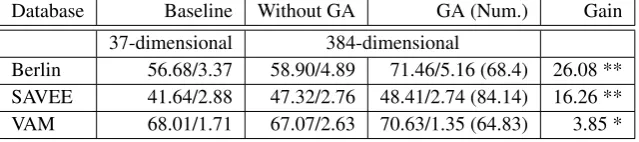
Table 2: Evaluation Result (mean / standard deviation) with the baseline and IS’09 feature sets: Accuracy of the baseline system (37 features), Accuracy of PNN (Without GA), Experiment with selected by proposed method features (GA), having the average number of selected features in parentheses, relative (comparing with Baseline results) improvement in per cent (Gain). Significant differences are marked with ** (α <0.0001) and * (α <0.005) using the T-test (Student, 1908).
Database Baseline Without GA GA (Num.) Gain
37-dimensional 384-dimensional
Berlin 56.68/3.37 58.90/4.89 71.46/5.16 (68.4) 26.08 ** SAVEE 41.64/2.88 47.32/2.76 48.41/2.74 (84.14) 16.26 ** VAM 68.01/1.71 67.07/2.63 70.63/1.35 (64.83) 3.85 *
unessential one), the corresponding representation of train-ing samples was used in order to create a PNN-based emo-tion model for each individual of the self-adaptive MOGA. To assess the model’s predictive ability the validation sam-ple was generated as 20% per cent of the training data set. During experiments it was revealed that the PNN per-formance depended on the sample division significantly. Therefore, we produced the averaged estimations of the rel-ative classification error for all individuals through multi-ple running (15 times) with the random data division. The testing set was used to get the final assessment of adjusted PNN-based emotion model (for both Experiments) with the feature set selected by MOGA (only for the 2nd Experi-ment).
In order to generate more statistically significant results, the complete classification process was run 10 times for each database. For each run, the databases were randomly divided into the training and testing sets (70–30% corre-spondingly). The final results are shown in Table 2. These results are calculated taking the average of all runs. The first two columns correspond to the PNN-based ER accu-racy, which was achieved without feature selection proce-dure (Experiment 1, baseline for the 37-dimensional feature set, and the 384-dimensional extended one). In the third column, the accuracy of the emotion recognition system us-ing the multi-criteria GA-based feature selection with the average number of selected features. The next column con-tains the relative accuracy improvement, comparing with the baseline system performance (the 37-dimensional fea-ture set without feafea-ture selection procedure).
Table 3 shows the results comparison of PCA- and pro-posed MOGA-based feature selection/reduction methods. The 0.95 variance threshold was performed on each itera-tion of PCA in order to create a feature set for training and testing of PNN-based emotional models. The results clearly showed that the proposed method could produce fewer fea-tures and the higher ER accuracy simultaneously.
The results of baseline ER as well as ER with feature sets selected by MOGA- and PCA-based feature selection tech-niques have been examined for significance using the t-test (Student, 1908) for comparing the results of each of the 10 runs of the experiments. All differences are significant with at leastα <0.005.
As a result, it can be concluded, that the proposed tech-nique could significantly improve the accuracy of the ER procedure (up to 26.08% of the relative improvement) and essentially decrease the number of attributes in the feature set for the involved corpora (Berlin, VAM and SAVEE).
The realized method was run with the following values of parameters: an adaptive SPEA had 100 generations and 100 individuals, the size of the outer set was equal to 50, adap-tation interval, penalty and social card were equal to 5, 10 and 10 correspondingly. As it was mentioned above, val-ues of the classification error criteria were estimated with the PNN-based classifier for all individuals in each gener-ation. For each run the Pareto set and frontier approxima-tions were defined and as a result the final solution was de-termined as the point from the Pareto set with the highest value of the ER accuracy.
Table 3: Evaluation Result (mean / standard deviation) with the IS’09 feature set: Accuracy of the PNN-based ER with selected by PCA features (PCA-PNN), having an average number of selected features in parentheses (Num.), rela-tive (comparing with proposed technique) improvement in per cent (Gain). Significant differences are marked with ** (α <0.0001) using the T-test (Student, 1908).
Database PCA-PNN (Num.) Gain Berlin 43.66/2.95 (129.3) -38.90 ** SAVEE 26.53/1.12 (123.6) -45.19 ** VAM 59.41/4.49 (148.6) -15.88 **
6.
Conclusion and Future Work
An application of the PNN-MOGA hybrid system for se-lecting the most representative features and maximizing the accuracy of the supervised learning algorithm could decrease the number of features from 384 to 43 and in-crease the ER accuracy up to 26.08 % for some of the corpora. Moreover, the proposed method outperforms the PCA-based feature reduction technique in terms of the ER performance achieved by PNN-based models.
The next step is to analyze the frequency of chosen fea-tures to create the most appropriate set for the speech-based emotion recognition task. Please, note that the proposed ap-proach also could be used for the speaker and gender iden-tification.
7.
References
Batliner, A., Hacker, C., Steidl, S., N¨oth, E., D’Arcy, S., Russell, M. J., and Wong, M. (2004). ” you stupid tin box”-children interacting with the aibo robot: A cross-linguistic emotional speech corpus. InLREC.
Bijankhan, M., Sheikhzadegan, J., Roohani, M., Samareh, Y., Lucas, C., and Tebyani, M. (1994). Farsdat-the speech database of farsi spoken language. In the Pro-ceedings of the Australian Conference on Speech Science and Technology, volume 2, pages 826–830.
Boersma, P. (2002). Praat, a system for doing phonetics by computer. Glot international, 5(9/10):341–345.
Burkhardt, F., Paeschke, A., Rolfes, M., Sendlmeier, W. F., and Weiss, B. (2005). A database of german emotional speech. InInterspeech, pages 1517–1520.
Carpenter, G. A., Grossberg, S., Markuzon, N., Reynolds, J. H., and Rosen, D. B. (1992). Fuzzy artmap: A neural network architecture for incremental supervised learn-ing of analog multidimensional maps.Neural Networks, IEEE Transactions on, 3(5):698–713.
Daridi, F., Kharma, N., and Salik, J. (2004). Parameterless genetic algorithms: review and innovation. IEEE Cana-dian Review, (47):19–23.
Eyben, F., W¨ollmer, M., and Schuller, B. (2010). Opens-mile: the munich versatile and fast open-source audio feature extractor. In Proceedings of the international conference on Multimedia, pages 1459–1462. ACM. Gharavian, D., Sheikhan, M., Nazerieh, A., and Garoucy,
S. (2012). Speech emotion recognition using fcbf fea-ture selection method and ga-optimized fuzzy artmap neural network. Neural Computing and Applications, 21(8):2115–2126.
Grimm, M., Kroschel, K., and Narayanan, S. (2008). The vera am mittag german audio-visual emotional speech database. InMultimedia and Expo, 2008 IEEE Interna-tional Conference on, pages 865–868. IEEE.
Hansen, J. H., Bou-Ghazale, S. E., Sarikaya, R., and Pel-lom, B. (1997). Getting started with susas: a speech under simulated and actual stress database. In EU-ROSPEECH, volume 97, pages 1743–46.
Haq, S. and Jackson, P., (2010). Machine Audition: Princi-ples, Algorithms and Systems, chapter Multimodal Emo-tion RecogniEmo-tion, pages 398–423. IGI Global, Hershey PA, Aug.
Kockmann, M., Burget, L., and ˇCernock`y, J. (2009). Brno university of technology system for interspeech 2009 emotion challenge. In Tenth Annual Conference of the International Speech Communication Association. Kwon, O.-W., Chan, K., Hao, J., and Lee, T.-W. (2003).
Emotion recognition by speech signals. In INTER-SPEECH.
Pearson, K. (1901). Liii. on lines and planes of closest fit to systems of points in space.The London, Edinburgh, and Dublin Philosophical Magazine and Journal of Science, 2(11):559–572.
Polzehl, T., Schmitt, A., Metze, F., and Wagner, M. (2011). Anger recognition in speech using acoustic and linguis-tic cues.Speech Communication, Special Issue: Sensing
Emotion and Affect - Facing Realism in Speech Process-ing.
Schmitt, A., Heinroth, T., and Liscombe, J. (2009). On no-matchs, noinputs and bargeins: Do non-acoustic features support anger detection? InProceedings of the 10th An-nual SIGDIAL Meeting on Discourse and Dialogue, Sig-Dial Conference 2009, London (UK), September. Asso-ciation for Computational Linguistics.
Schuller, B., Vlasenko, B., Eyben, F., Rigoll, G., and Wendemuth, A. (2009). Acoustic emotion recogni-tion: A benchmark comparison of performances. In
Automatic Speech Recognition & Understanding, 2009. ASRU 2009. IEEE Workshop on, pages 552–557. IEEE. Specht, D. F. (1990). Probabilistic neural networks.
Neu-ral networks, 3(1):109–118.
Student. (1908). The probable error of a mean.
Biometrika, 6(1):1–25.