31st Pacific Asia Conference on Language, Information and Computation (PACLIC 31), pages 319–328 Cebu City, Philippines, November 16-18, 2017
A Morphosyntactic Analysis of the Pronominal System of
Southern Alta
Marvin M. Abreu
De La Salle University
[email protected]
Abstract
Pronouns are one of the universal components of language and they provide information on the morphosyntactic characteristics of any languages such as Philippine languages. Past researches show various analyses on the mor-phosyntax of PLs, a recent typological study claims that Philippine languages (PLs) are er-gative. Another study shows a similar claim; however, this study utilizes the pronominal systems of major Philippine languages and uses an ergative-absolutive framework. This research examines the pronouns of Southern Alta language. It aims to contribute in the ty-pological studies of pronominal systems of Negrito and Non-negrito languages. This study employs an ergative-absolutive frame-work. The initial result shows that the pro-nominal systems of the Southern Alta language consist of absolutive, ergative, oblique, and genitive pronouns. The ergative-absolutive framework unravels the morpho-syntax of the pronominal system of Southern Alta. The framework helps describe the func-tions and characteristic of the different sets of pronouns. The study also reveals linguistic phenomena such as inclusivity/exclusivity, first person dual pronouns, homomorphy, clit-icization, hierarchy, person–deixis interface and portmanteau pronouns. In conclusion, the ergative-absolutive framework fits the mor-phosyntactic analysis of the Southern Alta language. This study also suggests to examine the clausal construction including the noun phrases (NPs) of Southern Alta.
1
Introduction
The Philippines has over 150 languages (Reid, 2013, pp. 330-331). This large inventory excludes the Sama varieties spoken in the Sulu Archipelago and the South Mindanao languages. Although the-se varieties are spoken within the Republic of the Philippines; they differ morphosyntactically from other Philippine languages and are generally not included in generalizations about Philippine lan-guages (Himmelmann, 2005, p. 111). However, Reid (2013) made a distinction between the origi-nal settlers and migrants of pre-colonial Philip-pines. They are the Negritos and non-Negritos, respectively. Although both groups spoke Austro-nesian languages, the former was non-Austronesian not until the first non-Austronesian in-migrant the Negritos came in contact 5,000 years ago while the latter groups are the Austronesian-speaking peoples in the Philippines.
Reid and Liao (2004, p. 435) conducted a typo-logical study of the syntax of most Philippine lan-guages and claim that Philippine lanlan-guages are ergative. In support to the previous claim, Dita (2011) conducted a typological study anchored on ergative-absolutive framework by examining the pronominal systems of most of the major lan-guages of the Philippines.
Dita (Dita, 2011, p. 1) explains that pronomi-nals are a universal component of human lan-guages and are considered basic vocabulary of any given language. In additon, she explains that per-sonal pronouns are generally closed-class and are unaffected by borrowing or code-switching (Dita, 2011). Pronouns exist together with other closed-class words such as prepositions, articles and con-junctions. Unlike open-class categories (e.g. verbs and nouns), pronouns do not change over time, and
they signal grammatical relationships between the verb and the subject or object of a clause. The pro-nominal system of a language is one of the key components to uncover the morphosyntactic struc-ture and properties of the languages, not to men-tion other linguistic features that may come along with the analysis. She also explains that this new analysis will provide ample understanding on the mophosyntax of many languages in the Philippines (Dita, 2010).
Past studies on the pronominal systems of Ne-grito and non-NeNe-grito languages focus on recon-structions such as word lists and phonologies (Reid, 1971), Northern Cordilleran subgroup (Tharp, 1974), Arta (Reid, 1989), Alta languages (Reid, 1991), Central Cagayan Agta (Liao, 2005) and Umiray Dumaget (Lobel, 2013). Other topics include deictics (MacFarland, 2006), reference grammar (Headland & Healey, 1974), supplemen-tary texts (Miller & Miller, 1991). This study aims to contribute in the typological study of the pro-nominal system of Negrito and Non-negrito lan-guages in the Philippines.
1.1
Previous analysis
Dita (2011) explains that early studies on Taga-log language (Bloomfield, 1917) utilized the nom-inative-accusative distinction and has then dominated the literature on PL for many years. She further explains other analyses have emerged such as active-stative analysis (Drossard, 1994); the flu-id voice analysis (Shibatani, 1999); the hybrflu-id analysis (Machlachlan 1996), and the precategorial symmetrical voice analysis (Foley, 1998). But many of the mophosyntactic analysis of Philippine languages remain unclear. However, ergative-absolutive analysis that came about in the 1980s with the works of Payne (1982) and Starosa (1986) and, Gerdts (1988) show viable results.
One of the studies that introduces ergative-absolutive framework is the study of Dixon (1972) on Dyirbal language. This framework is a depar-ture from the nominative-accusative framework that has dominated the early studies of world‟s languages such as the Indo-European languages. It is, thus congruent to the fact that about a quarter of the world‟s languages have this unique case-marking. Dita (2011) compares the nominative-accusative and ergative-absolutive analyses. She illustrates the analysis labeled as Figure 1.
Figure 1 – Ergative-absolutive alignment and nominative-accusative alignment
Figure 1 shows two analysis, the one in the left is the ergative-absolutive alignment and on the right is the nominative-accusative alignment. The first row is labeled as A (agent) and O (patient), and they are core arguments of a canonical transi-tive agent (A) and object (O). The second row with only one argument is marked as S (subject). The object of the transitive clause (or the patient) and the sole argument of an intransitive clause (or the subject) in second row are treated alike, that is, they both receive absolutive case-marks. While on the right shows that the agent of a transitive clause and the subject of an intransitive clause are treated alike, thereby receiving the same case-marks. Dita (2010) simplifies, “if S=A, then the language be-longs to the nominative-accusative type, and if S=O, it belongs to the ergative- absolutive type”.
Below are examples in Tagalog language (1), (2), and (3) (Dita, 2010).
(1) Bibili ako ng mangga.
will.buy ABS.1S DET mango „I will buy a mango (or some mangoes).‟
(2) Binili ko ang mangga.
bought ERG.1S DET mango „I bought the mango.‟
(3) Nakita nila ako
saw ERG. ABS.1S „They saw me.‟
The absolutive is the actor in an intransitive clause, as in (1); and the ergative is the agent in a transitive clause, as in sentences (2), (3)
1.1
Background of the Study
The Southern Alta language is one of the Alta languages, a single branch subgroup of the Meso-Cordilleran languages, an Austronesian language spoken by a group of Negritos in the Philippines.
tive. The former is labeled ERG as agent of a tran-sitive clause while the latter is labeled GEN as the possessor of a possessive construction.
(4) …iatod ko dikayo at <i>atod ERG.1S OBL.2P TL GF-give I to you TL
nu pala lahi yo."
DET PL lahi GEN.2P DET PL descendant your
…I will give this to you, this one place in Ca-naan, and to all your descendants.
(5) …"Lawin mo yi gewang ko." lawin ERG.2S DET gewa<ng> GEN.1S see you DET to do my
…“Witness what I can do”.
Sentence 4 shows that first person ko and se-cond person yo pronouns. First person pronoun ko precedes a verb while the second person yo pre-cedes a noun. The first pronoun functions as a sub-ject and as agent of the transitive clause while the second pronoun yo functions as genitive. The geni-tive yo modifies the possessum, lahi; this distin-guishes second pronoun yo as having a possessor-possessum relationship. A similar case in Sentence (5), second person mo also precedes a verb while first person ko precedes a verbal inflection or a nominal. Both sentences are deemed to provide ample evidence of an ergative-absolutive frame-work.
3.1
Absolutive pronouns
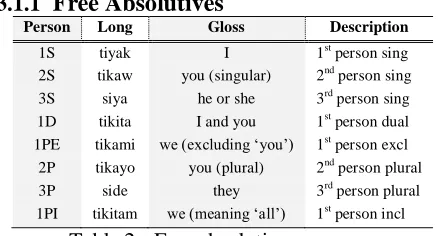
Absolutive pronouns have first person singular exclusive (1PE) and inclusive (1PI) both in free and bound forms. The singular first person siya has no gender distinction.
3.1.1
Free Absolutives
Person Long Gloss Description
1S tiyak I 1st person sing
2S tikaw you (singular) 2nd person sing
3S siya he or she 3rd person sing
1D tikita I and you 1st person dual 1PE tikami we (excluding „you‟) 1st person excl
2P tikayo you (plural) 2nd person plural
3P side they 3rd person plural 1PI tikitam we (meaning „all‟) 1st person incl
Table 2 - Free absolutive pronouns
Free absolutive pronouns may stand alone in an utterance. They are usually a response to a
ques-tion or it can be a form of self-referencing from previous utterances. The functions of absolutives are as follows:
(i) As a subject, a response from a previous inquiry, or as vocative. They are clause-initial. Ex-ample (6) is a transcript of an interview. Below the respondent uses absolutive, genitive, and oblique pronouns. All pronouns are first person singular. Pronouns in (7) and (8) are used as a subject, while (9) is vocative.
(6) “Tiyak ti Sonny. ABS.1S PN Sonny I PN Sonny
Pangawi diyak na pamilya ko, Yayo.
nickname OBL1S DET family GEN.1S Yayo
Asawa ko ay ti Ema.
wife GEN.1S TL PN Ema
Yi panganay me, ti Latdok, at
PN eldest GEN. 1PE PN Latdok TL
ti Lagyu ti pangaduwa.
PN Lagyu OBL second
Ti Salon duman ay pangsangay…
PN Salon EXP TL third
Tiyak a tatlongpu at pito.”
ABS.1S LIG thirty and three I LIG thirty and three
I am Sonny. My family calls me Yayo. My wife(‟s name) is Ema. My eldest son(„s name) is Latdok, and the second is Lagyu. Salon is the third. I am thirty-seven years old.‟
(7) Tikitam i pala anak Na. ABS.1PI DET PL anak GEN.3S We(all) DET PL child His
We (including you) are His children.
(8) Side I umawit. ABS.3P DET <um>awit they DET PERF.sang
They are the ones who sang.
(9) „Tiatin i ki adi tu sundang?‟ „Tiyak.‟
Q DET EXIST adi DET dagger ABS. 1S
„Who owns the dagger?‟ „I am (or I own it).‟
(ii) Serves as predicates of identificational constructions such as (10) and (11)
(10) “Tikaw linaway ko nuapon.” ABS.2S l<in>way ERG.2S TIME you PERF-saw I yesterday
You are the one I saw yesterday.
(11) …"Tikaw mismo tu petang ko
ABS.1S PART DET <peta>ng GEN.1S you PART DET choice my
LIG DET alta LIG <ma>mahala DET DEM
…“You are the one, my chosen person, who will take care of these.
(iii) As appositive in (12) (12) “Tikami a pala Dumaget ABS.1P LIG PL Dumaget we LIG PL Dumagat
ay mondongol kami na lutu.”
TL listen ABS.1P DET lutu TL listen we DET lutu
We, the Dumagats, (we) listen to the sounds made by the bird lutu.
(iv) As a form of respect or honorific. A singu-lar addressee (13) is addressed in the plural form, such as God or any Supreme Being in (15). Sen-tence (16) is a reference to the elders.
(13) Tikayo amo yi isa=y mongnol, ABS.2P amo yi NUMBER know, you PART DET one know
Ta uwannak ki magewa,
Ta uwan=(n)yak ki magewa, CONJ NEG=ABS.1S EXIST <ma>gewa and NEG.I EXIST can do
labes tai nu kabudiyan yo
ADV DEM DET <ka>budi<yan> GEN. 2S ADV this DET goodness your
You are the only one who knows everything and I can‟t give much of it unlike the goodness you do for all us.
(14) …Side tu monudu,
ABS.3P DET <mon><t>udu they DET teach
at side tu mogdisisyon na…
TL ABS.3P DET <mog>disisyon PART TL they DET decide PART
Taking care of the council is the responsibility of the elders in the council. They should teach and do the decisions on any matters that need to be done in the council.
3.1.2
Enclitic absolutives
Table 3 - Enclitic absolutive pronouns
The „short‟ forms in Table 3 show the absolu-tive enclitics. Although some can stand alone, a few needs a host to complete its syntactic function. The functions are:
(i) as subject in an intransitive clause (15), (16), (17), and (18) or as a sole argument or expe-riencer in an intransitive clause (19).
(15) Nakakannak din.
<naka>kan=(n)yak din. already.eat=ABS.1S eat=I already
I have already eaten, too. (lit. Already ate I)
(15) …sinabi ni Lot, a "Umakang kitam." s<in>abi PN Lot LIG <um>akang ABS.1PI
PERF-said PN Lot LIG AF-walk we …Lot said, “Let‟s walk.”
(16) Ta=din kita. let go 1D.ABS let go I and you
Come, let‟s go. (lit. I and you go.)
(17) Mun i budi kita. like 1D.ABS like I and you
We like one another. (lit. I and you like.)
(19) …molamang modognin siya. PART <mo>dognin ABS.3S probably feel.cold he and she … probably, he feels very cold.
(ii) As a subject of a monadic intransitive clause,
(20) Sumubli kayo. s<um>ubli ABS.2P AF.come back you-P
Come back, all of you.
(iii) As subject in a dyadic intransitive clause: (21) Linumukdes siya ti gebunay. l<inum>ukdes ABS. 3S OBL gebunay AF-descended down he on earth He descended down on earth.
(iv) As object in a dyadic transitive clause
(22) Sinabi na dut a apostol siya. s<in>abi 3S.ERG PART LG apostle 3S.ABS PERF-said PART LG apostle he He also said that he is an apostle.
(23) Inabuyanan de siya
<in>abuyanan ERG. 3P ABS.3S PERF-knew they he
Person Short Gloss Description
1S yak=(y)ak I 1st person sing 2S ka you (singular) 2nd person sing
3S siya he or she 3rd person sing
1D kita I and you 1st person dual
They knew him.
(v) As object in a triadic transitive clause (24) Olagean Na sid mopatud <o>alage<an> ERG.3S ABS.3P <mo>patud GF-took care of he they male siblings He took care of them, the brothers.
(vi) As respect to God (24) and to the elders (14). Example (14) and (24) also shows that abso-lutive free and clitic pronouns co-exist in a clause.
(25) …"Dingol ta=kayo a hear ERG.1D=ABS.2P DET
hear I.she=you
monakang, kanya nonsuksuk kami
DET PROG-walk PART PST-hide ABS.1P DET PROG-walk PART PST-hide we
ta motakottak dehil tiyak ay obe." PART <mo>takot=(t)yak PART ABS.1S TL obe PART <mo>takot=ABS.1S PART ABS.1S TL obe PART fear= I PART I TL obe Adam said, we heard You walking towards us, so we hid ourselves and I was scared (of You) be-cause I am nude.
3.2
Ergative pronouns
Dita (2011) explains that genitives are morpho-logically identical with ergatives. It is with this morphological synonymity that prompted some Philippinists to use the label GEN to both ergative and genitive pronouns. She argues that these items should not receive similar treatment. Again to dis-tinguish the two, PL genitives are generally post-nominals whereas ergatives are postverbals (Dita, 2011). Table 4 is a summary of the ergative (free and enclitic) pronouns.
Table 4 – Ergative (Free and Enclitic) Pronouns
(i) As subject of a transitive clause, either dy-adic (26) and tridy-adic (27) and (28).
(26) ... iatod ko dikayo at <i>atod ERG.1S OBL.2P CONJ GF-give I to you and nu pala lahi yo."
DET PL decendant GEN.2P DET PL decendant your
God said, I will give this (place) to you to all your descendants.
(27) Inotos Na sid
<in>otos ERG.3S ABS.3P. GF-ordered he they
a mampakaadu LIG to become many
He orders them to multiply.
(28) …"Lapditon mo tu detnap
lapdit<on> ERG.2S DET detnap GF-hit you DET stone nu salokod mo."
DET salokod GEN.2S DET cane your
Then it happened, God said to Moises, (You) Strike the stone with your cane.
(ii) Ergative and genitive constructions co-exist in a clause
(29) …"Dehil nu ginawam=mo, CONJ DET g<in>awa=ERG.2S
CONJ DET GF.do =you
ialagang
mo
i tiyan
mo
<i>alaga<ng> ERG.2S DET tiyan GEN.2S GF-take care you DET belly your
ti dupit umpisa niedut.''
OBL dupit <um><p><isa> TIME OBL soil PERF.starting now
Then, God said to the snake, “Because of what you‟ve done, you will carry your belly on the ground from this day onward.
3.3
Oblique pronouns
Person Oblique Gloss Description
1S diyak „to me‟ 1st person sing
2S dikaw „to you‟ (singular) 2nd person sing
3S dikana „to him/ her‟ 3rd person sing 1D dikita „to me and you‟ 1st person dual 1PE dikame to both of us 1st person excl 2P dikayo „to you‟ (plural) 2nd person plural
3P dikade „to them‟ 3rd person plural
1PI dikitam „to us‟ 1st person incl Table 5 - Oblique pronouns
Dita (2010) explains that oblique pronouns are used to express direction towards a person or per-sons, or the transmission of an object towards the entity or party specified by the oblique pronoun. They are formed by adding pronouns to the stem di-. Table 5 shows the oblique pronouns. Their functions are the following:
Person Ergative Gloss Description
1S ko=k I 1st person sing
2S mo=m you (singular) 2nd person sing 3S na he or she 3rd person sing 1D ta I and you 1st person dual
1PE me we (excluding „you‟) 1st person excl
2P yo you (plural) 2nd person plural
(i) as semantic role of „source‟ (29). (30) Opodin tam tu Makidepat <o>podin ERG.1PI DET Makidepat praise we(all) DET Makidepat
pagmogpasalamat kitamdikana,
<pag><mog><pa>salamat ABS.1PI OBL.3S to give thanks we(all) to him
ta ipalaway tam dikana
CONJ <ipa>laway ERG.1PI OBL.3S CONJ to see we(all) to him
nu pamamagitan nu paagpasalamat
DET pa<mama>gitan DET <paag><pa>salamat DET act of DET to give thanks
tam dikana, a Siya
ERG.1PI OBL3S LIG ABS.3S we(all) to him LIG he
tu ki kapangyadihan at ki gewa
DET EXIST kapangyadihan CONJ EXIST gewa DET EXIST greatness and EXIST creation
na lahat, bala lahat a
DET PART PART PART LIG of all before all LIG
mopeya ay unalang dikana.
<mo>peya TL una<lang> OBL.3S goodness TL came from him
Let us praise and give thanks to Him, and let us show Him our gratitude by glorifying His great-ness and His creations. Because all things before us are good, and that all things came from Him.
(ii) As a semantic role of „goal‟in (31)
(31) I ginawa nu Makidepat, ay impanol Na
DET g<in>awa DET Makidepat TL inform ERG.3S DET GF-make DET Makidepat TL inform he
dikade tu kailangan de
OBL.3P DET kailangan GEN.3P to them DET kailangan their
God made sure that what He informs them is what they should write about.
(iii) Third, obliques can also function as bene-factives (Dita, 2010)
(32) Namate ti Hesus pade dikitam.
<na>mate PN Hesus PART OBL.3P AF-die PN Jesus for all of us
Jesus gave his life for us.
(iv) obliques express possession when they co-occur with existentials.
(33) Ki katahimekang kitam dikana. exist peacefulness ABS.1PI OBL.3S exist peacefulness we (all) (to) him
We have peacefulness in Him.
(v) as a deictic pronoun in place of a personal pronoun
(34) Yie magkalake tu pinakaminona tam
this <mag><ka>lake DET <pinaka>minona GEN.1PI this adult man-P DET DEG.old our
a lahat, kanya matotkakaylang kitam
LIG PART PART <matot>kakaylang ABS.1PI LIG all PART DEG.close relative we a lahat ti gebunay.
LIG PART OBL earth
These men, the oldest of all, are our ancestors, so we are all relatives on earth.
(35) Yie lahat a alta ay kausil PROX/SP PART LIG alta TL companion this all LIG person TL companion
ni Pablo de idi…
PN
of Paul before there
Long ago, these people are companions of Paul there.
In (33), the proximal spatial demonstrative Yie (this) can be replaced with third person plural side (we) such as (34) and (35).
(36) Side a magkalake tu pinakaminona tam
ABS.3P LIG men DET DEGREE.old GEN.1PI they DET men DET DEGREE.old our
a lahat, kanya…
LIG PART, PART
They, the old men, are our ancestors, so…
(37) Side a lahat a alta ay
ABS.3P LIG PART LIG alta TL they PART all DET person TL
kausil ni Pablo de idi…
companion PN Paul before there
Long ago, they, all the people there, are com-panions of Paul.
3.4
Genitive pronouns
Genitive pronouns encode possession. The noun (possessum) follows the pronoun (the posses-sor) which is opposite to the phrase structure like English language (e.g. my book, possessor-possessum) (Payne, 1997). Table 6 shows the genitive pronouns. Besides possessive phrases (36) and (37), many other examples are shown in sen-tence (6).
(38) tu anak de
(39) tu bele na
DET house GEN.1S his/ her house
Person Genitive Gloss Description
1S ko my 1st person sing
2S mo your (singular) 2nd person sing
3S na his or her 3rd person sing
1D ta our (mine and yours) 1st person dual 1PE me ours (excluding „you‟) 1st person excl 2P yo your (plural) 2nd person plural 3P de their 3rd person plural
1PI tam our (meaning „all‟) 1st person incl Table 6 - Genitive Pronouns
3.5
Other linguistic phenomena
This study uncovers other linguistic phenome-na, similar to the results found in Dita (2010). The-se are homomorphy (3.5.1), cliticization (3.5.2), hierarchy (3.5.3), and person-deixis interface (3.5.4).
3.5.1
Homomorphy
Dita (2010) explains that ergatives and geni-tives are spelled and pronounced the same but they differ in their distributional properties. Consider the sentences (23) and (24), and compare them with sentences (38) and (39). The third person plu-ral de is labeled ERG (23) while GEN in (38). And also the first person singular na is labelled ERG (24) while GEN (39). Consider also sentence (29), second person singular ERG and GEN co-exist in the clause.
3.5.2
Cliticization
Clitics are grammatical words that are unable to stand on their own phonologically, but must in-stead lean on another adjacent word. They must be incorporated into the prosodic structure of another word. Dita (2010) explains that pronominal clitics exhibit various characteristic. Examine Table 1 above. Absolutives and genitives have enclitics and they enclitizes with the preceding word such as sentence (13), (15), (25) and (29), and they all en-clitize with the predicate.
3.5.3
Hierarchy
Another note-worthy observation is the study of Schachter (1973) on Tagalog language (in Dita, 2010). According to him, monosyllabic pronouns always precede disyllabic. Consider the sentences (4), (23), (25), (30), (31), and (33).
3.5.4 Person-deixis interface
Another note-worthy study is done by MacFar-land (2006) on Tagalog language (in Dita, 2010). He explains that it is quite common in PL to use a deictic pronoun in place of a personal pronoun. Consider the sentences (34) and (35) and the re-vised sentences (36) and (37). The rere-vised sentenc-es are replaced with third person plural pronouns, and yet the contextual meanings of the clauses are the same.
3.5.5 Portmanteau
Dita (2011) explains that portmanteau pronouns exist in Philippine languages. These portmanteau pronouns is a combination of ERG.1s and ABS.2s, where the former is the agent and the latter the pa-tient in a clause. Data shows that it is also present in Southern Alta language. Interlinear gloss and symbols use 1D instead of 1s in Dita (2011) such as (40). In addition, the absolutive pronoun in (25) encodes ABS.1D+ERG.2P as a form of respect to a Supreme Being.
(40) Besan taka.
read ta=ka.
read ERG.1D+ABS.2S
Let us read this biblical passage.
4
Summary and Recommendation
Acknowledgments
My sincerest thanks to my all-time adviser, Dr. Shirley Dita, for the inspiring words and wisdom to pursue this study. I am also very thankful to Dr. Lawrence Reid, who never forgets the helpful tips and keen suggestions despite his busy trips and schedules. I am thankful to our Dean Dr. Crisol Bruza and his associates at the CAS for their un-wavering support. Thank you also for the time, words, and wisdom to all of my Kabuloan Dumagat respondents and friends, Rogelio Del Monte, Sonny Del Monte, Johny Bote, Ruping Ramos, and their families.
References
Abreu, M. (2014). The Dumaget language. An unpublished short paper on AgraPhil, Manila.
Adelaar, A. (2005). The Austronesian languages of the Asia and Madagascar: A historical perspective. In A. Adelaar, & N. Himmelmann (Eds.), The Austronesian languages of the Asia and Madagascar (pp. 1-42). New York, USA: Routledge.
Blust, R. (2013). The Austronesian languages. The Australian National University, Research School of Pacific and Asian Studies. Canberra: Asian-Pacific Linguistics.
Dita, S. (2007). A Reference Grammar of Ibanag. De La Salle University, DEAL. Manila: De La Salle University.
Dita, S. (2011). A morphosyntactic analysis of pronominal system of Philippine languages. Proceedings of the 24th Pacific Asia Conference on Language, Information and Computation (pp. 45-59). Institute of Digital Enhancement of Cognitive Processing, Waseda University.
Dixon, R. (2010). Basic Lingusitic Theory (Vol. 2). Oxford: Oxford University Press.
Headland, T. (2003). Thirty endangered languages in the Philippines. Work Papers of the Summer Institute of Linguistics, 47, 1-12.
Headland, T. (2010). Why the Philippine Negrito languages are endangered. In Florey, M.,
Endangered Languages of Austronesia (pp. 110-120). Oxford: Oxford University Press.
Headland, T., & Healey, A. (1974). Grammatical sketch of Dumagat (Casiguran). Pacific Linguistics, 1-54.
Himmelmann, N. (2005). The Austronesian languages of Asia and Madagascar: Typological characteristics. In A. Adelaar, & N.
Himmelmann, The Austronesian languages of Asia and Madagascar (pp. 110-181). New York: Routledge.
Lewis, P., Simon, G., & Fenning, C. (Eds.). (2015). Ethnologue: Languages of the World (18th ed.). Dallas, Texas, USA: SIL-International.
Liao, H. (2005). Pronominal forms in Central Cagayan Agta. In H. Liao, & C. Rubino, Current Issues in Philippine Linguistics and Anthropology: Parangal kay Lawrence A. Reid (pp. 346-363). Manila: LSP: SIL-Philippines.
Lobel, J. (2013). Philippine and North Bornean languages: Issues in description, subgrouping, and reconstruction. University of Hawai'i, Graduate Division. Manoa: University of Hawai'i.
Miller, H., & Miller, J. (1991). Mamanwa Texts. Quezon City: LSP and SIL.
Payne, T. (1997). Describing morphosyntax: A guide for field liguists. Cambridge, UK: Cambridge University Press.
Reid, L. (1971). Philippine minor languages: Word lists and phonologies. Oceanic Linguistics Special Publications, 1-241.
Reid, L. (1989). Arta, another Philippine negrito language. Oceanic Linguistic, 47-74.
Reid, L. (2006). On reconstructing the morphosyntax of Proto-Northern Luzon. Paper presented at Tenth International Conference on
Austronesian Linguistics (pp. 1-73). Palawan: SIL-International.
Reid, L. (2013). Who are the Philippine Negritos?: Evidence from language. Human Biology, 85(1), 1-32.
Reid, L., & Liao, H. (2004). A brief syntactic typology of Philippine languages. Language and Linguistics, 5(2), 433-490.