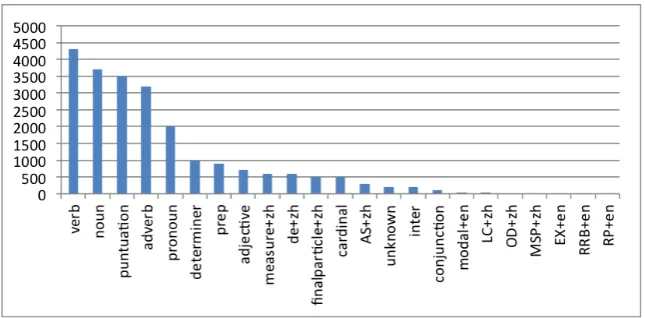
code-Figure 1: Distribution of POS tags of the conversational meetings.
Figure 2: Distribution of POS tags for the conversational meetings.
The project meeting speech from three meetings was transcribed and annotated by a Mandarin-English bilingual speaker. The duration of the transcribed speech is 2.3 hours. There are 10030 Chinese words and 2688 English words. The percentage of the embedded language is 21.15%.
Table 2 shows the statistics of code-switching type fore the project meeting speech.
Code-switching Code-Switching from English from Chinese
Inter-sentential 85 95
Intra-sentential 117 182
Table 2: Code-switching type of the project meetings
4.
Interviews of Students
The interview speech data was collected from university students during the examination period for stress emotion detection in different languages. The recordings took place in a quiet conference room with high-quality equipment (Creativer Labs, Model No. SB0490). Speech was recorded in a lossless format with a sampling rate of 16,000Hz, using a single channel 16-bit digitization.
61 university students were asked to contribute to the Mandarin database, 42 university students to the En-glish database and 69 university students to the Cantonese database. The duration of the Mandarin database is 9 hours, the duration of the English database is 4 hours and that of the Cantonese database is 12 hours.
Although only part of the English speech is transcribed, we found code-switching occurred during the interviews in the Mandarin and English databases.
In each interview setup, there was an interviewer and an interviewee. Only the interviewee’s answer was recorded using a close-talking microphone.
5.
Text Data from the Web
The text data containing code-switching was automatically downloaded from the web. The size of the database is 100 million characters.
There are constraints on data collection, because, al-though code-switching is commonly used in newsgroups and online diaries, it is quite different in style from either spoken or written Mandarin, and therefore, is not suitable for code-switching text data.
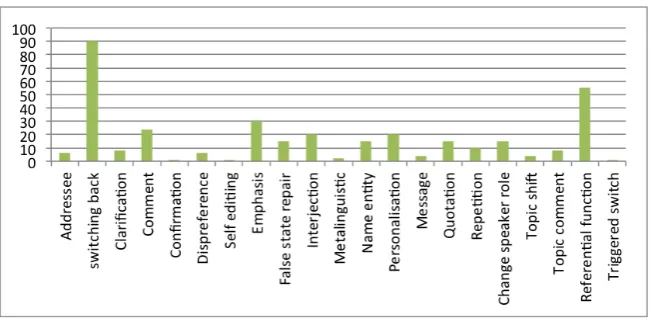
code-Figure 3: Distribution of POS tags of the conversational meetings.
Figure 4: Distribution of POS tags of the conversational meetings.
switching occurs, using Google news API. The algorithm is described below:
1. Initialize the seed list of commonly used code-switching words and phrases. The seed terms are the most frequently used phrases in the embedded lan-guage of the collected database.
2. Use each word or phrase in the pool as a keyword to search for news in the matrix language. Detect if there is code-switching to the embedded language in the re-sultant news.
3. Update the list of words and phrases.
78k English words are mixed in the text corpus. The per-centage of the embedded language is 7.8%. Most of the code-switching type is intra-sentential code-switching.
6.
Conclusion
A straightforward approach to recognizing code-switching speech is to train acoustic and language models using switching data. However, there have not been many code-switching corpora. In this paper, the collection and an-notation of a Mandarin-English code-switching corpus is described. The corpus includes conversational meeting
speech and transcriptions, project meeting speech and tran-scriptions, a student interview corpus, as well as code-switching text from the web. We have provided an al-gorithm for downloading text data which contains code-switching from the internet. Our collected data can be used for the study of internal rules which code-switching should follow. The corpus can also be used for training acoustic and language models to recognize Mandarin-English code switching speech.
7.
References
Myers-Scotton C. and Myers C. 1993. Duelling lan-guages: Grammatical structure in codeswitching. Clarendon Press Oxford.
J.Y.C. Chan, PC Ching, and T. Lee. 2005a. Development of a cantonese-english code-mixing speech corpus. In Ninth European Conference on Speech Communication and Technology.
J.Y.C. Chan, PC Ching, T. Lee, and H.M. Meng. 2005b. Detection of Language Boundary in Code-switching ut-terances by Bi-phone Probabilities. InChinese Spoken Language Processing, 2004 International Symposium on, pages 293–296. IEEE.
code-mixing utterances. InNinth International Conference on Spoken Language Processing. ISCA.
Li D. 2000. Cantonese-english code-switching research in hong kong: a y2k review. World Englishes, 19(3):305– 322.
J.J. Gumperz. 1982. Discourse strategies, volume 1. Cam-bridge Univ Pr.
Schultz I.T., Fung P., and Burgmer C. 2010. Detecting code-switch events based on textual features.
D.C. Lyu and R.Y. Lyu. 2008. Language identification on code-switching utterances using multiple cues. InNinth Annual Conference of the International Speech Commu-nication Association.
D. Lyu, R. Lyu, Y. Chiang, and C. Hsu. 2006. Speech recognition on code-switching among the Chinese Di-alects.ICASSP, I (1105-1108).
D.C. Lyu, T.P. Tan, E.S. Chng, and H. Li. 2010. Seame: A mandarin-english code-switching speech corpus in south-east asia. In Eleventh Annual Conference of the International Speech Communication Association. C.J. Shia, Y.H. Chiu, J.H. Hsieh, and C.H. Wu. 2004.
Lan-guage boundary detection and identification of mixed-language speech based on map estimation. In Acous-tics, Speech, and Signal Processing, 2004. Proceed-ings.(ICASSP’04). IEEE International Conference on, volume 1, pages I–381. IEEE.
T. Solorio and Y. Liu. 2008. Learning to predict code-switching points. InProceedings of the Conference on Empirical Methods in Natural Language Processing, pages 973–981. Association for Computational Linguis-tics.
Li Y., Fung P., Xu P., and Liu Y. 2011. Asymmetric acous-tic modeling of mixed language speech. In Acoustics, Speech and Signal Processing (ICASSP), 2011 IEEE In-ternational Conference on, pages 5004–5007. IEEE. Q. Zhang, J. Pan, and Y. Yan. 2008. Mandarin-English