Detecting Code-Switching in a Multilingual Alpine Heritage Corpus
Martin Volk and Simon Clematide University of Zurich
Institute of Computational Linguistics
volk|[email protected]
Abstract
This paper describes experiments in de-tecting and annotating code-switching in a large multilingual diachronic corpus of Swiss Alpine texts. The texts are in En-glish, French, German, Italian, Romansh and Swiss German. Because of the mul-tilingual authors (mountaineers, scientists) and the assumed multilingual readers, the texts contain numerous code-switching elements. When building and annotating the corpus, we faced issues of language identification on the sentence and sub-sentential level. We present our strategy for language identification and for the an-notation of foreign language fragments within sentences. We report 78% precision on detecting a subset of code-switches with correct language labels and 92% un-labeled precision.
1 Introduction
In the Text+Berg project we have digitized the yearbooks of the Swiss Alpine Club (SAC) from its first edition in 1864 until today. They contain articles about mountain expeditions, the flora and fauna of the Alpes and other mountain regions, glacier and climate observations, geology and his-tory papers, book reviews, accident and security reports, as well as the protocols of the annual club gatherings. The texts are in the four official languages of Switzerland French, German, Italian and Romansh1 plus a few in English and Swiss
German dialects.
Because of the multilinguality of the authors and readers, many articles are mixed-language texts with inter-sentential and intra-sentential
1. Romansh is the 4th official language in Switzerland. It is spoken by around 25,000 people in the mountainous South-Eastern canton of Graub¨unden.
code-switching. This poses a challenge for auto-matically processing the texts. When we apply Part-of-Speech (PoS) tagging, named entity recog-nition or parsing, our systems need to know the language that they are dealing with. Therefore we had used a language identifier from the start of the project to mark the language of each sentence. We report on our experiences with sentence-based lan-guage identification in section 3. Figure 1 shows an example of a French text with an English ap-pendix title plus an English quote from this book.
Lately we discovered that our corpus also contains many intra-sentential code-switches. For example, we find sentences like
... und ich finde esvery nice and
de-lightfuleinen Vortrag halten zu d¨urfen.
(Die Alpen, 1925)(EN : ... and I find it very nice and delightful to be allowed to give a talk.)
where the German sentence contains an English phrase in quotation marks. Obviously, a German PoS tagger will produce nonsense tags for the En-glish phrase as the words will be unknown to it. PoS taggers are good at tagging single unknown words based on the surrounding context, but most taggers fail miserably when a sequence of two or more words is unknown. The upper half of fi-gure 2 shows the PoS tagger output for the above example. The wordsvery, nice, delightfulare sen-selessly tagged as proper names (NE), onlyandis tagged as foreign word (FM).
Our goal is to detect all intra-sentential code-switches and to annotate them as exemplified in the lower half of figure 2. They shall be framed with the TEI-conformant tag<foreign>which also shall specify the language of the foreign lan-guage segment. All tokens in the segment shall be tagged as foreign words (e.g. FM in the German STTS tag set, ET in the French Le Monde tag set (Abeill´e et al., 2003)), and each lemma shall get
the special symbol @fn@ to set it apart from lem-mas of the surrounding sentence. In this paper we report on our experiments towards this goal and suggest an algorithm for detecting code-switching. We adopt a wide definition of code-switching. We are interested in detecting all instances where a text is in a dominant language and contains words, phrases and sentences in another language. Though our definition is broad, it is clearly more restricted than others, as e.g. the definition by Kracht and Klein (2014) which includes special purpose codes like bank account numbers or shoe sizes.
In this paper we will give an overview of the language mix in the yearbooks of the Swiss Al-pine Club over the 150 years, and we will illus-trate how we identified inter-sentential and intra-sentential code-switching. We will give a quanti-tative overview of the number of code-switching candidates that we automatically located.
2 The Text+Berg Corpus
The Text+Berg corpus comprises the annual pu-blications of the Swiss Alpine Club (SAC) from its first edition in 1864 until 2013. From the start until 1923 the official yearbook was called “Jahr-buch des Schweizer Alpen-Club” (EN : yearbook of the Swiss Alpine Club), and it typically consis-ted of 500 to 700 pages. The articles of these first 60 years were mostly in German (with 86% of the words), but some also in French (13% of the words) and few in Italian and Romansh (Volk et al., 2010).
Interestingly, the German articles contained passages in French and sometimes other languages (e.g. English, Swiss German, Latin) without trans-lations, and vice versa. Obviously, the article au-thors and yearbook editors assumed that the rea-ders of the yearbook were polyglott at least in En-glish, French, German and Latin during that time. In fact, the members of the SAC in the 19th cen-tury came from an academic elite. Mountain ex-ploration was a past-time of the rich and educated. Still, during that same time the French-speaking sections of the Swiss Alpine Club published their own yearbook in parallel to the official yearbook and called it “Echo des Alpes”. It started shortly after the official yearbook in the late 1860s and continued until 1923. Each “Echo des Alpes” year-book contained between 300 to 600 pages adding up to a total of 22,582 pages with 7.4 million
to-kens, almost all in French with rare quotes in Ger-man.
As of 1925 the official SAC yearbook and the “Echo des Alpes” were merged into a new publi-cation called “Die Alpen. Les Alpes. Le Alpi” (in German, French, Italian) which has been publi-shed ever since. Over the years it sometimes ap-peared as quarterly and sometimes as monthly gazine. Today it appears 12 times per year in ma-gazine format. For the sake of simplicity we conti-nue to call each annual volume a yearbook.
The merger in 1925 resulted in a higher per-centage of French texts in the new yearbook. For example, the 1925 yearbook had around 143,000 words in German and 112,000 in French (56% to 44%). The ratio varied somewhat but was still at 64% to 36% in 1956.
From 1957 onwards, the SAC has published pa-rallel (i.e. translated) French and German versions of the yearbooks. At the start of this new era only half of the articles were translated, the rest was printed in the original language in identical ver-sions in the two language copies.
Over the next decade the number of translations increased and as of 1983 the yearbooks were com-pletely translated between German and French. Few Italian articles were still published verbatim in both the French and German yearbooks. As of 2012 the SAC has launched an Italian language version of its monthly magazine so that now it pro-duces French, German and Italian parallel texts.
In its latest release the Text+Berg corpus (com-prising the SAC yearbooks, the ALPEN maga-zine and the Echo des Alpes) contains around 45.8 million tokens (after tokenization). French and German account for around 22 million tokens each, Italian accounts for 0.8 million tokens. The remainder goes to English, Latin, Romansh and Swiss German. The corpus is freely available for research purposes upon request.
3 Language Identification in the Text+Berg Corpus
We compiled the Text+Berg corpus by scanning all SAC yearbooks from 1864 until 2000 (around 100,000+ pages). Afterwards we employed com-mercial OCR software to convert the scan images into electronic text. We developed and applied techniques to automatically reduce the number of OCR errors (Volk et al., 2011).
FIGURE1 – Example of an English title and an English quote in a French text (Die Alpen, 1955)
FIGURE 2 – Example of an annotated German sentence with English segment, before and after
2009 as PDF documents which we automatically converted to text. The subsequent yearbooks from 2010 until 2013 we received as XML files from the SAC.
We have turned the whole corpus into a uniform XML format. For this, the OCR output texts as well as the texts converted from PDF and XML are structured and annotated by automatically mar-king article boundaries, by tokenization, language identification, Part-of-Speech tagging and lemma-tization. Our processing pipeline also includes to-ponym recognition and geo-coding of mountains, glaciers, cabins, valleys, lakes and towns. Further-more we recognize and co-reference person names (Ebling et al., 2011), and we annotate temporal expressions (date, time, duration and set) with a variant of HeidelTime (Rettich, 2013). Finally we analyze the parallel parts of our corpus and pro-vide sentence alignment information that is com-puted via BLEUalign (Sennrich and Volk, 2011).
In order to process our texts with language-specific tools (e.g. PoS tagging and person name recognition) we employed automatic language identification on the sentence level. We used Lingua-Ident2(developed by Michael Piotrowski)
to determine for each sentence in our corpus whe-ther it is in English, French, German, Italian or Ro-mansh. Lingua-Ident is a statistical language iden-tifier based on letter n-gram frequencies. For long sentences it reliably distinguishes between the lan-guages. Unfortunately it often misclassifies short sentences. Therefore we decided to use it only for sentences with more than 40 characters. Shorter sentences are assigned the language of the article. This can be problematic for mixed language ar-ticles. An alternative strategy would be to assign the language of the previous sentence to short sen-tences.
For sentences that Lingua-Ident judges as Ger-man we run a second classifier that distinguishes between Standard German and Swiss German dia-lect text. Since there are no writing rules for Swiss German dialects, they come in a variety of spel-lings. We have compiled a list of typical Swiss German words (e.g. Swiss-German : chli, chlii, chlini, chline= German :klein, kleine= English :
small) that are not used in Standard German in or-der to identify Swiss German sentences.3
2. http ://search.cpan.org/dist/Lingua-Ident/
3. We are aware that the Text+Berg corpus contains also occasional sentences (or sentence fragments) in other Ger-man dialects (e.g. Austrian GerGer-man, Bavarian GerGer-man) and
Based on the language tag of each sentence we are able to investigate coarse-grained code-switching. Whenever the language of a sentence deviates from the language of the article, we have a candidate for code-switching. For example, in the yearbook 1867 we find a German text (describing the activities of the club) with a French quote :
Der Berichterstatter bemerkt dar¨uber : “On peut remarquer `a cette occasion qu’il est rare que par un effort de l’es-prit on puisse mettre du brouillard en bouteille, et . . . ” Die etwas ¨altere Sek-tion Diablerets, deren Steuer Herr Au-gust Bernus mit kundiger Hand . . .
Most code-switching occurs with direct speech, quotes and book titles. The communicative goal is obviously to make the text more authentic.
4 Related Work on Detection of Code-Switching
Most previous work on automatically detecting code-switching focused on the switches between two known languages (whereas we have to deal with a mix of 6 languages).
Solorio and Liu (2008) worked on real-time prediction of code-switching points in Spanish-English conversations. This means that the judge-ment whether the current word is in a different lan-guage than the lanlan-guage of the matrix clause can only be based on the previous words. They use the PoS tag and its probability plus the lemma as pro-vided by both the Spanish and the English Tree-Tagger as well as the position of the word in the Beginning-Inside-Outside scheme as features for making the decision. In order to keep the number of experiments manageable they restricted their history to one or two preceding words. As an inter-esting experiment they generated code-switching sentences Spanish-English based on their different predictors and asked human judges to rate the na-turalness of the resulting sentences. This helped them to identify the most useful code-switching predictor.
Vu et al. (2013) and Adel et al. (2013) consi-der English-Mandarin code-switching in speech recognition. They investigate recurrent neural net-work language models and factored language mo-dels to the task in an attempt to integrate syntac-tic features. For the experiments they use SEAME,
the South East Asia Mandarin-English speech cor-pus compiled from Singaporean and Malaysian speakers. It consists of spontaneous interviews and conversations. The transcriptions were clea-ned and each word was manually tagged as En-glish, Mandarin or other. The data consists of an intensive mix of the two languages with the ave-rage duration of both English and Mandarin seg-ments to be less than a second ( !). In order to as-sign PoS tags to this mixed language corpus, the authors applied two monolingual taggers and com-bined the results.
Huang and Yates (2014) also work on the de-tection of English-Chinese code-switching but not on speech but rather on web forum texts produ-ced by Chinese speakers living in the US. They use statistical word alignment and a Chinese lan-guage model to substitute English words in Chi-nese sentences with suitable ChiChi-nese words. Pre-paring the data in this way significantly improved Machine Translation quality. Their approach is li-mited to two known languages and to very short code-switching phrases (typically only one word). Tim Baldwin and his group (Hughes et al., 2006) have surveyed the approaches to language identification at the time. They found a number of missing issues, such as language identification for minority languages, open class language identifi-cation (in contrast to identifiidentifi-cation within a fixed set of languages), sparse training data, varying encodings, and multilingual documents. Subse-quently they (Lui and Baldwin, 2011) introduced a system for language identification of 97 languages trained on a mixture of corpora from different domains. They claim that their system Langid is particularly well suited for classifying short input strings (as in Twitter messages). We therefore tes-ted Langid in our experiments for code-switching detection.
5 Exploratory Experiments with the SAC Yearbook 1925
In order to assess the performance of Langid for the detection of code-switching we performed an exploratory experiment with the SAC yearbook 1925. We extracted all word sequences between pairs of quotation marks where at least one token had been assigned the “unknown” lemma by our PoS tagger. The “unknown” lemma indicates that this word sequence may come from a different lan-guage.
The word sequence had to be at least 4 cha-racters long, thus skipping single letters and ab-breviations. In this way we obtained 333 word sequences that are potential candidates for intra-sentential code-switching. We then ran these word sequences through the Langid language identifica-tion system with the restricidentifica-tion that we expect the word sequences only to be either English, French, German, Italian or Latin (Romansh and Swiss Ger-man are not included in Langid). For a given string Langid delivers the most likely language together with a confidence score.
We then compared the language predicted by the Langid system with the (automatically) com-puted language of the complete sentence. In 189 out of the 333 sentences the Langid output pre-dicted a code-switch. We then manually graded all Langid judgements and found that 225 language judgements (67.5%) were correct. But only 89 of the 189 predicted code-switches came with the correct language. 40 of the 100 incorrect judge-ments were actually code-switches but with a dif-ferent language. The remaining ones should have been classified with the same language as the sur-rounding sentence and are thus no examples of code-switching.
A closer inspection of the results revealed that the book contained not only code-switches in the expected 5 languages, but also into Romansh (6), Spanish (4) and Swiss-German (13). Obviously all of these were incorrectly classified. Most (8) of the Swiss-German word sequences were classified as German which could count as half correct, but the others were misclassified as English (among them a variant of the popular Swiss German fare-well phraseuf Wiederluegespelled asuf’s Wieder-luege).
The Langid system has a tendency to classify word sequences as English. Many of the short, in-correctly classified word sequences were judged as English. It turns out that Langid judges even the empty string as English with a score of 9.06. The-refore all judgements with this score are dubious. We found that 56 short word sequences were clas-sified as English with this score, out of which 35 were erroneously judged as English. Only strings with a length of 15 and more characters that are classified as English should be trusted. All others need to be discarded.
SAC yearbooks candidates predicted code-sw correct wrong lang no code-sw
1868 to 1878 388 121 88 33 13
1926 to 1935 792 335 266 69 23
Total 1180 456 354 102 36
TABLE1 – Recognition of code-switches in the Text+Berg corpus
with 20 or more characters. In our test set only 4 strings that were longer than 20 characters were incorrectly classified within the selected language set. Among the errors was the famous Latin phrase
conditio sine qua non(length : 21 characters inclu-ding blanks) which Langid incorrectly classified as Italian.
Another reason for the considerable number of misclassifications can be repeated occurrences of a word sequence. Our error count is a token-based count and thus prone to misclassified recurring phrases. In our experiment, Langid misclassified the French book nameEcho des Alpes as Italian. Unfortunately this name occurs 18 times in our test set and thus accounts for 18 errors. We suspect that an-oat the end of a word is a strong indicator for Italian. In a short string likeEcho des Alpes(14 characters), this can make the difference.
Another interesting observation is that hyphens speak for German. Our test set contains the hy-phenated French stringvesse-de-neigewhich Lan-gid misclassifies as German with a clear margin over French. When the same string is analyzed without hyphens, then Langid correctly computes a preference for French over German. A similar observation comes from the Swiss German phrase
uf’s Wiederluegebeing classified as English when spelled with the apostrophe (which is less frequent in German than in English). Without the apos-trophe Langid would count the string as German. With short strings like this, special symbols have a visible impact on the language identification.
We also observed that Langid is sensitive to all-caps capitalization. For example, AUS DEM LEBEN DER GEBIRGSMUNDARTEN(EN : The Lives of Mountain Dialects) is misclassified as En-glish (with the default score) while Aus dem Le-ben der Gebirgsmundarten is correctly classified as German.
Overall, we found that code-switching within the same article rarely targets different languages. For example, if the article is in German and contains code-switches into English, then it hardly ever contains code-switches into other languages.
In analogy to the one-sense-per-discourse hypo-thesis we might call this the one-code-switch-language-per-discourse hypothesis.
6 Detecting Intra-sentential Code-Switching
Based on exploratory studies and observations we decided on the following algorithm for detec-ting and annotadetec-ting intra-sentential foreign lan-guage segments in the Text+Berg corpus. We search for sub-sentential token sequences (possi-bly of length 1) that are framed by a pair of quota-tion marks and that contain at least one “unknown” lemma. There must be at least two tokens outside of the quotation marks in the same sentence. As a compromise we restrict our detection to strings longer than 15 characters so that we get relati-vely reliable language judgements by Langid. The strings may consist of one token that is longer than 15 characters (e.g.Matterhornhochtourist) or a se-quence of tokens whose sum of characters inclu-ding blanks is more than 15. We feed these can-didate strings to Langid for language identifica-tion and compare the output language with the lan-guage attribute of the surrounding sentence. If the languages are different, then we regard the token sequence as code-switch and mark it accordingly in XML as shown in figure 2.
In order to determine the precision of this al-gorithm, we checked 10 yearbooks from 1868 to 1878 (there was no yearbook in 1870) and from 1926 to 1935. The results are in table 1. From the 1180 code-switch candidates that we compu-ted based on the above restrictions, Langid predic-ted 456 code-switches (39%). This means that in 39% of the cases Langid predicted a language that was different from the language of the surrounding sentence.
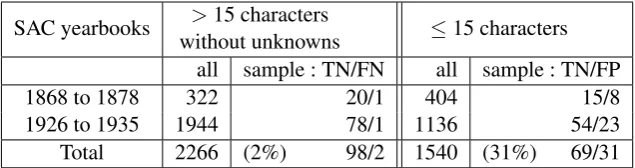
seg-SAC yearbooks without unknowns>15 characters ≤15 characters all sample : TN/FN all sample : TN/FP 1868 to 1878 322 20/1 404 15/8 1926 to 1935 1944 78/1 1136 54/23 Total 2266 (2%) 98/2 1540 (31%) 69/31
TABLE2 – Estimation of the loss of recall due to the filtering approach based on a random sample of 100
quotations for each filtering category (TN : true negatives, FN : false negatives)
ment in the following German sentence is cor-rectly detected and classified :
Anschliessend f¨uhrte Ambros dasselbe Bergsteigertriodans des circonstances
tr`es d´efavorablesauf den Monte Rosa
... (Die Alpen, 1935) (EN : After-wards Ambros led the same 3 mountai-neers under very unfavorable condi-tionsonto Monte Rosa.)
Out of the 102 segments whose language was wrongly classified, only 36 were no code-switches. For example, the Latin segment cum grano salis africani is indeed a code-switch in a German sentence although Langid incorrectly classifies it as English. In fact, our evaluation sho-wed that Langid is “reluctant” to classify strings as Latin. Latin strings are often misclassified as En-glish or Italian.
Overall this means that only 8% of the predicted code-switches are no code-switches. Therefore we can safely add the module for code-switch detec-tion into our processing and annotadetec-tion pipeline.
In order to estimate the recall of our quota-tion filtering approach we manually evaluated a sample of the quotations that our algorithm exclu-ded. Table 2 presents the numbers for the two time periods for two cases : first for sequences that are longer than 15 characters and contain only known lemmas, second for sequences that are shorter than 16 characters and contain at least one “unknown” lemma. For both cases we checked 100 instances. The evaluation for the quotations with more than 15 characters but with all known lemmas (no “unknown” lemma) shows only 2 false negatives. Therefore, we can conclude safely that most of the code-switches with more than 15 characters were included in our candidate set.
Table 2 also shows that there were 1540 quota-tions with 15 or less characters. The manual ins-pection of 100 randomly selected quotations
re-vealed that 31 indeed include foreign material. Some of these quotations are geographic names, e.g. the valley Bergell (EN/IT : Val Bregaglia), where it is difficult to decide whether this should be regarded as a code-switch. For this evaluation, we sticked to the principle that a foreign geogra-phic name in quotation marks counts as a code-switch. The number of missed code-switches is high (31%). However, due to the limited preci-sion of Langid (and other character-based lan-guage identifiers) for short character sequences, we still consider our length threshold appropriate. A different approach to language identification is needed to reliably classify these short quotes.
7 Discussion
The correctly marked code-switches in our test periods can be split by language of the matrix sen-tence and the language of the sub-sentential seg-ment (= the code-switch segseg-ment). Table 3 gives an overview of the types of code-switches for the two periods under investigation. We see clearly that code-switches from German to English were rare in the 19th century (8 out of 89 = 9%) but be-came much more popular in the 1920s and 1930s (61 out of 265 = 23%). This came at the cost of French which lost ground from 54% (48 out of 89) to 40% (106 out of 265).
[image:7.595.140.458.62.146.2]num-sent
lang segmlang 1868 to1878 1926 to1935
de en 8 61
de fr 48 106
de it 24 19
de la 7 3
fr de 2 35
fr en - 20
fr it - 11
fr la - 2
it de - 3
it en - 2
it fr - 3
Total 89 265
TABLE3 – Correctly detected code-switches in the
Text+Berg corpus
sent
lang segmlang 1868 to1878 1926 to1935
de en 13 23
de fr 9 5
de it 8 12
de la 2 1
fr de - 7
fr en 1 10
fr it - 8
fr la - 1
it en - 2
Total 33 69
TABLE 4 – Incorrectly labeled code-switches in
the Text+Berg corpus
ber of code-switches have clearly increased. For French we observe the same trend with 2 code-switches in 200’000 words in the first period com-pared to 68 code-switches in the 1 million tokens in the second period.
There is also a striking difference between French and German with many more code-switches in German than in French. For instance, for German we find 135 code-switches per 1 mil-lion tokens in the second period vs. 68 code-switches per 1 million tokens for French.
One surprising finding were the code-switches into Latin. We had not noticed them before, since our corpus does not contain longer passages of La-tin text. But this study shows that code-switches
correct
segm Langid prediction
lang en it fr la de Total
la 15 12 3 1 31
de 7 5 5 1 18
fr 7 3 10
it 6 6
es 3 1 2 6
rm 1 2 3
ru 1 1
id 1 1
Total 40 22 10 3 1 76
TABLE5 – Confusion matrix for incorrectly
labe-led code-switches in the periods 1868 to 1878 and 1926 to 1935
into Latin persisted into the 1920s (3 out of Ger-man and 2 out of French).
On the negative side (cf. table 4), misclassi-fying segments as English is the most frequent cause for a wrong language assignment in both periods. Table 5 shows the confusion matrix which contrasts the manually determined segment lan-guage with the incorrect lanlan-guage predicted by Langid. This confirms that Langid has a tendency to classify short text segments as English. But there are also a number of errors for Latin being mistaken for Italian, and German being mistaken for Italian or French.
As a general remark, it should be noted that an n-gram-based language identifier has advantages over a lexicon-based language identifier in the face of OCR errors. In the yearbook 1926 we observed the rare case of a whole English sentence having been contracted to one token Ilovetobemothered. Still, our code-switch detector recognizes this as an English string.4
8 Conclusions
We have described our efforts in language iden-tification in a multilingual corpus of Alpine texts. As part of corpus annotation we have identified the language of each corpus sentence amongst En-glish, French, Standard German, Swiss German,
4. The complete sentence is :Un long Anglais, avec le-quel, dans le hall familial, je m’essaie `a ´echanger laborieu-sement quelques impressions `a ce sujet, me dit :I love to be
Italian and Romansh. Furthermore we have de-veloped an algorithm to identify intra-sentential code-switching by analyzing sentence parts in quotation marks that contain “unknown” lemmas. We have shown that token sequences that amount to 15 or more characters can be judged by a state-of-the-art language identifier and will result in 78% correctly labeled code-switches. Another 14% are code-switches but with a language dif-ferent from the auto-assigned language. Only 8% are not code-switches at all.
There are many ways to continue and extend this research. We have not included language iden-tification for Swiss German nor for Romansh in the intra-sentential code-switch experiments re-ported in this paper. We will train language models for these two languages and add them to Langid to check the impact on the recognition accuracy. Since code-switches into Romansh are rare, and since Romansh can easily be confused with Ita-lian, it is questionable whether the addition of this language model will have a positive influence.
We have used the “general-purpose” language identifier Langid in these experiments. It will be interesting to investigate language identifiers that are optimized for short text fragments as discus-sed by Vatanen et al. (2010). Given the relati-vely high number of short quotations (31%) that contain code-switches, recall could improve consi-derably.
In this paper we have focused solely on code-switching candidates that are triggered by pairs of quotation marks. In order to increase the recall we will certainly enlarge the set of triggers to other in-dicators such as parentheses or commas. We have briefly looked at parentheses as trigger symbols and found them clearly less productive than quo-tation marks. To also find code-switches that have no overt marker remains the ultimate goal.
Finally, we will exploit the parallel parts of our corpus. If a sentence in German contains a French segment, then it is likely that this French segment occurs verbatim in the parallel French sentence. Based on sentence and word alignment we will search for identical phrases in both language ver-sions. We hope that this will lead to high accuracy code-switch data that we can use as training mate-rial for machine learning experiments.
Acknowledgments
We would like to thank Michi Amsler and Don Tuggener for useful comments on literature and tools for language identification and code-switching, as well as Patricia Scheurer for com-ments and suggestions on the language use in the SAC corpus. This research was supported by the Swiss National Science Foundation under grant CRSII2 147653/1 through the project “MO-DERN : Modelling discourse entities and relations for coherent machine translation”.
References
Anne Abeill´e, Lionel Cl´ement, and Francois Tousse-nel. 2003. Building a Treebank for French. In Anne Abeill´e, editor,Building and Using Parsed Corpora, volume 20 of Text, Speech and Language Tech-nology, chapter 10, pages 165–187. Kluwer, Dor-drecht.
Heike Adel, Ngoc Thang Vu, and Tanja Schultz. 2013. Combination of recurrent neural networks and fac-tored language models for code-switching language modeling. InProceedings of the 51st Annual Mee-ting of the Association for Computational Linguis-tics (ACL), Sofia.
Sarah Ebling, Rico Sennrich, David Klaper, and Martin Volk. 2011. Digging for names in the mountains : Combined person name recognition and reference resolution for German alpine texts. InProceedings of The 5th Language & Technology Conference : Human Language Technologies as a Challenge for Computer Science and Linguistics, Poznan.
Fei Huang and Alexander Yates. 2014. Improving word alignment using linguistic code switching data. InProceedings of the 14th Conference of the Euro-pean Chapter of the Association for Computational Linguistics, pages 1–9, G¨oteborg.
Baden Hughes, Timothy Baldwin, Steven Bird, Jeremy Nicholson, and Andrew Mackinlay. 2006. Reconsi-dering language identification for written language resources. In Proceedings of LREC 2006, pages 485–488, Genoa.
Marcus Kracht and Udo Klein. 2014. The grammar of code switching. Journal of Logic, Language and Information, 23(3) :313–329.
Marco Lui and Timothy Baldwin. 2011. Cross-domain feature selection for language identification. InProceedings of 5th International Joint Conference on Natural Language Processing, pages 553–561, Chiang Mai, Thailand. Asian Federation of Natural Language Processing.
Katrin Rettich. 2013. Automatische Annotation von deutschen und franz¨osischen temporalen Aus-dr¨ucken im Text+Berg-Korpus. Master thesis, Uni-versit¨at Z¨urich, Institut f¨ur Computerlinguistik. Rico Sennrich and Martin Volk. 2011.
In Proceedings of The 18th International Nordic Conference of Computational Linguistics (Noda-lida), Riga.
Thamar Solorio and Yang Liu. 2008. Learning to pre-dict code-switching points. In Proceedings of the Conference on Empirical Methods in Natural Lan-guage Processing, pages 973–981, Honolulu. Asso-ciation for Computational Linguistics.
Tommi Vatanen, Jaakko J. V¨ayrynen, and Sami Vir-pioja. 2010. Language identification of short text segments with n-gram models. In Proceedings of LREC, pages 3423–3430, Malta.
Martin Volk, Noah Bubenhofer, Adrian Althaus, Maya Bangerter, Lenz Furrer, and Beni Ruef. 2010. Chal-lenges in building a multilingual alpine heritage cor-pus. InProceedings of LREC, Valletta, Malta. Martin Volk, Lenz Furrer, and Rico Sennrich. 2011.
Strategies for reducing and correcting OCR errors. In C. Sporleder, A. van den Bosch, and K. Zerva-nou, editors,Language Technology for Cultural He-ritage : Selected Papers from the LaTeCH Work-shop Series, Theory and Applications of Natural Language Processing, pages 3–22. Springer-Verlag, Berlin.