Converting a Corpus into a Hypertext:
An Approach Using XML Topic Maps and XSLT
Eva Anna Lenz, Angelika Storrer
Universit¨at Dortmund, Institut f¨ur deutsche Sprache und Literatur Emil-Figge-Str. 50, D-44227 Dortmund, Germany
lenz, storrer @hytex.info
Abstract
In the context of the HyTex project, our goal is to convert a corpus into a hypertext, basing conversion strategies on annotations which explicitly mark up the text-grammatical structures and relations between text segments. Domain-specific knowledge is represented in the form of a knowledge net, using topic maps. We use XML as an interchange format. In this paper, we focus on a declarative rule language designed to express conversion strategies in terms of text-grammatical structures and hypertext results. The strategies can be formulated in a concise formal syntax which is independend of the markup, and which can be transformed automatically into executable program code.
1.
Project Framework
We illustrate a model for converting a text corpus into a hypertext. The approach is being developed in the con-text of the HyTex project (Hypercon-text conversion based on textgrammatical annotation, http://www.hytex.info/) funded by the Deutsche Forschungsgemeinschaft (DFG), which investigates methods and strategies for text-to-hypertext conversion. The central idea of the project is to base conversion strategies on annotations which ex-plicitly mark up the text-grammatical structures and rela-tions between text segments, e.g. co-reference relarela-tions, se-mantics of connectives, text-deictic expressions, and ex-pressions indicating topic handling (Storrer, to appear). The project will develop a methodology which (semi-)automatically constructs hypertext layers and views, using the text-grammatical annotations.
By storing the hypertext as additional document lay-ers, this methodology preserves structure and content of the original text documents, thus ensuring their recover-ability. The multiple-layer approach facilitates the publish-ing of the same content in different media (cross-media-publishing), and, in addition, provides the reader with the choice beween sequential and selective reading modes. Se-lective hypertext readers will be supported in finding coher-ent pathways through the documcoher-ent network.
Feasability and performance of the methodology will be tested and evaluated using a German text corpus. The corpus documents will deal with the same global subject domain, namely “text technology”. The corpus comprises various genres (including papers, project reports, text-books, FAQ, technical specifications, glossaries/lexicons, and newsgroup postings). These genres differ with respect to parameters which are crucial for hypertext conversion: length, topic handling, linearity. The corpus will be trans-formed into a hyperbase by a stepwise approach, the steps being:
corpus collection and automated annotation of the hi-erarchical document structure,
(semi-)automatic text-grammatical annotation, e.g. segmentation of paragraphs into smaller functional units,
annotation of co-reference relations between text units, in particular expressions used in topic-handling and expressions indicating the rhetorical function of smaller segments,
annotation of definitions for technical terms of the subject domain and of term instances,
modelling terminological knowledge of the global subject domain, using topic maps (Pepper and Moore, 2001),
implementation and evaluation of procedures for seg-mentation, reorganisation, and linking. These oper-ate on the text-grammatical annotations and the topic map model.
In this paper, we concentrate on the technical realisa-tion of the last step. In particular, we focus on a declarative rule language for describing the transformation process. In section 2, we outline this approach. We then give a brief overview of the model’s components in section 3 before we focus on the design of the rule language and its implementa-tion in secimplementa-tion 4. Conclusions and an outlook are presented in section 5.
2.
Simplifying the Transformation Process
The transformation process can be viewed as a map-ping from the corpus to the hypertext. It can be described by rules consisting of two parts: a condition (on the docu-ments) and an action that is to be executed when the condi-tion holds. In particular, on the basis of various coherence relations modelled by annotations (conditions), a linking structure of the hypertext is to be generated (actions).
Traditionally, transformations are implemented using programming languages where these rules remain implicit. In the project context – as in other contexts – many rules are similarly structured, leading to either redundant pro-gram code or complex propro-gramming expressions. Further-more, a programming language includes many constructs not needed in our context.
compact, easier to understand, and easier to maintain than program code. We will further discuss the advantages and drawbacks of the approach in section 5.
3.
Model Overview
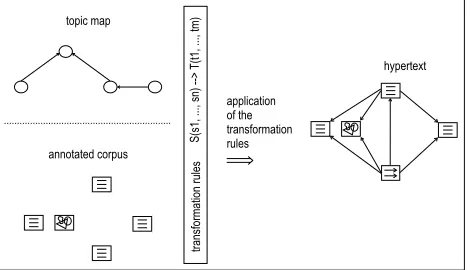
Our architecture contains three components (see figure 1):
the corpus of annotated documents,
the topic map modelling the technical terms of the subject domain in terms of WordNet relations, and
a set of rules which declaratively describe how the corpus and the topic map are to be transformed into a hypertext.
All components are expressed in or transformed into XML syntax. This allows us to apply available tools (parsers, generators, browsers, etc.). For example, the syntax of ev-ery genre in the corpus, the topic map, and the rule lan-guage can be defined and checked by document grammars (e.g., Document Type Definitions (DTDs)). We can easily reuse documents available in XML or HTML, and produce documents for the web.
Figure 1: Model overview.
3.1. The Corpus
The German text corpus dealing with the subject do-main “text technology” originally contains texts in various formats, including Word and HTML. In a first step, these formats are converted to XML in order to have a consistent format.
The corpus is then annotated on different levels in sub-sequent steps in order to prepare it for hypertext con-version. We annotate the hierarchical document struc-ture for each genre, the text-grammatical strucstruc-ture, co-reference relations between text units, and definitions and instances of technical terms. We gain these annotations semi-automatically, applying several steps of markup gen-eration and filtering, where intermediate levels of annota-tions (e.g., part-of-speech-tagging, lemmatisation, chunk-ing) finally disappear.
Annotations of technical term definitions and instances will serve us as examples throughout this paper. These en-able us to implement a linking strategy based on knowledge
prerequisites. This linking strategy is suitable in an
appli-cation scenario where a reader is a semi-expert, not recog-nising or being acquainted with every technical term of the
domain, for example in the contexts of interdisciplinary re-search, studies and education, journalism, or lexicography. Application of the linking strategy provides the reader with a hypertext that supports a selective and problem-oriented reading mode. For example, when a reader comes across a term (the term instance), we can indicate that it is a technical term in the domain, and to provide him with the possibility to learn more about this term, e.g. by following a link to the term definition.
We differentiate between three kinds of knowledge pre-requisites:
intratextual knowledge prerequisite: the author of a text uses a term for which he has given a definition in the same text,
extratextual knowledge prerequisite: the author indi-cates that he uses a term whose definition is given in another corpus document, or
domain-specific knowledge prerequisite: the author uses a term well known in the community of the subject domain without indicating that it is a technical term.
We semi-automatically annotate term definitions as well as term instances together with the type of knowledge prereq-uisite. For example, we assume that the knowledge pre-requisite is domain-specific when no term definition can be found prior to its use.
3.2. The Topic Map
In order to implement the linking strategy based on knowledge prerequisites, we need to model terminological knowledge of the subject domain. This knowledge com-prises
The terms and their relations to other terms, e.g. su-perordinates and subordinates, synonyms, etc. We or-ganise this knowledge according to the principles of the lexical database WordNet (Fellbaum, 1998), i.e. in the form of a lexical network, and add domain-specific relations.
The relationships of terms to documents, e.g. to stan-dard definitions, or to occurrences of a term in spe-cific genres, e.g. in an FAQ (“Frequently asked ques-tions”).
Attributions of terms to usages and communities. For example, we can express that one term is employed by the web community rather than the hypertext com-munity.
Topic Maps (ISO, 2000) provide a standardised syntax for such networks. The main unit of organisation is called a “topic”. Topics can be typed, related to other topics, and related to documents in a user-definable and flexible way. We model attributions of terms to usages using the topic map construct of scopes. A topic map can be expressed in XML syntax (Pepper and Moore, 2001); topic maps thus meet all our requirements.
addition to definitions, the extended glossary for a term contains related terms as well as links to other relevant text passages.
The topic map syntax can be validated using the topic map DTD. In the future, topic map software may also be able to check the semantics of a topic map – for example, the allowed types for relations between topics – defined in the form of a topic map schema (Rath, 2000).
4.
Describing the Transformation in Terms
of a Rule Language
Before explaining the rule language, we give an ex-ample of rules implementing the linking strategy based on knowledge prerequisites. These rules make use of the an-notation of term definitions and instances described above. Two rules based on this linking strategy can be ex-pressed as follows:
intratextual linking rule: For each technical term used intratextually (i.e. for each instance of a term defined in the same text), generate a link from the term in-stance to its definition.
domain-specific linking rule: For each technical term used domain-specifically (i.e. for each instance of a technical term known in the community and not de-fined by the author), generate an icon indicating a link to the glossary entry for this term.
4.1. The rule language
It should be possible to formulate hypertextualisation strategies – and transformation rules – independently of the markup actually used in the source and target documents. To this end, we introduce the notion of conceptual
con-structs (or concon-structs). Each time when a new construct is
introduced, the correspondance between the construct and the markup has to be defined (see section 4.2.). Once de-fined, rules can operate on the constructs.
We distinguish between two forms of constructs:
Source constructs are constructs of the source documents, e.g. constructs for expressing coherence relations, term definitions and instances, or WordNet synsets.
Target constructs are constructs of the target documents to be generated by the rules. Target constructs in the domain of hypertext comprise, for example, source and destination anchors for hyperlinks, as well as link types or stretchtext.
Each construct has a unique name and can have a num-ber of arguments. The construct depends on the arguments; they form the construct.
In order to address a construct, we use the following syntax:
c (, , , )
wherecis the name of the construct, and to are the arguments.
As a simplified example from our domain, the construct
termDefinition (term, defText)
is a source construct which denotes a definition of a techni-cal term. It is namedtermDefinitionand characterised by the technical term defined (term) and the text passage containing the definition (defText). Accordingly, the construct
termOccurrence
(termRef, usageType, termInstance)
is a source construct denoting a term instance of a tech-nical term. Here, the arguments are the techtech-nical term referenced (termRef), the way it is used in relation to its definition (usageType: intratextually, extratextually, or domain-specifically) and the actual word form used in the text (termInstance). As an example for a target construct, consider
sourceAnchor
(destinationAddress, anchorContent)
which denotes a source anchor for a link (in HTML:
a href=""
/a ), and
destinationAnchor
(anchorName, anchorContent)
which denotes a destination anchor for a link (in HTML:
a name=""
/a ).
The definition of a construct comprises the following:
the declaration of the construct’s name,
the declaration of its arguments, if any,
and a fragment of program code relating the con-struct to its markup.
A rule consists of a source construct, serving as a dition on the source documents, an arrow, and a target con-struct, denoting an action that is to be performed when the condition holds. The arguments of the source construct can be bound to variables (indicated by a $ sign), whose values can be used in the target construct. It can also be expressed that an argument has to have a given value (indicated by single quotes) in order for the source construct to match. Consider the following two rules as examples:
termDefinition
(term=$termVar, defText=$defTextVar)
destinationAnchor (anchorName=$termVar, AnchorContent=$defTextVar)
and
termOccurrence
(termRef=$termRefVar, usageType=’intratextual’,
termInstance=$termInstanceVar) sourceAnchor
(destinationAddress=$termRefVar, anchorContent=$termInstanceVar)
We particularly benefit from the separation between conceptual constructs and the markup actually used in cases where the markup is complex, and especially when the in-formation about a construct is scattered about an XML file, as it is the case with topics in topic maps (due to the fact that a network structure cannot be presented hierarchically). In this case, a programmer can once define the desired con-struct (e.g., a concon-struct for WordNet word forms, with syn-onyms, antonyms etc. as arguments), writing an inevidently complex code fragment. An expert in hypertext, although not familiar with XSLT, can then apply the construct in a rule describing the transformation of a WordNet word form into a glossary entry.
The separation between constructs and markup has the further advantage that changes in the structure of the markup will only necessitate a change in the program code associated with the definition of the corresponding con-struct, i.e. it will require a revision at only one particular and well-defined place. Rules operating on the construct do not have to be changed at all.
We also consider it an advantage that at the time of defining a construct, one has to reflect on its arguments. We believe that thinking in an abstract way independently of the markup can enable us to find out where information in the markup is missing, or where the markup should be reorganised.
However, a serious restriction of the present approach is the fact that target constructs can effectuate an output only at one place in the target document. We intend to enhance the rule language in such a way that an output at two or more places in the target document can be produced. This will enable us to define target constructs such as “link” that can generate both a source and a destination anchor at dif-ferent places in the target document. Likewise, the possi-bility to combine different source constructs in one rule is very desirable.
An interesting extension of the rule language would al-low to define constructs with different markup in different contexts. For example, the source constructheadingcould be marked up differently in different kinds of input docu-ments, or it might be desirable to choose between the output formats HTML and XLink for target constructs generating hyperlinks.
Although performance is not crucial in our context, we also plan to optimise the implementation, using the “key” construct of XSLT which implements a hash mechanism.
It is also necessary to check the semantics of rules, con-struct definitions, and other parts of the model automati-cally. For example, it should be ensured that rules contain only constructs that have been defined. We intend to use Schematron (Cagle et al., 2001, cp.14), a schema language designed to generate this kind of messages for XML docu-ments.
The model will also be extended to include the gener-ation of adaptive hypertexts (Brusilovky, 2001), i.e. hyper-texts adapted to a particular user. For example, the different usages of terms modelled in the topic map could be used to generate different hypertext versions for users from differ-ent domains or subdomains. Brusilovsky describes several adaptive hypertext techniques (e.g. stretchtext, sorting,
vi-sual annotation, and “dimming” of links). Conceptual tar-get constructs for these techniques would greatly facilitate the task of adaptive hypertext generation.
6.
References
Peter Brusilovky. 2001. Adaptive hypermedia. User
Mod-eling and User-Adapted Interaction, 11(1/2):87–110.
Kurt Cagle, Jon Duckett, Oliver Griffin, Stephen Mohr, Francis Norton, Nik Ozu, Ian Stokes-Rees, Jeni Ten-nison, and Kevin Williams. 2001. Professional XML
Schemas. Wrox Press, Birmingham.
James Clark, editor. 1999. XSL Transformations (XSLT)
Version 1.0. W3C Recommendation. W3C. http://www.w3.org/TR/xslt/.
Christiane Fellbaum, editor. 1998. WORDNET: an
elec-tronic lexical database. MIT Press, Cambridge,
Mas-sachusetts.
ISO. 2000. ISO/IEC 13250:2000 Document de-scription and processing languages – Topic Maps. http://www.y12.doe.gov/sgml/sc34/document/0129.pdf, Geneva.
Michael Kay. 2001. XSLT Programmer’s Reference. 2nd
edition. Wrox Press.
Steve Pepper and Graham Moore, editors. 2001. XML
Topic Maps (XTM) 1.0. TopicMaps.Org Specification.
TopicMaps.Org. http://www.topicmaps.org/xtm/1.0/. Hans Holger Rath. 2000. Topic maps self-control. Markup
Languages: Theory & Practice, 2(4):367–388.
Angelika Storrer. to appear. Coherence in text and hyper-text. Document Design. Journal of research and problem
solving in organizational communication.
Klaus Tochtermann. 1995. Ein Modell f ¨ur