Applying a Dynamic Bayesian Network Framework to Transliteration
Identification
Peter Nabende
Alfa-Informatica, University of Groningen
P. O. Box 716, Postcode 9712 EK, Groningen, The Netherlands E-mail: [email protected]
Abstract
Identification of transliterations is aimed at enriching multilingual lexicons and improving performance in various Natural Language Processing (NLP) applications including Cross Language Information Retrieval (CLIR) and Machine Translation (MT). This paper describes work aimed at using the widely applied graphical models approach of ‘Dynamic Bayesian Networks (DBNs) to transliteration identification. The task of estimating transliteration similarity is not very different from specific identification tasks where DBNs have been successfully applied; it is also possible to adapt DBN models from the other identification domains to the transliteration identification domain. In particular, we investigate the applicability of a DBN framework initially proposed by Filali and Bilmes (2005) to learn edit distance estimation parameters for use in pronunciation classification. The DBN framework enables the specification of a variety of models representing different factors that can affect string similarity estimation. Three DBN models associated with two of the DBN classes originally specified by Filali and Bilmes (2005) have been tested on an experimental set up of Russian-English transliteration identification. Two of the DBN models result in high transliteration identification accuracy and combining the models leads to even much better transliteration identification accuracy.
1.
Introduction
Transliteration identification is a task that is aimed at leading to improvements in various NLP applications including: Machine Translation (MT), Cross Language Information Retrieval (CLIR), and automated Question Answering (QA). A common approach to identifying transliterations involves using bilingual or multilingual corpora where the text is represented using different writing systems or alphabets. The transliteration identification task can then be specified as: given a word in one language (a source language), identify a matching transliteration or transliterations from another language’s (a target language) text. For example given the following name written using English as “Bukenya”, we are interested in determining its most likely target representation out of a set of candidates such as
{Набенде ‘Nabende’, Букенья ‘Bukenya’,
Фергюсон ‘Ferguson’, … , Артур ‘Arthur’}. We
expect a good model to give the Russian representation “Букенья” as the most likely match for “Bukenya” since it is the correct representation.
Major approaches that have been used in transliteration identification include: rule-based methods (Tsuji et al., 2002), statistical methods (Bilac and Tanaka, 2005; Pouliquen et al., 2006) and various machine learning methods (Lee & Chang, 2003; Kuo et al., 2007; Lee et al., 2006; Udupa, et al., 2008, Udupa et al., 2009; Saravanan and Kumaran, 2008; Oh & Isahara, 2007; Lei et al., 2009; Li et al., 2008; Zhou et al., 2008; Wu et al., 2009). Two main recent categorizations are whether the methods used are generative or discriminative. In this paper, we investigate a class of generative graphical models referred to as ‘Dynamic Bayesian Networks (DBNs)’. DBNs have found successful application in various Identification and Recognition tasks including: Protein Structure
approaches but is rather aimed at evaluating one DBN-based edit distance framework that has successfully been applied on tasks that are similar to transliteration identification (Filali and Bilmes, 2005; Kondrak and Sherif, 2006). The DBN-based edit distance framework enables the specification of various models that represent various random variable dependencies that may seem to be important factors in transliteration identification. The paper is organized as follows: section 2 introduces the concept of Dynamic Bayesian Networks and how they can be applied in transliteration identification; section 3 introduces the DBN-based edit distance framework proposed by Filali and Bilmes (2005); section 4 describes the transliteration identification experimental setup and discusses the results obtained from applying the DBN-based framework to transliteration identification; section 5 concludes the paper with pointers to future work.
2.
Dynamic Bayesian Networks
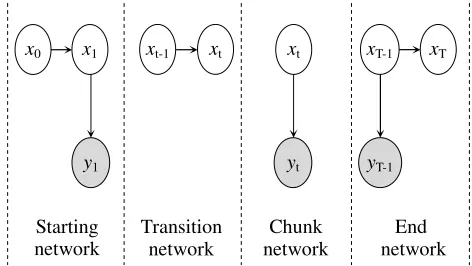
DBNs are directed acyclic graphical models that can be used to represent both time-series data that is generated by some causal process and sequence (Natural Language Processing or Biological) data where we are doubtful about the generating mechanism (Murphy, 2002). DBNs generalize HMMs by representing the hidden state as an arbitrary set of random variables with arbitrary conditional independence assumptions (Zweig and Russell, 1998). Murphy (2002) describes a number of advantages that are associated with using DBNs including: the ability to use generic DBN inference and learning procedures that take a lesser time; and the ability to easily change a model once it is represented as a DBN. Figure 1 shows the Bayesian Networks that are needed to completely specify a DBN representation for the standard HMM which has one hidden state variable and one observation variable. Figure 1 shows that when representing a given sequence, we begin from an initial state x0 that is usually denoted as a start state, and proceed to the state at the next time step, x1 where we observe y1. It
Figure 1: Bayesian networks needed to completely specify a DBN for the simple case of the classic HMMs. Following the most common convention used for representing graphical models (Buntine, 1994), a shaded node represents an observed variable while an unshaded node represents a hidden state variable.
should be noted that the subscripts do not mean that we always proceed to a different state at each time step, instead, they show the movement from one time step to the next, and there is a possibility of staying in a particular state at the next time step. The hidden state variable xt can have only one value where we realize different observations at different time steps, or it can have different values in which we realize different observations. Figure 1 also shows that a state transition network and a chunk network are needed and they can be unrolled either at once or in intervals to enable doing inference over a particular observation sequence. We also need an end network where we stop at a particular end state at time T in the end state xT. T is the total length of the unrolled
sequence.
In general, a DBN is defined as a pair ˂ B0 , B→ > where
B0 is a Bayesian network over an initial distribution over states, and B→ is a two slice Temporal Bayes Net (2-TBN). In the example of Figure 1, B0is equivalent to the starting network while B→ would be composed from the transition and chunk networks. Given a desired window length, an
inter-slice (e.g. the transition network) topology and
intra-slice (e.g. the chunk network) topology are used to compose the initial Bayesian network B0 and the transition network B→ into a Bayesian network over all the variables within that window (Lerner, 2002) so as to fit a particular observation sequence. Once a particular DBN topology is determined, the remaining task then is how to do inference with it. There are two major categories of inference associated with DBNs: Exact Inference and Approximate inference. In exact inference, a full summation (or integration) over discrete (or continuous) variables is done and it is NP-hard. Depending on the task, exact inference may be intractable. A variety of approximate inference algorithms have been proposed to help overcome the limitations associated with exact inference algorithms. Details about some of the common DBN inference algorithms can be found in (Murphy, 2002).
Currently, there exist a variety of open source and commercial tools that implement the semantics1 of DBNs. Two commonly used and well implemented tools that are associated with DBNs and are of major interest in this paper are: the Bayes Net Toolbox (BNT) by Murphy (2002), and the Graphical Models Tool Kit (GMTK) by Bilmes and Zweig (1998). A number of the tools differ in the way they represent DBNs and in the algorithms they implement to do inference with the DBNs. For a more detailed comparison of some of the common Graphical Model and Bayesian Network software, please see (Korb & Nicholson, 2004). This paper is mostly concerned with the application of the GMTK toolkit to transliteration identification. In that regard, we adapt a DBN-based edit distance framework implemented using the GMTK toolkit to estimate transliteration similarity. The DBN-based edit distance framework was initially
1 This means that the graphs are directed and conditional
independence relationships are determined by the notion of “d-separation” (Bilmes and Zweig, 2002)
x0 x1 xt-1 xt xt xT-1 xT
y1 yt yT-1
Starting network
Transition network
Chunk network
proposed and used in the task of pronunciation classification by Filali and Bilmes (2005) and in cognate identification by Kondrak and Sherif (2006). In the next section we review the features of the GMTK toolkit and introduce the DBN-based edit distance framework.
3.
Using GMTK in Transliteration
Similarity Estimation
To enable the comparison of various target strings for a given source string, we expect the method used to discriminate among the target strings to determine the most likely target match for the source string. We follow the approach of training a model on correct source target string matches, and thereafter apply the model in estimating the similarity between a source string and a target string. In this section we describe the features of the GMTK toolkit that is used in specifying, training, and testing the DBN models described in this paper
3.1 GMTK Features
GMTK is aimed at implementing various approaches in the Graphical Models framework. GMTK mainly supports the semantics of Bayesian networks (Bilmes and Zweig, 1998). For the transliteration identification task, GMTK has a number of features that support the creation and application of various DBN models:
GMTK generalizes the ability of specifying DBNs through what are referred to as Graphical Model (GM) templates. The templates are defined using GMTK’s structure specification language, GMKTL. A template defines a collection of frames2 and a chunk specifier. With regard to DBNs, a frame represents a time-slice that contains a set of variables. A frame also includes attributes for each of the variables such as a variable’s parents, type of variable (discrete, continuous), parameters associated with a variable and implementation of the parameters (for example discrete probability tables, deterministic relationship, decision trees, etc.) (Bilmes, 2002). The chunk specifier defines two integers which divide the DBN template into a prologue (the first N frames); a repeating chunk; and an epilogue. The chunk frame can be unrolled until the network is long enough to represent a specific observation sequence. The GMTK version that we use to estimate the similarity between transliterations supports the creation of junction trees3 that allow for easy implementation of exact inference. The particular algorithm used is referred to as the Frontier algorithm and it uses all the hidden nodes in a slice to
d-separate the past from the future. A number of improvements (Murphy, 2002; Tian and Lu, 2004) have
2
The term “frame” is a concept in Automatic Speech Recognition that refers to contagious, small regions of a speech signal which aid in the identification of phonemes.
3
A junction tree algorithm uses graph theory to form graphs which have the same coupling properties as the original graph but which are ‘easier’ to deal with than the original graph.
been suggested over the Frontier algorithm and it is necessary to determine the possibility of benefiting from applying other algorithms to the task of transliteration identification. All that is required to use GMTK is to represent our transliteration data in a format that can processed using the algorithms implemented in GMTK. We follow the approach proposed by Filali and Bilmes (2005) to avoid re-implementing the procedures required in applying GMTK on transliteration data. This approach uses the notion of learning edit distance using DBN graphical models framework. This approach is reviewed in the following subsection.
3.2 The DBN-based Edit Distance Framework
(Filali and Bilmes, 2005)
Filali and Bilmes (2005) use a transducer model proposed by Ristad and Yianilos (1998) as a baseline model in their DBN-based edit distance framework. When specified as a DBN model, the transducer model is referred to as a
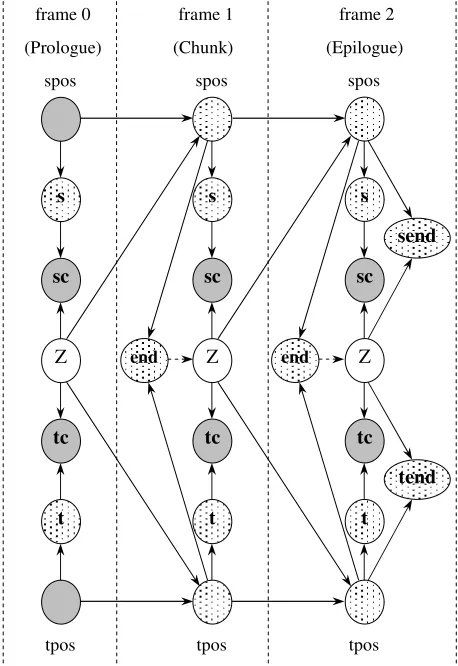
Memory-less and Context Independent (MCI) DBN model. Figure 2 is a graphical representation of the template for the MCI DBN model that was specified using GMTKL. In Figure 2, Z denotes the current edit operation
Figure 2: Template for the MCI DBN model. Following the common convention, shaded nodes represent observed variables, while unshaded nodes represent hidden nodes. Nodes with dots represent deterministic hidden variables (Adapted from Filali and Bilmes, 2005).
spos
s
sc
tc Z
t
tpos
spos
s
sc
tc Z
t
tpos
spos
s
sc
tc Z
t
tpos
end end
send
tend
(i.e. substitution, deletion, or insertion). spos is a variable representing the current position in the source string, and
tpos represents the current position in the target string. s
represents the current character in the source string and takes the current position variable in the source string
spos as its parent variable, likewise, t represents the current character in the target string and takes the current position variable tpos as its parent variable . The sc and tc
nodes are source and target consistency nodes respectively. sc and tc have a fixed observed value 1 and the only configuration of their parents are such that the source component of Z is s or an empty symbol (ϵ) for sc
and t or empty symbol (ϵ) for tc, and that Z does not generate empty source and empty target symbols at the same time (Filali and Bilmes, 2005). The end node is a switching parent of Z as illustrated by the dashed arrow and represents the variable that indicates when we are past the end of both source and target strings, i.e when spos > m and tpos > n, where m and n are the lengths of the source and target string respectively. The send and tend
nodes represent variables that ensure that we are at or past the end of the source and target strings respectively. Filali and Bilmes (2005) implement additional classes of DBN models using the MCI DBN model as a base model. In the other DBN model classes, Filali and Bilmes (2005)
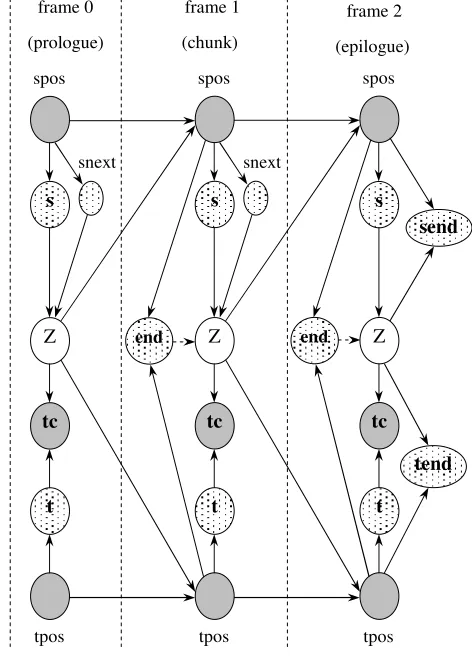
Figure 3: Template for the context dependent DBN model. The consistency variable sc is not represented here since the consistency is enforced through the direct relationship between the edit variable Z and source symbols.
add edges to enable modelling of various factors including: context where various context window sizes in a source language string or a target language string or both source and target language strings are represented;
memory where different dependencies on the hidden edit operation variables are tested; position where dependencies on the position in the source or target string are tested; length where the length of the sequence is fac- tored into the similarity estimate for the source and target language strings. Figure 3 is a graphical representation of the template for one of the DBN models tested in this paper that is referred to as a Context dependent (CON) DBN model where the edit operation Z directly depends on the current and next characters in the source string. Apart from the CON DBN model, the other two DBN models tested in this paper are the Context dependent length (CON length) DBN model and the MCI length
DBN model. Figure 4 shows the template for the MCI
Figure 4: Template for the MCI Length unrolling DBN model. (Adapted from Filali and Bilmes, 2005)
spos
send
(Prologue) (Chunk) (Epilogue) frame 0 frame 1 frame 2
s
sc
tc Z
t
tpos
send end
tend
s
sc
tc Z
t
tpos
send end
tend
end
tend
inilen counter inilen counter inilen counter
atReqLen atReqLen atReqLen
spos spos
s
sc
tc Z
t
tpos inclen inclen inclen
end
snext
tpos
s
snext spos
s
Z
tc
t
tpos
spos
s
Z
tc
t
tpos
tend
spos
Z
tc
t
send
end
(prologue) frame 0
(chunk) frame 1
Filali, K. & Bilmes, J. (2005). A Dynamic Bayesian Framework to model Context and Memory in Edit Distance Learning: An Application to Pronunciation Classification. In Proceedings of the 43rd Annual Meeting of the Association for Computational Linguistics (ACL 2005), Ann Arbor, Michigan, USA , pp. 338--345.
Jeong, K.S., Myaeng, S.H., Lee, J.S. & Choi, K-S. (1999). Automatic Identification and Back-Transliteration of Foreign Words for Information Retrieval. In
Information Processing and Management, 35 (1999): pp. 523--540.
Klementiev, A. & Roth, D. (2006). Weakly Supervised Named Entity Transliteration and Discovery from Multilingual Comparable Corpora. In Proceedings of the 21st International Conference on Computational Linguistics and 44th Meeting of the ACL, Sydney, Australia, pp. 817-824.
Kondrak, G. & Sherif, T. (2006). Evaluation of Several Phonetic Similarity Algorithms on the Task of Cognate Identification. In Proceedings of the COLING-ACL Workshop on Linguistic Distances, Sydney, Australia, pp. 43--50.
Korb, K.B. & Nicholson, A.E. (2004).Bayesian Artificial Intelligence. CRC Press, Florida, USA.
Kumaran, A. & Kellner, T. (2007). A Generic Framework for Machine Transliteration. In Proceedings of the30th Annual International ACM SIGIR Conference on Research and Development in Information Retrieval
(SIGIR 2007), Amsterdam, The Netherlands, Association for Computing Machinery, Inc., pp. 721-722.
Kuo, J-S., Li, H., & Yang, Y-K. (2007). A Phonetic Similarity Model for Automatic Extraction of Transliteration Pairs. In ACM Trans. Asian Language Information Processing, 6(2) : article 6.
Lee, C-J. & Chang, J.S. (2003). Acquisition of English-Chinese Transliterated Word Pairs from Parallel Aligned Texts using a Statistical Machine Transliteration Model. In Mihalcea, R. & Pederson, T. (eds.) Proceedings of the HLT-NAACL 2003 Workshop on Building and Using Parallel Texts: Data Driven Machine Translation and Beyond, pp. 96--103. Lee, C-J., Chang, J.S. & Jang, J-S. R. (2006). Extraction
of Transliteration Pairs from Parallel Corpora using a Statistical Transliteration Model. In International Journal of Information Science, Elsevier Science Inc., 176 (1) : pp. 67--90.
Lei., G., Mei-ling, Z., Jian-Min, Y., & Qiao-Ming, Z. (2009). A Supervised Method for Transliterated Person Name Identification. In Proceedings of the Second International Symposium on Electronic Commerce and Security, vol. 2, pp. 117--120.
Lerner, U.N. (2002). Hybrid Bayesian Networks for Reasoning about Complex Systems. Ph.D. Thesis, Stanford University.
Li, H., Kuo, J-S., Su, J., & Lin, C-L. (2008). Mining Live Transliterations Using Incremental Learning Algorithms. In International Journal Of Computer
Processing of Languages (IJCPOL), World Scientific, 21(2): pp. 183--203.
Murphy, K. (2002). Dynamic Bayesian Networks: Representation, Inference, and Learning. Ph.D. dissertation, University of California, Berkeley. Nabende, P. (2010). Evaluation of a Dynamic Bayesian
Network Framework for Transliteration Similarity Estimation. Presentation at the 20th Meeting of Computational Linguistics in the Netherlands (CLIN), Utrecht, The Netherlands.
Nabende, P., Tiedemann, J., & Nerbonne, J. (2008). Pair Hidden Markov Model for Named Entity Matching. In Tarek, S. (ed.) Innovations and Advances in Computer Sciences and Engineering, Springer , pp. 497--502. Oh, J-H. & Choi, K-S. (2001). Automatic Extraction of
Transliterated Foreign Words using HMM. In
Proceedings of the Internation Conference of Computer Processing on Oriental Language
(ICCPOL2001), 19, pp. 433--438.
Oh, J-H., & Isahara, H. (2006). Mining the Web for Transliteration Lexicons: Joint-Validation Approach. In
Proceedings of the 2006 IEEE/WIC/ACM International Conference on Web Intelligence, pp. 254--261.
Oliver, N. & Horvitz, E. (2005). A Comparison of HMMs and Dynamic Bayesian Networks for Recognizing Office Activities. In Ardissono, L., Brna, P., & Mitrovic, A. (Eds.) UM 2005, LNAI, Springer-Verlag Berlin Heidelberg, 3538: pp. 205-215.
Pouliquen, B., Steinberger, R., Ignat, C., Temnikova, I., Widiger, A., Zaqhouani, W., & Zizka, J. (2006). Multilingual Person Name Recognition and Transliteration. CORELA – Cognition, Representation, Language, Poiters, France, CERLICO, 3(2): pp. 115--128.
Rabiner, L.R. (1989). A Tutorial on Hidden Markov Models and Selected Applications in Speech Recognition. In Proceedings of the IEEE, 77 (2): pp. 257--286.
Ristad, E.S. and Yianilos, P.N. (1998). Learning String Edit Distance. In Trans. on Pattern Recognition and Machine Intelligence, 20 (5): pp. 522--532.
Saravanan, K.,& Kumaran, A. (2008). Some Experiments in Mining Named Entity Transliteration Pairs from Comparable Corpora. In Proceedings of the 2nd International Workshop on “Cross Lingual Information Access” Addressing the Information Need of Multilingual Societies, pp. 26--33.
Shermin, A. & Orgun, M.A. (2009). Using Dynamic Bayesian Networks to infer Gene Regulatory Networks from Expression Profiles. In Proceedings of the 2009 ACM Symposium on Applied Computing, Honolulu, Hawaii, ACM, pp. 799--803.
Terry, L.H. & Katsaggelos, A.K. (2008). A Phone- Viseme Dynamic Bayesian Network for Audio-Visual Automatic Speech Recognition. In Proceedings of 2008 International Conference on Pattern Recognition, Tampa, Florida.
Congress on Intelligent Control and Automation. Tsuji, K., Daille, B. & Kageura, K. (2002). Extracting
French-Japanese Word Pairs from Bilingual Corpora based on Transliteration Rules. In Proceedings of the third LREC Conference, pp. 499--502.
Udupa, G., Saravanan, K., Bakalov, A., & Bhole, A. (2009). “They Are Out There, If You Know Where to Look”: Mining Transliterations of OOV Query Terms for Cross-Language Information Retrieval. In
Advances in Information Retrieval, LCNS, Springer Berlin / Heidelberg, 5478/2009: pp. 437--448.
Udupa, R., Saravanan, K., Kumaran, A., Jagarlamudi, J. (2008). Mining Named Entity Transliteration Equivalents from Comparable Corpora. In CIKM’08, Napa Valley, California, USA, pp. 1423--1424. Wu, X., Okazaki, N., & Tsujii, J. (2009). Semi-Supervised
Lexicon Mining from Parenthetical Expressions in Monolingual Web Pages. In Proceedings of the 2009 Annual Conference of the North American Chapter of the ACL, Boulder, Colorado, ACL., pp. 424--432. Yao, X-Q., Zhu, H., & She, Z-S. (2008). A Dynamic
Bayesian Network Approach to Protein Secondary Structure Prediction. In BMC-Bioinformatics 2008, 9, 48.
Zhou, Y., Huang, F., & Chen, H. (2008). Combining Probability Models and Web Mining Models: A Framework for Proper Name Transliteration. In
Journal of Information Technology and Management, Springer Netherlands, 9: pp. 91--103