Using an Error-Annotated Learner Corpus to Develop an ESL/EFL Error
Correction System
Na-Rae Han, Joel Tetreault, Soo-Hwa Lee, Jin-Young Ha
University of Pittsburgh, Educational Testing Service, Chungdahm Learning, Inc., Kangwon National University Pittsburgh, PA 15260, USA; Princeton, NJ 08541, USA; Seoul, Korea; Chuncheon, Korea
[email protected], [email protected], [email protected], [email protected]
Abstract
This paper presents research on building a model of grammatical error correction, for preposition errors in particular, in English text produced by language learners. Unlike most previous work which trains a statistical classifier exclusively on well-formed text written by native speakers, we train a classifier on a large-scale, error-tagged corpus of English essays written by EFL learners, relying on contextual and grammatical features surrounding preposition usage. First, we show that such a model can achieve high performance values: 93.3% precision and 14.8% recall for error detection and 81.7% precision and 13.2% recall for error detection and correction when tested on preposition replacement errors. Second, we show that this model outperforms models trained on well-edited text produced by native speakers of English. We discuss the implications of our approach in the area of language error modeling and the issues stemming from working with a noisy data set whose error annotations are not exhaustive.
1.
Introduction
With the growing adoption of new technologies and com-puterized applications in language classrooms, applying the latest NLP techniques to the the area of language education is gaining more support. For many ESL (English as a Sec-ond Language) and EFL (English as a Foreign Language) students, interacting with computerized applications is an integral part of their learning experience; NLP-based lan-guage models can be a valuable tool in assisting teachers and students alike by providing prompt feedback on cer-tain aspects of language, such as mechanical errors, writing quality, and grammatical errors.
Lately there have been efforts aimed at developing gram-mar correction applications designed specifically with learners of English in mind. A common approach shared by most of the previous work (Izumi et al., 2003; Han et al., 2006; Tetreault and Chodorow, 2008a; Gamon et al., 2008; De Felice and Pulman, 2008) is the reliance on well-formed texts written by native English speakers to train a statistical model. This is mostly due to the fact that to date, con-structing a large enough error-annotated corpus to support a statistical approach is time-consuming and labor-intensive. As a result, these approaches train on millions of examples of correct usage and then use a series of thresholds to de-termine if a writer’s usage is correct “enough” given the context. Another issue with this approach is that it fails to model the types of errors and confusions that non-native writers will make.
The main research question we address in this work there-fore is: is there an advantage to actually constructing an error-annotated corpus? Specifically, would a model trained on error-annotated data outperform one trained ex-clusively on well-formed, native text? In this paper, we present a large error-annotated learner corpus, and develop a novel statistical method to ESL/EFL error detection and correction trained exclusively on this corpus. We show that a model trained on examples of correct and incorrect usage,
*Please direct all data-related inquiries to Soo-Hwa Lee.
even when the error annotations are not exhaustive, out-performs much larger statistical models trained on native text. In this work, we focus our efforts on preposition error detection and correction since prepositions are among the most difficult for non-native speakers of English to master.
2.
Chungdahm English Learner Corpus
We base our model-building experiments on the Chung-dahm English Learner Corpus (henceforth ChungChung-dahm Corpus), a collection of English essays written by Korean-speaking students of Chungdahm Institute, a national chain of English language schools run by Chungdahm Learning, Inc., and error-annotated by tutors.1 The entire data exists
in the form of a continuously growing database rather than as a corpus in the strictest sense, but we refer to the por-tion that we extracted and cleaned up for the purpose of our research as the Chungdahm Corpus. The corpus consists of 131 million words in 861,481 essays for an average es-say length of 152 words. The eses-says were written on 1,545 prompts. There are 6.6 million error annotations made by the tutors on this data set. The specifics of this corpus are shown in Table 1.
There are 45 distinct classes of corrections and feedback, which are categorized under 4 areas: grammar, strategy, style and substance. As a part of the grammar-type feed-back, a variety of aspects are coached, including spelling, punctuation, verbal forms, subject-verb agreement, noun phrase formulation and prepositions. One notable aspect about the feedback practice is that not all of these diagnos-tics are applied to every text. The primary role of Chung-dahm Institute’s essay-writing curriculum as an instruc-tional tool means that only a few selected aspects of English writing are focused on at a particular time and therefore are designated as the target areas for providing feedback. For this reason, it was necessary for the purpose of this study
1
Authors Students of Chungdahm Institute
Demographic Info Students of ages 10–16, whose L1 is Korean Corpus size 130,754,000 words # of prompts 1,545
Total # of essays 861,481 Avg essay length 152 words Total # of error
an-notation 6,605,678
Table 1: Chungdahm Corpus (as of Nov 2008)
to further process the data in order to extract a sub-corpus, which we can be sure were subject to preposition error cor-rection. We discuss this in detail in the next section.
3.
The Preposition Data Set
As expected, preposition errors are among the most fre-quent error types encountered in Chungdahm Corpus: there are 127,345 preposition error annotations, which amount to roughly 2% of all error annotations and other feedback. The prominence of preposition errors in our data is consis-tent with previous literature on preposition error detection (Chodorow et al., 2007; Tetreault and Chodorow, 2008b). Preposition errors can be categorized into the following three types: omission, commission (i.e., extraneous prepo-sition), and replacement, which are illustrated below.
(1) Preposition error types a. OmissionhNULL, pi:
“Yes, I wait∅/for you.”
b. Commission (extraneous)hp,NULLi: “So I go to/∅home quickly.” c. Replacementhp1, p2i:
“Adult give money at/on New Years day.”
There are over 50 different prepositions represented in preposition error annotations, either as the original student choice or as the tutor’s correction. Among them, 10 prepo-sitions plus the “no preposition” choice were predominant: about, at, by, for, from, in, of, on, to, with, andNULL. To-gether they account for the 99% of student error tokens; the same top 11 types were found to cover over 97% of all tu-tor correction tokens, with some differences in individual proportions and rankings.
Based on this observation, a decision was made to limit the scope of our preposition error modeling to those 10 prepo-sitions plus “NULL” (for simplicity, this set is henceforth referred to as the “11 prepositions”). It would be ideal, and certainly not impossible, to include all 50+ types of prepositions, but we believe that the practical advantages offered by simplifying the model far outweigh the rather small amount of actual error cases that are discarded. This reduction is consistent with previous work such as (De Fe-lice and Pulman, 2008) and (Gamon et al., 2008) who fo-cused on 9 and 14 prepositions respectively.
Once we filtered out those preposition error annotations in-volving prepositions other than those 11, the number of er-ror annotations shrunk down to 122,387, or 96.1% of the
entire preposition error annotations. We further excluded those cases that are not genuine preposition errors, such as those involving particles (“He carried in/on.”) and infini-tive tos mistakenly categorized as prepositions (“He tried NULL/to succeed.”) with the help of a parser (Klein and Manning, 2003), which eventually left us with 117,665 annotated preposition errors to use in our model build-ing experiments (item c. in Table 4). All 110 possi-ble hstudent, tutori pairings are represented in the data, whose distribution is shown in Table 2.
hs, ti count cnt% cumul% 1 NULL, to 20102 17.08 17.08 2 NULL, in 8885 7.55 24.63
3 in, on 8768 7.45 32.08
4 NULL, at 6075 5.16 37.24 5 NULL, with 4718 4.00 41.25
6 at, in 4648 3.95 45.20
7 to,NULL 4348 3.69 48.90
8 NULL, for 3974 3.37 52.28 9 NULL, of 3956 3.36 55.64
10 in, at 3346 2.84 58.48
11 to, for 2998 2.54 61.03
12 NULL, on 2910 2.47 63.50
13 on, in 2896 2.46 65.97
14 NULL, about 2000 1.69 67.67
15 to, with 1976 1.67 69.34
16 about, with 1896 1.61 70.96
17 for, to 1823 1.54 72.51
18 of,NULL 1755 1.49 74.00
19 of, for 1531 1.30 75.30
20 in,NULL 1466 1.24 76.54
... ... ... ... ...
109 about, by 11 0.0 99.99
110 by, about 4 0.0 100
Table 2: Distribution ofhstudent, tutoripreposition cor-rection pairs
The distribution of the 11 prepositions found in either slot of the error annotations is shown in Table 3. One thing immediately noticeable is that the prepositions supplied as corrections by the tutor are more evenly distributed across the 11 categories, whereas the original student prepositions are less so, with a significant portion (46%) concentrated on theNULLchoice. As one might expect, pairs involving a NULLstudent preposition dominate the top ranks, and each pair is represented in a relatively small number.
prep student tutor count count% count cnt%
NULL 54259 46.11 9791 8.32
about 3265 2.77 2883 2.45
at 8556 7.27 11408 9.69
by 1194 1.01 1498 1.27
for 4852 4.12 11110 9.44
from 1085 0.92 4099 3.48
in 16705 14.19 19846 16.86
of 6328 5.37 5919 5.03
on 4577 3.88 15062 12.80
to 14497 12.32 25047 21.28
with 2347 1.99 11002 9.35
117665 100% 117665 100%
Table 3: Distribution of 11 prepositions inhstudent, tutori correction pairs
a. text size (words) 20,472,948
b. # of essays 111,060
c. # of all preposition error 117,665 tokens (c1+c2+c3)
c1. # of omissionhNULL, pi 54,259
error tokens
c2. # of extraneoushp,NULLi 9,791
error tokens
c3. # of replacementhp1, p2i 53,615
error tokens
d. # of preposition tokens 1,104,752 with no error annotation
e. # of all preposition tokens 1,222,417 (c+d)
f. preposition error rate in data 9.6% (c/(c+d))
Table 4: Data set used for preposition modeling
introduced into our experiments, which has direct ramifica-tions in the resultant models.
Even with this filtering, we later learned that many over-looked and unannotated errors still exist in this data set, which indicates error annotation is not applied exhaustively within a text. We will discuss later in Sections 5. and 7.2. how our approaches have direct ramifications in the resul-tant models.
In the end, the selected subset of the Chungdahm Corpus to be used in our experiments consisted of 111,060 essays and 20,472,948 words which yielded 1.2M preposition tokens. Specifics of this sub-corpus are shown in Table 4.
4.
A Maximum-Entropy-Based Model for
Preposition Prediction
In our language model, a preposition use is represented as an ordered pairhs, ciwheresindicates the original, poten-tially incorrect, preposition choice made by the student, and cthe correct preposition. sandcrange over the set of 11 preposition types{NULL, about, at, by, for, from, in, of, on,
Text & Annotation:
snow is falling there at the winter .
-3 -2 -1 s +1 +2 +3
MOD ARG
hs, ci: hat, ini
Event: outcome: in
features:
name value
s at
wd−1 there
wd+1 the
MOD falling
ARG winter
MOD ARG falling winter
MOD s falling at
s ARG at winter
MOD s ARG falling at winter
wd−1,2 s falling there at
s wd+1,2 at the winter
3GRAM there at the
5GRAM falling there at the
winter
wd L snow, is, falling
wd R the, winter, .
MODt ARGt VBG NN
MODt s VBG at
s ARGt at NN
MODt s ARGt VBG at NN
TRIGRAMt NN at DT
Table 5: Event representation of a preposition token
to, with}. In preposition cases where there is no error anno-tation, the original student choice is presumed correct andc defaults tos. Our goal is to build a classifier whose choice of outcomemmatchesc.
To this end, we employed a maximum entropy (ME) model (Ratnaparkhi, 1998) as our machine learning method of choice. Maximum entropy has been shown to perform well in combining heterogeneous forms of linguistic evidence. Out of the entire set of 1.2M preposition tokens, approxi-mately 200K were set aside for development purposes, and the remaining set of about 978,000 preposition tokens was used in training a ME classifier. This is a relatively small training data size; previous work in preposition error detec-tion has typically used training models built from millions of preposition events.2
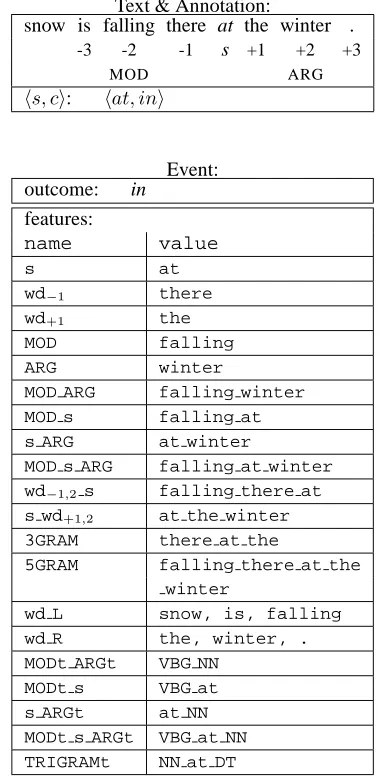
In the model, each proposition token along with its context is represented as a preposition event (Table 5): a prepo-sition event consists of an outcome, the correct preposi-tion choice, and a set of contextual features, each of which encoding a particular aspect of the linguistic context sur-rounding the preposition instance, including the original
2
Code Description Example
OK Writer’s preposition is acceptable “So she has a lot of money.” Wrong Choice Writer used the wrong preposition “So she got married with him.”
Extraneous Use Writer used a preposition in a context that does not license one
“Next to year, Jennifer and Mike are married.”
Indecipherable Context is too messy or confusing to make a judgment on preposition usage
“Thry thought museumis fit to knowreal world.”
Table 6: Evaluation corpus preposition annotation scheme
preposition choice made by the student writer.
Designing a set of contextual features that are strong pre-dictors of a particular preposition outcome is paramount in achieving good system performance. Some of these fea-tures are based on surface phenomena such as nearby word forms; others require more sophisticated linguistic knowl-edge such as the part-of-speech of a word or the two ele-ments that perhaps play the most definitive role in preposi-tion choice: the lexical head of the phrase which the prepo-sition modifies (MOD) and the lexical head of the preposi-tion argument noun phrase (ARG). We used the Stanford Parser (Klein and Manning, 2003) to identify theMODand ARG. The following configurations are targeted in the local context of a preposition: (a)sthe preposition token chosen by the student, (b)wd− the word immediately preceding s, (c)wd+ the word immediately followings, (d)MOD, (e)ARG, (f) 3 words precedings, (g) 3 words followings. Actual features are built from these bits of information by combining related ones (e.g., “trigrams” concatenating (a), (b), (c)) and/or substituting part-of-speech tags for actual lexical entries (e.g.,POS trigrams). Table 5 illustrates the entire feature set used in our experiments for the sample sentence “Snow is falling there at the winter.” which has the correction of in.
In extracting features, we applied limited semantic pro-cessing in order to generalize on items of open lexical categories, such as numbers and person names. Specifi-cally, digits and numbers were collapsed into representa-tive forms (e.g., 1987→1111, thirty-five→eleven), and so were hyphenated Korean names (e.g., Min-kyoung, Su-Hee→HYPHEN-NAME).
5.
Evaluation
5.1. Evaluation Corpus
Because the error flagging in the Chungdahm Corpus is far from exhaustive, automated methods of evaluation could not be relied upon beyond its utility in the feature selection process3. For a true measure of system performance,
there-fore, we conducted a round of manual annotation to create a fully error-annotated evaluation set from a subset of the corpus.
To create this set, three trained raters annotated 1,000 preposition contexts randomly selected from the set-aside portion of our data set. The original annotations were
3Automated evaluation, relying on the development portion of
Chungdahm Corpus, was used as a basis for verifying that addition and/or removal of certain features lead to a performance gain or loss.
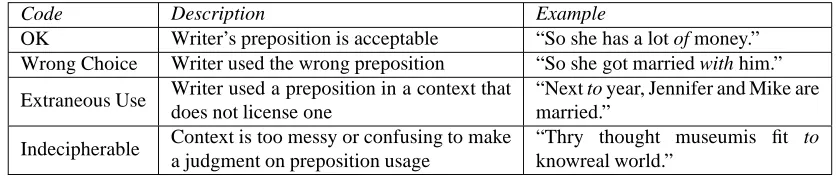
not presented to them. The raters followed the annota-tion scheme presented in Tetreault and Chodorow (2008b) in which the writer’s preposition is rated on a 4-point scale: (1) OK: writer’s preposition is acceptable, (2) Wrong Choice: writer used the wrong preposition, (3) Extraneous Use: writer used a preposition in a context that does not li-cense one, and (4) Indecipherable: context is too messy or confusing to make a judgment on preposition usage. See Table 6 for examples of each of the four categories. All three raters also judged an overlap set of 100 preposition contexts to compute kappa. Agreement ranged from 0.860 to 0.910 and kappa from 0.662 to 0.804, which are on par with those reported in Tetreault and Chodorow (2008b). Next, we compared the new annotations in our evaluation corpus with the original ones supplied by Chungdahm tu-tors. Agreement and kappa between the two annotations were 0.827 and 0.426 respectively. More importantly, the comparison revealed that indeed many genuine preposition errors are left unflagged in Chungdahm Corpus: 57.4% of all replacement-type errors and 85% of extraneous preposi-tion errors were found to be unmarked in the original anno-tation supplied by Chungdahm tutors. This problem of in-complete error annotation has direct consequences for the resulting models, which is discussed in detail in Section 7.2.
5.2. Evaluation of Learner Model
Our system works primarily as a multi-outcome prediction model (an 11-way classifier), which produces a prediction on the correct preposition choice given a context: for a preposition use represented ashs, ci(wheresindicates the original, potentially incorrect, preposition choice made by the student, and c the correct preposition), the machine’s choice of outcomempurports to matchc. When used as an error diagnostic tool, it not only detects the existence of a preposition error when the model prediction differs from the student’s original choice (i.e., whenm 6= s) but also supplies correction in the form of the model’s preposition choice m. In other words, the model produces a multi-outcome decision (error detection and correction: “The model suggests prepositionmas the correct alternative to the student choices”) which can be backed off to a binary decision (error detection: “The model’s preposition predic-tionmdiffers from the student choices”)4. The former is successful iffs 6=candm =c; the latter is successful iff
4
An exception to this is the omission error typehNULL, pi,
s6=c.
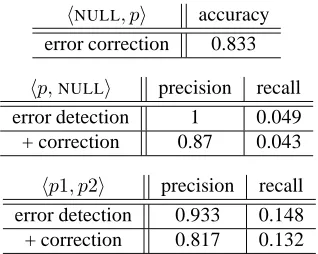
Since the model’s prediction is ultimately used as a diag-nostic tool, its performance is measured in two key figures: precision (“Of all error flags that the system raises, how many of them are correct?”) and recall (“Of all existing errors, how many does the system successfully diagnose?). The performance of our model is reported separately for the three types of preposition errors in Table 7.
hNULL, pi accuracy error correction 0.833
hp,NULLi precision recall error detection 1 0.049 + correction 0.87 0.043
hp1, p2i precision recall error detection 0.933 0.148 + correction 0.817 0.132
Table 7: Performance of omission hNULL, pi, extraneous hp,NULLi, and replacementhp1, p2itype errors
For the replacement and extraneous error types (e.g., hin, oniandhto,NULLi), both precision and recall figures are presented for the two types of decisions. For omission type errors (NULL as the student preposition,hNULL, pi), the “error vs. non-error” binary decision has effectively been made: the classifier learns to predict that givenNULL as the original student choice the correct preposition has to be an overt one (x6=NULLforhNULL, xi). The accuracy of the model’s alternative preposition suggestion is, there-fore, the only relevant performance measure for this type. This means that as far as omission errors are concerned, our model does not actually identify them in a novel text; it must depend on the output of another model whose specific task is identifying missing prepositions, as is done in Ga-mon et al. (2008), for which it is then able to recommend the correct proposition choice. We have plans to implement such a model in the future.
Overall, the results indicate good levels of precision though low recall. The model’s intended use as an instructional tool, however, means more emphasis is placed on precision than recall; the goal of reducing “false positives”, that is, a system diagnosing an error where the student choice is in fact correct, is paramount. Furthermore, upon close in-spection it was found that none of the false positive cases of error detection actually involved those preposition us-ages ruled “OK” by annotators; they were all of the “In-decipherable” type. Therefore, the system’s “false posi-tives” are not genuine cases of the system erroneously flag-ging grammatical preposition usages as ungrammatical. In this regard, we believe our system achieves a performance level that is suitable for operational use, albeit with ample room for improvement in the recall rates. We believe that our model’s low recall rates are directly related to the non-comprehensive error annotation in the training data; again see Section 7.2. for further discussion.
5.3. Comparison with Models Trained on Native Text
One of the goals of our study is to provide a comparison between a learner-corpus-based model and a model trained on well-formed, native text (i.e., text produced by native speakers of English). To accomplish this, we trained a sta-tistical model on texts from the Lexile Corpus, a collection of K-12 reading materials. As one might immediately no-tice, this comparison is inherently biased, as we are weigh-ing between a model trained and tested on the same mate-rial (the learner model) and one trained on one set of data and then tested on another (the native model). It should be noted, however, that the point of this exercise is not about obtaining a completely balanced comparison between the two models; it is meant to provide a comparison point be-tween the two general approaches to L2 learner error mod-eling, namely, our current approach of relying on error-corrected learner language and the other, more prevalent, one that relies entirely on native-speaker corpora.
In addition, we took further steps to minimize the dispar-ity between the two corpora; a decision was made to limit our data set to the texts from the 7th and 8th grade read-ing levels of the Lexile Corpus, which were deemed to have the closest writing style and content as those of the Chungdahm Corpus, with the exclusion of all other, lower and higher, grade reading levels. While some might argue that there is still too big a disparity between the Lexile data and the Chungdahm corpus, we would like to point out that the training corpora employed by previous studies are even more dissimilar to the typical texts produced by L2 learn-ers (San Jose Mercury News data were used in Chodorow et al. (2007), Tetreault and Chodorow (2008a), Tetreault and Chodorow (2008b) along with the Lexile Corpus; Mi-crosoft Encarta Encyclopedia and Reuters News were used in Gamon et al. (2008)).
One advantage native texts have over error-annotated learner corpora is the fact that they are available in a much larger size. In order to take advantage of this, we trained five differently sized models ranging from 1 lion, roughly the size of our learner model, up to 5 mil-lion in training event size5. When tested on a held-out
portion of the same data set (thus training and testing on well-formed native text), these models show performance levels comparable to what is reported in previous research for the same task (Tetreault and Chodorow, 2008a; Gamon et al., 2008; De Felice and Pulman, 2008): the accuracies of multi-outcome preposition classification task for the four models ranged from 0.694 (the 1 million model) to 0.740 (5 million).
An identical set of features are used for these models except for those that include references to the original preposition choice, which were either dropped altogether or altered to remove such references. Note that the students’ preposition
5It is certainly possible to construct a native-speaker-produced
choice does play a role in the application of the native-text-trained models as well, but in a different stage. For our learner-data trained model, the student preposition choice is built into the training data and therefore informs the model itself; for models trained on native text, the crucial piece of information is consulted in the diagnosis-producing phase, when thresholds are applied.
For models trained on native text, it is essential that thresh-olds are set so that the models are allowed skip error di-agnosis on those cases with lower confidence. With no such mechanism in place, these models typically over-diagnose errors, resulting in high recall but low precision. In an approach consistent with those used in similar sys-tems (Tetreault and Chodorow, 2008a; Gamon et al., 2008; De Felice and Pulman, 2008), we let the models skip diag-nosis on those cases where: (1) the difference between the probabilities of the two top preposition choices is less than 0.8 or (2) the probability of the student preposition choice is greater than 0.1. Also consistent with previous work, we favored precision over recall. This tactic was taken be-cause the goal is to reduce the number of false positives, that is, reducing the cases where the system diagnoses an error where the student choice is in fact correct.
hp1, p2i error detection + correction precis. recall precis. recall Learner 0.933 0.148 0.817 0.132 N-1mil 0.536 0.132 0.416 0.106 N-2mil 0.585 0.142 0.463 0.116 N-3mil 0.594 0.126 0.453 0.099 N-4mil 0.583 0.153 0.462 0.125 N-5mil 0.605 0.147 0.484 0.121
Table 8: Performance comparison on replacementhp1, p2i preposition errors
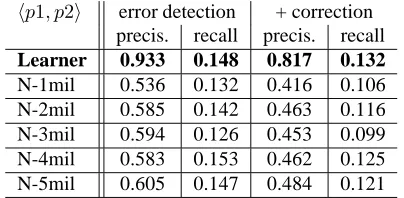
Table 8 shows comparison results for replacement type er-rorshp1, p2i. The native-trained models, by design, are un-able to handle the other two types, which involve NULL preposition choices. The main finding is that the Learner model outperforms all of the native-trained models, even the N-5mil model which was trained on a data set that is five times as large. Overall, the recall for all models is low, but the precision of the Learner model far exceeds that of the native-trained models.
From this, we conclude that models trained on error-annotated learner corpora, albeit with inexhaustive error an-notation, not only have a competitive advantage over sim-ilarly sized native corpora but also much larger sized ones as well.
6.
Related Work
There have been a few previous efforts aimed at building an application for diagnosing preposition errors by English learners. Not all of them, however, include evaluation on genuine, learner-produced text, opting instead for testing on native texts only (Lee and Seneff, 2006; De Felice and Pulman, 2007). We review here those ones that do. Chodorow et al. (2007) designed a preposition error de-tection model targeting as many as 34 prepositions. They
trained a ME-based binary classifier on 7 million prepo-sition events extracted from a large corpus of native texts and applied it to 2,000 preposition cases from non-native texts. They report 0.88 overall precision and 0.16 recall on detecting replacement type preposition errors, and 0.796 precision and 0.304 recall for replacement and extraneous type errors. In a follow-up work (Tetreault and Chodorow, 2008a), they experimented with combination features and incorporating data from additional corpora, and report pre-cision and recall figures of 0.84 and 0.19.
Gamon et al. (2008), on the other hand, targeted all three types of preposition errors involving 14 prepositions (not including NULL), from identification to correction. They employed two classifiers, one to determine whether a preposition/article should be present and one for the cor-rect choice, and an additional model as a filter. Their system was trained on large sets of native text and tested on 8,000 English sentences by Chinese learners of English. Its 362 system error diagnoses on preposition use were then judged by a human reviewer: precision was about 80% and recall was not reported.
Izumi et al. (2003) and Izumi et al. (2004) are the only pre-vious work that we are aware of that employ an approach similar to our own, namely, training and testing solely on learner data. Their data size, however, is rather too small: using the Standard Speaking Test Corpus as their source, the core of their data set consists of English interview tran-scripts of 56 Japanese speakers totaling 6,216 sentences. They do not present performance for prepositions specifi-cally, but overall performance for all of the 13 grammatical error types they targeted was at 25% precision and 7% re-call.
More recently, Tetreault and Chodorow (2009) used region web counts to discover typical preposition replacement er-rors made by different language groups. They showed that a statistical classifier trained on well-formed text could be improved by augmenting it with information about prepo-sition constructions that are problematic for non-native En-glish speakers. Their work is similar in spirit to ours in that they are leveraging data about errors that non-native speak-ers typically make.
7.
Discussion
7.1. Learner Language vs. Native Corpora
As mentioned earlier, the central methodology that is com-mon to much previous research is use of native-produced texts as the basis of statistical modeling. Essentially, this method creates a model of well-formed, native speak-ers’ English, and uses it to make a prediction on learner language, which, when found to outweigh the learner-produced choice, is turned into an error diagnosis.
In particular, the language error model presented in this study is that of the students of Chungdahm Institute, that is, 10-16 year old English learners whose L1 (first lan-guage) is Korean. This, then, ultimately raises the ques-tion of the extensibility of our model to other varieties of learner language, for instance, the English of Chinese col-lege students, the English of French-born residents in the US, or even the English of Korean adults. Arguably, there is a certain universal quality to the native-corpora-based ap-proach, in which a single model of idealized English is cre-ated, which just might prove it better-suited for wider appli-cation. This prognosis, of course, is something that needs empirical verification. Furthermore, it would also be inter-esting to investigate possible ways to combine the two ap-proaches in an attempt to reap the benefits that each of them has to offer. One potential method is to have a system with specific models for different L1s and then a generic model to which it can back-off when it does not have a model or the L1 model has a low confidence in its decision.
7.2. The Problem of Partial Error Annotation
Though providing a unique and invaluable resource for second language error modeling, the Chungdahm English Learner Corpus has its weaknesses, of which the problem of partial error annotation challenge. As noted earlier in Section 5.1., we estimate that only about 43% of the re-placement errors and 15% of the extraneous preposition er-rors are corrected by tutors.
On a practical level, it renders cumbersome the evaluation process of a system developed on it, as we saw in Section 5.. Reliance on human evaluation means quick modifica-tion and testing of the system for either performance gain or other testing purposes is no longer feasible. One can either extrapolate from automated evaluation results to roughly gauge the system’s true performance, or alternatively cre-ate a set of testing data with accurcre-ate and thorough error annotations applied, as we did here, which however will have to be fairly large in order for the diverse patterns and contexts of preposition misusages to be represented in it. Another, more fundamental, kind of question is the problem of training a model on a set of data that includes conflicting evidence. In our data set, evidence of an error is valid, as-suming, of course, a perfect accuracy of those error correc-tions that are present6, while evidence of a non-error may or may not be. The low recall rates of our trained model are the direct consequences of this: the system not only as-sumes a lower-than-true error rate, which overwhelmingly favors the original preposition choice by the student, but it also has to work with the disadvantage of having to recon-cile between conflicting sets of evidence.
As much as we would like our data set to be perfect for our projects, the issue of partial error annotation is inher-ent in the provenance of derived data such as ours: they are a byproduct of an instructional courseware, and providing full and thorough error correction for student errors is not in the interest of the educational institutions who initiate
6
Consistency and accuracy of error annotation have been shown to be difficult to achieve; detailed discussions can be found in Tetreault and Chodorow (2008b).
it. Meanwhile, efforts to create error-annotated learner cor-pora for purely academic and research purposes have so far engendered smaller corpora, much too small for machine learning methods, although presumably with more exhaus-tive and principled sets of annotations (Chinese Learners’ English Corpus, 1 million words; the Standard Speaking Test Corpus, 1M). Even with the few large-scale corpora available, error tagging is done only on a subsection of the data (Longman Learners’ Corpus, 10M; HKUST Corpus, 25M), or the corpus is not publicly available (The Cam-bridge Learner Corpus, 20M) (Xiao, 2008).
Given the alternatives, and also the promising early results presented in this study, partially error-annotated large-scale data sets are attractive resources to be exploited for statis-tical modeling of learner language. It is, then, cristatis-tical for the researchers to engineer solutions that address the chal-lenges posed by incomplete error annotation. One potential approach that might prove effective for our data would be to apply bootstrapping methods; through successive training sessions, those non-error cases whose validity is deemed highly suspect can be re-labeled for next runs. We plan on pursuing this avenue in future work.
8.
Conclusions
In this paper we investigated the impact of using a vast error-annotated data set for the tasks of ESL/EFL error de-tection and correction. Our results showed that even with a partially error-annotated set, a model that leveraged the corrections drastically outperformed models of the same size trained on well-formed native text, as well as models five times the size. We believe this shows how much one can expect to increase performance in a statistical system by leveraging such large error-annotated corpora, though we do acknowledge the non-trivial time and cost expenses. Also of note is that this work shows that an exhaustive an-notation is not necessary to outperform a standard native-trained model. This note is of significance because it has implications for expediting annotation procedures by uti-lizing existing resources with noisy annotation.
In sum, we have presented a method of building an er-ror identification and correction model of preposition us-age based on English texts that are produced by L2 learners and partially annotated for errors. A first attempt at training such a system exclusively on a large set of learner texts, our approach shows that such a method is not only viable but also leads to good system performance. For future work, we are planning to experiment with larger native-trained models to investigate how much is required for a native-trained model to approach the performance of a learner-trained model. In addition, we will investigate if a model trained on Korean learner data can be effective in detecting errors by writers of other L1s.
9.
Acknowledgments
10.
References
Martin Chodorow, Joel R. Tetreault, and Na-Rae Han. 2007. Detection of grammatical errors involving prepo-sitions. In Proceedings of the 4th ACL-SIGSEM Work-shop on Prepositions, pages 25–30.
Rachele De Felice and Stephen G Pulman. 2007. Automat-ically acquiring models of preposition use. In Proceed-ings of the ACL-07 Workshop on Prepositions.
Rachele De Felice and Stephen G. Pulman. 2008. A classifier-based approach to preposition and determiner error correction in L2 english. In Proceedings of the 22nd International Conference on Computational Lin-guistics (COLING 2008), Manchester, UK.
Michael Gamon, Jianfeng Gao, Chris Brockett, Alexan-der Klementiev, William Dolan, Dmitriy Belenko, and Lucy Vanderwende. 2008. Using contextual speller techniques and language modeling for ESL error cor-rection. In Proceedings of The Third International Joint Conference on Natural Language Processing (IJCNLP 2008).
Na-Rae Han, Martin Chodorow, and Claudia Leacock. 2004. Detecting errors in English article usage with a maximum entropy classifier trained on a large, diverse corpus. In Proceedings of the 4th International Con-ference on Language Resources and Evaluation (LREC 2004), Lisbon, Portugal.
Na-Rae Han, Martin Chodorow, and Claudia Leacock. 2006. Detecting errors in English article usage by non-native speakers. Natural Language Engineering, 12(2):115–129.
George Heidorn. 2000. Intelligent writing assistance. In Robert Dale, Herman Moisl, and Harold Somers, editors, Handbook of Natural Language Processing, pages 181– 207. Marcel Dekker, Inc.
Emi Izumi, Kiyotaka Uchimoto, Toyomi Saiga, Thepchai Supnithi, and Hitoshi Isahara. 2003. Automatic error de-tection in the Japanese learners’ English spoken data. In ACL ’03: Proceedings of the 41st Annual Meeting on Association for Computational Linguistics, pages 145– 148, Morristown, NJ, USA. Association for Computa-tional Linguistics.
Emi Izumi, Kiyotaka Uchimoto, and Hitoshi Isahara. 2004. SST speech corpus of Japanese learners’ English and au-tomatic detection of learners’ errors. ICAME Journal, 28:31–48. http://icame.uib.no/ij28/.
Dan Klein and Christopher D. Manning. 2003. Accurate unlexicalized parsing. In Proceedings of the 41st Meet-ing of the Association for Computational LMeet-inguistics, pages 423–230.
Kevin Knight and Ishwar Chander. 1994. Automated postediting of documents. In AAAI ’94: Proceedings of the Twelfth National Conference on Artificial Intelli-gence (vol. 1), pages 779–784.
John Lee and Stephanie Seneff. 2006. Automatic grammar correction for second-language learners. In Proceedings of Interspeech 2006, Pittsburgh, PA.
John Lee and Stephanie Seneff. 2008. Correcting misuse of verb forms. In Proceedings of ACL 2008, Columbus, Ohio.
Ting Liu, Mingh Zhou, Jianfeng Gao, Endong Xun, and Changning Huan. 2000. PENS: A machine-aided En-glish writing system for Chinese users. In Proceedings of ACL 2000, pages 529–536.
Adwait Ratnaparkhi. 1998. Maximum Entropy Models for Natural Language Ambiguity Resolution. Ph.D. thesis, University of Pennsylvania.
Hisami Suzuki and Kristina Toutanova. 2006. Learning to predict case markers in Japanese. In Proceedings of COLING-ACL, pages 1049–1056.
Joel Tetreault and Martin Chodorow. 2008a. The ups and downs of preposition error detection. In Proceedings of the 22nd International Conference on Computational Linguistics (COLING 2008), Manchester, UK.
Joel R. Tetreault and Martin Chodorow. 2008b. Native judgments of non-native usage: Experiments in prepo-sition error detection. In COLING Workshop on Human Judgments in Computational Linguistics.
Joel Tetreault and Martin Chodorow. 2009. Examining the use of region web counts for ESL error detection. In Pro-ceedings of Web as Corpus Workshop (WAC-5), San Se-bastian, Spain.
Jenine Turner and Eugene Charniak. 2007. Language modeling for determiner selection. In Human Language Technologies 2007: The Conference of the North Ameri-can Chapter of the Association for Computational Lin-guisticsLinguistics; Companion Volume, Short Papers, pages 177–180.
Richard Xiao. 2008. Well-known and influential cor-pora. In Anke L¨udeling and Merja Kyt¨o, editors, Cor-pus Linguistics: An International Handbook, Handbooks of Linguistics and Communication Science. Mouton de Gruyter, Berlin.