The Brachial Plexus: Development and Assessment of a Computer Based Learning Tool
Douglas J. Gould, Ph.D.
**
Department of Anatomy & Neurobiology University of Kentucky
Abstract - The objective of the present study is to evaluate the use of multimedia technology to simplify study of the brachial plexus. A combination of newly-rendered illustrations, animations, explanatory text, and a set of printable sample questions were combined into a program to provide a tutorial for the brachial plexus. One aspect of the program is an animation showing the devel-opment of the brachial plexus from its develdevel-opmental origins that illustrates limb rotation and the resulting adult anatomy and dermatomal arrangement. The cross-platform program requires Quicktime 3.0 and is packaged on CD-ROM. Student evaluation of the program highlights its ease of use and intuitive navigation. User evaluation provides validation that the use of illustra-tions and animaillustra-tions is beneficial to user’s understanding and retention of the material. Future plans involve incorporation of pathologic images in order to enhance the clinical relevance of the product.
Keywords: computer program, anatomy, development, embryology, animation, CD-ROM
Introduction
Anatomy laboratories across the country are faced with continually increasing pressures. These pressures include ever-larger numbers of students needing a gross anatomy laboratory experience and a decreasing number of faculty qualified to teach hu-man gross anatomy, the latter primarily being a result of life science PhD recipients being routed into ca-reers in bench research1 (National Research Council, 1998). In 1995 the 141 U.S. medical schools en-rolled 18,090 allopathic and osteopathic students.2 The total population of health-science professional students is even higher when factoring in all other first year health professions students across the country that are required to take human anatomy (ie. nursing, physical therapy, occupational therapy, den-tistry, pharmacy, etc.).
The numbers of faculty who are qualified to teach gross anatomy at the professional level are pro-portionally shrinking every year when considering the ever increasing ratio of research oriented Ph.D.’s awarded and available academic positions to the steadily increasing number of students.1 The prob-lem involving the lack of anatomy instructors is ex-acerbated by the fact that most life science Ph.D. re-cipients, including those from anatomy departments, can spend up to an average of five years in postdoc-toral positions learning research techniques while
their instructional expertise and interests slowly fade.1 Thus there is a need for an alternative to the traditional gross anatomy experience.
The purpose of the present study is to determine the efficacy of an adult and developmental anatomy multimedia CD-ROM. The goals of the program being evaluated were to: 1) render difficult topics in an animated two-dimensional form, 2) ease the bur-den on overcrowded and overused anatomy labs, and 3) make use of the beneficial aspects of computers which have been shown to increase the ability of stu-dents to learn, comprehend and retain informa-tion.3,4,5 An interactive, multimedia CD-ROM with a self-examination element was developed for use by health professions students at the University of Ken-tucky. A voluntary student survey was used to assess satisfaction and the overall effectiveness of the prod-uct.
Development and Design
The primary goal was to augment current gross anatomy and development lectures and laboratories dealing with the brachial plexus. Newly-rendered, two-dimensional illustrations of the motor and cuta-neous innervation patterns of the terminal branches of the brachial plexus, combined with a Quicktime animation showing the derivation of the adult der-matomes are packaged on a CD-ROM. The self-contained nature of the current brachial plexus mod-ule makes it easily accessible to computer users re-gardless of Internet accessibility.
Instructional designers and medical illustrators from the University of Kentucky’s Chandler Medical Center department of Medical Arts and Photography provided design guidance, programming expertise, and professional medical illustrations. The anima-tion, also developed by Medical Arts and Photogra-phy, was created using Macromedia Director soft-ware. Additionally, colleagues in the Department of Anatomy and Neurobiology provided valuable in-sight and advice. Overall project supervision and direction as well as all content was provided by the author.
Important considerations for the design of this project included; 1) ease of navigation, 2) efficient and realistic testing element, 3) logical and organized arrangement of information, and perhaps most im-portant 4) the use of new technologies must have some benefit over the existing system for teaching the morphology and formation of the brachial plexus. A further benefit of the current program is that it seeks to enhance the educational process while de-veloping student’s basic computer and information retrieval skills.
Ease of Navigation - It is necessary for any software program that may be used away from in-structional support be easily navigable. The quantity and complexity of the material necessitated a logical interface and intuitive system of navigation to create a successful learning tool. Users should be able to proceed forward in a logical fashion, jump ahead to desired information, back up in a step-by-step way, or jump back to the area of interest. Navigation is made logical by having a semi-linear pathway for the user to follow. Possible navigation choices are indi-cated by Rollover Hotspots, which consist of text that becomes highlighted as the cursor is dragged over it.
Printable Testing Element - Self-evaluation is a valuable learning tool and is made possible in the current program in the form of a printable sample question bank. Thirty questions of varying degrees of difficulty and depth are presented on three print-able pages of ten questions each. Answers are not provided in order to encourage the user to actively find the correct answer. In future versions of the program, a computerized testing element may be de-veloped, which would allow for statistical analysis of the questions.
Beneficial Use of Technology - Beneficial use of technology means using technology to mimic what can be seen in an actual laboratory but also to present things that can not be presented any other way. In the present study animation is used to show devel-opmental limb rotation. The adult relationships and dermatomal patterns are much easier to understand after you have witnessed their evolution from an early form.
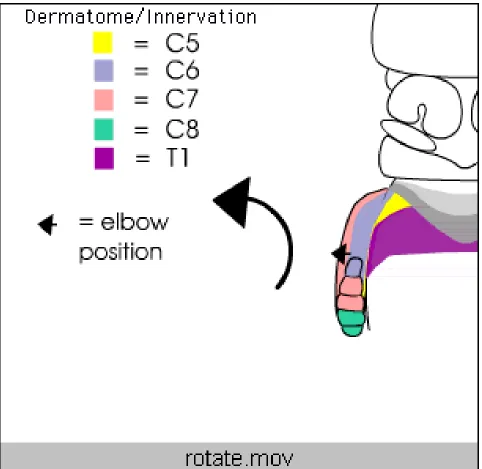
A Quicktime 3.0 movie depicts a six-eight week old embryo with the dermatomes of the upper limb (C5-T1) color coded in a pre-rotational state (Figure 1). The seven-second animation shows the limb rotation that occurs during this time period as a result of forces generated by the developing elbow joint. Facial features of the embryo are also animated in order to provide a more realistic picture of the em-bryo at this time. In addition, a simple black arrow-head is used to designate the changing orientation of the elbow joint throughout the animation. The ani-mation ends with the color coded dermatomes, elbow joint, and facial features of the embryo as they appear after the ninety-degree external limb rotation is com-plete.
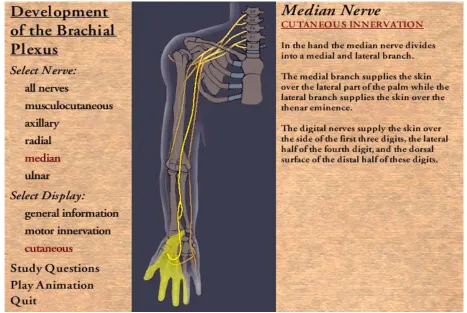
of the plexus drawn in situ (Figure 2). Each of the five terminal branches can be selected individually or all five can be displayed as a group. After a terminal branch is selected its course through the upper limb is highlighted and described. Information on its pattern of cutaneous or motor innervation can then be se-lected and is also described and highlighted in the illustration.
Methods of Analysis
Questionnaire - A ten-item questionnaire was used to assess the effectiveness of the current pro-gram. Subjects (n=23) voluntarily agreed to anony-mously use and evaluate the CD during the nervous system unit in their respective graduate level human gross anatomy course. The subject group was com-prised of first year professional students from the
Physician Assistant & Physical Therapy program (n=12), Dental program (n=1), and Medicine (n=10).
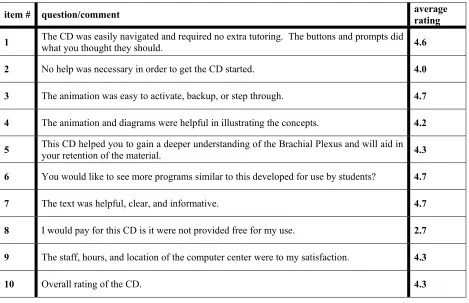
Subjects were asked to evaluate the program by responding to questionnaire items using a scale from 1-5 (1=strongly disagree, 2=disagree, 3=no opinion, 4=agree, 5=strongly agree) (Table 1). In addition, written comments were invited regarding how users would change the CD if they could. The average scores of all 23 users are reported in Table 1.
Written Comments - Student users provided written feedback (n=17) in accordance with the fol-lowing statement; what would you change about the CD if you could? The written feedback can be grouped and summarized into comments pertaining to the testing element and comments pertaining to the content. There were no written comments regarding the navigation and overall structural format of the program. The overall theme of the written comments regarded student desire to have more programs such
as the current one developed/available for their use, and indicated a desire for the inclusion of more clini-cally relevant information. Some of the other, more
common, written comments are summarized as fol-lows:
Testing Element Comments
• Provide the answers to items in the sample ques-tion bank
• Provide information as to why an answer is wrong if user answers it incorrectly
Content Comments
• Include arteries to show relationship to nerves
• More animations and more detail
• Use a wider variety of colors
• Make the illustrations printable
Discussion
The results of the presents study reveal that: 1) student users felt strongly that the text included in the
current program was helpful and informative, 2) an-imations of development aided students in learning and retaining information regarding the adult mor-phology of the brachial plexus, 3) users were pleased with the organization, ease of use, and intuitive navi-gation of the current program, and 4) students were unwilling to pay for the current version of the CD. Moreover, the results of the present study indicate the strong desire of students to have more programs similar to this one made available for their use. Written comments on student evaluations also indi-cate users liked the added convenience of having a high-quality, comprehensive learning tool such as the current CD available for use outside of the classroom and they recognize the benefits of using computers for their education.
Textual information is easily incorporated into multimedia products. However, computers users are not inclined to read text from a computer screen,
pre-ferring to print text whenever possible. Therefore an attempt was made when writing the essential textual information in the current program to limit it to con-cise summaries in order to minimize the amount of
non-interactive reading of material. Student users gave an average rating of a 4.7 regarding the level of helpfulness, clarity, and informative properties of the text (Table 1). Above all, text must be accurate, other important considerations included: organiza-tion, font size, brevity, and clarity.
Integration of the basic sciences is already a re-ality in many professional health curriculums across the country. At the University of Kentucky, first year medical gross anatomy and embryology have been combined into one course. Students felt using the animation (Figure 1) aided them in learning and re-taining information regarding the adult morphology of the brachial plexus. Users gave this aspect of the current program an average rating of 4.2 (Table 1). Integration of the basic science courses provides a continuity and synthesis of knowledge that is una-chievable when information is presented separately, often during separate semesters. Integration is not
item # question/comment averagerating
1 The CD was easily navigated and required no extra tutoring. The buttons and prompts didwhat you thought they should. 4.6
2 No help was necessary in order to get the CD started. 4.0
3 The animation was easy to activate, backup, or step through. 4.7
4 The animation and diagrams were helpful in illustrating the concepts. 4.2
5 This CD helped you to gain a deeper understanding of the Brachial Plexus and will aid inyour retention of the material. 4.3
6 You would like to see more programs similar to this developed for use by students? 4.7
7 The text was helpful, clear, and informative. 4.7
8 I would pay for this CD is it were not provided free for my use. 2.7
9 The staff, hours, and location of the computer center were to my satisfaction. 4.3
10 Overall rating of the CD. 4.3
Table 1Student Survey
only a historically sound idea for learning and reten-tion of concepts but it also makes sense as time be-comes increasingly scarce in curricula where the so-lution to many problems is simply to add courses and/or topics to the already demanding first year schedule.
Users were pleased with the organization, ease of use, and intuitive navigation of the current program. Several items on the survey were designed to assess these aspects of the current program (Table 1). Other questions were devoted to the technical and structural issues of the program. If there is a flaw in one of these elements the user will be less likely to use the program to its fullest potential or critically evaluate the content and other features of the CD. Individuals using the current program may often be places that have no technical assistance available, such as at home or in the library. Relatedly, the program should be easy to start; this aspect of the current project only received an average score of 4.0. Some computers students were using did not have Quicktime 3.0 installed on them. Subsequent versions of the pro-gram will have Quicktime 3.0 installation instruc-tions included on the cover insert.
Students were unwilling to pay for the current version of the CD. The average user rating of this item, 2.7, was the lowest of any of the items on the survey (Table 1). It is believed that students, gener-ally with limited financial resources, would be un-willing to pay for the current program because of the limited scope of this preliminary version. The item will be eliminated from future assessments, as the purpose of the current survey is to receive feedback regarding design and content, not to serve as a market analysis, which can be conducted more fully after a more complete version is developed.
Written comments from students emphasized the testing element of the current program. Students like the ability to print the 30-question test bank. Many comments indicated that users wanted the correct answers to the sample questions provided for them, indications/prompts on where in the program to look for information regarding answers, and information on why their incorrect answers were wrong. In addi-tion, students indicated their desire for a more realis-tic testing element rather than a listing of sample questions. Most written anatomy exams are multiple choice exams and it is not hard to design such a test-ing element for inclusion in multimedia programs. Although, it is somewhat beyond the scope of for the preliminary version of the program, a timed multiple choice exam will be developed and included in future versions.
Additionally, written comments indicate that users desire incorporation of clinically relevant in-formation into future versions of the program. Gross and developmental anatomy courses have taken on a progressively more clinical orientation at many in-stitutions across the country. An updated version of the program is currently being created which incorpo-rates clinical nerve lesion photographs of patients, with an accompanying description of the injury and the results of the injury.
Users gave an average rating of 4.3 in regards to the hours and location of the computer center (Table 1). Considerations for future versions of this and similar programs will need to include the accessibil-ity of the program to users. User access to the pro-gram should be carefully planned, especially if the program is not intended for individual sale, such as the current one. Present considerations included class size, hours of availability, and equipment neces-sary to run the program.
Overall the program received an average rating of 4.3. Users felt that it was useful in helping them gain a deeper understanding of the brachial plexus and in retention of the material, average rating 4.3. Since helping students understand and retain mate-rial, or learn matemate-rial, is the overarching goal of any educational product, the current program was deemed a success. The encouraging average rating of a 4.7 on whether students would like to see more programs of this type developed for their use, reinforces the idea that students will use this type of multimedia product if they feel it is useful and will help them in their studies
.
omy, and impact on reducing laboratory overcrowd-ing and overuse be more fully assessed.
Acknowledgements
The author wishes to express his appreciation to Kathryn Wong, Clarissa Spawn and Martha Cooper from the Department of Medical Arts and Photogra-phy at the University of Kentucky. In addition, this grant was supported by a gift from the Lexington Clinic Foundation, Lexington, KY.
Project Support:
A gift from the Lexington Clinic Foundation, Lex-ington, KY
References
1 Trends in the early careers of life scientists. National Research Council, 1998.
2 Medical school information, Best graduate schools. U.S. News and World Report: 1-18, 1997
3 Candler, C. and Blair, R., An analysis of web-based instruction in a neurosciences course. Medical Education Online 3(3): 1-4, 1998.
4 Keane, DR., Geoffrey, RN., Vickers, J. The inadequacy of recent research on computer-assisted instruction. Academic Medicine 66: 444-448, 1991.
5 Hersh, W., “A world of knowledge at your fin-gertips”: the promise, reality, and future direc-tions of on-line information retrieval. Aca-demic Medicine 74 (3): 240-243, 1999.
Address Correspondence to:
Douglas J. Gould, Ph.D.
MN 208 Chandler Medical Center Department of Anatomy & Neurobiology University of Kentucky
Lexington, KY 40536-0298
e-mail - [email protected]