Unified Framework for Handling Different
Types of Top-K Queries
Saxin Merona V V
1, Soumya Mathew
2M.Tech Student, Dept. of CSE, VJCET, Mahatma Gandhi University, Vazhakulam, Kerala, India1 Assistant Professor, Dept. of CSE, VJCET, Mahatma Gandhi University, Vazhakulam, Kerala, India2
ABSTRACT: In this paper we present a unified framework which can handle different types of queries. The function used for handle queries is called scoring function. Scoring function used to compute the score of a pair of objects, such as score is the absolute difference between the pairs. In the case of top-k queries the scoring function returns top-k objects with the smallest scores. Here we are defining two types of queries that are top-k pairs queries and top-k groups queries. We present score based method, threshold algorithm and detailed theoretical analysis that demonstrates that the expected performance of our proposed algorithms. We also demonstrate that our framework can handle multivalued top-k pairs queries, multivalued top-k group queries and exclusive top-k pairs queries. We conduct extensive experiments to demonstrate the efficiency of our proposed approach.
KEYWORDS: Exclusive objects, multivalued objects, top-k group queries, top-k pairs queries
I. INTRODUCTION
Information systems of different types use various techniques to rank query answers. In many application domains, end-users are more interested in (top-k) query answers in the potentially huge answer space. Different emerging applications want efficient support for top-k queries. To identify the top-k objects is scoring all objects based on some scoring function. An object score acts as a valuation for that object according to its characteristics. Data objects are usually evaluated by multiple scoring predicates that contribute to the total object score. A scoring function is therefore usually defined as an aggregation over partial scores. Mainly the scoring function is taken as the difference between the objects.
Our framework can handle different types top-k queries such pairs queries and group queries. The pairs queries which retrieve the results as in the form of object pairs. But in the case of group queries it retrieves the values in the form of group of objects. The top-k objects which retrieved based on the distance between objects. In our framework pairs queries based on source based method [11]. Source based method is same as internal source algorithm [8]. Our framework supports chromatic and non-chromatic pairs queries. Chromatic queries depend on the color. For example, a state consist a lot of cities. Each city in the state has same color. Chromatic queries retrieve the results based on color. Chromatic queries are two types such as homochromatic and heterochromatic. Homochromatic pairs queries retrieve the pair of objects which having the same color. In heterochromatic pairs queries, retrieve the pair of objects having different colors. But in non-chromatic queries which does not depend on the color.
Pairs queries can handle multivalued and exclusive pairs. Multi-valued pairs mean the objects which has multiple instances [12]. For example, a state consists of many cities. Here we are considering population as an attribute. Because each city has different population. The different populations are the multiple instances. So we can say that state is a multivalued object. Exclusive pairs [13] that object pair which satisfies a condition the pair consider as exclusive. The pair objects will never see in other pairs.
The group queries [14] which is another extension of top-k queries. Group queries are contains group of objects. Group queries are little different than pairs queries. It retrieves the object groups based on group count. Group count is set default as three. For example, if we need to find top-k locations closest in distance to three other locations such that the total distances is minimum. The three locations changes according to query. Group queries are also chromatic and non-chromatic. Theses are same as of pairs queries. In the group queries object groups contains the same or different colors of objects. The group queries also can handle multivalued objects.
We first propose a unified framework for a broad class of top-k pairs queries. Here we define the top-k pairs queries on multi-valued objects and top-k pairs to answer exclusive pairs objects. Here we propose an algorithm for exclusive pairs.
This paper is an extended version of [14] and we make the following additional contributions in this version.
We extend the unified framework for a broad class of top-k group queries including k-closest group queries, k group queries and chromatic variants.
We define the top-k group queries on multi-valued objects and present efficient techniques based on non-trivial lower bounds.
The extensive experimental study demonstrates a significant improvement over the pairs queries. For generic top-k group queries, a comparison with the top-k pairs queries demonstrates the improvement.
II. RELATED WORK
To increase the efficiency of unified framework we need a good method. So here we referred a lot papers to find better method and another type of top-k query. Here we get different methods such as skyband based [3] [13], view based [10] [11], graph based [4] and source based [8] [14].
Top-k monitoring and skyband monitoring algorithm [2] introduced by Kyriakos Mouratidis, Spiridon Bakiras and Dimitris Papadias. Here it defines the method to handle top-k queries. But these algorithms are very complicated and expensive. So we refer dominant graph [4] introduced Lei Zou and Lei Chen, it shows another of graph view. It is very complicated to build. If we want to find the query results as by keyword search we refer the paper [7] introduced by Jianhua Feng, Guoliang Li, and Jianyong Wang. But this also cannot handle the unified framework. In the case of spatial queries defined in [5] introduced by Joao B. Rocha-Junior, Akrivi Vlachou, Christos Doulkeridis, and Kjetil Norvag. Unified framework handle top k queries using internal and external memory algorithm [8] introduced by Muhammad Aamir Cheema, Xuemin Lin, Haixun Wang, Jianmin Wang, and Wenjie Zhang. This is good paper to handle the unified framework. Source based algorithm is easy to handle.AHBA and AMSA used to top-K dominating queries [9] introduced by G. Sandhya and S. Kousalya Devi. These methods are very difficult to handle. It cannot give the efficiency for a unified framework. In the case of view based method we studied LPTA and LPTA+ used to handle top-k query answering using Cached Views[10] introduced by Min Xie, Laks V.S. Lakshmanan and Peter T. Wood. Another method for view as view based approach used to handle all top-k [11 ]introduced by Shen Ge, Leong Hou U, Nikos Mamoulis, and David W. Cheung. If cannot get all the answers for a query we refer Handle why-not questions on top-K queries [12] introduced by Zhian He and Eric Lo. It helps to increase the speed of the framework. To study more about the source based method use paper [10] introduced by Zhitao Shen, Muhammad Aamir Cheema, Xuemin Lin, Wenjie Zhang, and Haixun Wang. Here it defined the top-k objects and top-k pairs queries. Another is unified framework for answering closest pairs and variants [14]. This paper provides the base of the paper and gets the method. Here we use threshold algorithm to get top-k objects. To study about the extensions such as multi-valued, exclusive and group queries we refer [6] [3] [1]. In the [6] which defines the features of multi-valued objects. Multi-valued objects have multiple instances. In [3] defined about exclusive and [1] defines about the group queries based on KNN. Top-k queries and their variants are mainly depend on the source based methods and threshold algorithm. It defined in section 3.
III.PROPOSED ALGORITHM
This section focuses on the Top-k Queries. Section A, B, C describes top-k pairs queries, Top-k pairs queries on multivalued objects and Top-k pairs on exclusive objects. Section D describes top-k group queries and section E presents top-k group queries on multivalued objects.
A. Top-K Pairs Queries:
Top-k pairs query problems solved by applying the existing work on the top-k queries. The algorithms assume that the sources can report the elements in a sorted order. So if we need to create and maintain the sources then need to develop efficient techniques.
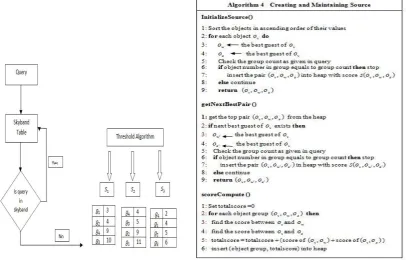
The framework which shown in the Fig. 1 is the main work of the Top-k pairs queries. Here we added a technique called skyband table. Its usage is very important in the case of top-k queries. Its working is described as: Initially create skyband table in database with query and result fields. If a user wants to give a query, then first he should check whether the query is already in skyband table or not. If it is available then select the query from skyband table. The data will be retrieved very fast. Otherwise whole process will be take place and then saved into the database.
Mainly top-k pairs queries consist of three steps. Initially we need to create the skyband table then create and maintain the source and at last find the top-k pairs using threshold algorithm. These are defined in [14]. Fig. 2 defines the threshold algorithm. It is the main technique to get top-k pairs.
Fig.1. Framework Fig. 2. Algorithm 1
B. Top-k Pairs on Multivalued Objects
In this section, we formally define top-k pairs queries on multi-valued objects and propose efficient query processing techniques. Mainly top-k pairs queries on multivalued objects consist of three steps. Initially we need to create the skyband table then create and maintain the source and at last find the top-k pairs using threshold algorithm. In the case of computation of top-k pairs we need to find
SCORE
[
i
](
U
,
V
)
. Creation of skyband table is alreadydefined above. The whole technique and algorithm referred in [14].
C. Top-k Pairs on Exclusive Objects
Here we define exclusive pairs (ECP). A real-life application of the ECP query is the car parking assignment problem, where each car driver requests for a parking slot from the set B of available slots. The ECP searches for the one-to-one assignment of cars to parking spaces, such that the sum/average of travel distances is minimized. It is more reasonable to assign each car c to A to the parking space p to B that may not be taken by another driver c0. So the car assignment problem handled by ETP.
Mainly top-k pairs queries consist of three steps. Initially we need to create the skyband table then create and maintain the source and at last find the top-k pairs using threshold algorithm. These are already defined in [14]. Here we add algorithm 2 (Fig. 3) and 3 (Fig. 4) to know how the exclusive top-k pairs will work. The threshold algorithm is same as algorithm 1 (Fig. 2).
D. Top-k Pairs on Exclusive Objects
In top-k group query that contains d number of local scoring functions. If we get a query first of all we need to find out the scores of the group elements from different sources. Sources are always sorted. The maintenance of d sources is shown in Fig. 3.2 such that each source
i
Fig. 3. Algorithm 3 Fig. 4. Algorithm 2
Top-k group query problems solved by applying the existing work on the top-k pairs queries. The algorithms assume that the sources can report the elements in a sorted order. So if we need to create and maintain the sources then need to develop efficient techniques. The technique which used here will give the source with group of objects in a sorted order. A straightforward solution to create a source Si is to sort all possible group objects according to their local
scores on the ith attribute.
In the top-k group queries they have an opportunity to select queries directly from skyband table which shown in Fig. 5. The skyband table which stores the all the top-k groups queries as well as the results. So it reduces the time of execution. We can directly retrieve the values from table. Mainly top-k group queries consist of three steps. Initially we need to create the skyband table then create and maintain the source and at last find the top-k group using threshold algorithm. The creation of skyband table is defined above.
Step 1: Maintaining the Sources:
Initially all the objects are sorted of their attribute values in ascending order such that
o
1
o
2...
o
N. For any group)
,
,
(
o
vo
wo
x , the host iso
vwhich the first object in the group and the guests of the group (ow,ox)are the second andthird object. A group (ov,ow,ox)means the objects (ow,ox) are the guests to host
o
v. Every objecto
vcan host onlythe objects that are on the right side of ov in the sorted list
N
o o
o1 2... . For chromatic queries, the guest objects in the group that are on the right side of
o
v that meet the color requirement. In the case ofo
vwhich has two guests suchas
o
wandox. Here we can say(
o
w,
o
x)
are the best guests of ov than (ow',ox') ifs
(
o
v,
o
w,
o
x)
<s(ov,ow',ox'). Theobjects (ow,ox) are called the best guests of a host
o
v if for every other guest (ow,ox)of the hostov, s(ov,ow,ox)<)
,
,
(
o
vo
w'o
x's
. We can say that the group (ov,ow,ox)has been reported as best group, if object ov has hosted the objectowandx
o .
Here we use the Algorithm 4 (Fig. 6) which presents the details of creating and maintaining a source. Initially, read and then sort all the objects in ascending order of their attribute values. For each objectov, if (ow,ox)are the best guests
of ov then created a group
(
o
v,
o
w,
o
x)
if the group number is limited to 3. At last all these groups are inserted to theheap. Whenever a request for the next best group arrives, the source retrieves the top group (ov,ow,ox)from the heap
and reports it to the main algorithm. The next best group is (ov,ox,oy)is inserted to the heap where (ox,oy) are the
next best guests ofov. At any stage during the execution, the next best guest of
o
v is the best guest among the guests ofv
o which has not been hosted byov.
Example: Consider the example of Fig.7 which shows six objects o1to
o
6 which are sorted on their attribute values. Attribute values are contains inside the circles. Here we assume the scoring function as absolute difference. A group)
,
,
(
o
vo
wo
xs
is shown by a directed edge from the host ov to the guests(ow,ox). Initially, for each object, this inserted in the heap as a group with its best guests. If the scoring function is absolute difference, then for each object the best guests are its right adjacent objects. Fig. 3.3 shows the groups that are inserted in the heap. Here we consider the best group as (o3,o4,o5)because it has smallest score. Here the score of the group is 7. After retrieving that group,the algorithm determines that the next best guest of
o
3and inserts (o3,o5,o6)in the heap with score 14 (see Fig.7).AdjacentObjects: The first and second objects (ou,ot)are on the left side of ov in the sorted list is the left adjacent
object of ov such that the group (ov,ou,ot) satisfies the color requirement. Next object of the group will be left
adjacent of
o
tthat iso
s satisfies the color requirement. So the group is(
o
v,
o
t,
o
s)
. If the group contains thehomochromatic group which contains the objects with same color. If it is heterochromatic the group contains different color objects, where the host and second guest have same color.
The first and second objects (ow,ox) are on the right side of ov in the sorted list o1o2...oN is the right adjacent
object of ov such that the group (ov,ow,ox) satisfies the color requirement. Next object of the group will be right
adjacent of ox that is oysatisfies the color requirement. So the group is(ov,ox,oy). In the Fig. 8 which shows some
objects are (o2,o4,o5)and some are white(o1,o3,o6). Fig. 7(a), 7(b) and 7(c) show the adjacent objects for
non-chromatic queries, heteronon-chromatic queries and homonon-chromatic queries, respectively. The broken lines have shown the adjacent objects. An arrow from an object
u
o to ov indicate that ou is the adjacent object of ov in that direction.
Step 2: Finding the Best Guest for Each Objectov:
In the case of right increasing functions, the score is s(ov,ow,ox)<s(ov,ow',ox'). Hence, for any object ov their right
Fig. 7 Illustration of Algorithm Fig. 8. (a) non-chromatic (b) heterochromatic (c) homochromatic
In the case of rightdecreasing functions, for any object
v
o, (ow,ox) are the best guests because these are the right
most objects such that the group (ov,ow,ox) meets the color requirement. In the case of non-chromatic queries, the
best guest of any object ov isoN. For example, in Fig. 8 (a) the best guest of every object o6 is if the scoring function is
a right decreasing function. For the heterochromatic queries, in each group contains different objects with different colors. Such as, if oN has a color different than
v
o then oN is the best guest ofov. In the case of left adjacent objects,
N
o is the best left guest of ov because it has the color different thanov. In the Fig. 8(b),
o
2ando
3 are the best guests of1
o whereas o4 and o6 are the best guests ofo2.
For the homochromatic queries, initially we scan the sorted list o1o2...oN once and maintain the right most object of each color. For each object
v
o , its best guest is the right most object of the same color. In the example of Fig.
8(c),
o
3 ando
6 are the best guests of o1 whereas o4and o5 are the best guests ofo2.Step 3: Finding next best guest of any objectov:
Let (ow,ox) are the current best guests of the objectov. We need to find the next best guest ofov. Here describe how to
find the next best guests for the right increasing functions and the right decreasing functions. For non-chromatic and homochromatic queries, the next best guest of ov are ow' and ox' which are the right adjacent object ofow andox. In the
example of Fig. 8(c), let ) 6 3,
(o o be the current guests ofo1. The next best guests of o1 are o6 and
8
o which are the right
adjacent objects ofo3.
For the heterochromatic queries, the next best guests are ow' and ox' of ov if ow' has a color different thanox'.
Consider the example of Fig. 8(b) and assume that the current best guests of o1 are o2 ando3. When (o1,o2,o3)is
reported, the algorithm checks o3 to see if it is the next best guest ofo1. Since o1 and o3 have the same color, the next
best guest of o1 is o4 which is the right adjacent object ofo3. The next best group is(o1,o4,o6).
Step 4: Finding the adjacent objects:
The procedure of finding adjacent objects is not needed for non-chromatic queries. So, it used in the case of heterochromatic queries. So initially we need to set the right adjacent object of oNto NULL. Then we scan the sorted
list of the objects from right to left. When ow' and ox'is set as the right adjacent object of ovif ow' has a different color
thanov and ox' has a different color thanow'. Consider the example of Fig. 8(b), the right adjacent object of o6 is set to
NULL. The right adjacent objects of
3
o is o4 and o6 because they have different colors. The right adjacent object of o3
is not o5because they have same color. So, the right adjacent object of o5 is set as the right adjacent object ofo3. The
For the homochromatic queries, here scan the list from right to left, maintain the last seen object of each color. The right adjacent object for any object
v
o , is the last seen object of the same color. The left adjacent objects are set similarly by scanning the list from left to right.
Step 5: Query processing algorithm
Here we use threshold algorithm to combine the scores of a group from different sources and return the top-k groups. The threshold algorithm supports the random accesses. That is if return a group from a source Sithreshold algorithm
needs to find out its score on every other attribute. All the objects are stored in memory. Initially, we return a pair )
, ,
(ov ow ox from a source, then find the objects attribute valuesov, w
o and oxfrom the object table and then compute the
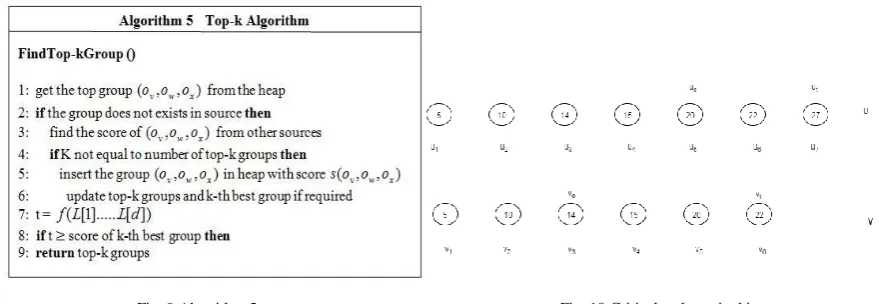
score of the pair (ov,ow,ox)on every other attribute. Algorithm 5 (Fig. 9) shows the computation of top-k groups.
Fig. 9 Algorithm 5 Fig. 10 Critical and terminal instances
E. Top-k Pairs on Multivalued Objects
In the previous section and [14] we already studied about multivalued objects. Multivalued objects have many instances. For example a state has a lot cities and each city has different population. So states multiple instances are cities. Each city is evaluated with some attributes such as coordinates, population etc. Here discussing about top-k groups on multivalued objects. The top-k groups retrieve the top k multivalued object groups. It is different than top-k pairs. Here we can get the object groups based on the group number.
In this section, we formally define top-k group queries on multi-valued objects and propose efficient query processing techniques. Mainly top-k group queries on multivalued objects consist of three steps. Initially we need to create the skyband table then create and maintain the source and at last find the top-k pairs using threshold algorithm. In the case of computation of top-k group we need to findSCORE[i](U,V,W). Creation of skyband table is already
defined above.
The local score of a group of instances is g = (u, v, w) in ith dimension which is denoted as g.score[i] that is g.score[i] = |u[i]-v[i]+ u[i]-w[i] |. Here we using g.score[i] to compute the ith local ϕ-quantile score of a group of instances of multivalued object (U,V,W) and is denoted as S[i](U,V,W). To compute top-k groups of multivalued
objects, first of all we need to divide the problem into d one-dimensional problems and then apply the algorithm. To achieve this, ensures that the global ϕ-quantile score SCORE(U,V,W)of a pair (U, V,W) can be lower bounded by using
its /d-quantile local scores S/d[i](U,V,W)in each of d dimensions. We use LB_SCORE[i](U,V,W) which denote a
lower bound on SCORE[i](U,V,W)and LB_SCORE[i](U,V,W) to denote a lower bound onS[i](U,V,W).
Framework: The basis of creation and maintenance d sources as 1) each source
i
S incrementally returns the group (U,V,W) with the smallest and LB_SCORE [i](U,V,W)
Step 1: Creating and maintaining sources
In this section, we describe how to create and maintain the sources. Initially we need to sort the instances of all multivalued objects to create the sources.
Let L denote the list of every group ( , , ) k j i v w
u where ui in U, vj in Vand wk in W. Let L’ € L be the set of groups such that the total weight of the group of instances in L’ is at least 1-
/d. Let p € L'be a group with thesmallest ith local score in L’.
Here we define the construction of L’ andLB_SCORE [i](U,V,W)
, using these instances.
(1)Terminal instance: For a multivalued object U, its terminal instance in ith dimension is the instance with the largest value in ith dimension and is denoted as
t
u .
(2)Critical instance: Let (u1....um)denote the instances of a multivalued object U sorted in ascending order of their
values in ith dimension. The critical instance of U is an instance
c
u such that
m cj w(uj) 1 /d and
1 ( )m c
j wuj <
1-d /
.
Fig. 10 shows two multivalued objects U and V with seven and six instances, respectively. The weight of each instance
i
u € U is 0.14 and the weight of each vi € V is 0.16. u7 and v6 are the terminal instances of U and V which are
shown as circles having thick boundaries. Assuming 1- /d=0.6, the critical instances of U and V are u2 and v3
respectively. Algorithm 6 presents the details of creation, maintenance and computation of group queries on multivalued objects.
Fig.7 in [14] shows the example, where five multi-valued objects U, V, W, X and Y are shown. The terminal instances of the objects are shown in that Fig.
In the sorting of multivalued objects, initially we need to sort the instances of each object in ascending order of their values in ith dimension. The terminal and critical instances of each object are identified by shown above. Here we get two sorted lists such as
1) Terminal list contains the terminal instances of the objects sorted according to their values 2) Critical list contains the critical instances sorted on their values.
Here we define how to find the best guest of U. Initially an object U serves as a host to an objects V and W only if
t
u ≤ vt and ut≤wt. In Fig. 7 in [14], U will be the host of the objects V, X and Y. We consider V as best guest of U if it has minimum LB_SCORE [i](U,V)
= max (0, vc-ut). The objects has minimum vcthat are called the eligible guests of U. Such that if consider V and W as the best guests of U which has minimum
c
v andwc. Here we consider the group
(U, V, W) because it has minimum score. The score get by LB_SCORE[i](U,V,W)=max (0,
c
v -ut) + max (0, wc
-t
u ). Fig. 7 in [14] shows the best guest object for each object by drawing an arrow from the host object to the guest object. The source is initialized then inserts these four pairs to heap. Here V and X be the current best guests of U in a group. The next best guests of U can be finding by binary search. In the case when V, X was obtained using a binary search, then an object (V’, X’) are the next guests where (X’, Y’)is the objects that has critical instancex'c, y'cadjacent
to vc in the sorted list.
The algorithm 6 (Fig. 11) accesses each source in a round-robin fashion. A group (U, V, W) returned by a source i
S
is possibly among the top-k groups. So we need to compute its ϕ-quantile global score and update the list of top-k groups accordingly (lines 7 and 8). SCORE(U,V,W) iscomputed using Algorithm 6. Here we do not need to compute
) , , (UV W
SCORE if (U, V, W) has already seen in any other source (line 4). Otherwise need to compute the lower bound
) , , (
_SCORE U VW
LB by doing random access on each other source. If LB_SCORE(U,V,W) is larger than the score of
k-th best group seen k-then (U, V, W) cannot be among k-the top-k groups. Hence, k-the computation SCORE(U,V,W) is not
required (line 6). The algorithm stops when the best possible score of any unseen group (i.e., threshold) cannot be
smaller than the score of k-th best group. Let
L
i denote the lower bound local score of the last group accessed from theTherefore, if t is not smaller than the score of k-th best group, the algorithm terminates by reporting top-k groups (lines 9 to 11).
Fig. 11 Algorithm 6 Fig. 10 Algorithm 7
Step 2: Compute SCORE(U,V,W)
Here we describe how to compute the score SCORE(U,V,W) of a group of object (U, V, W) requested at line 7 of
Algorithm 6 (Fig. 11). Here we describe Algorithm 6 shows the computation ofSCORE(U,V,W). Here the algorithm
maintains the sources with groups of instances according to their local scores. The sources allow sorted and random accesses on groups of multi-valued objects of a given (U, V, W). The algorithm initializes an empty list L that will maintain the accessed groups in ascending order of their global scores (i.e., g.score).
Initially set p.score=0 and g.score=0. Here p.score means that the score of each pair in the multivalued pair such as (U, V) from (U, V, W) and g.score means the total score of group. The algorithm 7 (Fig. 12) proceeds with doing sorted
accesses on each source Si in a round robin fashion (line 2). For each accessed group (line 3) from a source
S
i. If gwas never accessed before, its score g.score is computed by doing random accesses on each other source (line 5). First of all, need select the pair (U, V) from (U, V, W) (line 6). Then select each pair from the (U, V) and compute the score from all the sources Si (line 7-8). Score will be the aggregate of all sources (line 9). Each time p.score will be modified
as p.score+score (line 10). This will be repeated for all the pairs in a group. Example next pair will be (U, W) (line 12-13). Each time the pair number is increasing (line 11).If the group count is 4 we get p.score by three times of p.score. For example (U, V, W, Z) is a group we get the p.score from (U, V), (U, W) and (U, Z). At last we find the p.score by p.score divided with total no of pairs that is number of i (line 14). Then we can find totalscore from add totalscore with p.score (line 15). Then return the g.score (line 16).
IV.SIMULATION RESULTS
We are done the experiment with some real data. Here we check whether how much time to take to get the results. It based on K values as well as no of objects. The parameters are shown in Table 1. Here we use a skyband table which helps to get the result fast. Skyband table contains the queries which we used for retrieving the results. So if user need same query, need to check the query in skyband table. If that available select it from the table. It will help to get the result quickly. In each two weeks the skyband table removes the queries that are expired. It has a big benefit that is it reduces the time.
Parameter Range
K 1,5,10,15,20,25,30,35,40,45,50
No of objects 1000,3000,5000,7000,9000,11000,13000,15000,17000,19000
A. Scoring Functions
Real data: The real data set consists of location data having 30000 location points from different cities in USA. Each location corresponds to the location of a city which has four attributes: two coordinates, population and state which contains the city. The cities that are in the same town are assigned the same color. We run several heterochromatic and homochromatic queries each involving two to four preferences (i.e., attributes).
B. Top-k Pair Queries and Top-k Group Queries
In the top-k pair queries we get the results as pairs of cities. In the case of group queries, we will get the groups of cities based on group count. It will be 3, 4, etc. The group count will be decided by user. If the city considers the same state it will give result of homochromatic queries. If the cities in different state it will be heterochromatic query. In the case of population, homo and hetero chromatic based on the range of population. If the range changes it will be have different colors.
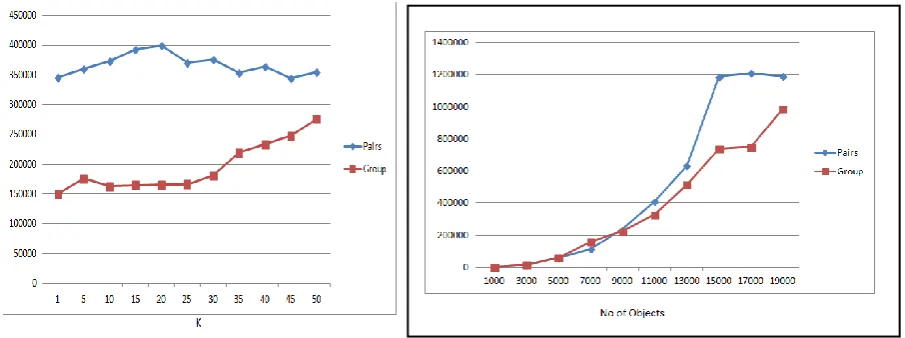
For example, the query used to retrieve top 4 pairs where population greater than 3000. Here population greater than 3000, those cities has same color. So we retrieve such pairs which have same color. That will be homochromatic. In the case of heterochromatic the cities are in different states. Fig. 13 shows K versus Execution Time values and Fig. 14 shows No of Objects versus Execution Time values. The time will be in milliseconds.
Fig.13. K Versus Time Values Fig. 14. No of Objects Versus Execution Time Values
According to the table we can see that execution time is reducing in the case of group queries. Fig. 15 shows the effect of increasing number of K on the queries issued on real data sets and the Fig. 16 shows the effect of increasing number of objects on the queries issued on real data sets. After the evaluation we get the result as, in pair queries which show that it will take more time than group queries. Because the group queries which has group number is low. The default no of group count is 3. Example, if we take 5 cities, it has mainly 10 pairs and 5 groups. So the execution will be reduced. So here we can say that the group queries better than pairs queries.
V. CONCLUSION AND FUTURE WORK
The unified framework is used to handle different types of queries. Mainly such a framework needs a method and algorithm. They have a lot of methods are used. So we need to find out the best method and best algorithm. Used methods are view based, sky band based, graph based and source based. So we take the best method is the combination of source and skyband based. Because it create and maintain the source based on attributes in the query. It is good method and easy to implement. These two methods will be the best method to handle the framework. All the method mainly use threshold algorithm for calculate the accurate results. So use threshold algorithm as best algorithm.
After using the method and algorithm we can identify that it is a good method to handle different types of queries. Mainly it uses in pairs and group queries. The pairs queries are single valued, multivalued and exclusive. The group queries are single valued and multivalued. The group queries are retrieve the result as group of objects depending on the group count. The pairs queries retrieve the result as pair of objects. In the experiment get the result as group queries are better than pairs queries. Because it takes less execution time compared to pairs queries.
REFERENCES
1. Dimitris Papadias,Qiongmao Shen,Yufei Taos Kyriakos Mouratidis, ‘Group Nearest Neighbour Queries’, Proc. IEEE 20th Intl Conf. Data Eng. (ICDE), pp.9217, April 2004.
2. K. Mouratidis, S. Bakiras, and D. Papadias, ‘Continuous monitoring of top-k queries over sliding windows’, Proc. ACM SIGMOD Intl Conf. Management of Data, PAGES 636-645, June 2006.
3. L.H.U.N., Mamoulis, and M.L. Yiu, ‘Continuous Monitoring of Exclusive Closest Pairs’, Proc. 10th Intl Symp. Advances in Spatial and Temporal Databases (SSTD), 2007.
4. L. Zou and L. Chen, ‘Dominant graph: An efficient indexing structure to answer top-k queries’, in Proc. IEEE ICDE, Washington, DC, USA, 2008, pp. 536545.
5. Joao B. Rocha-Junior, Akrivi Vlachou, Christos Doulkeridis, and Kjetil Norv, ‘efficient Processing of Top-k Spatial Preference Queries’, Proc. ACM VLDB, vol. 4, no.2, November 2010.
6. W. Zhang, X. Lin, M.A. Cheema, Y. Zhang, and W. Wang, ‘Quantile- Based KNN over Multi-Valued Objects’, Proc. IEEE 26th Intl Conf. Data Eng. (ICDE), pp. 16-27, 2010.
7. Jianhua Feng, Guoliang Li, and Jianyong Wang, ‘Finding Top-k Answers in Keyword Search over Relational Databases Using Tuple Units’, IEEE Transactions on Knowledge and Data Engineering, Vol. 23,No. 112, December 2011.
8. M.A. Cheema, X. Lin, H. Wang, J. Wang, and W. Zhang, ‘A Unified Approach for Computing Top-K Pairs in Multidimensional Space’, Proc. IEEE 27th Intl Conf. Data Eng., pp. 1031-1042, 2011.
9. G. Sandhya and S. Kousalya Devi, “’An Adaptive Sliding Window Based Continuous Top-K Dominating Queries’, in Proc. IEEE ICDE,, 2012.
10. Min Xie, Laks V.S. Lakshmanan and Peter T. Wood, ‘Efficient Top-k Query Answering using Cached Views’, Proc. 16th ACM Conf. Extending Database Technology, March 2013.
11. Shen Ge, Leong Hou U, Nikos Mamoulis, and David W. Cheung, ‘Efficient All Top-k Computation A Unified Solution for All Top-k, Reverse Top-k and Top-m Influential Queries’, IEEE Transactions on Knowledge and Data Engineering, vol. 25, no. 5, May 2013. 12. Zhian He and Eric Lo, Answering Why-Not Questions on Top-K Queries’, IEEE Trans. Knowledge and Data Engineering, vol. 26, no. 6,
June 2014.
13. Zhitao Shen, Muhammad Aamir Cheema, Xuemin Lin, Wenjie Zhang, and Haixun Wang, ‘A Generic Framework for Top-K Pairs and Top-K Objects Queries over Sliding Windows’, IEEE Trans. Knowledge and Data Engineering, preprint,vol. 26, no. 6, June 2014. 14. Muhammad Aamir Cheema, Xuemin Lin, Haixun Wang, Jianmin Wang, and Wenjie Zhang, ‘A Unified Framework for Answering k
Closest Pairs Queries and Variants’, IEEE Trans. Knowledge and Data Engineering, vol. 26, no.11, November 2014.
BIOGRAPHY
Saxin Merona V Vis a Mtech Student in the Computer Science And Engineering Department, Viswajyothi College of Engineering And Technology, Mahatma Gandhi University, Vazhakulam, Kerala, India.